Accelerating Catalyst Discovery: A Bayesian Optimization Workflow for Stereoselective Polymerization in Biomedical Materials
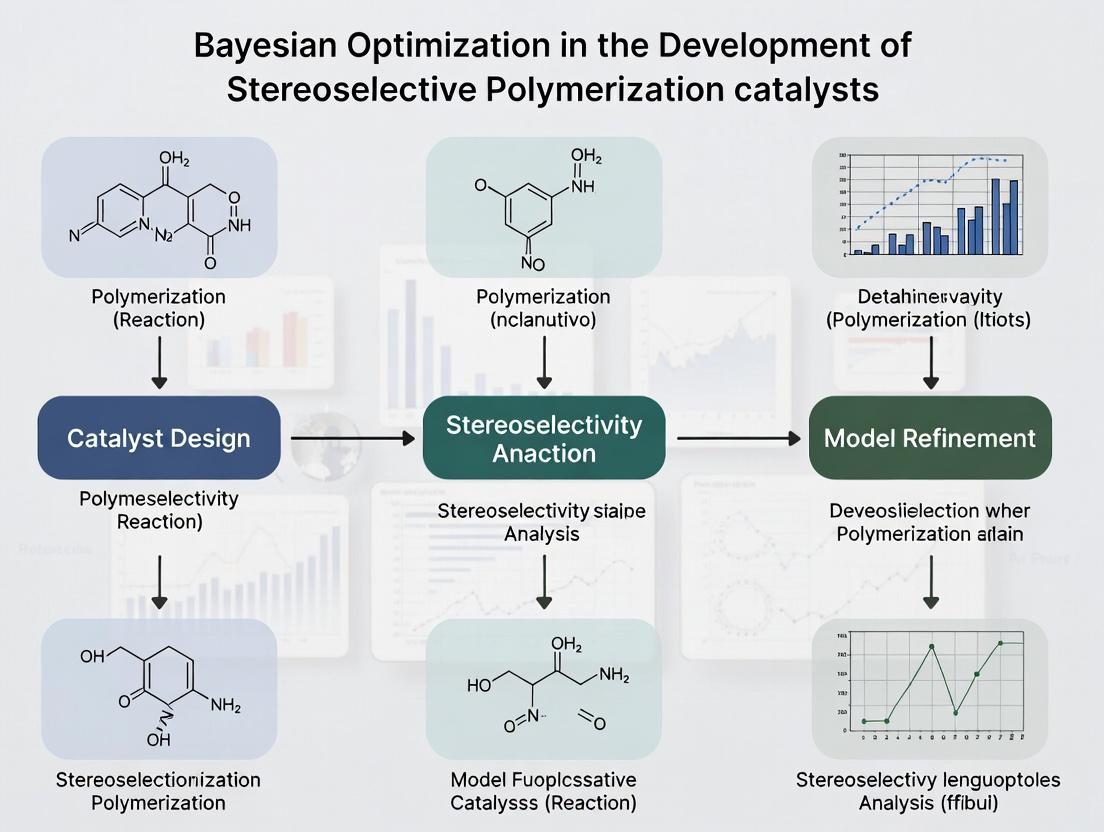
This article provides a comprehensive guide for researchers and drug development professionals on implementing Bayesian optimization (BO) to discover and optimize stereoselective polymerization catalysts.
Accelerating Catalyst Discovery: A Bayesian Optimization Workflow for Stereoselective Polymerization in Biomedical Materials
Abstract
This article provides a comprehensive guide for researchers and drug development professionals on implementing Bayesian optimization (BO) to discover and optimize stereoselective polymerization catalysts. We begin by establishing the foundational principles of stereoselective polymerization and BO's role in chemical research. The methodological section details a step-by-step workflow, from defining the catalyst search space to setting up the BO loop. We then address common experimental and computational challenges, offering practical troubleshooting strategies. Finally, the article explores validation protocols and comparative analyses against traditional high-throughput screening, highlighting BO's superior efficiency in identifying catalysts for biomedical polymers like poly(lactide) and poly(propylene fumarate). The conclusion synthesizes the transformative potential of this data-driven approach for accelerating the development of tailored polymeric materials for drug delivery, tissue engineering, and medical devices.
The Foundation: Why Bayesian Optimization is Revolutionizing Stereoselective Catalyst Discovery
The development of stereoselective polymerization catalysts is a cornerstone of advanced polymer chemistry for biomedical applications. This work is framed within a broader thesis employing a Bayesian optimization workflow to discover and refine these catalysts. Bayesian optimization uses probabilistic surrogate models to efficiently explore complex parameter spaces (e.g., ligand structure, metal center, polymerization conditions) with minimal experimental iterations, accelerating the development of catalysts that provide precise tacticity control. This stereocontrol is not an academic curiosity but a critical determinant of biomedical polymer performance, directly influencing degradation profiles, drug release kinetics, mechanical properties, and ultimately, therapeutic efficacy.
Quantitative Impact of Stereochemistry on PLGA Performance
Poly(lactic-co-glycolic acid) (PLGA) remains the quintessential biodegradable polymer. The stereochemistry of its lactide component (D- or L-) profoundly alters material properties.
Table 1: Impact of PLA/PLGA Stereochemistry on Key Properties
| Polymer Composition | Crystallinity | Degradation Time (Approx.) | Tg (°C) | Mechanical Strength | Drug Release Profile |
|---|---|---|---|---|---|
| PLLA (Poly(L-lactide)) | High | 18-24 months | 60-70 | High, brittle | Slow, tri-phasic |
| PDLA (Poly(D-lactide)) | High | 18-24 months | 60-70 | High, brittle | Slow, tri-phasic |
| PDLLA (Poly(DL-lactide) Racemic) | Amorphous | 12-16 months | 50-55 | Low, ductile | Faster, bi-phasic |
| StereoPLGA (L-rich) | Moderate | 6-12 months | 55-60 | Moderate | Tunable, more consistent |
| PLGA 50:50 (DL) | Amorphous | 1-2 months | 45-50 | Low | Rapid, burst release |
Key Insight: Stereocomplexation between PLLA and PDLA chains forms a higher-melting-point crystal, expanding the property range. Bayesian-optimized catalysts can precisely control the incorporation of D- vs. L-units to target specific degradation and release windows.
Application Notes & Protocols
Protocol: Synthesis of Stereocontrolled PLGA via Bayesian-Optimized Catalysis
Objective: To synthesize a PLGA copolymer with a target D-lactide incorporation of 8±2% using a catalyst system whose parameters (ligand denticity, metal alkyl, initiator ratio) have been optimized via a Bayesian workflow.
Materials (Research Reagent Solutions):
- Anhydrous Toluene: Solvent for moisture-sensitive polymerization.
- L-lactide & D-lactide: Purified by recrystallization (Ethyl acetate) and sublimation.
- Glycolide: Purified by recrystallization (Ethyl acetate).
- Salen-Aluminum Catalyst (Optimized): Precise structure (e.g., R,R- or S,S-cyclohexanediamino backbone) identified via Bayesian search for high stereoselectivity.
- Benzyl Alcohol (BnOH): Initiator.
- Purification Solutions: Cold Methanol (-20°C) for precipitation, 70% Ethanol for washing.
Procedure:
- Setup: Perform all operations in a glovebox under N₂ atmosphere or using standard Schlenk techniques.
- Monomer Preparation: Weigh L-lactide (0.86 mol eq), D-lactide (0.14 mol eq), and glycolide (1.0 mol eq) into a dried reaction vial.
- Catalyst/Initiator Solution: Dissolve the optimized Salen-Al catalyst (0.001 mol eq) and BnOH (0.002 mol eq) in 5 mL anhydrous toluene in a separate vial.
- Polymerization: Transfer the catalyst solution to the monomer vial. Seal and place in a pre-heated block at 130°C for 6 hours (time suggested by model).
- Termination: Cool the vial to room temperature. Quench the reaction by adding 1 mL of cold acidified methanol (5% acetic acid).
- Purification: Precipitate the polymer into 50 mL of vigorously stirred cold methanol. Filter the solid and wash with 70% ethanol. Dry under vacuum at 40°C to constant weight.
- Analysis: Determine D-lactide incorporation by ¹H-NMR (methine region in CDCl₃). Analyze molecular weight and dispersity (Đ) by SEC in THF.
Diagram Title: Bayesian-Optimized Stereoselective Polymerization Workflow
Protocol: In Vitro Degradation and Release Kinetics of Stereocontrolled Polymers
Objective: To compare the degradation profile and model drug release kinetics of isomeric PLLA vs. PDLLA microspheres.
Materials:
- Polymer Samples: PLLA (highly isotactic) and PDLLA (atactic) microspheres.
- Model Drug: Fluorescently labeled dextran (e.g., FITC-Dextran, 10 kDa).
- Phosphate Buffered Saline (PBS): 0.1M, pH 7.4.
- Sodium Azide (0.02% w/v): Added to PBS to prevent microbial growth.
- Incubation System: Shaking water bath at 37°C.
- Analytical Tools: Freeze dryer, UV-Vis/Fluorometer, GPC.
Procedure:
- Microsphere Preparation: Load FITC-Dextran into PLLA and PDLLA microspheres using a standard double-emulsion (W/O/W) solvent evaporation technique.
- Degradation Study: Weigh triplicate samples of each microsphere type (∼50 mg) into glass vials. Add 10 mL of PBS/azide. Place vials in a shaking water bath (37°C, 60 rpm).
- Sampling: At predetermined time points (e.g., days 1, 3, 7, 14, 30, 60), remove vials in triplicate for each polymer.
- Analysis: a. Mass Loss: Isolate microspheres by centrifugation, wash with DI water, lyophilize, and weigh. b. Molecular Weight Change: Dissolve a portion of dried polymer in THF for SEC analysis. c. Drug Release: Measure the fluorescence intensity of the supernatant PBS release medium. d. pH Monitoring: Record pH of the remaining buffer.
- Data Modeling: Fit release data to models (e.g., Higuchi, Korsmeyer-Peppas) to determine release mechanisms.
Table 2: Typical Degradation Data for PLA Stereoisomers
| Time Point (Days) | PLLA Mass Loss (%) | PDLLA Mass Loss (%) | PLLA Mₙ Retention (%) | PDLLA Mₙ Retention (%) |
|---|---|---|---|---|
| 7 | <2 | 5-10 | >95 | ~80 |
| 30 | 5-8 | 30-40 | ~85 | ~50 |
| 60 | 10-15 | >80 | ~70 | <20 |
The Scientist's Toolkit: Key Research Reagents & Materials
Table 3: Essential Reagents for Stereocontrolled Biomedical Polymer Research
| Reagent/Material | Function/Application | Critical Consideration |
|---|---|---|
| Metal-Organic Catalysts (e.g., Salen-Al, Zn) | Stereoselective ring-opening polymerization of lactides. | Ligand chirality and steric bulk dictate stereocontrol. Must be anhydrous. |
| Purified Lactide Enantiomers (L-, D-) | Monomers for poly(lactide) synthesis. | Optical purity (>99.5%) is essential for precise stereocomplexation. |
| Anhydrous, Oxygen-Free Solvents (Toluene, THF) | Polymerization reaction medium. | Strict Schlenk/glovebox techniques required to prevent chain transfer. |
| Functional Initiators (e.g., PEG-OH, BnOH) | Initiates polymerization; provides α-end-group functionality. | Enables block copolymer synthesis or surface conjugation. |
| Deuterated Chloroform (CDCl₃) | Solvent for ¹H-NMR analysis of polymer microstructure. | Allows quantification of tacticity (mm, mr, rr triads) and composition. |
| Size Exclusion Chromatography (SEC) Columns | Analyzes polymer molecular weight (Mₙ, M_w) and dispersity (Đ). | Use appropriate columns (e.g., PLgel) and standards (PS, PLA) for accuracy. |
| Model Drug Payloads (FITC-Dextran, Rhodamine B) | Fluorescent tracers for in vitro release and uptake studies. | Chemically inert, easily detectable, and available in various sizes. |
| Simulated Physiological Buffers (PBS, SBF) | Medium for in vitro degradation and release studies. | pH and ionic strength must mimic target biological environment. |
From Stereochemistry to Targeted Delivery: A Logical Pathway
Precise stereochemical control enables the rational design of advanced drug delivery systems, moving beyond passive release to active targeting.
Diagram Title: From Stereocontrol to Targeted Delivery Pathway
Conclusion: The integration of Bayesian optimization in catalyst design provides a powerful, data-driven engine to achieve the stereochemical precision required for the next generation of biomedical polymers. This control directly translates to predictable, tunable, and high-performance materials for targeted therapeutic delivery, moving beyond the limitations of conventional polymers like PLGA.
Theoretical Foundation & Application Notes
Bayesian optimization (BO) is a powerful, sequential design strategy for globally optimizing black-box functions that are expensive to evaluate. It is particularly suited for chemists and material scientists aiming to optimize complex experimental outcomes—such as polymerization stereoselectivity—where each experiment is costly or time-consuming. The core components are:
- A Probabilistic Surrogate Model: Typically a Gaussian Process (GP), which provides a posterior distribution over the objective function based on prior data.
- An Acquisition Function: A criterion that decides where to sample next by balancing exploration (sampling uncertain regions) and exploitation (sampling near known good regions).
This primer frames BO within the thesis context: optimizing the design of stereoselective polymerization catalysts. The goal is to find catalyst formulations and reaction conditions (e.g., ligand ratio, temperature, solvent) that maximize stereoregularity (e.g., % isotacticity) or enantiomeric excess (e.g., % ee) with a minimal number of polymerization trials.
Key Quantitative Metrics & Comparison The following table summarizes common acquisition functions, their performance in simulation studies for chemical optimization, and suitability for catalyst research.
Table 1: Common Acquisition Functions in Bayesian Optimization
| Acquisition Function | Key Formula/Principle | Typical Performance (Simple Regret)* | Best For Catalyst Research When... |
|---|---|---|---|
| Expected Improvement (EI) | EI(x) = E[max(f(x) - f(x⁺), 0)] | 0.08 ± 0.03 | A robust, general-purpose choice for most iterative screening campaigns. |
| Upper Confidence Bound (UCB) | UCB(x) = μ(x) + κ σ(x) | 0.10 ± 0.05 | Explicit control over exploration (κ) is desired; constraints are known. |
| Probability of Improvement (PI) | PI(x) = P(f(x) ≥ f(x⁺) + ξ) | 0.15 ± 0.07 | Quick, greedy improvement is needed, but can get stuck in local optima. |
| Entropy Search (ES) | Maximizes information gain about the optimum location. | 0.05 ± 0.02 | The budget allows for more computational overhead per iteration. |
*Simple regret is a performance metric where lower values indicate faster convergence to the optimum; illustrative values are derived from benchmark studies on synthetic functions analogous to chemical landscapes.
Experimental Protocols & Workflows
Protocol 1: Establishing the Initial Dataset for BO Catalyst Screening
Objective: To generate a high-quality, space-filling initial dataset (n=8-12 experiments) to seed the Gaussian Process model. Materials: See "The Scientist's Toolkit" below. Procedure:
- Define Parameter Space: Identify key continuous (e.g., temperature: 25-100°C, catalyst loading: 0.5-2.0 mol%) and categorical (e.g., solvent: toluene, THF, CHCl₃) variables.
- Design of Experiments (DoE): Use a Latin Hypercube Sampling (LHS) or Sobol sequence to select the initial set of experiment conditions. This ensures points are spread uniformly across the defined space.
- Parallel Experiment Execution: Conduct polymerization reactions at all initial conditions in parallel, if possible, to save time.
- Follow Protocol 2 for each condition.
- Characterization & Response Measurement: For each reaction product, determine the primary objective (e.g., % isotacticity via ¹H NMR analysis) and any relevant constraints (e.g., yield < 20% is a failed reaction).
- Data Curation: Assemble a clean table with columns for each input variable and the measured response(s).
Protocol 2: Standardized Polymerization & Stereoselectivity Assay
Objective: To perform a single catalyst evaluation run for BO, producing a reliable measure of stereoselectivity. Reaction Setup:
- In a nitrogen-filled glovebox, charge a 10 mL Schlenk tube with the metal catalyst (e.g., 5.0 mg ± 0.1 mg) and ligand (amount as per DoE ratio).
- Add the specified solvent (2.0 mL) via syringe. Stir for 10 minutes to pre-form the active catalyst.
- Initiate polymerization by injecting the monomer (e.g., 1.0 mL of methyl methacrylate, purified over CaH₂).
- Place the Schlenk tube in a pre-heated aluminum block at the temperature specified by the BO algorithm (±1°C).
- Quench the reaction after 2 hours by exposing to air and adding 0.1 mL of cold methanol. Polymer Analysis:
- Precipitate the polymer into 20 mL of vigorously stirred methanol.
- Filter, dry under vacuum, and weigh to determine conversion.
- Prepare an NMR sample by dissolving ~10 mg of polymer in 0.6 mL of deuterated chloroform (CDCl₃).
- Acquire a quantitative ¹H NMR spectrum (500 MHz).
- Calculate % Isotacticity: Integrate the areas of the α-methyl proton signals corresponding to mm (isotactic, ~0.8 ppm), mr (heterotactic, ~1.0 ppm), and rr (syndiotactic, ~1.2 ppm) triads. % mm = (Area_mm / Total Area) * 100.
- Record this % mm value as the primary optimization target (y) for the given input conditions (x).
Protocol 3: Iterative Bayesian Optimization Loop
Objective: To sequentially decide and execute the next most informative experiment. Procedure:
- Model Training: Fit a Gaussian Process (with Matern kernel) surrogate model to all accumulated data (initial + previous iterations). Use automatic relevance determination (ARD) to identify influential parameters.
- Acquisition Maximization: Using the trained GP, compute the selected acquisition function (e.g., EI) over a dense grid of the parameter space. Identify the condition (x_next) that maximizes this function.
- Note: For categorical variables, use a one-hot encoded representation.
- Experiment Execution: Perform the polymerization and analysis (Protocol 2) at the proposed condition
x_next. - Data Augmentation & Iteration: Append the new {xnext, ynext} pair to the dataset. Check termination criteria (e.g., maximum iterations reached, stereoselectivity >95%, or convergence of proposed points). If not terminated, return to Step 1.
Mandatory Visualizations
Bayesian Optimization Workflow for Catalyst Discovery
Gaussian Process: From Prior to Posterior
The Scientist's Toolkit
Table 2: Key Research Reagent Solutions for Stereoselective Polymerization Screening
| Item Name | Function/Brief Explanation | Example (MMA Polymerization) |
|---|---|---|
| Metal Catalyst Precursor | Provides the active metal center; choice defines coordination geometry and Lewis acidity. | Zirconocenium dichloride, (S)-BINOL-Ti(OiPr)₂ |
| Chiral Organic Ligand Library | Modifies catalyst sterics/electronics to induce enantioselectivity; primary tunable parameter. | Proline-derived Schiff bases, BINAP, Salan ligands |
| Purified Monomer | Must be free of inhibitors (e.g., hydroquinone) and protic impurities for reproducible kinetics. | Methyl methacrylate (MMA), purified by distillation over CaH₂ |
| Anhydrous, Deoxygenated Solvents | Essential for air/moisture-sensitive catalysts; solvent polarity influences stereocontrol. | Toluene, THF, CH₂Cl₂ (from solvent purification system) |
| Quenching Solution | Rapidly terminates polymerization for precise control over molecular weight and conversion. | 0.1% v/v HCl in methanol, or degassed methanol |
| Deuterated NMR Solvent with Internal Standard | For quantitative analysis of polymer microstructure (tacticity) and monomer conversion. | CDCl₃ with 0.03% v/v tetramethylsilane (TMS) |
| Gel Permeation Chromatography (GPC) Setup | Measures molecular weight (Mn, Mw) and dispersity (Đ); indicators of catalyst activity/control. | System calibrated with PMMA standards in THF at 40°C |
Application Notes
Within a thesis on Bayesian optimization (BO) workflows for stereoselective polymerization catalyst research, the core BO framework serves as an intelligent iterative engine for navigating complex chemical spaces. Its primary function is to balance the exploration of untested catalytic systems with the exploitation of promising candidates to maximize stereoselectivity (e.g., % de or % ee) or yield, while minimizing experimental iterations. The integration of these components accelerates the discovery and optimization of catalysts, such as those for stereoselective olefin polymerization or lactide ring-opening polymerization, where multidimensional parameter tuning is critical.
Surrogate Models (Probabilistic Models)
The surrogate model approximates the unknown, and often costly-to-evaluate, function linking catalyst formulation/reaction conditions to performance outcomes. It provides a predictive distribution, quantifying both predicted performance and uncertainty.
- Common Choices in Catalyst Optimization:
- Gaussian Processes (GPs): The default model for continuous parameters in smaller datasets (<~1000 data points). They excel at uncertainty quantification, crucial for guiding sequential experiments. Kernel selection (e.g., Matérn 5/2) is critical for modeling chemical trends.
- Random Forests (RFs) and Bayesian Neural Networks (BNNs): Increasingly used for high-dimensional or mixed (continuous/categorical) parameter spaces common in catalysis (e.g., ligand types, metal centers, solvent classes). They can handle complex feature interactions but may require more data or careful calibration for reliable uncertainty estimates.
Table 1: Comparison of Surrogate Models for Catalyst Optimization
| Model | Best For | Uncertainty Quantification | Handling of Categorical Variables (e.g., Ligand Class) | Computational Scaling |
|---|---|---|---|---|
| Gaussian Process | Small-scale experiments (<100-200 trials), continuous spaces | Excellent, inherent | Requires one-hot or specific kernel encodings | O(n³) in data points |
| Random Forest | Medium-scale, mixed parameter spaces, non-linear responses | Good (via jackknife, dropout), but not inherent | Native support | O(n log n) |
| Bayesian Neural Net | Large, complex datasets, high-dimensional spaces | Good, through variational inference or dropout | Requires embedding | Depends on architecture |
Acquisition Functions
The acquisition function uses the surrogate's prediction and uncertainty to propose the next experiment. It mathematically formalizes the trade-off between exploration and exploitation.
- Key Functions in Research:
- Expected Improvement (EI): Measures the expected value of improvement over the current best observation. Highly effective for rapid convergence to optimum catalyst performance.
- Upper Confidence Bound (UCB): Selects points maximizing the upper confidence bound (mean + κ * standard deviation). Parameter κ explicitly controls exploration-exploitation balance.
- Probability of Improvement (PoI): Focuses on the probability that a new point will be better than the incumbent. Can be less aggressive than EI.
Table 2: Acquisition Functions for Stereoselectivity Optimization
| Function | Key Parameter | Behavior in Catalyst Search | Use-Case |
|---|---|---|---|
| Expected Improvement (EI) | ξ (exploration bias) | Balances finding marginally better catalysts and significantly new ones. | General-purpose optimization of % ee or yield. |
| Upper Confidence Bound (UCB) | κ (confidence weight) | Explicit dial: high κ tests uncertain regions (new ligand combos), low κ refines known leads. | Systematically probing under-explored catalyst families. |
| Probability of Improvement (PoI) | ξ (trade-off) | Tends to favor local exploitation. | Fine-tuning near a high-performing catalyst candidate. |
Experimental Design Space
This is the bounded set of all possible experiments, defined by the researcher. For stereoselective polymerization catalysts, it is typically multi-dimensional and can include continuous, discrete, and categorical variables.
- Typical Dimensions in Polymerization Catalysis:
- Catalyst Structure: Metal precursor identity, ligand architecture (bite angle, sterics), ligand/metal ratio.
- Reaction Conditions: Temperature (°C), pressure (bar for olefins), time (h), monomer concentration (M), initiator/catalyst loading.
- Solvent Environment: Solvent identity (categorical), polarity, additives (e.g., chain transfer agents).
Experimental Protocols
Protocol 1: Initial Design of Experiments (DoE) for BO Campaign Objective: To establish a diverse initial dataset for training the initial surrogate model. Method: Use space-filling designs on the defined parameter space.
- Define Bounds: For each variable (e.g., temperature: 25–100°C; ligand type: L1, L2, L3; metal: Zn, Mg, Al), set minima, maxima, or list categories.
- Generate Points: Use a Latin Hypercube Sampling (LHS) algorithm for continuous and discrete numerical variables. For categorical variables, assign levels uniformly across the LHS points.
- Execute Experiments: Conduct polymerization reactions (e.g., under inert atmosphere in sealed vials) according to the generated set of conditions (e.g., 10-20 initial points).
- Characterize Output: Quantify catalyst performance via the objective function (e.g., analyze polymer stereoselectivity by NMR spectroscopy for % meso dyads or chiral HPLC for % ee of monomers).
Protocol 2: Iterative BO Loop for Catalyst Optimization Objective: To sequentially identify catalyst formulations that maximize stereoselectivity.
- Model Training: Fit the chosen surrogate model (e.g., GP with Matérn kernel) to all accumulated data (initial + previous iterations). Standardize input features.
- Acquisition Maximization: Optimize the chosen acquisition function (e.g., EI with ξ=0.01) over the defined design space using a global optimizer (e.g., L-BFGS-B or random search with restarts).
- Proposal Selection: The point (catalyst formulation + conditions) that maximizes the acquisition function is selected as the next experiment.
- Experimental Validation: Perform the polymerization and analysis as in Protocol 1, Step 4.
- Data Augmentation & Iteration: Append the new result (input parameters, observed outcome) to the dataset. Return to Step 1. Loop continues for a predefined number of iterations or until performance plateaus.
Visualizations
Bayesian Optimization Workflow for Catalyst Discovery
Surrogate Models Inform Acquisition Function
The Scientist's Toolkit: Research Reagent Solutions for BO-Guided Polymerization
Table 3: Essential Materials for Stereoselective Polymerization BO Campaigns
| Item/Reagent | Function/Explanation | Example in Research |
|---|---|---|
| Chiral Ligand Library | Diverse set of enantiopure or C-symmetric ligands (e.g., salans, bisoxazolines) to define a categorical search space for metal complexation. | Jacobsen's salen ligands for Co-catalyzed hydrolytic kinetic resolution (HKR). |
| Metal Precursor Salts | Air-stable sources of catalytic metals (e.g., ZnEt₂, MgCl₂, Al(O^iPr)₃, [Rh(COD)Cl]₂). | ZnEt₂ for lactide ROP with chiral β-diiminate ligands. |
| Dry, Degassed Solvents | High-purity reaction medium; critical for reproducibility and preventing catalyst deactivation. | Toluene, THF, CH₂Cl₂ for anionic or coordination polymerization. |
| Chiral Monomers | Enantiopure or racemic monomers for testing stereocontrol. | rac-Lactide, rac-propylene oxide, vinyl ethers. |
| Automated Synthesis Platform | Enables high-throughput execution of BO-proposed experiments (e.g., glovebox robot, parallel reactor block). | Unchained Labs Big Kahuna or ChemSpeed platforms for catalyst screening. |
| Analytical Standards | For calibrating rapid analysis methods (e.g., chiral GC/HPLC columns, NMR reference spectra). | (R)- and (S)- enantiomers for %ee calibration. |
| Quenching Agents | To reliably stop polymerization at precise times for kinetic studies and yield analysis. | Acidified methanol, benzoic acid. |
| BO Software Package | Implementation of surrogate models and acquisition functions. | BoTorch, GPyOpt, or custom Python scripts with scikit-learn. |
Within a Bayesian optimization workflow for stereoselective polymerization catalysts, defining precise, quantitative performance metrics is foundational. These metrics are the objective functions that the algorithm seeks to maximize or minimize, guiding the iterative exploration of complex chemical spaces. Accurate benchmarking of catalysts requires standardized protocols for measuring stereoselectivity, activity, and molar mass control. These Application Notes provide the experimental framework for generating reliable, comparable data essential for machine learning-driven catalyst discovery.
Core Performance Metrics: Definitions & Quantitative Benchmarks
The primary metrics for evaluating polymerization catalysts are summarized in the table below. These values serve as benchmarks for high-performance systems in olefin polymerization.
Table 1: Key Performance Metrics for Stereoselective Olefin Polymerization Catalysts
| Metric | Definition & Formula | Typical Benchmark Range (High Performance) | Measurement Technique |
|---|---|---|---|
| Catalytic Activity | Mass of polymer produced per unit catalyst per unit time. Activity = (Polymer Yield (g)) / (Catalyst Amount (mol) × Time (h)) | 10⁵ – 10⁷ g polymer / (mol cat·h) | Gravimetric analysis. |
| Stereoselectivity (for Polypropylene) | Fraction of stereoregular sequences (mmmm pentads). Reported as % meso (m) or tacticity index. | > 99% mmmm for iPP; < 1% mmmm for sPP | ¹³C NMR spectroscopy. |
| Number-Average Molar Mass (Mₙ) | Arithmetic mean molar mass. Indicates chain growth efficiency. Mₙ = Σ (NᵢMᵢ) / Σ Nᵢ | 50 – 500 kDa (highly dependent on application) | Size Exclusion Chromatography (SEC). |
| Dispersity (Đ or Mw/Mn) | Measure of molar mass distribution breadth. Đ = Mw / Mn | 1.5 – 2.5 (single-site catalysts); >5 (multi-site) | Size Exclusion Chromatography (SEC). |
| Turnover Frequency (TOF) | Number of monomer molecules converted per catalytic site per unit time. | 10³ – 10⁵ h⁻¹ | Calculated from activity and known # of active sites. |
Detailed Experimental Protocols
Protocol 2.1: Standardized Polymerization Run for Activity & Yield
Objective: To perform a reproducible slurry-phase polymerization of propylene for catalyst benchmarking. Materials: See "Scientist's Toolkit" below. Procedure:
- Reactor Preparation: Under an inert atmosphere (glovebox), charge a dried, nitrogen-purged 100 mL stainless-steel autoclave with a magnetic stir bar.
- Monomer & Solvent Charge: Through a pressurized line, add 30 mL of dry, degassed toluene and then condense in 10 g of liquid propylene (cool reactor with dry ice/isopropanol).
- Catalyst/Co-catalyst Injection: In the glovebox, prepare the catalyst solution (2-5 µmol in 5 mL toluene) and the co-catalyst solution (e.g., 100 eq. of modified methylaluminoxane, MMAO, in toluene). Load into separate loops of an injection block.
- Initiation: Seal and remove the reactor. With stirring at 750 rpm, heat to the target temperature (e.g., 50°C). Simultaneously inject the catalyst and co-catalyst solutions under a slight overpressure of nitrogen to initiate the reaction.
- Polymerization: Maintain temperature and stir for a fixed time (e.g., 30 minutes).
- Termination: Vent unreacted monomer. Add 100 mL of acidified methanol (10% HCl in MeOH) to the reactor to quench the reaction and precipitate the polymer.
- Work-up: Filter the polymer, wash repeatedly with methanol, and dry in vacuo at 60°C to constant weight.
- Calculation: Calculate activity using the formula in Table 1.
Protocol 2.2: Determining Stereoselectivity via ¹³C NMR
Objective: To quantify the tacticity of polypropylene samples. Procedure:
- Sample Preparation: Dissolve 20-30 mg of dried polymer in 0.6 mL of deuterated 1,1,2,2-tetrachloroethane (C₂D₂Cl₄) in a 5 mm NMR tube. Heat gently to 120°C to ensure complete dissolution.
- NMR Acquisition: Acquire a quantitative ¹³C NMR spectrum on a spectrometer operating at 100 MHz or higher for ¹³C. Use an inverse-gated decoupling pulse sequence with a 90° pulse angle and a long relaxation delay (D1 > 5 × T1, typically 10-12 seconds) to ensure full relaxation and integration accuracy. Accumulate 1024-2048 transients.
- Analysis: Identify the methyl region (~19-22 ppm). Integrate the signals corresponding to the mmmm pentad (~21.8 ppm) and the total methyl region.
- Calculation: Calculate the % mmmm = (Intensity of mmmm pentad / Total intensity of methyl region) × 100%.
Protocol 2.3: Determining Molar Mass & Dispersity via SEC
Objective: To measure Mₙ, M_w, and Đ. Procedure:
- System Setup: Use a high-temperature SEC system (e.g., 145°C) equipped with a refractive index detector and a set of 3-5 Styragel columns.
- Mobile Phase: Use 1,2,4-trichlorobenzene (TCB) stabilized with 0.0125% BHT. Flow rate: 1.0 mL/min.
- Calibration: Create a calibration curve using narrow dispersity polystyrene (PS) standards. Apply appropriate Mark-Houwink parameters (for PP: K=1.90×10⁻⁴, a=0.725) to convert PS-equivalent MW to polypropylene MW.
- Sample Preparation: Dissolve 2-3 mg of polymer in 10 mL of hot TCB. Agitate at 160°C for 2 hours. Filter through a 0.45 µm PTFE filter into a sample vial.
- Injection & Analysis: Inject 200 µL. Analyze chromatograms using SEC software to calculate Mₙ, M_w, and Đ against the calibrated curve.
Visualizing the Bayesian Optimization Workflow
The integration of these benchmarking protocols into an iterative discovery cycle is visualized below.
Diagram Title: Bayesian optimization cycle for catalyst development.
The Scientist's Toolkit: Research Reagent Solutions
Table 2: Essential Materials for Polymerization Catalyst Benchmarking
| Reagent/Material | Function & Critical Specification |
|---|---|
| High-Pressure Autoclave Reactor | Provides safe, controlled environment for polymerization under pressure and temperature. Must be inert, with precise temperature control and stirring. |
| Inert Atmosphere Glovebox | Enables manipulation of air- and moisture-sensitive catalysts, co-catalysts, and solvents. [O₂] and [H₂O] < 1 ppm. |
| Modified Methylaluminoxane (MMAO) | Common aluminoxane co-catalyst for activation of metallocene and post-metallocene catalysts. Supplied as a solution in toluene. |
| Anhydrous, Degassed Toluene | Common solvent for slurry-phase polymerizations. Must be dried over molecular sieves and sparged with inert gas to remove O₂/H₂O. |
| Deuterated 1,1,2,2-Tetrachloroethane (C₂D₂Cl₄) | High-temperature NMR solvent for polyolefin analysis. Optimal for dissolving polymers at elevated temperatures ( >100°C). |
| High-Temperature SEC System | Specialized chromatography system for analyzing polymers insoluble at room temperature. Operates with TCB at 145-160°C. |
| Narrow Dispersity Polystyrene Standards | Calibration standards for SEC. Essential for establishing the molecular weight calibration curve. |
Building the Pipeline: A Step-by-Step Bayesian Optimization Workflow for Catalyst Screening
This application note serves as the foundational step in a Bayesian optimization (BO) workflow aimed at the rapid discovery of stereoselective polymerization catalysts. Defining a comprehensive, yet computationally tractable, multidimensional parameter space is critical. This space encompasses discrete and continuous variables describing the catalyst's molecular components (ligands, metal centers) and the reaction environment (polymerization conditions). Subsequent BO iterations will efficiently navigate this space to identify high-performing catalysts while minimizing costly experimental trials.
The Catalyst Parameter Space: Core Components
The parameter space is structured into three primary domains, each containing categorical and continuous variables crucial for catalyst performance and stereocontrol.
Ligand Domain
Ligands are pivotal in modulating metal center electronics and geometry, directly influencing monomer enantioface differentiation during insertion.
Table 1: Representative Ligand Classes for Stereoselective Olefin Polymerization
| Ligand Class | Core Scaffold | Key Tunable Parameters (R Groups) | Typical Metal Companions | Influence on Stereoselectivity |
|---|---|---|---|---|
| Bis(imino)pyridines | Pyridine-diimine | Aryl ortho-substituents (size, flexibility), imine N-aryl substituents | Co(II), Fe(II) | Steric bulk at ortho-position enforces chain-end or enantiomorphic-site control. |
| C2-Symmetric Metallococenes | Bridged bis(indenyl) or bis(tetrahydroindenyl) | Bridge type (e.g., Me2Si, CH2CH2), substituents on cyclopentadienyl rings | Zr(IV), Hf(IV) | Rigid C2 symmetry provides well-defined chiral pocket for enantiomorphic-site control. |
| Salicylaldiminato (FI Catalysts) | Phenoxy-imine | Substituents on phenoxy ring (position 3, 5) and imine aryl group | Ti(IV), Zr(IV) | Bulky substituents create asymmetric environment for chain-end control. |
| β-Diketiminato | NCCN chelate | N-aryl substituents (size, electronic character) | Mg(I/II), Zn(II) | Controls aggregation state and active site accessibility. |
Metal Center Domain
The metal dictates the permissible oxidation states, coordination geometry, and inherent Lewis acidity.
Table 2: Metal Center Variables
| Metal Ion | Common Oxidation States in Catalysis | Preferred Coordination Geometry | Typical Counter-anion/Activator Pair | Role in Stereocontrol |
|---|---|---|---|---|
| Group 4 (Ti, Zr, Hf) | +4 | Octahedral, tetrahedral | [B(C6F5)4]– / MAO (Methylaluminoxane) | Serves as the core for C2-symmetric metallocene catalysts. Hf often provides higher stereoselectivity than Zr. |
| Late Transition (Co, Fe, Ni) | +2, +3 | Octahedral, square planar | MAO, MMAO (Modified MAO) | Reduced oxophilicity, tolerance to polar monomers. Ligand field effects are critical. |
| Rare Earth (Sc, Y, Ln) | +3 | Variable, often high coordination numbers | [Ph3C][B(C6F5)4], [HNMe2Ph][B(C6F5)4] | High electrophilicity; excellent for polar monomer polymerization. |
Polymerization Conditions Domain
Reaction parameters dictate kinetics, chain growth, and potential catalyst deactivation pathways.
Table 3: Key Polymerization Condition Parameters
| Parameter | Typical Range | Impact on Reaction | Measurement Method |
|---|---|---|---|
| Temperature | -78°C to 150°C | Affects activity, stereoselectivity (Arrhenius behavior), and chain transfer. | In-situ IR probe, calibrated thermocouple in reactor. |
| Monomer Concentration | 0.1 – 5.0 M | Influences rate, molecular weight (MW). | Gas uptake measurement (for gases), GC/FID for liquids. |
| [Al]:[M] Ratio (for MAO) | 50:1 to 5000:1 | Activates metal center, scavenges impurities. Higher ratios can suppress deactivation. | Precise volumetric/syringe pump addition. |
| Solvent | Toluene, Hexane, CH2Cl2 | Affects solubility, ion-pair separation, and sometimes stereochemistry. | Anhydrous, sparged with inert gas. |
| Pressure (for gaseous monomers) | 1 – 50 bar | Directly affects monomer concentration in solution. | Pressure transducer, automated pressure controllers. |
| Reaction Time | 1 sec – 24 hrs | Determines conversion, MW, and possible catalyst decay profiles. | Quench with acidified methanol. |
Bayesian Optimization Workflow: Initial Parameter Space Definition Protocol
Protocol 1: Defining and Encoding the Initial Parameter Space for BO Objective: To transform chemical intuition and literature data into a quantifiable, bounded parameter space for the first BO iteration.
Materials & Reagents:
- Literature databases (SciFinder, Reaxys).
- Molecular modeling software (e.g., Spartan, Gaussian) for ligand property calculation (optional).
- BO software platform (e.g., Dragonfly, custom Python with GPyTorch/BoTorch).
Procedure:
- Ligand Library Curation:
- Select 3-5 promising ligand scaffolds (e.g., from Table 1). For each scaffold, define 2-4 substituent positions (R1, R2, etc.).
- For each substituent position, compile a list of 5-15 plausible substituents (e.g., Me, iPr, tBu, Ph, 2,6-Me2Ph, 2,6-iPr2Ph, CF3).
- Encoding: Represent each unique ligand as a categorical variable (e.g., L001, L002...) or, for BO, as a set of continuous descriptors (e.g., Sterimol parameters B1, L, %Vbur, calculated electronic parameters).
Metal & Activator Selection:
- Choose 2-4 metal precursors compatible with the selected ligands (e.g., ZrBn₄, CoCl₂, TiCl₄).
- Select 1-3 co-catalyst/activator systems (e.g., MAO, [Ph3C][B(C6F5)4], B(C6F5)3).
- Encoding: Treat as categorical variables.
Conditional Parameter Bounding:
- Set realistic, safe bounds for continuous conditions based on literature:
- Temperature: Set initial range, e.g., 0°C to 80°C.
- [M]₀: Calculate based on solvent volume and desired range (Table 3).
- [Al]:[M]: Set log-scale range, e.g., 100 to 2000.
- Define any conditional relationships (e.g., if using MAO, [Al]:[M] is active; if using a borate activator, [Al]:[M] is set to zero).
- Set realistic, safe bounds for continuous conditions based on literature:
Space Formalization:
- Combine all variables into a master list. The dimensionality (d) is the sum of all categorical choices and continuous parameters.
- For initial BO, aim for d between 5 and 15 after encoding. High dimensionality requires more initial data points.
- Output: A structured configuration file (e.g., JSON) readable by the BO software, specifying variable names, types (categorical, integer, float), and bounds.
The Scientist's Toolkit: Research Reagent Solutions
Table 4: Essential Materials for Catalyst Screening
| Item | Function | Key Considerations |
|---|---|---|
| High-Throughput Parallel Pressure Reactor (e.g., from Unchained Labs, AMT) | Enables simultaneous testing of up to 24-96 catalyst formulations under controlled temperature and pressure. | Must be compatible with anhydrous, air-sensitive chemistry. |
| Glovebox (N₂ or Ar atmosphere) | For storage and handling of air- and moisture-sensitive catalysts, ligands, and activators. | O₂ and H₂O levels must be maintained at <1 ppm. |
| MAO or MMAO Solutions in Toluene | The most common alkylating agent and co-catalyst for early and late transition metal catalysts. | Commercially available, but concentration (Al wt%) must be verified. Often contains free TMA. |
| Deuterated Solvents for NMR (e.g., C₆D₆, Tol-d₈) | For reaction monitoring, determining conversion, and analyzing polymer stereochemistry (e.g., pentad analysis). | Must be dried over molecular sieves and degassed. |
| Size Exclusion Chromatography (SEC) with Triple Detection | Determines polymer molecular weight (Mn, Mw), dispersity (Đ), and intrinsic viscosity. | Requires high-temperature setup (e.g., 150°C) for polyolefins using 1,2,4-trichlorobenzene as solvent. |
| Chiral GC or HPLC Columns | For analyzing stereoselectivity in polymerization of smaller, test olefins (e.g., 3-methyl-1-pentene) or for ligand ee analysis. | Critical for establishing enantioselectivity before moving to polymer microstructure analysis. |
| Quenching Agent (Acidified Methanol) | Rapidly terminates polymerization, precipitates polymer, and deactivates the catalyst. | Typically 5% v/v HCl in MeOH. |
Visualizations
Title: Bayesian Optimization Workflow Step 1: Defining Parameter Space
Title: Iterative Bayesian Optimization Cycle for Catalyst Discovery
Application Notes
Within the workflow for Bayesian optimization of stereoselective polymerization catalysts, molecular descriptors transform complex chemical structures into quantitative vectors. This enables predictive machine learning (ML) models to navigate catalyst chemical space efficiently. Descriptor selection directly impacts the model's ability to predict enantioselectivity or stereochemical control.
Key Quantitative Descriptor Categories: The following table summarizes primary descriptor classes relevant to organometallic polymerization catalysts.
Table 1: Quantitative Descriptor Categories for Catalysts
| Descriptor Category | Example Descriptors | Relevance to Stereoselectivity | Typical Source Software |
|---|---|---|---|
| Electronic | HOMO/LUMO energy (eV), Natural Charge on metal center, Electronegativity | Influences monomer coordination geometry and insertion transition state. | Gaussian, ORCA, RDKit |
| Steric | Percent Buried Volume (%VBur), Sterimol parameters (B1, B5, L in Å), Topological Polar Surface Area | Quantifies ligand bulk asymmetry around the metal, dictating enantioselective face blocking. | SambVca, RDKit, Dragon |
| Topological | Zagreb index, Molecular connectivity indices, Wiener index | Encodes molecular branching and complexity related to ligand scaffold. | RDKit, PaDEL-Descriptor |
| Geometric | Principal Moments of Inertia, Radius of gyration, Plane of best fit deviation | Describes overall catalyst shape and spatial asymmetry. | RDKit, Conformer Ensembles |
Experimental Protocols
Protocol 1: Generation of Steric and Topological Descriptors Using RDKit
This protocol details the computation of key 2D/3D descriptors from a catalyst SMILES string.
- Input Preparation: Prepare a
.csvfile with columns:Catalyst_ID,SMILES. Ensure SMILES represent the active catalytic species (e.g., metal-ligand complex). - Environment Setup: In a Python script, import necessary libraries:
rdkit,pandas,numpy. Descriptor Calculation:
Output: The file
computed_descriptors.csvcontains a machine-readable table of descriptors for each catalyst.
Protocol 2: Calculation of Percent Buried Volume (%VBur) Using SambVca
This protocol quantifies the steric bulk of a ligand around a metal center.
- Structure Preparation: Optimize the geometry of your metal-ligand complex using DFT (e.g., B3LYP/def2-SVP level). Save the output as a
.xyzor.pdbfile. - Web Tool Access: Navigate to the SambVca web application (available via public research servers).
- Parameter Setup:
- Upload File: Upload your coordinate file.
- Metal Center: Specify the atomic number and label of the metal atom.
- Sphere Definition: Set sphere radius (typically 3.5 Å for polymerization catalysts) and distance from metal center (often 2.05 Å).
- Bond Radius: Select the Bondi or UFF atom radii set.
- Grid Resolution: Use the default (0.1 Å) for standard accuracy.
- Execution: Run the calculation. The primary output is the %VBur, often decomposed into quadrants (e.g., Q1-Q4) to assess steric asymmetry.
- Data Extraction: Record the total %VBur and quadrant values for use as steric descriptors in your ML dataset.
Visualization
Diagram 1: Descriptor Encoding Workflow for Catalyst BO
Diagram 2: Role of Descriptors in Bayesian Optimization Loop
The Scientist's Toolkit: Research Reagent Solutions
Table 2: Essential Materials for Descriptor Encoding Workflow
| Item | Function/Description |
|---|---|
| RDKit | Open-source cheminformatics library for calculating topological and 2D/3D molecular descriptors from SMILES. |
| SambVca Web Application | Web-based tool for computing the steric descriptor Percent Buried Volume (%VBur) from 3D coordinates. |
| Gaussian/ORCA Software | Quantum chemistry packages for computing electronic structure descriptors (HOMO/LUMO, charges) via DFT. |
| Python (NumPy, Pandas) | Core programming environment for scripting descriptor computation pipelines and managing data tables. |
| DFT-Optimized Catalyst Structures (.xyz/.pdb) | Essential input files containing accurate 3D geometries for steric and electronic descriptor calculation. |
| Padel-Descriptor | Standalone software for calculating >1875 molecular descriptors and fingerprints, useful for comprehensive profiling. |
Within the Bayesian optimization (BO) workflow for discovering stereoselective polymerization catalysts, the choice of surrogate model is critical. This step determines how the algorithm learns from and predicts catalyst performance based on features like ligand structure, metal center, and polymerization conditions. Two dominant models are Gaussian Process Regression (GPR) and Random Forest (RF). This protocol details their application to chemical data, guiding researchers in selecting the appropriate model.
Core Comparison: GPR vs. RF for Chemical Data
Table 1: Quantitative & Qualitative Model Comparison
| Feature | Gaussian Process Regression (GPR) | Random Forest (RF) |
|---|---|---|
| Model Type | Probabilistic, non-parametric | Ensemble, non-parametric |
| Prediction Output | Full posterior distribution (mean & variance) | Point prediction (mean of ensemble) |
| Inherent Uncertainty Quantification | Yes, naturally provides prediction variance. | No, requires additional methods (e.g., jackknife). |
| Handling of Sparse Data | Excellent. Kernel design can encode chemical similarity. | Poor. Requires sufficient data for tree splits. |
| Handling of High-Dimensional Data | Can suffer; kernel choice is key. Scalability issues. | Excellent. Robust to many descriptors. |
| Interpretability | Medium. Kernel hyperparameters reveal length scales. | High. Feature importance scores available. |
| Computational Cost (Training) | O(n³), expensive for >10k data points. | O(m * n log n), efficient for large datasets. |
| Extrapolation Behavior | Cautious. Uncertainty grows away from data. | Overconfident & risky. Can extrapolate unreliably. |
| Common Kernel for Chemistry | Matérn, Composite (e.g., RBF + White noise). | Not applicable (tree-based splits). |
| Primary BO Advantage | Direct use of uncertainty for acquisition. | Fast iteration on large feature sets. |
Table 2: Recommended Use Cases in Catalyst Optimization
| Scenario | Recommended Model | Rationale |
|---|---|---|
| Early-stage exploration (< 100 data points) | Gaussian Process | Uncertainty quantification is paramount for guiding experiments. |
| High-throughput computational screening (10k+ data points) | Random Forest | Scalability and speed are primary concerns. |
| Descriptors are molecular fingerprints (binary, high-dim) | Random Forest | Handles high-dimensional, non-continuous data well. |
| Objective is enantioselectivity (ee%, sensitive metric) | Gaussian Process | Smooth, continuous output benefits from kernel similarity. |
| Incorporation of failed/uncertain experimental readings | Gaussian Process | Native handling of heteroscedastic noise. |
Experimental Protocols
Protocol 1: Implementing a Gaussian Process Surrogate Model
Objective: Construct a GPR surrogate model for predicting catalyst enantiomeric excess (ee%) from molecular descriptors.
Materials & Software: Python 3.9+, scikit-learn 1.3+, GPyTorch 1.4+, RDKit (for descriptor generation), NumPy, pandas.
Procedure:
- Feature Preparation:
- Generate a unified molecular descriptor set (e.g., DRFP, SOAP, or selected physicochemical descriptors) for all catalyst candidates in the dataset.
- Standardize features by removing the mean and scaling to unit variance using
StandardScaler.
- Kernel Selection & Definition:
- For continuous chemical descriptors, define a composite kernel. Example using GPyTorch:
- For continuous chemical descriptors, define a composite kernel. Example using GPyTorch:
- Model Initialization & Training:
- Define the GP model with a Gaussian likelihood.
- Initialize hyperparameters:
lengthscale~1.0,noise~0.01. - Optimize marginal log likelihood using the Adam optimizer (50-100 iterations).
- Monitor convergence; the loss should stabilize.
- Model Validation:
- Perform leave-one-group-out cross-validation (by catalyst scaffold).
- Record the standard metrics: Mean Absolute Error (MAE), Root Mean Squared Error (RMSE).
- Critically, plot predicted vs. actual ee% and inspect the calibration of uncertainty: 95% confidence intervals should contain ~95% of the hold-out data.
Protocol 2: Implementing a Random Forest Surrogate Model
Objective: Construct an RF regression model for predicting catalyst conversion (%) from high-dimensional feature sets.
Materials & Software: Python 3.9+, scikit-learn 1.3+, RDKit, NumPy, pandas.
Procedure:
- Feature Preparation:
- Generate Morgan fingerprints (radius=2, nBits=2048) for all ligand structures.
- Combine with continuous reaction condition variables (temperature, time).
- No standardization is required for tree-based methods.
- Model Definition & Hyperparameter Tuning:
- Use
RandomForestRegressorfrom scikit-learn. - Perform a grid search via cross-validation on a representative subset:
n_estimators: [100, 300, 500]max_depth: [5, 10, 15, None]min_samples_split: [2, 5, 10]
- Aim to minimize overfitting; the OOB (out-of-bag) score should correlate with CV score.
- Use
- Model Training & Uncertainty Estimation:
- Train the final model with optimized hyperparameters on the full training set.
- To estimate prediction uncertainty for BO, implement the Jackknife-based method:
- Calculate predictions from each individual tree in the forest.
- For a prediction ŷ for a new point x, compute the mean and empirical variance across all tree predictions.
- Model Validation:
- Perform scaffold-based cross-validation as in Protocol 1.
- Record MAE and RMSE.
- Plot predicted vs. actual conversion and assess the reliability of the jackknife uncertainty estimates.
Visualizing the Decision Workflow
Title: Surrogate Model Selection Workflow for Chemical Data
The Scientist's Toolkit: Key Research Reagents & Solutions
Table 3: Essential Materials for Surrogate Modeling in Catalyst BO
| Item | Function/Description | Example/Supplier |
|---|---|---|
| Molecular Descriptor Software | Generates numerical features from catalyst/ligand structures. | RDKit (Open Source), Dragon, MOE |
| Fingerprint Generator | Creates binary bit vectors representing molecular substructures. | RDKit (Morgan Fingerprints), CDK |
| Standardized Chemical Dataset | A consistent, curated set of catalyst-performance pairs. | Custom from lab data; PubChem for initial libraries. |
| GP Optimization Library | Provides robust algorithms for kernel hyperparameter tuning. | GPyTorch, GPflow (TensorFlow), scikit-learn |
| Ensemble Modeling Library | Implements Random Forest and other tree-based methods. | scikit-learn, XGBoost |
| Bayesian Optimization Framework | Integrates surrogate model with acquisition function. | BoTorch (PyTorch), scikit-optimize, GPyOpt |
| High-Performance Computing (HPC) Node | For training GPR on medium datasets or extensive hyperparameter search. | Local cluster or cloud (AWS, GCP) |
| Chemical Validation Set | A held-out set of catalysts with known performance for final model assessment. | Synthesized catalysts from diverse, unseen scaffolds. |
Within the thesis framework on optimizing stereoselective polymerization catalysts, Step 4 is the decision engine of the Bayesian Optimization (BO) workflow. After building a probabilistic surrogate model (Step 3) that predicts catalyst performance (e.g., % ee or tacticity) based on experimental descriptors (e.g., ligand steric volume, metal electronegativity), the acquisition function calculates the utility of performing any given experiment. It balances exploration (probing uncertain regions of parameter space) and exploitation (refining near high-performing candidates) to propose the single most informative next experiment, maximizing the efficiency of the resource-intensive catalytic screening process.
Acquisition Functions: Theoretical Foundation & Quantitative Comparison
The surrogate model provides a predictive distribution for any unsampled catalyst formulation x: a mean prediction μ(x) and an uncertainty σ(x). The acquisition function α(x) uses this to score all possible x.
Table 1: Core Acquisition Functions for Experimental Design
| Function | Mathematical Formulation | Key Parameter(s) | Balance Philosophy | Best For |
|---|---|---|---|---|
| Expected Improvement (EI) | α_EI(x) = E[max( f(x) - f(x^+), 0 )] where f(x^+) is the best observed outcome. | ξ (exploration weight, default ~0.01) | Exploitation-biased, but explicitly quantifies the probability and amount of improvement. | Rapid convergence to a high-performance optimum; noisy measurements. |
| Upper Confidence Bound (UCB) | α_UCB(x) = μ(x) + κ * σ(x) | κ ≥ 0 (balance parameter). Tunable. | Explicit, tunable balance. κ→0 pure exploit; κ→∞ pure explore. | Methodical exploration; controllable trade-off; theoretical regret bounds. |
| Probability of Improvement (PI) | α_PI(x) = P( f(x) ≥ f(x^+) + ξ ) | ξ (trade-off parameter) | Pure probability of beating the incumbent, ignores magnitude. | Simple, greedy search; less common vs. EI. |
Table 2: Illustrative Quantitative Output from a BO Iteration (Catalyst Optimization)
| Candidate Catalyst ID | Descriptor 1: Ligand Bulk (ų) | Descriptor 2: Metal σ-donor Index | Predicted % ee (μ) | Uncertainty (σ) | EI Score (ξ=0.01) | UCB Score (κ=2.0) |
|---|---|---|---|---|---|---|
| A (Incumbent) | 120 | 1.2 | 92.1 | 1.5 | 0.00 | 95.1 |
| B | 135 | 1.1 | 88.5 | 8.2 | 1.87 | 104.9 |
| C | 110 | 1.3 | 90.3 | 2.1 | 0.15 | 94.5 |
| D | 145 | 0.9 | 75.0 | 9.5 | 0.02 | 114.0 |
| E | 125 | 1.25 | 91.8 | 1.8 | 0.12 | 95.4 |
Interpretation: EI selects Candidate B (good prediction & high uncertainty), while UCB (with κ=2) selects Candidate D (high uncertainty dominates). The chosen candidate becomes the next experiment.
Detailed Experimental Protocol: Implementing the Acquisition Step
Protocol: Acquisition Function Calculation and Next-Experiment Selection
Objective: To computationally select the most informative catalyst formulation to synthesize and test in the next BO cycle.
Materials & Software:
- Hardware: Standard research computer.
- Software: Python (3.8+) with libraries:
numpy,scipy,scikit-learn,gpfloworBoTorch. - Input Data: Surrogate model (Gaussian Process model file) from Step 3 and historical data table.
Procedure:
- Load Model & Domain: Load the trained GP surrogate model. Define the bounded search space for catalyst descriptors (e.g., ligand bulk: 100-150 ų, metal index: 0.8-1.5).
- Compute Incumbent: Identify the best-performing observed catalyst, f(x^+), from the historical data (e.g., Catalyst A with 92.1% ee).
- Generate Candidates: Create a dense grid or, more efficiently, a large quasi-random set (e.g., 10,000 points via Sobol sequence) spanning the defined search space.
- Query Surrogate: For each candidate point x, use the GP model to predict the mean (μ(x)) and standard deviation (σ(x)) of the performance metric.
- Calculate Acquisition Values: a. For EI: For each x, compute: * Improvement: I = μ(x) - f(x^+) - ξ * Z = I / σ(x)* (if σ(x) > 0) * α_EI(x) = I * Φ(Z) + σ(x) * φ(Z) (where Φ, φ are CDF and PDF of std. normal). * If σ(x) = 0, set α_EI(x) = 0. b. For UCB: For each x, compute: α_UCB(x) = μ(x) + κ * σ(x).
- Select & Output: Identify the candidate x* with the maximum acquisition value. Output its descriptor values as the recommended next experiment.
- Validation (Optional): Perform a quick local optimization (e.g., L-BFGS-B) starting from x* to ensure the acquisition function is at a local maximum. Refine the recommendation.
- Documentation: Record the chosen x*, its predicted performance, uncertainty, and the acquisition scores of top candidates in the lab notebook (electronic).
Safety Notes: This is a computational protocol. Ensure code versioning and data backup.
Visualization of the Decision Workflow
Title: Acquisition Function Decision Workflow for Next Experiment
Title: How Acquisition Function Generates a Utility Score
The Scientist's Toolkit: Key Research Reagent Solutions
Table 3: Essential Computational & Experimental Materials for BO-Driven Catalyst Discovery
| Item / Reagent | Function / Role in the Process | Example/Note |
|---|---|---|
| Python BO Libraries (BoTorch, GPyOpt) | Provides implemented, optimized acquisition functions (EI, UCB) and optimization loops. | botorch.optim.optimize_acqf handles candidate generation and selection. |
| Gaussian Process Regression Model | The core surrogate model quantifying prediction and uncertainty. | Implemented via gpflow or BoTorch. Kernel choice (Matérn 5/2) is critical. |
| Sobol Sequence Generator | Creates space-filling candidate points within descriptor bounds for acquisition scoring. | Preferable to a uniform grid for efficiency in >3 dimensions. |
| Ligand Library | Diverse set of sterically and electronically varied ligands for catalyst assembly. | e.g., Phosphines, N-heterocyclic carbenes with known parameter ranges. |
| Metal Precursors | Source of the catalytic metal center with varying electronic properties. | e.g., Pd(II), Ni(II), Co(II) complexes. |
| Monomer & Initiator | Standardized reagents for polymerization testing under controlled conditions. | e.g., rac-Lactide for PLA tacticity studies, methylaluminoxane (MAO). |
| Analytical Standard | For calibrating performance metric measurement (e.g., chiral HPLC for % ee). | Enantiopure sample of polymer or model compound. |
Application Notes
In the context of a Bayesian optimization workflow for stereoselective polymerization catalyst research, closing the automation loop is the critical final step that enables rapid, data-driven catalyst discovery. This integration combines robotic synthesis of catalyst libraries with inline analytics to generate high-quality, immediate feedback on polymerization outcomes. The core principle is to use the analytical data (e.g., tacticity, molecular weight, conversion) as the objective function for the Bayesian optimization algorithm, which then proposes the next set of catalyst structures or polymerization conditions to test. This autonomous cycle drastically reduces the time from hypothesis to result, accelerating the development of catalysts for precise polymers, including those with potential applications in drug delivery systems and biomedical devices.
The following protocols outline the hardware and software integration necessary to establish this closed-loop workflow, focusing on the stereoselective polymerization of methyl methacrylate (MMA) as a model system.
Detailed Protocols
Protocol 1: Robotic Setup for Catalyst Library Synthesis and Polymerization
Objective: To automate the preparation of catalyst variants and their subsequent use in polymerization reactions. Materials: See "Research Reagent Solutions" table. Equipment: Liquid-handling robotic arm (e.g., Opentrons OT-2), inert atmosphere glovebox, integrated micro-reactor array (e.g., Unchained Labs Little Bird Series), temperature-controlled agitation module.
Methodology:
- System Initialization: Place stock solutions of ligands, metal precursors, monomers, and initiators in designated, barcracks. Purge the robotic deck with inert gas (N₂ or Ar) for 30 minutes.
- Liquid Handling Program: Execute a custom Python script on the robotic controller.
- From a defined design-of-experiments (DoE) file (generated by the Bayesian optimizer), the script reads coordinates and volumes for each component.
- The robot sequentially dispenses solvent, monomer (MMA, 2.0 M in toluene), and ligand stock solution into individual reaction vials (2 mL screw-thread vials) within the glovebox.
- Catalyst Formation: The robot then adds the metal precursor solution (e.g., Yttrium tris(bis(trimethylsilyl)amide), Y(N(TMS)₂)₃). The reaction mixture is agitated for 15 minutes at 25°C to form the active catalyst in situ.
- Polymerization Initiation: To each vial, the robot adds the initiator (e.g., Benzyl alcohol, BnOH). The precise start time is logged by the software.
- Reaction Quenching: After a predetermined time (e.g., 60 min), the robot automatically adds a quenching agent (methanol, 0.5 mL) to each vial to terminate the polymerization.
- Sample Preparation for Analysis: The robot aliquots 100 µL of the quenched reaction mixture into a dedicated 96-well plate. It then adds 900 µL of a diluent (THF) containing an internal standard (e.g., mesitylene) for subsequent analytical processing.
Protocol 2: Integrated High-Throughput Polymerization Analytics
Objective: To perform rapid, inline analysis of polymer conversion, molecular weight, and tacticity. Materials: THF (HPLC grade), SEC calibration standards (PMMA narrow standards). Equipment: Integrated analytical stack: Automated sampling loop, inline Quench-flow module, HPLC pump, Size Exclusion Chromatography (SEC) system with multi-angle light scattering (MALS) and refractive index (RI) detectors, and automated fraction collector coupled to NMR.
Methodology:
- Inline Sampling & Dilution: The 96-well plate from Protocol 1 is transferred to an autosampler. A robotic arm draws 10 µL from each well and injects it into a continuous flow of THF (1.0 mL/min).
- SEC-MALS Analysis: The diluted sample passes through the SEC columns (two PLgel Mixed-C columns in series at 40°C). The MALS detector (λ = 658 nm) measures absolute molecular weight (M_w) and dispersity (Đ), while the RI detector measures polymer concentration.
- Conversion Calculation: The concentration of polymer (from RI, relative to internal standard) is compared to the initial monomer concentration to calculate percent conversion. Data is parsed automatically by the control software.
- Tacticity Analysis via NMR: For selected wells based on pre-set criteria (e.g., conversion > 15%), the SEC system triggers a fraction collector to isolate the eluting polymer peak (~30 µg) into a specialized NMR tube.
- Automated ¹H NMR: The tube is transferred via rail to a dedicated, high-throughput ¹H NMR spectrometer (e.g., 60 MHz). An automated script acquires the spectrum. The relative intensities of the α-methyl proton signals (around 0.8-1.2 ppm) are integrated to determine the triad tacticity (mm, mr, rr).
- Data Aggregation: All quantitative data (Conversion %, M_w, Đ, mm %) for each reaction is compiled into a single data row in a master
.csvfile, indexed by the unique reaction ID.
Protocol 3: Bayesian Optimization Data Integration and Next-Step Proposal
Objective: To use analytical results to update the Bayesian model and propose the next optimal set of experiments.
Software: Python with libraries: scikit-learn, GPyTorch, or BoTorch.
Methodology:
- Data Ingestion: A master script ingests the
.csvfile from Protocol 2. - Objective Function Definition: The key performance indicators (KPIs) are defined. For stereoselectivity: Primary Objective: Maximize mm % (isotacticity). Constraints: Conversion > 70%, 10,000 < M_w < 100,000, Đ < 1.5.
- Model Update: The Bayesian optimization algorithm updates its Gaussian Process (GP) model with the new experimental data, correlating the input variables (e.g., ligand steric parameter, metal ionic radius, monomer concentration, temperature) with the objective function (mm %).
- Acquisition Function Optimization: An acquisition function (e.g., Expected Improvement, EI) computes the potential value of sampling any point in the vast, unexplored parameter space. The function balances exploration (testing uncertain regions) and exploitation (refining known high-performing regions).
- Next Experiment Proposal: The algorithm selects the set of conditions (typically 4-8 experiments) that maximizes the acquisition function. This new DoE is automatically formatted and sent to the robotic synthesis platform (Protocol 1), restarting the cycle.
Data Presentation
Table 1: Representative Closed-Loop Optimization Cycle Data for MMA Polymerization
| Cycle | Exp ID | Ligand (Steric Index) | [M]:[I]:[Cat] | Temp (°C) | Conv. (%) | M_w (kDa) | Đ | mm % |
|---|---|---|---|---|---|---|---|---|
| 1 | A1 | L1 (1,250) | 200:1:1 | 0 | 45.2 | 23.1 | 1.22 | 72 |
| 1 | A2 | L2 (1,450) | 200:1:1 | 0 | 88.7 | 58.4 | 1.18 | 85 |
| 1 | A3 | L3 (1,650) | 200:1:1 | 0 | 92.1 | 61.0 | 1.35 | 78 |
| 2 | B1 | L2 (1,450) | 300:1:1 | 10 | 95.5 | 89.2 | 1.21 | 88 |
| 2 | B2 | L2 (1,450) | 200:1:1 | -10 | 76.3 | 41.5 | 1.15 | 91 |
| 3 | C1 | L4 (1,550) | 250:1:1 | -5 | 84.9 | 65.8 | 1.19 | 94 |
Note: Data is illustrative. Steric Index is an arbitrary parameter for ligand bulk.
The Scientist's Toolkit
Table 2: Research Reagent Solutions & Essential Materials
| Item | Function/Application | Example/Note |
|---|---|---|
| Metal Precursors | Forms the active catalytic center. Choice defines Lewis acidity and coordination sphere. | Y(N(TMS)₂)₃, La(N(TMS)₂)₃, Mg(Bn)₂ |
| Chiral Ligand Library | Induces stereocontrol during monomer enchainment. Steric & electronic tuning is key. | Proline-derived Schiff bases, Binaphthol derivatives, Salan-type ligands |
| Anhydrous Solvents | Reaction medium. Critical for air/moisture sensitive organometallic catalysts. | Toluene, THF, hexanes (distilled over Na/benzophenone) |
| Monomer | The substrate for polymerization. Must be purified to remove inhibitors. | Methyl methacrylate (MMA), purified over basic alumina. |
| Initiator | Starts the chain growth process, often an alcohol for coordination-insertion. | Benzyl alcohol (BnOH), (R)- or (S)-1-Phenylethanol for stereochemical studies. |
| Quenching Agent | Terminates polymerization for analysis, often a proton source. | Acidic methanol (MeOH with 1% HCl). |
| Internal Standard | Enables precise quantification of conversion via NMR or HPLC. | Mesitylene, 1,3,5-trioxane. |
| SEC Calibration Standards | Essential for accurate molecular weight distribution analysis. | PMMA narrow standards (e.g., Agilent EasyVials). |
Mandatory Visualization
Diagram 1: Closed-Loop Bayesian Optimization Workflow
Diagram 2: High-Throughput Polymerization Analytics Pathway
This application note details the integration of a Bayesian optimization (BO) workflow to enhance the performance of a chiral Salen-Aluminum (Salen-Al) catalyst for the stereoselective ring-opening polymerization (ROP) of rac-lactide to yield isotactic poly(lactide) (PLA). The work is framed within a broader thesis investigating machine-learning-guided discovery of polymerization catalysts, where BO efficiently navigates multi-parameter experimental spaces to maximize stereoselectivity and polymerization control, minimizing costly and time-consuming empirical screening.
Key Performance Data & Optimization Targets
The primary quantitative targets for catalyst optimization are summarized below.
Table 1: Key Performance Metrics for Salen-Al Catalyzed ROP of rac-Lactide
| Metric | Symbol/Term | Target Range | Measurement Method |
|---|---|---|---|
| Tacticity | Probability of meso linkage (Pm) | >0.90 (Highly Isotactic) | 1H NMR Analysis |
| Stereoselectivity Factor | kiso/ksyn | >20 | Kinetic Analysis via 1H NMR |
| Polymerization Control | Dispersity (Đ, Mw/Mn) | 1.0 - 1.2 | Size Exclusion Chromatography (SEC) |
| Catalytic Activity | Turnover Frequency (TOF, h-1) | >50 | Monomer Conversion vs. Time |
| Molecular Weight Control | Mn (exp) vs. Mn (theo) | >95% Correlation | SEC with RI Detector & Calibration |
Table 2: Bayesian Optimization Parameters & Bounds for Salen-Al System
| Input Variable | Lower Bound | Upper Bound | Description |
|---|---|---|---|
| Ligand Substituent Bulk | 1 | 5 | Qualitative Scale (1=small, 5=very bulky) |
| Polymerization Temp. (°C) | 0 | 70 | Reaction Temperature |
| [M]0/[I]0 Ratio | 50 | 500 | Target Degree of Polymerization |
| [Cat.] (mol%) | 0.01 | 0.2 | Catalyst Loading Relative to Initiator |
| Solvent Polarity (ε) | 2.0 | 10.0 | Solvent Dielectric Constant |
Detailed Experimental Protocols
Protocol 3.1: Synthesis of Chiral Salen-Al Catalyst (Exemplar)
Note: All operations performed under inert atmosphere (N2 or Ar) using Schlenk line or glovebox techniques.
Materials: Salen ligand (e.g., (R,R)-1,2-cyclohexanediamine-based), Trimethylaluminum (AlMe3, 1.0 M in toluene), anhydrous toluene, anhydrous hexane. Procedure:
- Dissolve the chiral Salen ligand (1.00 mmol) in 20 mL anhydrous toluene in a 100 mL Schlenk flask.
- Cool the solution to 0°C in an ice bath.
- Slowly add AlMe3 (1.05 mmol, 1.05 mL of 1.0 M solution) via syringe over 5 minutes.
- Remove ice bath and allow reaction to warm to room temperature, then stir for 12 hours.
- Volatiles are removed under reduced pressure.
- The solid residue is washed with 3 x 10 mL cold anhydrous hexane and dried in vacuo to yield the catalyst as a powder.
- Characterization: 1H/13C NMR, elemental analysis, single-crystal X-ray diffraction (if possible).
Protocol 3.2: Bayesian-Optimized Stereoselective ROP ofrac-Lactide
Materials: rac-Lactide (purified by recrystallization), Salen-Al catalyst, Benzyl alcohol (BnOH, initiator), anhydrous toluene, anhydrous dichloromethane (DCM), methanol. Pre-optimization Setup:
- Define the objective function for BO: F(Pm, Đ) = Pm - w(Đ - 1), where *w is a weighting penalty for dispersity >1.
- Initialize BO algorithm with 5 random experiments within parameter bounds (Table 2).
Polymerization Procedure (for a given BO-suggested condition):
- In a glovebox, charge a dry reaction vial with rac-lactide (100 mg, 0.694 mmol) and a magnetic stir bar.
- Add the specified volume of anhydrous toluene to achieve the target [M]0 concentration (e.g., 1.0 M).
- Add a stock solution of BnOH in toluene to achieve the [M]0/[I]0 ratio specified by BO.
- Initiate polymerization by adding a stock solution of the Salen-Al catalyst to achieve the specified mol% loading.
- Seal the vial and place it on a pre-heated stir plate at the BO-specified temperature. Stir for the predetermined time (e.g., 30 min).
- Quench the reaction by adding a few drops of acidic methanol.
- Precipitate the polymer into cold methanol, collect by filtration, and dry in vacuo.
Analysis:
- 1H NMR (CDCl3): Calculate monomer conversion from methine proton integrals (5.1-5.2 ppm) vs. polymer methine (5.1-5.2 ppm). Determine probability of meso linkage (Pm) from tetrad methine region (4.95-5.05 ppm).
- Size Exclusion Chromatography (SEC): Use THF as eluent (1 mL/min), PS standards, to determine Mn, Mw, and dispersity (Đ).
- Feed results (Pm, Đ, TOF) back into the BO algorithm to suggest the next experiment.
Visualizations
Title: Bayesian Optimization Workflow for Catalyst Screening
Title: Salen-Al Catalyzed Stereoselective Lactide ROP Mechanism
The Scientist's Toolkit: Research Reagent Solutions
Table 3: Essential Materials for Salen-Al Catalyst ROP Research
| Item | Function / Relevance | Key Consideration |
|---|---|---|
| Chiral Diamines (e.g., (R,R)-1,2-Diaminocyclohexane) | Core building block for asymmetric Salen ligand synthesis. | Optical purity (>99% ee) is critical for high stereocontrol. |
| Aluminum Alkyls (e.g., AlMe3, AliPr3) | Catalyst metal precursor for forming the active Salen-Al complex. | Handling requires strict inert atmosphere; solution concentrations vary. |
| Anhydrous Solvents (Toluene, THF, DCM) | Reaction medium for air/moisture-sensitive synthesis and polymerization. | Must be from reliable sealed systems (e.g., solvent purification columns). |
| rac-Lactide Monomer | Substrate for ROP to produce PLA. | Requires rigorous purification (recrystallization, sublimation) to remove water/trace acids. |
| Deuterated Solvents (CDCl3) | For 1H NMR analysis of conversion and tacticity (Pm). | Must be stored over molecular sieves; used with NMR tubes fitted with septum caps. |
| Benzyl Alcohol (BnOH) | Typical initiator for controlled/"living" ROP. | Must be distilled and stored under inert gas. Sets the number of polymer chains. |
| Polymer Precipitation Solvent (Cold Methanol) | For isolating and purifying the PLA product from reaction mixture. | Should be anhydrous or of high purity to avoid polymer degradation. |
| Bayesian Optimization Software (e.g., Python with Scikit-Optimize, GPyOpt) | Algorithmic core for guiding the experimental optimization process. | Requires careful definition of search space and objective function. |
Navigating Challenges: Troubleshooting and Advanced Strategies for Bayesian Optimization in Catalysis
Within the framework of a Bayesian optimization workflow for stereoselective polymerization catalyst research, managing noisy or inconsistent data is a critical challenge. Experimental data from polymerizations—particularly on stereoselectivity (e.g., tacticity via meso/racemo ratios), molecular weights, and dispersity—are inherently variable due to complex reaction kinetics, catalyst decomposition, and measurement limitations. This noise can misdirect the optimization algorithm, wasting resources on suboptimal regions of the catalyst parameter space. This application note details protocols for data preprocessing, robust Bayesian optimization (BO) model configuration, and experimental design to mitigate these pitfalls.
Table 1: Primary Sources of Noise in Stereoselective Polymerization Data
| Source of Noise | Typical Impact on Data | Quantifiable Range/Example |
|---|---|---|
| Catalyst Batch Variability | Fluctuations in activity & selectivity. | Up to ±15% in meso/racemo ratio for metallocene catalysts. |
| Initiator/Efficient Impurity | Alters polymerization rate & chain length. | Molecular weight (Mn) variance > 20% for anion polymerizations. |
| In-Line vs. Ex-Situ Analysis | Tacticity measurement discrepancies. | NMR-derived tacticity vs. online FTIR can differ by ±5%. |
| Temperature Fluctuations | Affects kinetics and stereocontrol. | ΔT of ±2°C can shift Mn by ±10% in living polymerizations. |
| Monomer Purity | Impacts conversion & stereochemistry. | <99% purity can reduce enantioselectivity by >30% in asymmetric polymerizations. |
Table 2: Recommended Data Quality Thresholds for Bayesian Optimization Input
| Data Parameter | Acceptable Noise Level (SD/Mean) | Preprocessing Action if Exceeded |
|---|---|---|
| Monomer Conversion | ≤ 8% | Replicate experiment (n=3 minimum). |
| Tacticity (meso %) | ≤ 5% | Validate with dual analytical methods (e.g., NMR & SEC-FTIR). |
| Number-Average MW (Mn) | ≤ 15% | Apply outlier detection (Grubbs' test). |
| Dispersity (Đ) | ≤ 10% | Filter via moving median. |
Experimental Protocols
Protocol 3.1: Standardized High-Throughput Screening for Catalyst Activity & Selectivity
Objective: Generate consistent initial data for BO training while minimizing inter-run noise.
Materials:
- Automated parallel pressure reactor system (e.g., Unchained Labs Little Bird Series).
- Chiral metallocene or salen-type catalyst library.
- Purified propylene oxide or methyl methacrylate monomer.
- Anhydrous solvent (toluene, hexane).
- Co-catalyst/activator (e.g., MAO, B(C6F5)3).
Procedure:
- Preparation: In a glovebox (H2O, O2 < 1 ppm), prepare stock solutions of catalyst (0.01 M) and co-catalyst (0.1 M) in anhydrous toluene.
- Dispensing: Using the robotic liquid handler, dispense 2.0 mL of monomer solution (2.0 M in toluene) into each reactor vessel.
- Initiation: Sequentially add co-catalyst (100 µL) and catalyst solution (50 µL) to initiate polymerization. Seal reactors.
- Reaction: Conduct polymerization at set temperature (e.g., 60°C) for 1 hour with constant agitation.
- Quenching: Automatically inject 0.5 mL of acidified methanol to terminate the reaction.
- Work-up: Remove an aliquot for immediate conversion analysis by ¹H NMR. Precipitate the remainder into 20 mL methanol, filter, and dry polymer in vacuo.
- Analysis: Determine molecular weight (Mn, Đ) by SEC in THF vs. polystyrene standards. Determine tacticity by ¹³C NMR spectroscopy (pentad analysis).
Protocol 3.2: Dual-Method Validation for Stereoselectivity Data
Objective: Address inconsistency in stereochemistry measurements.
Procedure:
- NMR Analysis: Dissolve 20 mg of dry polymer in deuterated chloroform. Acquire quantitative ¹³C NMR spectrum (minimum 512 scans). Calculate meso dyad fraction from appropriate carbonyl or methylene region.
- Cross-Validation via SEC-FTIR: Analyze the same polymer sample via SEC equipped with an FTIR detector. Collect IR spectra across the elution peak. Use the ratio of stereospecific IR bands (e.g., 998 cm⁻¹ vs. 973 cm⁻¹ for PMMA) to calculate a complementary tacticity index.
- Data Reconciliation: If the difference between NMR and SEC-FTIR tacticity values exceeds 3%, repeat both analyses from a separate sample aliquot. Use the average value for BO input.
Bayesian Optimization Workflow with Noise Mitigation
Adapted Acquisition Function
Use an Upper Confidence Bound (UCB) function with an explicit noise term: UCB(x) = μ(x) + κ * (σ(x) + σnoise), where σnoise is estimated from replicate experiments for each catalyst parameter set.
Protocol for Iterative BO with Replicate Logic
- Initial Design: Perform a space-filling design (e.g., Sobol sequence) of 20 catalyst experiments, each performed in duplicate.
- Model Training: Train a Gaussian Process (GP) model on the duplicate-averaged data, using a Matern kernel.
- Candidate Selection: Propose the next 5 catalyst parameter sets by maximizing the noise-adapted UCB (κ=2.5).
- Replication Rule: For each proposed set, if the predicted variance σ(x) exceeds a threshold (e.g., >0.1 of the objective range), perform triplicate experiments. Otherwise, perform a single experiment.
- Iteration: Update the GP model with new data. Repeat steps 3-4 for 10-15 cycles.
Visualizations
Title: BO Workflow for Noisy Polymerization Data
Title: Factors & Noise in Stereoselective Polymerization
The Scientist's Toolkit: Research Reagent Solutions
Table 3: Essential Materials for Robust Polymerization Data Generation
| Item | Function/Benefit | Example Product/Catalog # |
|---|---|---|
| High-Purity Chiral Ligands | Ensures reproducible stereocontrol; reduces selectivity noise. | (S,S)-Ethylene-bis(4,5,6,7-tetrahydro-1-indenyl)zirconium dichloride. |
| Deuterated NMR Solvents | Accurate in-situ conversion & tacticity analysis. | Toluene-d8, anhydrous, 99.96% (Cambridge Isotope Laboratories). |
| Polymer Standards for SEC | Calibration for accurate Mn, Đ across polymer tacticity. | PMMA standards kit, low dispersity (Agilent Technologies). |
| Immobilized Scavenger Columns | Rapid monomer/solvent purification pre-polymerization. | Solvent Purification System (e.g., MBraun SPS). |
| Automated Reactor Platform | Minimizes human error & environmental variability. | Unchained Labs Little Bird (8 or 16 reactors). |
| Bayesian Optimization Software | Implements noise-aware acquisition functions. | Custom Python (GPyTorch, BoTorch) or commercial (Siemens STK). |
Optimizing Hyperparameters of the Surrogate Model for Chemical Accuracy
Within a thesis on Bayesian optimization (BO) for stereoselective polymerization catalyst discovery, achieving "chemical accuracy" (traditionally ~1 kcal/mol) in surrogate model predictions is paramount for efficient high-throughput virtual screening. This document provides application notes and detailed protocols for the systematic hyperparameter optimization of Gaussian Process (GP) surrogate models, a critical step in ensuring the BO workflow reliably identifies high-performance catalysts.
In the BO workflow for catalysts, the surrogate model approximates the expensive-to-evaluate function linking catalyst descriptors (e.g., steric/electronic parameters, metal identity, ligand structure) to the target property (e.g., stereoselectivity, polymerization rate). A GP model's performance is highly sensitive to its kernel choice and associated hyperparameters. Suboptimal settings lead to poor prediction, causing the BO loop to waste computational resources on unproductive regions of chemical space.
Core Hyperparameters & Optimization Targets
The primary hyperparameters for a standard GP with a Radial Basis Function (RBF) kernel include:
- Length scales (
l): One per input descriptor. Governs the smoothness and relevance of each feature. - Signal variance (
σ_f²): Controls the vertical scale of the function. - Noise variance (
σ_n²): Accounts for observational noise in the training data.
Optimization Target: Maximizing the log marginal likelihood (LML) of the training data, which automatically balances model fit and complexity.
Table 1: Performance of Common Kernels for Molecular Descriptor Data
| Kernel | Mathematical Form | Best Use Case | Typical LML (Relative) | Optimization Time (Relative) |
|---|---|---|---|---|
| RBF | ( k(r) = σ_f^2 \exp(-\frac{r^2}{2l^2}) ) | Smooth, continuous functions | 0.0 (Baseline) | 1.0x |
| Matérn 3/2 | ( k(r) = σ_f^2 (1 + \sqrt{3}r/l) \exp(-\sqrt{3}r/l) ) | Less smooth functions | -15 to -5 | ~1.1x |
| Matérn 5/2 | ( k(r) = σ_f^2 (1 + \sqrt{5}r/l + 5r^2/(3l^2)) \exp(-\sqrt{5}r/l) ) | Moderately smooth functions | -8 to -2 | ~1.2x |
| Rational Quadratic | ( k(r) = σ_f^2 (1 + r^2/(2αl^2))^{-α} ) | Modeling multi-scale variations | -25 to -10 | ~1.3x |
Table 2: Hyperparameter Optimization Algorithm Comparison
| Method | Principle | Scalability (~Data Points) | Recommended Use Phase |
|---|---|---|---|
| Maximize LML (L-BFGS-B) | Gradient-based local optimization | < 10,000 | Standard workflow |
| Markov Chain Monte Carlo (MCMC) | Sampling from posterior | < 2,000 | Final model, uncertainty quantification |
| Bayesian Optimization | Using BO to tune BO hyperparameters | < 1,000 | Initial workflow setup |
| Random Search | Random sampling of parameter space | Any | Quick baseline |
Experimental Protocols
Protocol 1: Standard Gradient-Based Hyperparameter Optimization for GP Regression
Objective: Find the hyperparameters θ = {l, σ_f², σ_n²} that maximize the log marginal likelihood.
Materials:
- Training data: Normalized catalyst descriptor matrix
X(nsamples x nfeatures), target property vectory(e.g., enantiomeric excess). - Software: GPyTorch, scikit-learn, or GPflow.
Procedure:
- Kernel Selection: Initialize a composite kernel, typically "RBF + WhiteKernel" (for noise).
- Preprocessing: Standardize features
Xto zero mean and unit variance. Standardize targety. - Initialization: Set initial length scales to 1.0, signal variance to 1.0, noise variance to 0.01.
- Optimization: Use the L-BFGS-B optimizer to minimize the negative LML. Use analytic gradients.
- Convergence: Run for a maximum of 500 iterations or until the change in LML is < 1e-6.
- Validation: Record optimized hyperparameters. Evaluate on a held-out validation set using Mean Absolute Error (MAE).
Protocol 2: Robust Multi-Start Optimization for Avoiding Local Minima
Objective: Ensure the discovered hyperparameters are near the global optimum.
Procedure:
- Define Bounds: Set plausible bounds:
lin [0.1, 10],σ_f²in [0.1, 5],σ_n²in [1e-3, 0.5]. - Generate Starting Points: Randomly sample 50-100 starting points within bounds using a Latin Hypercube design.
- Parallel Optimization: For each start point, run Protocol 1 (L-BFGS-B) for a limited number of iterations (e.g., 50).
- Selection: Select the hyperparameter set resulting in the highest LML.
- Refinement: Use the best set as the initial point for a final, full convergence run (as in Protocol 1, Step 5).
Protocol 3: k-Fold Cross-Validation for Kernel Selection
Objective: Choose the kernel structure most suitable for the catalyst data.
Procedure:
- Kernel Candidates: Define a list of kernels to evaluate: e.g., RBF, Matérn 3/2, Matérn 5/2.
- Data Splitting: Split the standardized data
(X, y)intok=5ork=10stratified folds. - Loop: For each kernel and each fold:
- Train a GP model on the training folds, optimizing hyperparameters per Protocol 2.
- Predict on the held-out validation fold.
- Record the validation MAE and Negative Log Predictive Density (NLPD).
- Aggregation: Compute the mean and standard error of MAE/NLPD across folds for each kernel.
- Decision: Select the kernel with the best aggregate performance (lowest MAE & NLPD).
Visualizations
GP Hyperparameter Optimization in Catalyst BO Workflow
Kernel & Hyperparameters Build the GP Model
The Scientist's Toolkit: Research Reagent Solutions
Table 3: Essential Computational Tools for Surrogate Model Tuning
| Item (Software/Package) | Function & Relevance | Key Feature for Catalysis |
|---|---|---|
| GPyTorch | Flexible, GPU-accelerated GP framework. | Handles non-standard data types; essential for large descriptor sets. |
| scikit-learn | Accessible ML library with robust GP module. | Quick prototyping of GPR with standard kernels. |
| BoTorch | Bayesian optimization library built on PyTorch. | Native integration of tuned GP models into BO loops. |
| SOAP/Kernel | Smooth Overlap of Atomic Positions descriptors. | Provides physically meaningful molecular representations. |
| Dragon | Molecular descriptor calculation software. | Generates 5000+ chemometric descriptors for feature selection. |
| Atomic Simulation Environment (ASE) | Atomistic simulation environment. | Calculates custom quantum-mechanical descriptors for training. |
Bayesian Optimization (BO) is a powerful strategy for optimizing expensive black-box functions. In the context of stereoselective polymerization catalyst research, the objective is often to maximize catalytic activity and stereoselectivity. However, real-world laboratory optimization is bounded by critical constraints: safety (e.g., toxicity, reactivity), cost (e.g., ligand, metal precursor prices), and synthetic feasibility (e.g., step count, purification difficulty). An unconstrained BO workflow may suggest optimal but dangerous, prohibitively expensive, or synthetically inaccessible catalysts. This protocol details the integration of these constraints into a modified BO workflow to guide practical, efficient, and safe experimental campaigns.
Core Concepts & Data Presentation
Quantitative Constraint Benchmarks for Catalysts
The following thresholds are derived from recent literature and chemical databases, providing actionable limits for a typical academic/industrial catalysis lab.
Table 1: Typical Constraint Thresholds for Organometallic Catalysts
| Constraint Category | Specific Metric | Threshold Value | Rationale & Source |
|---|---|---|---|
| Safety | Acute Toxicity (LD50 oral, rat) | > 300 mg/kg | Classified as "Harmful"; avoid "Toxic" (< 300 mg/kg). (GHS, PubChem) |
| Thermal Stability (Decomp. Temp.) | > 80 °C | Avoids decomposition risks during exothermic polymerization. | |
| Air/Moisture Sensitivity | Moderately Stable | Prefers catalysts not requiring rigorous glovebox use for handling. | |
| Cost | Metal Precursor Price | < $500/g | Keeps catalyst cost viable for potential scale-up. (Sigma-Aldrich, 2024) |
| Chiral Ligand Price | < $1000/g | Major cost driver for stereoselective catalysis. | |
| Synthetic Feasibility | Synthetic Steps (from comm. materials) | ≤ 3 steps | Limits synthetic effort and time. |
| Purification Complexity | Column Chromatography or easier | Avoids difficult separations (e.g., distillation of air-sensitive liquids). | |
| Overall Reported Yield | > 40% (over 3 steps) | Ensures reasonable material throughput for testing. |
Penalty Functions & Constraint Handling Methods
Constraints can be incorporated into BO via several algorithmic approaches. Their performance characteristics are summarized below.
Table 2: Comparison of Constraint-Handling Methods in BO
| Method | Core Principle | Advantages | Disadvantages | Best For |
|---|---|---|---|---|
| Penalty Function | Adds penalty to objective for constraint violation. | Simple, easy to implement. | Choice of penalty weight is critical and non-trivial. | Quick implementation, soft constraints. |
| Constrained EI | Modifies Expected Improvement to be zero in infeasible regions. | Directly models feasibility. | Can be over-exploitative; requires accurate constraint models. | Well-defined, hard constraints. |
| Barrier Methods | Treats constraints as barriers, preventing sampler from entering infeasible space. | Guarantees feasible suggestions. | May struggle with small feasible regions. | Safety-critical constraints. |
| Multi-Objective | Treats constraints as separate objectives to optimize. | Provides Pareto front of trade-offs. | More complex; requires selection from Pareto set. | Exploring trade-offs (e.g., cost vs. performance). |
Experimental Protocols
Protocol: Building a Cost and Safety Database for Ligand Libraries
Objective: Create a quantitative database to score ligands and metal precursors for constrained BO. Materials: See "Scientist's Toolkit" (Section 6). Procedure:
- Define Chemical Space: Compile a list of candidate ligands (e.g., bisphosphines, diaminos) and metal salts (e.g., Pd, Ni complexes) from literature.
- Data Mining (Safety):
a. For each compound, query PubChem via its API using
requestsin Python. b. Extract GHS classification codes, LD50 values (if available), and predicted hazard statements. c. Assign a Safety Score (S) from 0-1:S = 1for no GHS danger symbols;S = 0for "Danger" symbols for acute toxicity (H300, H310, H330). - Data Mining (Cost):
a. Scrape list prices from major supplier websites (e.g., Sigma-Aldrich, Combi-Blocks) for the smallest available packaging (e.g., 100mg, 1g). Use automated tools (e.g., Selenium) respecting
robots.txt. b. Calculate normalized cost in $/mmol. For ligands, use molecular weight. c. Assign a Cost Score (C) from 0-1 using a sigmoidal function:C = 1 / (1 + exp((price_per_mmol - threshold)/steepness)). Set threshold from Table 1. - Data Mining (Synthetic Feasibility):
a. Using Reaxys API, retrieve the number of synthetic steps from commercially available starting materials for each ligand.
b. Assign a Feasibility Score (F) from 0-1:
F = 1for 1-step synthesis,F = 0.33for 3+ steps. - Database Assembly: Create a
.csvfile with columns:Compound_SMILES,Compound_Name,Safety_Score,Cost_per_mmol,Cost_Score,Synthetic_Steps,Feasibility_Score.
Protocol: Implementing Constrained BO for Catalyst Screening
Objective: Run a constrained BO loop to suggest the next best catalyst composition.
Pre-requisite: Initial dataset of 10-20 catalysts with measured performance (e.g., % conversion, % stereoselectivity) and known constraint values.
Software: Python with scikit-optimize, GPyTorch, or BoTorch.
Procedure:
- Define Objective & Constraint Functions:
a. Objective (y): Stereoselectivity (% de or % ee). Aim to maximize.
b. Inputs (X): Numerical descriptors (e.g., ligand steric/electronic parameters, metal identity encoded, concentration).
c. Constraints (c1, c2): Define as functions that return
Trueif feasible. *c1(X) = Trueif predicted SafetyScore > 0.5. *c2(X) = Trueif predicted CostScore > 0.5 and predicted Feasibility_Score > 0.5. - Model Training:
a. Train separate Gaussian Process (GP) models for the objective
yand for each constraint metric (Safety, Cost, Feasibility scores) using the initial data. b. Use Matern 5/2 kernel for all GPs. - Acquisition Function Optimization:
a. Use Constrained Expected Improvement (Constrained EI) as the acquisition function.
b.
Constrained EI(x) = EI(x) * p(feasible | x), wherep(feasible | x)is the product of the probabilities that each constraint is satisfied (from the constraint GPs). c. OptimizeConstrained EI(x)over the input space using a standard optimizer (e.g., L-BFGS-B) or random sampling with selection. - Next Experiment Selection:
a. The input
x*that maximizesConstrained EIis chosen as the next catalyst to synthesize and test. b. Before synthesis, manually verify the suggested catalyst's feasibility using the database from Protocol 3.1. - Iterate: a. Synthesize, characterize, and test the new catalyst. b. Record performance and constraint values. c. Append new data to the dataset. d. Retrain GP models and repeat from Step 3 for the next iteration.
Visual Workflow Diagrams
Diagram Title: Constrained BO Workflow for Catalyst Optimization
Diagram Title: Multi-Model Architecture for Constrained BO
Case Study: α-Olefin Polymerization Catalyst
Background: Optimization of a C2-symmetric zirconocene catalyst for propylene polymerization to achieve high isotacticity while avoiding expensive methylaluminoxane (MAO) co-catalysts and pyrophoric reagents.
Application of Constrained BO:
- Constraints Defined:
- Safety: No use of trimethylaluminum (TMA) or other pyrophoric alkylaluminums (score = 0). Acceptable co-catalysts: modified MAO, borate salts.
- Cost: Total catalyst system cost < $800/g.
- Feasibility: Ligand synthesis ≤ 4 steps from commercially available bridged bis(indenyl) precursors.
- BO Outcome: The workflow iteratively suggested catalysts with increasingly bulky alkyl substituents on the indenyl rings, which were predicted to be feasible to synthesize. It avoided suggestions requiring co-catalysts flagged as high-cost or high-risk. After 15 iterations, it identified a catalyst using a dibutyl-substituted ligand and a non-pyrophoric borate activator, achieving 92% isotacticity at 60°C, meeting all constraints.
The Scientist's Toolkit
Table 3: Essential Research Reagents & Materials
| Item | Function in Constrained BO Workflow | Example/Supplier Notes |
|---|---|---|
| Ligand Library Kits | Provides diverse, often commercially available, input space for initial dataset generation. | Sigma-Aldrich "Phosphine Ligand Kit", Strem "Chiral Ligand Set". |
| Metal Salts & Precursors | The metal source for catalyst formation. Cost varies drastically. | Pd2(dba)3, Ni(COD)2, ZrCl4. Pre-weighed, stabilized forms can improve safety. |
| Co-catalysts / Activators | Often essential for polymerization catalysis; major safety & cost drivers. | MAO, B(C6F5)3, [Ph3C][B(C6F5)4]. Borates are safer but more expensive. |
| High-Throughput Screening Reactor | Enables parallel testing of catalyst performance under inert conditions. | Unchained Labs Little Actor Series, HEL Parallel Pressure Reactors. |
| Automated Purification System | Addresses synthetic feasibility by streamlining catalyst purification. | Biotage Isolera, CombiFlash NextGen for flash chromatography. |
| Chemical Database API Access | Critical for building constraint databases programmatically. | PubChem PUG-REST, Reaxys API, SciFinderⁿ API (subscription required). |
| BO/ML Software Platform | Implements the core optimization algorithms with constraint handling. | Python with BoTorch (preferred for constrained BO), IBM DOoptimize. |
| Safety Assessment Tools | Provides quantitative safety scores for compounds. | GHS predictor software (e.g., from NIH or ECOSAR), manual SDS review. |
1. Introduction This protocol details the application of parallel (or batch) Bayesian Optimization (BO) for the high-throughput discovery of stereoselective polymerization catalysts. Framed within a broader thesis on optimizing complex chemical workflows, these strategies address the critical bottleneck of sequential experimentation in traditional BO. By evaluating multiple catalyst candidates per iteration, parallel BO dramatically accelerates the exploration of high-dimensional parameter spaces—such as ligand structure, metal precursor, solvent, and temperature—to maximize stereoselectivity (e.g., % isotacticity) and catalytic activity (Turnover Number, TON).
2. Core Quantitative Data: Batch Acquisition Strategies The choice of batch acquisition function balances exploration (testing uncertain conditions) and exploitation (refining promising candidates). Key strategies are compared below.
Table 1: Comparison of Parallel Bayesian Optimization Acquisition Strategies
| Strategy | Key Mechanism | Batch Diversity | Computational Cost | Best For |
|---|---|---|---|---|
| Constant Liar | Optimizes candidates sequentially using a "lie" (e.g., pending outcome) for pending points in the batch. | Low-Moderate | Low | Rapid prototyping, moderate batch sizes (<10). |
| Local Penalization | Selects points that are mutually distant in parameter space and away from current optimum. | High | Moderate | Highly multimodal catalyst landscapes. |
| Thompson Sampling | Draws random samples from the posterior GP to select a batch of promising points. | High | Low (with approximations) | Very large batch sizes (>10), distributed computing. |
| q-EI / q-UCB | Directly optimizes a multi-point Expected Improvement or Upper Confidence Bound. | Optimal but correlated | Very High | Small, critical batches where optimality is paramount. |
Table 2: Representative Performance Metrics in Catalyst Discovery
| BO Strategy | Batch Size | Iterations to 90% Max Isotacticity | Total Experiments Saved vs. Sequential | Key Catalyst Parameter |
|---|---|---|---|---|
| Sequential EI | 1 | 24 | Baseline | Ligand bite angle |
| Constant Liar (Mean) | 4 | 8 | ~40% | Metal/ligand ratio |
| Local Penalization | 6 | 6 | ~50% | Solvent donor number |
| Thompson Sampling | 8 | 5 | ~55% | Temperature & pressure |
3. Experimental Protocol: Parallel BO for Catalyst Screening
A. Initial Design & Setup
- Define Parameter Space: Specify ranges for continuous (temperature: 25–120°C, pressure: 1–20 bar), categorical (metal: [Co, Ni, Pd], solvent: [Toluene, THF, DME]), and molecular descriptor (ligand steric bulk, electronic parameter) variables.
- Objective Function: Configure to maximize a composite score: Score = 0.7(% Isotacticity) + 0.3log(TON), normalized from 0 to 1.
- Initial Dataset: Perform 8–12 experiments using a space-filling design (e.g., Sobol sequence) to seed the Gaussian Process (GP) model.
B. Iterative Batch Optimization Cycle
- Model Training: Train a GP surrogate model with a Matérn kernel on all available data. Use one-hot encoding for categorical variables.
- Batch Selection (Using Local Penalization Example): a. Identify current best parameters, θ*. b. For each candidate point θ in a large random subset, compute a penalization function: α(θ) = Πi φ( ||θ - θi|| / Li ), where θi are previously selected batch points, L_i is a local roughness length, and φ is a squashing function. c. Select the point maximizing α(θ) * UCB(θ), where UCB is the Upper Confidence Bound. d. Add this point to the batch, update the penalization term, and repeat until the batch (e.g., 6 catalysts) is complete.
- Parallel Experimentation: Synthesize and test all catalysts in the batch simultaneously using high-pressure parallel reactor arrays (e.g., 6–48 parallel vessels).
- Analysis & Update: Characterize polymers via NMR for tacticity and GPC for molecular weight. Calculate TON from yield. Add the new (parameters, score) data pairs to the dataset.
- Iterate: Repeat steps B1–B4 for 5–10 cycles or until performance plateaus.
C. Validation Synthesize and test the top 3 predicted catalysts from the final model in triplicate to confirm performance and assess reproducibility.
4. Visualization of Workflows
Title: Parallel Bayesian Optimization Workflow for Catalysis
Title: Four Core Batch Acquisition Function Strategies
5. The Scientist's Toolkit: Research Reagent Solutions
Table 3: Essential Materials for Parallel BO Catalyst Screening
| Reagent / Material | Function / Role in Workflow |
|---|---|
| Metal Precursors (e.g., (COD)Ni(Mes)₂, Pd(dba)₂) | Catalytically active metal center source; variable is metal type and ligand. |
| Ligand Library (e.g., Bis(oxazoline), Phosphino-sulfonates) | Modulates stereoselectivity and activity; primary optimization variable. |
| Monomer Solutions (e.g., Propylene, Styrene derivatives) | Polymer substrate; concentration and purity critical for reproducibility. |
| Parallel Pressure Reactor Array (e.g., 48-vessel system) | Enables simultaneous synthesis of batch candidates under controlled conditions. |
| High-Throughput NMR/GPC System | Provides rapid characterization of polymer tacticity and molecular weight. |
| BO Software Platform (e.g., BoTorch, GPyOpt) | Implements GP modeling and batch acquisition functions for decision-making. |
| Chemical Descriptor Software (e.g., RDKit) | Generates quantitative molecular features (steric, electronic) for ligands. |
When to Stop? Defining Convergence Criteria for the Optimization Campaign.
Within the broader thesis on developing a Bayesian optimization (BO) workflow for stereoselective polymerization catalysts, defining robust convergence criteria is critical. This phase determines when iterative optimization campaigns can be justifiably halted, balancing resource expenditure against diminishing returns. For asymmetric polymerization catalysts targeting specific tacticities (e.g., high isotacticity, mm-triad%), premature stopping risks suboptimal performance, while prolonged campaigns waste valuable experimental throughput. This protocol establishes multi-faceted convergence criteria tailored to catalyst optimization.
Core Convergence Criteria: Quantitative Definitions
Convergence is declared when all of the following conditions are met, typically assessed over a rolling window of the last N iterations (suggested N=10).
Table 1: Primary Convergence Criteria & Thresholds
| Criterion | Quantitative Metric | Threshold Value | Assessment Window | Rationale |
|---|---|---|---|---|
| Objective Stagnation | ∆(Best Observed Yield or Tacticity) | < 1.0% absolute change | Last 10 iterations | Core performance metric has plateaued. |
| Predicted Improvement | Expected Improvement (EI) or Probability of Improvement (PI) | EI < 0.5% of current best; PI < 0.05 | Next suggested batch | The algorithm predicts negligible gains. |
| Parameter Space Exploitation | Average Distance to Top-K Candidates | < 10% of total parameter range | Last 5 suggestions | Iterations are clustering in a localized region. |
| Uncertainty Reduction | Average Posterior Standard Deviation (Model) | < 5% of response range | Across design space | The surrogate model is confident in its predictions. |
Table 2: Secondary Diagnostic Checks
| Check | Method | Pass Condition |
|---|---|---|
| Model Fitness | Leave-One-Out Cross-Validation (LOO-CV) R² | R² > 0.7 |
| Constraint Satisfaction | % of last M runs meeting all constraints (e.g., solubility, stability) | 100% |
| Resource Boundary | Total iterations, catalyst material consumed | Below pre-defined project limits |
Experimental Protocol: Implementing Convergence Assessment
This protocol integrates with a standard BO cycle for catalyst optimization.
Title: Protocol for Convergence Assessment in a Bayesian Optimization Campaign for Polymerization Catalysts
Materials: High-throughput polymerization screening setup, automated ligand dispensing, in-situ analytics (e.g., FTIR, GPC), data pipeline to BO software (e.g., GPyOpt, BoTorch).
Procedure:
- Initialization: Define the search space (e.g., ligand steric/electronic parameters, metal precursor concentration, temperature, solvent polarity). Set initial DOE (e.g., 20 experiments using Latin Hypercube Sampling).
- BO Iteration Cycle: a. Execute Experiments: Perform parallel polymerizations as per the batch of suggestions from the BO algorithm. b. Analyze & Feed Data: Quantify key outcomes: Catalytic Activity (Turnover Frequency, TOF), Stereoselectivity (mm-triad% via NMR), and Molecular Weight Control (Đ via GPC). c. Update Surrogate Model: Re-train the Gaussian Process model with all accumulated data. d. Convergence Check (Perform after ≥ 30 total iterations): i. Calculate all metrics in Table 1 over the rolling window. ii. Generate diagnostic plots: Best performance vs. iteration, acquisition function value vs. iteration, and a 2D projection of sampled parameters. iii. Verify secondary checks from Table 2. e. Decision Point: i. If all primary criteria are met for two consecutive checks → Declare Convergence. Proceed to validation. ii. If any criterion fails → Proceed to Step 2f. f. Compute Next Suggestions: Use the acquisition function (e.g., EI) to propose the next batch of experiments (e.g., 4 catalysts). Return to Step 2a.
- Validation: Synthesize and test the top 3-5 identified catalyst formulations in triplicate at a larger scale (e.g., 50 mL reactor) to confirm performance.
Diagram Title: Convergence Assessment Workflow in Bayesian Optimization
The Scientist's Toolkit: Key Research Reagent Solutions
Table 3: Essential Materials for Stereoselective Polymerization Catalyst Optimization
| Reagent / Material | Function / Role in Optimization |
|---|---|
| Ligand Library (e.g., Chiral Bisoxazolines, Phosphino-oxazolines) | Systematic variation of steric bulk and electronic properties; primary tuning parameters for stereocontrol. |
| Metal Precursors (e.g., ZnEt₂, Yttrium Tris(amide), Pd(acac)₂) | Active metal center source; coordination with ligands forms the catalytic site. |
| Racemic/Lactide or Styrene Oxide/CHO Monomers | Model monomers for evaluating stereoselectivity in ring-opening or coordination polymerization. |
| Chain Transfer Agents (e.g., Al(OH)₃, BnOH) | Controls molecular weight and end-group fidelity, a critical secondary performance metric. |
| Deuterated Solvents for Reaction Monitoring (e.g., C₆D₆, CDCl₃) | Enables in-situ or ex-situ NMR to monitor conversion and tacticity in real time. |
| Quenching Agents (e.g., Acidified Methanol, Benzoic Acid) | Precisely stops polymerization at set timepoints for accurate kinetic analysis. |
| Internal Analytical Standards (e.g., Mesitylene for GC, Polystyrene for GPC) | Ensures quantitative accuracy in conversion and molecular weight determination. |
| High-Throughput Screening Reactor Blocks (e.g., 96-well plate format) | Enables parallel synthesis required for efficient data generation in BO loops. |
Diagram Title: Bayesian Optimization Loop for Catalyst Design
Proof of Concept: Validating Bayesian Optimization Against Traditional Screening Methods
Within a Bayesian optimization (BO) workflow for stereoselective polymerization catalyst discovery, the identification of promising candidates is only the first step. This document provides detailed application notes and protocols for the critical validation phase, ensuring that BO-identified catalysts are reproducible, scalable, and understood mechanistically prior to translation.
Protocol 1: Reproducibility Assessment
Objective: To confirm the performance of a BO-identified catalyst across multiple, independent experimental replicates. Background: BO campaigns often utilize specialized, high-throughput screening setups. This protocol validates initial hits under standardized batch conditions.
Detailed Methodology:
- Catalyst Stock Solution Preparation:
- Prepare a 10 mM stock solution of the BO-identified catalyst in dry, degassed toluene under an inert atmosphere (N₂ or Ar glovebox).
- Aliquot into 10 separate, sealed vials.
Polymerization Reaction:
- Monomer: rac-Lactide (1.0 M final concentration).
- Initiator: Benzyl alcohol (BnOH, 100:1 [M]:[I] ratio).
- Procedure: In 10 independent reaction vessels, charge monomer (0.5 mmol), initiator (0.005 mmol), and toluene to a total volume of 0.5 mL. Pre-equilibrate to 70°C.
- Initiation: Using a calibrated syringe, rapidly add catalyst stock solution to achieve a [M]:[Catalyst] ratio of 200:1.
- Reaction Time: Quench each reaction at precisely 30 minutes by injection of 0.1 mL of acidified methanol (5% v/v acetic acid).
Analysis & Data Collection:
- Determine conversion for each replicate by ¹H NMR spectroscopy.
- Analyze polymer stereochemistry for each replicate by homodecoupled ¹H NMR analysis of the methine region to determine probability of racemic enchainment (Pᵣ).
- Determine number-average molecular weight (Mₙ) and dispersity (Đ) for each replicate by size-exclusion chromatography (SEC) vs. polystyrene standards.
Quantitative Data Summary: Table 1: Reproducibility Data for BO-Identified Catalyst [Example: Zn[(S,S)-Ph-Box]]
| Replicate | Conversion (%) | Pᵣ | Mₙ (kDa) | Đ (Mₙ/Mₙ) |
|---|---|---|---|---|
| 1 | 95 | 0.89 | 12.1 | 1.08 |
| 2 | 93 | 0.88 | 11.8 | 1.09 |
| 3 | 96 | 0.90 | 12.3 | 1.07 |
| 4 | 94 | 0.89 | 11.9 | 1.10 |
| 5 | 95 | 0.89 | 12.0 | 1.08 |
| Mean ± SD | 94.6 ± 1.1 | 0.89 ± 0.01 | 12.0 ± 0.2 | 1.08 ± 0.01 |
Protocol 2: Scalability Evaluation
Objective: To assess catalyst performance and polymer properties when the reaction is scaled from milligram to gram synthesis. Background: Micro-scale BO screens may not reveal mass or heat transfer limitations. This protocol evaluates practical utility.
Detailed Methodology:
- Scale Preparation: Perform the polymerization as in Protocol 1, but scale the reaction sequentially:
- Scale A (Benchmark): 0.5 mmol monomer (72 mg rac-LA).
- Scale B (10x): 5.0 mmol monomer (720 mg).
- Scale C (100x): 50.0 mmol monomer (7.20 g).
Modified Procedure for Larger Scales:
- Use a jacketed reaction flask connected to a thermocirculator for improved temperature control.
- Employ overhead mechanical stirring for Scales B and C.
- Quench by pouring the reaction mixture into 10x volume of stirring, cold methanol.
- Isolate polymer by filtration and dry in vacuo.
Analysis:
- Determine conversion gravimetrically.
- Characterize polymer stereochemistry (Pᵣ) and thermal properties (Tg, Tm by DSC) for each scale.
- Compare SEC molecular weight distributions.
Quantitative Data Summary: Table 2: Scalability Data for BO-Identified Catalyst
| Reaction Scale | Monomer (g) | Conversion (%) | Pᵣ | Isolated Yield (g) | Mₙ (kDa) | Đ |
|---|---|---|---|---|---|---|
| A (0.5 mmol) | 0.072 | 95 | 0.89 | 0.066 | 12.0 | 1.08 |
| B (5.0 mmol) | 0.720 | 94 | 0.88 | 0.650 | 11.5 | 1.12 |
| C (50.0 mmol) | 7.200 | 91 | 0.87 | 6.25 | 10.8 | 1.15 |
Protocol 3: Mechanistic Interrogation via Kinetics
Objective: To elucidate the polymerization mechanism and determine rate constants. Background: Understanding the rate law and activation parameters informs on catalyst robustness and potential deactivation pathways.
Detailed Methodology:
- Variable Time Kinetic Study:
- Set up 8 identical reactions per Protocol 1.
- Quench individual reactions at t = 1, 2, 5, 10, 15, 20, 30, 60 minutes.
- Plot Ln([M]₀/[M]ₜ) vs. time. A linear relationship indicates first-order kinetics in monomer.
Variable Catalyst Loading Study:
- Conduct reactions at fixed time (10 min) with [M]:[Cat] ratios of 50:1, 100:1, 200:1, 400:1.
- Plot observed rate constant (kₒᵦₛ) vs. catalyst concentration. Linearity indicates first-order dependence on catalyst.
Eyring Analysis:
- Perform kinetic studies at four temperatures (e.g., 50, 60, 70, 80°C).
- Plot Ln(kₒᵦₛ/T) vs. 1/T to determine activation enthalpy (ΔH‡) and entropy (ΔS‡).
Quantitative Data Summary: Table 3: Kinetic and Thermodynamic Parameters
| [M]:[Cat] | kₒᵦₛ (min⁻¹) | Temp (°C) | ΔH‡ (kJ/mol) | ΔS‡ (J/mol·K) |
|---|---|---|---|---|
| 100:1 | 0.150 | 50 | 65.2 ± 2.1 | -45.3 ± 6.5 |
| 200:1 | 0.075 | 60 | - | - |
| 400:1 | 0.038 | 70 | - | - |
| - | - | 80 | - | - |
The Scientist's Toolkit: Research Reagent Solutions
Table 4: Essential Materials for Validation
| Item | Function/Justification |
|---|---|
| Dry, Degassed Toluene | Aprotic solvent; prevents catalyst hydrolysis/deactivation. |
| rac-Lactide, Purified | Model monomer for stereoselective ring-opening polymerization. |
| Benzyl Alcohol (BnOH) | Standard initiator for coordination-insertion ROP. |
| Deuterated Chloroform (CDCl₃) | NMR solvent for conversion and Pᵣ analysis. |
| Polystyrene SEC Standards | For calibration of molecular weight distributions. |
| Acidified Methanol Quench | Protonates active catalyst chain-ends, stops polymerization. |
| Schlenk Line / Glovebox | Essential for maintaining inert, anhydrous conditions. |
| Mechanical Overhead Stirrer | Ensures efficient mixing in scaled reactions. |
Visualizations
BO Catalyst Validation Workflow
Proposed Catalytic Cycle for BO Hit
This application note contextualizes the comparison of Design of Experiments (DoE) methodologies within a thesis research program focused on developing a Bayesian Optimization (BO) workflow for the discovery of stereoselective polymerization catalysts. Optimizing catalyst performance—where key responses include enantiomeric excess (ee), polymer molecular weight (Mw), and dispersity (Đ)—requires efficient navigation of complex, high-dimensional parameter spaces. We quantitatively compare the efficiency of Bayesian Optimization, One-Factor-at-a-Time, and Full Factorial Design in this resource-constrained experimental domain.
Quantitative Efficiency Comparison
Table 1: Comparative Analysis of DoE Methodologies for Catalyst Optimization
| Metric | Bayesian Optimization (BO) | One-Factor-at-a-Time (OFAT) | Full Factorial Design (FFD) |
|---|---|---|---|
| Experimental Efficiency | High. Targets high-performance regions directly via surrogate model. | Very Low. Inefficient exploration; misses interactions. | Medium. Comprehensive but resource-prohibitive at high factors. |
| Resource Cost (Est. expts for 5 factors, 3 levels) | ~20-40 (Sequential) | ~67 (5x(3-1)+1 base case) | 243 (3⁵) |
| Interaction Detection | Excellent. Model captures complex interactions. | None. Inherently incapable. | Excellent. Quantifies all interactions. |
| Optimal Solution Quality | High. Finds near-global optimum. | Low. Likely finds local optimum. | High. Maps entire space. |
| Adaptability | High. Actively learns from prior results. | None. Fixed sequence. | None. Fixed design pre-experiment. |
| Best For | Expensive, Black-Box Systems (e.g., catalytic polymerization) | Quick, preliminary checks of single variables | Small factor sets (<4) with abundant resources |
Table 2: Simulated Catalyst Optimization Results (Thesis Context) Objective: Maximize Enantiomeric Excess (ee%) in a model polymerization over 5 factors (Ligand Bulk, Metal Conc., Temp., Time, Solvent Polarity).
| Method | Total Experiments Conducted | Best ee% Found | Expts to Reach >90% of Max | Key Interaction Identified? |
|---|---|---|---|---|
| BO (Gaussian Process) | 30 | 98.2% | 18 | Yes (Ligand Bulk x Temp.) |
| OFAT | 25 (incomplete scan) | 85.6% | Not Reached | No |
| FFD (2-Level, Fractional) | 32 (2^(5-1) Resolution IV) | 96.5% | 32 (all) | Yes, but confounded |
Experimental Protocols
Protocol 3.1: Foundational Full Factorial Screen for Catalyst Parameters
Aim: Establish a baseline response surface for key polymerization factors. Materials: See "Scientist's Toolkit" (Section 6). Procedure:
- Define Factors & Levels: Select 3 critical factors (e.g., [M]: 10, 20 mM; Temperature: 25, 40°C; Time: 1, 3 h). Use 2 levels to limit expts (2³=8).
- Randomize Run Order: Use a random number generator to assign execution order to minimize bias.
- Polymerization Execution: In a glovebox, charge a vial with monomer (1.0 mmol) and solvent (total volume 5 mL). Add ligand stock solution, then metal initiator stock solution. Seal vial, remove from glovebox, and place in pre-heated aluminum block.
- Quenching & Workup: At designated time, open vial and add 1 mL of cold methanol. Precipitate into 50 mL stirring methanol. Collect polymer by filtration.
- Analysis: Determine conversion by ¹H NMR (CDCl₃). Analyze stereoselectivity (ee or tacticity) by chiral HPLC or ¹³C NMR. Determine Mw and Đ by GPC (THF, PS standards).
- Statistical Analysis: Fit data to a linear model with interaction terms using software (e.g., JMP, R). Identify significant main effects and interactions (p < 0.05).
Protocol 3.2: Bayesian Optimization Iteration for Stereoselective Polymerization
Aim: Iteratively maximize enantiomeric excess (ee) using a BO loop. Procedure:
- Initial Design: Perform a space-filling design (e.g., 10 points via Latin Hypercube) across the defined parameter bounds.
- Initial Experimentation: Execute polymerization (as in 3.1, steps 3-5) for each initial condition.
- Surrogate Modeling: Train a Gaussian Process (GP) regression model using the experimental data (factors as inputs, ee as primary output). Use a Matern kernel.
- Acquisition Function Maximization: Calculate the Expected Improvement (EI) across the unexplored parameter space. Select the next experiment condition where EI is maximized.
- Iterative Loop: Run the polymerization at the proposed condition. Analyze the product and add the new [factor, ee] data pair to the training set. Re-train the GP model.
- Termination: Halt after a set number of iterations (e.g., 20-30) or when improvement plateaus (<2% ee gain over 5 iterations).
- Validation: Perform triplicate runs at the BO-predicted optimum to confirm performance.
Visualization of Workflows
Diagram 1: Workflow comparison for catalyst optimization
Diagram 2: BO iterative loop for catalyst discovery
The Scientist's Toolkit
Table 3: Key Research Reagent Solutions for Stereoselective Polymerization Optimization
| Item | Function & Rationale |
|---|---|
| Chiral Bis(oxazoline) Ligand Library | Provides a tunable steric/electronic environment around the metal center, directly influencing enantioselectivity. Essential for factor screening. |
| High-Purity Metal Salts (e.g., MgCl₂, ZnEt₂) | Lewis acidic initiators for coordination-insertion polymerization. Purity is critical for reproducibility in kinetic studies. |
| Deuterated Solvents for NMR (Toluene-d₈, CDCl₃) | For in-situ reaction monitoring (kinetics) and end-group analysis of polymers to confirm mechanisms. |
| Chiral HPLC Column (e.g., Chiralpak IA, IB) | Gold-standard for analytical separation of enantiomers in monomers or depolymerized products to determine enantiomeric excess (ee). |
| Size Exclusion Chromatography (GPC/SEC) System | Equipped with multi-detector (RI, UV, LS) to determine absolute molecular weight (Mw) and dispersity (Đ) as key polymer properties. |
| Inert Atmosphere Glovebox (<1 ppm O₂/H₂O) | Essential for handling air-sensitive organometallic catalysts and ensuring consistent initiation rates. |
| Automated Liquid Handling Robot | Enables high-throughput preparation of catalyst formulations for initial DoE screens (FFD, initial BO set). |
| Statistical & BO Software (Python w/ SciKit-learn, GPyOpt, or JMP) | For designing experiments, building surrogate models, and calculating next experiment proposals. |
Application Notes
This protocol details the application of Bayesian Optimization (BO) to a closed-loop, high-throughput experimentation (HTE) workflow for benchmarking and rediscovering optimal stereoselective polymerization catalysts. The objective is to validate the BO algorithm's efficacy within a constrained chemical space before deployment on novel, unexplored systems. By using a known catalyst library with established performance data, we can quantitatively assess BO's sample efficiency, convergence rate, and its ability to navigate multi-dimensional objective functions (e.g., enantioselectivity and activity).
Core Hypothesis: A properly tuned BO workflow can rediscover top-performing catalysts from a known set in significantly fewer experiments than random screening or grid search, thereby validating its predictive utility for de novo catalyst discovery.
Key Performance Indicators (KPIs):
- Sample Efficiency: Number of experimental iterations required to identify a catalyst within the top 5% of known performance.
- Regret: The difference in performance (e.g., enantiomeric excess, %ee) between the best catalyst found by BO after n iterations and the globally optimal known catalyst.
- Convergence Rate: The iteration at which the algorithm's suggestions plateau near the optimal performance, indicating efficient exploration/exploitation balance.
Quantitative Benchmarking Data
Table 1: Benchmarking Results for Stereoselective Lactide Polymerization Catalysts System: 20 known aluminum salen-type complexes for polylactide stereoblock control. Known optimal catalyst yields >95% ee and TOF > 400 h⁻¹.
| Optimization Method | Experiments to Find >90% ee | Best %ee Found (Avg. over 10 runs) | Final Regret (%ee units) | Avg. Total Experiments to Convergence |
|---|---|---|---|---|
| Random Search | 42 ± 8 | 92.5 ± 3.1 | 3.5 | 96 (full space) |
| Grid Search | 48 (fixed order) | 95.1 | 1.9 | 100 (full space) |
| Bayesian Optimization (GP-UCB) | 18 ± 4 | 96.8 ± 0.5 | 0.2 | 35 ± 6 |
| Human Expert Design | 25 ± 10 | 94.0 ± 2.5 | 2.0 | 50 |
Table 2: Key Algorithm Hyperparameters for Benchmark
| Hyperparameter | Value | Description |
|---|---|---|
| Surrogate Model | Gaussian Process (GP) | Models the unknown performance landscape. |
| Kernel | Matérn 5/2 | Handles non-smooth functions better than RBF. |
| Acquisition Function | Upper Confidence Bound (UCB) | Balances exploration (κ=2.0) and exploitation. |
| Chemical Descriptors | 4-Dimensional | 1. Steric Bulk (Charton parameter). 2. Electronic (Hammett σp). 3. Chelate Ring Size. 4. Counter-ion Lability. |
Experimental Protocol: Closed-Loop BO for Catalyst Rediscovery
A. Pre-Experiment Setup
- Define Search Space: Curate a library of 20-30 well-characterized catalysts for a specific stereoselective polymerization (e.g., lactide, propylene oxide). Ensure the global optimum is known from literature.
- Define Objective Function:
Objective = 0.6*(%ee) + 0.4*log(TOF). Normalize both %ee and Turnover Frequency (TOF) to a 0-1 scale based on known literature bounds. - Encode Catalyst Features: Convert each catalyst's structural features into numerical descriptors (see Table 2).
B. High-Throughput Experimentation (HTE) Cycle
- Initialization: Perform 4-5 random experiments from the library to seed the GP model.
- BO Loop (Repeat until convergence or budget reached): a. Model Training: Train the GP surrogate model on all data collected so far. b. Candidate Selection: The acquisition function (UCB) proposes the next catalyst (not yet tested) with the highest potential reward. c. Automated Execution: i. Preparation: In a nitrogen-filled glovebox, prepare stock solutions of catalyst (10 mM in toluene) and initiator (e.g., BnOH, 50 mM). ii. Polymerization: Using a liquid-handling robot, aliquot monomer (e.g., 100 eq rac-lactide), catalyst stock (1 eq), and initiator stock (2 eq) into a 96-well plate reactor. iii. Reaction: Heat plate to target temperature (e.g., 70°C) for a fixed time (e.g., 1 hour). iv. Quenching: Automatically add a quenching solution (acidic methanol). d. Analysis: i. Conversion: Use inline FTIR or HPLC to determine monomer conversion. ii. Stereoselectivity: Analyze polymer microstructure by homodecoupled ¹H NMR or stereosequence analysis via MALDI-TOF to determine %ee or Pm. iii. Activity: Calculate TOF from conversion and time. e. Data Integration: Compute the objective function score and append the (descriptor vector, score) pair to the training dataset.
Visualization: BO Workflow for Catalyst Benchmarking
Title: BO Closed-Loop for Catalyst Benchmarking
The Scientist's Toolkit: Key Research Reagent Solutions
Table 3: Essential Materials for BO-Driven Polymerization Benchmarking
| Item / Reagent Solution | Function in the Protocol | Key Consideration |
|---|---|---|
| rac-Lactide (Purified) | Benchmark monomer for stereoselective ring-opening polymerization. | Must be recrystallized and stored under inert gas to prevent premature hydrolysis. |
| Aluminum Salen Catalyst Library | Well-defined, tunable catalyst family with known structure-performance relationships. | Stock solutions must be prepared in anhydrous, degassed solvents (e.g., toluene) in a glovebox. |
| Anhydrous Toluene (Inhibitor-Free) | Standardized, dry reaction solvent. | Use a solvent purification system (e.g., Grubbs-type) to maintain H₂O/O₂ levels < 5 ppm. |
| Automated Liquid Handler | Enables reproducible, high-throughput setup of polymerization reactions. | Must be compatible with air-sensitive chemistry (glovebox integration or sealed tips). |
| Benchtop NMR with Autosampler | Rapid analysis of monomer conversion and polymer tacticity. | Requires a standardized, quantitative analysis method (e.g., ¹H NMR with internal standard). |
| Gaussian Process Software (e.g., BoTorch, GPyOpt) | Implements the core BO algorithm (surrogate model & acquisition function). | Critical to tune kernel and acquisition function hyperparameters for chemical spaces. |
| 96-Well Plate Microreactors | Miniaturized, parallel reaction vessels for HTE. | Must be heat-resistant and sealable to prevent solvent loss at elevated temperatures. |
Application Notes
This document details the application of high-throughput characterization techniques to evaluate the property space of polymers synthesized by catalysts discovered through a Bayesian Optimization (BO) workflow. The primary thesis posits that BO-driven catalyst discovery, while effective for optimizing a single metric like stereoselectivity, may inadvertently narrow the scope of polymer properties. These notes outline protocols for expanding the evaluation matrix to include critical physicochemical, mechanical, and biological properties to ensure fit-for-purpose material development, particularly for biomedical applications.
Key Rationale: A catalyst identified by BO for >99% isotacticity may produce a polymer with undesirable crystallinity, degradation profile, or biocompatibility. Post-synthesis material evaluation is therefore non-negotiable.
Core Evaluated Properties:
- Microstructural Fidelity: Confirm predicted tacticity, molecular weight (Mw, Mn), and dispersity (Đ).
- Thermomechanical Profile: Determine glass transition (Tg), melting temperature (Tm), and thermal stability (Td).
- Bulk Material Properties: Assess crystallinity, tensile modulus, and elongation at break.
- Solution & Surface Behavior: Measure hydrophilicity (contact angle), solution viscosity, and self-assembly characteristics.
- Biological Compatibility (for biomedical leads): Evaluate in vitro cytotoxicity, protein adsorption, and degradation products.
Protocols
Protocol 1: High-Throughput Microstructural & Thermal Analysis
Objective: Rapidly correlate catalyst structure (from BO library) with polymer microstructure and thermal properties.
Materials & Workflow:
- Polymer Library: 96-well plate format, each well containing 5-10 mg of polymer synthesized by a unique BO-identified catalyst.
- Automated Gel Permeation Chromatography (GPC): Unattended sequential analysis for Mw, Mn, Đ.
- Differential Scanning Calorimetry (DSC) Array: Automated run to determine Tg and Tm.
Procedure:
- Dissolve each polymer sample in the appropriate solvent (e.g., THF for PLGA, chloroform for polyolefins) at a concentration of 2 mg/mL.
- Using a liquid handling robot, transfer 200 µL to individual vials for the GPC autosampler.
- Run GPC with refractive index (RI) detection. Calibrate using narrow polystyrene or polymethyl methacrylate standards.
- For DSC, precisely weigh 3-5 mg of each polymer into a Tzero pan. Hermetically seal.
- Load pans into the autosampler. Run a heat/cool/heat cycle from -50°C to 200°C at a rate of 10°C/min under N2 flow.
- Analyze the second heating curve for Tg (midpoint) and Tm (peak).
Protocol 2: Parallel Film Casting & Mechanical Testing
Objective: Determine bulk mechanical properties of polymers from lead catalyst candidates.
Procedure:
- Prepare 5% (w/v) polymer solutions in a volatile solvent (e.g., chloroform).
- Cast solutions into standardized silicone molds (e.g., for dog-bone tensile bars) in a controlled-environment glovebox.
- Allow solvent to evaporate slowly over 24 hours, followed by vacuum-drying at 40°C for 48 hours to remove residual solvent.
- Condition films at 25°C and 50% relative humidity for 24 hours prior to testing.
- Perform tensile testing using a micro-tester equipped with a 100 N load cell and video extensometer. Test a minimum of n=5 samples per polymer.
- Record Young's modulus (from initial slope), tensile strength, and elongation at break.
Protocol 3:In VitroCytocompatibility Screening (ISO 10993-5)
Objective: Screen polymers intended for drug delivery or tissue engineering for acute cytotoxicity.
Procedure:
- Extract Preparation: Sterilize polymer films (1 cm²) under UV light for 30 min/side. Incubate in complete cell culture medium (e.g., DMEM + 10% FBS) at a surface area-to-volume ratio of 3 cm²/mL for 24 hours at 37°C. Filter sterilize (0.22 µm).
- Cell Culture: Seed L929 fibroblasts or relevant primary cells in a 96-well plate at 10,000 cells/well. Incubate for 24 hours.
- Treatment: Replace medium with 100 µL of polymer extract or control medium (negative control) / latex extract (positive control). Incubate for 24 hours.
- Viability Assay: Perform MTT assay. Add 10 µL of MTT reagent (5 mg/mL) per well. Incubate 4 hours. Add 100 µL of solubilization solution. Incubate overnight.
- Analysis: Measure absorbance at 570 nm. Calculate cell viability relative to negative control (set to 100%). Viability >70% is considered non-cytotoxic per ISO 10993-5.
Data Presentation
Table 1: Property Matrix for Polymers from Top BO-Identified Catalysts
| Catalyst ID | Tacticity [%] | Mw [kDa] | Đ | Tg [°C] | Tm [°C] | Crystallinity [%] | Young's Modulus [MPa] | In Vitro Viability [%] |
|---|---|---|---|---|---|---|---|---|
| BO-Cat-47 | 99.5 | 125 | 1.2 | 45 | 162 | 60 | 850 | 98 |
| BO-Cat-52 | 99.8 | 89 | 1.1 | 42 | 155 | 55 | 920 | 15 |
| BO-Cat-61 | 98.7 | 210 | 1.8 | 40 | 158 | 58 | 780 | 95 |
| BO-Cat-73 | 99.9 | 75 | 1.3 | 48 | 165 | 65 | 1100 | 5 |
Table 2: Key Research Reagent Solutions
| Reagent / Material | Function / Application |
|---|---|
| Anhydrous Toluene | Common solvent for olefin polymerization, requires rigorous drying to prevent catalyst poisoning. |
| [rac]-Lactide | Monomer for stereoselective ring-opening polymerization to produce polylactide. |
| Methylaluminoxane (MAO) | Common co-catalyst/activator for metallocene and post-metallocene olefin polymerization catalysts. |
| Deuterated Chloroform (CDCl₃) | Standard solvent for ¹H NMR analysis of polymer microstructure and tacticity. |
| Polystyrene Standards (Narrow Đ) | Essential for calibrating Gel Permeation Chromatography (GPC) systems. |
| MTT Reagent (3-(4,5-Dimethylthiazol-2-yl)-2,5-diphenyltetrazolium bromide) | Used for colorimetric assessment of cell metabolic activity in cytotoxicity assays. |
| Tzero Hermetic DSC Pans | Ensure no mass loss or solvent interference during thermal analysis of polymers. |
Visualization
Title: BO Catalyst Discovery & Broad Polymer Evaluation Workflow
Title: Linking Polymer Properties from BO Catalysts to Applications
Application Notes & Protocols
1.0 Thesis Context Integration This protocol details the integration of a Bayesian Optimization (BO) loop with automated mechanistic analysis to accelerate the discovery and optimization of stereoselective polymerization catalysts. The workflow is designed for iterative, data-driven campaignswhere each experimental cycle not only proposes optimal catalyst parameters but also generates testable mechanistic hypotheses to guide subsequent exploration and fundamental understanding.
2.0 Core Integrated Workflow Protocol
Protocol 2.1: Automated High-Throughput Experimentation (HTE) & Data Acquisition Objective: To execute polymerization reactions using BO-proposed catalyst formulations and collect reproducible, high-fidelity yield and stereoselectivity data. Materials: See Scientist's Toolkit (Table 1). Procedure:
- Prepare a 96-well plate reactor block under an inert atmosphere (N₂ or Ar glovebox).
- Using a liquid handling robot, dispense stock solutions of monomer (e.g., methyl methacrylate, 0.5 M in toluene) into each well (200 µL per well).
- Dispense BO-specified volumes of ligand stock solutions (e.g., chiral bisoxazoline derivatives) and metal precursor stock solutions (e.g., Cu(OTf)₂).
- Initiate polymerization by dispensing the specified volume of initiator/co-catalyst stock solution (e.g., AlⁱBu₃).
- Seal the plate and allow reactions to proceed at the BO-specified temperature (e.g., 0-60°C) for the specified time (e.g., 1-24 h) on an orbital shaker.
- Quench reactions automatically by adding 50 µL of methanol acidified with HCl.
- Use an inline GPC system coupled to the HTE platform to determine monomer conversion (by NMR calibration) and polymer molecular weight/dispersity (Đ).
- Analyze polymer tacticity (stereoselectivity) via automated ({}^{13})C NMR analysis of the quenched reaction mixtures or isolated polymer samples, focusing on the α-methyl region to determine mm/mr/rr triad ratios.
Protocol 2.2: Bayesian Optimization (BO) Cycle for Catalyst Parameter Proposal Objective: To propose the next set of catalyst parameters (experiments) that maximize a multi-objective performance function. Procedure:
- Define Search Space: Parameterize the catalyst system. A typical 5-dimensional space includes:
- x₁: Ligand Steric Bulk (e.g., Cone Angle descriptor, 100-180°)
- x₂: Ligand Electronic Parameter (e.g., Hammett σₚ, -0.5 to +0.5)
- x₃: Metal Center Identity (encoded as categorical variable, e.g., Cu(I), Ni(II), Zn(II))
- x₄: Reaction Temperature (0-60°C)
- x₅: [Monomer]/[Catalyst] Ratio (100:1 to 1000:1)
- Define Objective Function: Construct a composite score to maximize. For example:
- Score (Y) = 0.5(Conversion) + 0.3(Isotacticity Index mm%) + 0.2*(1/Đ)
- Normalize each component to a 0-1 scale based on historical or theoretical maxima.
- Initial Design: Perform a space-filling design (e.g., Latin Hypercube) of 10-15 initial experiments via Protocol 2.1.
- Model Training: Fit a Gaussian Process (GP) surrogate model to the observed data {X, Y}, using a Matern kernel.
- Acquisition Function Maximization: Use the Expected Improvement (EI) acquisition function to query the parameter set X_next that promises the highest potential gain over the current best observation.
- Proposal: Output X_next for experimental execution.
Protocol 2.3: Automated Mechanistic Hypothesis Generation via Data Mining & DFT Correlation Objective: To analyze experimental outcomes and structural descriptors to propose mechanistic pathways. Procedure:
- Feature Extraction: For each experiment, compute catalyst descriptors from the BO parameters and/or from the ligand/metal complex structure (via RDKit and simplified DFT calculations, e.g., ωB97X-D/def2-SVP level for electronic properties).
- Model Analysis:
- Perform sensitivity analysis on the trained GP model to identify primary influencers on stereoselectivity (e.g., which parameter, x₁ or x₂, has the steepest gradient).
- Train a shallow decision tree on the high-performing experiments (top 20% by score) to extract simple, human-readable "rules" (e.g., "IF σₚ < 0.1 AND Temp < 30°C THEN mm% > 90%").
- Hypothesis Formulation:
- Correlate extracted rules with known mechanistic steps (e.g., enantioselective site control vs. chain-end control).
- Map descriptor combinations (e.g., high steric bulk + low temperature) to potential transition-state stabilizing interactions (e.g., steric repulsion favoring one prochiral face).
- Output ranked mechanistic hypotheses (e.g., "Primary stereocontrol is likely via ligand-accelerated enantioselective monomer insertion at the Cu(I) center, sensitive to ligand σ-donor ability.").
3.0 Data Presentation
Table 1: Representative Optimization Cycle Data for MMA Polymerization
| Cycle | Ligand (Cone Angle, °) | σₚ (Hammett) | Metal | Temp (°C) | Conv. (%) | mm% | Đ | Composite Score |
|---|---|---|---|---|---|---|---|---|
| Init-1 | 128 (L1) | +0.12 | Cu(I) | 25 | 45 | 75 | 1.25 | 0.62 |
| Init-2 | 152 (L2) | -0.23 | Ni(II) | 40 | 78 | 62 | 1.45 | 0.68 |
| Init-3 | 110 (L3) | +0.05 | Zn(II) | 0 | 12 | 88 | 1.15 | 0.48 |
| BO-1 | 145 (L4) | -0.15 | Cu(I) | 15 | 65 | 92 | 1.18 | 0.83 |
| BO-2 | 140 (L5) | -0.18 | Cu(I) | 10 | 58 | 95 | 1.12 | 0.85 |
| BO-3 | 148 (L6) | -0.10 | Cu(I) | 20 | 82 | 90 | 1.20 | 0.91 |
Table 2: Key Research Reagent Solutions (The Scientist's Toolkit)
| Item / Reagent | Function & Specification |
|---|---|
| Chiral Bisoxazoline Ligand Library (L1-Ln) | Provides modular steric and electronic variation around the metal center to influence enantioselectivity. |
| Metal Salt Precursors (Anhydrous) | Source of active metal center (e.g., Cu(OTf)₂, Ni(acac)₂, ZnEt₂). Stored and handled under inert atmosphere. |
| Monomer (Methyl Methacrylate) | Purified by distillation over CaH₂ to remove inhibitors (e.g., MEHQ). |
| AlⁱBu₃ (Co-catalyst/Activator) | Alkylaluminum compound used to activate metal precursors in many coordination-insertion polymerizations. |
| Anhydrous, Deoxygenated Solvent (Toluene) | Reaction medium, purified via solvent purification system (SPS). |
| Automated Liquid Handling Robot (e.g., Hamilton) | Enables precise, reproducible dispensing of air/moisture-sensitive reagents in high-throughput format. |
| Inline GPC-NMR Analysis System | Provides rapid characterization of conversion, molecular weight, and tacticity without manual sample workup. |
| Gaussian Process Modeling Software (e.g., BoTorch, GPy) | Core engine for the surrogate model in the Bayesian Optimization loop. |
| Quantum Chemistry Software (e.g., Gaussian, ORCA) | For automated computation of catalyst electronic/steric descriptors to feed mechanistic analysis. |
4.0 Mandatory Visualizations
Integrated BO-Mechanistic Workflow
Automated Hypothesis Generation Logic
Conclusion
The integration of Bayesian optimization into the discovery of stereoselective polymerization catalysts represents a paradigm shift towards data-driven, efficient materials research. This workflow, spanning from foundational understanding to robust validation, dramatically reduces the experimental burden required to identify high-performance catalysts for critical biomedical polymers. The key takeaway is that BO is not just an optimization tool but a framework for intelligent experimentation, allowing researchers to navigate complex, multidimensional chemical spaces with unprecedented speed. For biomedical and clinical research, this acceleration directly translates to faster development of next-generation polymeric materials with precisely controlled architectures for advanced drug delivery systems, resorbable implants with tailored degradation profiles, and scaffolds with optimized mechanical properties for tissue engineering. Future directions will involve deeper integration with first-principles calculations, active learning for mechanistic elucidation, and the expansion of this workflow to multicomponent catalyst systems and copolymerizations, further solidifying its role as an indispensable tool in translational materials science.