Advanced Heat Management Strategies for High-Power LED Photoreactions: A Critical Guide for Biomedical Research and Drug Discovery
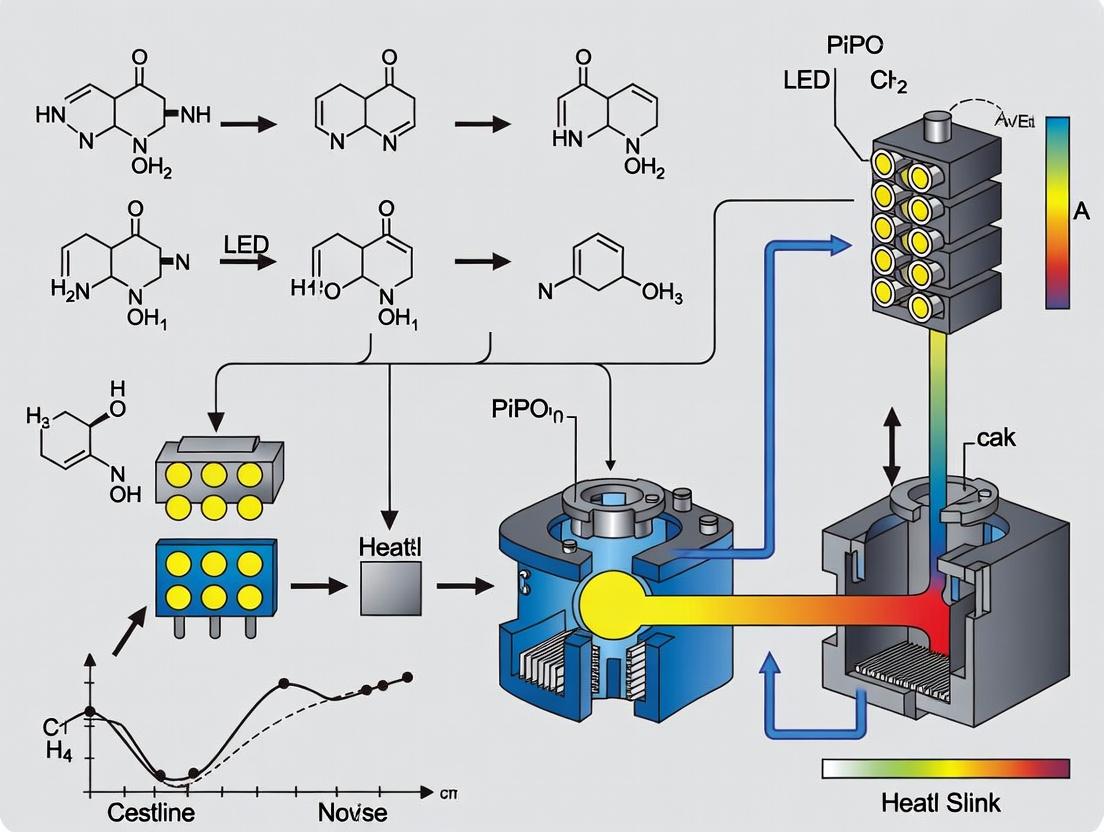
This article provides a comprehensive guide for researchers and drug development professionals on managing thermal challenges in high-power LED photoreactions.
Advanced Heat Management Strategies for High-Power LED Photoreactions: A Critical Guide for Biomedical Research and Drug Discovery
Abstract
This article provides a comprehensive guide for researchers and drug development professionals on managing thermal challenges in high-power LED photoreactions. It explores the fundamental physics of heat generation, details practical cooling methodologies from passive to active systems, offers troubleshooting for common thermal issues, and validates solutions through comparative performance data. The content bridges the gap between photochemical theory and robust experimental design, enabling reliable scale-up and reproducibility in photoredox catalysis, photobiology, and continuous-flow pharmaceutical synthesis.
The Heat Challenge: Understanding Thermal Dynamics in High-Power LED Photoreactors
Why Heat is the Primary Bottleneck in Scaling Photochemical Reactions
Technical Support Center: Troubleshooting High-Power LED Photoreactions
Welcome to the Heat Management Support Center. This resource addresses common experimental challenges related to thermal effects in scaling photochemical reactions with high-power LEDs, framed within our thesis that effective heat dissipation is the critical factor for successful scale-up.
Troubleshooting Guides
Issue 1: Decreased Reaction Yield at Increased Scale
- Problem: Reaction conversion drops significantly when moving from a 10 mL vial to a 500 mL flow cell, even with matched photon flux.
- Diagnosis: Inadequate heat dissipation. The increased path length and reactor volume reduces the surface-area-to-volume ratio, creating localized hot spots that degrade photosensitizers, promote side reactions, or quench excited states.
- Solution: Implement active cooling and optimize reactor geometry. Use a coiled flow reactor immersed in a thermostated cooling bath instead of a simple batch reactor. Ensure coolant temperature is monitored at both inlet and outlet.
Issue 2: Irreproducible Reaction Times
- Problem: Reaction completion time varies between runs despite identical configured light intensity.
- Diagnosis: LED Junction Temperature Shift. High-power LED output wavelength and intensity are sensitive to junction temperature. Inadequate heat sinking causes the LED chip to heat up over time, reducing photon output and altering emission spectrum.
- Solution: Mount LEDs on actively cooled heat sinks (e.g., Peltier-cooled or water-cooled plates). Use a constant-current LED driver and include a photodiode or radiometer for real-time, closed-loop feedback on actual photon delivery.
Issue 3: Photocatalyst Degradation
- Problem: Expensive transition metal photocatalyst (e.g., Ir(ppy)₃) decomposes after short operation periods in a scaled continuous flow system.
- Diagnosis: Thermal degradation from adiabatic heating. In flow systems, if the heat generated by photon absorption is not removed, the temperature can rise steadily along the reactor channel, exceeding the thermal stability limit of the catalyst.
- Solution: Integrate inline temperature sensors (e.g., IR or thin thermocouple) at multiple points. Redesign the flow reactor to use materials with high thermal conductivity (e.g., aluminum or copper blocks with milled channels) instead of glass or PTFE.
Frequently Asked Questions (FAQs)
Q1: My reaction works perfectly in small-scale vials. Why does it fail when I simply use a larger vessel and a more powerful LED? A1: This is the core scaling challenge. Photochemical reactions scale with photon flux, not just power. A more powerful LED generates proportionally more waste heat. In a larger vessel, convective mixing is less efficient at distributing this heat, leading to thermal gradients. The reaction likely fails due to a combination of reactant/catalyst thermal decomposition and unwanted thermal (non-photonic) background reactions becoming dominant.
Q2: How do I accurately measure the true temperature of my reaction mixture under irradiation? A2: Avoid external bath sensors. Use an internal probe:
- Fiber-Optic Thermometer: Best for non-invasive measurement in stirred vessels or flow cells.
- Flush-Mounted Micro-Thermocouple: Minimizes shadowing. Calibrate it against a known standard in situ.
- IR Thermal Camera: Useful for mapping surface temperatures of reactors and LED arrays to identify cooling failures.
Q3: What is the most effective cooling method for a benchtop continuous flow photoreactor? A3: The choice depends on the thermal load (Watts):
- < 50W: Forced air cooling with aluminum heat sinks/fans may suffice.
- 50W - 500W: Recirculating chiller with a Peltier or compressor, connected to a cold plate or reactor jacket.
- > 500W: Dedicated industrial chiller or tap water cooling (with caution for temperature stability and condensation).
Q4: Can I just pulse the LED to reduce heat? A4: Pulsing (duty cycling) can reduce average heat load on the LED, extending its life. However, it creates a complex, time-varying photon flux. This can alter reaction kinetics and may not reduce peak temperature spikes in the reaction medium if the pulse energy is high. It is a useful strategy but must be coupled with thermal monitoring of the reaction itself.
Table 1: Thermal Impact on Common Photocatalysts
| Photocatalyst | Optimal Temp. Range (°C) | Decomposition Onset Temp. (°C) | Primary Thermal Degradation Pathway |
|---|---|---|---|
| Ru(bpy)₃²⁺ | 20 - 30 | > 70 | Ligand dissociation & decomposition |
| Ir(ppy)₃ | 20 - 40 | > 90 | Oxidative degradation of cyclometalated ligand |
| 4CzIPN | 15 - 35 | > 110 | Isomerization & fragmentation |
| Eosin Y | 15 - 30 | > 80 | Dehalogenation and loss of fluorescence |
Table 2: Cooling Method Efficacy for a 100W LED Array
| Cooling Method | Steady-State LED Junction Temp. (°C) | Time to Reach Thermal Steady-State (min) | Relative Photon Output Stability (%) |
|---|---|---|---|
| Passive Heat Sink | 112 | 45 | 58 |
| Active Air Cooling (Fan) | 85 | 25 | 75 |
| Peltier Cooler | 42 | 8 | 98 |
| Water Cooling Block | 35 | 5 | 99 |
Experimental Protocol: Measuring Adiabatic Temperature Rise in a Flow Photoreactor
Objective: Quantify the temperature increase due solely to photon absorption in a scaled flow system.
Materials:
- High-power LED reactor system (e.g., 450 nm, 100W)
- Peristaltic or syringe pump
- Insulated tubular flow reactor (e.g., PFA, 1/8" ID, 5 m length)
- Inline fiber-optic temperature sensor (2x)
- Data logger
- Reaction solution (e.g., 0.1 mM photocatalyst in solvent)
- Recirculating chiller
Method:
- Insulate the entire length of the flow reactor with closed-cell foam.
- Place one temperature sensor (T1) at the reactor inlet and one (T2) at the outlet.
- Pre-cool the reaction solution to a setpoint (e.g., 20°C) using the chiller in a reservoir.
- Pump the solution through the reactor in the dark at the desired flow rate until T1 and T2 stabilize and are equal. Record this baseline temperature (T_base).
- Without changing any other parameter, turn the LED to the desired power setting.
- Monitor T1 and T2 continuously. T1 should remain near T_base. T2 will rise.
- Continue until T2 reaches a new steady state. Record this value (T_max).
- Calculate Adiabatic Rise: ΔTadiabatic = Tmax - T_base.
- Interpretation: A large ΔT_adiabatic (>10°C) indicates poor thermal management and a high risk of thermal side reactions at scale.
Workflow Diagram: Integrated Heat Management Strategy
Diagram Title: Photochemical Scale-Up Heat Management Workflow
The Scientist's Toolkit: Research Reagent & Equipment Solutions
Table 3: Essential Materials for Thermal-Managed Photoreactions
| Item | Function & Rationale |
|---|---|
| High-Power LED Module with Integrated Heat Sink | Provides high photon flux; the integrated heat sink is the first critical stage for moving heat away from the semiconductor junction. |
| Recirculating Chiller (e.g., 1 kW capacity) | Removes waste heat from LED heat sinks and jacketed reactors to maintain a constant temperature. Essential for >50W systems. |
| Fiber-Optic Temperature Probe (e.g., Fluoroptic) | Enables accurate, in-situ temperature measurement without electrical interference from strong EM fields near LEDs. |
| Calibrated Radiometer/Photodiode | Measures actual photon flux arriving at the reactor. Critical for distinguishing thermal effects from photonic effects. |
| Micro-Tubular Flow Reactor (Coiled, Metal) | Coiling increases mixing; metal (e.g., stainless steel, Hastelloy) provides excellent thermal conductivity for rapid heat exchange. |
| Insulating Materials (e.g., Aerogel Blanket) | Used selectively to create adiabatic zones for diagnostic tests or to protect temperature-sensitive components. |
| Thermal Interface Paste | Applied between LED module and heat sink to fill microscopic gaps, dramatically improving thermal conductivity. |
| Data Acquisition (DAQ) Unit | Logs synchronized data from temperature sensors, photodiodes, and flow meters for rigorous kinetic and thermal analysis. |
Troubleshooting Guides & FAQs
Q1: During a prolonged photoreaction, my product yield decreases despite constant LED drive current. What is the primary cause?
A: The most likely cause is a rise in LED junction temperature (Tj). As Tj increases, the internal quantum efficiency (IQE) drops, reducing photon output (radiant flux). This non-linear decrease in photons delivered to the reaction directly lowers the reaction rate and yield. Verify cooling system operation and measure heatsink temperature.
Q2: How can I verify if LED junction temperature is affecting my experimental reproducibility?
A: Implement a direct measurement protocol: 1) Use a thermal camera or calibrated thermocouple on the LED package near the chip (following manufacturer guidelines). 2) Record the forward voltage (Vf) at a low, pulsed measurement current (e.g., 1mA) before and immediately after the high-power pulse. The change in Vf is directly proportional to the change in Tj (using the K factor, typically -2 mV/°C for blue LEDs). Consistent ΔVf indicates stable Tj.
Q3: My spectrometer shows a shift in the LED's peak wavelength during operation. Is this related to heat?
A: Yes. LED peak emission wavelength shifts linearly with junction temperature. For typical InGaN LEDs, the shift is approximately 0.1 nm/°C. A red-shift (longer wavelength) confirms a Tj increase. This can alter the photon energy and affect photo-initiated reactions sensitive to specific wavelengths.
Q4: What is the most critical parameter to monitor for consistent photon output?
A: Maintain a constant Junction Temperature (Tj). Radiant flux (Φe) has an inverse, non-linear relationship with Tj. Controlling Tj via active cooling is more effective than attempting to compensate by increasing drive current, which further heats the LED.
Data Presentation
Table 1: Effect of Junction Temperature on LED Performance Parameters
| Parameter | Change per °C Rise in Tj (Typical Blue/White LED) |
Impact on Photoreaction |
|---|---|---|
| Radiant Flux (Φe) | Decreases by 0.5% to 1.0% | Reduced photon count per second. |
| Dominant Wavelength | Red-shifts by ~0.1 nm | Altered photon energy. |
| Forward Voltage (Vf) | Decreases by ~2.0 mV | Can affect constant-current driver stability. |
| Internal Quantum Efficiency (IQE) | Non-linear decrease | Fundamental reduction in light generation. |
Table 2: Comparison of Cooling Methods for High-Power LED Arrays
| Method | Max. Thermal Resistance (Junction-to-Ambient) | Best Use Case | Maintenance Need |
|---|---|---|---|
| Passive Heatsink | 5-10 °C/W | Low-duty cycle, low-power arrays. | Low (Dusting) |
| Active Air Cooling (Fan) | 2-5 °C/W | Continuous operation, moderate power. | Medium (Fan failure risk) |
| Active Liquid Cooling | 0.5-2 °C/W | High-power, dense arrays, long experiments. | High (Leak prevention, coolant) |
| Thermoelectric (Peltier) | 1-3 °C/W (with heatsink) | Precise temperature stabilization. | High (Condensation management) |
Experimental Protocols
Protocol 1: Measuring the Relationship Between Drive Current, Tj, and Radiant Flux
Objective: Quantify the drop in photon output as a function of LED self-heating.
Materials: High-power LED (mounted on heatsink), constant current driver, integrating sphere spectrometer or calibrated photodiode, thermal sensor, data logger.
Method:
- Place the LED-thermal sensor assembly in a temperature-controlled chamber at a baseline (e.g., 25°C).
- Operate the LED at a low current (e.g., 100mA) until thermal equilibrium. Record
Tj(baseline) and radiant flux (Φe). - Immediately switch to the target high drive current (e.g., 1000mA).
- Simultaneously record
Φeand the proxy forTj(heatsink temp orVfdrop) every 10 seconds until readings stabilize (thermal equilibrium). - Plot
Φevs.Tj. The slope quantifies the thermal roll-off for your specific setup.
Protocol 2: Calibrating Tj via Forward Voltage (Vf) Method
Objective: Establish a reliable, in-situ method for junction temperature estimation.
Materials: LED on a temperature-controlled plate, precision current source, voltmeter, thermocouple.
Method:
- Place the LED on a hot plate with a thermocouple attached to the package.
- In a low-thermal-mass setup, set the hot plate to a known temperature (
T1= 25°C). Allow to stabilize. - Inject a very short, low measurement current (
I_meas, e.g., 1mA, 100ms pulse) that does not cause self-heating. Record the forward voltageVf1. - Repeat step 3 at a higher known temperature (
T2= e.g., 75°C). RecordVf2. - Calculate the
Kfactor:K = (Vf2 - Vf1) / (T2 - T1)(units: V/°C, typically negative). - In the experimental setup, the instantaneous
Tjcan be estimated:Tj = T_ambient + (Vf_measured - Vf_calibrated@T_ambient) / K.
Visualizations
Title: Causal Chain: LED Self-Heating Lowers Yield
Title: In-Situ LED Junction Temperature Measurement Protocol
The Scientist's Toolkit: Research Reagent Solutions
Table 3: Essential Materials for High-Power LED Photoreactions Research
| Item | Function | Critical Specification |
|---|---|---|
| Constant Current LED Driver | Provides stable drive current independent of LED Vf changes. |
Low current ripple (<5%), high efficiency, pulse capability. |
| Thermal Interface Material (TIM) | Enhances heat conduction from LED package to heatsink. | Low thermal resistance (e.g., <0.2 °C·cm²/W), non-silicone for reactors. |
| Copper or Aluminum Heatsink | Dissipates heat from the LED into the surrounding air. | Low thermal resistance (junction-to-ambient), sufficient surface area. |
| Integrating Sphere with Spectrometer | Measures total radiant flux (in Watts) and spectrum of the LED. | Correct sphere size for LED power, calibrated detector. |
| Thermocouple or RTD Sensor | Directly measures temperature at critical points (heatsink, coolant). | Fast response time, small form factor, accurate to ±0.5°C. |
| Optical Window (e.g., Fused Silica) | Seals reaction vessel while transmitting LED wavelength. | High UV-Vis transmittance (>90%), low autofluorescence, chemical resistance. |
| Heat Transfer Fluid | For liquid-cooled LED arrays, transfers heat to a remote radiator. | High specific heat, low conductivity, non-corrosive (e.g., deionized water with inhibitor). |
Technical Support Center: Troubleshooting High-Power LED Photoreactions
Frequently Asked Questions (FAQs)
Q1: During a continuous high-power LED photoreaction, I observe a significant drop in product yield after 30 minutes. What is the likely cause? A1: This is indicative of a primary thermal degradation pathway affecting either your photocatalyst or a key reaction intermediate. Elevated local temperature from LED emission can lead to catalyst decomposition or ligand dissociation. Implement real-time temperature monitoring with an immersion probe and consider pulsed LED operation to manage heat.
Q2: My reaction solvent appears to darken over time under LED irradiation, and I detect new byproducts via HPLC. What should I investigate? A2: Solvent degradation is a common thermal side pathway. Halogenated solvents (e.g., DCE) and some ethers can decompose under photothermal stress. Review the table below for solvent stability thresholds and switch to a more robust solvent like MeCN or a water-acetone mixture.
Q3: How can I determine if my precious-metal photocatalyst (e.g., Ir(III), Ru(II)) is decomposing under my high-power LED setup? A3: Perform a catalyst stability test. Run the reaction mixture without the limiting reactant under standard LED conditions. Periodically sample and use UV-Vis spectroscopy to track changes in the metal-to-ligand charge transfer (MLCT) bands. A decay in absorbance correlates with catalyst degradation.
Q4: I suspect thermal runaway is degrading my light-sensitive reactant. How can I modify my protocol? A4: Implement active cooling and adjust reactor geometry. Use a jacketed reactor with a cryostat set to 5°C. Ensure the LED array is not directly in contact with the vessel and that the solution is well-stirred. Consider diluting the reaction to improve heat dissipation.
Q5: What are the best practices for measuring the actual temperature inside a photoreaction vessel? A5: Use a fiber-optic temperature probe placed directly in the reaction medium. Avoid metal thermocouples as they can interfere with the light path and catalyze side reactions. Calibrate the probe against a standard prior to the experiment.
Troubleshooting Guides
Issue: Declining Yield in Scale-Up Photoreactions Symptoms: Yield drops from 85% (5 mmol) to 60% (50 mmol) using the same LED power density. Diagnosis: Inefficient heat transfer in larger volumes leads to localized hotspots (> ΔT of 15°C), accelerating unwanted thermal pathways. Solution:
- Switch to a flow photoreactor with a high surface-area-to-volume ratio.
- Segment the LED array with separate cooling fins.
- Use the modified protocol for "Scaled Photoreaction with Thermal Management" below.
Issue: Inconsistent Results Between Batch Runs Symptoms: Yield varies by ±15% under seemingly identical conditions. Diagnosis: Fluctuations in ambient cooling (e.g., fan position, room temperature) cause variable thermal profiles. Solution:
- Enclose the reactor in a temperature-controlled box.
- Standardize the distance between the LED and the vessel with a fixture.
- Implement an LED driver with constant current output, not constant voltage, to ensure consistent photon flux and associated thermal load.
Issue: Formation of a High-Molecular-Weight Polymeric Byproduct Symptoms: Reaction mixture becomes viscous, and GPC analysis shows a polymeric peak. Diagnosis: Thermal initiation of a radical polymerization side pathway from an acrylic reactant or styrene derivative. Solution:
- Introduce a radical inhibitor (e.g., BHT, 0.1 mol%) to the reaction mixture.
- Reduce the reaction temperature using a lower-power LED setting or enhanced cooling.
- Purge the reactant of stabilizers more thoroughly if present, as they can decompose thermally.
Table 1: Thermal Stability Thresholds of Common Photocatalysts
| Catalyst | Recommended Max Temp. (°C) | Degradation Product (Common) | Yield Loss Onset Time at 50°C |
|---|---|---|---|
| [Ir(ppy)₃] | 65 | Ir colloids / Ligand fragments | ~45 min |
| Ru(bpy)₃Cl₂ | 75 | Ru oxides / De-bpy complexes | ~60 min |
| 4CzIPN (Organic) | 90 | Isomerized / Fragmented species | ~120 min |
| Eosin Y | 80 | Dehalogenated, bleached product | ~30 min |
Table 2: Solvent Photothermal Stability Under 450 nm LED (100 W)
| Solvent | Boiling Point (°C) | Observed Decomposition Temp. in Reactor (°C) | Key Degradation Byproducts |
|---|---|---|---|
| Dichloroethane (DCE) | 83 | ~65 | Chlorides, HCl, vinyl chlorides |
| Acetonitrile (MeCN) | 82 | >85 (Stable) | Trace HCN only at extreme T |
| Acetone | 56 | ~70 | Aldol condensation products |
| Dimethylformamide (DMF) | 153 | ~130 | Dimethylamine, CO |
| Water (deionized) | 100 | >95 (Stable) | None detected |
Table 3: Impact of Cooling Method on Product Yield in Model Aryl Bromide Coupling*
| Cooling Method | Avg. Internal Temp. (°C) | Max Temp. Fluctuation | Yield (%) | Selectivity (%) |
|---|---|---|---|---|
| Passive (Air) | 58 | ±8 | 62 | 85 |
| Active (Fan) | 45 | ±5 | 78 | 90 |
| Active (Peltier Jacket) | 25 | ±1 | 92 | 98 |
| Circulating Cryostat | 5 | ±0.5 | 95 | 99 |
*Reaction: 4-bromoacetophenone photoreduction, 10 mmol scale, 425 nm LED, 1 hr.
Experimental Protocols
Protocol 1: Catalyst Thermal Stability Assay Objective: Quantify the degradation half-life of a photocatalyst under operational temperatures. Materials: See "The Scientist's Toolkit" below. Procedure:
- Prepare a 0.1 mM solution of the photocatalyst in degassed solvent in a sealed quartz cuvette.
- Place the cuvette in a temperature-controlled block heater set to the target temperature (e.g., 40°C, 60°C).
- Do not irradiate. Use heat only.
- At time intervals (0, 15, 30, 60, 120 min), take an aliquot.
- Immediately cool the aliquot and analyze by UV-Vis spectroscopy.
- Plot absorbance at λmax (MLCT band) vs. time. Fit the decay to a first-order kinetic model to determine the rate constant (kdegrad) and half-life.
Protocol 2: Scaled Photoreaction with Thermal Management (Flow Setup) Objective: Perform a 50 mmol scale photoreaction with controlled thermal conditions. Materials: Peristaltic or syringe pump, PTFE tubing (ID 1 mm), coiled glass reactor, LED array, fiber-optic thermometer, cryostat. Procedure:
- Prepare the reactant solution and load into a feed reservoir.
- Connect the reservoir to the peristaltic pump, then to the coiled reactor.
- Immerse the coiled reactor in a jacketed beaker connected to a cryostat set to 5°C.
- Position the LED array concentrically around the jacketed beaker.
- Start the cryostat circulation and allow temperature to equilibrate.
- Start the pump at a flow rate calculated to achieve the desired residence time (e.g., 10 min).
- Turn on the LED array. Monitor the outlet temperature with the fiber-optic probe.
- Collect the product stream and work up as required.
Diagrams
Thermal Degradation Pathways in Photoreactions
Troubleshooting Workflow for Thermal Yield Loss
The Scientist's Toolkit: Research Reagent Solutions
Table 4: Essential Materials for Thermal Management Studies
| Item | Function & Rationale |
|---|---|
| Fiber-Optic Temperature Probe | Provides accurate, real-time internal reaction temperature without interfering with light or acting as a catalyst. |
| Circulating Cryostat & Jacketed Reactor | Enforces precise, active cooling to maintain isothermal conditions, suppressing thermal side reactions. |
| PTFE Tubing & Peristaltic Pump | Enables flow photochemistry, drastically improving surface-area-to-volume ratio for efficient heat exchange. |
| UV-Vis Spectrophotometer | Key for quantifying catalyst stability via time-resolved absorbance measurements of MLCT bands. |
| High-Power LED with PWM Driver | Pulse-width modulation allows control of total photon flux and associated thermal load, enabling "cooling periods." |
| Thermal Imaging Camera | Visualizes surface temperature gradients and hotspots on reactor vessels for diagnostic purposes. |
| Radical Inhibitors (BHT, TEMPO) | Used diagnostically to quench thermally-initiated radical polymerization side pathways. |
| Degassing Solvent Kit | Removes oxygen which can participate in thermal oxidation pathways of catalysts and reactants. |
The Thermal Runaway Risk in Continuous and Batch Photoreactions
Technical Support Center
FAQs & Troubleshooting Guides
Q1: What are the primary indicators of an imminent thermal runaway in my photoreactor? A: Key indicators include:
- A sudden, exponential temperature rise exceeding the setpoint by >15°C.
- Uncontrolled pressure increase leading to venting or safety disk rupture.
- Visible decomposition (color change, gas evolution, precipitate formation) of reaction mixture.
- LED power output fluctuation or automatic shutdown due to internal overheating (often indicated by a warning light).
Q2: How do I choose between batch and continuous flow to minimize thermal risk for a new exothermic photoreaction? A: The decision is based on reaction enthalpy and photon flux. Use this risk assessment table:
| Parameter | Batch Reactor (Cooled Jacket) | Continuous Flow Microreactor (Typical Channel Size: 250-1000 µm) | Recommended Use Case |
|---|---|---|---|
| Surface Area-to-Volume Ratio | Low (~10-100 m⁻¹) | Very High (>10,000 m⁻¹) | Flow is superior for rapid heat removal. |
| Photon Flux (Typical High-Power LED) | Up to 150 mmol·h⁻¹·L⁻¹ | Can exceed 500 mmol·h⁻¹·L⁻¹ due to thin optical path. | Flow enables safer use of higher flux. |
| Molar Enthalpy (ΔHᵣ) Safety Threshold | < -100 kJ/mol (with agitation) | Can manage <-200 kJ/mol safely. | Highly exothermic reactions mandate flow. |
| Temperature Gradient (ΔT) | Can be large (5-25°C) between light zone and bulk. | Typically minimal (<2°C). | Flow ensures precise, uniform temperature control. |
| Risk Mitigation Level | Moderate | High |
Q3: My safety disk ruptured during a scale-up in batch. What protocol adjustments are critical? A: Implement this step-by-step protocol for safe scale-up:
- Calorimetry First: Perform differential scanning calorimetry (DSC) on reagents and mixture to determine total reaction enthalpy (ΔHᵣ) and onset temperature of decomposition.
- Calculate Adiabatic Temperature Rise (ΔTad): Use the formula ΔTad = (-ΔHᵣ * C₀) / (ρ * Cp), where C₀ is initial concentration, ρ is density, and Cp is specific heat capacity. A ΔT_ad > 50 K indicates high risk.
- Semi-Batch Operation: Switch to adding the limiting reagent (e.g., photocatalyst or substrate) slowly via a syringe pump over ≥5 half-lives of the reaction to limit instantaneous heat release.
- External Cooling Pre-Chill: Cool the reactor jacket to at least 10°C below the target temperature before irradiation begins.
- Photon Dose Ramping: Use programmable LED drivers to start at 20% max power and ramp up incrementally only after confirming temperature stability.
Q4: In continuous flow, I observe hot spots and fluctuating product yield. How can I diagnose and fix this? A: This points to poor mixing or erratic flow. Follow this diagnostic workflow:
Title: Troubleshooting Flow Reactor Hot Spots
Q5: What are the essential materials for constructing a safe, high-power LED photoreaction setup? A: The Scientist's Toolkit:
Research Reagent & Hardware Solutions
| Item | Function & Critical Specification |
|---|---|
| Back-Pressure Regulator (BPR) | Maintains constant pressure in flow system, prevents gas bubble expansion and flow instability. Set 10-20% above solvent vapor pressure at reaction T. |
| Immersion Cooler (e.g., Cryostat) | Provides active cooling to batch reactor jacketed vessels. Seek >1000 W heat removal capacity. |
| In-line IR Temperature Sensor | Non-contact, real-time measurement of fluid temperature exiting the flow chip. Critical for detecting exotherms. |
| Programmable LED Driver | Allows power ramping and pulsed operation to manage photon flux and initial heat load. |
| PTFE-coated Magnetic Stir Bar | For batch mixing. Must be coated to prevent metal-induced decomposition. Size for turbulent mixing (≥1/3 vessel diameter). |
| Thermal Runaway Inhibitor (e.g., Hydroquinone) | Emergency reagent or additive to quench radical chain reactions. Pre-dissolve at 1% v/v in feed for flow systems. |
| Safety Shield & Kevlar Sleeves | Mandatory personal protective equipment (PPE) for containing potential vessel rupture. |
| Sacrificial Safety Disk | Last line of defense. Calibrate burst pressure to 50% of reactor's maximum working pressure. |
Practical Cooling Solutions: From Passive Heat Sinks to Advanced Active Systems
Technical Support Center: Troubleshooting & FAQs for High-Power LED Photoreactors
This support center addresses common thermal management challenges encountered in high-power LED photoreactions for photochemical synthesis and drug development research. Efficient passive cooling is critical for maintaining LED junction temperature, optical output stability, and reaction reproducibility.
Frequently Asked Questions (FAQs)
Q1: My high-power LED (450 nm, 10W) experiences rapid lumen decay after 30 minutes of continuous operation in my flow photoreactor. The aluminum heat sink feels hot. What is the likely cause? A: This indicates insufficient thermal dissipation, leading to LED junction temperature (Tj) exceeding its maximum rated spec (typically 125°C for high-power LEDs). The primary cause is often a high thermal interface resistance between the LED module and the heat sink, or an undersized heat sink for the applied power and ambient conditions. Verify the thermal interface material (TIM) application and consider a heat sink with increased fin surface area or a material with higher thermal conductivity.
Q2: I replaced an aluminum heat sink with a copper one of identical geometry, but the temperature drop was less than 5°C. Why wasn't the improvement more significant? A: While copper has ~90% higher bulk thermal conductivity than aluminum (see Table 1), the dominant thermal resistance in many systems is at the interfaces (LED-to-sink) or is limited by surface convection. For identical geometry, the improvement is constrained by the convective heat transfer coefficient. To leverage copper's advantage, redesign the geometry (e.g., more, thinner fins) to increase the convection surface area, as copper allows more efficient heat spreading to fin tips.
Q3: How do I choose between extruded aluminum and bonded fin heat sinks for a multi-LED array reactor? A: Extruded aluminum sinks are cost-effective and suitable for moderate power densities with linear fin layouts. For arrays creating localized "hot spots," bonded fin or skived copper sinks offer better spreading performance and customizable fin placement. Prioritize bonded fin designs if your thermal analysis shows high heat flux concentrations.
Q4: My computational model and experimental temperature readings for the heat sink base differ by over 15%. What should I check? A: 1. TIM Contact Pressure: Ensure the mounting mechanism provides even, adequate pressure (typical range 0.5-2 MPa for silicone-based pads). 2. Sensor Attachment: Verify thermocouple or RTD is properly attached with thermal adhesive. 3. Emissivity Settings: For IR camera measurements, set correct surface emissivity (~0.09 for polished Al, ~0.8 for anodized Al). 4. Ambient Conditions: Account for enclosure effects and nearby heat sources in your lab setup.
Troubleshooting Guide: Common Issues & Solutions
| Symptom | Possible Cause | Diagnostic Step | Corrective Action |
|---|---|---|---|
| LED Wavelength Shift | High Tj altering semiconductor bandgap. | Measure heat sink base temp near LED. Use Tj = Tbase + (Rth-jb × Power). | Increase heat sink volume/fin density. Improve airflow orientation (chimney effect). |
| Reaction Yield Inconsistency | Variable LED optical output due to thermal drift. | Log LED case temperature over reaction time with a data logger. | Implement a thermal feedback loop to adjust driver current or add a thermoelectric cooler (TEC) for critical control. |
| Hot Spot on Heat Sink Base | Poor lateral heat spreading. | Use thermal imaging to visualize temperature distribution. | Switch to a copper base plate or vapor chamber base. Apply a higher-performance TIM (e.g., phase-change material). |
| Condensation on Heat Sink | Sink temperature below ambient dew point in cooled environments. | Monitor lab ambient temperature & humidity. | Insulate the cold side or introduce a controlled heater to keep sink above dew point, avoiding electrical shorts. |
Table 1: Key Material Properties for Passive Cooling
| Material | Thermal Conductivity (W/m·K) | Density (kg/m³) | Specific Heat (J/kg·K) | Cost Index (Relative) | Typical Use Case |
|---|---|---|---|---|---|
| Aluminum 6063 (Extruded) | 201-218 | 2700 | 900 | 1.0 (Baseline) | Standard fin heatsinks, enclosures. |
| Copper C110 (Oxygen-Free) | 388-401 | 8930 | 385 | ~3.5 | High-flux spreading layers, base plates. |
| Thermal Paste (Silicone) | 3-5 | N/A | N/A | Low | Filling microscopic air gaps. |
| Phase-Change TIM | 5-8 | N/A | N/A | Medium | Pre-applied, automatable interfaces. |
| Graphite Pad | 5-20 (in-plane) | ~1100 | 700 | High | Electrically insulating, conformable interface. |
Table 2: Effect of Heat Sink Geometry Parameters on Thermal Resistance
| Parameter | Increase Leads to... | Typical Experimental Range | Impact on Thermal Resistance (R_th-sa) |
|---|---|---|---|
| Fin Height | Increased surface area & airflow resistance. | 20-80 mm | Decreases initially, then plateaus due to reduced fin efficiency. |
| Fin Density (fins/inch) | Increased surface area & potential for airflow blockage. | 8-20 FPI | Decreases up to an optimum, after which forced convection may be needed. |
| Base Plate Thickness | Improved lateral heat spreading. | 6-20 mm | Significant reduction for point sources; minimal for uniform loads. |
| Natural Convection Orientation | Maximizes chimney effect. | Fins vertical | Up to 30% lower R_th-sa vs. horizontal orientation. |
Experimental Protocols
Protocol 1: Measuring Heat Sink Thermal Performance (Static Air) Objective: Determine the overall thermal resistance (R_th-sa) of a heatsink-LED assembly under natural convection. Materials: High-power LED on MCPCB, test heat sink, thermal interface material, DC power supply, multimeter, thermocouples (or IR camera), data logger, insulated test chamber. Method:
- Attach thermocouple to the heat sink base directly under the LED die location. Place another in ambient air away from the assembly.
- Mount the LED/MCPCB onto the heat sink using a standardized TIM and a controlled torque.
- Place the assembly in the insulated chamber to minimize ambient air disturbances.
- Power the LED at a known constant current (Ioperate) and forward voltage (Vf). Calculate electrical input power: Pin = Ioperate × V_f.
- Allow system to reach thermal steady-state (typically 60-90 mins). Record final base temperature (Tbase) and ambient (Tamb).
- Calculate: Rth-sa = (Tbase - Tamb) / Pin. Units: °C/W. Note: This measures system resistance. Subtract known LED/MCPCB and TIM resistances to isolate the heat sink's performance.
Protocol 2: Comparing Aluminum vs. Copper in Identical Geometry Objective: Quantify the performance difference attributable solely to material conductivity. Materials: Two heat sinks of identical fin geometry (e.g., 100mm x 100mm x 40mm), one aluminum 6063, one copper C110. Identical LED, TIM, and measurement setup from Protocol 1. Method:
- Perform Protocol 1 for the aluminum heat sink (Rth-saAl).
- Repeat with the copper heat sink (Rth-saCu) using the same TIM, mounting pressure, and ambient conditions.
- Calculate percentage improvement: %Δ = [(Rth-saAl - Rth-saCu) / Rth-saAl] × 100.
- Map temperature distribution using an IR camera at steady-state to visualize differences in heat spreading.
The Scientist's Toolkit: Research Reagent Solutions
| Item | Function in Thermal Management Experiments |
|---|---|
| Thermal Interface Material (TIM) Kit | Contains various pastes, pads, and phase-change materials to standardize and optimize contact resistance between LED and sink. |
| Torque Screwdriver Set | Ensures reproducible and adequate mounting pressure for MCPCB attachment, critical for TIM performance. |
| Data Logging Thermometer with K-Type Probes | For simultaneous, long-duration logging of multiple temperature points (base, ambient, fin tips). |
| Infrared Thermal Camera | Visualizes 2D temperature gradients, identifies hot spots, and verifies fin efficiency. |
| Anemometer | Measures local airflow velocity in natural or weakly forced convection setups. |
| Insulated Test Enclosure | Minimizes stray air currents and ambient temperature fluctuations during natural convection tests. |
| High-Power LED Driver (Constant Current) | Provides stable, adjustable electrical input to simulate operational loads. |
Visualizations
Title: Thermal Resistance Network for Passive LED Cooling
Title: Heat Sink Selection & Validation Workflow
Troubleshooting Guides
Issue: Persistent Hot Spots in Reactor Vessel Q: Despite using a fan, I measure temperature differentials exceeding 15°C across my high-power LED array reactor. What should I check? A: This indicates insufficient or misdirected airflow. Follow this protocol:
- Verify Airflow Direction: Ensure the fan is oriented for intake (pushing air into the setup) or exhaust (pulling air out) based on your ducting design. An intake setup often provides more directed cooling.
- Check for Obstructions: Inspect if cables, sensors, or other equipment are blocking the primary airflow path between the fan and the LED heat sinks.
- Assess Fan Specifications: Confirm your fan's Cubic Feet per Minute (CFM) rating is adequate for the thermal load. For a typical benchtop LED photoreactor (>100W total), aim for a fan with >50 CFM.
- Implement Airflow Guides: Use cardboard or 3D-printed shrouds to channel air directly over all heat sinks uniformly, preventing air from taking the path of least resistance.
Issue: Excessive Acoustic Noise and Vibration Q: My cooling fan generates high noise and vibration, which interferes with sensitive instrumentation. How can I mitigate this? A: Noise often stems from turbulent airflow or mechanical resonance.
- Reduce Turbulence: Place a straight, smooth duct (minimum length 5x fan diameter) on the fan's intake side to laminarize flow. Use foam gaskets to seal gaps between the fan and the duct.
- Decouple Mechanically: Mount the fan using silicone or rubber vibration isolators rather than rigid screws.
- Speed Control: If the thermal load allows, use a pulse-width modulation (PWM) controller to run the fan at a lower, quieter speed while monitoring temperature stability.
Issue: Inconsistent Temperature Over Long Experiments Q: Temperature homogeneity degrades over multi-hour photoreactions, with gradual drift. What is the cause? A: This suggests system dynamics are changing.
- Filter Check: If using an intake filter, it may be clogging with dust over time, reducing CFM. Check and clean or replace filters regularly.
- Fan Performance: Brushless DC fans can experience bearing wear. Monitor fan speed (via tachometer signal if available) for drops.
- Ambient Conditions: Document lab ambient temperature. A rising room temperature will reduce cooling efficacy. Consider a closed-loop cooling system if ambient variance is high.
Frequently Asked Questions (FAQs)
Q: What is more effective for a uniform temperature field: a single high-CFM fan or multiple lower-CFM fans? A: Multiple fans strategically placed are almost always superior for homogeneity. A single fan creates strong airflow gradients. Multiple fans allow for targeted cooling of specific hot zones (e.g., at the reactor's ends) and can be operated at lower, quieter speeds. See Table 1 for a comparison.
Q: Should I use the fan to blow air into (push) or pull air out of (pull) my cooling enclosure? A: Both have merits. A push configuration provides more directed, focused cooling but can create turbulence. A pull configuration often creates more even, laminar airflow across the entire system but may be less focused. The optimal choice depends on internal geometry. Testing both with a thermal anemometer is recommended.
Q: How do I quantify the effectiveness of my active air cooling setup? A: You need to measure temperature at multiple critical points. Use calibrated thermocouples or IR thermography to create a thermal map. Key metrics are:
- ΔT_max: Maximum temperature difference across the LED array or reactor vessel.
- T_stability: Variation at any single point over time during a reaction.
- See the Experimental Protocol below for a standard method.
Q: What is the recommended distance between the fan and the heat sink for optimal heat transfer? A: There is no universal optimum, as it depends on fan blade design and shroud. However, a distance of 10-30mm, with a shroud connecting the fan directly to the heat sink fin array, typically forces air through the fins rather than allowing it to spill out laterally. Performance should be validated empirically.
Data Presentation
Table 1: Cooling Configuration Performance Comparison Data generated from a simulated 200W LED array reactor (70°C baseline without cooling).
| Configuration | Avg. CFM | ΔT_max Across Array (°C) | Avg. Noise Level (dBA) | Notes |
|---|---|---|---|---|
| Single Axial Fan (Push) | 75 | 12.5 | 52 | Strong gradient from front to back. |
| Single Axial Fan (Pull) | 70 | 9.8 | 50 | More even, but lower peak CFM at source. |
| Dual Axial Fans (Push-Pull) | 150 | 4.2 | 48 | Best homogeneity; fans at 80% speed. |
| Single Blower Fan (Centrifugal) | 45 | 7.1 | 58 | High static pressure good for dense fins. |
Table 2: Impact of Airflow Guides on Temperature Homogeneity Measured ΔT_max under different ducting conditions with a dual push-pull fan setup (150 CFM total).
| Ducting / Shroud Type | Material | ΔT_max (°C) | Improvement vs. No Shroud |
|---|---|---|---|
| No Shroud / Open Air | N/A | 8.5 | Baseline |
| Rectangular Cardboard Duct | Cardboard | 5.1 | 40% |
| 3D-Printed Convergent Nozzle | PLA Plastic | 3.8 | 55% |
| Flexible Corrugated Plastic Duct | Polyethylene | 6.0 | 29% |
Experimental Protocols
Protocol: Measuring Temperature Homogeneity in an LED Photoreactor Objective: To quantitatively assess the efficacy of an active air cooling configuration in maintaining a uniform temperature field across a high-power LED array.
Materials:
- High-power LED photoreactor system
- Active cooling fan(s) and mounting hardware
- Thermocouples (Type K or T) or IR thermal camera
- Data logger or multimeter with thermocouple input
- Airflow anemometer (optional)
- Materials for airflow guides (cardboard, tape, 3D-printed shrouds)
Methodology:
- Sensor Placement: Affix at least five temperature sensors to critical locations: (1) center of LED array, (2 & 3) both ends of the array, (4) on the primary heat sink near the fan inlet, (5) on the reactor vessel wall adjacent to the LED output window.
- Baseline Measurement: Run the LED array at full operational power without active cooling for 30 minutes. Record the steady-state temperature at all sensor points. Calculate ΔT_max (max temperature minus min temperature).
- Cooling Test: Activate the cooling system. Allow the system to reach a new steady state (typically 15-20 minutes).
- Data Collection: Record temperatures from all sensors every minute for a 30-minute period under cooling.
- Variation: Repeat Step 4 for different fan configurations (push vs. pull, multiple fans), fan speeds, and with/without airflow guides/ducts.
- Analysis: For each test condition, calculate:
- Steady-State ΔT_max: The temperature spread across the array.
- Temporal Stability: The standard deviation of temperature at any single point over the 30-minute run.
Visualization
Diagram 1: Active Cooling Optimization Workflow
Diagram 2: Fan & Airflow Configurations for LED Arrays
The Scientist's Toolkit
Table 3: Research Reagent Solutions for Thermal Management Experiments
| Item | Function & Rationale |
|---|---|
| Thermal Interface Paste | Fills microscopic gaps between LED module and heat sink, significantly improving conductive heat transfer. Critical for baseline performance. |
| K-Type Thermocouples | Provide point-specific, real-time temperature data. Essential for creating spatial thermal maps and validating homogeneity. |
| Data Logging Thermometer | Allows simultaneous, time-series recording from multiple thermocouples. Key for assessing temporal stability during long reactions. |
| Miniature Vane Anemometer | Measures local airflow velocity (CFM). Used to quantify and map airflow distribution across the setup to identify dead zones. |
| PWM Fan Speed Controller | Enables precise adjustment of fan RPM. Allows optimization of the trade-off between cooling efficacy and acoustic noise/vibration. |
| Heat Sink Compound Putty | Adhesive putty for temporarily mounting temperature sensors to heat sinks and reactor surfaces without permanent damage. Facilitates experimental setup. |
Technical Support Center
Troubleshooting Guides
Issue: Inadequate Temperature Stability in LED Photoreactor
- Symptoms: Reaction temperature fluctuates beyond ±0.5°C of setpoint, leading to inconsistent reaction yields.
- Diagnostic Steps:
- Check Chiller Setpoint and Bath Level: Confirm the recirculating chiller is set correctly and the reservoir is adequately filled with a 50/50 water-glycol mixture.
- Inspect Fluid Lines: Look for kinks, blockages, or air bubbles in the recirculation tubing. Bleed the system.
- Verify Flow Rate: Ensure the chiller's pump is providing sufficient flow (≥ 4 L/min for a typical 250W LED array). Use a flow meter.
- Examine Peltier Connections: For hybrid systems, ensure the Peltier element's power supply is stable and its cold/hot sides are properly thermally coupled to the heatsink and reactor interface.
- Calibrate Sensors: Verify the calibration of both the chiller's internal sensor and the external reactor probe using a NIST-traceable reference thermometer.
Issue: Condensation on Cold Surfaces (Peltier Systems)
- Symptoms: Water droplets forming on cold reactor parts, posing a risk of electrical shorts or sample contamination.
- Remediation Protocol:
- Increase Setpoint Temperature: If possible, set the temperature no lower than 5°C above the ambient dew point.
- Apply Insulation: Use closed-cell foam insulation (e.g., Armaflex) to cover all cold surfaces.
- Employ a Dew Point Controller: Integrate a humidity sensor and a controller to adjust the Peltier drive current to prevent surface temperature from falling below dew point.
Issue: Recirculating Chiller Over-Temperature Alarm
- Symptoms: Chiller shuts down or alarms due to high temperature.
- Action Checklist:
- Ambient Ventilation: Ensure the chiller's condenser coils and air intake are clean, unobstructed, and have ≥30cm clearance. Room temperature must be below 25°C.
- Heat Load Verification: Confirm the total heat load (LED power + reaction exotherm) does not exceed the chiller's cooling capacity at your set temperature (see Table 1).
- Check for External Recirculation: If using an external bath, verify the secondary circulator is functioning and set to a temperature below the primary chiller's setpoint.
Frequently Asked Questions (FAQs)
Q1: What is the primary advantage of combining a recirculating chiller with a Peltier element stage? A: A recirculating chiller efficiently removes the bulk heat load from high-power LEDs (e.g., 200-500W). A downstream Peltier element provides ultrafine (±0.1°C) trimming and dynamic control directly at the reaction vessel, compensating for fast exotherms or radiative heat. This hybrid approach marries high capacity with supreme precision.
Q2: How often should I maintain my recirculating chiller's fluid, and what type should I use? A: For a 50/50 mixture of deionized water and inhibitor-rich glycol, complete fluid replacement is recommended every 6-12 months under continuous use. Regularly check pH; a drop below 7.0 indicates microbial growth or corrosion, necessitating immediate change. Always use the fluid specified by the chiller manufacturer.
Q3: My Peltier-cooled reactor stage is not reaching the low temperature setpoint. What could be wrong? A: The most common cause is insufficient heat rejection from the Peltier's hot side. Ensure: * The hot side is firmly attached to a heatsink or a cold plate connected to the recirculating chiller. * The chiller fluid temperature is set well below your target reaction temperature. * The Peltier's power supply is delivering the required voltage/current (see device datasheet).
Q4: Can I use a standard laboratory chiller for a high-power LED photoreactor? A: Not all chillers are suitable. Key specifications to match are: * Cooling Capacity: Must exceed the total heat load at your desired operating temperature (capacity drops as setpoint temperature decreases). * Pump Pressure/Flow: Must overcome the pressure drop of your external flow path (reactor, tubing, valves). * Compatibility: The chiller's materials (pump, seals) must be compatible with your coolant fluid.
Data Presentation: Chiller Performance Comparison
Table 1: Comparison of Recirculating Chiller Specifications for High-Power LED Photoreactions
| Model | Max. Cooling Capacity @ 20°C | Temperature Stability | Pump Pressure Max. (bar) | Reservoir Volume (L) | Key Feature for Photoreactions |
|---|---|---|---|---|---|
| Chiller A | 1.0 kW | ±0.1°C | 1.0 | 6 | Compact, integrated Pt1000 sensor input |
| Chiller B | 1.8 kW | ±0.5°C | 1.5 | 12 | High-pressure pump for complex flow loops |
| Chiller C | 3.0 kW | ±0.01°C | 2.0 | 25 | Dual-circuit, can handle multiple reactors |
Experimental Protocol: Calibrating a Hybrid Cooling System for an LED Photoredox Catalysis
Objective: To establish and verify precise temperature control (±0.2°C) within a 50 mL photoreaction vessel under a 250W LED array. Materials: See "The Scientist's Toolkit" below. Methodology:
- Setup: Connect the recirculating chiller to the cold plate supporting the Peltier element. Mount the reactor vessel on the Peltier stage. Insert a calibrated PT100 probe into the reaction solvent (without reactants) matching the planned volume.
- Chiller Baseline: Set the recirculating chiller to 5.0°C. Allow the system to equilibrate for 20 minutes. Record the solvent temperature via the PT100.
- LED Heat Load Test: Activate the LED array at 100% power. Monitor the solvent temperature rise until it stabilizes (approx. 10-15 min). Record the steady-state temperature (T_led).
- Hybrid System Engagement: Set the Peltier controller to the target reaction temperature (e.g., 25.0°C). The Peltier will now actively cool against the combined heat from the LED and the chiller's 5°C baseline.
- Dynamic Stability Test: Program the LED to cycle (e.g., 5 minutes ON, 5 minutes OFF) for 60 minutes. Log the PT100 temperature at 10-second intervals.
- Validation: Calculate the mean temperature and standard deviation during the ON/OFF cycles. The system is calibrated if the mean is within 0.1°C of the setpoint and σ ≤ 0.2°C.
Diagrams
Title: Hybrid Cooling System for LED Photoreactor Workflow
Title: Troubleshooting Temperature Instability Logic
The Scientist's Toolkit: Research Reagent & Hardware Solutions
Table 2: Essential Materials for Precision Cooling in Photoreactions
| Item | Function/Explanation | Example Specification |
|---|---|---|
| Recirculating Chiller | Removes bulk heat from the system. Requires sufficient capacity at your operating temperature. | 1.5 kW cooling @ 20°C, 1.5 bar pump pressure. |
| Peltier Element Module | Provides fast, localized temperature correction directly at the reaction vessel. | 100W max heat pumping, with integrated heatsink. |
| PID Temperature Controller | Precisely drives the Peltier based on sensor feedback to minimize overshoot and oscillation. | 24-bit resolution, auto-tuning function. |
| PT100/1000 Sensor | High-accuracy, stable temperature probe for reliable feedback. | 4-wire PT100, 1/10 DIN Class B accuracy. |
| Inhibited Glycol Coolant | Prevents corrosion and biological growth in chiller fluid paths. | 50% Inhibited Propylene Glycol / 50% DI Water. |
| Low Thermal Grease | Maximizes thermal conductivity between surfaces (Peltier, cold plate, reactor). | Thermal conductivity ≥ 5 W/m·K. |
| Insulation Material | Prevents condensation and reduces ambient heat gain on cold surfaces. | Closed-cell foam tubing (Wall thickness ≥ 10mm). |
| Flow Meter (In-line) | Verifies sufficient coolant circulation through the external loop. | 0.5-10 L/min range, compatible with coolant. |
Technical Support Center
Troubleshooting Guides & FAQs
Q1: My reaction yield has dropped significantly upon scaling from a 5 mL vial to a 200 mL flask using the same high-power LED array. What is the primary cause? A: This is a classic symptom of inadequate photon penetration and heat management at scale. In small vials, the light path is short, and heat dissipates quickly. In larger vessels, the inner regions become photon-poor and overheated. Solution: Implement internal cooling (e.g., a cooled immersion well) and consider segmented LED arrays or flow chemistry to maintain a short, consistent light path.
Q2: I observe decomposition of my photocatalyst and/or starting materials. How can I mitigate this? A: Decomposition is often thermally driven. The localized heat from high-power LEDs can degrade sensitive compounds.
- Verify Temperature: Use an internal probe. Surface temperature ≠ core temperature.
- Enhance Cooling: Increase coolant flow rate. For water-cooling, ensure temperature is <10°C.
- Filter IR Radiation: Place a IR-cutoff filter (e.g., cold mirror) between the LED and reactor to remove heat-generating infrared wavelengths.
Q3: My reaction reproducibility is poor, even with identical settings. A: Inconsistent thermal profiles lead to variable results.
- Stabilize LED Output: Use a constant current LED driver with heat sinking to prevent output drift.
- Standardize Geometry: Fix the distance and angle between the LED and reactor precisely.
- Pre-equilibrate Cooling: Start coolant circulation at least 15 minutes before the reaction to achieve thermal stability.
Q4: How do I accurately measure and report the light dose for my reaction? A: Use a calibrated spectrometer or actinometer.
- Chemical Actinometry: Perform a ferrioxalate actinometry run in your exact reactor setup to determine photons per second.
- Calculate Photon Flux: Use the formula:
Photon Flux (Einstein/s) = (Moles of Fe²⁺ formed) / (Quantum Yield * Time(s)). - Report Comprehensively: Include LED wavelength (FWHM), power output (mW), distance to reactor, and calculated photon flux.
Experimental Protocol: Determination of Photon Flux via Potassium Ferrioxalate Actinometry
Objective: To quantify the photon flux delivered by a high-power LED system to a reaction vessel.
Materials:
- Potassium ferrioxalate solution (0.15 M, in 0.05 M H₂SO₄)
- Phenanthroline solution (0.1% w/v in water)
- Sodium acetate buffer (1 M, pH 3.5)
- High-power LED reactor with cooling
- Spectrophotometer
Method:
- In the target reaction vessel, add 10.0 mL of potassium ferrioxalate solution.
- Stir and thermally equilibrate under active cooling with the LED OFF for 10 minutes.
- Irradiate the solution with the LED for a precisely measured time, t (typically 30-120 s).
- Immediately after irradiation, pipette 1.0 mL of the solution into a mixture of 2.0 mL phenanthroline solution and 3.0 mL sodium acetate buffer.
- Allow color development for 1 hour in the dark.
- Measure the absorbance of the sample at 510 nm against a blank prepared identically but kept in the dark.
- Calculate the concentration of Fe²⁺ formed using the Beer-Lambert law (ε = 11,100 M⁻¹cm⁻¹).
- Calculate photon flux:
Φ = (moles of Fe²⁺) / (φ * t), where φ is the quantum yield for ferrioxalate (1.0 at 450 nm).
Data Presentation
Table 1: Impact of Cooling Methods on Reaction Temperature and Yield in a Model Photoredox Alkylation*
| Cooling Method | LED Power (W) | Max Internal Temp (°C) | Yield (%) | Comment |
|---|---|---|---|---|
| Passive (Air) | 30 | 62 | 45 | Severe thermal gradient |
| External Jacket (Water, 20°C) | 30 | 42 | 68 | Improved, but core heating |
| Immersion Cooler (Water, 5°C) | 30 | 25 | 92 | Optimal thermal control |
| Immersion Cooler | 50 | 28 | 90 | Enables higher power use |
*Reaction conditions: 0.1 mol% Ir(ppy)₃, 5 mmol substrate, 150 mL solvent, 2h irradiation at 450 nm.
Table 2: Key Research Reagent Solutions for High-Power LED Photoredox API Synthesis
| Item | Function | Example/Specification |
|---|---|---|
| High-Power LED Module | Tunable, intense light source. | Collimated array, 365-455 nm, with active TEC cooling. |
| Constant Current Driver | Provides stable, flicker-free power to prevent output drift. | LED driver with PWM/PFM control, ±1% current stability. |
| IR-Cutoff Filter | Removes infrared wavelengths that contribute to heating. | Dielectric cold mirror, >90% transmission at λLED, >90% reflection at λ>700 nm. |
| Cooling System | Manages waste heat from LED and reaction exotherm. | Recirculating chiller with immersion probe, capacity >500 W. |
| Chemical Actinometer | Quantifies photon flux in situ. | Potassium ferrioxalate (for UV-blue), 0.15 M in H₂SO₄. |
| Temperature Probe | Monitors internal reaction temperature accurately. | Fiber-optic or PTFE-coated micro-thermocouple. |
| Bandpass Filter | Ensures monochromatic light, prevents side-reactions. | 10 nm FWHM interference filter at target wavelength. |
The Scientist's Toolkit
Diagram Title: High-Power LED Photoreaction Workflow with Thermal QA
Diagram Title: Primary Heat-Related Failure Pathway
Diagnosing and Solving Common Thermal Issues in LED-Driven Reactions
Troubleshooting Guides & FAQs
Q1: How do I definitively diagnose that my high-power LED photoreaction is suffering from inadequate cooling? A: Monitor both reaction conversion and side-product profiles. A primary symptom is a significant drop in the target product yield compared to well-cooled benchmark runs. Simultaneously, analyze the crude reaction mixture via HPLC or GC-MS for new or increased peaks. A characteristic sign is the formation of dimeric, oligomeric, or over-reduced/oxidized species due to excessive localized heat. Direct temperature measurement using an internal probe in the reaction vessel is critical.
Q2: What are the typical quantitative indicators of cooling failure in my experimental data? A: The following table summarizes key quantitative indicators:
| Parameter | Well-Cooled Reaction | Inadequately Cooled Reaction | Measurement Method |
|---|---|---|---|
| Target Product Yield | Consistent, high (e.g., >85%) | Decreased by 15-50% or more | NMR, HPLC, GC analysis |
| Selectivity | High, consistent side-product profile | Significantly reduced | HPLC/GC-MS area% |
| Reaction Temperature | Stable, near setpoint (e.g., 25°C) | Elevated & fluctuating (+10°C to +30°C) | Internal PTFE probe |
| Reproducibility (Run-to-Run) | High (RSD < 5%) | Poor (RSD > 15%) | Statistical analysis of yields |
Q3: What is the step-by-step protocol to experimentally correlate cooling efficiency with product formation? A: Protocol: Cooling Efficiency Calibration and Impact Analysis.
- Setup: Use a jacketed reaction vessel connected to a refrigerated circulator. Install a calibrated, inert temperature probe directly into the reaction mixture.
- Baseline Run: Under optimal cooling, run the photoreaction. Monitor temperature throughout. Analyze conversion (e.g., by in situ FTIR or TLC) and final yield/selectivity (HPLC).
- Stress Test: Repeat the reaction, but intentionally set the circulator to a higher temperature (e.g., 10°C) or reduce coolant flow rate by 50%.
- Data Collection: Record the maximum temperature spike observed after LED activation. Quench the reaction at the same timepoint as the baseline run.
- Analysis: Perform identical HPLC/GC-MS analysis. Compare chromatograms to identify new side-product peaks. Integrate and tabulate yields for the main product and all major side products.
- Correlation: Plot yield and selectivity against the recorded maximum internal temperature.
Q4: Which side-products are most commonly formed due to overheating in LED-driven photoredox reactions? A: Common thermal side-products depend on the reaction but often include:
- Dimerization/Polymerization products from radical intermediates.
- Over-reduced products (e.g., dehalogenated species beyond the desired step).
- Thermal rearrangement products distinct from photochemical pathways.
- Decomposed starting materials or catalysts.
Diagram: Thermal Pathway Competition from Poor Cooling
The Scientist's Toolkit: Key Research Reagent Solutions
| Item | Function & Relevance to Cooling |
|---|---|
| Refrigerated Circulator (Chiller) | Precisely controls coolant temperature for jacketed reactors. Critical for removing waste heat from high-power LEDs. |
| PTFE-Coated Temperature Probe | Provides accurate in situ reaction temperature monitoring without interfering with the photoreaction. |
| Coolant (e.g., 50% Ethylene Glycol/Water) | High heat-capacity fluid for efficient heat transfer from the reactor to the chiller. |
| IR Thermal Camera | Non-contact tool to visualize thermal gradients and hotspots on the reactor surface. |
| Backpressure Regulator | When using low-boiling-point solvents (e.g., DCM), it allows operation at elevated pressure, preventing solvent boil-off from localized heating. |
| Quantum Sensor (PAR Meter) | Measures Photosynthetically Active Radiation to ensure light dose is consistent, separating thermal from photonic effects. |
Q5: What is a definitive control experiment to prove side-products are thermal, not photochemical? A: Protocol: Thermal vs. Photochemical Pathway Isolation.
- "Dark Thermal" Control: In the exact same setup, with cooling intentionally inadequate, perform the reaction WITHOUT turning on the LED. Heat the reaction to the same maximum temperature recorded during the faulty photoreaction (using the circulator or external heater).
- Analysis: Analyze the mixture. Any products formed here are purely thermal in origin.
- Comparison: Overlay the HPLC chromatogram from this "Dark Thermal" control with the one from the overheated photoreaction. Matching peaks confirm which side-products are thermally induced.
- "Well-Cooled Photochemical" Baseline: Compare both to the well-cooled photoreaction chromatogram to identify the pure photochemical product profile.
Diagram: Experimental Workflow to Isolate Thermal Side-Products
Troubleshooting Guides & FAQs
Q1: In our high-power LED photoreactor, the IR sensor reading is significantly lower than the thermocouple reading at the same reaction vessel location. Which should we trust? A: This is a common issue. Trust the thermocouple for direct liquid temperature, but investigate the discrepancy. IR sensors measure surface temperature and are affected by:
- Emissivity: Glass vessels have low/ variable emissivity. Use a high-emissivity coating (e.g., matte black tape) on a non-critical area for a true reading.
- Glass Transparency: IR sees through glass, potentially reading the cooler interior wall or even external reflections. Ensure the sensor is focused on an opaque, coated area.
- Condensation: Vapor on the reactor lid distorts IR readings. Use a dry purge gas or a heated lens accessory. Protocol: Calibrate IR against a thermocouple on a dry, blackened, isothermal block set to typical reaction temps (e.g., 30°C, 60°C, 90°C).
Q2: Our K-type thermocouples show drift and inconsistent readings between batches of the same photoreaction. What is the likely cause and solution? A: The likely cause is galvanic corrosion of the thermocouple wires due to electrolyte exposure in photoredox or electrochemical reactions. Ions create parasitic junctions.
- Solution: Use sheathed, grounded-junction thermocouples with an inert sheath material (e.g., Inconel 600, stainless steel 316) compatible with your reaction mixture. Replace them periodically as part of preventative maintenance.
- Protocol: Perform an in-situ verification before each critical experiment: Immerse the thermocouple and a reference RTD in a stirred water bath at a stable temperature (e.g., from a calibrated hot plate). Record the difference; apply an offset if consistent, or replace if deviation >1°C.
Q3: What is the recommended calibration schedule and method for temperature sensors in a quantitative research setting? A: Schedule depends on usage and criticality.
| Sensor Type | Calibration Interval (Typical) | Primary Standard | Acceptable Tolerance for Photoreactions |
|---|---|---|---|
| IR Sensor | Annual (or if physically disturbed) | Blackbody Calibrator | ±2°C or better |
| Standard T/C | Every 6 months | Dry-Block Calibrator & Reference PRT | ±1°C |
| Sheathed T/C | Every 3-6 months (harsh chem) | Dry-Block Calibrator & Reference PRT | ±0.5°C |
| Data Logger | Annual | Electrical Simulator | ±0.2°C |
Protocol: Two-Point Calibration (Ice Bath & Hot Bath)
- Preparation: Use a finely crushed ice bath (0.0°C) and a calibrated hot bath or dry-block (e.g., 80.0°C).
- Reference: Use a calibrated reference platinum RTD traceable to NIST.
- Measurement: Immerse probes alongside the reference in the ice bath. Record readings after 5 mins of stability.
- Repeat: Move to the hot bath. Record again.
- Adjustment: Apply a two-point offset in your data acquisition software, or document the correction factor.
Q4: How do we accurately map temperature gradients within a multi-LED array photoreactor? A: Use a multi-thermocouple array (e.g., a custom-made "tree" of fine-wire T/Cs) and a data logger with simultaneous sampling.
- Protocol:
- Position reaction vessel filled with a thermally conductive, optically transparent solvent (e.g., acetonitrile) but no reagents.
- Suspend thermocouple junctions at defined XYZ coordinates (center, near LEDs, near coolant inlet/outlet).
- Run the LED array at typical power (e.g., 100%, 50%).
- Log temperature at all points simultaneously over 30 minutes.
- Generate a 3D spatial-temperature map to identify hot/cold zones for process optimization.
The Scientist's Toolkit: Research Reagent Solutions
| Item | Function in Heat-Managed Photoreactions |
|---|---|
| Fine-Wire K/T-Type Thermocouples | Fast response time for mapping dynamic temperature changes near LED sources. |
| Sheathed, Grounded-Junction T/C | Provides chemical resistance and durability for in-situ monitoring of reactive mixtures. |
| IR Sensor with Adjustable Emissivity | Non-contact measurement of vial/reactor surface temperature; crucial for safety checks. |
| Blackbody Calibration Paint/ Tape | Creates a high-emissivity surface for accurate IR sensor readings on glassware. |
| Calibrated Dry-Block/ Bath | Provides stable, known temperatures for sensor verification and calibration. |
| NIST-Traceable Reference RTD | The gold standard for in-lab calibration of all other temperature sensors. |
| Multi-Channel Data Logger | Enables simultaneous logging from multiple sensors for gradient mapping and control. |
Workflow: Temperature Monitoring & Management Protocol
Title: Sensor Selection and Calibration Workflow for Photoreactions
Calibration Data Comparison Table
| Calibration Method | Typical Accuracy Achievable | Best For | Equipment Cost | Time Required |
|---|---|---|---|---|
| Ice-Point (0°C) Only | ±0.5°C | Quick field check of sensor function. | Very Low | 15 min |
| Two-Point (0°C & 100°C) | ±0.2°C | Full lab calibration of thermocouples. | Medium | 1-2 hours |
| Blackbody Calibrator | ±0.5°C to ±2°C | Calibrating IR sensors at multiple temps. | High | 30 min |
| Professional Service | ±0.1°C or better | Certifying reference sensors for audits. | Very High | 1 week |
Optimizing LED Duty Cycles and Pulsing Protocols to Minimize Heat Load
Technical Support Center: Troubleshooting & FAQs
Q1: During a pulsed LED experiment, we observe inconsistent reaction yields despite consistent duty cycles. What could be the cause? A: This is often due to thermal transient buildup. Even with a low duty cycle, a high pulse frequency may not allow sufficient time for heat dissipation between pulses, causing localized temperature spikes. Reduce the pulse frequency (e.g., from 1 kHz to 100 Hz) while maintaining the same duty cycle to allow for longer cooling intervals. Ensure your temperature probe (e.g., a micro-thermocouple) is in direct contact with the reaction vessel near the LED illumination point to monitor these transients.
Q2: How do we accurately measure the true photon flux delivered in a pulsed protocol? A: Standard continuous-wave radiometers can be inaccurate for pulsed light. Use a dedicated pulsed laser power meter or a fast-response photodiode with an oscilloscope. Calibrate the system by comparing the integrated pulsed signal to a known continuous-wave standard. Common errors arise from meter response times being slower than pulse widths.
Q3: Our LED array shows a significant spectral shift (e.g., blue LEDs emitting more green) after prolonged pulsed operation. Is this a failure? A: This indicates junction overheating and potential degradation. Spectral shift is a critical sign of heat-induced stress, even with pulsing. Check that your heat sink thermal resistance is sufficiently low (see Table 1). Implement a protocol with longer "off" times and verify that the driving current during the "on" pulse is not exceeding the LED's datasheet specifications for pulsed operation.
Q4: What is the optimal duty cycle for minimizing heat while maximizing photon delivery? A: There is no universal value; it depends on your LED's thermal mass, heat sinking, and reaction kinetics. The goal is to find the "thermal steady-state" where pulse heat equals inter-pulse dissipation. Start with the empirical data in Table 1 and perform a calibration experiment (see Protocol 1).
Q5: Can pulsing protocols affect photochemical pathways or product selectivity? A: Yes, profoundly. Pulsing can alter the steady-state concentration of short-lived photo-intermediates (e.g., triplet states, radicals). If your reaction is sensitive to these species, pulsing may change selectivity versus continuous wave illumination. This requires kinetic study of your specific photoreaction.
Table 1: Thermal Performance of Common Pulsing Protocols (for a 10W Blue LED, 450nm, on Aluminium Heat Sink)
| Duty Cycle | Frequency | Avg. Power (W) | Peak Junction Temp. Rise (°C)* | Relative Photon Delivery Efficiency (%) |
|---|---|---|---|---|
| 100% (CW) | N/A | 10.0 | 65.2 | 100 |
| 50% | 100 Hz | 5.0 | 18.7 | 49.5 |
| 50% | 10 Hz | 5.0 | 16.1 | 49.8 |
| 25% | 100 Hz | 2.5 | 8.3 | 24.9 |
| 25% | 1 Hz | 2.5 | 5.1 | 25.0 |
| 10% | 100 Hz | 1.0 | 4.5 | 9.9 |
*Above ambient (25°C), measured with thermal camera after 5 min operational steady-state.
Table 2: Troubleshooting Chart: Symptoms & Solutions
| Symptom | Likely Cause | Diagnostic Step | Corrective Action |
|---|---|---|---|
| Yield decreases with pulsing | Insufficient photon flux | Measure integrated light dose | Increase pulse width or driving current; verify reactant absorbance. |
| LED forward voltage increasing | Excessive junction temperature | Check heat sink contact; monitor pulse train | Improve thermal interface; reduce duty cycle; add active cooling. |
| Erratic driver behavior | Inductive voltage spikes from pulsing | Probe driver output with oscilloscope | Add snubber circuits/flyback diodes; use a driver designed for pulsed operation. |
| Reaction selectivity changes | Altered photokinetics | Analyze intermediates (e.g., with transient absorption) | Systematically vary pulse width and frequency to map kinetic landscape. |
Experimental Protocols
Protocol 1: Calibrating Duty Cycle for Thermal Equilibrium Objective: To establish the maximum duty cycle that maintains the LED junction temperature below a critical threshold (e.g., 60°C). Materials: High-power LED module, pulsed LED driver, thermal camera or thermocouple, heat sink, oscilloscope, power supply.
- Mount the LED onto the specified heat sink using thermal paste.
- Connect the LED to the driver, and the driver's modulation input to a function generator.
- Set the function generator to a square wave at a fixed frequency of 100 Hz and a 10% duty cycle.
- Power on the system and immediately measure the LED case temperature with the thermal camera/thermocouple.
- Record the temperature every 30 seconds until it stabilizes (approx. 10-15 min).
- Incrementally increase the duty cycle (e.g., to 20%, 30%, etc.), repeating step 5 for each new setting.
- Plot steady-state temperature vs. duty cycle. The maximum safe duty cycle is where the temperature curve begins to inflect sharply or crosses your threshold.
Protocol 2: Quantifying Photochemical Efficiency Under Pulsed Illumination Objective: To compare the effective photochemical yield of a pulsed protocol against continuous wave (CW) baseline. Materials: LED setup (as in Protocol 1), chemical actinometer (e.g., potassium ferrioxalate for UV, [Ru(bpy)3]2+ for visible), spectrophotometer.
- Prepare a standardized solution of your actinometer.
- Under CW illumination at a known, fixed power, irradiate a sample for time t to establish a reference conversion (e.g., ΔAbsorbance).
- Using a pulsed protocol with the same average power, irradiate an identical sample for the same total time t.
- Measure the conversion (ΔAbs) in the pulsed sample.
- Calculate the Pulsed Efficiency Factor (PEF): PEF = (ΔAbspulsed / ΔAbsCW) * 100%.
- A PEF < 100% indicates thermal mitigation is outweighing any potential non-thermal benefits; PEF > 100% suggests a favorable photokinetic effect.
Diagrams
Title: LED Heat Optimization Experimental Workflow
Title: Heat Load Causality & Mitigation Pathways
The Scientist's Toolkit: Research Reagent Solutions
| Item | Function & Relevance to LED Heat Management |
|---|---|
| Pulsed LED Driver | Provides precise control over current, pulse width (duty cycle), and frequency. Essential for implementing non-continuous illumination protocols. |
| Thermal Interface Material (TIM) | High-thermal-conductivity paste or pad placed between LED and heat sink. Reduces thermal resistance, critical for dissipating pulsed heat spikes. |
| Chemical Actinometer | A light-sensitive standard solution (e.g., Potassium Ferrioxalate). Used to quantify the actual photon dose delivered by a pulsed source, verifying output. |
| Fast-Response Thermocouple/Thermal Camera | Measures transient temperature changes at the LED junction or reaction vessel. Diagnoses ineffective pulsing protocols. |
| Active Cooling System | Peltier cooler or water-cooled block attached to the heat sink. Enables use of higher duty cycles by increasing heat dissipation capacity. |
| Oscilloscope with Current Probe | Monitors the actual current/voltage waveform delivered to the LED. Identifies driver instability or ringing caused by pulsed operation. |
| Spectrometer with Integrating Sphere | Measures the absolute spectral output (in W/nm) of the LED under pulsed conditions. Detects heat-induced spectral shifts. |
Technical Support Center: Troubleshooting & FAQs
Q1: During my high-power LED photoreaction, the sample temperature increases uncontrollably, skewing kinetic data. What is the primary optical culprit?
A: The primary culprit is often near-infrared (NIR) radiation emitted by the LED. Even "cool" white or blue high-power LEDs generate significant NIR waste heat (700-1400 nm). This non-actinic radiation directly heats the reaction vessel. The secondary source is ultraviolet (UV) light (<400 nm), which can degrade optical components and generate heat through unwanted secondary reactions or fluorescence.
Q2: I've installed a commercial "heat filter," but my solution still heats up. What could be wrong?
A: Common issues include:
- Spectral Mismatch: The filter's cut-on/cut-off profile does not match your LED's emission spectrum. A filter blocking only IR >800 nm is ineffective if your LED's peak NIR emission is at 750 nm.
- Filter Placement: Placing the filter after the light guide or too far from the LED allows IR to heat the intermediate optics.
- Filter Type: Absorptive filters (e.g., doped glass) themselves can heat up and re-radiate heat if not actively cooled. Reflective (dichroic) filters are generally more effective but are angle-sensitive.
- Ambient Cooling: Inadequate heat sinking of the LED, filter, and light guide assembly.
Q3: My liquid light guide appears discolored and transmission has dropped after 200 hours of use. Why?
A: This is likely UV degradation. High-energy UV photons break chemical bonds in the light guide's core/cladding materials (often PMMA or silicone). This causes yellowing, increased scattering, and reduced transmission. It also increases the guide's absorption, turning it into a heat source. You must implement a UV-blocking filter before the light enters the guide.
Table 1: Common Optical Filter Performance for Thermal Management
| Filter Type / Material | Primary Function | Typical Cut-off/Cut-on (nm) | IR Blocking Efficiency (%)* | UV Blocking Efficiency (%)* | Key Consideration |
|---|---|---|---|---|---|
| Dichroic (Hot) Mirror | Reflects IR, transmits visible | Reflects > 700 nm | >95 | <10 | Performance degrades at non-normal incidence. |
| KG-series Glass (e.g., KG3) | Absorbs IR, transmits visible | Broadband absorption from ~700 nm | ~85 | <5 | Can heat up significantly; requires cooling. |
| Schott BG-40 | Absorbs IR & transmits blue/UV | Bandpass: ~300-600 nm | ~90 @ 800nm | Blocks >600 nm | Used for specific actinic ranges. |
| Water Filter (10 cm path) | Absorbs broad IR | Strong absorption >900 nm | ~70 (900-1200nm) | 0 | Inexpensive but can promote condensation. |
| Fused Silica Light Guide | Transmit UV-Vis-NIR | Broadband: 180-2200 nm | 0 | 0 | Excellent UV durability but transmits all heat. |
| Liquid Light Guide (PMMA core) | High NA for focusing | 400-700 nm (optimal) | 0 | 0 | Severely degraded by UV exposure. |
*Efficiency values are approximate and wavelength-dependent. Always consult manufacturer datasheets for your specific wavelength.
Table 2: Light Guide Material Properties for Thermal Management
| Material | Transmission Range (nm) | Numerical Aperture (NA) | Max Continuous Temp (°C) | Resistance to UV Degradation | Suitability for High-Power LED |
|---|---|---|---|---|---|
| Fused Silica / Quartz | 180 - 2500 | 0.22 or 0.37 (low OH) | 1000 | Excellent | High. Transmits heat but won't degrade. |
| Borosilicate Glass | 350 - 2000 | 0.22 - 0.55 | 450 | Good | Moderate. Lower UV edge requires care. |
| PMMA (Acrylic) | 400 - 700 | 0.51 - 0.65 | 70 - 85 | Poor | Low without rigorous UV/IR filtering. |
| Silicone Elastomer | 400 - 700 | Up to 0.71 | 150 - 200 | Fair | Moderate. More flexible, sensitive to high IR. |
Experimental Protocols
Protocol 1: Characterizing Thermal Load from Your LED Source
Objective: To measure the spectral and thermal contribution of non-actinic wavelengths from your high-power LED system.
Materials: High-power LED reactor, spectrometer (200-1100 nm), optical power/energy meter, thermopile or thin-wire thermocouple, test filters (water cell, dichroic mirror, KG glass), beaker with water or solvent.
Methodology:
- Baseline Measurement: Place the spectrometer at the sample plane. Record the full emission spectrum (S_total) of the LED at your standard operating current.
- IR Contribution: Place a high-quality, visible-blocking, IR-pass filter (e.g., RG850) in the beam. Record the spectrum (SIR). The difference (Stotal - S_IR) approximates the visible/UV actinic component.
- Thermal Measurement: Fill a beaker with a known volume of water. Place a thermocouple at its center. Irradiate the water with the full LED beam for a fixed time (e.g., 60 s) at a fixed distance. Record temperature rise (ΔT_full).
- Filtered Thermal Test: Repeat step 3, but with your selected UV/IR filter stack in place. Record the new temperature rise (ΔT_filtered).
- Calculate Efficacy: The reduction in thermal input is proportional to (ΔTfull - ΔTfiltered) / ΔT_full. Correlate this with the removed spectral bands from steps 1 & 2.
Protocol 2: Testing UV Degradation of Light Guide Materials
Objective: To assess the long-term stability of light guide materials under high-power LED exposure.
Materials: LED source (with known UV content), test light guides (fused silica, PMMA, silicone), integrating sphere or power meter, spectrometer, mounting jig.
Methodology:
- Initial Transmission: Measure the output spectrum and total power (P_initial) at the exit of the light guide with the LED at a standard power.
- Accelerated Aging: Continuously irradiate the input end of the light guide at 2-3x standard power for a set period (e.g., 100 hours). Ensure adequate cooling for the LED, but not the guide itself.
- Periodic Monitoring: At 0, 1, 10, 50, 100 hours, measure the output spectrum and power (P_time).
- Analysis: Plot normalized transmission (Ptime / Pinitial) vs. time. PMMA guides will show a rapid drop, especially if UV is present. Inspect the input face for physical discoloration or cracking.
Visualizations
Thermal Management Pathway
Component Selection Workflow
The Scientist's Toolkit: Research Reagent Solutions
| Item | Function & Rationale |
|---|---|
| Dichroic Hot Mirror | A reflective filter placed as the first optical element to redirect IR wavelengths away from the optical path, preventing them from heating subsequent components. |
| KG-3 or KG-5 Schott Glass | Absorptive glass filter used as a secondary "clean-up" filter to remove residual IR and some UV. Must be mounted with heat sinking. |
| Circulating Water Chiller | Provides active cooling to the LED heat sink and filter housings. Stabilizes component temperature, preventing wavelength drift and filter damage. |
| Fused Silica UV-Vis Lenses | For any focusing/collimating optics post-filtering. Fused silica transmits the desired actinic light without absorbing UV and degrading like plastics. |
| Spectralon Reflectance Target | Used for calibration and consistent measurement of LED output intensity and spectrum over time, crucial for reproducible photochemical dosing. |
| Optical Power Meter with Thermopile Head | Measures total radiant power (including IR) exiting the system. Comparing power before/after filtering quantifies parasitic energy removal. |
| In-situ Fiber Optic Temperature Probe | A non-perturbing method to monitor reaction temperature directly within the solution during irradiation, validating thermal management efficacy. |
Technical Support Center: Troubleshooting Heat Management in Photoreactors
Troubleshooting Guides
Issue 1: Reaction Temperature Exceeds Setpoint During LED Illumination
- Symptoms: Temperature reading climbs steadily after light turn-on, reaction vial feels hot, potential solvent evaporation or product degradation.
- Diagnostic Steps:
- Measure the actual LED power output (in W) at the vial surface using a calibrated photodiode or thermopile sensor.
- Calculate the total enthalpy input: Photonic energy (W) + chemical reaction enthalpy (ΔH, estimated from literature or calorimetry).
- Compare this total heat load to the rated cooling capacity (in W) of your chiller or Peltier system at your working temperature.
- Check coolant flow rate and for blockages in reactor cooling jacket.
- Solution: If heat load > cooling capacity, you must: Reduce LED power (use neutral density filters or PWM), improve cooling (increase flow rate, use lower-temperature coolant), or scale down the reaction volume.
Issue 2: Inconsistent Yield or Product Distribution Between Runs
- Symptoms: Variable results despite identical chemical inputs and nominal light power.
- Diagnostic Steps:
- Log the temperature profile (not just setpoint) for each run. Inconsistent cooling can cause thermal side reactions.
- Verify that the LED spectral output is stable; aging LEDs can shift wavelength and efficiency, altering the photonic heat input.
- Ensure consistent vial positioning and cooling jacket contact.
- Solution: Implement real-time temperature logging and closed-loop feedback control. Characterize LED emission profile periodically.
Issue 3: Condensation on Reactor Viewing Port or LED Lens
- Symptoms: Fogging, reduced light intensity at the sample.
- Diagnostic Steps: This occurs when the cooling bath temperature is set significantly below the dew point of the lab air.
- Solution: Insulate cooling lines and reactor ports. Use a dry air or nitrogen purge over optical surfaces. Slightly increase coolant temperature if possible.
Frequently Asked Questions (FAQs)
Q1: How do I calculate the total heat load on my photoreactor system?
A: The total heat load (Φtotal) is the sum of the photonic heat and the chemical reaction enthalpy.
Φ_total = Φ_LED + Φ_rxn
Where Φ_LED = P_LED * (1 - η_QY) (PLED is electrical power to LED, η_QY is photon-to-product quantum yield efficiency, with remainder converting to heat). Φ_rxn is derived from reaction calorimetry or estimated from bond energies. Always add a safety margin of 20-30% to the calculated cooling capacity required.
Q2: My chiller has adequate cooling capacity, but my sample still overheats. Why? A: The limiting factor is often the thermal transfer interface. Poor thermal conductivity between the reaction vial, the cooling jacket, and the coolant will create a bottleneck. Ensure good thermal contact (e.g., use thermal paste, opt for immersion-cooled reactor designs) and that your coolant has high thermal conductivity (e.g., water/ethylene glycol mix vs. pure water).
Q3: Can I simply use a higher-powered chiller for all my reactions? A: Not always. Over-cooling can be detrimental. Excessive cooling power without precise control can lead to thermal cycling if the controller overshoots, potentially damaging products or causing condensation. The goal is to match the cooling system's capacity to the maximum heat load while ensuring its control precision matches the reaction's sensitivity.
Q4: What are the key specifications to look for when selecting a cooling system for high-power LED photoreactions? A: Focus on these three parameters in order:
- Cooling Capacity (W) at Your Target Temperature: Must exceed your maximum calculated
Φ_total. - Temperature Stability (±°C): Must be tighter than your reaction's permissible temperature window.
- Pump Pressure/Flow Rate: Must be sufficient to overcome the pressure drop in your reactor's cooling jacket for effective heat exchange.
Data Presentation: Cooling System Comparison
Table 1: Comparison of Common Laboratory Cooling Methods for Photoreactions
| Cooling Method | Typical Max. Cooling Capacity (W) at 20°C | Temperature Stability | Best For | Key Limitation |
|---|---|---|---|---|
| Recirculating Chiller (Single Stage) | 500 - 2000 | ±0.1 °C | Bench-scale flow reactors, high-power batch systems. | Bulky, can be noisy. |
| Peltier (Thermoelectric) Module | 20 - 200 | ±0.01 °C | Microscale, well-plate photoreactions where precise stability is critical. | Low maximum heat flux; efficiency drops at high ΔT. |
| Building Water Loop | ~1000 (variable) | ±2.0 °C | Preliminary testing, low-precision large-scale reactions. | Poor temperature control and stability; wasteful. |
| Dry Ice / Cryostat | 100 - 500+ | ±0.05 °C | Low-temperature photochemistry (e.g., < -20°C). | Consumable cost (dry ice), complex setup (cryostat). |
Experimental Protocols
Protocol 1: Calorimetric Measurement of Photoreactor Heat Load
Objective: Empirically determine the total heat input (Φ_total) of a given LED-photoreaction combination.
- Setup: Fill the photoreactor with a inert, light-absorbing solution (e.g., water with a black dye) that mimics the optical density of your actual reaction. Install a calibrated thermocouple directly into the solution.
- Insulation: Heavily insulate the reactor vessel to approximate an adiabatic system.
- Measurement: Record the initial temperature (Tinitial). Illuminate with the LED at the desired power (PLED, measured electrically). Record the temperature rise (ΔT) over a precise time interval (Δt, e.g., 60 seconds).
- Calculation: Use the formula
Φ_total = (m * Cp * ΔT) / Δt, wheremis the mass of solution andCpis its specific heat capacity. This measuredΦ_totalis the value your cooling system must handle.
Protocol 2: Validating Cooling System Performance Objective: Test if the integrated cooling system can maintain setpoint temperature under the measured heat load.
- Set the cooling system to your target reaction temperature (T_set).
- Perform the calorimetric measurement from Protocol 1, but with the cooling system active and the reactor in its standard, non-adiabatic configuration.
- Log the solution temperature throughout the illumination period. A stable temperature at T_set indicates sufficient cooling capacity and control. A steady climb indicates insufficient capacity.
Visualizations
Title: Heat Balance Logic in a LED Photoreactor System
Title: Troubleshooting Workflow: Photoreactor Overheating
The Scientist's Toolkit: Research Reagent Solutions
Table 2: Essential Materials for Thermal Management in Photoreactions
| Item | Function | Key Consideration |
|---|---|---|
| High-Precision Recirculating Chiller | Provides stable, powerful cooling to reactor jackets/blocks. | Look for high pumping pressure for flow reactors and programmable temperature profiles. |
| Thermal Interface Paste/Grease | Improves thermal conductivity between reactor vial and cooling block. | Must be chemically inert and non-volatile to avoid contamination. |
| Calibrated Thermopile Sensor | Measures absolute LED optical power (W) at the sample plane. | Essential for calculating the photonic component of heat load accurately. |
| Inert Calorimetric Solution | Used for empirical heat load measurement (Protocol 1). | Should match the optical density and approximate heat capacity of your reaction mixture. |
| Optical Neutral Density Filters | Attenuates LED light intensity without changing spectrum. | Allows reduction of photonic heat load while maintaining irradiation wavelength. |
| Insulating Reactor Sleeve | Minimizes ambient heat exchange during calorimetry. | Use closed-cell foam or vacuum jacketing for best adiabatic approximation. |
| PTFE-Coated Stir Bar | Ensures homogeneous temperature and reagent mixing. | Efficient mixing is critical for accurate temperature measurement and heat transfer. |
Benchmarking Performance: Data-Driven Validation of Heat Management Strategies
Technical Support Center
Troubleshooting Guides & FAQs
Q1: My high-power LED photoreactor shows inconsistent product yield upon scaling from 5 mL to 50 mL. The temperature probe in the reactor jacket reads stable, but I suspect localized overheating. What could be wrong? A: This is a classic sign of insufficient heat transfer at larger scales. Jacket cooling becomes less efficient as reaction volume increases due to a decreasing surface-area-to-volume ratio. The temperature sensor in the jacket fluid does not measure the reaction solution's internal "hot spots," especially near the LED array. The increased photon flux density required to irradiate the larger volume generates more heat in the core.
- Solution: Implement combined cooling. Continue using the reactor jacket for bulk temperature control, but augment with an internal cooling coil or a cold-finger insert. Alternatively, consider pulsed LED operation to allow for heat dissipation periods. Verify the solution temperature directly with a narrow-gauge thermocouple inserted into the reaction mixture at various points.
Q2: When I increase LED intensity (photon flux) to reduce reaction time, I observe increased side-product formation. How is this related to cooling, and how can I mitigate it? A: Higher photon flux increases the rate of excited state generation and thus the rate of heat generation from non-radiative decay. Inadequate cooling leads to elevated temperature, which can accelerate competing thermal pathways or degrade thermally sensitive substrates/intermediates, leading to side products.
- Solution: Do not rely on passive cooling. First, calibrate your system: run a dummy reaction with just solvent, measuring the internal solution temperature rise at different LED powers. You must match your cooling capacity to your photon flux. For high flux, transition from passive (heat sink) to active forced-air cooling, and ultimately to liquid-based cooling (Peltier or recirculating chiller) of the LED module and/or reaction vessel. See Table 1 for guidance.
Q3: My Peltier-cooled reactor plate struggles to maintain setpoint temperature during long photochemical reactions, with temperature gradually drifting upward. What should I check? A: This indicates that the thermal load exceeds the Peltier's heat-removal capacity or its heat sink is saturated.
- Solution:
- Check the Heat Sink: Ensure the hot side of the Peltier is attached to a sufficiently large heat sink with active forced-air cooling (fan). The fan must be operational and free of dust.
- Check Contact: Verify good thermal contact (using thermal paste) between the Peltier, the reactor plate, and the heat sink.
- Ambient Temperature: Ensure the lab ambient temperature is stable and within the Peltier system's specifications. High ambient temperature drastically reduces efficiency.
- Duty Cycle: For very high thermal loads, implement an external recirculating chiller to manage the Peltier's hot side, vastly improving its capacity.
Q4: I am planning a photoreaction with a highly absorbing substrate at 100 mL scale. What cooling strategy should I prioritize from the start? A: For a highly absorbing substrate at this scale, photon penetration is shallow, creating an intense, localized heat source near the vessel wall or light source. This is a high-risk scenario for overheating.
- Solution: Prioritize internal cooling and efficient mixing. Use a reactor with a cooling coil immersed directly in the reaction mixture or a design where the cooling jacket is in very close proximity to the light source (e.g., annular reactor). Combine this with turbulent flow mixing (e.g., magnetic stirring is insufficient; use an overhead stirrer). Aggressive external cooling of the LED module itself is also critical in this setup.
Data Presentation
Table 1: Cooling Method Efficacy Across Reaction Scales and Photon Flux Ranges
| Cooling Method | Typical Effective Scale Range | Max Photon Flux Tolerance (approx.) | Key Advantage | Primary Limitation |
|---|---|---|---|---|
| Passive (Heat Sink) | < 10 mL | Low (< 50 mW/cm²) | Simple, low cost | Very low heat removal capacity. |
| Active Forced-Air (Fan) | 10 - 50 mL | Medium (50 - 200 mW/cm²) | Improved capacity, compact | Limited by ambient temperature and air flow. |
| Recirculating Chiller (Jacket) | 50 - 500 mL | Medium to High (100 - 500 mW/cm²) | Good bulk temperature control | Poor control of localized "hot spots" at large scale/high flux. |
| Peltier (Direct Contact) | < 100 mL | Medium (100 - 300 mW/cm²) | Precise temperature control | Heat removal capacity limited; efficiency drops at high ΔT. |
| Internal Cooling Coil | > 50 mL | High (> 300 mW/cm²) | Direct heat extraction from reaction core | Adds complexity, potential for fouling or reduced light penetration. |
| Combined (Jacket + Internal) | > 100 mL | Very High (> 500 mW/cm²) | Manages both bulk and localized heat | Most complex and expensive setup. |
Experimental Protocols
Protocol: Calibration of Photothermal Load in a Photoreactor Objective: To quantify the relationship between LED photon flux and temperature rise in a given reactor-cooling configuration. Materials: Photoreactor, power-adjustable LED module, temperature probe (thermocouple), data logger, solvent (e.g., acetonitrile), recirculating chiller or other cooling system. Methodology:
- Fill the reactor with a fixed volume of solvent. No chemical reactants are used.
- Set the cooling system to a constant setpoint (e.g., 20°C). Allow temperature to equilibrate.
- Position the temperature probe in the geometric center of the reaction mixture.
- Turn on the LED at a defined power (e.g., 25%). Record the temperature every 10 seconds for 10 minutes.
- Turn the LED off and allow the system to return to baseline.
- Repeat steps 4-5 for a series of increasing LED powers (e.g., 50%, 75%, 100%).
- Plot temperature vs. time for each run. Calculate the maximum steady-state temperature rise (ΔT) above the setpoint for each LED power.
- This ΔT vs. LED Power curve defines the thermal performance limit of your setup. Any chemical reaction run under these conditions will experience at least this temperature rise unless cooling is improved.
Protocol: Evaluating Cooling Efficacy via Actinometric Kinetics Objective: To empirically determine the effect of cooling method on the practical photon delivery (and thus reaction efficiency) in a model photoreaction. Materials: Potassium ferrioxalate actinometer solution, photoreactor with alternative cooling options (e.g., jacket only vs. jacket + coil), calibrated LED light source, spectrophotometer. Methodology:
- Prepare a standardized potassium ferrioxalate actinometer solution (sensitive to UV-Vis).
- Under identical LED power and solution volume, run the actinometric reaction using Cooling Configuration A (e.g., jacket only).
- Sample at regular time intervals. Quantify the formation of Fe²⁺ complex spectrophotometrically to calculate the photonic efficiency (moles of product per total photons delivered).
- Thoroughly clean the reactor and repeat the experiment with Cooling Configuration B (e.g., enhanced cooling).
- Compare the initial rates and final photonic efficiencies. A higher rate and efficiency under Configuration B directly demonstrate the benefits of improved heat management, as less photon energy is wasted as heat and more drives the photoreaction.
Mandatory Visualization
Thermal Management Logic in Photoreactions
Cooling Strategy Selection Workflow
The Scientist's Toolkit: Research Reagent Solutions
| Item | Function & Rationale |
|---|---|
| Potassium Ferrioxalate Actinometer | A chemical solution with known quantum yield. Used to accurately measure the actual photon flux entering a reaction, critical for replicating conditions and calculating photonic efficiency when evaluating cooling setups. |
| Narrow-Gauge Immersion Thermocouple | For direct measurement of reaction mixture temperature, bypassing the lag and inaccuracy of jacket sensors. Essential for identifying "hot spots." |
| Thermal Interface Paste | Improves thermal conductivity between cooling elements (e.g., LED heat sink, Peltier plates, cooling coils) to maximize heat transfer efficiency. |
| Chemically Inert Cooling Coils (PTFE/Glass) | Provide direct internal cooling within the reaction mixture. PTFE is flexible and chemically resistant; glass allows better light transmission if placed strategically. |
| High-Viscosity Model Reaction Solution | A non-reactive, light-absorbing viscous solution used to simulate poor mixing conditions during photothermal calibration, helping to design for worst-case scenarios. |
| Programmable LED Driver with Pulsing | Allows operation in pulsed mode (e.g., 50 ms on/off). This drastically reduces average thermal load while maintaining peak photon flux, offering a digital cooling strategy. |
Technical Support & Troubleshooting Center
Context: This support center is part of a broader thesis research program focused on heat management in high-power LED photoreactions, crucial for applications in photoredox catalysis, photopolymerization, and drug development.
FAQs & Troubleshooting Guides
Q1: During our long-term accelerated aging test, we observe a rapid lumen depreciation (>30% in 500 hours) in our high-power 450nm LED array. What is the likely cause and how can we mitigate it? A: Rapid lumen depreciation under driven conditions is typically linked to junction temperature (Tj) exceeding the manufacturer's maximum rating. The primary failure mechanism is thermal stress degrading the phosphor (for white LEDs) or the semiconductor quantum wells.
- Troubleshooting Protocol:
- Verify Thermal Management: Measure the heatsink temperature (Ts) directly at the mounting interface. Using the thermal resistance (Rθ-JS) from the datasheet, calculate Tj:
Tj = T_s + (R_θ-JS × Power_Dissipated). If Tj > rated max (often 120°C or 150°C), your cooling is insufficient. - Check Drive Current: Ensure the constant current driver is not exceeding the LED's specified forward current (I_f). Even slight overdrive (e.g., 1050mA vs. 1000mA) exponentially increases heat.
- Mitigation: Improve heatsink conductivity (use copper vs. aluminum), apply fresh thermal interface material, increase airflow with a fan (active cooling), or reduce the duty cycle/pulse width modulation (PWM) frequency of the drive signal.
- Verify Thermal Management: Measure the heatsink temperature (Ts) directly at the mounting interface. Using the thermal resistance (Rθ-JS) from the datasheet, calculate Tj:
Q2: Our spectroscopy data shows a significant blue shift (≈2.5 nm) in the dominant wavelength of a blue LED after 2000 hours of thermal cycling. Is this expected and does it invalidate our photoreaction kinetics data? A: A measurable blue shift is a classic indicator of chronic thermal degradation affecting the bandgap of the semiconductor material. For a blue (GaN-based) LED, this is often due to stress in the multi-quantum well (MQW) structure from repeated thermal expansion/contraction.
- Troubleshooting Protocol:
- Quantify the Shift: Use a calibrated spectrometer (not just a photodiode) to track the peak and dominant wavelength weekly. Plot shift vs. cumulative operating hours and Tj.
- Assess Experimental Impact: For photoreactions, a 2.5 nm shift may be critical if your photoinitiator/catalyst has a narrow absorption band. Correlate wavelength shift with a decrease in reaction yield in a standardized control reaction.
- Action: Implement stricter Tj control (<85°C is a common research target for stability). Consider LEDs with a stated wavelength stability specification. For critical long-term studies, implement real-time optical feedback to adjust drive power to maintain constant photon flux at a target wavelength.
Q3: How do we accurately measure the junction temperature (Tj) of an LED in our custom-built photoreactor without specialized infrared equipment? A: The Forward Voltage Method is the most accessible and accurate technique for researchers.
- Experimental Protocol:
- Calibration: Place the LED in a temperature-controlled oven. At a known, low sense current (Isense, e.g., 1mA that produces negligible self-heating), measure the forward voltage (Vf) at multiple stabilized temperatures (e.g., 25°C, 50°C, 75°C). Record the linear coefficient K (mV/°C). Typically, K is -2 to -4 mV/°C.
- In-Situ Measurement: During reactor operation, briefly switch the driver from the high operating current to the low Isense (for < 10ms to avoid cooling). Measure the Vf at this instant.
- Calculation: Apply the formula:
Tj = T_calibrated + [(V_f_operating - V_f_calibrated) / K]. This provides a real-time Tj estimate critical for validating your thermal management system.
Q4: Our accelerated lifetime test data (at 85°C case temperature) does not align with the projected L70 lifetime from the LED supplier's datasheet. How should we interpret our own dataset? A: Manufacturer datasheets often report extrapolated lifetimes under ideal conditions. Your experimental data is more valuable.
- Analysis Protocol:
- Define Failure: For photoreactions, "failure" may be L70 (70% lumen maintenance) or a specific wavelength shift threshold (e.g., ±1.5 nm). Clearly state your criteria.
- Apply Arrhenius Model: Conduct tests at (at least) three different elevated temperatures (e.g., 75°C, 85°C, 95°C). Plot the log of time-to-failure vs. 1/T (in Kelvin). The slope gives the activation energy (E_a) for the dominant degradation process.
- Extrapolate: Use the fitted Arrhenius equation to predict lifetime at your intended operating temperature (e.g., 40°C). This site-specific prediction is more reliable than generic datasheet values for your thesis modeling.
Table 1: Typical LED Degradation Signatures & Root Causes
| Observed Anomaly | Primary Likely Cause | Secondary Check | Impact on Photoreactions |
|---|---|---|---|
| Rapid Lumen Decay | Junction Overheat (High Tj) | Drive Current, Thermal Interface | Reduced Photon Flux; Slower/Incomplete Reactions |
| Wavelength Blue Shift | Degraded MQW (Thermal Stress) | Thermal Cycling Amplitude | Altered Photon Energy; Catalyst Efficiency Drop |
| Wavelength Red Shift | Phosphor/Epoxy Degradation (Yellowing) | UV Exposure, High Tj | Contamination of Emission Spectrum |
| Sudden Catastrophic Failure | Electrostatic Discharge (ESD) | Handling Procedures, Circuit Protection | Complete Experiment Halt |
| Increased Forward Voltage | Solder/Die-Attach Degradation | Thermal Shock History | Increased Power Draw & Heat |
Table 2: Recommended Test Conditions for Accelerated Lifetime Studies
| Parameter | Standard Industrial Test (IES LM-80) | Suggested for Photoreaction Research | Rationale |
|---|---|---|---|
| Case Temp (T_s) | 55°C, 85°C, 105°C | 50°C, 70°C, 90°C (+ your Op Temp) | Fits typical reactor temps; enables better Arrhenius fit |
| Drive Current | Maximum Rated (I_f) | If and 0.7*If | Quantifies heat-current dependency |
| Test Duration | ≥ 6000 hours | ≥ 1000-2000 hours (accelerated) | Practical for thesis timelines |
| Key Metrics | Lumen Maintenance, Chromaticity | L70, Wavelength Shift (Δλ), Spectral Power Density | Direct relevance to photon delivery |
| Environment | Dry, Still Air | Controlled Ambient, Possibly Reactive Atmosphere | Mimics actual reactor conditions |
Experimental Protocol: Junction Temperature Measurement via Forward Voltage
Objective: Determine the in-situ junction temperature (Tj) of a high-power LED in an operational photoreactor. Materials: See "The Scientist's Toolkit" below. Procedure:
- Calibration:
- Solder fine-gauge thermocouple wires to the LED's anode and cathode.
- Place the LED in a temperature-controlled environmental chamber.
- Allow the LED to stabilize at a set temperature (T1 = 25°C).
- Inject a low, non-heating sense current (Isense = 1.0 mA) and record the forward voltage (Vf1) using a precision multimeter.
- Repeat at T2 = 50°C, T3 = 75°C, recording Vf2, Vf3.
- Calculate the calibration coefficient:
K = (V_f3 - V_f1) / (T3 - T1)in mV/°C.
- In-Situ Measurement:
- Integrate the LED with its thermal management into the operational reactor.
- The driver circuit must be capable of rapidly switching from high operating current (Iop) to the low Isense.
- During stable operation, trigger a <10ms switch to Isense and record the instantaneous Vfop.
- Immediately switch back to Iop.
- Calculation:
- Apply the formula:
Tj_op = T1 + [(V_f_op - V_f1) / K]. - Repeat triplicate and average. Perform this measurement at key ambient temperatures.
- Apply the formula:
Diagrams
Diagram 1: LED Thermal Management & Measurement Workflow
Diagram 2: Heat Flow Path in High-Power LED System
The Scientist's Toolkit: Research Reagent Solutions
| Item | Function & Relevance to Thermal Testing |
|---|---|
| High-Power LED on MCPCB | Device Under Test (DUT). Metal Core PCB provides primary heat spreading. Select wavelength relevant to your photoreaction (e.g., 450nm for common photoredox catalysts). |
| Thermal Interface Material (TIM) | Fills microscopic gaps between LED MCPCB and heatsink. Critical for minimizing thermal resistance (R_θ-TIM). Use silicone-free grease for cleanliness in chem labs. |
| Thermoelectric (Peltier) Cooler | For active temperature control of a test stage, enabling precise case temperature (T_s) settings for accelerated aging tests. |
| Constant Current Driver w/ PWM | Provides stable, adjustable drive current (I_f). PWM capability allows for duty cycle adjustments to manage average power and heat. |
| Precision Multimeter / Data Logger | For accurate forward voltage (V_f) measurement during Tj calibration and in-situ testing. High resolution (0.1mV) is required. |
| Calibrated Integrating Sphere & Spectrometer | Gold-standard for measuring total luminous flux (lumens) and spectral power distribution (wavelength, FWHM). Tracks degradation metrics. |
| Thermocouples (Type K/T) | For direct temperature measurement of heatsink (T_s) and ambient. Essential for validating thermal models. |
| Environmental Chamber / Oven | Provides controlled ambient temperature for calibration steps and for conducting elevated temperature aging tests. |
Technical Support Center: Troubleshooting Heat Management in LED Photoreactions
Frequently Asked Questions (FAQs)
Q1: My lab-scale LED reactor shows a 10-15°C temperature rise above ambient during prolonged runs, affecting reaction reproducibility. What is the most cost-effective first step? A: Implement an active air-cooling system. A simple configuration using a 12V DC axial fan (e.g., 80mm x 80mm, 25 CFM) paired with an aluminum heatsink (40mm x 40mm x 10mm) attached to the LED module can reduce temperature rise to 2-4°C. Total cost is typically under $50. Ensure the fan's airflow is directed across the heatsink fins.
Q2: When scaling a photochemical reaction from a 50 mL lab reactor to a 5 L pilot-scale continuous flow reactor, the heat dissipation requirement becomes excessive. My water-cooling chiller is insufficient. What should I evaluate? A: You are likely facing a shift from linear to volumetric heat generation. At pilot scale, evaluate a hybrid cooling system. This combines: 1) A primary closed-loop water-cooling circuit with a high-capacity chiller (≥1 kW heat removal) for the LED array housing, and 2) a secondary cooling jacket for the reactor vessel itself. This addresses both LED junction temperature and reaction exotherm.
Q3: I observe inconsistent product yield in flow chemistry reactions suspected to be due to temperature fluctuations along the reactor tube. How can I diagnose this? A: This points to inadequate cooling capacity or poor thermal contact. Perform an infrared thermal imaging run with the reactor under operational conditions (flow rate, LED power) but without the chemical reaction. This will map the temperature profile. If variations exceed ±1.5°C, switch from a simple cooling fan to a recirculating water jacket that uniformly surrounds the reactor coil.
Q4: Condensation forms on my cooled LED array window during sub-ambient temperature photoreactions, blocking light. How can I prevent this? A: This is a common issue when the LED cooling plate is below the dew point. Implement a two-stage solution: 1) Use a dry air or inert gas (N₂) purge across the optical window to create a moisture-free environment. 2) Integrate a thermoelectric Peltier cooler with a separate heat exchanger to precisely control the window temperature just above the dew point, preventing condensation.
Q5: The cost of running a high-capacity recirculating chiller for my pilot-scale system is very high. Are there more energy-efficient alternatives? A: Yes, consider a facility cooling water (FCW) system if available, which uses mains water from a cooling tower. It is more energy-efficient for large heat loads (> 3 kW). Critical: You must use a plate heat exchanger to isolate your clean coolant loop from the often corrosive FCW. This protects your reactor and LED modules from scaling and biofouling while leveraging efficient heat rejection.
Comparative Data: Cooling Solutions
Table 1: Cost & Performance Analysis of Cooling Solutions
| Solution | Scale | Approx. Capital Cost | Operating Cost/Year | Max Heat Dissipation | Temp. Control Precision (±°C) | Best For |
|---|---|---|---|---|---|---|
| Passive Heatsink | Lab (0.1-100 mL) | $10 - $50 | $0 | ≤ 25 W | 3.0 - 5.0 | Low-power, batch screening |
| Active Air Cooling | Lab (50-500 mL) | $40 - $200 | $5 - $15 | ≤ 150 W | 1.5 - 3.0 | Medium-power batch & microflow |
| Recirc. Water Chiller | Lab to Pilot (500 mL - 2 L) | $1k - $5k | $100 - $400 | ≤ 1.5 kW | 0.5 - 1.5 | High-power, exothermic, flow systems |
| Facility Water + HX | Pilot/Prod. (2L+) | $2k - $8k | $50 - $200* | ≥ 3 kW | 1.0 - 2.0 | Large-scale, continuous operation |
| Hybrid (Air + Jacket) | Lab (100-1000 mL) | $300 - $1k | $20 - $80 | ≤ 300 W | 1.0 - 2.0 | Sensitive, precise thermal control |
*Assumes access to existing facility cooling water; cost primarily for pumping.
Table 2: Troubleshooting Guide for Common Cooling Failures
| Symptom | Possible Cause | Diagnostic Test | Corrective Action |
|---|---|---|---|
| Gradual yield decrease over time | Coolant pump failure or clogging | Check flow meter reading; feel coolant hose for vibration. | Clean filter; replace or repair pump. |
| Sudden, erratic temperature spikes | Air pocket in cooling loop | Inspect reservoir level; listen for gurgling sounds in pump. | "Bleed" the system by tilting and running pump to purge air. |
| LED wavelength shift or dimming | Insufficient cooling leading to high junction temperature (Tj) | Measure heatsink temp near LED. If >60°C, Tj is likely >85°C. | Increase cooling capacity (e.g., bigger heatsink, stronger fan, switch to water). |
| Condensation on optical components | Cooling surface below dew point | Measure air dew point vs. window temperature. | Apply a dry gas purge; slightly raise coolant temperature. |
| Corrosion in coolant lines | Use of deionized water only | Inspect for green/blue deposits (copper) or rust (steel). | Switch to a inhibited coolant mixture (e.g., 50/50 water:glycol with corrosion inhibitors). |
Experimental Protocols
Protocol 1: Measuring LED Heat Load and Cooling System Requirement
- Objective: Quantify the thermal power output of an LED array to specify an appropriate cooler.
- Materials: LED photoreactor, thermocouples, data logger, power supply, thermal insulation wrap.
- Method: a. Operate the LED at the desired optical power output in an insulated enclosure. b. Record the steady-state temperature rise (ΔT) of a known mass of coolant (e.g., water) flowing through a cooling jacket at a known flow rate (F) over a time period (t). c. Calculate heat load (Q) using: Q = (m * cp * ΔT) / t, where m is mass of coolant (derived from F and t), and cp is specific heat capacity of coolant. d. Select a cooling system rated for >125% of calculated Q.
Protocol 2: Validating Thermal Uniformity in a Flow Photoreactor
- Objective: Map the axial temperature profile of a tubular flow reactor under irradiation.
- Materials: Flow reactor system, multiple calibrated thermocouples or IR camera, insulation.
- Method: a. Attach thermocouples at 5-10 points along the reactor length, ensuring good thermal contact. b. Flow a thermally equilibrated, non-reactive solvent (e.g., acetonitrile) at the operational flow rate. c. Activate LEDs at target power. Record temperatures at each point after reaching steady state. d. Calculate the standard deviation of the temperature points. A deviation >±2°C indicates poor thermal design requiring improved cooling (e.g., a coaxial cooling jacket instead of fan cooling).
Mandatory Visualizations
Title: Heat Management Decision Path for LED Photoreactions
Title: Cooling Solution Scaling Workflow for Photoreactions
The Scientist's Toolkit: Research Reagent Solutions for Thermal Management
Table 3: Essential Materials for Thermal Management Experiments
| Item | Function in Experiment | Key Consideration for Selection |
|---|---|---|
| Thermal Interface Paste | Fills microscopic gaps between LED module and heatsink, drastically improving heat transfer. | Use a paste with high thermal conductivity (>5 W/m·K) and low electrical conductivity. |
| Inhibited Glycol Coolant | Circulating fluid in closed-loop chillers; prevents freezing, boiling, and corrosion. | Pre-mixed 50/50 water-propylene glycol is common. Ensure compatibility with system metals. |
| PTFE Tubing & Fittings | Forms the coolant circulation loop; chemically inert and flexible for routing. | Select a pressure rating suitable for your pump. Ensure fittings are compatible (e.g., NPT, barb). |
| K-Type Thermocouples | For accurate, multi-point temperature measurement in reaction mixtures and on surfaces. | Use thin-wire (≤24 AWG) probes for fast response. Ensure data logger has cold-junction compensation. |
| IR Thermal Camera | Provides a 2D temperature map of reactor surfaces and LEDs non-invasively. | Critical for diagnosing hot spots. Emissivity setting must be calibrated for the material being measured. |
| Programmable Chiller | Precisely controls coolant temperature to maintain constant reaction conditions. | Select based on required temperature range, stability (±0.1°C), and pumping capacity (L/min). |
Conclusion
Effective heat management is not merely an engineering concern but a fundamental requirement for the advancement of high-power LED photoreactions in biomedical research. By understanding thermal dynamics (Intent 1), implementing robust cooling methodologies (Intent 2), proactively troubleshooting thermal issues (Intent 3), and validating strategies with comparative data (Intent 4), researchers can achieve unprecedented control, reproducibility, and scalability. The future of photochemical synthesis in drug discovery hinges on integrating thermal design from the outset, enabling more efficient photoredox steps, stable photobiological assays, and reliable continuous-flow processes. This paves the way for translating innovative photochemical discoveries from the bench to the clinic with greater speed and confidence.