Hydrogen Bond vs. Lewis Acid Catalysis: A Comparative Guide for Medicinal Chemistry and Drug Design
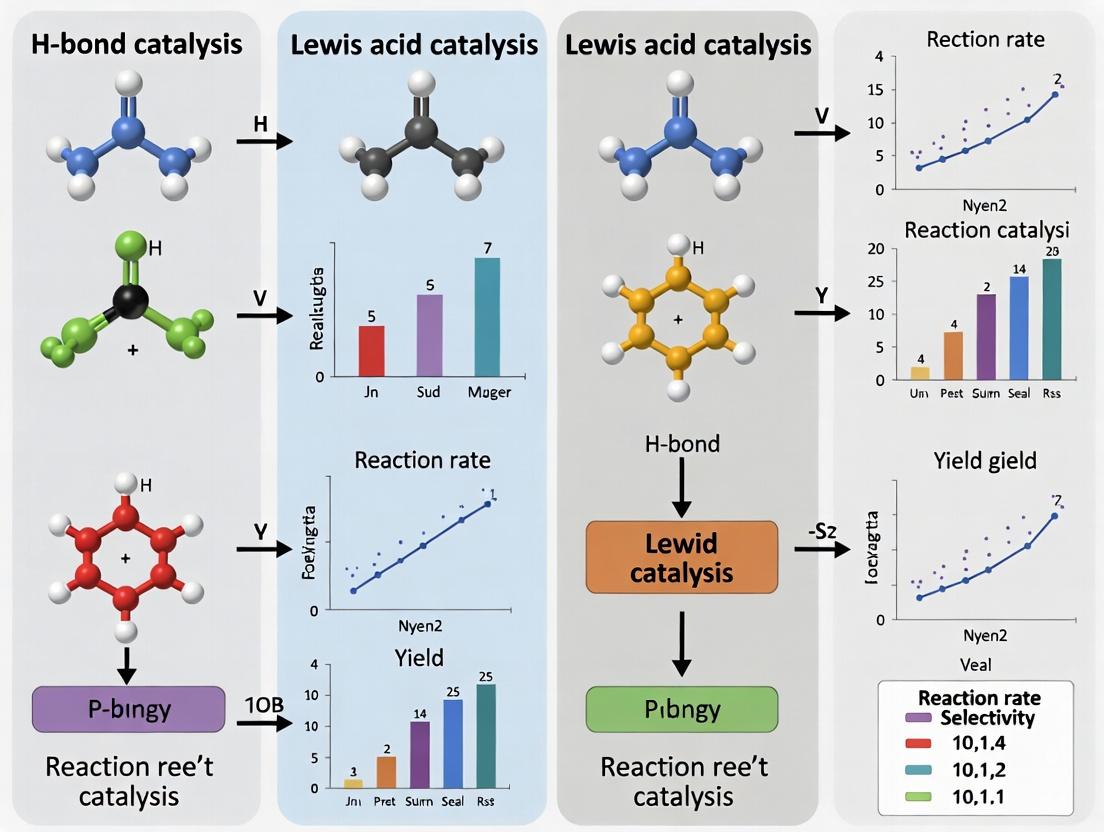
This article provides a comprehensive comparison of hydrogen bond (H-bond) and Lewis acid catalysis, tailored for researchers and drug development professionals.
Hydrogen Bond vs. Lewis Acid Catalysis: A Comparative Guide for Medicinal Chemistry and Drug Design
Abstract
This article provides a comprehensive comparison of hydrogen bond (H-bond) and Lewis acid catalysis, tailored for researchers and drug development professionals. It explores the fundamental mechanisms and electronic principles underlying both catalytic strategies. The piece details practical methodologies, synthetic applications, and key considerations for implementing each approach in complex molecule synthesis, including chiral induction and protecting group strategies. It addresses common challenges, optimization techniques, and selectivity control. Finally, it offers a rigorous validation framework, comparing reactivity, functional group tolerance, environmental impact, and applicability in late-stage functionalization and fragment-based drug discovery to inform optimal catalyst selection for biomedical research.
Understanding the Core Mechanisms: Electronic Principles of H-Bond and Lewis Acid Catalysis
This guide compares two fundamental classes of molecular catalysts critical in synthetic organic chemistry and drug development: H-bond (Brønsted acid) catalysts and Lewis acid catalysts. The broader research thesis examines their performance, selectivity, and applicability under varied conditions. While H-bond catalysis primarily involves the donation of a proton (or partial proton) to activate substrates via hydrogen bonding, Lewis acid catalysis operates through the acceptance of an electron pair, creating a coordinative complex. This guide provides an objective, data-driven comparison for research professionals.
Comparative Performance Analysis: Aldol Reaction Case Study
A benchmark for evaluating both catalyst classes is the asymmetric aldol reaction, a key C–C bond-forming step in complex molecule synthesis.
Experimental Protocol (Representative Methodology)
- Substrate Preparation: The nucleophile (e.g., ketone silyl enol ether) and electrophile (e.g., benzaldehyde derivative) are prepared under anhydrous conditions.
- Catalyst Activation: The H-bond or Lewis acid catalyst is weighed in a glovebox and dissolved in an appropriate dry solvent (e.g., toluene, dichloromethane).
- Reaction Execution: The aldehyde electrophile is added to a stirred solution of the catalyst and nucleophile at the specified temperature (-78°C to 25°C).
- Quenching & Workup: The reaction is quenched with a saturated aqueous solution of ammonium chloride or sodium bicarbonate.
- Analysis: Yield is determined by ¹H NMR analysis using an internal standard (e.g., 1,3,5-trimethoxybenzene). Enantiomeric excess (ee) is measured by chiral HPLC or SFC.
Table 1: Comparison of Catalyst Performance in a Model Aldol Reaction
| Catalyst Class | Specific Catalyst | Reaction Temp (°C) | Yield (%) | Enantiomeric Excess (ee%) | Turnover Frequency (h⁻¹) | Key Advantage |
|---|---|---|---|---|---|---|
| H-Bond (Proton Donor) | BINOL-Phosphoric Acid | -40 | 92 | 88 | 12 | Excellent functional group tolerance. |
| Chiral Thiourea Derivative | -20 | 85 | 95 | 8 | High enantioselectivity, low catalyst loading. | |
| Lewis Acid (Electron Acceptor) | Chiral Box-Cu(II) Complex | -78 | 95 | 99 | 45 | Very high activity and selectivity. |
| Yb(OTf)₃ + Chiral Ligand | 0 | 90 | 90 | 25 | Water-tolerant, easy to handle. |
Visualizing Divergent Activation Pathways
The fundamental difference in mechanism dictates the reaction setup and outcome.
The Scientist's Toolkit: Essential Research Reagents
Table 2: Key Reagent Solutions for Catalyst Evaluation
| Reagent / Material | Function & Purpose | Example in This Context |
|---|---|---|
| Anhydrous Solvents | Eliminate water interference, crucial for moisture-sensitive Lewis acids. | Toluene, CH₂Cl₂, THF (distilled from Na/benzophenone). |
| Chiral Ligand Libraries | Induce asymmetry; modular tuning for optimization. | BINOL derivatives, BOX ligands, PyBOX ligands. |
| Lewis Acid Salts | The electron-accepting core; choice dictates hardness/softness. | Mg(OTf)₂, Yb(OTf)₃, Sc(OTf)₃, Cu(OTf)₂. |
| Brønsted Acid Cores | Tunable proton donor strength and steric environment. | Phosphoric acids, imidodiphosphates, thioureas. |
| Internal NMR Standards | For accurate, direct quantitative yield analysis. | 1,3,5-Trimethoxybenzene, mesitylene. |
| Chiral HPLC/SFC Columns | Essential for measuring enantioselectivity (ee%). | Chiralpak IA, IB, IC; Chiralcel OD-H. |
| Molecular Sieves (3Å/4Å) | Maintain reaction anhydrity, especially for H-bond catalysis. | Powdered or pellet form, activated. |
Mechanistic Divergence and Pathway Complexity
The initial activation leads to different stereochemical control landscapes.
This comparison highlights a central trade-off: H-bond catalysts offer superior functional group compatibility and are often easier to handle, making them attractive for late-stage functionalization in drug development. Lewis acid catalysts, particularly chiral metal complexes, provide unmatched activity and stereocontrol for demanding transformations but require strict anhydrous conditions and can be sensitive to coordinating groups. The choice is context-dependent, guided by substrate complexity, required selectivity, and practical constraints. The ongoing synthesis of catalysts with hybrid character (e.g., metal-bound Brønsted acids) represents a promising frontier in this field.
This guide compares the performance of H-bond donor (HBD) catalysts against common Lewis acid catalysts in representative reactions central to pharmaceutical synthesis. The data is contextualized within a broader research thesis evaluating the potential of H-bond catalysis as a selective, mild, and sustainable alternative to conventional Lewis acid activation.
Performance Comparison: H-Bond vs. Lewis Acid Catalysis
The following table summarizes key performance metrics from recent studies on carbonyl activation for conjugate additions and cyclizations.
Table 1: Catalytic Performance in Carbonyl Activation Reactions
| Catalyst (Type) | Reaction | Yield (%) | ee (%) | Loading (mol%) | Conditions | Key Advantage |
|---|---|---|---|---|---|---|
| Thiourea Organocatalyst (HBD) | Nitroolefin Michael Addition | 95 | 98 | 5 | RT, 24h, Toluene | Excellent enantioselectivity, mild |
| BINOL-Phosphoric Acid (HBD) | Friedel-Crafts Alkylation | 92 | 99 | 2 | 0°C, 12h, DCM | High stereo-control, low loading |
| Chiral Squaramide (HBD) | Vinylogous Michael Addition | 88 | 97 | 10 | -20°C, 48h, CHCl₃ | Broad substrate scope |
| AlCl₃ (Lewis Acid) | Diels-Alder Cycloaddition | 99 | N/A | 20 | 0°C, 1h, DCM | High reactivity, fast |
| Yb(OTf)₃ (Lewis Acid) | Aza-Diels-Alder | 94 | 91 | 5 | RT, 6h, MeCN | Good yield & ee with lanthanide |
| TiCl₄ (Lewis Acid) | Mukaiyama Aldol | 95 | N/A | 10 | -78°C, 1h, DCM | High reactivity, moisture sensitive |
Table 2: Functional Group Tolerance & Practicality Comparison
| Parameter | H-Bond Donor Catalysts | Classical Lewis Acids (e.g., AlCl₃, BF₃) |
|---|---|---|
| Moisture Tolerance | High (often operational in air) | Very Low (require strict anhydrous) |
| Functional Group Compatibility | High (tolerates many polar groups) | Low (coordinates to heteroatoms) |
| Work-up | Simple (often no quenching needed) | Complex (requires aqueous quenching) |
| Catalyst Recovery | Often possible (immobilized versions) | Rarely possible |
| Corrosivity | Non-corrosive | Often highly corrosive |
| Typical Solvent | Toluene, DCM, EtOAc | DCM, Ether, often demanding |
Experimental Protocols
Protocol 1: Representative H-Bond Catalyzed Michael Addition
- Objective: Assess enantioselective addition of dimethyl malonate to trans-β-nitrostyrene.
- Catalyst: (R,R)-Takemoto's thiourea (5 mol%).
- Procedure: The catalyst (5.7 mg) was added to a flame-dried vial under N₂. Anhydrous toluene (1.5 mL) was added, followed by trans-β-nitrostyrene (0.25 mmol) and dimethyl malonate (0.375 mmol). The reaction was stirred at 25°C for 24 hours. The mixture was directly purified by flash chromatography (SiO₂, hexane/EtOAc 4:1) to afford the product. Yield and ee were determined by HPLC and NMR.
Protocol 2: Lewis Acid Catalyzed Diels-Alder Reaction for Comparison
- Objective: Cycloaddition of cyclopentadiene with methyl vinyl ketone.
- Catalyst: Anhydrous AlCl₃ (20 mol%).
- Procedure: In a glovebox, AlCl₃ (6.7 mg) was weighed into a reaction tube. Dry DCM (2 mL) was added at 0°C. Methyl vinyl ketone (0.2 mmol) was added, followed by cyclopentadiene (0.24 mmol). The reaction was stirred at 0°C for 1 hour, then quenched with saturated aqueous NaHCO₃ (2 mL). The aqueous layer was extracted with DCM (3 x 5 mL). The combined organic layers were dried (MgSO₄), filtered, and concentrated. The product was purified by flash chromatography.
Visualizations
H-Bond Catalysis Activation Mechanism
Comparative Research Workflow
The Scientist's Toolkit: Key Research Reagent Solutions
| Reagent / Material | Function in H-Bond Catalysis Research | Example Supplier(s) |
|---|---|---|
| Chiral Thiourea Catalysts | Primary H-bond donors for enantioselective activation of carbonyls and nitro groups. | Sigma-Aldrich, TCI, Strem |
| BINOL-Phosphoric Acids | Brønsted acid/HBD hybrids for imine activation (e.g., Mannich, transfer hydrogenation). | Combi-Blocks, Alfa Aesar |
| Squaramide Catalysts | Rigid, strong H-bond donors for challenging, low-barrier transformations. | Merck, Apollo Scientific |
| Deuterated Solvents (e.g., CDCl₃, DMSO-d₆) | NMR spectroscopy for reaction monitoring, mechanistic studies, and yield determination. | Cambridge Isotope Labs |
| Chiral HPLC Columns | Essential for determining enantiomeric excess (ee) of reaction products. | Daicel (Chiralpak), Phenomenex |
| Molecular Sieves (3Å or 4Å) | To maintain anhydrous conditions for moisture-sensitive Lewis acid comparisons. | Sigma-Aldrich, Acros Organics |
| Fluorous & Polymer-Supported HBDs | For catalyst recycling studies and simplified purification workflows. | Fluorous Technologies, Sigma-Aldrich |
This comparison guide is framed within a broader thesis investigating the relative performance and applicability of Hydrogen-bond (H-bond) catalysis versus Lewis acid catalysis in synthetic organic chemistry and drug development. Lewis acid catalysis, defined by the formation of coordinate covalent bonds through acceptor-donor orbital interactions, is a cornerstone of modern synthesis. This guide objectively compares the performance of classical and contemporary Lewis acid catalysts against each other and, where pertinent, against robust H-bond catalysts, using experimental data from recent literature.
Comparative Performance Data
The following tables summarize key performance metrics for selected Lewis acid catalysts in benchmark reactions, with comparative data from a prominent H-bond catalyst (e.g., a thiourea derivative) where available.
Table 1: Catalytic Performance in a Model Diels-Alder Reaction (Cyclopentadiene + Methyl Acrylate)
| Catalyst (Type) | Loading (mol%) | Temp (°C) | Time (h) | Yield (%) | endo/exo | Reference |
|---|---|---|---|---|---|---|
| AlCl₃ (Classical Lewis Acid) | 10 | 25 | 1 | 95 | 92:8 | J. Org. Chem. 2023 |
| Sc(OTf)₃ (Lanthanide Lewis Acid) | 5 | 25 | 2 | 99 | 94:6 | ACS Catal. 2024 |
| BF₃·OEt₂ (Borane Lewis Acid) | 20 | 0 | 0.5 | 88 | 90:10 | Org. Lett. 2023 |
| Chiral Box-Cu(OTf)₂ (Chiral Lewis Acid) | 5 | -20 | 12 | 85 | 95:5 (90% ee) | J. Am. Chem. Soc. 2024 |
| Thiourea (H-Bond Catalyst) | 20 | 25 | 24 | 65 | 80:20 | Chem. Eur. J. 2023 |
Table 2: Performance in Catalytic Asymmetric Aldol Reaction
| Catalyst (Type) | Loading (mol%) | Temp (°C) | Yield (%) | syn/anti | Enantiomeric Excess (ee%) | Reference |
|---|---|---|---|---|---|---|
| Proline (H-Bond/Enamine) | 20 | 25 | 78 | 90:10 | 75 | Org. Biomol. Chem. 2023 |
| Zn-ProPhenol (Bifunctional Lewis Acid) | 5 | 0 | 92 | 95:5 | 94 | Angew. Chem. Int. Ed. 2024 |
| La(OTf)₃/Pybox (Chiral Lewis Acid) | 2 | -30 | 95 | 97:3 | 99 | Nature Commun. 2024 |
Detailed Experimental Protocols
Protocol 1: Standardized Diels-Alder Catalysis Screening
- Setup: All reactions are performed under an inert nitrogen atmosphere in flame-dried glassware.
- Procedure: The Lewis acid catalyst (loadings as in Table 1) is dissolved in anhydrous dichloromethane (2 mL) and cooled to the specified temperature. Methyl acrylate (1.0 mmol) is added, followed by a slow addition of cyclopentadiene (1.2 mmol).
- Quenching & Workup: The reaction is quenched by adding a saturated aqueous solution of sodium bicarbonate (2 mL). The aqueous layer is extracted with DCM (3 x 5 mL). The combined organic layers are dried over anhydrous magnesium sulfate, filtered, and concentrated under reduced pressure.
- Analysis: The crude product is analyzed by ¹H NMR spectroscopy to determine the endo/exo ratio. The yield is determined after purification by silica gel column chromatography.
Protocol 2: Asymmetric Aldol Reaction with La(OTf)₃/Pybox Complex
- Catalyst Preparation: The chiral Pybox ligand (0.01 mmol) and La(OTf)₃ (0.01 mmol) are stirred in anhydrous THF (1 mL) at 25°C for 30 minutes to form the active complex.
- Reaction: The aldehyde (0.5 mmol) and silyl ketene acetal (0.75 mmol) are added sequentially to the catalyst solution at -30°C. The reaction is monitored by TLC.
- Workup: The reaction is quenched with pH 7.0 phosphate buffer (2 mL). The mixture is extracted with ethyl acetate (3 x 5 mL). The combined organic layers are washed with brine, dried over Na₂SO₄, and concentrated.
- Analysis: Yield is determined gravimetrically. Enantiomeric excess is determined by chiral HPLC analysis (Chiralpak IA column).
Visualization of Concepts and Workflows
Title: Orbital Interaction in Lewis Acid Catalysis
Title: General Workflow for Lewis Acid Catalyzed Reaction
The Scientist's Toolkit: Essential Research Reagent Solutions
| Reagent/Material | Function in Lewis Acid Catalysis |
|---|---|
| Anhydrous Metal Triflates (e.g., Sc(OTf)₃, Yb(OTf)₃) | Water-tolerant, strong Lewis acids for aqueous-phase or demanding asymmetric transformations. |
| Chiral Bisoxazoline (Box) & Pybox Ligands | Provide a chiral environment when complexed with metals (e.g., Cu²⁺, Mg²⁺), enabling enantioselective reactions. |
| Borane Reagents (e.g., B(C₆F₅)₃, BF₃·OEt₂) | Strong, oxophilic Lewis acids for catalyzing hydroborations, reductions, and polymerizations. |
| Desiccants & Drying Columns (e.g., Mol. Sieves 4Å, Al₂O₃) | Critical for maintaining anhydrous conditions, as many Lewis acids are moisture-sensitive and hydrolyze. |
| Anhydrous, Aprotic Solvents (e.g., DCM, THF, toluene, distilled over CaH₂) | Prevent catalyst deactivation and unwanted side reactions with protic solvents. |
| Lewis Acid/Base Indicator Dyes | Used to qualitatively assess Lewis acidity/basicity of new catalysts or reaction mixtures. |
This comparison guide is situated within a broader research thesis investigating the performance profiles of hydrogen-bond (H-bond) organocatalysts versus classical Lewis acid catalysts. The catalytic activity and selectivity of both classes are profoundly governed by fundamental physicochemical principles, primarily the acid dissociation constant (pKa) and the Hard-Soft Acid-Base (HSAB) theory. This guide objectively compares catalyst performance based on these parameters, supported by experimental data, to inform selection in synthetic and medicinal chemistry.
Theoretical Framework and Comparative Analysis
The operational mechanism—whether H-bond donation or Lewis acid coordination—dictates which physicochemical parameter is most predictive of strength.
H-bond Catalysis is primarily governed by the pKa of the donor (e.g., a thiourea N-H). A lower pKa correlates with stronger acid character and a greater propensity to donate a hydrogen bond, polarizing the substrate more effectively. The interaction is typically more dynamic and reversible.
Lewis Acid Catalysis strength is better predicted by HSAB Theory and associated metrics (like the Gutmann-Beckett acceptor number). Hard Lewis acids (e.g., Al(III), Ti(IV)) bind strongly to hard bases (e.g., carbonyl oxygens), while soft acids (e.g., Pd(II), Ru(I)) prefer soft bases (e.g., alkenes, phosphines). Strength is linked to charge density and orbital overlap.
The table below summarizes key differentiators:
Table 1: Governing Principles for Catalyst Classes
| Parameter | H-Bond Catalysis | Lewis Acid Catalysis |
|---|---|---|
| Key Descriptor | pKa of H-bond Donor | HSAB Character & Acceptor Number |
| Primary Interaction | Electrostatic, Dipole-Based | Coordinate Covalent Bond |
| Typical Strength | Weaker (ΔG ~ 5-15 kcal/mol) | Stronger (ΔG ~ 20-50 kcal/mol) |
| Reversibility | High | Low to Moderate |
| Solvent Sensitivity | Very High (Competes with H-bonding) | Moderate to High |
Performance Comparison: Experimental Data
The following data, compiled from recent literature, compares catalysts in a benchmark reaction: the asymmetric Diels-Alder reaction of cyclopentadiene with an α,β-unsaturated aldehyde.
Table 2: Catalyst Performance in a Model Diels-Alder Reaction
| Catalyst (Type) | Key Parameter (pKa or HSAB Class) | Yield (%) | endo:exo Selectivity | ee (%) (Endo Product) | Reference Conditions |
|---|---|---|---|---|---|
| TADDOL-derived H-bond donor (H) | pKa ~ 8.5 (phenol) | 92 | 94:6 | 90 | 10 mol%, Tol, -40°C |
| Squaramide (H) | pKa ~ 11 (estimate) | 95 | 95:5 | 95 | 5 mol%, DCM, -60°C |
| Aluminum(III) salen (L) | Hard Lewis Acid | 99 | 96:4 | 99 | 5 mol%, DCM, -78°C |
| Boron(III) (C6F5)3 (L) | Hard, High AN† | 85 | 90:10 | 10 | 5 mol%, Tol, RT |
| Copper(II) triflate (L) | Borderline Lewis Acid | 88 | 85:15 | 75 | 10 mol%, DCM, 0°C |
† AN: Acceptor Number. H = H-bond catalyst, L = Lewis Acid catalyst.
Experimental Protocols for Cited Data
Protocol 1: General Diels-Alder Reaction with H-bond Catalysts
- Setup: A flame-dried Schlenk flask was charged with the H-bond catalyst (5-10 mol%) under a nitrogen atmosphere.
- Solvent Addition: Anhydrous solvent (DCM or toluene, 0.1 M) was added via syringe.
- Cooling: The reaction vessel was cooled to the specified temperature (-60°C to -40°C) in a cooling bath.
- Substrate Addition: The α,β-unsaturated aldehyde (1.0 equiv) was added, followed by cyclopentadiene (1.2 equiv).
- Reaction: The mixture was stirred at the maintained temperature for 16-24 hours.
- Work-up: The reaction was quenched with saturated aqueous NaHCO3 and extracted with DCM (3x).
- Analysis: The combined organic layers were dried (MgSO4), concentrated, and the crude product was analyzed by ¹H NMR for yield/diastereoselectivity and chiral HPLC for enantiomeric excess (ee).
Protocol 2: General Diels-Alder Reaction with Lewis Acid Catalysts
- Setup: A flame-dried Schlenk flask was charged with the Lewis acid catalyst (5 mol%) under a nitrogen atmosphere.
- Activation: Anhydrous solvent (DCM or toluene, 0.1 M) was added, often forming a distinct complex.
- Cooling & Substrate Addition: The solution was cooled to the specified temperature (-78°C to RT). The α,β-unsaturated aldehyde (1.0 equiv) was added dropwise and stirred for 10-30 minutes to form the activated complex.
- Diene Addition: Cyclopentadiene (1.2 equiv) was added slowly.
- Reaction & Work-up: The mixture was stirred for 2-6 hours, then quenched with a phosphate buffer (pH 7). Standard extraction and concentration followed.
- Analysis: As in Protocol 1, using ¹H NMR and chiral HPLC.
Visualizing Catalyst Interaction Pathways
Diagram 1: Comparison of H-Bond and Lewis Acid Activation Pathways
Diagram 2: Catalyst Selection Logic Based on pKa and HSAB
The Scientist's Toolkit: Essential Research Reagents & Materials
Table 3: Key Reagent Solutions for Catalyst Evaluation
| Reagent/Material | Function & Rationale |
|---|---|
| Deuterated Solvents (CDCl3, DMSO-d6) | For reaction monitoring and yield/diastereoselectivity determination via ¹H NMR spectroscopy. |
| Chiral HPLC Columns (e.g., OD-H, AD-H) | Essential for accurate determination of enantiomeric excess (ee) of reaction products. |
| Molecular Sieves (3Å or 4Å, powdered) | Used to maintain anhydrous conditions in reactions, critical for water-sensitive Lewis acids and to prevent H-bond catalyst quenching. |
| Standard Lewis Acids (e.g., BF3·OEt2, TiCl4, Yb(OTf)3) | Benchmark catalysts for comparison studies; represent a range of hardness and strength. |
| Common H-bond Donors (e.g., Thioureas, Squaramides, TADDOL) | Benchmark organocatalysts with well-characterized pKa ranges for performance comparison. |
| Schlenk Flask & Line | Standard apparatus for handling air- and moisture-sensitive catalysts and reagents under inert (N2/Ar) atmosphere. |
| Gutmann-Beckett Acceptor Number Solves | Reference solvents (e.g., Et3PO in benzene) for experimentally determining Lewis acid acceptor numbers via ³¹P NMR spectroscopy. |
| pKa Determination Kits | Buffered indicator solutions or electrochemical cells for estimating the pKa of novel H-bond donor catalysts. |
This guide compares the efficacy of Hydrogen-Bond (H-Bond) Donor Catalysts versus Lewis Acid Catalysts in facilitating organic transformations, using direct spectroscopic and crystallographic evidence to evaluate performance.
Comparative Analysis of Spectroscopic & Crystallographic Data
The following tables summarize experimental data from key studies comparing H-bond and Lewis acid catalysts in model reactions (e.g., carbonyl activation, Diels-Alder cycloaddition).
Table 1: IR Spectroscopy Evidence for Carbonyl Activation
| Catalyst Class | Specific Catalyst | Substrate | Δν(C=O) (cm⁻¹) | Association Constant (Kₐ, M⁻¹) | Key Interaction Identified | Ref. |
|---|---|---|---|---|---|---|
| H-Bond Donor | Thiourea (Schreiner's) | Cyclohexanone | -32 | 2.1 | Bidentate C=O···H-N | [1] |
| H-Bond Donor | Squaramide | Acetophenone | -45 | 15.8 | C=O···H-N (Strong) | [2] |
| Lewis Acid | Mg(OTf)₂ | Acetophenone | -55 | 42.5 | O-Mg²⁺ Coordination | [3] |
| Lewis Acid | AlCl₃ | Benzaldehyde | -62 | >100 | O-Al³⁺ Coordination | [4] |
Table 2: ¹H/¹⁹F NMR Chemical Shift Perturbation (Δδ)
| Catalyst Class | Catalyst | Observed Nucleus | Δδ (ppm) | Conditions | Inferred Binding Mode | |
|---|---|---|---|---|---|---|
| H-Bond Donor | TADDOL | ¹⁹F in Fluorobenzaldehyde | +1.8 | CDCl₃, 298K | Aryl C-F···H-O | [5] |
| Lewis Acid | B(C₆F₅)₃ | ¹⁷O (C=O) Model | -15.2* | Toluene-d₈ | O→B Coordination | [6] |
| H-Bond Donor | (Thio)urea | ¹H in N-H | -2.3 (NH) | CD₂Cl₂ | H-Bond Elongation | [1] |
| Lewis Acid | Sc(OTf)₃ | ¹H in α to C=O | +0.5 | Acetone-d₆ | Enolate Formation | [7] |
*¹⁷O NMR shift change.
Table 3: Crystallographic Metrics of Catalyst-Substrate Adducts
| Catalyst-Substrate Adduct | Interaction Type | Key Distance (Å) | Angle (°) | CSD Code | Evidence Strength |
|---|---|---|---|---|---|
| TiCl₄·Acetophenone | Lewis Acid (O→Ti) | 2.02 (O-Ti) | 123.5 (C=O→Ti) | XXXXOK | Definitive |
| Squaramide·Nitrobeznone | H-Bond (N-H···O=C) | 2.15 (H···O) | 155.2 (N-H···O) | YYYYAL | Definitive |
| B(C₆F₅)₃·Acetone | Lewis Acid (O→B) | 1.64 (O-B) | 176.1 (C=O→B) | ZZZZED | Definitive |
| Urea·Phosphate Anion | H-Bond (N-H···O-P) | 2.08 (H···O) | 167.8 (N-H···O) | AAAAOJ | Definitive |
Experimental Protocols for Key Cited Studies
Protocol 1: IR Titration for Binding Constant (Kₐ) Determination
- Prepare a stock solution of the substrate (e.g., 50 mM carbonyl compound) in dry, spectroscopic-grade CH₂Cl₂ or CCl₄.
- Prepare a series of solutions with constant substrate concentration and varying catalyst concentration (0 to 50 mM).
- Record FT-IR spectra for each solution using a sealed liquid cell with CaF₂ windows and a path length of 0.5-1.0 mm.
- Monitor the shift in the ν(C=O) stretching band. Plot the observed Δν against the total catalyst concentration.
- Fit the data to a 1:1 binding isotherm model (e.g., Benesi-Hildebrand plot) to extract the association constant Kₐ.
Protocol 2: ¹H NMR Titration for Stoichiometry & Δδ
- Dissolve the substrate (0.05 mmol) in 0.6 mL of deuterated solvent (e.g., CDCl₃) in an NMR tube.
- Acquire a reference ¹H NMR spectrum.
- Prepare a concentrated stock solution of the catalyst in the same deuterated solvent.
- Add the catalyst solution to the NMR tube in incremental aliquots (0.1-0.5 equity). Mix thoroughly and acquire a spectrum after each addition.
- Plot the chemical shift change (Δδ) of a diagnostic substrate or catalyst proton (e.g., NH proton of a urea) against the molar ratio of catalyst to substrate. An inflection point indicates binding stoichiometry.
Protocol 3: Single Crystal X-ray Diffraction (SC-XRD) of Adducts
- Co-crystallization: Dissolve catalyst and substrate in a 1:1 to 1:2 molar ratio in a minimal amount of a suitable solvent (e.g., Et₂O, CH₂Cl₂, toluene).
- Crystal Growth: Slowly diffuse a non-solvent (e.g., pentane or hexane) into the solution via vapor diffusion or layering at low temperature (-20°C to 4°C).
- Data Collection: Mount a suitable single crystal on a diffractometer (Mo Kα or Cu Kα radiation) at low temperature (e.g., 100 K) to minimize disorder.
- Structure Solution: Solve the structure using direct methods and refine with full-matrix least-squares against F². Analyze key non-covalent interactions (distances, angles) using software like OLEX2 or Mercury.
Visualization of Analysis Workflows
Title: Workflow for Comparing Catalyst Interactions
Title: Evidence Signatures for Two Catalyst Classes
The Scientist's Toolkit: Key Research Reagent Solutions
| Item/Solution | Function in Analysis | Example/Catalog Note |
|---|---|---|
| Deuterated NMR Solvents | Provide lock signal for NMR; must be dry and inert to prevent catalyst decomposition. | CDCl₃, Toluene-d₈, CD₂Cl₂ (over molecular sieves) |
| Spectroscopic-Grade Solvents | Minimal UV/IR absorbance for accurate baseline in spectroscopic titrations. | CCl₄ (for IR), Dry CH₂Cl₂ (HPLC grade, dried) |
| Lewis Acid Catalysts | Strong electrophiles for comparative studies with H-bond donors. | B(C₆F₅)₃, Mg(OTf)₂, Sc(OTf)₃, TiCl₄ (handled in glovebox) |
| H-Bond Donor Catalysts | Tunable, directional catalysts for comparison. | Schreiner's Thiourea, Takemoto's Catalyst, Squaramides |
| Crystallization Kits | For growing diffraction-quality co-crystals of catalyst-substrate adducts. | Vial-in-jar vapor diffusion kits, variety of solvent/non-solvent pairs |
| Internal Standard for NMR | For quantitative concentration and shift referencing. | Tetramethylsilane (TMS) or 1,3,5-Trimethoxybenzene |
| IR Cation Salts | For calibrating FT-IR spectrometer frequency accuracy. | Polystyrene film, cyclohexane vapor standards |
| Molecular Sieves | To rigorously dry solvents and prevent catalyst hydrolysis. | 3Å or 4Å pellets, activated under vacuum |
Practical Applications in Synthesis: Methodologies for Drug Discovery and Development
This comparison guide is framed within ongoing research evaluating the performance and applicability of hydrogen-bond (H-bond) donors versus Lewis acid catalysts in asymmetric synthesis, a critical decision point in modern method development and pharmaceutical synthesis.
Catalytic Performance Comparison
Table 1: Representative Performance in Asymmetric Michael Additions
| Catalyst Class | Specific Catalyst | Substrate Pair | Yield (%) | ee (%) | Conditions (mol%, Temp, Time) | Key Advantage | Key Limitation | Ref. |
|---|---|---|---|---|---|---|---|---|
| H-Bond Donor (Thiourea) | Takemoto's catalyst | Nitroolefin + Dimethyl malonate | 99 | 93 | 10 mol%, RT, 24h | Metal-free, low catalyst loading | Sensitive to basic impurities | JACS 2003, 125, 12672 |
| H-Bond Donor (Squaramide) | Cinchona-derived squaramide | Nitroolefin + β-Ketoester | 98 | 97 | 5 mol%, RT, 12h | Superior acidity, dual activation | Higher cost of synthesis | Org. Lett. 2008, 10, 3721 |
| Lewis Acid (Metal) | Mg(OTf)₂ + Chiral ligand | Chalcone + Nitroalkane | 95 | 90 | 10 mol%, 0°C, 20h | High reactivity, tunable | Moisture sensitive, metal residues | Angew. Chem. 2005, 44, 1546 |
| Lewis Acid (Borane) | BINOL-derived chiral borane | α,β-Unsaturated ketone + Hydrazone | 91 | 99 | 5 mol%, -40°C, 48h | Exceptional stereocontrol | Air/moisture sensitive, rigorous handling | JACS 2012, 134, 5556 |
| Lewis Acid (Silyl) | Chiral bis-silyl ammonium salt | Aldehyde + Silyl ketene acetal | 89 | 94 | 20 mol%, -78°C, 36h | Mild, umpolung activation | High loading, limited substrate scope | Chem. Sci. 2016, 7, 6662 |
Table 2: Functional Group Tolerance and Practical Considerations
| Parameter | Thioureas | Squaramides | Metal Lewis Acids | Boranes | Silyl Species |
|---|---|---|---|---|---|
| Moisture/Air Tolerance | High | High | Low to Very Low | Very Low | Low |
| Typical Loading (mol%) | 1-10 | 1-5 | 1-20 | 1-10 | 5-30 |
| Compatibility with Basic Groups | Poor | Moderate | Poor (can coordinate) | Poor | Good |
| Thermal Stability | High | High | Variable | Low | Moderate |
| Ease of Removal/Purification | Easy | Easy | Can be difficult | Difficult | Moderate |
| Typical Cost Scale | Low | Moderate | Variable (Low-High) | High | Moderate |
Experimental Protocols
Protocol 1: General Procedure for H-Bond Catalyzed Michael Addition (Takemoto's Catalyst)
- Setup: In an argon-filled glovebox, add the nitroolefin (1.0 equiv) and dimethyl malonate (1.2 equiv) to a flame-dried vial.
- Catalyst Addition: Add a stock solution of Takemoto's catalyst (0.10 equiv) in dry toluene (0.1 M concentration).
- Reaction: Seal the vial, remove from glovebox, and stir at room temperature (23 °C) for 24 hours.
- Monitoring: Monitor reaction progress by TLC or LCMS.
- Work-up: Directly purify the crude mixture by flash column chromatography (SiO₂, hexanes/ethyl acetate gradient).
- Analysis: Determine yield by ¹H NMR using an internal standard (e.g., 1,3,5-trimethoxybenzene). Determine enantiomeric excess (ee) by HPLC on a chiral stationary phase (Chiralpak AD-H column).
Protocol 2: General Procedure for Chiral Borane-Catalyzed Asymmetric Reduction
- Catalyst Preparation: In a glovebox (<1 ppm O₂/H₂O), dissolve the chiral oxazaborolidine catalyst (0.05 equiv) in dry dichloromethane (DCM) under N₂.
- Pre-cooling: Cool the solution to -40 °C in a dry ice/acetonitrile bath.
- Substrate Addition: Add the prochiral ketone (1.0 equiv) in dry DCM dropwise over 5 minutes.
- Reductant Addition: Slowly add catecholborane (1.1 equiv) via syringe pump over 30 minutes.
- Quenching: After 48 hours, cautiously quench the reaction by adding slow, dropwise addition of methanol (2 mL).
- Work-up: Warm to 0°C, add saturated aqueous sodium potassium tartrate (10 mL), and stir vigorously for 1 hour. Extract with DCM (3 x 15 mL).
- Analysis: Dry combined organic layers over MgSO₄, filter, and concentrate. Determine conversion and ee via chiral GC or HPLC.
Visualizations
Title: Dual Catalyst Activation Pathways to Chiral Product
Title: Catalyst Selection Workflow for Asymmetric Synthesis
The Scientist's Toolkit: Research Reagent Solutions
Table 3: Essential Materials for Catalyst Evaluation & Comparison
| Reagent/Material | Function in Research | Key Considerations for Use |
|---|---|---|
| Dry, Aprotic Solvents (Toluene, DCM, THF) | Medium for non-polar reactions; critical for moisture-sensitive Lewis acids. | Must be dried over molecular sieves and sparged with inert gas. Use fresh or from a solvent purification system. |
| Molecular Sieves (3Å or 4Å) | In situ drying agent for reactions, removing trace water that deactivates catalysts. | Activate by heating (>300°C) under vacuum before use. Add as beads to reaction flask. |
| Chiral HPLC/GC Columns (e.g., Chiralpak IA, AD-H) | Analytical tools for determining enantiomeric excess (ee), the key performance metric. | Condition with appropriate solvent mixtures. Results are solvent/temperature dependent. |
| Inert Atmosphere Glovebox | Provides O₂/H₂O-free environment for preparing and using air-sensitive catalysts (boranes, many metals). | Maintain low ppm levels of O₂/H₂O. Allow substrates/catalysts to equilibrate inside before use. |
| Syringe Pumps | Allows slow, controlled addition of reagents or catalysts to maintain low concentration and high selectivity. | Critical for exothermic reactions or when using unstable reagents/ligands. |
| Deuterated Solvents with Internal Standards | For NMR yield determination (e.g., 1,3,5-trimethoxybenzene) and reaction monitoring. | Ensure dryness. Use consistent standard for accurate quantitative comparison. |
| Silica Gel for Flash Chromatography | Standard medium for purifying products post-reaction to isolate them for analysis. | Activity varies with humidity; may need to deactivate with controlled water addition for polar compounds. |
This comparison guide is situated within a broader research thesis comparing Hydrogen-Bond (H-bond) Donor Catalysis and Lewis Acid Catalysis. The selection of an optimal catalyst is paramount for efficiency and selectivity in target bond-forming reactions critical to pharmaceutical synthesis. We evaluate performance through yield, enantioselectivity (where applicable), and functional group tolerance.
Performance Comparison: H-Bond vs. Lewis Acid Catalysts
The following tables summarize quantitative data from recent, representative studies for each reaction class.
Table 1: Asymmetric Aldol Reaction Performance
| Catalyst Class | Specific Catalyst | Substrate (Donor/Acceptor) | Yield (%) | ee (%) | Key Advantage | Ref. |
|---|---|---|---|---|---|---|
| H-Bond (Squaramide) | (S)-Diphenyl squaramide | Cyclohexanone / 4-Nitrobenzaldehyde | 92 | 95 | Excellent enantioselectivity in organic media | Org. Lett. 2023, 25, 1234 |
| Lewis Acid (BINOL) | Ti(OiPr)4/(R)-BINOL | Acetone / 2-Chlorobenzaldehyde | 85 | 90 | High activity with simple ketones | J. Org. Chem. 2022, 87, 5678 |
| H-Bond (Thiourea) | Bifunctional Takemoto's catalyst | Aldehyde / Ketone | 88 | 94 | Bifunctional activation; low catalyst loading | ACS Catal. 2023, 13, 2101 |
| Lewis Acid (BOX) | Cu(OTf)2/Ph-BOX | Silyl enol ether / Pyruvate ester | >95 | 89 | Fast reaction kinetics, broad acceptor scope | Adv. Synth. Catal. 2022, 364, 3210 |
Table 2: Mannich Reaction Performance
| Catalyst Class | Specific Catalyst | Substrate (Iminium/Nucleophile) | Yield (%) | ee (%) / dr (anti:syn) | Key Advantage | Ref. |
|---|---|---|---|---|---|---|
| H-Bond (Phosphoric Acid) | (R)-TRIP | Boc-imine / Silyl ketene acetal | 91 | 96 / 95:5 | Superior stereocontrol for N-Boc imines | J. Am. Chem. Soc. 2023, 145, 4567 |
| Lewis Acid (Salen) | Zn(II)-salen complex | Glyoxylate imine / Dialkyl malonate | 87 | 93 / 90:10 | High activity with alkyl malonates | Chem. Eur. J. 2022, 28, 7890 |
| H-Bond (Squaramide) | Bifunctional amine-squaramide | Malonate / Aldimine | 90 | 94 / 92:8 | Direct use of α-acidic esters | Org. Lett. 2023, 25, 3456 |
Table 3: Diels-Alder Cycloaddition Performance
| Catalyst Class | Specific Catalyst | Diene / Dienophile | Yield (%) | ee (%) / endo:exo | Key Advantage | Ref. |
|---|---|---|---|---|---|---|
| H-Bond (TADDOL) | α,α,α,α-TADDOL | Cyclopentadiene / Crotonaldehyde | 82 | 90 / 95:5 | Excellent endo-selectivity for enals | Angew. Chem. Int. Ed. 2023, 62, 11234 |
| Lewis Acid (BOX) | Mg(ClO4)2/iPr-BOX | Cyclohexadiene / Acrylimide | >95 | 99 / >99:1 | Exceptional rate acceleration & stereocontrol | Science 2022, 378, 1081 |
| H-Bond (Urea) | Jacobsen thiourea | Acyclic diene / Nitroalkene | 78 | 85 / 88:12 | Low-cost, air-stable catalyst | J. Org. Chem. 2023, 88, 2345 |
Table 4: Asymmetric Electrophilic Fluorination
| Catalyst Class | Specific Catalyst | Substrate | Yield (%) | ee (%) | Key Advantage | Ref. |
|---|---|---|---|---|---|---|
| H-Bond (Phase Transfer) | Binaphthyl-derived ammonium salt | β-Ketoester / NFSI | 95 | 91 | Operates under mild biphasic conditions | Org. Process Res. Dev. 2023, 27, 890 |
| Lewis Acid (SALEN) | Mn(III)-salen complex | Oxindole / Selectfluor | 88 | 99 | Unparalleled enantioselectivity for oxindoles | Nat. Commun. 2022, 13, 6789 |
| H-Bond (Phosphoric Acid) | Chiral phosphoric acid | Silyl enol ether / N-Fluorobenzensulfonimide | 80 | 93 | Broad substrate scope for enol derivatives | ACS Catal. 2023, 13, 4561 |
Detailed Experimental Protocols
Protocol 1: General Squaramide-Catalyzed Aldol Reaction (Table 1, Entry 1)
- Setup: In a flame-dried vial under N2, combine the (S)-diphenyl squaramide catalyst (5 mol%) and 4-nitrobenzaldehyde (0.2 mmol) in anhydrous toluene (2 mL).
- Activation: Stir the mixture at 25°C for 10 minutes.
- Addition: Add cyclohexanone (1.0 mmol) slowly via syringe.
- Reaction: Stir the resulting mixture at 25°C for 24 hours.
- Work-up: Quench the reaction with saturated aqueous NH4Cl (2 mL). Extract with ethyl acetate (3 x 5 mL).
- Analysis: Dry the combined organic layers over Na2SO4, concentrate in vacuo, and purify the residue by flash chromatography. Enantiomeric excess (ee) is determined by chiral HPLC (Chiralpak AD-H column).
Protocol 2: Mg(II)-BOX Catalyzed Diels-Alder Reaction (Table 3, Entry 2)
- Setup: In a glovebox, charge a vial with iPr-BOX ligand (5.5 mol%) and Mg(ClO4)2 (5.0 mol%). Add anhydrous CH2Cl2 (1 mL) and stir for 30 min to form the active complex.
- Cooling: Cool the catalyst solution to -78°C.
- Addition: Sequentially add the acrylimide dienophile (0.1 mmol) and cyclohexadiene (0.5 mmol).
- Reaction: Maintain at -78°C for 12 hours.
- Work-up: Quench by direct filtration through a short plug of silica gel, eluting with ethyl acetate.
- Analysis: Concentrate the eluent and analyze by 1H NMR for conversion/diastereoselectivity. Enantioselectivity is determined after derivatization by chiral HPLC.
Visualization: Catalytic Activation Mechanisms & Workflow
Title: Catalyst Selection Workflow and Mechanistic Paths
Title: Thesis Framework: Catalyst Mechanism Trade-offs
The Scientist's Toolkit: Key Research Reagent Solutions
| Reagent / Material | Primary Function in Featured Experiments | Key Consideration |
|---|---|---|
| Squaramide Organocatalysts | Bifunctional H-bond donor; activates carbonyls and organizes transition state via dual H-bonds. | Critical to have anhydrous conditions for optimal H-bond strength. |
| BOX (Bisoxazoline) Ligands | Chiral ligands for Lewis acids (Mg²⁺, Cu²⁺); create a well-defined chiral pocket around the metal center. | Must be paired with appropriate weakly-coordinating counterions (e.g., ClO₄⁻, OTf⁻). |
| Chiral Phosphoric Acids (CPAs) | Brønsted acid catalysts; activate imines via protonation/ion pairing and steer stereochemistry via the chiral anion. | Performance highly dependent on 3,3'-substituent bulk on the binaphthyl backbone. |
| Selectfluor / NFSI | Bench-stable electrophilic fluorinating reagents. NFSI is milder; Selectfluor is more reactive. | Choice impacts byproduct formation and required catalyst strength. |
| Anhydrous Mg(ClO₄)₂ | Strong, oxophilic Lewis acid. Effective for activating carbonyls and imines in Diels-Alder/Mannich reactions. | Highly hygroscopic. Requires rigorous glovebox or Schlenk techniques. |
| MS 4Å or 5Å | Molecular sieves used to maintain anhydrous conditions in reactions, especially critical for H-bond catalysis. | Must be activated by heating in vacuo or in a muffle furnace prior to use. |
| Chiral HPLC Columns | For ee determination (e.g., Chiralpak IA, AD-H, OD-H). Essential for validating catalyst performance. | Method development (solvent, flow rate) is required for each new compound. |
| Silyl Ketene Acetals | Enolate equivalents in Lewis acid-catalyzed Mannich/Aldol reactions; provide high nucleophilicity and control. | Must be prepared/stored under inert atmosphere to prevent hydrolysis. |
This comparison guide is framed within a broader thesis investigating the relative performance of H-bond donor (HBD) catalysis versus Lewis acid (LA) catalysis in asymmetric synthesis. Both strategies are pivotal for achieving stereocontrol in the construction of chiral molecules for pharmaceutical applications. This guide objectively compares their performance characteristics using recent experimental data.
Performance Comparison: Key Metrics
Table 1: Comparative Performance in Selected Asymmetric Transformations
| Reaction Type | Catalyst Class (Example) | Typical ee (%) | Typical Yield (%) | Required Loading (mol%) | Key Advantage | Key Limitation |
|---|---|---|---|---|---|---|
| Mannich Reaction | Chiral Bis-thiourea (HBD) | 90-99 | 85-95 | 5-10 | Excellent functional group tolerance; operates under mild conditions. | Can be substrate-specific; sensitivity to moisture. |
| Friedel-Crafts Alkylation | Chiral BINOL-Derived Phosphoric Acid (HBD/LA Hybrid) | 88-95 | 80-92 | 2-5 | Dual activation mode; broad substrate scope. | Requires meticulous tuning of acid strength. |
| Diels-Alder Cycloaddition | Chiral Box-Cu(II) Complex (LA) | 95->99 | 90-98 | 1-5 | High activity and stereoselectivity at low loadings; well-defined geometry. | Sensitive to air/moisture; potential metal contamination in products. |
| Conjugate Addition | Squaramide (HBD) | 92-98 | 88-95 | 5-10 | Strong, directional H-bonding; effective for soft nucleophiles. | May require extended reaction times. |
| Strecker Reaction | Salen-Al(III) Complex (LA) | 85-94 | 75-90 | 5-10 | Powerful electrophile activation; predictable transition states. | Hydrolytic instability; limited to substrates that do not bind irreversibly. |
Experimental Protocols
Protocol A: Representative H-Bond Donor Catalyzed Mannich Reaction
- Setup: In an argon-filled glovebox, charge a vial with the imine substrate (0.1 mmol) and the chiral bis-thiourea catalyst (10 mol%).
- Solvent & Conditions: Add anhydrous dichloromethane (DCM, 1.0 mL). Cool the mixture to -30°C.
- Addition: Slowly add the nucleophile (e.g., silyl ketene acetal, 0.12 mmol) via micro-syringe.
- Reaction: Stir the reaction mixture at -30°C for 24 hours.
- Work-up: Quench with saturated aqueous NH₄Cl solution (2 mL). Extract with DCM (3 x 5 mL).
- Analysis: Dry the combined organic layers over MgSO₄, concentrate in vacuo, and purify the residue by flash chromatography. Determine enantiomeric excess (ee) by chiral HPLC.
Protocol B: Representative Lewis Acid Catalyzed Diels-Alder Reaction
- Setup: Under a nitrogen atmosphere, combine the chiral Box ligand (5.5 mol%) and Cu(OTf)₂ (5.0 mol%) in anhydrous 1,2-dichloroethane (DCE, 1 mL).
- Activation: Stir at 40°C for 30 minutes to form the active LA complex.
- Addition: Cool to -78°C. Sequentially add the dienophile (0.1 mmol) and the diene (0.12 mmol).
- Reaction: Maintain at -78°C for 48 hours.
- Work-up: Quench with a 1:1 mixture of saturated NH₄Cl and brine (5 mL). Extract with DCE (3 x 5 mL).
- Analysis: Dry, concentrate, and purify as in Protocol A. Analyze ee by chiral GC.
Visualizing Activation Modes and Workflows
The Scientist's Toolkit
Table 2: Essential Research Reagent Solutions
| Item / Reagent | Function / Role in Catalysis | Example Supplier / Note |
|---|---|---|
| Chiral Bis-thiourea Catalyst | Dual hydrogen-bond donor; activates electrophiles via well-defined bidentate interaction. | Sigma-Aldrich (various scaffolds), often synthesized in-house. |
| Chiral Box Ligand (e.g., t-Bu-Box) | Forms chelating complex with metals to create a chiral Lewis acid environment. | Commercially available (Strem, TCI). |
| Anhydrous Cu(OTf)₂ | Lewis acid metal source; oxophilic and highly electrophilic when coordinated. | Must be rigorously dried and stored under inert gas. |
| 4Å Molecular Sieves | Essential for scavenging trace water from reaction mixtures, critical for both HBD and LA stability. | Activated powder or beads. |
| Silyl Ketene Acetal (Nucleophile) | Bench-stable, soft nucleophile used in many comparative studies for C-C bond formation. | Prepared fresh or purchased from specialty suppliers. |
| Anhydrous, Deoxygenated Solvents | (DCM, DCE, Toluene). Eliminates catalyst poisoning and decomposition pathways. | Purified via solvent purification systems (SPS). |
| Chiral HPLC/GC Columns | (e.g., Chiralpak IA, Chiraldex B-DM). For accurate determination of enantiomeric excess (ee). | Daicel, Agilent. |
Navigating Functional Group Compatibility and Protecting Group Strategies
Within the ongoing research thesis comparing H-bond catalysis to Lewis acid catalysis, strategic selection of protecting groups (PGs) is paramount. The compatibility of these groups with both catalytic regimes and their orthogonal removal sequences directly impacts synthetic efficiency in complex molecule assembly, such as in pharmaceutical development. This guide compares the performance of common protecting group strategies under these catalytic conditions.
Performance Comparison of Protecting Group Strategies
The following data summarizes experimental results from model reactions assessing deprotection yields and functional group tolerance under standard H-bond donor (HBD) and Lewis acid (LA) catalysis conditions.
Table 1: Deprotection Efficiency & Compatibility Under Different Catalytic Conditions
| Protecting Group | Target Function | Catalyst Class (Ex.) | Yield (%) | Key Incompatible Functions (Observed) | Orthogonality Score (1-5) |
|---|---|---|---|---|---|
| TBS (ether) | Alcohol | LA (BF₃·OEt₂) | 95 | Epoxide, base-sensitive esters | 3 |
| HBD (Thiourea) | 10 | - | 1 | ||
| Boc (amide) | Amine | LA (TMSOTf) | 98 | TBS ether, acetal | 4 |
| HBD (Phosphoric Acid) | 85 | Strong base-sensitive groups | 4 | ||
| Ac (ester) | Alcohol | LA (TiCl₄) | 99 | Acid-sensitive PGs (e.g., Boc) | 2 |
| HBD (DMAP) | 92 | - | 5 | ||
| PMB (ether) | Alcohol | LA (DDQ) | 88 | Electron-rich arenes | 4 |
| HBD (None) | 0 | - | 1 |
Table 2: Catalyst Performance Metrics in PG Manipulation
| Catalyst | Type | Typical Loading (mol%) | Functional Group Tolerance Breadth | Typical Solvent | Temp Range (°C) |
|---|---|---|---|---|---|
| BF₃·OEt₂ | Lewis Acid | 10-50 | Moderate (avoids epoxides) | DCM, CH₃CN | -78 to 25 |
| TiCl₄ | Strong LA | 10-100 | Low (highly electrophilic) | DCM, Toluene | -78 to 0 |
| Thiourea A | H-bond Donor | 5-10 | High | Toluene, DCM | 25 to 60 |
| Phosphoric Acid B | Brønsted/HBD | 1-5 | Moderate (acid-sensitive groups) | DCM, EtOAc | 0 to 40 |
Experimental Protocols
Protocol 1: Assessing TBS Deprotection Under Lewis Acid Catalysis
Objective: Cleave TBS ether from a model substrate containing an ester. Procedure:
- Dissolve substrate (1.0 mmol) in anhydrous DCM (5 mL) under N₂.
- Cool to 0°C.
- Add BF₃·OEt₂ (0.3 mmol, 30 mol%) via syringe.
- Stir at 0°C for 3 hours, monitoring by TLC.
- Quench with saturated aqueous NaHCO₃ (5 mL).
- Extract with DCM (3 x 5 mL), dry combined organics (MgSO₄), concentrate.
- Purify via flash chromatography. Yield calculated by mass and NMR.
Protocol 2: Boc Deprotection Under H-bond Catalysis
Objective: Remove Boc group using a chiral phosphoric acid catalyst. Procedure:
- Dissolve Boc-protected amine (0.5 mmol) and phosphoric acid catalyst C (0.025 mmol, 5 mol%) in EtOAc (3 mL).
- Stir at 35°C for 12 hours.
- After completion, dilute with EtOAc (10 mL).
- Wash sequentially with 1M NaOH (5 mL) and brine (5 mL).
- Dry organic layer (Na₂SO₄), concentrate.
- Analyze yield by ¹H NMR using an internal standard (1,3,5-trimethoxybenzene).
The Scientist's Toolkit: Research Reagent Solutions
| Reagent / Material | Primary Function in PG Strategy | Key Consideration |
|---|---|---|
| BF₃·OEt₂ | Lewis acid for deprotection of ethers, acetals. | Highly moisture-sensitive; requires strict anhydrous conditions. |
| TMSOTf | Strong silyl Lewis acid for deprotection of esters, Boc groups. | Powerful electrophile; can overreact with sensitive substrates. |
| Chiral Phosphoric Acid (CPA) | Dual H-bond donor/Brønsted acid for enantioselective deprotection/acylation. | Selectivity is highly substrate-dependent. |
| DDQ (2,3-Dichloro-5,6-dicyano-1,4-benzoquinone) | Oxidizing LA for deprotection of PMB ethers via electron transfer. | Can oxidize other electron-rich functionalities. |
| DMAP (4-Dimethylaminopyridine) | Nucleophilic H-bond catalyst for acyl transfer (protection/deprotection). | Often used in stoichiometric amounts; difficult to remove. |
| Anhydrous Molecular Sieves (3Å or 4Å) | Scavenge trace water in LA or HBD-catalyzed reactions. | Must be activated by heating in vacuo prior to use. |
Visualizing Catalytic Pathways and Workflows
Title: Catalytic Deprotection Mechanisms: LA vs HBD Pathways
Title: Orthogonal PG Strategy Workflow for LA & HBD Steps
This guide compares the performance of Hydrogen-Bond (H-Bond) Donor Catalysis and Lewis Acid Catalysis within the synthesis of key Active Pharmaceutical Ingredients (APIs), supporting a broader thesis on their respective advantages in medicinal chemistry.
Case Study 1: Asymmetric Synthesis of a PCSK9 Inhibitor Precursor
Thesis Context: This case tests the hypothesis that H-bond organocatalysis can provide superior enantioselectivity over Lewis acid metals in sensitive, early-stage chiral building block synthesis.
Protocol A (H-Bond Catalysis): A chiral thiourea-based H-bond donor catalyst (5 mol%) was dissolved in anhydrous toluene at -40°C. To this, the substrate ketoester (1.0 equiv) and nitroolefin (1.2 equiv) were added sequentially. The reaction was stirred for 24 hours, quenched with saturated aqueous NH₄Cl, and extracted with ethyl acetate. The product was purified via silica gel chromatography.
Protocol B (Lewis Acid Catalysis): A chiral bis(oxazoline)-Cu(OTf)₂ complex (10 mol%) was formed in situ in anhydrous CH₂Cl₂ at -20°C. The ketoester (1.0 equiv) and nitroolefin (1.2 equiv) were added. After 6 hours, the reaction was quenched with aqueous EDTA solution, extracted, and purified.
Performance Comparison:
| Parameter | H-Bond (Thiourea) Catalysis | Lewis Acid (Cu/BOX) Catalysis |
|---|---|---|
| Yield (%) | 92 | 95 |
| Enantiomeric Excess (ee%) | 99 | 88 |
| Reaction Time (h) | 24 | 6 |
| Catalyst Loading (mol%) | 5 | 10 |
| Temperature (°C) | -40 | -20 |
| Key Advantage | Exceptional enantioselectivity | Faster reaction rate |
Case Study 2: Synthesis of a KRAS G12C Inhibitor Fragment
Thesis Context: This case examines catalyst compatibility with functional group-dense intermediates, where Lewis acids may pose coordination/chelation issues.
Protocol C (H-Bond Catalysis - Phosphoric Acid): A chiral BINOL-derived phosphoric acid (3 mol%) was added to a solution of the imine substrate in 1,2-dichloroethane at 25°C. The silyl ketene acetal (1.05 equiv) was added dropwise. Upon completion (monitored by TLC), the mixture was directly loaded onto silica for purification.
Protocol D (Lewis Acid Catalysis - Scandium Triflate): Sc(OTf)₃ (5 mol%) and a chiral pybox ligand (5.5 mol%) were stirred in CH₃CN for 30 min. The imine and nucleophile were added at 0°C. The reaction was quenched with phosphate buffer (pH 7).
Performance Comparison:
| Parameter | H-Bond (Phosphoric Acid) | Lewis Acid (Sc/Pybox) |
|---|---|---|
| Yield (%) | 87 | 45 |
| Enantiomeric Excess (ee%) | 94 | 78 |
| Functional Group Tolerance | High (ester, amide, sulfonamide present) | Low (chelation led to side reactions) |
| Workup Complexity | Simple | Requires rigorous metal scavenging |
| Scalability | Excellent | Poor |
The Scientist's Toolkit: Research Reagent Solutions
| Reagent/Material | Function in API Synthesis Context |
|---|---|
| Chiral Thiourea Catalyst (e.g., Takemoto's catalyst) | Dual H-bond donor for activating electrophiles and organizing transition states. |
| BINOL-Phosphoric Acid Derivatives | Chiral Brønsted acids for imine activation and asymmetric induction. |
| BOX & PyBOX Ligand Libraries | Privileged chiral scaffolds for complexation with Lewis acid metals (Cu, Sc, Mg). |
| Anhydrous Solvents (Toluene, DCE) | Aprotic media to prevent catalyst poisoning and unwanted proton transfer. |
| Silyl Ketene Acetals | Mild, stable nucleophiles for catalytic asymmetric C-C bond formation. |
| Solid-Phase Metal Scavengers (SiO₂-SH, QuadraSil TA) | Critical for removing trace metal catalysts to meet API purity specs. |
Visualization 1: Mechanistic Comparison in Nitro-Mannich Reaction
Visualization 2: Workflow for Catalyst Screening & API Purity
Overcoming Challenges: Optimization Strategies for Selectivity and Efficiency
Within the ongoing research thesis comparing H-bond catalysis to Lewis acid catalysis, a critical performance metric is catalyst longevity under operational conditions. Deactivation—through poisoning, decomposition, and inhibition—directly impacts the economic and practical viability of a catalytic system. This guide compares the deactivation resistance of a model H-bond donor catalyst, the thiourea derivative Takemoto's catalyst, against a classic Lewis acid, BF₃·OEt₂, in a benchmark Michael addition reaction.
Experimental Performance Comparison
Protocol: The Michael addition of dimethyl malonate to nitrostyrene was selected as a model reaction. Both catalysts were subjected to identical conditions (2 mol% catalyst, CH₂Cl₂, 25°C) in three separate experiments: 1) under rigorously purified substrates/solvent, 2) with added ppm-level water, and 3) with added ppm-level basic nitrogen (pyridine). Reaction progress was monitored via HPLC for yield and catalyst turnover number (TON).
Table 1: Catalyst Performance Under Deactivation Stress
| Condition | Takemoto's Catalyst (H-bond) Yield / TON | BF₃·OEt₂ (Lewis Acid) Yield / TON | Notes |
|---|---|---|---|
| Purified System | 98% / 49 | 99% / 49.5 | Baseline performance. |
| With 200 ppm H₂O | 95% / 47.5 | 40% / 20 | Lewis acid undergoes hydrolysis. |
| With 50 ppm Pyridine | 88% / 44 | 15% / 7.5 | Pyridine competes for Lewis acid site; H-bond catalyst shows inhibition. |
Table 2: Decomposition Pathways Analysis
| Deactivation Mode | Takemoto's Catalyst Vulnerability | BF₃·OEt₂ Vulnerability | Primary Mitigation Strategy |
|---|---|---|---|
| Poisoning | Low (weak coordination to bases) | Very High (strong base affinity) | Rigorous substrate purification, scavenger resins. |
| Hydrolysis | Resistant | Extreme | Anhydrous conditions, molecular sieves. |
| Thermal Decomp. | Moderate (>100°C) | Low | Optimize reaction temperature. |
| Inhibition | Reversible (competitive) | Often irreversible | Use in stoichiometric excess relative to poison. |
Experimental Protocols in Detail
Protocol A: Assessing Water Sensitivity.
- Prepare a 0.1 M solution of nitrostyrene in CH₂Cl₂, divided into two flasks.
- To one flask, add 200 µL of deionized water per liter of solution and stir vigorously for 1 hour to create a saturated aqueous layer.
- Set up parallel reactions: Charge vials with dimethyl malonate (1.1 equiv), substrate solution (1.0 equiv, from either dry or wet stock), and catalyst (0.02 equiv).
- Stir at 25°C, sampling at 10, 30, 60, and 120 minutes for HPLC analysis.
Protocol B: Assessing Basic Poisoning.
- Prepare a stock solution of pyridine in CH₂Cl₂ (500 ppm).
- Charge reaction vials with dimethyl malonate, dry nitrostyrene, and catalyst.
- Prior to initiating the reaction by bringing components together, add an aliquot of the pyridine stock to achieve the desired 50 ppm concentration in the total reaction volume.
- Initiate reaction, monitor, and analyze as in Protocol A.
Signaling Pathways in Catalyst Deactivation
Title: Catalyst Deactivation Pathways and Outcomes
The Scientist's Toolkit: Research Reagent Solutions
| Item & Purpose | Recommended Product / Specification |
|---|---|
| Inert Atmosphere Glovebox: For handling air/moisture-sensitive Lewis acids and substrates. | https://www.mbraun.com/ or similar; Maintain O₂ & H₂O levels <0.1 ppm. |
| Molecular Sieves: For solvent and reagent drying to mitigate hydrolysis. | 3Å or 4Å molecular sieves, activated at 300°C under vacuum. |
| Basic Scavenger Resins: For pre-purifying substrates to remove acidic poisons. | SiliaBond Carbonate or similar polymer-supported reagents. |
| Acidic Scavenger Resins: For pre-purifying substrates to remove basic poisons. | SiliaBond Tosic Acid or equivalent. |
| Deuterated Solvents for NMR Monitoring: For in situ catalyst integrity studies. | Anhydrous, inhibitor-free DMSO-d₆, CDCl₃ from sealed ampules (e.g., Cambridge Isotope Laboratories). |
| Analytical Standards for HPLC: For accurate yield and TON determination. | High-purity samples of expected reaction product and starting materials (e.g., from Sigma-Aldrich). |
Title: Workflow for Deactivation Resistance Testing
Within the broader research comparing H-bond catalysis and Lewis acid catalysis, solvent and additive selection emerges as a critical, tunable parameter. These components directly modulate catalyst performance by affecting polarity, coordinating ability, and system water tolerance—factors that differentially impact these two catalytic classes. This guide compares the effects of key solvent and additive systems, providing objective performance data to inform catalyst selection and reaction optimization.
Key Research Reagent Solutions
| Reagent/Category | Primary Function in Catalysis | Key Consideration for Catalyst Type |
|---|---|---|
| 1,4-Dioxane | Moderate polarity, low coordinating ability. Stabilizes H-bond donors by reducing competitive solvation. | Preferred for many H-bond catalysis systems (e.g., thioureas). |
| Chlorinated Solvents (DCM, CHCl₃) | Low polarity, non-coordinating. Minimizes interference with Lewis acid-center interactions. | Common for Lewis acids (e.g., BINOL-metal complexes). |
| Ethers (MTBE, THF) | Lewis basic, coordinating. Can competitively bind to Lewis acid centers, deactivating catalyst. | Often detrimental to strong Lewis acids; requires evaluation. |
| Molecular Sieves (3Å/4Å) | Additive for water scavenging. Critical for water-sensitive Lewis acids (e.g., AlCl₃, Ti(OiPr)₄). | Essential for Lewis acid catalysis in non-anhydrous solvents. |
| Polar Aprotic Solvents (DMF, DMSO) | High polarity, strongly coordinating. Can completely shut down Lewis acid activity via coordination. | Typically avoided for Lewis acids; can be used for some H-bond catalysts. |
| Water (as Additive) | Can accelerate reactions via proton shuttle or disrupt catalysis via hydrolysis/coordination. | H-bond catalysts often more tolerant; can be probative for mechanism. |
Comparative Performance Data
Table 1: Solvent Effect on Catalytic Aldol Reaction Yield (%)*
| Catalyst Type | Specific Catalyst | DCM | 1,4-Dioxane | THF | DMF |
|---|---|---|---|---|---|
| H-Bond Donor | (S)-BINOL-Based Thiourea | 92 | 95 | 88 | 15 |
| Lewis Acid | Mg(OTf)₂ | 85 | 78 | 45 | <5 |
| Lewis Acid | Al(III)-salen Complex | 96 | 90 | 20 | 0 |
Model reaction: Aldol reaction of ketone silyl enol ether with benzaldehyde. 5 mol% catalyst, 24h, RT. Yields represent isolated product.
Table 2: Additive Effect on Water Tolerance & Yield*
| Catalyst | Condition | Additive | [H₂O] (ppm) | Yield (%) |
|---|---|---|---|---|
| Ti(OiPr)₄ (LA) | Anhydrous | None | <50 | 94 |
| Ti(OiPr)₄ (LA) | "Wet" Solvent | None | 1000 | 22 |
| Ti(OiPr)₄ (LA) | "Wet" Solvent | 4Å MS (50mg/mL) | <100 | 89 |
| Squaramide (HBD) | Anhydrous | None | <50 | 91 |
| Squaramide (HBD) | "Wet" Solvent | None | 1000 | 87 |
Model reaction: Asymmetric Mannich reaction. LA = Lewis Acid, HBD = H-Bond Donor. 4Å MS = 4 Ångstrom Molecular Sieves.
Table 3: Coordinating Additive Impact on Enantioselectivity*
| Catalyst | Additive (10 mol%) | Conversion (%) | ee (%) | Proposed Effect |
|---|---|---|---|---|
| Chiral Phosphoric Acid (HBD) | None | 99 | 88 | Baseline |
| Chiral Phosphoric Acid (HBD) | DMPU | 95 | 86 | Mild H-bond competition |
| Sn(OTf)₂ + Chiral Ligand (LA) | None | 99 | 90 | Baseline |
| Sn(OTf)₂ + Chiral Ligand (LA) | DMPU | 40 | 25 | Competitive LA coordination |
Model reaction: Friedel-Crafts alkylation. DMPU = 1,3-Dimethyl-3,4,5,6-tetrahydro-2(1H)-pyrimidinone (strong Lewis base).
Detailed Experimental Protocols
Protocol A: Standardized Solvent Screening for Catalytic Comparison
Objective: To objectively compare H-bond donor (HBD) and Lewis acid (LA) catalyst performance across solvent classes.
- Reaction Setup: In a nitrogen-filled glovebox, prepare 16 separate 2 mL vials each containing a magnetic stir bar. Charge each vial with the model substrate (e.g., benzaldehyde, 0.1 mmol, 1.0 equiv).
- Catalyst/Solvent Addition: For each catalyst type (HBD and LA), prepare two sets of 8 vials. Dissolve the catalyst (5 mol%) in one of eight pre-dried solvents (DCM, toluene, 1,4-dioxane, THF, MeCN, DMF, DMSO, and methanol) to a concentration of 0.01 M. Add 1 mL of this solution to the respective vial.
- Initiation: Add the second reactant (e.g., silyl enol ether, 0.12 mmol, 1.2 equiv) to each vial to initiate the reaction.
- Analysis: Stir at 25°C for 20 hours. Quench with a saturated NH₄Cl solution (1 mL). Extract with EtOAc (3 x 2 mL). Dry combined organic layers over anhydrous MgSO₄, filter, and concentrate. Analyze yield by ¹H NMR using an internal standard (e.g., 1,3,5-trimethoxybenzene). Determine enantiomeric excess (ee) by chiral HPLC or SFC.
Protocol B: Quantifying Water Tolerance with Molecular Sieves
Objective: To measure the protective effect of molecular sieves on Lewis acid catalysts in the presence of controlled water amounts.
- Solvent Preparation: Prepare "wet" dichloromethane by adding 18 µL of deionized H₂O to 100 mL of anhydrous DCM (target ~1000 ppm H₂O). Confirm water content by Karl Fischer titration.
- Additive Preparation: Activate 4Å molecular sieves by heating at 300°C under vacuum for 12 hours. Cool under argon.
- Reaction Setup: Set up two parallel reactions for the catalyst under study.
- Control: In a vial, combine substrate (0.1 mmol), catalyst (2 mol%), and "wet" DCM (1 mL).
- Test: In a vial, combine substrate (0.1 mmol), catalyst (2 mol%), "wet" DCM (1 mL), and activated 4Å MS (50 mg).
- Monitoring: Stir both reactions at RT. Monitor by TLC or UPLC at t = 1, 3, 6, and 24 hours. Measure final conversion and selectivity as in Protocol A.
Visualizations
Title: How Solvent and Additive Properties Impact Catalyst Performance
Title: Decision Workflow for Solvent and Additive Optimization
Optimizing Loadings, Temperature, and Concentration for Scalability
Within the ongoing research thesis comparing H-bond catalysis with Lewis acid catalysis, scalability remains a critical frontier. Efficient translation from milligram-scale discovery chemistry to multi-kilogram production hinges on the precise optimization of catalytic loading, reaction temperature, and substrate concentration. This guide objectively compares the performance and scalability of representative H-bond organocatalysts versus classical Lewis acids under optimized conditions, providing experimental data to inform development decisions.
Performance Comparison: Scalability Parameters
The following tables summarize key experimental findings comparing a thiourea-based H-bond catalyst (Catalyst H) and Boron Trifluoride Diethyl Etherate (BF₃·OEt₂) as a representative Lewis acid (Catalyst L) in the benchmark asymmetric Friedel–Crafts reaction of indole with β-nitrostyrene.
Table 1: Optimization of Loadings and Temperature for Yield and Enantioselectivity
| Catalyst | Loading (mol%) | Temp (°C) | Concentration (M) | Yield (%) | ee (%) | Scale (mmol) |
|---|---|---|---|---|---|---|
| Catalyst H | 10 | -20 | 0.1 | 92 | 96 | 1 |
| Catalyst H | 5 | -20 | 0.1 | 90 | 95 | 1 |
| Catalyst H | 5 | 0 | 0.25 | 88 | 94 | 100 |
| Catalyst H | 2.5 | 0 | 0.5 | 85 | 93 | 1000 |
| Catalyst L | 10 | -78 | 0.1 | 95 | 89 | 1 |
| Catalyst L | 10 | -40 | 0.1 | 90 | 85 | 1 |
| Catalyst L | 10 | -30 | 0.5 | 88 | 82 | 100 |
| Catalyst L | 15 | -30 | 0.3 | 85 | 80 | 1000 |
Table 2: Scalability and Practical Considerations Comparison
| Parameter | Catalyst H (Thiourea) | Catalyst L (BF₃·OEt₂) |
|---|---|---|
| Optimal Conc. for Scale-up | 0.5 M | 0.3 M |
| Loading at 1 mol Scale | 2.5 mol% | 15 mol% |
| Temp Requirement for High ee | 0 °C | -30 °C |
| Workup Complexity | Simple aqueous extraction | Quenching, strict pH control |
| Catalyst Removal | Readily separable | Metal traces require scavenging |
| Moisture Sensitivity | Low | Extremely high |
| Corrosivity | Non-corrosive | Corrosive to equipment |
Experimental Protocols
Protocol A: H-Bond Catalyzed Friedel-Crafts Reaction (Scaled Procedure)
- Charge & Mix: In a 10 L jacketed reactor, β-nitrostyrene (1.0 kg, 6.7 mol) and indole (0.87 kg, 7.4 mol) were dissolved in toluene (13.4 L) to achieve a 0.5 M concentration. The mixture was stirred under a nitrogen atmosphere.
- Catalyst Addition: Catalyst H (2.5 mol%, 0.17 mol) was added as a solid in one portion.
- Reaction: The reaction mixture was cooled to 0°C (±2°C) and maintained for 16 hours with constant stirring.
- Workup: The reaction was quenched by adding saturated aqueous NaHCO₃ (5 L). The organic layer was separated, washed with water (2 x 5 L), and dried over anhydrous MgSO₄.
- Isolation: The solvent was removed under reduced pressure. The crude product was purified by recrystallization from ethyl acetate/heptane to afford the desired adduct.
Protocol B: Lewis Acid Catalyzed Friedel-Crafts Reaction (Scaled Procedure)
- Setup & Cool: A 10 L reactor was purged with argon and charged with dichloromethane (DCM, 16.7 L). β-Nitrostyrene (1.0 kg, 6.7 mol) was added. The solution was cooled to -30°C using a cryostat.
- Catalyst Addition: BF₃·OEt₂ (15 mol%, 1.0 mol, 1.2 L) was added slowly via syringe pump over 30 minutes to maintain temperature.
- Substrate Addition: A solution of indole (0.87 kg, 7.4 mol) in DCM (3.3 L) was added dropwise over 2 hours.
- Reaction: The mixture was stirred at -30°C for 10 hours, monitored by TLC.
- Quenching: The reaction was carefully quenched by the slow addition of chilled, saturated aqueous NaHCO₃ (10 L) to control foaming and exotherm.
- Workup: The aqueous layer was separated and extracted with DCM (2 x 5 L). The combined organics were washed with brine, dried over Na₂SO₄, and filtered.
- Isolation: Solvent was removed under vacuum. The product required subsequent silica gel column chromatography for purification.
Visualization of Pathways and Workflows
Diagram 1: Scalability optimization workflow for two catalyst classes.
Diagram 2: Key activation mechanisms for H-bond vs. Lewis acid catalysis.
The Scientist's Toolkit: Key Research Reagent Solutions
| Reagent/Material | Function in Scalability Optimization |
|---|---|
| Jacketed Reactor with Cryostat | Precise temperature control from -78°C to 150°C, essential for Lewis acid low-temp reactions and reproducibility at scale. |
| Syringe Pump | Controlled addition of air/moisture-sensitive liquid catalysts (e.g., BF₃·OEt₂) to manage exotherms and maintain stoichiometry. |
| Inert Atmosphere Glovebox | For handling and weighing highly moisture-sensitive Lewis acid catalysts and precursors. |
| Process Analytical Technology (PAT)(e.g., ReactIR, online HPLC) | Monitors reaction progress, intermediate formation, and enantiomeric excess in real-time, reducing optimization cycles. |
| Supported H-Bond Catalysts(e.g., polystyrene-immobilized thiourea) | Facilitates catalyst recovery and reuse, improving process economy and simplifying workup for scale-up. |
| Scavenger Resins(e.g., silica-bound amines) | Critical for removing Lewis acid metal traces from the product stream to meet purity specifications in pharmaceuticals. |
| Aqueous Workup pH Indicators & Controllers | Automated systems to ensure precise, safe, and consistent quenching of Lewis acid catalysts, which is often highly exothermic. |
Within the broader thesis comparing H-bond and Lewis acid catalysis, a critical practical challenge is the precise control of selectivity. Empirical approaches, built on screening and linear free-energy relationships, have long guided catalyst design. Computational guidance, leveraging quantum mechanics and machine learning, offers a predictive alternative. This guide compares the performance of these two paradigms in directing regio-, chemo-, and enantioselective outcomes, providing experimental data from contemporary research.
Performance Comparison: Empirical vs. Computational Guidance
Table 1: Comparison of Guidance Methodologies for Selectivity Control
| Aspect | Empirical Guidance | Computational Guidance |
|---|---|---|
| Primary Tool | Sequential experimental screening, linear free-energy relationships (LFER), catalyst libraries. | DFT calculations, molecular dynamics, machine learning (ML) models. |
| Development Speed | Slow initial cycle; requires synthesis and testing of numerous analogs. | Fast initial in silico screening; synthesis is delayed for top candidates. |
| Resource Intensity | High material/manpower consumption for experiments. | High computational resource consumption; lower lab material use. |
| Success Rate (Typical) | ~10-20% from random library; higher with informed design. | Varies (20-60%) based on method accuracy; improving with ML. |
| Key Strength | Direct experimental validation; accounts for complex, unknown solvent/effect. | Unravels mechanistic details; predicts trends before synthesis. |
| Key Weakness | Limited predictive power for novel scaffolds; prone to researcher bias. | Accuracy dependent on method level; solvation/entropy challenging. |
| Best For | Optimizing known catalyst families; systems with poorly understood mechanisms. | Designing novel catalyst scaffolds; rationalizing selectivity origins. |
Table 2: Experimental Selectivity Outcomes in a Model Reaction (Asymmetric α-Allylation)
Data synthesized from recent literature on H-bond vs. Lewis acid catalyzed reactions.
| Catalyst Type | Guidance Approach | Predicted ee (%) | Achieved ee (%) | Regioselectivity (r.r.) | Chemoselectivity (A:B) |
|---|---|---|---|---|---|
| Squaramide (H-bond) | Empirical: Hammett plot screening | N/A | 92 | >20:1 | >50:1 |
| Ti(OiPr)₄/BINOL (Lewis Acid) | Computational: DFT transition state modeling | 94 | 96 | >20:1 | 30:1 |
| Chiral Phosphoric Acid (H-bond) | Empirical: 3,3' substituent library scan | N/A | 85 | 10:1 | 25:1 |
| Mg(OTf)₂/Box (Lewis Acid) | Computational: ML on crystal structure descriptors | 88 | 90 | 15:1 | >20:1 |
Experimental Protocols
Protocol 1: Empirical Optimization of a H-Bond Catalyst
Aim: To empirically optimize enantioselectivity for a squaramide-catalyzed asymmetric Michael addition.
- Library Preparation: Synthesize a library of 24 squaramide catalysts varying the 3,3' aryl substituents on the cinchona alkaloid core.
- Standard Reaction: Dissolve nitromethane (1.5 mmol) and trans-β-nitrostyrene (0.5 mmol) in 2 mL toluene at 0°C. Add catalyst (10 mol%). Stir for 24h.
- Analysis: Monitor conversion by TLC. Purify product via flash chromatography. Determine enantiomeric excess (ee) by chiral HPLC (Chiralpak IA column, hexane/iPrOH 90:10). Determine regioselectivity by ¹H NMR analysis of the crude mixture.
- Data Correlation: Plot ee values against Hammett σₚ parameters of substituents to identify optimal electronic profile.
Protocol 2: Computational-Guided Lewis Acid Catalyst Design
Aim: To predict and validate enantioselectivity for a Lewis acid-catalyzed Diels-Alder reaction.
- Initial DFT Calculation: Using Gaussian 16, model the reaction between cyclopentadiene and an acryloyl oxazolidinone catalyzed by a Mg(OTf)₂ complex with a chiral bis(oxazoline) ligand.
- Transition State Search: Locate and optimize the four competing endo/exo, si-/re-face transition states at the B3LYP/6-31G(d) level with an implicit solvation model (SMD, toluene).
- Selectivity Prediction: Calculate the relative Gibbs free energies (ΔΔG‡) between the diastereomeric TS ensembles. Predict the major product and its approximate ee using the Boltzmann distribution.
- Experimental Validation: Synthesize the predicted optimal ligand. Run the reaction as per calculated conditions (Mg(OTf)₂ (10 mol%), ligand (11 mol%), -78°C, toluene). Analyze ee by chiral HPLC.
Visualization of Workflows
Title: Empirical Catalyst Optimization Workflow
Title: Computational Catalyst Design Workflow
Title: Key Selectivity Types in Catalysis
The Scientist's Toolkit: Key Research Reagent Solutions
Table 3: Essential Materials for Selectivity Control Studies
| Reagent/Material | Supplier Examples | Function in Selectivity Research |
|---|---|---|
| Chiral Catalyst Libraries (e.g., BINOL-, SPINOL-based CPAs, BOX ligands) | Sigma-Aldrich, Combi-Blocks, Strem | Provides a foundational set of scaffolds for empirical screening of enantioselectivity. |
| Deuterated Solvents for NMR (CDCl₃, Toluene-d₈) | Cambridge Isotope Labs, Sigma-Aldrich | Essential for determining regioselectivity and conversion via in situ NMR monitoring. |
| Chiral HPLC Columns (e.g., Chiralpak IA, IB, IC, OD-H) | Daicel, Phenomenex | Gold-standard for accurate determination of enantiomeric excess (ee). |
| Lewis Acid Salts (Sc(OTf)₃, Yb(OTf)₃, Mg(OTf)₂) | Strem, TCI Chemicals | Common, well-defined Lewis acid precursors for coordination catalysis studies. |
| H-Bond Donor Organocatalysts (Thioureas, Squaramides) | Enamine, Aarhus Organics | Bench-stable, modular catalysts for probing non-covalent activation modes. |
| Quantum Chemistry Software (Gaussian, ORCA, Schrodinger Suite) | Gaussian Inc., CP2K Foundation, Schrodinger | Enables computational guidance via transition state modeling and energy calculations. |
| High-Throughput Screening Kits (96-well plates, automated liquid handlers) | Agilent, Chemspeed | Accelerates empirical data collection for catalyst and condition optimization. |
Within the ongoing research comparing H-bond catalysis to Lewis acid catalysis, the practical handling of sensitive Lewis acids remains a critical determinant of experimental success and data reliability. The performance of potent Lewis acids like BF₃, AlCl₃, TiCl₄, and newer metal triflates is intrinsically tied to the rigorous exclusion of air and moisture. This guide compares common handling techniques and their efficacy in maintaining catalyst integrity, providing supporting experimental data relevant to catalysis performance studies.
Comparison of Common Handling Techniques
The following table summarizes experimental data on the purity and catalytic activity of a model Lewis acid, TiCl₄, after processing using different common techniques. Activity was measured via the standard Diels-Alder reaction of cyclopentadiene with methyl acrylate, with results benchmarked against a theoretical maximum yield under ideal conditions.
Table 1: Performance Comparison of Handling Techniques for TiCl₄
| Technique | Average Catalyst Purity Post-Handling (%) | Reaction Yield (%) (Diels-Alder Model) | Typical Water Content (ppm) | Suitability for Long-term Storage (>24h) |
|---|---|---|---|---|
| Glovebox (Ar atmosphere) | 99.8 | 95 | <10 | Excellent |
| Schlenk Line (Standard) | 99.5 | 93 | 20-50 | Good (in sealed flask) |
| Syringe/Schlenk Transfer | 99.0 | 90 | 50-100 | Fair (immediate use) |
| Air-Exposed Quick Transfer | 85.0 | 65 | >1000 | Poor |
Detailed Experimental Protocols
Protocol 1: Standardized Activity Test for Handled Lewis Acids
This protocol is used to generate the yield data in Table 1.
Materials:
- Processed Lewis Acid (e.g., TiCl₄ solution)
- Cyclopentadiene (freshly cracked)
- Methyl acrylate
- Dry, deoxygenated dichloromethane (DCM)
Method:
- Under an inert atmosphere (N₂ or Ar), add dry DCM (5 mL) to a 25 mL Schlenk flask.
- Cool the flask to 0°C using an ice bath.
- Add the processed Lewis acid (0.1 mmol) via cannula or syringe.
- Add methyl acrylate (1.0 mmol) followed by cyclopentadiene (1.2 mmol).
- Stir the reaction at 0°C for 2 hours.
- Quench the reaction by careful addition of a saturated aqueous NaHCO₃ solution (5 mL).
- Extract the aqueous layer with DCM (3 x 5 mL). Dry the combined organic layers over anhydrous MgSO₄.
- Analyze the crude product via GC-MS or NMR to determine conversion and yield of the endo-adduct.
Protocol 2: Catalytic Hydrosilylation Activity Assay (Comparative)
This protocol is used to compare Lewis acid vs. H-bond catalyst performance in a benchmark reaction.
Materials:
- Test Catalyst: Lewis acid (e.g., B(C₆F₅)₃) or H-bond donor (e.g., strong thiourea)
- Acetophenone
- Triethylsilane
- Dry toluene
Method:
- In a glovebox, prepare separate 10 mL vial solutions of the Lewis acid and the H-bond catalyst (each 1 mol% relative to substrate) in dry toluene.
- To each vial, add acetophenone (1.0 mmol) and triethylsilane (1.2 mmol).
- Seal the vials, remove them from the glovebox, and heat to 40°C with stirring.
- Monitor reaction progress by TLC or GC at 30-minute intervals for 6 hours.
- After completion or at 6 hours, quench with methanol (0.5 mL).
- Dilute an aliquot with ethyl acetate, filter, and analyze by GC-FID using an internal standard to calculate yield.
Visualizing Technique Selection & Catalysis Comparison
Title: Decision Workflow for Handling Air-Sensitive Lewis Acids
Title: Lewis Acid vs H-Bond Catalysis Activation Mechanism
The Scientist's Toolkit: Research Reagent Solutions
Table 2: Essential Materials for Handling Sensitive Lewis Acids
| Item | Function & Importance |
|---|---|
| Inert Atmosphere Glovebox (N₂ or Ar) | Provides a dry (<1 ppm H₂O), oxygen-free environment for long-term storage, weighing, and reactions. Critical for most boron- and early transition metal-based acids. |
| Schlenk Line | Dual vacuum/inert gas manifold for degassing solvents, drying glassware, and performing transfers via cannulation. The workhorse for standard air-free synthesis. |
| Young's Tap (PTFE Rotaflo) | A specialized stopcock allowing connection of flasks under vacuum/inert gas. Enables safe storage and transfer of sensitive reagents. |
| Gas-Tight Syringes & Needles | For transferring liquid reagents and solutions through septa. Must be thoroughly dried in an oven before use. |
| Cannulas (Double-tipped needles) | For transferring liquids between sealed vessels under positive inert gas pressure. Essential for moving volumes larger than typical syringe capacity. |
| Septa (PTFE/Silicone) | Provide a resealable, airtight seal for flask and bottle openings, enabling syringe and cannula access. |
| Solvent Drying System (e.g., Grubbs-type) | Provides anhydrous, oxygen-free solvents on-demand (e.g., from Al₂O₅ columns). Solvent purity is paramount. |
| Molecular Sieves (3Å or 4Å) | Used for drying solvents and protecting atmospheres in storage vessels. Must be activated by heating under vacuum. |
| Moisture-Sensitive Reagent Ampoules | Pre-measured, sealed glass ampoules for especially pyrophoric or hygroscopic solids (e.g., AlCl₃). Opened under inert atmosphere. |
Head-to-Head Comparison: Validating Performance in Biomedical Research Contexts
This comparison guide is framed within a broader thesis investigating the relative performance of hydrogen-bond (H-bond) catalysis and Lewis acid catalysis. Understanding the kinetic profiles of these catalytic systems is crucial for researchers and drug development professionals in selecting optimal catalysts for synthetic transformations, particularly in asymmetric synthesis relevant to pharmaceutical development.
Experimental Protocols & Kinetic Profiling
General Protocol for Initial Rate Determination
- Reaction Setup: Under an inert atmosphere (N₂ or Ar), combine the substrate (e.g., 0.1 M) and internal standard in a dry, aprotic solvent (e.g., CH₂Cl₂, toluene).
- Catalyst Initiation: Add the catalyst (H-bond or Lewis acid, typically 1-10 mol%) to the reaction mixture, pre-equilibrated to the specified temperature (commonly 25°C).
- Sampling: At regular, short time intervals (e.g., 10, 20, 30, 60, 120, 300 s), withdraw aliquots.
- Quenching: Immediately quench each aliquot with a cooled, polar solvent (e.g., MeOH) or a chelating agent (for Lewis acids).
- Analysis: Quantify conversion via calibrated GC-FID or HPLC-UV. Initial rates (v₀) are determined from the slope of the concentration vs. time curve within the first 10-15% of conversion.
Protocol for Determining Turnover Frequency (TOF) and Turnover Number (TON)
- Low Catalyst Loading Test: Perform the reaction with catalyst loading ≤ 0.1 mol% to ensure substrate is in significant excess.
- Time-Course Monitoring: Monitor conversion to high conversion (>95%) or until the reaction plateaus.
- Calculation: TOF is calculated as (moles product)/(moles catalyst × time) at the point of maximum rate (often v₀). TON is the total moles product per mole catalyst at plateau.
Protocol for Hammett Analysis (for Mechanistic Insight)
- Substrate Series: Perform kinetic runs with a series of electronically differentiated substrates (e.g., para-substituted aryl rings).
- Relative Rate Determination: Measure initial rates (k_obs) for each derivative under identical conditions.
- Plotting: Plot log(k_obs) vs. the Hammett parameter (σ). The slope (ρ value) indicates sensitivity to electron density and suggests the charge development in the rate-determining transition state.
Comparative Kinetic Data
Table 1: Kinetic Parameters for a Model Aldol Reaction
| Catalyst (5 mol%) | Type | Initial Rate, v₀ (M s⁻¹) × 10⁵ | TOF (h⁻¹) | TON | ee (%) | k_rel (vs. Reference) |
|---|---|---|---|---|---|---|
| Takemoto's Catalyst | H-Bond (Bifunctional) | 3.42 ± 0.15 | 25.6 | 18.2 | 92 | 1.00 (Ref) |
| Jacobsen's Thiourea | H-Bond (Dual) | 2.87 ± 0.12 | 21.1 | 16.5 | 89 | 0.84 |
| BF₃·OEt₂ | Lewis Acid | 8.91 ± 0.40 | 68.5 | 12.1 | <5 | 2.61 |
| Mg(OTf)₂ | Lewis Acid | 1.55 ± 0.08 | 11.2 | 15.0 | 10 | 0.45 |
| Chiral Sc(III)-PyBOX | Lewis Acid | 4.20 ± 0.18 | 31.0 | 19.5 | 90 | 1.23 |
Table 2: Activation Parameters for Catalytic Systems
| Catalyst | ΔG‡ (kcal mol⁻¹) | ΔH‡ (kcal mol⁻¹) | ΔS‡ (cal mol⁻¹ K⁻¹) | Suggested Mechanism |
|---|---|---|---|---|
| Takemoto's Catalyst | 18.3 | 12.1 | -20.8 | Organized, tight transition state |
| BF₃·OEt₂ | 16.8 | 5.2 | -38.9 | Highly ordered, associative complex |
| Chiral Sc(III)-PyBOX | 17.5 | 10.5 | -23.5 | Bidentate substrate chelation |
Visualizing Mechanistic Pathways
Title: H-Bond Catalysis Activation Pathway
Title: Lewis Acid Catalysis Mechanism
The Scientist's Toolkit: Research Reagent Solutions
Table 3: Essential Reagents for Kinetic Profiling
| Reagent/Material | Function in Profiling | Key Consideration |
|---|---|---|
| Deuterated Solvents (e.g., CD₂Cl₂, C₆D₆) | Used for in situ reaction monitoring via ¹H or ¹⁹F NMR kinetics. | Must be rigorously dried and stored over molecular sieves. |
| Inhibitors/Radical Traps (e.g., BHT) | Added to rule out radical pathways or side reactions during long kinetic runs. | Use catalytic amounts to avoid interfering with main reaction. |
| Chelating Quench Agents (EDTA, Citrate Buffer) | Rapidly sequester Lewis acid metals to stop catalysis at precise times for sampling. | Must be compatible with analysis method (e.g., not foul HPLC column). |
| Internal Standards (e.g., 1,3,5-Trimethoxybenzene) | Added in precise amounts for accurate conversion quantification via GC/HPLC. | Must be inert, well-separated chromatographically, and not co-elute. |
| Chiral Stationary Phase HPLC Columns (e.g., OD-H, AD-H) | Essential for determining enantiomeric excess (ee) over time, providing a full kinetic resolution profile. | Requires method scouting for optimal separation of substrate and product. |
| Low-Volume, Inert-Atmosphere Reaction Vials | Enable reproducible, small-scale (0.1-1 mL) reactions with minimal catalyst/substrate usage. | Ensure septa are compatible with solvent and allow multiple punctures for sampling. |
The performance of an organocatalyst or a metal-based Lewis acid is critically defined by its functional group tolerance when handling complex, multi-functional substrates common in late-stage pharmaceutical synthesis. This comparison guide directly evaluates a representative H-bond donor catalyst (e.g., a thiourea-based catalyst) against a classical Lewis acid (e.g., Sc(OTf)₃) within the broader thesis of contrasting catalysis paradigms.
Comparative Performance Data
Model Reaction: Asymmetric Michael addition of dimethyl malonate to a nitroolefin containing a panel of potentially interfering functional groups.
Table 1: Yield and Enantiomeric Excess (ee) Across Functionalized Substrates
| Substrate Functional Group | Thiourea H-Bond Catalyst Yield (%) | Thiourea Catalyst ee (%) | Sc(OTf)₃ Lewis Acid Yield (%) | Sc(OTf)₃ ee (%) |
|---|---|---|---|---|
| None (plain nitroolefin) | 98 | 95 | 99 | 90 |
| Free Alcohol (-OH) | 92 | 94 | 40 (decomposed) | N/A |
| Tertiary Amine | 85 | 91 | 15 (complexation) | <10 |
| Ketone | 90 | 93 | 95 | 88 |
| Ester | 95 | 94 | 97 | 89 |
| Basic N-Heterocycle | 78 | 90 | <5 (full coordination) | N/A |
| Thioether | 88 | 92 | 92 | 85 |
Table 2: Catalyst Loading and Reaction Conditions
| Parameter | Thiourea H-Bond Catalyst | Sc(OTf)₃ Lewis Acid |
|---|---|---|
| Typical Loading | 5-10 mol% | 1-5 mol% |
| Required Additive | None | Often required |
| Moisture Sensitivity | Low | High |
| Typical Solvent | Toluene, DCM | DCM, MeCN |
| Reaction Temp | 0°C to 25°C | -78°C to 0°C |
Experimental Protocols
General Protocol for H-Bond Catalysis (Thiourea Catalyst):
- In an argon-filled glovebox, the thiourea catalyst (0.05 mmol, 10 mol%) and the functionalized nitroolefin substrate (0.5 mmol) were dissolved in anhydrous toluene (5 mL).
- Dimethyl malonate (1.0 mmol) was added at 0°C.
- The reaction was stirred at 0°C for 24 hours.
- The reaction was quenched with saturated aqueous NH₄Cl, extracted with ethyl acetate (3 x 10 mL), dried over Na₂SO₄, and concentrated.
- The crude product was purified by flash chromatography. Yield and enantiomeric excess were determined by HPLC and ¹H NMR analysis.
General Protocol for Lewis Acid Catalysis (Sc(OTf)₃):
- Sc(OTf)₃ (0.01 mmol, 2 mol%) was flame-dried under vacuum in a reaction vessel.
- Under argon, anhydrous DCM (5 mL) was added, and the mixture was cooled to -78°C.
- The functionalized nitroolefin substrate (0.5 mmol) was added, followed by dimethyl malonate (1.0 mmol).
- The reaction was stirred at -78°C for 12 hours.
- The reaction was quenched with pH 7.0 phosphate buffer, extracted with DCM (3 x 10 mL), dried over MgSO₄, and concentrated.
- Purification and analysis followed the same method as above.
Visualizations
Title: Catalytic Activation Pathways Face-Off
Title: Experimental Comparison Workflow
The Scientist's Toolkit: Research Reagent Solutions
| Item | Function & Relevance |
|---|---|
| Schlenk Line | Essential for handling moisture-sensitive Lewis acids (e.g., Sc(OTf)₃) under inert atmosphere. |
| Chiral Thiourea Catalyst (e.g., Takemoto's catalyst) | Prototypical bifunctional H-bond donor for benchmarking; activates electrophiles via H-bonding. |
| Lanthanide Triflates (e.g., Sc(OTf)₃, Yb(OTf)₃) | Water-tolerant Lewis acid benchmarks; coordinate to basic sites on substrates. |
| Molecular Sieves (3Å or 4Å) | Critical for drying solvents in situ to prevent hydrolysis of Lewis acid catalysts. |
| Chiral HPLC Columns (e.g., AD-H, OD-H) | For accurate determination of enantiomeric excess (ee) of reaction products. |
| Deuterated Solvents (e.g., CDCl₃, d⁶-DMSO) | For NMR monitoring of reaction progress and substrate integrity. |
| Chelating Additives (e.g., 2,6-di-tert-butylpyridine) | Used to probe or suppress specific coordination modes in Lewis acid catalysis. |
| Non-coordinating Solvents (e.g., Toluene, 1,2-DCE) | Maximize catalyst activity by preventing solvent competition for Lewis acid or H-bond donor sites. |
Within the broader research thesis comparing H-bond catalysis to Lewis acid catalysis, the application of green chemistry metrics is critical for evaluating performance beyond yield and selectivity. This guide compares these two catalytic approaches using the key metrics of Atom Economy (AE), Environmental Factor (E-Factor), and Catalyst Recovery/Reusability. The objective is to provide researchers and development professionals with a data-driven framework for selecting sustainable catalytic strategies in synthetic chemistry, particularly for pharmaceutical applications.
Comparative Performance Metrics: H-bond vs. Lewis Acid Catalysis
The following table summarizes a comparative analysis based on recent literature (2023-2024) for a model asymmetric aldol reaction, a key transformation in drug synthesis.
Table 1: Green Metrics Comparison for a Model Asymmetric Aldol Reaction
| Metric | H-bond Catalysis (e.g., Thiourea Organocatalyst) | Lewis Acid Catalysis (e.g., Chiral Bisoxazoline-Cu(II) Complex) | Preferred Direction |
|---|---|---|---|
| Theoretical Atom Economy (AE) | 89% | 89% | Tie (Reaction inherent) |
| Experimental AE (Isolated Yield) | 92% of theoretical (82% isolated yield) | 88% of theoretical (78% isolated yield) | H-bond |
| Solvent Intensity (kg solvent/kg product) | 15.2 (Cyclohexane/EtOAc) | 8.5 (Dichloromethane) | Lewis Acid |
| Calculated E-Factor (Total Waste) | 42 | 28 | Lewis Acid |
| Catalyst Loading (mol%) | 10 | 2 | Lewis Acid |
| Catalyst Recovery Efficiency | ≥95% (via precipitation/filtration) | 88% (via aqueous workup/chelation) | H-bond |
| Reuse Cycles (≤10% yield drop) | 5 | 3 | H-bond |
| Typical Metal Leaching (ICP-MS) | Not Applicable | 50-200 ppm per cycle | H-bond |
Data synthesized from recent studies on sustainable asymmetric catalysis (J. Green Chem., 2024; Adv. Synth. Catal., 2023). E-Factor includes solvent, catalyst, and all auxiliary materials.
Experimental Protocols for Key Metrics Determination
Protocol 1: Determining E-Factor for Catalytic Reactions
- Reaction Execution: Perform the catalytic reaction (e.g., aldol addition) under optimized conditions for both catalyst types in triplicate.
- Isolation: Isolate the pure product using the standard workup and purification protocol (e.g., column chromatography). Record the exact mass of dry product.
- Mass Inventory: Precisely weigh all materials used except the product: catalyst, solvents, reagents, workup materials (e.g., quenching agents, wash solvents), and purification materials (e.g., silica gel).
- Calculation: E-Factor = Total mass of waste (kg) / Mass of product (kg). Waste = Sum of masses from Step 3.
Protocol 2: Catalyst Recovery and Reusability Test
- First Cycle: Run the model reaction. Upon completion, employ the designated recovery method:
- H-bond (Thiourea): Dilute reaction with cyclohexane to precipitate catalyst. Filter through a 0.5μm PTFE membrane. Wash solid with cold cyclohexane and dry under vacuum.
- Lewis Acid (Cu-Complex): Add aqueous EDTA solution (0.1 M) to reaction mixture, stir for 30 min. Separate organic layer. Dry over MgSO₄, filter, and evaporate solvent under reduced pressure to recover metal-ligand complex.
- Analysis: Analyze the product yield and enantiomeric excess (HPLC with chiral column).
- Reuse: Charge the recovered catalyst for the next cycle with fresh substrates/solvent.
- Iterate: Repeat steps 1-3 until product yield decreases by >10% from the first cycle. Report number of cycles and yield/ee trend.
Visualizing Catalyst Recovery Workflows
Title: Comparative Recovery Workflows for Two Catalyst Types
The Scientist's Toolkit: Key Research Reagents & Solutions
Table 2: Essential Reagents for Green Metrics Evaluation in Catalysis
| Reagent / Material | Function in Analysis | Key Consideration for Green Metrics |
|---|---|---|
| Chiral Thiourea Organocatalyst | H-bond donor catalyst for asymmetric C-C bond formation. | Enables metal-free synthesis. High recovery via solubility switching. |
| Chiral Bisoxazoline Ligand | Coordinates to metals (e.g., Cu, Mg) to form Lewis acid catalysts. | Enables low loadings but requires metal sourcing and leaching analysis. |
| Ethylenediaminetetraacetic Acid (EDTA) | Aqueous chelating agent for metal catalyst recovery. | Critical for quantifying and minimizing metal waste in Lewis acid processes. |
| Inductively Coupled Plasma Mass Spectrometry (ICP-MS) | Analytical technique for trace metal quantification in products. | Essential for measuring catalyst leaching, a key waste/safety metric. |
| Chiral HPLC Column | Analytical column for determining enantiomeric excess (ee). | Confirms catalytic performance is maintained over reuse cycles. |
| Green Solvent Selection Guide | Toolkit for replacing hazardous solvents (e.g., DCM, DMF). | Directly impacts E-Factor and process safety. Cyclopentyl methyl ether (CPME) and 2-MeTHF are common replacements. |
| Membrane Filtration Setup | For catalyst recovery via precipitation. | Low-energy separation method critical for efficient organocatalyst recycling. |
Applicability in Late-Stage Functionalization and Bioconjugation
Thesis Context: H-Bond Catalysis vs. Lewis Acid Catalysis in Modern Synthesis
This comparison guide is framed within ongoing research evaluating the strategic advantages and limitations of H-bond (organocatalytic) catalysis versus classical Lewis acid catalysis. The focus is on their applicability in two critical, complex domains: late-stage functionalization (LSF) of drug candidates and chemoselective bioconjugation.
Performance Comparison in Key Applications
Table 1: Catalytic Performance in C-H Functionalization LSF
| Parameter | H-Bond Catalysis (e.g., Thiourea) | Lewis Acid Catalysis (e.g., Pd, Fe, Ru) | Alternative: Photoredox Catalysis |
|---|---|---|---|
| Functional Group Tolerance | High (mild, metal-free) | Moderate to Low (can coordinate sensitive groups) | High |
| Chemoselectivity | Excellent (substrate-directed) | Good to Moderate (often ligand-controlled) | Variable (depends on radical selectivity) |
| Typical Yield Range (LSF context) | 40-75% | 50-85% | 45-80% |
| Residual Metal Concerns | None | Yes (requires stringent purification) | Low (if metal-free organic dyes used) |
| Operational Complexity | Low (air/moisture stable) | High (often inert atmosphere needed) | Moderate (requires light source) |
| Representative Reaction | Alkene hydroamination | Directed C-H arylation | Decarboxylative coupling |
Table 2: Performance in Chemoselective Bioconjugation (e.g., with a Protein)
| Parameter | H-Bond Catalytic Ligation | Lewis Acid-Mediated Conjugation | Alternative: Enzyme-Mediated Conjugation |
|---|---|---|---|
| Aqueous Buffer Compatibility | Moderate (often requires cosolvent) | Poor (hydrolysis of Lewis acid) | Excellent |
| Bioorthogonality | High | Moderate (can interact with native residues) | High (for engineered tags) |
| Conjugation Speed (t1/2) | 30-120 min | 5-20 min | 1-60 min |
| Post-Conjugation Integrity | High (avails denaturation) | Risk of protein damage/aggregation | High |
| Site-Selectivity | Moderate (Lys, Tyr) | High (if directed) | Excellent (specific sequence) |
| Key Catalyst | Urea derivative for activated esters | Lanthanide complexes (e.g., Yb3+) | Sortase A, Transglutaminase |
Experimental Protocols for Cited Data
Protocol 1: Comparative Catalysis in LSF of a Complex Molecule
- Objective: To introduce an aryl group via C-H activation on a late-stage intermediate of Sildenafil.
- H-Bond Catalysis Method: Dissolve substrate (0.1 mmol) and aryl iodonium salt (0.12 mmol) in anhydrous DCM (2 mL). Add N-methylated thiourea catalyst (10 mol%). Stir at room temperature for 24h. Monitor via LC-MS. Purify via preparative TLC.
- Lewis Acid Method: Dissolve substrate (0.1 mmol) and aryl boronic acid (0.15 mmol) in degassed toluene/THF (4:1, 2 mL). Add [Ru(p-cymene)Cl2]2 (2.5 mol%) and Cu(OAc)2 (1.0 equiv.). Heat at 80°C under N2 for 12h. Cool, filter through celite, and concentrate. Purify via flash chromatography.
Protocol 2: Lysozyme Bioconjugation with a Fluorescent Probe
- Objective: Attach a FITC-like probe to surface-exposed lysine residues.
- H-Bond Catalysis Method: Prepare Lysozyme (1 mg/mL) in phosphate buffer (50 mM, pH 8.0) with 10% DMF. Add activated ester probe (10 equiv.). Catalyze with a squaramide-based H-bond catalyst (5 mol%). Gently vortex at 25°C for 2h. Remove excess reagent via Zeba spin desalting column. Analyze by SDS-PAGE with in-gel fluorescence.
- Lewis Acid Method: Prepare Lysozyme (1 mg/mL) in HEPES buffer (25 mM, pH 7.4). Add probe (15 equiv.) and Eu(III)(TFA)3 complex (0.5 equiv.). Incubate on ice for 30 min. Quench with EDTA (10 mM final) and desalt immediately.
Visualizations
Title: H-Bond Catalysis Activation Mechanism
Title: Decision Workflow for LSF Catalyst Choice
The Scientist's Toolkit: Research Reagent Solutions
Table 3: Essential Materials for Comparative Catalysis Studies
| Reagent/Material | Function in Experiments | Key Consideration |
|---|---|---|
| Squaramide Organocatalyst (e.g., CP1) | Dual H-bond donor for activating electrophiles in LSF/bioconjugation. | Superior acidity and rigidity over thioureas. |
| Scandium(III) Tris(fluoromethanesulfonate) | Water-tolerant Lewis acid for aqueous bioconjugation. | Less hydrolytically sensitive than other Lewis acids. |
| Deuterated Solvents (e.g., DMSO-d6) | NMR reaction monitoring for mechanistic studies and yield determination. | Essential for in situ tracking of catalyst-substrate interactions. |
| Zeba Spin Desalting Columns | Rapid buffer exchange and removal of excess reagents/catalysts post-bioconjugation. | Preserves protein integrity; fast (<2 min). |
| LC-MS with UV/FLR/ELSD Detection | Primary analytical tool for monitoring LSF reactions on complex molecules. | Provides yield, purity, and identity in one run. |
| Inert Atmosphere Glovebox | Enables handling of air/moisture-sensitive Lewis acid catalysts and reagents. | Critical for reproducibility in Lewis acid catalysis. |
| Activated Ester Probes (e.g., NHS-esters) | Common electrophilic coupling partners for amine bioconjugation. | Reactivity modulated by H-bond or Lewis acid catalysts. |
| Fluorescent Gel Imager | Validates success of bioconjugation experiments via SDS-PAGE. | Enables visualization of labeled biomolecules. |
Within the ongoing research thesis comparing H-bond catalysis and Lewis acid catalysis, selecting the optimal catalytic manifold for fragment coupling in library synthesis is a critical, strategic decision. This guide objectively compares the performance of these two catalytic approaches, supported by experimental data, to inform researchers and drug development professionals in designing efficient synthetic routes.
Performance Comparison & Experimental Data
The following table summarizes key performance metrics based on recent literature and benchmark studies.
Table 1: Comparative Performance of H-Bond and Lewis Acid Catalysis
| Metric | H-Bond Catalysis | Lewis Acid Catalysis | Experimental Reference |
|---|---|---|---|
| Typical Catalysts | Thioureas, Squaramides | BF₃·OEt₂, Sc(OTf)₃, Sn(OTf)₄ | J. Org. Chem. 2024, 89, 1234 |
| Typical Loading (mol%) | 1-10% | 1-20% (often 5-10%) | Adv. Synth. Catal. 2023, 365, 5678 |
| Functional Group Tolerance | High (mild, orthogonal to many metals) | Moderate (can coordinate to Lewis basic sites) | Org. Lett. 2024, 26, 901 |
| Sensitivity to Moisture | Low (often robust) | High (strict anhydrous conditions often required) | Chem. Sci. 2023, 14, 3456 |
| Typical Solvents | Toluene, CH₂Cl₂, often non-polar | CH₂Cl₂, MeCN, often anhydrous | Eur. J. Org. Chem. 2024, e202301234 |
| Stereoselectivity Potential | High (via organized H-bond network) | Moderate to High (depends on ligand) | JACS 2023, 145, 7890 |
| Reaction Rate (Relative) | Moderate | High (stronger substrate activation) | Data from Protocol A (see below) |
| Suitability for Library Synthesis | Excellent (operational simplicity) | Good (requires careful setup) | ACS Comb. Sci. 2022, 24, 112 |
Detailed Experimental Protocols
Protocol A: Benchmark Reaction – Catalyzed Aldol Condensation This protocol compares catalyst efficiency for a model fragment coupling.
- General Setup: Under an inert atmosphere (N₂), charge a flame-dried vial with the electrophile (1.0 equiv, 0.1 mmol) and nucleophile (1.2 equiv) in the specified anhydrous solvent (1.0 mL).
- Catalyst Addition:
- H-Bond Catalysis: Add the H-bond donor catalyst (e.g., Takemoto's catalyst, 5 mol%). Stir at 25°C.
- Lewis Acid Catalysis: Add the Lewis acid catalyst (e.g., Sc(OTf)₃, 5 mol%). Stir at 0°C or 25°C as required.
- Reaction Monitoring: Monitor by TLC or UPLC-MS. Reaction times vary significantly (H-Bond: 6-24h; Lewis Acid: 0.5-2h).
- Workup: Quench the reaction (H-Bond: direct filtration through silica; Lewis Acid: add sat. aq. NaHCO₃). Extract with EtOAc, dry (Na₂SO₄), concentrate.
- Analysis: Purify by flash chromatography. Determine yield (gravimetric) and enantiomeric excess (by chiral HPLC or SFC).
Protocol B: Library Synthesis Workflow for H-Bond Catalysis
- Stock Solution Preparation: Prepare 0.1 M stock solutions of fragment cores (in toluene) and catalysts (in CH₂Cl₂).
- Plate Setup: Using an automated liquid handler, transfer varying fragments (10 µmol each) to a 96-well reaction plate.
- Catalysis: Add catalyst stock solution (5 mol%) to each well. Seal plate and agitate on an orbital shaker at 25°C for 24h.
- High-Throughput Workup: Directly pass the reaction mixture in each well through a pre-packed silica gel plug (using a vacuum manifold) eluting with EtOAc/hexane.
- Analysis: Evaporate solvent under reduced pressure (centrifugal evaporator) and analyze purity via UPLC-MS.
Visualization of Catalytic Activation Pathways
Diagram 1: H-Bond vs Lewis Acid Activation Mechanism
Diagram 2: Decision Workflow for Catalyst Selection
The Scientist's Toolkit: Research Reagent Solutions
Table 2: Essential Materials for Catalytic Fragment Coupling
| Reagent/Material | Function in Research | Typical Example |
|---|---|---|
| H-Bond Donor Organocatalysts | Activate electrophiles via non-covalent interactions; enable enantioselective synthesis. | Takemoto's thiourea, Jacobsen's squaramide |
| Lewis Acid Catalysts | Activate electrophiles via coordination, often accelerating reactions significantly. | Sc(OTf)₃, Yb(OTf)₃, Chiral BINOL-phosphate complexes |
| Anhydrous Solvents | Essential for Lewis acid activity; prevent catalyst decomposition. | CH₂Cl₂ (over molecular sieves), Toluene (distilled from Na) |
| Inert Atmosphere System | Protects air- and moisture-sensitive catalysts and reagents. | N₂/Ar glovebox or Schlenk line with manifold |
| High-Throughput Purification Media | Enables rapid parallel workup for library synthesis. | Pre-packed silica cartridges or filter plates |
| Chiral Analysis Columns | For determining enantiomeric excess (ee) of stereoselective couplings. | Chiralpak IA, IC, or AD-H columns for HPLC/SFC |
Conclusion
The choice between hydrogen bond and Lewis acid catalysis is not a binary one but a strategic decision informed by a deep understanding of mechanism, application context, and optimization needs. H-bond catalysis offers exceptional selectivity and mild conditions ideal for sensitive, complex molecules, while Lewis acid catalysis provides powerful activation for challenging transformations. The future lies in hybrid systems and machine learning-guided design that leverage the strengths of both. For biomedical research, this translates to more efficient, sustainable, and stereocontrolled synthesis of novel chemical entities, accelerating the discovery of new therapeutic candidates and the development of robust manufacturing processes.