Temperature Programmed Desorption (TPD) Explained: Principles, Analysis, and Applications in Material Science & Drug Development
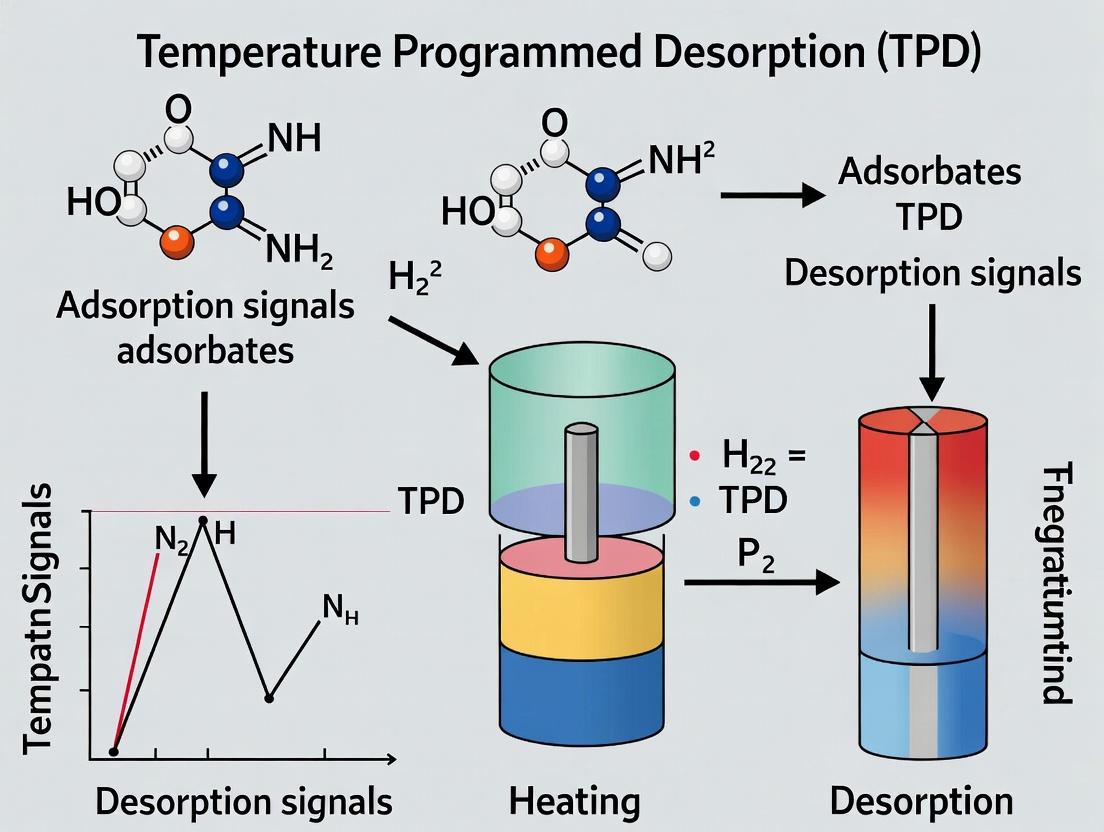
This article provides a comprehensive guide to Temperature Programmed Desorption (TPD), a vital surface science technique for quantifying adsorption strength, binding energy, and site heterogeneity.
Temperature Programmed Desorption (TPD) Explained: Principles, Analysis, and Applications in Material Science & Drug Development
Abstract
This article provides a comprehensive guide to Temperature Programmed Desorption (TPD), a vital surface science technique for quantifying adsorption strength, binding energy, and site heterogeneity. We detail the foundational principles of TPD, from the Arrhenius equation to common desorption kinetics models. The methodological section covers experimental setup, data acquisition, and critical applications in catalyst characterization, drug formulation analysis, and biomaterial surface interaction studies. We address common troubleshooting challenges, optimization strategies for data quality, and advanced techniques like TPD-MS. Finally, we compare TPD with complementary methods such as microcalorimetry and AFM, validating its role in the researcher's toolkit. Aimed at scientists and development professionals, this guide equips readers to design, execute, and interpret TPD experiments for advanced material and biomedical research.
What is TPD? Unpacking the Core Principles and Theoretical Framework
Temperature Programmed Desorption (TPD) is a quintessential surface science technique used to probe the energetics and kinetics of molecules adsorbed on solid surfaces. Within the context of the broader research thesis, "How does temperature programmed desorption (TPD) work?", this whitepaper details its fundamental principles, experimental execution, and critical role in characterizing catalytic and adsorbent materials. By monitoring desorbing species as a function of linearly increasing temperature, TPD provides quantitative data on adsorption strength, surface coverage, binding states, and reaction kinetics.
Fundamental Principles and Theory
TPD experiments measure the rate of desorption (-dθ/dt) from a surface as its temperature (T) is increased linearly over time (T = T₀ + βt, where β is the heating rate). The desorption rate is governed by the Polanyi-Wigner equation:
-dθ/dt = v_n θⁿ exp(-E_des/RT)
where θ is surface coverage, n is the desorption order, v_n is the pre-exponential factor (frequency factor), and E_des is the activation energy for desorption (often equated to the adsorption energy for simple molecular desorption).
The resulting TPD spectrum (desorption rate vs. temperature) acts as a fingerprint for the adsorbate-surface interaction. Peak temperatures (T_p) shift with heating rate and initial coverage, allowing extraction of kinetic parameters.
Quantitative Data from Typical TPD Studies
Table 1: Characteristic TPD Peak Temperatures for Common Gases on Metal Single Crystals (Heating Rate β ≈ 1-5 K/s)
| Adsorbate | Substrate | Binding State | Approx. Peak Temp. Range (K) | Implied E_des (kJ/mol)* |
|---|---|---|---|---|
| Carbon Monoxide (CO) | Pt(111) | Linear-bonded | 400 - 500 | 100 - 130 |
| Hydrogen (H₂) | Ni(110) | Recombinative | 300 - 350 | 80 - 95 |
| Ammonia (NH₃) | SiO₂ | Acid site-bound | 450 - 600 | 50 - 80 |
| Oxygen (O₂) | Ag(110) | Atomic, recombinative | 600 - 700 | 200 - 250 |
| Nitrogen (N₂) | Fe(111) | Atomic, recombinative | 700 - 800 | ~200 |
Note: E_des values are estimates derived from Redhead analysis; precise values require further kinetic fitting.
Table 2: Effect of Experimental Parameters on TPD Data
| Parameter | Typical Range | Impact on TPD Spectrum | Primary Use |
|---|---|---|---|
| Heating Rate (β) | 0.5 - 50 K/s | T_p increases with √β for same E_des. | Extracting E_des via variable heating rates. |
| Initial Coverage (θ₀) | 0.01 - 1 ML | Peak shape & T_p shift indicate lateral interactions & desorption order. | Mapping adsorbate-adsorbate interactions. |
| Mass Spectrometer Signal | m/z 2 to 200+ | Must track unique, non-fragmented mass for quantitative accuracy. | Identifying desorbing species; monitoring reaction products. |
Experimental Protocols
A. Standard UHV-TPD Protocol for a Model Catalyst (Single Crystal):
- Surface Preparation: The single crystal is cleaned in an ultra-high vacuum (UHV, base pressure < 2x10⁻¹⁰ mbar) via cycles of argon ion sputtering (1-3 keV, 10-20 μA, 15-30 min) followed by annealing at high temperature (e.g., 1000-1300 K for metals).
- Adsorption: The clean surface is exposed to a precise dose of the probe gas (e.g., CO) using a calibrated molecular doser or by back-filling the chamber to a known pressure (e.g., 1x10⁻⁸ mbar) for a defined time. The sample is held at a low temperature (often 100-150 K) to facilitate adsorption.
- Temperature Programming: With gas exposure terminated and UHV restored, the sample is heated linearly using a resistive heater or electron bombarder. The heating rate (β) is kept constant by a programmable temperature controller.
- Detection: A quadrupole mass spectrometer (QMS) positioned close to the sample monitors the partial pressure of the desorbing species (and its fragments) in real-time. The QMS is typically configured in a line-of-sight to the sample to minimize background signal.
- Data Acquisition: The QMS signal (proportional to desorption rate) and sample temperature (from a thermocouple) are recorded simultaneously to produce the raw TPD spectrum.
B. High-Pressure TPD / "TAP" Variant for Porous Materials:
- Sample Preparation: A known mass (50-100 mg) of porous catalyst (e.g., zeolite, supported metal) is loaded into a quartz micro-reactor.
- Pretreatment: The sample is activated in situ under flowing inert gas (He, Ar) while heating to remove contaminants (e.g., 573 K for 1-2 hours).
- Adsorption/Saturation: The probe molecule (e.g., NH₃ for acidity) is pulsed or flowed over the sample at adsorption temperature (e.g., 373 K) until saturation is achieved.
- Purge: The system is purged with inert gas to remove physisorbed species from the gas phase and interparticle voids.
- Desorption: The temperature is ramped linearly under continuous inert gas flow. The effluent is analyzed by a downstream mass spectrometer or thermal conductivity detector (TCD).
- Calibration: A known volume of probe gas is injected to calibrate the detector signal, allowing quantification of total adsorbed amount.
Essential Diagrams
Title: TPD Experimental Workflow
Title: Core TPD Theory & Output Relationships
The Scientist's Toolkit: Key Research Reagent Solutions & Materials
Table 3: Essential Materials and Reagents for TPD Experiments
| Item | Function & Specification |
|---|---|
| Single Crystal Sample | Well-defined, atomically flat surface (e.g., Pt(111), Cu(110)). Serves as the model substrate. |
| Porous Catalyst Sample | High-surface-area material (e.g., H-ZSM-5 zeolite, γ-Al₂O₃ support). Typically 60-80 mesh. |
| High-Purity Probe Gases | Analytical grade CO, H₂, NH₃, NO, CO₂, etc. Used to interrogate specific surface sites. |
| Calibrated Leak Valve/Doser | Introduces precise, reproducible amounts of gas into UHV system for adsorption. |
| Quadrupole Mass Spectrometer (QMS) | Detects and identifies desorbing species via mass-to-charge ratio (m/z). Requires electron impact ionizer. |
| Programmable Temperature Controller | Provides precise linear temperature ramp (β). Critical for kinetic parameter extraction. |
| UHV System (≤10⁻¹⁰ mbar) | Maintains clean surface by minimizing contamination from background gases during experiment. |
| Micro-reactor (Flow TPD) | Holds powdered sample, enables in-situ pretreatment, and operates at ambient or elevated pressure. |
| Thermal Conductivity Detector (TCD) | Quantifies desorbed amounts in flow systems; universal but non-specific detector. |
| Calibration Gas Mixture | Known concentration of probe gas in inert carrier. Essential for quantitative analysis in flow TPD. |
Temperature Programmed Desorption (TPD) is a cornerstone surface science technique for quantifying adsorbate-substrate bond strength. By monitoring desorption as a function of temperature, TPD provides direct access to kinetic parameters, primarily the activation energy for desorption (E_d), which is intrinsically linked to bond strength. This whitepaper details the operational principles, rigorous experimental protocols, and quantitative analysis frameworks that enable TPD to answer this fundamental question, contextualized within ongoing research into catalytic mechanisms and molecular surface interactions critical to fields including heterogeneous catalysis and pharmaceutical development.
The central thesis of TPD research is to decode surface kinetics and energetics through controlled thermal stimulation. The desorption rate, governed by the Polanyi-Wigner equation, serves as the primary observable. The technique's power lies in its ability to distinguish between different binding states, quantify their population, and measure the strength of each adsorbate-surface interaction. This directly informs models of catalytic activity, sensor design, and drug-receptor binding analog studies.
Theoretical Foundation: From Spectrum to Energy
The desorption rate is modeled by:
r(θ,T) = -dθ/dt = ν_n θ^n exp(-E_d(θ)/RT)
where:
r: Desorption rateθ: Surface coveragen: Desorption orderν_n: Pre-exponential factor (frequency factor)E_d: Activation energy for desorptionR: Gas constantT: Temperature
A TPD spectrum (desorption rate vs. temperature) is a fingerprint of the adsorbate-surface bond. Peak temperature (T_p) shifts with coverage indicate interactions between adsorbed molecules. Analysis methods extract E_d and ν.
Table 1: TPD Peak Characteristics vs. Bond Strength
| Peak Feature | Indication | Typical Link to Bond Strength |
|---|---|---|
Higher T_p |
Larger activation energy for desorption (E_d) |
Stronger surface bond |
| Peak Broadening | Coverage-dependent E_d (lateral interactions) |
Bond strength modified by neighbor presence |
| Multiple Peaks | Distinct adsorption states/sites | Different bond strengths for each state |
| Asymmetric Tail | First-order desorption kinetics | Often associated with simple bond breaking |
Detailed Experimental Protocol
A robust TPD experiment requires meticulous setup and execution.
1. System Preparation:
- Utilize an ultra-high vacuum (UHV) chamber (base pressure < 1×10⁻⁹ mbar).
- Clean the single-crystal substrate via repeated cycles of sputtering (Ar⁺ ions, 1-3 keV) and annealing (up to 80-90% of melting point).
- Verify surface cleanliness and order with Low-Energy Electron Diffraction (LEED) and Auger Electron Spectroscopy (AES).
2. Adsorbate Dosing:
- Expose the clean, temperature-controlled substrate to a precise dose of the probe molecule (e.g., CO, H₂, NH₃).
- Dosing is performed via a directed capillary doser or backfilling the chamber.
- Exposure is measured in Langmuir (1 L = 10⁻⁶ Torr·s), with care to avoid multilayer formation for initial studies.
3. Temperature Programming and Detection:
- Initiate a linear temperature ramp (β = dT/dt, typically 0.5-10 K/s) using a resistive heater or liquid nitrogen-cooled manipulator.
- Monitor desorbing species with a quadrupole mass spectrometer (QMS).
- Critical: Place the QMS in a line-of-sight configuration to the sample, often within a differentially pumped shroud, to signal from the sample surface selectively and minimize background gas detection.
- Record partial pressure of the mass-to-charge (m/z) signal specific to the adsorbate versus sample temperature.
4. Data Calibration:
- Convert the QMS signal to a desorption rate. For quantitative analysis, calibrate the system using a known reference (e.g., desorption from a saturated monolayer with known density) to determine the sensitivity factor.
Data Analysis Methodologies
1. Simple Redhead Analysis (for first-order, assuming ν ≈ 10¹³ s⁻¹):
E_d / RT_p ≈ ln(νT_p / β) - 3.64
Useful for a quick estimate but assumes invariant parameters.
2. Complete Analysis for E_d(θ) Determination:
- Leading Edge Analysis: Uses the low-coverage side of the peak at various initial coverages to determine
E_dat specific θ. - Series of Spectra Method: Fits a set of TPD spectra taken at different initial coverages simultaneously to a model using the Polanyi-Wigner equation.
- Modern Computational Fitting: Uses software to simulate spectra based on a postulated kinetic model (coverage-dependent
E_dandν) and iterates to achieve a best fit with experimental data.
Table 2: Common TPD Analysis Methods & Outputs
| Method | Key Requirement | Output | Accuracy & Notes |
|---|---|---|---|
| Redhead Peak Max | Fixed ν, first-order kinetics |
Single E_d value |
Low. Approximate only. |
| Leading Edge | Low coverage data points | E_d as function of θ |
Medium. Avoids recombination effects. |
| Complete Curve Fitting | Set of spectra at different θ | E_d(θ) and ν(θ) |
High. The most rigorous approach. |
| TPD Simulation | Assumed kinetic model | Model parameters | High. Dependent on model correctness. |
The Scientist's Toolkit: Essential Research Reagent Solutions
Table 3: Key Materials & Reagents for TPD Experiments
| Item | Function in TPD Experiment |
|---|---|
| Single Crystal Substrate (e.g., Pt(111), Cu(110)) | Provides a well-defined, reproducible surface of known structure for fundamental studies. |
| High-Purity Probe Gases (e.g., CO (99.999%), H₂ (99.999%)) | Ensures the adsorbate is free of contaminants that could co-adsorb and skew results. |
| Sputtering Gas (Ultra-pure Argon) | Used with ion guns to remove impurities and reconstruct the surface layer. |
| Calibrated Leak Valve & Capillary Dosers | Allows precise, reproducible exposure of the sample to gases, enabling sub-monolayer control. |
| Quadrupole Mass Spectrometer (QMS) | The primary detector for identifying and quantifying desorbing species. |
| UHV-Compatible Thermocouples (e.g., K-type, spot-welded) | Accurately measures and controls the sample temperature during annealing and the TPD ramp. |
Advanced Considerations & Applications
Modern TPD extends beyond simple metals. Studies involve porous materials (zeolites), oxides (TiO₂, CeO₂), and supported nanoparticles. Here, transport effects can complicate spectra. In drug development, TPD principles are analogously applied in studies of molecular desorption from functionalized surfaces and in assessing binding strength in some biosensor formats.
Title: TPD Experimental and Analysis Workflow
Title: From TPD Data to Bond Strength Parameters
TPD remains an indispensable, direct experimental probe of surface bond strength. The fidelity of its answer to "How strong is the bond?" hinges on rigorous UHV practice, careful experimental design, and the application of appropriate kinetic analysis models. As a quantitative bridge between observed desorption phenomena and fundamental kinetic parameters, TPD continues to underpin advances in surface science and related disciplines, from catalyst design to advanced materials engineering.
Temperature Programmed Desorption (TPD) is a cornerstone analytical technique in surface science and catalysis research, providing critical insights into adsorbate-surface interactions, binding energies, and reaction kinetics. Its fundamental principle involves adsorbing molecules onto a prepared surface, then controllably heating the substrate while monitoring desorbing species. The resulting desorption rate versus temperature profile serves as a fingerprint for the state of the adsorbate, revealing information about adsorption sites, surface coverage, and the mechanism of desorption (e.g., associative, dissociative). In pharmaceutical development, analogous principles are applied in techniques like thermal gravimetric analysis (TGA) and differential scanning calorimetry (DSC) to study drug-excipient interactions, polymorph stability, and dehydration processes. This whitepaper delves into the core technical components of any TPD experiment: the precision-controlled temperature ramp and the subsequent desorption pulse detection.
Technical Core: The Temperature Ramp and Desorption Pulse
The Controlled Temperature Ramp
The linear, reproducible heating of the substrate is the primary independent variable in TPD. Modern systems employ sophisticated temperature controllers and heating elements (often resistive heaters or radiative heating) to achieve precise ramps, typically ranging from 0.1 to 50 K/s.
Table 1: Common Temperature Ramp Parameters in TPD Studies
| Parameter | Typical Range | Impact on Experiment | Considerations for Drug Development |
|---|---|---|---|
| Ramp Rate (β) | 0.5 – 20 K/s | Determines peak resolution and kinetic parameters via the Redhead analysis. Lower rates improve separation of overlapping states. | Analogous to controlled stress stability testing of APIs; slower ramps detect subtle phase transitions. |
| Start Temperature (T₀) | 80 – 300 K | Must be below desorption threshold for the adsorbate of interest. Often cryogenic for physisorbed species. | Equivalent to sub-ambient storage testing for biologics or unstable compounds. |
| Final Temperature (T_f) | 300 – 1500 K | Must exceed complete desorption of all adsorbates without inducing substrate degradation. | Mirrors high-temperature accelerated degradation studies for solid dosage forms. |
| Linearity & Stability | ±0.5% of setpoint | Critical for accurate kinetic modeling. Non-linearity introduces error in activation energy (E_des) calculations. | Precision required in DSC for measuring glass transition or melting points. |
The Desorption Pulse Detection
As temperature increases, adsorbates gain sufficient energy to overcome the activation barrier for desorption (E_des). The resulting pulse of gas is detected, most commonly by a mass spectrometer (quadrupole mass spectrometer, QMS), which provides both quantification and species identification.
Table 2: Desorption Pulse Detection Methods & Data
| Detection Method | Measured Signal | Key Quantitative Outputs | Advantages/Limitations |
|---|---|---|---|
| Mass Spectrometry (QMS) | Partial pressure of specific m/z ratio. | Peak temperature (T_p), peak area (coverage), peak shape (kinetic order). | Highly specific; can track multiple species simultaneously. Requires ultra-high vacuum (UHV). |
| Thermal Conductivity Detector (TCD) | Change in gas thermal conductivity. | Integrated desorption amount (calibrated). | Non-destructive, universal detector. Less specific, lower sensitivity than QMS. |
| Pressure Rise | Total pressure increase in a closed system. | Total moles desorbed. | Simple and direct. Cannot distinguish different desorbing species. |
Experimental Protocols
Standard UHV-TPD Protocol for Catalytic Surface Analysis
This protocol outlines the essential steps for a classic TPD experiment on a single-crystal metal surface under ultra-high vacuum (UHV) conditions.
1. Substrate Preparation:
- The single-crystal sample is cleaned in UHV via repeated cycles of Ar⁺ sputtering (1-3 keV, 10-20 μA, 15-30 minutes) followed by annealing at high temperature (e.g., 1000-1300 K for Pt) until surface cleanliness is verified by Auger Electron Spectroscopy (AES) or X-ray Photoelectron Spectroscopy (XPS).
2. Adsorption Phase:
- The clean sample is cooled to the desired adsorption temperature (T₀, often 100-300 K) using liquid nitrogen cooling.
- The adsorbate gas is introduced via a precision leak valve to a specified exposure, measured in Langmuirs (1 L = 10⁻⁶ Torr·s). Exposure is controlled to achieve the desired initial coverage (θ).
3. Evacuation and Stabilization:
- The gas dosing line is closed, and the chamber is pumped down to base pressure (typically <1×10⁻⁹ Torr) to remove any gas-phase or weakly physisorbed species.
4. Temperature Programmed Desorption:
- A linear temperature ramp is initiated from T₀ to T_f using a programmable temperature controller connected to the sample heater.
- Simultaneously, the mass spectrometer (tuned to a specific mass-to-charge ratio, m/z, of the adsorbate or a fragment) records the partial pressure as a function of sample temperature. The QMS is typically placed in line-of-sight of the sample for maximum sensitivity.
5. Data Analysis:
- The resulting plot (desorption rate vs. temperature) is analyzed. Peak temperatures (Tp) are identified. For simple systems, activation energies for desorption are estimated using methods like the Redhead equation: Edes / R Tp² ≈ β / ν exp(-Edes / R T_p), where ν is the pre-exponential factor.
Protocol for Pharmaceutical Solid-State Analysis via TGA-MS
This adaptation applies TPD principles to pharmaceutical materials using coupled TGA and mass spectrometry.
1. Sample Preparation:
- A precisely weighed sample (5-20 mg) of the active pharmaceutical ingredient (API) or formulation is loaded into an open alumina crucible.
2. Instrument Calibration & Purge:
- The TGA furnace is purged with an inert carrier gas (N₂ or He) at a constant flow rate (e.g., 50 mL/min). The mass spectrometer is calibrated for relevant m/z signals (e.g., 18 for H₂O, 44 for CO₂).
3. Controlled Temperature Ramp:
- A linear temperature ramp (e.g., 10 K/min) is applied from room temperature to a final temperature (e.g., 500°C) suitable for the material without decomposition.
4. Simultaneous Detection (Desorption Pulse):
- The TGA continuously records mass loss. The evolved gases are transferred via a heated capillary line to the QMS, which monitors selected ions in real-time, correlating specific mass losses with the evolution of water, solvents, or decomposition products.
5. Data Correlation:
- The derivative of the TGA mass loss curve (DTG) is plotted alongside the MS ion currents. Peaks are aligned by temperature to identify the nature of each desorption/evolution event (e.g., dehydration at 120°C, decarboxylation at 250°C).
Visualizing TPD Concepts and Workflows
Title: The Six-Step TPD Experimental Workflow
Title: Instrumental Data Flow in a TPD Experiment
The Scientist's Toolkit: Key Research Reagent Solutions
Table 3: Essential Materials and Reagents for TPD Experiments
| Item | Function & Role in Experiment | Technical Specifications / Notes |
|---|---|---|
| Single-Crystal Substrates | Provides a well-defined, atomically flat surface with known orientation (e.g., Pt(111), Au(100)) for fundamental adsorption studies. | Typically discs (10mm diameter, 1-2mm thick). Must be polished to <0.03 μm finish. |
| High-Purity Gases | Source of adsorbate molecules (e.g., CO, H₂, O₂, NO) or inert purge/sputtering gas (Ar, Ne). | 99.999% purity or higher to prevent surface contamination. Delivered via precision leak valves. |
| Calibrated Mass Spectrometer | Detects and quantifies the desorbing species; the primary sensor for the "desorption pulse." | Quadrupole mass spectrometer with secondary electron multiplier. Must be calibrated for sensitivity factors. |
| UHV-Compatible Sample Holder & Heater | Holds the sample and enables precise resistive heating for the temperature ramp. | Often made from Ta or W wire/heater foil; must allow for electron beam heating or liquid nitrogen cooling. |
| Temperature Measurement Sensor | Accurately measures sample temperature during the ramp. Critical for correlating desorption events with T. | Typically a K-type (Chromel-Alumel) thermocouple spot-welded to the sample edge, or an infrared pyrometer. |
| Sputtering Ion Gun | Cleans the sample surface by bombarding it with inert gas ions (Ar⁺) to remove impurities. | Operates at 1-5 keV, with adjustable current and beam rastering for uniform cleaning. |
| Reference Standard Materials | For pharmaceutical TGA-MS, used to calibrate temperature and mass loss. | Common standards: Indium (melting point), Alumel (Curie point), Calcium Oxalate (dehydration steps). |
| Inert Carrier Gas (Pharma TGA) | Transports evolved gases from the TGA furnace to the MS detector without reaction. | Ultra-high purity Helium or Nitrogen, with oxygen/moisture traps installed in the gas line. |
Temperature Programmed Desorption (TPD) is a cornerstone experimental technique in surface science, catalysis, and materials characterization. It provides critical insights into adsorbate binding energies, surface coverage, and reaction mechanisms. The quantitative interpretation of TPD spectra fundamentally relies on the Polanyi-Wigner equation, which serves as the primary theoretical model for describing desorption kinetics. This guide delves into the technical foundations of this equation and its application in modern research, directly supporting thesis-level investigations into "How does temperature programmed desorption (TPD) work?"
The Polanyi-Wigner Equation: Mathematical Foundation
The Polanyi-Wigner equation formulates the rate of desorption, ( rd ), from a surface as a function of surface coverage (( \theta )), temperature (( T )), and the activation energy for desorption (( Ed )).
[ rd(\theta, T) = -\frac{d\theta}{dt} = \nun \, \theta^n \, \exp\left(-\frac{Ed(\theta)}{kB T}\right) ]
Where:
- ( \nu_n ): The pre-exponential factor (frequency factor) for the (n^{th})-order process ((s^{-1}) for (n>0), molecules·cm(^{-2})·s(^{-1}) for zero-order).
- ( \theta ): Surface coverage (monolayers).
- ( n ): The order of the desorption process.
- ( E_d(\theta) ): The coverage-dependent activation energy for desorption (J/mol or eV).
- ( k_B ): Boltzmann constant.
- ( T ): Absolute temperature (K).
The order ( n ) is diagnostic of the desorption mechanism:
- ( n = 0 ): Characteristic of multilayer desorption or desorption from a saturated surface with constant rate.
- ( n = 1 ): Associated with first-order kinetics, such as molecular desorption without dissociation or recombination-limited processes from a single site.
- ( n = 2 ): Indicates second-order kinetics, typically representative of associative desorption where two adsorbed species recombine (e.g., ( H{ad} + H{ad} \rightarrow H_{2(g)} )).
Key Parameter Determination from TPD Spectra
In a standard TPD experiment, temperature is ramped linearly (( T = T0 + \beta t ), where ( \beta ) is the heating rate). The resulting desorption rate is plotted against temperature, producing characteristic peaks. Key kinetic parameters (( Ed ), ( \nu_n )) are extracted from these spectra.
Common Analysis Methods:
Redhead Peak Maximum Method (for first-order, ( Ed ) independent of ( \theta )): [ \frac{Ed}{RTp} = \frac{\nu1}{\beta} \exp\left(-\frac{Ed}{RTp}\right) ] Simplified for ( \nu1 / \beta \approx 10^{13} ): ( Ed / RTp \approx \ln(\nu1 T_p / \beta) - 3.64 ).
Analysis of Leading Edge (Chan–Archer–Weinberg Method): Assumes initial low coverage where ( Ed(\theta) ) is constant. Plots (\ln(rd)) vs (1/T) at constant ( \theta ) yield (-E_d/R) as slope.
Complete Line Shape Analysis: Fitting the entire TPD spectrum using the Polanyi-Wigner equation with assumed forms for ( E_d(\theta) ) and ( \nu(\theta) ).
Quantitative Parameter Tables
Table 1: Typical Ranges of Polanyi-Wigner Parameters for Common Adsorbates on Metals
| Adsorbate System | Typical Desorption Order (n) | Activation Energy, ( E_d ) (kJ/mol) | Pre-exponential, ( \nu_n ) (s⁻¹) | Comments |
|---|---|---|---|---|
| CO on Pt(111) | 1 | 115 - 140 | 10¹³ - 10¹⁶ | Strongly coverage-dependent due to lateral interactions. |
| H₂ on Ni(110) | 2 | 70 - 95 | 10⁻² - 10² m²·mol⁻¹·s⁻¹ | Second-order, indicative of associative desorption. |
| N₂ on Fe(111) | 0 (Multilayer) | ~10 (multilayer) | ~10²⁵ molecules·cm⁻²·s⁻¹ | Zeroth-order multilayer peak precedes chemisorbed layer. |
| H₂O on TiO₂(110) | 1 | 45 - 85 | 10¹² - 10¹⁵ | Broad peaks often indicate a distribution of binding sites. |
| NH₃ on Cu(111) | 1 | 55 - 75 | 10¹² - 10¹⁴ | Used in studies of catalytic ammonia synthesis/decomposition. |
Table 2: Effect of Heating Rate (( \beta )) on TPD Peak Temperature (( T_p )) for First-Order Desorption
| Heating Rate, ( \beta ) (K/s) | Peak Temp, ( Tp ) (K) for ( Ed=100 ) kJ/mol, ( \nu=10^{13} ) s⁻¹ | Peak Temp, ( Tp ) (K) for ( Ed=120 ) kJ/mol, ( \nu=10^{13} ) s⁻¹ | Shift ( \Delta T_p ) |
|---|---|---|---|
| 1 | 483 | 581 | 98 |
| 5 | 514 | 618 | 104 |
| 10 | 530 | 637 | 107 |
| 20 | 547 | 657 | 110 |
Note: Increasing ( \beta ) shifts ( T_p ) to higher temperatures. The magnitude of the shift is used to calculate ( E_d ) via the "heating rate variation" method.
Experimental Protocol: A Standard UHV-TPD Experiment
Objective: To determine the binding energy and kinetic order of carbon monoxide (CO) on a single-crystal metal surface.
Materials & Equipment:
- Ultra-High Vacuum (UHV) chamber (base pressure < 2x10⁻¹⁰ mbar).
- Single crystal sample mounted on a manipulator with resistive heating and liquid nitrogen cooling.
- Quadrupole Mass Spectrometer (QMS) with shielding aperture (differential pumping).
- Precision leak valve for gas dosing.
- Electron gun and analyzer for Auger Electron Spectroscopy (AES) or Low-Energy Ion Scattering (LEIS) for surface cleanliness verification.
- Temperature controller with linear ramp capability.
Procedure:
- Surface Preparation: The single crystal is cleaned in UHV by repeated cycles of Ar⁺ sputtering (1-3 keV, 10-15 μA, 30 min) followed by annealing at a high temperature (e.g., 1000 K for Pt) until surface contaminants (C, O, S) are below the detection limit of AES (<1% monolayer).
- Adsorbate Dosing: The clean sample is cooled to the adsorption temperature (typically 100-150 K using liquid N₂). CO is introduced into the chamber via the leak valve at a controlled pressure (e.g., 1x10⁻⁸ mbar) for a precise time to achieve the desired initial coverage (( \theta_0 )). Coverage is often calibrated using the integrated TPD area, with the first monolayer saturation defined as ( \theta = 1 ).
- Temperature Programming: The gas supply is shut off, and the chamber is pumped to base pressure. The QMS is tuned to the mass-to-charge ratio (m/z) of CO (28) or a fragment. The sample temperature is ramped linearly (e.g., ( \beta = 2-10 ) K/s) from the adsorption temperature to a high temperature (e.g., 800 K).
- Data Acquisition: The QMS signal (proportional to desorption rate, ( -d\theta/dt )) and the sample temperature (from a thermocouple) are recorded simultaneously.
- Data Analysis: The resulting spectrum (rate vs. T) is analyzed. Peak temperatures (( Tp )) and line shapes are compared for different initial coverages (( \theta0 )) and heating rates (( \beta )) to determine the desorption order ( n ) and extract ( Ed ) and ( \nun ) using the methods in Section 3.
Visualizing the TPD Workflow and Data Analysis Logic
Title: TPD Experimental and Analysis Workflow
Title: Polanyi-Wigner Parameter Extraction Logic
The Scientist's Toolkit: Essential Research Reagents & Materials
Table 3: Key Reagents and Materials for TPD Experiments
| Item | Function / Explanation | Typical Specification |
|---|---|---|
| Single Crystal Surfaces | Provides a well-defined, atomically flat substrate with known orientation for fundamental studies. | e.g., Pt(111), Cu(110), TiO₂(110), 10mm diameter, oriented to <0.1°. |
| High-Purity Research Gases | Source of the adsorbate molecules for dosing. Trace impurities can poison the surface. | CO (99.999%), H₂ (99.999%), O₂ (99.999%), with in-line purifiers. |
| Sputtering Gas (Argon) | Inert gas ionized to create Ar⁺ ions for physical removal of surface contaminants. | Ar (99.9999%), used at pressures of 1-5 x 10⁻⁵ mbar during sputtering. |
| Calibration Reference Materials | Used to verify the accuracy of temperature measurements and QMS sensitivity. | Thin-film standards or well-characterized systems (e.g., CO on Pd(111)). |
| UHV-Compatible Sample Mounts | Holds the crystal, enables heating and cooling, and maintains electrical contact. | Made from Ta or W wires, spot-welded to crystal tabs. |
| UHV-Compatible Thermocouples | Accurately measures sample temperature during the linear ramp. | Type K (Chromel-Alumel) or Type C (W-5%Re/W-26%Re), spot-welded to sample edge. |
| Mass Spectrometer Calibration Gas | Used to calibrate the QMS for absolute partial pressure measurements if required. | A known mixture (e.g., 1% CO in Ar) or a pure gas with a known fragmentation pattern. |
Temperature Programmed Desorption (TPD) is a cornerstone surface science technique used to probe adsorption energies, surface kinetics, and reaction mechanisms. A critical component of TPD analysis is modeling the desorption kinetics, which are classified by their order. This whitepaper provides an in-depth technical guide to zero-, first-, and second-order desorption kinetics, framed within the context of TPD research. We detail the theoretical foundations, experimental protocols for differentiation, and implications for catalyst characterization and drug delivery system development.
In TPD, a surface with adsorbed species is heated in a controlled, linear fashion (dT/dt = β). The rate of desorption, measured as a function of temperature by a mass spectrometer, is described by the Polanyi-Wigner equation:
-dθ/dT = (ν/β) * θ^n * exp(-E_des/(RT))
where θ is surface coverage, ν is the pre-exponential factor, n is the desorption order, E_des is the activation energy for desorption, R is the gas constant, and T is temperature. The order of desorption (n) is a critical parameter revealing the molecular mechanism of the surface process.
Theoretical Framework and Key Characteristics
Zero-Order Desorption (n=0)
Mechanism: Desorption rate is independent of surface coverage. This typically occurs from multilayers or condensed phases where desorption occurs from the top layer, and the rate is constant until the multilayer is depleted.
Rate Equation: -dθ/dt = ν₀ exp(-E_des/(RT))
TPD Peak Characteristics: Asymmetric peak with a sharp leading edge and a trailing edge that drops abruptly when the reservoir is exhausted. Peak temperature (T_p) decreases with increasing initial coverage (θ₀).
First-Order Desorption (n=1)
Mechanism: Desorption rate is proportional to the concentration of adsorbed species. Characteristic of molecular desorption without dissociation or where desorption of a single species from a single site is rate-limiting.
Rate Equation: -dθ/dt = ν₁ θ exp(-E_des/(RT))
TPD Peak Characteristics: Symmetric peak shape. Peak temperature (T_p) is independent of initial coverage (θ₀).
Second-Order Desorption (n=2)
Mechanism: Desorption rate is proportional to the square of the coverage or to the product of coverages of two species. Indicative of recombinative desorption (e.g., 2H* → H₂) or bimolecular processes.
Rate Equation: -dθ/dt = ν₂ θ² exp(-E_des/(RT))
TPD Peak Characteristics: Symmetric peak shape. Peak temperature (T_p) increases with increasing initial coverage (θ₀).
Quantitative Data Comparison
The following table summarizes the defining characteristics of each desorption order.
Table 1: Comparative Analysis of Desorption Kinetic Orders
| Characteristic | Zero-Order (n=0) | First-Order (n=1) | Second-Order (n=2) |
|---|---|---|---|
| Rate Law | -dθ/dt = k |
-dθ/dt = kθ |
-dθ/dt = kθ² |
| Typical Mechanism | Desorption from multilayers, constant source | Molecular desorption from single site | Recombinative desorption from two sites |
| Peak Shape (TPD) | Sharp cut-off at high T; asymmetric | Symmetric | Symmetric |
| Dependence of T_p on θ₀ | Decreases with increasing θ₀ | Independent of θ₀ | Increases with increasing θ₀ |
| Activation Energy (E_des) | Approx. equal to heat of sublimation/evaporation | Approx. equal to bond energy with surface | Sum of bond energies + recombination barrier |
| Common Examples | Noble gases on metals, physisorbed multilayers | CO on many metals, molecularly adsorbed species | H₂ from metals (2H*→H₂), O₂ from oxides |
Table 2: Protocol Parameters for TPD Kinetic Order Determination
| Experimental Variable | Purpose in Order Determination | Typical Settings/Range |
|---|---|---|
| Initial Coverage (θ₀) | Vary systematically to observe T_p shift | 0.05 ML to several ML (monolayers) |
| Heating Rate (β) | Used in Arrhenius analysis (e.g., Redhead method) | 0.5 - 20 K/s |
| Surface Temperature | Must be uniform; linear ramp is critical | Start: 100-150 K; End: 800-1200 K |
| Mass Spectrometer | Must track desorbing species with high sensitivity | Quadrupole MS with electron impact ionization |
| Vacuum Base Pressure | Minimize re-adsorption during experiment | < 1 x 10⁻¹⁰ mbar (UHV) |
Experimental Protocols for Kinetic Order Determination
Protocol A: Variable Initial Coverage Method
This is the definitive method for determining desorption order n.
- Surface Preparation: Clean a single crystal or well-defined sample in an Ultra-High Vacuum (UHV) chamber using cycles of sputtering (Ar⁺ ions, 1 keV, 5-15 μA, 30 min) and annealing (to >1000 K, as material allows).
- Adsorption: Expose the clean, cooled surface (typically 100 K) to a precise dose of the adsorbate gas using a calibrated doser. Vary the exposure to achieve a series of initial coverages (e.g., 0.1, 0.25, 0.5, 0.75, 1.0 ML). One monolayer (ML) is defined by the saturation coverage of the first layer.
- TPD Measurement: With the gas dosing valve closed, initiate a linear temperature ramp (e.g., β = 2 K/s) using a resistively heated manipulator with a calibrated thermocouple. Monitor the partial pressure of the desorbing species (e.g., m/z=2 for H₂, m/z=28 for CO) with a quadrupole mass spectrometer positioned close to the sample.
- Data Analysis: Plot the desorption rate vs. temperature for each θ₀. Observe the direction of the peak temperature (T_p) shift.
- Tp decreases with increasing θ₀ → Zero-Order.
- Tp constant → First-Order.
- T_p increases with increasing θ₀ → Second-Order.
Protocol B: Lineshape Analysis Method
- Perform a TPD experiment at a single, intermediate coverage (≈0.5 ML) following steps 1-3 above.
- Fit the Data: Attempt to fit the resulting TPD spectrum with simulated curves generated using the Polanyi-Wigner equation for n=0, 1, and 2.
- Determine Best Fit: The order n that yields the best fit (minimized χ²) to the peak's asymmetry and full width at half maximum (FWHM) is assigned. First- and second-order peaks are symmetric, while zero-order peaks are distinctly asymmetric.
Protocol C: Isothermal Desorption Method
- Prepare and adsorb at a known θ₀ as in Protocol A.
- Rapid Heating: Quickly heat the sample to a fixed, constant temperature below the expected T_p.
- Monitor Decay: Record the partial pressure (desorption rate) as a function of time at this constant temperature.
- Analyze Decay Kinetics: Plot ln(Rate) vs. time (linear for 1st order) or 1/Rate vs. time (linear for 2nd order). A constant rate indicates zero-order kinetics.
Visualization of Concepts and Workflows
Title: TPD Kinetic Order Determination Workflow
Title: Core Kinetic Order Models and Their TPD Signatures
The Scientist's Toolkit: Key Research Reagent Solutions
Table 3: Essential Materials and Reagents for TPD Studies
| Item | Function & Specification | Application Context |
|---|---|---|
| Single Crystal Surfaces | Well-defined atomic structure (e.g., Pt(111), Cu(110)). Provides a model substrate with no grain boundaries or defects to simplify analysis. | Fundamental studies of adsorption energetics and kinetics. |
| Calibrated Gas Doser | Aperture or tube directing a known flux of ultra-pure gas (≥99.999%) onto the sample. Allows precise control of exposure (Langmuirs, L). | Accurate and reproducible dosing to achieve specific initial coverages (θ₀). |
| Quadrupole Mass Spectrometer (QMS) | Detects partial pressure of specific mass-to-charge (m/z) ratios with high sensitivity and fast response time. Must be differentially pumped. | Real-time monitoring of desorption rates for one or multiple species. |
| UHV System | Chamber maintaining base pressure <1×10⁻¹⁰ mbar. Minimizes contamination and unwanted adsorption from the background during experiment. | Prerequisite for clean surface science studies. |
| Programmable Temperature Controller | Provides linear heating ramps (β) from cryogenic (80-100 K) to high temperatures (1200+ K). Stability is critical. | Executes the core TPD temperature program. |
| Sputter Ion Gun | Source of inert gas ions (typically Ar⁺) at energies of 0.5-3 keV for physically removing surface contaminants. | Sample cleaning prior to adsorption/TPD experiment. |
| Calibrated Thermocouple | Spot-welded to the sample edge (e.g., K-type, Chromel-Alumel). Provides accurate and direct temperature measurement. | Essential for correlating desorption events with exact sample temperature. |
| Reference Adsorbate Gases | Ultra-high purity CO, H₂, NO, O₂, etc. Used for system calibration and as model adsorbates. | Establishing baseline kinetic behavior and validating instrument performance. |
Determining the order of desorption is not merely a curve-fitting exercise; it provides fundamental mechanistic insight. Within a thesis on TPD, understanding these kinetics allows researchers to:
- Decipher Surface Bonding: First-order desorption suggests non-dissociative adsorption, while second-order points to dissociative adsorption and recombination.
- Quantify Energetics: The order is a key input for accurate extraction of activation energies for desorption (E_des) using methods like the Redhead analysis.
- Inform Catalyst Design: Identifying recombinative (second-order) desorption of products can be a critical step in heterogeneous catalytic cycles.
- Optimize Drug Delivery: In controlled-release pharmaceuticals, desorption/ release kinetics from a carrier material (often zero or first-order) directly impact dosage profiles.
Mastery of zero-, first-, and second-order desorption kinetics is therefore essential for the rigorous interpretation of TPD data, bridging the gap between experimental observation and molecular-level understanding in surface science and related fields.
Temperature Programmed Desorption (TPD) is a cornerstone analytical technique in surface science and heterogeneous catalysis, providing quantitative insights into adsorbate-surface interactions. This guide details the principles of TPD spectrum interpretation, focusing on extracting binding energy distributions and quantifying adsorption site heterogeneity. The discussion is framed within ongoing research into the fundamental mechanisms of TPD operation and its applications in materials science and drug development, where it characterizes binding to solid-phase targets.
TPD measures the rate of desorption of molecules from a surface as it is heated in a controlled, often linear, fashion. The resulting spectrum (desorption rate vs. temperature) is a fingerprint of the adsorption state. The core thesis of TPD research interrogates how the measured spectra relate to fundamental parameters: the binding energy (Ed), the pre-exponential factor (ν), and the adsorption order. Decoding these spectra reveals the presence of multiple distinct binding sites (heterogeneity) and the distribution of binding strengths within them, data critical for catalyst design and drug carrier optimization.
Theoretical Foundations: From Peaks to Parameters
The analysis is based on the Polanyi-Wigner equation:
-dθ/dt = ν * θ^n * exp(-Ed/RT)
where θ is surface coverage, n is the desorption order, ν is the pre-exponential factor, Ed is the activation energy for desorption (often equated to binding energy for non-dissociative adsorption), R is the gas constant, and T is temperature.
For a first-order process (n=1, e.g., molecular desorption), the peak temperature (Tp) shifts with initial coverage if Ed changes with coverage, indicating interactions between adsorbates or site heterogeneity. For a second-order process (n=2, e.g., recombinative desorption), Tp typically decreases with increasing initial coverage.
Key Relationships Summarized
The table below summarizes the quantitative relationships used in basic TPD analysis.
Table 1: Key Quantitative Relationships in TPD Analysis
| Parameter | Equation/Relationship | Typical Values / Notes |
|---|---|---|
| Polanyi-Wigner Eq. | -dθ/dt = ν θⁿ exp(-E_d/RT) |
Foundation for all analysis. |
| Redhead Analysis (1st order) | E_d / RT_p = ln(ν T_p / β) - 3.64 |
Approximation. Assumes ν=10¹³ s⁻¹. |
| Chan-Aris-Weinberg Method | E_d = RT_p [ln(ν T_p / β) - 3.64] |
More rigorous; requires ν. |
| Pre-exponential Factor (ν) | ν ≈ k_B T_p / h (Transition State Theory) |
Often 10¹² - 10¹⁵ s⁻¹ for 1st order. |
| Peak Width (FWHM) | FWHM ∝ E_d / (Coverage-dependent) |
Broad peaks suggest heterogeneous sites. |
| Activation Energy Trend | Shift in T_p with coverage |
Decreasing Ed with θ indicates repulsive interactions. |
Interpreting Peaks: Binding Energy & Heterogeneity
A single symmetric peak often corresponds to a single, homogeneous adsorption site with a unique Ed. Complex spectra with multiple or broad peaks reveal site heterogeneity.
- Multiple Discrete Peaks: Indicate distinct, well-defined adsorption sites with different binding energies (e.g., terrace vs. step sites on a metal).
- Broad or Asymmetric Peaks: Suggest a continuous distribution of binding energies, caused by:
- Intrinsic surface disorder (amorphous materials).
- Lateral interactions between adsorbed molecules (repulsive or attractive).
- Gradual change in adsorption state with coverage.
Extracting Binding Energy Distributions
For heterogeneous surfaces, the TPD spectrum is a superposition of desorption from sites with different Ed. The analysis involves inverting the spectrum to obtain the probability density function P(Ed).
Table 2: Methods for Analyzing Complex TPD Spectra
| Method | Principle | Use Case | Key Assumptions |
|---|---|---|---|
| Leading Edge Analysis | Analyzes the low-temperature side of the peak where coverage is constant. | Wide energy distributions. | Desorption is first-order; ν is constant for all sites. |
| Complete Line-Shape Analysis | Fits the entire spectrum with a model distribution (e.g., Gaussian). | Discrete or narrow distributions. | A functional form for P(Ed) is assumed. |
| Inversion Methods | Numerical inversion of the Polanyi-Wigner integral equation. | General case for 1st order desorption. | ν is constant and independent of Ed. |
Experimental Protocols for TPD
Protocol 1: Standard TPD Experiment for Catalyst Characterization
- Sample Preparation (~5 mg): Load powdered catalyst into a U-shaped quartz microreactor held by quartz wool plugs.
- In-situ Pretreatment: Heat the sample to 500°C (5°C/min) under 50 sccm He flow for 1 hour to clean the surface.
- Adsorption: Cool to adsorption temperature (e.g., 50°C). Expose to 10% probe gas (e.g., NH₃, CO₂) in He for 30 minutes. Flush with pure He for 60 minutes to remove physisorbed species.
- Temperature Ramp: Heat the reactor linearly (β = 10-30°C/min) to 800°C under He flow (30 sccm).
- Detection: Monitor effluent with a Mass Spectrometer (MS), tracking specific mass-to-charge ratios (m/z). Calibrate signals quantitatively using standard gas pulses.
Protocol 2: TPD for Drug-Loaded Carrier Analysis
- Sample Loading: Precisely weigh (e.g., 20.0 mg) drug-loaded porous carrier (e.g., mesoporous silica) into a shallow pan.
- Degassing: Place in TPD-MS system vacuum chamber. Degas at 40°C under vacuum for 12 hours to remove loosely bound solvent.
- Temperature Program: Ramp temperature from 25°C to 300°C at 5°C/min under continuous vacuum (10⁻⁷ mbar range).
- Multi-Channel Detection: Use MS to simultaneously monitor m/z signals for the drug molecule (characteristic fragment), water, and any residual solvents.
- Data Analysis: Deconvolute overlapping peaks to assign desorption events to specific binding sites (e.g., surface silanols vs. pore interiors).
Title: TPD Experimental Workflow
The Scientist's Toolkit: Key Reagent Solutions & Materials
Table 3: Essential Research Reagents & Materials for TPD
| Item | Function / Purpose | Example Specifications |
|---|---|---|
| UHP He Carrier Gas | Inert carrier for atmospheric-pressure systems; purges system, transports desorbed species. | 99.999% purity, with inline oxygen/moisture traps. |
| Probe Gases | Molecules used to interrogate surface sites (acidity, basicity, metal sites). | 10% NH₃ in He (acid sites); 10% CO₂ in He (basic sites); 5% CO in He (metal sites). |
| Quartz Microreactor | Holds sample during TPD; chemically inert at high temperatures. | U-shaped, OD 6 mm, with frit or quartz wool plugs. |
| Reference Catalyst | Standard material for calibrating and validating TPD setup and analysis. | Zeolite H-ZSM-5 with known acidity, γ-Al₂O₃. |
| Temperature Calibrant | Material with known melting point to verify sample thermocouple accuracy. | Indium foil (mp 156.6°C), Tin wire (mp 231.9°C). |
| Porous Model Drug Carrier | Well-characterized material for method development in drug release studies. | Mesoporous silica SBA-15, MCM-41 with uniform pore size. |
| Calibration Gas Standard | Known concentration of probe gas in MS for quantitative analysis. | 1000 ppm NH₃ in He, certified standard. |
Title: Logical Flow for TPD Peak Interpretation
Advanced Analysis & Current Research Directions
Modern TPD research leverages computational modeling and coupling with other techniques. Density Functional Theory (DFT) calculations predict Ed values for comparison. Integration with in-situ spectroscopy (e.g., DRIFTS) during TPD allows molecular-level identification of desorbing species. Recent advances involve high-throughput TPD for rapid catalyst screening and ultra-high vacuum (UHV) TPD on single crystals to obtain fundamental benchmarks free from mass-transfer effects. The ongoing thesis of TPD work aims to bridge the "materials gap" between ideal UHV models and practical, high-surface-area materials used in industry and medicine.
Temperature Programmed Desorption (TPD) is a pivotal surface science technique for quantifying adsorbate-surface interactions. At the core of its quantitative analysis lie three fundamental parameters: the activation energy for desorption (Ed), the pre-exponential factor (ν), and the surface coverage (θ). This whitepaper explicates these terms within the broader thesis of TPD operation, which involves heating an adsorbate-covered surface under controlled conditions and modeling the resulting desorption rate to extract kinetic and thermodynamic descriptors.
Foundational Concepts and Definitions
- Surface Coverage (θ): A dimensionless quantity defining the fractional occupancy of adsorption sites on a surface. θ = N/N₀, where N is the number of adsorbed molecules and N₀ is the total number of available sites. It governs the lateral interactions between adsorbates and influences desorption kinetics.
- Activation Energy for Desorption (Ed): The minimum energy barrier (in kJ/mol or eV) that must be surmounted for an adsorbed species to transition from the bound state to the gas phase. It is a critical measure of the strength of the adsorbate-substrate bond.
- Pre-exponential Factor (ν or A): Also termed the attempt frequency, this factor (in s⁻¹) represents the rate at which adsorbed species attempt to overcome the desorption barrier. It contains information about the entropy change during desorption and the nature of the transition state.
The Polanyi-Wigner equation forms the bedrock of TPD analysis, relating these parameters to the desorption rate:
-dθ/dt = ν * θⁿ * exp(-Ed/RT)
where n is the desorption order, R is the gas constant, and T is temperature.
Table 1: Representative Ed and ν Values from TPD Studies
| Adsorbate | Substrate | Coverage (θ) | Ed (kJ/mol) | ν (s⁻¹) | Desorption Order (n) | Reference |
|---|---|---|---|---|---|---|
| CO | Pt(111) | Low (~0.1) | 142 ± 10 | 1x10¹⁵ ± 1 | 1 | (1) |
| NH₃ | Si(100) | Monolayer | 96 ± 5 | 1x10¹³ ± 1 | 1 | (2) |
| H₂O | TiO₂(110) | Multilayer | 47 ± 3 | 1x10¹¹ ± 1 | 0 | (3) |
| N₂ | Ru(001) | Variable | 31 - 45 | 1x10¹² ± 1 | 1 | (4) |
| Ibuprofen | Amorphous Silica | ~0.8 ML | 89 ± 7 | 1x10¹² ± 1 | 1 | (5) |
Table 2: Effect of Coverage (θ) on Desorption Parameters (Example: CO on Pd(110))
| θ (ML) | Peak Temp (K) | Ed (kJ/mol) | Implication |
|---|---|---|---|
| 0.1 | 385 | 105 | Isolated molecules, intrinsic Ed. |
| 0.5 | 370 | 98 | Repulsive interactions lower Ed. |
| 0.8 | 355 | 92 | Strong repulsion, further Ed decrease. |
Experimental Protocols for Determination
Standard TPD Experiment Workflow
- Substrate Preparation: A single crystal or well-defined sample is cleaned in ultra-high vacuum (UHV, base pressure < 10⁻¹⁰ mbar) via cycles of ion sputtering and annealing.
- Dosing & Coverage Control: The adsorbate gas is introduced via a precise leak valve at a known exposure (Langmuirs, L). Coverage (θ) is calibrated using Auger Electron Spectroscopy (AES), Low-Energy Electron Diffraction (LEED), or by integrating TPD areas.
- Temperature Programming: The sample is heated linearly (β = dT/dt, typically 1-10 K/s) using a resistive heater or radiative source while monitoring temperature with a thermocouple.
- Mass Spectrometric Detection: Desorbing species are detected by a quadrupole mass spectrometer (QMS) positioned close to the sample. The QMS is tuned to the primary mass-to-charge ratio (m/z) of the adsorbate or its fragment.
- Data Acquisition: The QMS signal (proportional to desorption rate, -dθ/dt) is recorded as a function of sample temperature.
Protocol for Extracting Ed and ν: The Redhead Method (for 1st order, n=1)
A common, model-independent approach for initial estimation.
- Perform TPD at a fixed coverage and a known heating rate (β).
- Record the temperature (Tₚ) at the maximum of the desorption peak.
- Assume a typical ν value (often 10¹³ s⁻¹).
- Calculate Ed using the Redhead equation: Ed / RTₚ = ln(νTₚ / β) - 3.64.
Protocol for Advanced Analysis: The Arrhenius Plot Method
This method accounts for coverage dependence.
- Perform a series of TPD spectra at varying initial coverages (θ₀).
- For a fixed θ value (by "reading across" multiple TPD curves), plot ln(Desorption Rate) vs. 1/T.
- The slope of this line yields -Ed(θ)/R, and the intercept gives ln[ν(θ)θⁿ].
- Repeat for multiple θ values to map Ed and ν as functions of coverage.
Title: TPD Experimental and Analysis Workflow
Title: Relationship Between θ, Ed, ν, and TPD Data
The Scientist's Toolkit: Key Research Reagent Solutions
Table 3: Essential Materials for TPD Experiments
| Item | Function in TPD Research | Technical Notes |
|---|---|---|
| Ultra-High Vacuum (UHV) System | Provides a clean, contaminant-free environment to study intrinsic surface processes. | Base pressure < 10⁻¹⁰ mbar required to maintain surface cleanliness for hours. |
| Single Crystal Substrates | Well-defined, atomically flat surfaces with known orientation (e.g., Pt(111), Si(100)). | Enables correlation of kinetic parameters with specific surface structures. |
| Quadrupole Mass Spectrometer (QMS) | Detects and quantifies the partial pressure of desorbing species as a function of time/temperature. | Must be differentially pumped and shielded for signal fidelity. |
| Precision Sample Heater & Thermocouple | Enables linear temperature ramp (β) and accurate temperature measurement (±1 K). | Heating rates typically 0.5 - 10 K/s. Thermocouples are spot-welded. |
| Gas Dosing System | Introduces precise amounts of adsorbate onto the clean surface. | Calibrated leak valves and capillary dosers used for exposure in Langmuirs (L). |
| Surface Analysis Tools (AES, XPS, LEED) | For in-situ characterization of surface cleanliness, composition, and structure before/after TPD. | Essential for verifying coverage (θ) and substrate integrity. |
| Data Acquisition & Analysis Software | Controls temperature ramp, records QMS signal, and performs kinetic analysis (curve fitting). | Custom scripts often used for solving inverse problems to extract Ed(θ) and ν(θ). |
Historical Context and Evolution of the TPD Technique
Temperature Programmed Desorption (TPD) is a fundamental surface science technique used to probe the energetics and kinetics of molecular desorption from surfaces. Within the broader thesis on "How does temperature programmed desorption (TPD) work research," its evolution from a simple thermal desorption method to a sophisticated analytical tool underscores its critical role in catalysis, materials science, and drug development (e.g., in characterizing porous drug carriers or catalyst-based synthesis).
Historical Development
The TPD technique originated in the 1960s within the field of heterogeneous catalysis. Early work by pioneers like P.A. Redhead established the foundational theory, linking the temperature of desorption peaks to activation energies for desorption. The method evolved from simple glass vacuum systems with mass spectrometers to incorporate ultra-high vacuum (UHV) technology, programmable temperature controllers, and advanced detection systems (e.g., quadrupole mass spectrometers). Recent advancements include the integration with other techniques like X-ray photoelectron spectroscopy (XPS) in in-situ setups, the use of microreactors for high-throughput screening, and application to complex biomaterials.
Core Principles and Quantitative Analysis
TPD involves adsorbing a gas onto a sample surface, then linearly ramping the temperature while monitoring the desorbing species. The resulting spectrum (desorption rate vs. temperature) provides quantitative data on binding states, surface coverage, and desorption kinetics.
Table 1: Key TPD Desorption Kinetic Parameters and Equations
| Parameter | Symbol | Equation | Interpretation |
|---|---|---|---|
| Desorption Rate | -dθ/dt | rd = -dθ/dt = νn θ^n exp(-E_d/RT) | Rate of molecules leaving surface. |
| Pre-exponential Factor | ν_n | Typically 10^12-10^13 s⁻¹ for simple systems | Related to the attempt frequency for desorption. |
| Activation Energy for Desorption | E_d | For n=1: Ed = RTp [ln(ν1 Tp/β) - 3.64] (Redhead approx.) | Minimum energy required for desorption. |
| Desorption Order | n | n=0 (zero-order), n=1 (first-order), n=2 (second-order) | Dependence of rate on surface coverage (θ). |
| Heating Rate | β | β = dT/dt (K/s) | Linear temperature ramp rate. |
| Peak Temperature | T_p | Location of maximum in TPD spectrum. | Shifts with coverage and heating rate; related to E_d. |
Table 2: Evolution of TPD Technical Capabilities
| Era | Typical Vacuum | Detection | Sample Types | Key Advancement |
|---|---|---|---|---|
| 1960s-1970s | High Vacuum (10⁻⁶ mbar) | Simple Mass Spectrometer | Metal single crystals, foils | Establishment of kinetic theory (Redhead). |
| 1980s-1990s | Ultra-High Vacuum (UHV, 10⁻¹⁰ mbar) | Quadrupole Mass Spectrometer (QMS) | Well-defined single crystals, thin films | Coupling with other UHV techniques (LEED, AES). |
| 2000s-Present | UHV & Ambient Pressure | QMS, FTIR, MS | Single crystals, nanoparticles, porous materials, biomaterials | High-throughput microreactors, in-situ/operando studies, software automation. |
Experimental Protocols
Protocol 1: Standard UHV-TPD Experiment
Objective: Determine the binding states and desorption energy of CO from a Pt(111) single crystal.
- Sample Preparation: The single crystal is cleaned in-situ via repeated cycles of Ar⁺ sputtering (1 keV, 15 min) and annealing at 1200 K in UHV (< 2x10⁻¹⁰ mbar).
- Adsorption: The clean sample is cooled to 100 K using liquid nitrogen. CO gas is introduced via a precision leak valve to an exposure of 1-10 Langmuir (L) at a constant chamber pressure (e.g., 1x10⁻⁸ mbar).
- Pumping: The gas line is closed, and the chamber is pumped back to base pressure to remove gas-phase CO.
- Temperature Program: A linear temperature ramp (β) is initiated, typically 1-10 K/s, from 100 K to a final temperature (e.g., 800 K). The ramp is controlled by a feedback loop between a thermocouple (spot-welded to the sample) and a resistive heater.
- Detection: A QMS, tuned to the mass-to-charge ratio (m/z) of CO (28), records the partial pressure as a function of sample temperature. The signal is proportional to the desorption rate.
- Analysis: The resulting TPD spectrum is analyzed for peak temperatures (Tp). Using the Redhead method (for first-order desorption) and varying β, the apparent activation energy for desorption (Ed) is calculated.
Protocol 2: TPD for Porous Pharmaceutical Carrier Materials
Objective: Characterize the strength of drug (e.g., Ibuprofen) interaction with a mesoporous silica carrier.
- Sample Loading: The porous silica is saturated with a concentrated solution of Ibuprofen in an organic solvent. The solvent is slowly evaporated under vacuum.
- Degassing: The loaded material is placed in a quartz tube reactor connected to a mass spectrometer. The sample is lightly degassed at room temperature to remove physisorbed solvent and loosely bound surface molecules.
- Temperature Program: The sample is heated from room temperature to 600°C at a constant rate (e.g., 5°C/min) under a flow of inert gas (He or N₂).
- Detection: The effluent gas is monitored by a mass spectrometer for fragments characteristic of Ibuprofen (e.g., m/z 161, 206). A thermal conductivity detector (TCD) may also be used.
- Analysis: Desorption peaks are correlated with different binding sites (e.g., surface silanols, pore interiors). Quantification of the total desorbed amount gives drug loading capacity. Kinetic analysis provides insight into release profiles.
Visualization of TPD Workflow and Data Interpretation
Title: TPD Experimental Workflow Sequence
Title: Interpreting TPD Spectrum Features
The Scientist's Toolkit: Key Research Reagent Solutions for TPD
Table 3: Essential Materials and Reagents for TPD Experiments
| Item | Function in TPD | Technical Notes |
|---|---|---|
| Ultra-High Vacuum (UHV) System | Provides a clean, contaminant-free environment to study intrinsic surface processes. | Base pressure < 1x10⁻⁹ mbar. Constructed with stainless steel, using turbomolecular pumps. |
| Quadrupole Mass Spectrometer (QMS) | Detects and quantifies the partial pressure of specific desorbing molecules in real-time. | Must be differentially pumped, shielded with a collimating aperture to sample only desorption from the surface. |
| Programmable Temperature Controller | Provides a precise, linear temperature ramp (β) to the sample. Critical for kinetic analysis. | Uses PID control logic. Interfaces with thermocouples (K-type common) and resistive heaters or e-beam heaters. |
| Standard Calibration Gases | Used for QMS calibration, system testing, and as probe molecules (e.g., CO, H₂, O₂, NO). | High-purity (>99.99%) gases delivered via precision leak valves or gas dosing systems. |
| Single Crystal Samples | Well-defined surfaces for fundamental studies of adsorption/desorption energetics. | Crystals are oriented, cut, and polished to a specific Miller index (e.g., Pt(111)). |
| Porous Material Samples | Model systems for applied research in catalysis or drug delivery (e.g., zeolites, mesoporous silica). | Require careful degassing protocol prior to TPD. Often studied in a flow reactor coupled to MS/TCD. |
| Sample Mounting & Heating Assembly | Holds the sample and enables efficient and uniform heating. | Wires (Ta, W) for resistive heating or direct bombardment. Must be non-reactive and UHV-compatible. |
How to Perform TPD: A Step-by-Step Guide to Experimentation and Key Applications
Within the broader thesis on How does temperature programmed desorption (TPD) work research, this document provides an in-depth technical guide to the core hardware components of a TPD system. TPD is a pivotal surface science technique for quantifying adsorbate binding energies, surface coverage, and reaction kinetics. The fidelity of this data is intrinsically linked to the performance and integration of its core subsystems: the Ultra-High Vacuum (UHV) chamber, the sample stage, the heater, and the mass spectrometer.
Core Components and Their Technical Specifications
Ultra-High Vacuum (UHV) Chamber
The UHV chamber forms the foundational environment, typically maintaining a base pressure of ≤ 10⁻⁹ mbar. This minimizes the background gas adsorption rate, ensuring that the desorption signal originates solely from the pre-dosed sample surface.
Key Function: To provide a contamination-free environment with a mean free path longer than the chamber dimensions, allowing desorbed species to travel unimpeded to the detector.
Sample Stage and Manipulator
The stage must provide precise positional control (x, y, z, rotation, tilt) and thermal isolation. It is directly interfaced with the heating and cooling systems.
Key Function: To position the single-crystal or model catalyst sample reproducibly for dosing, analysis, and in line-of-sight of the mass spectrometer.
Heating System
A critical component for executing the linear temperature ramp (β = dT/dt), typically between 0.1 and 50 K/s. Common solutions include direct resistive heating, electron bombardment, or radiative heating from a filament behind the sample.
Key Function: To deliver a controlled, uniform, and reproducible temperature increase to the sample according to a predefined program.
Mass Spectrometer
A quadrupole mass spectrometer (QMS) is most common, tuned to the mass-to-charge ratio (m/z) of the desorbing species of interest. It must have a high sensitivity and a fast response time to accurately track the desorption rate.
Key Function: To quantitatively detect the partial pressure of desorbing species as a function of sample temperature/time.
Quantitative System Parameters
Table 1: Typical Performance Specifications for Core TPD Components
| Component | Key Parameter | Typical Specification | Performance Impact |
|---|---|---|---|
| UHV Chamber | Base Pressure | ≤ 1 x 10⁻⁹ mbar | Minimizes background adsorption. |
| Pumping Speed (for N₂) | ≥ 300 L/s | Governs gas removal rate. | |
| Sample Stage | Temperature Range | 30 K - 1500 K | Defines accessible adsorption states. |
| Heating Rate (β) | 0.5 - 10 K/s | Affects peak resolution and shape. | |
| Positioning | 5+ axes of motion | Enables sample alignment and transfer. | |
| Mass Spectrometer | Mass Range | 1 - 200 amu (or higher) | Determines detectable species. |
| Detection Limit | < 1 x 10⁻¹³ mbar partial pressure | Sets minimum detectable coverage. | |
| Scan Speed | < 100 ms per atomic mass unit | Resolves fast desorption events. |
Detailed Experimental Protocol for a Standard TPD Experiment
This protocol outlines the critical steps for acquiring a TPD spectrum.
Sample Preparation: The single-crystal sample is cleaned in UHV via repeated cycles of Ar⁺ sputtering (1-3 keV, 10-20 μA, 15-30 min) followed by annealing at a high temperature (e.g., 1000 K for metals) until surface cleanliness is verified by Auger Electron Spectroscopy (AES) or X-ray Photoelectron Spectroscopy (XPS).
Adsorbate Dosing: The clean sample is cooled to the dosing temperature (often 100-300 K). A high-purity gas is introduced via a leak valve to a specified exposure (in Langmuirs, 1 L = 10⁻⁶ Torr·s), often while facing a dosing tube to enhance local gas flux.
Temperature Programmed Desorption: The gas line is valved off, and the chamber is pumped to base pressure. The QMS is tuned to the primary fragmentation peak of the adsorbate (e.g., m/z = 2 for H₂, 28 for CO, 18 for H₂O). With the sample positioned in line-of-sight of the QMS ionizer, a linear temperature ramp is initiated. The QMS signal (proportional to desorption rate) and the sample temperature (measured by a thermocouple) are recorded simultaneously.
Data Analysis: The resulting spectrum (desorption rate vs. temperature) is analyzed. Peak temperatures shift with coverage and heating rate, enabling calculation of kinetic parameters via methods like the Redhead analysis (for first-order desorption) or more complete modeling.
Logical Workflow of a TPD Experiment
Title: Standard TPD Experimental Workflow
The Scientist's Toolkit: Essential Research Reagents & Materials
Table 2: Key Reagents and Materials for TPD Research
| Item | Typical Specification / Example | Function in TPD Experiment |
|---|---|---|
| Single-Crystal Sample | 10mm diameter, oriented (e.g., Pt(111), Cu(110)) | Provides a well-defined, reproducible surface for fundamental adsorption studies. |
| High-Purity Probe Gases | CO (99.999%), H₂ (99.999%), NO (99.5%), small organics. | Adsorbates whose desorption and reaction kinetics are under investigation. |
| Sputtering Gas | Research-grade Ar (99.9999%) | Inert gas used for ion sputtering to remove surface contaminants. |
| Calibration Thermocouple | Type K (Chromel-Alumel) or C (W-5%Re/W-26%Re) | Used to accurately measure and calibrate sample temperature. |
| Electron Bombardment Filament | Tungsten or Tantalum wire. | Heats the sample via radiative heating or electron bombardment for high-temperature ramps. |
| Mass Spectrometer Calibration Gas | Defined mixture (e.g., 1% CO in Ar). | Used to calibrate the sensitivity and fragmentation pattern of the QMS. |
| Sample Mounting Wires / Foils | High-purity Ta or W wires, Au foil. | Used for spot-welding or wrapping the sample to the holder for heating and electrical contact. |
Temperature Programmed Desorption (TPD) is a cornerstone surface science technique used to probe adsorption energies, surface reaction kinetics, and active site densities. The validity of any TPD experiment is critically dependent on the initial state of the sample surface. Contaminants, even at sub-monolayer levels, can block active sites, introduce competing reactions, and yield spurious desorption peaks, fundamentally compromising the data's integrity. Therefore, rigorous sample preparation and cleaning are not merely preliminary steps but the foundational prerequisites for generating reproducible, meaningful TPD data that can reliably inform models in catalysis, sensor development, and pharmaceutical interfacial studies.
Core Principles of Surface Cleaning for TPD
The objective is to produce a surface with a well-defined, reproducible composition and structure. This is achieved by removing all adventitious carbon, oxides, and other impurities to expose the intrinsic surface of the material. The chosen protocol depends on the sample's material properties (e.g., melting point, oxide stability) and the nature of the contaminants.
Detailed Methodologies and Protocols
Ultra-High Vacuum (UHV) Based Protocols
Applicable to: Single crystals, foils, and thin films studied in UHV TPD systems.
Protocol A: Cyclic Argon Ion Sputtering and Annealing (for metals and some semiconductors)
- Mounting: Secure the sample on a resistively heated stage using high-purity Ta or W wires.
- Initial Degassing: Heat the sample to ~600 K (below annealing temperature) for several hours to desorb volatile contaminants.
- Ar⁺ Ion Sputtering:
- Backfill UHV chamber with research-grade Ar (99.9999%) to a pressure of (5 \times 10^{-5}) mbar.
- Energize ion gun; typical settings are 1-3 keV beam energy, 10-20 µA sample current, 20-60 minutes duration.
- Raster the ion beam across the sample surface to ensure uniform milling.
- Thermal Annealing:
- Cease sputtering, pump chamber back to base pressure (< (1 \times 10^{-9}) mbar).
- Resistively heat the sample to a temperature high enough to re-crystallize the surface layer (typically 70-90% of the melting point in Kelvin) for 1-5 minutes.
- Rapidly cool the sample.
- Verification: Monitor surface cleanliness via Auger Electron Spectroscopy (AES) or X-ray Photoelectron Spectroscopy (XPS). Repeat cycles 3-4 until no carbon or oxygen signals are detected above the noise floor.
- Final Preparation: For adsorption studies, dose the cleaned surface with the probe molecule (e.g., CO, NH₃) using a calibrated doser or via backfilling at a specified pressure and time.
Protocol B: High-Temperature Flash Cleaning (for refractory metals)
- Follow steps for mounting and degassing.
- Directly flash heat the sample to very high temperatures (e.g., >2000 K for tungsten) repeatedly by resistive heating or electron bombardment.
- This method relies on the diffusion of bulk impurities to the surface and their subsequent desorption at extreme temperatures. It is often combined with brief sputtering cycles.
Ex-Situ and Solution-Based Protocols
Applicable to: Powders, porous materials, electrodes, and samples for near-ambient pressure TPD.
Protocol C: Wet Chemical Etching and Rinsing (for oxides, alloys)
- Solution Preparation: Prepare fresh etching solutions in a cleanroom or fume hood environment.
- For TiO₂ or SiO₂ wafers: Use a 5:1:1 (v/v) mixture of H₂O (Milli-Q, 18.2 MΩ·cm), NH₄OH (29%), and H₂O₂ (30%) (RCA-1 clean) at 75°C for 10 minutes.
- For gold surfaces: Use piranha solution (3:1 v/v H₂SO₄ (96%):H₂O₂ (30%)) EXTREME CAUTION: Highly exothermic and oxidizing for 5-10 minutes at room temperature.
- Etching: Immerse the sample using PTFE tweezers for the specified time.
- Rinsing: Rinse the sample copiously with copious amounts of ultrapure water (Milli-Q grade) to remove all ionic residues. A typical benchmark is a rinse until the effluent reaches a resistivity > 16 MΩ·cm.
- Drying: Dry under a stream of inert, dry gas (e.g., N₂, Ar) or in a vacuum desiccator. Avoid drying with laboratory tissue to prevent lint contamination.
- Transfer: Transfer to the TPD system as rapidly as possible using an inert transfer vessel or under protective atmosphere to minimize air exposure.
Table 1: Standard UHV Cleaning Parameters for Common TPD Substrates
| Substrate Material | Sputter Ion Energy (keV) | Sputter Time (min) | Annealing Temperature (K) | Base Pressure for Anneal (mbar) | Verification Technique |
|---|---|---|---|---|---|
| Pt(111) Single Crystal | 1.0 - 1.5 | 30 | 1100 - 1300 | < (5 \times 10^{-10}) | AES, LEED |
| Cu(100) Single Crystal | 1.0 | 20 | 800 - 900 | < (5 \times 10^{-10}) | AES, XPS |
| TiO₂(110) Single Crystal | 0.5 - 1.0 | 30 | 750 - 850 | < (1 \times 10^{-9}) | AES, XPS, UPS |
| Alumina Powder Support | N/A (ex-situ) | N/A | 773 (in O₂ flow) | 1 bar (flow) | XPS, IR Spectroscopy |
Table 2: Common Wet Chemical Cleaning Solutions and Efficacy
| Solution (Ratio by Volume) | Target Contaminant | Substrate Compatibility | Typical Immersion Time | Key Function |
|---|---|---|---|---|
| Piranha (3:1 H₂SO₄:H₂O₂) | Organic residues, carbon, metals | Au, Si, SiO₂, Pt (Not for Cr, Al) | 5-15 min | Powerful oxidizer, removes organics |
| RCA-1 (5:1:1 H₂O:NH₄OH:H₂O₂) | Organic residues, particles | Si, SiO₂, most oxides | 10 min at 75°C | Solubilizes organics, lifts particles |
| HCl (10% v/v) | Metallic cations, basic residues | Many oxides, Si | 5-10 min | Acidic dissolution of ionic species |
| UV-Ozone Treatment | Light organics, hydrocarbons | All (temperature-sensitive) | 15-30 min | Photochemical oxidation to volatile products |
The Scientist's Toolkit: Research Reagent Solutions
Table 3: Essential Materials for Surface Preparation
| Item / Reagent | Function & Critical Specification |
|---|---|
| Ultra-High Purity Gases (Ar, O₂, H₂) | Sputtering atmosphere, reduction/oxidation treatments. Must be 99.9999% pure with in-line purifiers. |
| Milli-Q or Equivalent Water | Final rinsing solvent. Must have resistivity ≥ 18.2 MΩ·cm and total organic carbon (TOC) < 5 ppb. |
| Electronic Grade Acids/Bases (HCl, H₂SO₄, NH₄OH) | Wet chemical etching. Low trace metal content (< 100 ppt) is essential to avoid re-deposition. |
| High-Purity Hydrogen Peroxide (30%) | Oxidizing component in cleaning solutions. Must be stabilized and stored properly. |
| PTFE or PFA Tweezers & Vessels | Sample handling. Chemically inert to prevent leaching of ions (e.g., Na⁺, K⁺). |
| Ion Gauge Calibrant (e.g., N₂) | For accurate pressure measurement during gas dosing, critical for quantifying surface coverage pre-TPD. |
| Calibrated Leak Valve & Dosers | For controlled, reproducible exposure of the cleaned surface to probe molecules (Langmuir, L). |
| Standard Reference Samples (e.g., Au foil, Si wafer) | For validating the cleaning and preparation protocol efficacy independently of the research sample. |
Process Visualization
TPD Surface Preparation Decision Workflow
Link Between Clean Surface & TPD Data Quality
Temperature Programmed Desorption (TPD) is a cornerstone technique in surface science and heterogeneous catalysis research, providing critical data on adsorbate binding energies, surface coverage, and reaction kinetics. The accuracy and reproducibility of any TPD experiment are fundamentally governed by the initial step: adsorbate dosing. This step dictates the initial coverage (θ) of molecules on the catalyst or material surface, which is the primary boundary condition for the subsequent thermal desorption analysis. Inconsistent or poorly controlled dosing leads to irreproducible TPD spectra, compromising the determination of desorption activation energies and pre-exponential factors. This guide details the technical methodologies for precise adsorbate dosing, ensuring controlled coverage and high reproducibility, which are essential for validating the broader mechanistic insights sought in TPD studies relevant to catalysis and drug-surface interactions.
Core Dosing Methodologies & Protocols
Back-Filling (Direct Exposure)
This method involves introducing the adsorbate gas directly into the entire ultra-high vacuum (UHV) chamber. Experimental Protocol:
- Isolate the sample in the analysis chamber via a gate valve.
- Pump the separate dosing line to UHV and then introduce the pure adsorbate gas to a known pressure (Pdose), typically via a leak valve.
- Open the gate valve to expose the entire chamber to the adsorbate.
- The exposure, Langmuir (L), is calculated as Exposure (L) = Pdose (Torr) × Time (s). 1 Langmuir = 10^-6 Torr·s.
- Close the gate valve after the desired exposure time and pump away the gas. Considerations: Prone to contamination of the entire chamber and requires large gas quantities. Best for non-sticky, inert gases (e.g., CO, Xe).
Directed Dosers (Molecular Beam)
A capillary array or tube is pointed directly at the sample, creating a localized, enhanced flux. Experimental Protocol:
- The doser is connected to a gas reservoir via a precision leak valve.
- The sample is positioned facing the doser outlet (~1-2 cm away).
- The pressure in the doser tube (Ptube) is measured, and the flux is calibrated. The enhanced flux factor (F) relative to background pressure is determined experimentally.
- The effective exposure is: Exposure (L) = F × Ptube (Torr) × Time (s).
- The doser valve is closed to terminate dosing. Considerations: Highly efficient, minimizes chamber contamination, allows for precise timing. Essential for reactive or condensable gases (e.g., H2O, hydrocarbons).
Calibrated Leak Valves & Pressure Measurements
Reproducibility hinges on calibrated instrumentation. Protocol for Calibration:
- A standard volume is filled with adsorbate gas to a known pressure.
- The gas is allowed to leak through the valve into an evacuated chamber of known volume.
- The pressure rise rate (dP/dt) is measured by a calibrated ion gauge or Baratron.
- The leak rate (Q) is calculated using the system's known volume (V): Q = V × (dP/dt). This calibrates the valve position to a specific flux.
Determining Absolute Coverage
Exposure (L) is a proxy; absolute coverage (θ) requires direct measurement. Common Calibration Protocols:
- Saturation Coverage Method: Dose until TPD area no longer increases. This maximum area corresponds to θ = 1 monolayer (ML). All subsequent coverages are normalized to this value.
- Work Function Change (Δφ): For metals, Δφ often varies linearly with coverage at low θ. Calibrate the slope against another method (e.g., Low Energy Electron Diffraction - LEED).
- X-ray Photoelectron Spectroscopy (XPS) Intensity: The adsorbate-to-substrate XPS peak intensity ratio can be quantified to yield θ using known sensitivity factors.
Data Presentation: Dosing Parameters & Outcomes
Table 1: Comparison of Adsorbate Dosing Methods
| Method | Typical Pressure Range | Best For | Key Advantage | Primary Limitation | Reproducibility Challenge |
|---|---|---|---|---|---|
| Back-Filling | 10^-9 – 10^-6 Torr | Inert, non-condensable gases (CO, N2, O2) | Simplicity, uniform exposure | Chambers contamination, high gas use | Gauge calibration, timing accuracy |
| Directed Dosers | 10^-8 – 10^-5 Torr (local flux) | Reactive, condensable gases (H2O, alcohols), low coverages | High local flux, clean chamber | Requires geometric calibration | Doser alignment, valve stability |
| Cryogenic Dosing | 10^-9 – 10^-7 Torr | Volatile organics, creating multilayer films | Controlled multilayer growth | Possible thermal effects on sample | Temperature stability of sample |
| Electrochemical Dosing | N/A (in liquid) | In-situ TPD from electro-catalysts | Direct relevance to operational environments | Complex transfer to UHV for analysis | Potential electrolyte contamination |
Table 2: Common Adsorbate Calibration Standards for TPD
| Adsorbate | Substrate | Saturation Coverage (ML) | Common TPD Peak Temperature (K) | Use Case |
|---|---|---|---|---|
| Carbon Monoxide (CO) | Pt(111) | 0.50* | ~400-500 (α), ~300 (β) | Metallic site titration, bridge/atop binding |
| Nitrogen (N2) | Fe(111) | ~0.25 | ~120-150 | Model for ammonia synthesis catalysts |
| Hydrogen (H2) | Pd(111) | 1.00 | ~300-350 | Sub-surface absorption studies |
| Xenon (Xe) | Graphite | 0.33 (√3×√3)R30° | ~75 | Surface area calibration, non-reactive probe |
| *CO on Pt(111) saturates at 0.5 ML for a (2x2) overlayer under UHV conditions. |
Visualization of Dosing Workflows
Title: Adsorbate Dosing Decision Workflow for TPD
The Scientist's Toolkit: Research Reagent Solutions
Table 3: Essential Materials & Reagents for Precise Adsorbate Dosing
| Item | Function/Description | Key Consideration for Reproducibility |
|---|---|---|
| Precision Leak Valve | Controls gas flow from reservoir into dosing line or chamber with fine adjustment. | Requires frequent calibration; stability over time is critical. |
| Calibrated Ion Gauge | Measures chamber pressure (typically 10^-10 – 10^-3 Torr). Calibration factor varies by gas. | Must be corrected for gas type (Relative Ionization Gauge Sensitivity - RIGS). |
| Capacitance Manometer (Baratron) | Measures pressure (10^-5 – 1000 Torr) via capacitance change. Absolute, gas-independent. | Essential for accurate pressure readings in dosing lines and for leak valve calibration. |
| Directed Doser (Capillary Array) | Creates a localized, enhanced flux of gas molecules directed at the sample. | Enhancement factor (F) must be measured for each geometry/alignment. |
| Ultra-High Purity (UHP) Gases | Adsorbate sources (e.g., 99.999% CO, H2, O2). Delivered via gas bottles or in-situ generators. | Impurities can poison surfaces. Use in-line cryo or chemical purifiers. |
| In-Situ Water Purifier | Generates high-purity H2O vapor by distillation or catalytic cycling. | Removes organic contaminants from standard deionized water sources. |
| Sample Mount with Cryostat | Allows precise temperature control from cryogenic (80 K) to high temperature (>1000 K). | Stable low T is needed for condensation; accurate thermocouple placement is vital. |
| Quadrupole Mass Spectrometer (QMS) | Detects desorbing species during TPD. Also used to verify gas purity during dosing. | Must be shielded from direct gas flux during dosing to prevent false signals. |
Within temperature programmed desorption (TPD) research, the precise control of the heating schedule is paramount. The temperature ramp program directly dictates the desorption kinetics data extracted from the experiment, influencing the accuracy of activation energy and surface coverage calculations. This guide explores the core considerations in selecting between linear and non-linear temperature profiles for advanced TPD studies.
Fundamentals of Temperature Programming in TPD
TPD involves adsorbing a species onto a substrate, then heating the sample under vacuum while monitoring desorbed gas as a function of temperature. The heating profile, β = dT/dt, is the critical experimental variable. The Polanyi-Wigner equation governs the desorption rate:
-dθ/dT = (v/β) * θ^n * exp(-E_des/RT)
where θ is coverage, n is the desorption order, v is the pre-exponential factor, and E_des is the activation energy for desorption.
Linear Temperature Ramp Profiles
A linear ramp increases temperature at a constant rate (β = constant). This is the traditional and most widely used approach due to its simplicity in programming and data interpretation.
Advantages:
- Simplified data analysis; peak temperature (Tp) shifts directly correlate with Edes.
- Straightforward deconvolution of overlapping desorption peaks.
- Easier comparison with literature data.
Disadvantages:
- Potential loss of resolution for complex surfaces with multiple binding states.
- Suboptimal for accurately determining kinetic parameters over a wide coverage range in a single experiment.
Non-Linear Temperature Ramp Profiles
Non-linear ramps modulate β during the experiment to achieve specific analytical goals. Common profiles include stepwise, exponential, and feedback-controlled ramps.
Types and Applications:
- Stepwise or Staircase Ramps: Short linear segments with isothermal holds. Used to separate desorption from different surface sites.
- Exponential Ramps (e.g., T(t) = T₀ exp(αt)): Provide higher resolution at lower temperatures, useful for weakly bound species.
- Inverse Ramp (β decreasing with T): Can improve peak separation for states with similar E_des but different v.
- Coverage-Dependent Feedback Ramps: The heating rate is adjusted based on real-time desorption signal to maintain a constant desorption rate, directly yielding the kinetic parameters.
Advantages:
- Enhanced resolution of overlapping desorption features.
- Improved accuracy in determining kinetic parameters (E_des, v).
- Potential for single-experiment determination of coverage-dependent energetics.
Disadvantages:
- Complex experimental programming and setup.
- More sophisticated, model-dependent data analysis is required.
- Less standardized, making cross-study comparisons more challenging.
Quantitative Comparison of Ramp Profiles
Table 1: Characteristics of Linear vs. Non-Linear Temperature Ramps
| Feature | Linear Ramp | Stepwise Ramp | Exponential Ramp | Feedback-Controlled Ramp |
|---|---|---|---|---|
| Heating Rate (β) | Constant | Changes abruptly at steps | Increases with temperature | Dynamically adjusted |
| Resolution (Peak Separation) | Standard | High at holds | Enhanced at low T | Maximized for target species |
| Kinetic Parameter Accuracy | Good for simple systems | Improved for multi-site | Good for low Edes | Excellent, direct measurement |
| Analysis Complexity | Low | Moderate | High | Very High |
| Common Application | Routine characterization | Heterogeneous surfaces | Physisorption/weak binding | Precise kinetics studies |
Table 2: Impact of Ramp Choice on Desorption Peak Parameters (Theoretical Data)
| Ramp Type | β (K/s) Profile | Effect on Peak Temp (Tp) | Effect on Peak Width (FWHM) | Key Influenced Parameter |
|---|---|---|---|---|
| Linear | 1 (constant) | Baseline shift with β | Increases with coverage for n>0 | Edes from Tp shift |
| Stepwise | 2, hold, 5, hold... | Peaks cluster at holds | Narrowing at isothermal holds | Distinguishes distinct sites |
| Exponential | 0.5 → 5 | Lower initial Tp | Broader at low T, sharper at high T | Resolves low-energy states |
| Constant Desorption Rate | Variable | Not directly comparable | Remains constant | Direct Edes(θ) determination |
Experimental Protocols
Protocol 1: Implementing a Linear Temperature Ramp for TPD
- Sample Preparation: Clean the single-crystal or powder substrate under UHV conditions. Expose to a calibrated dose of the probe molecule (e.g., CO, NH₃) at the adsorption temperature (often 100-150 K).
- Ramp Programming: Set the temperature controller to a constant heating rate (β). Typical values range from 0.5 to 20 K/s, with 1-5 K/s being common for detailed studies.
- Data Acquisition: Initiate the linear ramp. Monitor the sample temperature with a directly attached thermocouple (K-type common). Simultaneously record the partial pressure of the desorbing species (m/z) using a quadrupole mass spectrometer (QMS).
- Calibration: Relate QMS signal to desorption rate via a calibrated leak or known reference desorption area.
Protocol 2: Implementing a Stepwise (Non-Linear) Ramp for Site Discrimination
- Preparation & Adsorption: As in Protocol 1.
- Ramp Programming: Program a sequence: e.g., ramp at 3 K/s from 100 K to 250 K, hold for 60 s, ramp at 3 K/s to 400 K, hold for 60 s, ramp at 5 K/s to 700 K.
- Data Acquisition: During holds, the desorption signal from the most weakly bound states that desorb in that temperature window will decay. The QMS tracks this decay, isolating contributions.
- Analysis: Integrate desorption during ramps and holds separately. Treat each ramp segment as a quasi-linear TPD experiment for specific site populations.
Protocol 3: Constant Desorption Rate (CDR) TPD Protocol
- Preparation & Adsorption: As in Protocol 1.
- Feedback Loop Setup: Connect the output of the QMS (desorption rate) to the input of a programmable temperature controller. Set the controller to adjust the heating power to maintain a constant QMS signal (desorption rate).
- Experiment Execution: Start heating. The controller will constantly adjust β to keep the desorption rate constant. Record both temperature (T) and the applied heating rate (β) as functions of time.
- Direct Calculation: For a first-order process, the activation energy at a given coverage is given directly by: E_des(θ) = R * T * ln(v * T / β).
Logical Workflow for Ramp Selection
Title: Decision Workflow for Selecting a TPD Temperature Ramp
The Scientist's Toolkit: Research Reagent Solutions & Essential Materials
Table 3: Essential Materials for Programming Temperature Ramps in TPD
| Item | Function in TPD Ramp Programming |
|---|---|
| Programmable Temperature Controller | Executes the predefined linear or non-linear heating schedule with precision; often features PID control and external input for feedback loops. |
| UHV-Compatible Sample Holder with Direct Heating | Allows for rapid and controlled temperature changes. May use resistive heating (tungsten wire, foil) or electron bombardment. |
| Calibrated Thermocouple (Type K, C, or R) | Accurately measures sample temperature. Must be spot-welded to the sample or holder for reliable data. Critical for accurate β. |
| Quadrupole Mass Spectrometer (QMS) with Fast Response | Detects desorbing species in real-time. Its speed determines the temporal resolution of the desorption profile. |
| Data Acquisition (DAQ) System with Analog/Digital I/O | Records temperature and QMS signals simultaneously. For feedback ramps, outputs control signal to the heater based on QMS input. |
| Custom Ramp Programming Software (e.g., LabVIEW, Python scripts) | Enables the design and implementation of complex non-linear ramp profiles and feedback control algorithms beyond standard controller functions. |
| Calibrated Leak Valve & Reference Gas | Used to calibrate the QMS signal into an absolute desorption rate, essential for quantitative analysis and constant desorption rate experiments. |
Within the broader thesis on "How does temperature programmed desorption (TPD) work research," this section details the critical experimental phase of acquiring raw data. The primary objective is to accurately measure the desorption rate of molecules from a material's surface as a function of a linearly increasing temperature. This data forms the foundational curve from which binding energies, surface coverage, and reaction kinetics are derived, with direct applications in catalyst design, drug delivery system characterization, and materials science.
Experimental Protocols for TPD Data Acquisition
1. Core Protocol: Standard TPD Experiment
- Sample Preparation: The catalyst or material sample is first cleaned in-situ via repeated cycles of argon sputtering and annealing. It is then saturated with the probe molecule (e.g., CO, NH₃, H₂) at a specific adsorption temperature and pressure. Physisorbed species are removed by flushing with an inert carrier gas (He, Ar).
- Temperature Program: The sample is heated using a resistive heater or radiative furnace. A linear temperature ramp (β = dT/dt) is precisely controlled, typically between 0.1 and 50 K/s. Common ranges are 300–1000 K for catalysts.
- Desorption Rate Measurement: The partial pressure of the desorbing species is monitored in real-time using a quadrupole mass spectrometer (QMS) tuned to the molecule's dominant mass-to-charge ratio (m/z). The QMS is placed in a differentially pumped chamber to minimize background signals. The desorption rate is proportional to the change in partial pressure (dP/dt).
- Data Output: The primary dataset is a plot of desorption rate (arbitrary units or converted to molecules/cm²/s) versus sample temperature (K).
2. Protocol for Calibration and Quantification
- Signal Calibration: To convert the QMS signal into an absolute desorption rate, the system is calibrated by injecting a known volume of the probe gas into the chamber via a calibrated leak valve and measuring the corresponding QMS response.
- Coverage Determination: The total number of desorbed molecules (surface coverage) is obtained by integrating the area under the desorption rate vs. time (or temperature) curve and applying the calibration factor.
Table 1: Correlation Between TPD Peak Characteristics and Surface Processes
| Peak Characteristic | Physical Meaning | Quantitative Relationship |
|---|---|---|
| Peak Temperature (Tₚ) | Indicator of adsorption strength. Higher Tₚ suggests stronger binding. | Approx. related to desorption activation energy (Ed) via Redhead equation: Ed ≈ RTₚ [ln(νTₚ/β) – 3.64]. Assumes first-order kinetics and ν≈10¹³ s⁻¹. |
| Peak Shape & Width | Reveals the order of desorption kinetics and heterogeneity of adsorption sites. | First-order: Asymmetric, leading edge steep. Zero-order: Sharp peak at high T. Second-order: More symmetric. Broadening indicates multiple binding sites. |
| Peak Area | Directly proportional to the initial surface coverage (θ) of the adsorbate. | θ = (1/(Aβ)) ∫ (dN/dt) dT, where A is sample area, β is heating rate, and dN/dt is desorption rate. |
| Peak Shift with Coverage | Indicates intermolecular interactions (repulsion or attraction) on the surface. | Tₚ decreases with θ: Repulsive interactions. Tₚ increases with θ: Attractive interactions or transition from molecular to dissociative adsorption. |
Table 2: Typical Experimental Parameters in Catalytic TPD Studies
| Parameter | Typical Range | Impact on Acquired Data |
|---|---|---|
| Heating Rate (β) | 0.5 – 20 K/s | Affects Tₚ. Higher β shifts Tₚ to higher temperatures. Critical for accurate E_d calculation using multiple heating rates. |
| Initial Coverage (θ₀) | 0.01 – 1.0 ML (Monolayer) | Determines peak intensity and can influence Tₚ due to lateral interactions. |
| Sample Mass | 10 – 200 mg | Must be optimized to avoid pressure surges in the vacuum system and ensure temperature uniformity. |
| Carrier Gas Flow Rate | 20 – 60 sccm (for flow systems) | Affects the speed of removed desorbed species. Must be constant to maintain a stable baseline. |
The Scientist's Toolkit: Essential Research Reagent Solutions & Materials
Table 3: Key Materials and Reagents for TPD Experiments
| Item | Function / Role in Experiment |
|---|---|
| Single Crystal or Powdered Catalyst Sample | The material under investigation. Must have a well-defined and clean surface. |
| High-Purity Probe Gases (e.g., CO, H₂, NH₃, O₂) | Adsorbates used to interrogate specific surface sites (acidic, metallic, basic). |
| Ultra-High Purity Inert Carrier Gas (He, Ar) | Creates a non-reactive atmosphere to transport desorbed species to the detector. |
| Quadrupole Mass Spectrometer (QMS) | The primary detector for monitoring the partial pressure of desorbing species in real-time. |
| Calibrated Leak Valve | Allows for the introduction of precise, minute quantities of gas for system calibration. |
| Thermocouple (K-type, R-type) | Welded to or placed in direct contact with the sample for accurate temperature measurement. |
| Programmable Temperature Controller | Precisely executes the linear temperature ramp protocol. |
| UHV-Compatible Sample Holder (Often with Heating/Cooling) | Holds the sample and facilitates thermal contact and electrical connections for heating. |
| Sputtering Ion Gun (Ar⁺) | For in-situ sample surface cleaning prior to adsorption. |
Visualizations
Title: TPD Data Acquisition Core Workflow
Title: Key Components of a TPD Instrument
This whitepaper serves as a core application chapter within a broader thesis investigating "How does temperature programmed desorption (TPD) work research?" TPD is a fundamental surface science and heterogeneous catalysis technique used to probe the strength and number of active sites on a catalyst surface. By quantifying the energy and population of adsorbates bound to catalytic sites, researchers can directly link material properties to catalytic performance, informing rational catalyst design for applications ranging from chemical synthesis to environmental remediation and drug precursor manufacturing.
Fundamental Principles of TPD for Active Site Characterization
In a TPD experiment, a catalyst sample is first saturated with a probe molecule (e.g., NH₃ for acidity, CO for metals). The sample is then heated in an inert gas flow at a linear rate. Desorbing molecules are detected as a function of temperature, producing a spectrum (rate vs. T). The peak temperature (Tₚ) is qualitatively related to the strength of the adsorbate-surface bond (higher Tₚ = stronger binding). The integrated area under the peak is directly proportional to the population of active sites of that strength.
Quantitative analysis requires applying a desorption model. The simplified method for a uniform surface (first-order kinetics, Redhead equation) is widely used:
Equation 1: Redhead Approximation
E_d / (RT_p) = ln(ν T_p / β) - 3.64
Where E_d is the activation energy for desorption (kJ/mol), R is the gas constant, T_p is the peak temperature (K), ν is the pre-exponential factor (typically 10¹³ s⁻¹), and β is the heating rate (K/s).
Key Experimental Protocols
Standard NH₃-TPD for Acid Site Characterization (Microreactor System)
Objective: Determine the strength distribution and concentration of acid sites on solid acid catalysts (e.g., zeolites, alumina).
Materials:
- Catalyst sample (50-100 mg, sieved to 250-425 μm).
- Quartz U-tube microreactor.
- Mass flow controllers for He, NH₃/He mixture.
- Thermal Conductivity Detector (TCD).
- Temperature-programmed furnace.
- Data acquisition system.
- Liquid N₂ trap (optional).
Detailed Protocol:
- Pretreatment: Load catalyst into reactor. Purge with inert gas (e.g., He) at 30 mL/min. Heat to 500°C (or calcination temperature) at 10°C/min, hold for 1 hour. Cool to adsorption temperature (typically 100°C).
- Saturation: Switch flow to 5% NH₃/He balance at 30 mL/min for 30-60 minutes.
- Physisorbed NH₃ Removal: Switch back to pure He flow at 30 mL/min. Maintain at 100°C for 1-2 hours to remove weakly physisorbed ammonia.
- Desorption: With He flow stabilized, initiate a linear temperature ramp (e.g., 10°C/min) from 100°C to 600°C. Continuously monitor effluent with TCD.
- Calibration: Inject known volumes of NH₃ into the He stream via a calibration loop. Relate peak area to moles of NH₃ desorbed.
- Data Analysis: Deconvolute TPD spectrum (if multiple peaks), determine Tₚ for each peak, and integrate areas. Convert area to site density using calibration.
CO-TPD for Metal Dispersion and Site Strength
Objective: Characterize metal sites (e.g., Pt, Pd, Cu) for strength and available surface atoms.
Protocol Notes: Similar workflow to NH₃-TPD but often conducted in vacuum (pulse chemisorption/TPD systems) or specialized inert gas systems.
- Pretreatment: Reduce catalyst in flowing H₂ at appropriate temperature (e.g., 300°C for Pt/Al₂O₃) to reduce metal particles, then cool in inert gas.
- Adsorption: Expose to pulses of CO until saturation (monitored by TCD or MS).
- Purge: Remove gas-phase and weakly bound CO with prolonged inert flow or evacuation.
- Desorption: Heat linearly, monitoring desorbed CO via Mass Spectrometer (preferred, m/z=28) or TCD. Peaks correspond to CO bound to different crystallographic faces or coordinatively unsaturated sites.
Data Presentation: Quantitative Comparison
Table 1: TPD Characterization of Representative Catalysts
| Catalyst Type | Probe Molecule | Tₚ Range (°C) | Site Density (μmol/g) | Implied Site Strength | Common Interpretation |
|---|---|---|---|---|---|
| H-ZSM-5 (Si/Al=25) | NH₃ | Low: ~200High: ~425 | 450-650 | Weak & Strong Brønsted | Weak: Silanol/Al-OH,Strong: Framework Brønsted |
| γ-Alumina | NH₃ | ~150-300 | 200-400 | Medium Lewis | Coordinatively unsaturated Al³⁺ |
| 1% Pt/Al₂O₃ | CO | ~100-250 | 50-150 (Metal Disp.) | Weak to Medium | Linear vs. bridged CO on Pt |
| Cu/ZnO/Al₂O₃ | CO₂ | ~100-150 | Varies | Weak/Medium | Basicity of Cu/ZnO interfaces |
| MgO | CO₂ | >400 | 10-50 | Strong | Strong basic (anionic) sites |
Table 2: Effect of Experimental Parameters on TPD Results
| Parameter | Typical Value Range | Impact on Tₚ | Impact on Quantification |
|---|---|---|---|
| Heating Rate (β) | 5-30 K/min | Increases linearly with ln(β) (Redhead Eq.) | None if calibrated correctly. |
| Sample Mass | 10-200 mg | Can shift Tₚ if mass/heat transfer limited. | Peak area scales linearly. |
| Gas Flow Rate | 20-60 mL/min | Minimal if no re-adsorption. | Low flow can cause re-adsorption, distorting peaks. |
| Particle Size | <500 μm | Minimal if internal diffusion is fast. | Large particles can broaden/shift peaks due to diffusion. |
Visualization: TPD Workflow and Data Analysis Logic
Title: TPD Experimental Workflow and Analysis Path
The Scientist's Toolkit: Essential Research Reagent Solutions
Table 3: Key Reagents and Materials for TPD Experiments
| Item | Function in TPD | Technical Specification & Notes |
|---|---|---|
| Probe Gases | Chemisorb selectively to specific site types. | NH₃ (5-10% in He/Ar): For acid sites (Brønsted/Lewis). CO (Ultra High Purity): For metal sites. CO₂: For basic sites. H₂: For metal dispersion (pulse chemisorption). |
| Inert/Carrier Gas | Purge, carrier for desorbed species. | Ultra High Purity He or Ar (>99.999%): Must be dry and O₂-free to prevent sample oxidation/deactivation during heating. |
| Quartz Reactor/Tube | Holds catalyst sample during experiment. | High-temperature tolerance, inert, minimal surface area to avoid unwanted adsorption. Often U-shaped for easy packing. |
| Thermal Conductivity Detector (TCD) | Quantifies desorption amount. | Universal detector. Requires reference gas flow. Calibrated with known gas pulses. |
| Mass Spectrometer (MS) | Identifies and quantifies desorbing species. | Crucial for complex desorptates or when using mixed probes. Monitors specific m/z ratios (e.g., 2 for H₂, 28 for CO, 18 for H₂O). |
| Calibration Loop/Syringe | Converts detector signal to moles. | Precision gas sampling valve with known volume (e.g., 0.5-1.0 mL) for gas-phase calibration. |
| Temperature Controller/Programmer | Provides precise linear heating ramp. | Controls furnace. Critical for reproducibility. Heating rate (β) is a key parameter in kinetic analysis. |
| Molecular Sieves/Traps | Purifies carrier gas. | Removes traces of H₂O and O₂ from gas lines to protect sensitive catalysts. |
This whitepaper details the application of Temperature Programmed Desorption (TPD) in the study of Active Pharmaceutical Ingredient (API)-excipient interactions, a critical aspect of formulation stability and performance. Within the broader thesis on "How does temperature programmed desorption (TPD) work research," this content establishes TPD as a core analytical technique for quantifying binding energies, assessing interaction strengths, and mapping desorption kinetics in solid-state pharmaceutical formulations. TPD provides direct, quantitative data on the physicochemical interactions between an API and its polymeric or non-polymeric excipients, which is essential for predicting formulation stability, dissolution behavior, and shelf-life.
Fundamentals of TPD for API-Excipient Interaction Studies
Temperature Programmed Desorption involves the controlled heating of a sample under vacuum or a carrier gas flow while monitoring the desorption of previously adsorbed probe molecules (e.g., water, organic vapors) or the API itself from the excipient surface. The resulting desorption rate versus temperature profile (TPD spectrum) contains information on:
- Interaction Strength: Peak temperature (
T_max) correlates with the binding energy/desorption activation energy. - Population of Sites: Integrated peak area is proportional to the amount of desorbed species.
- Interaction Heterogeneity: Peak shape and multiplicity indicate the presence of different binding sites (e.g., crystalline vs. amorphous regions, specific functional groups).
Key Experimental Protocols & Methodologies
Protocol for Probe Molecule TPD (e.g., Water Vapor)
This method assesses the surface energy and hydrophilicity/hydrophobicity of excipients and formulations.
- Sample Preparation: ~50-100 mg of pure excipient or API-excipient blend is loaded into a quartz U-tube or a flat sample holder. The sample is often pre-treated in situ by heating under inert gas flow (e.g., He, N₂) at 100-150°C for 1-2 hours to remove pre-adsorbed volatiles.
- Adsorption/Saturation: The cleaned, cooled sample is exposed to a saturated stream of probe vapor (e.g., H₂O in He) at a controlled temperature (typically 25°C) for a defined period (30-120 mins) to achieve monolayer coverage.
- Purging: The gas stream is switched to pure, dry carrier gas to remove physisorbed multilayer and gas-phase probe molecules, leaving only the strongly adsorbed layer.
- Temperature Ramp & Detection: The sample is heated at a constant, linear rate (β, e.g., 5-20°C/min). The desorbing probe molecules are detected downstream using a mass spectrometer (MS, most common), thermal conductivity detector (TCD), or humidity sensor.
- Data Analysis: The desorption rate (m/z signal intensity) is plotted against sample temperature. Peaks are deconvoluted to extract
T_maxand area.
Protocol for API Desorption TPD from Solid Dispersions
This direct method studies the mobility and phase behavior of API within a polymeric matrix.
- Preparation of Solid Dispersion: A physical mixture or spray-dried/melt-extruded solid dispersion of API in polymer (e.g., PVP, HPMC) is prepared.
- Sample Loading & Pre-treatment: The formulation is loaded and pre-treated under mild vacuum or inert flow at a temperature below the API's desorption point to remove moisture.
- Temperature Program: The sample is heated linearly (e.g., 10°C/min) from room temperature to beyond the polymer's degradation temperature, under high vacuum.
- Detection: A quadrupole MS is tuned to a specific fragment ion unique to the API. The API desorption signal is monitored continuously.
- Interpretation: A single, sharp peak indicates rapid, cooperative release (potential phase separation). A broad, sustained desorption profile indicates strong API-polymer interaction and molecular dispersion.
Quantitative Data & Typical TPD Results
Table 1: Representative TPD Peak Maxima (T_max) for Water Desorption from Common Pharmaceutical Excipients
| Excipient | Probe Molecule | Approx. T_max Range (°C) |
Interpretation (Binding Strength) |
|---|---|---|---|
| Microcrystalline Cellulose (MCC) | H₂O | 80 - 120 | Medium-strong, heterogeneous hydrophilic sites |
| Lactose Monohydrate | H₂O | ~100 (dehydration), 50-80 (surface) | Crystal water (strong), surface water (weaker) |
| Silicon Dioxide (colloidal) | H₂O | 40 - 70 | Weak to medium, physisorbed water |
| Cross-linked PVP (Crospovidone) | H₂O | 50 - 90 | Medium, hydrogen bonding to pyrrolidone |
| Magnesium Stearate | H₂O | < 50 | Very weak, hydrophobic surface |
Table 2: TPD-Derived Kinetic Parameters for Model API (Ibuprofen) from Polymer Matrices
| Polymer Matrix | API Loading | T_max of Ibuprofen Desorption (°C) |
Estimated E_d (kJ/mol) | Implied Interaction |
|---|---|---|---|---|
| Polyethylene Glycol (PEG) 6000 | 10% w/w | 95 | 65.2 | Weak, primarily dispersion forces |
| Polyvinylpyrrolidone (PVP K30) | 10% w/w | 142 | 88.7 | Strong, hydrogen bonding |
| Hydroxypropyl Methylcellulose (HPMC AS) | 10% w/w | 158 | 95.3 | Very strong, hydrogen bonding |
Visualizing TPD Workflows and Data Interpretation
Title: TPD Experimental Workflow for API-Excipient Analysis
Title: From TPD Spectrum to Physicochemical Parameters
The Scientist's Toolkit: Key Research Reagent Solutions
Table 3: Essential Materials and Reagents for TPD Studies of API-Excipient Interactions
| Item / Reagent | Function & Role in TPD Experiment | Technical Notes |
|---|---|---|
| High-Purity Carrier Gases (He, N₂, Ar) | Inert atmosphere for purging and during temperature ramp; prevents oxidation and acts as transport gas. | Must be ultra-dry (with in-line moisture traps) and oxygen-free (<1 ppm). |
| Probe Vapor Sources (H₂O, Organic Solvents like CH₂Cl₂, n-Heptane) | Characterize surface energy and specific functional group interactions on excipients. | Used in controlled saturation setups with vapor generators or bubblers. |
| Model APIs & Excipients (USP/PhEur grade) | Standardized materials for method development and fundamental interaction studies. | Ibuprofen, indomethacin, PVP, HPMC, MCC, lactose are common. |
| Reference Materials (e.g., Al₂O₃, SiO₂ with known surface area) | System calibration and validation of TPD signal response and temperature accuracy. | Certified reference materials ensure quantitative reliability. |
| Quartz Wool / Quartz Tube Reactors | Sample holder that is inert, withstands high temperature, and has minimal background adsorption. | Pre-cleaned by firing at high temperature to remove contaminants. |
| Calibration Gas Mixtures (for MS-TPD) | Quantitative calibration of mass spectrometer signal for specific desorbing species (e.g., 1000 ppm H₂O in He). | Enables conversion of signal intensity (A.U.) to moles desorbed. |
This whitepaper explores protein adsorption and release kinetics, a critical frontier in biomaterial surface science. The research is framed within a broader thesis investigating How does temperature programmed desorption (TPD) work, a pivotal technique for quantifying binding energies and desorption kinetics at interfaces. TPD provides the fundamental framework for understanding the thermodynamic and kinetic parameters governing protein-surface interactions, which directly inform the rational design of drug delivery systems, implantable devices, and diagnostic platforms. This guide details the application of TPD principles to protein-biomaterial systems.
Core Principles: From TPD to Protein Kinetics
Temperature Programmed Desorption (TPD), also known as thermal desorption spectroscopy (TDS), is a surface analysis technique where a pre-adsorbed species on a surface is heated in a controlled, linear fashion while the desorption rate is monitored. The resulting spectrum (desorption rate vs. temperature) reveals the number of binding states, their population, and crucially, the activation energy for desorption (E_d). For proteins, this translates to studying their adsorption strength and release profiles under thermal stimulus.
The Polanyi-Wigner equation describes the desorption rate:
r(θ,T) = -dθ/dt = ν_n θ^n exp(-E_d(θ)/RT)
Where:
r= desorption rateν_n= pre-exponential factor (attempt frequency)θ= surface coveragen= desorption orderE_d= activation energy for desorptionR= gas constantT= temperature
Proteins exhibit complex, often non-ideal, behavior due to conformational changes, multi-point attachment, and lateral interactions, making analysis more intricate than for small molecules.
Experimental Protocols
Protocol 1: QCM-D TPD for Protein Adsorption & Release
Aim: To measure adsorbed protein mass (including hydrodynamically coupled water) and viscoelastic properties during temperature-ramped release.
- Surface Preparation: A gold-coated quartz sensor is cleaned in a UV-ozone chamber for 15 minutes, then mounted in the QCM-D flow module.
- Baseline: A stable baseline is established in a suitable buffer (e.g., PBS, pH 7.4) at 25°C.
- Adsorption Phase: Protein solution (e.g., 0.1 mg/mL Fibrinogen in PBS) is flowed over the surface at 100 µL/min until saturation is observed (frequency shift ∆f stabilizes).
- Washing: Buffer is reintroduced to remove loosely bound proteins.
- TPD Phase: With buffer flow stopped, the temperature is ramped linearly (e.g., 0.5-1.0°C/min) from 25°C to 45°C. The fundamental frequency (∆f) and dissipation (∆D) at multiple overtones are recorded continuously.
- Analysis: The ∆f and ∆D shifts are modeled using the Sauerbrey or a viscoelastic model to calculate mass changes. Desorption events appear as sharp changes in ∆f.
Protocol 2: In-situ Ellipsometry for Adsorption Isotherm & Kinetics
Aim: To measure the thickness and refractive index of the adsorbed protein layer in real-time.
- Substrate Preparation: Silicon wafers are cleaned with piranha solution, thoroughly rinsed, and dried.
- Alignment: The substrate is placed in a temperature-controlled liquid cell, and the ellipsometer angles (Ψ, Δ) are nulled for the buffer.
- Adsorption Kinetics: Protein solution is injected. Ψ and Δ are measured continuously at a fixed wavelength (e.g., 532 nm) and angle of incidence (e.g., 70°).
- Data Fitting: Time-resolved (Ψ, Δ) data are fitted to a layer model (e.g., Si/SiO2/Protein layer/Ambient) to derive adsorbed layer thickness and refractive index.
- Isotherm Construction: The experiment is repeated at varying bulk protein concentrations. The steady-state adsorbed amount (Γ) is plotted vs. bulk concentration (C) and fitted to Langmuir or other isotherm models.
Protocol 3: Monitoring Release Kinetics in a USP-IV Flow-Through Apparatus
Aim: To quantify protein release under simulated physiological flow for drug delivery applications.
- Device Loading: A protein-loaded biomaterial (e.g., a lysozyme-loaded PLGA film) is placed in the apparatus's sample cell.
- Media Circulation: Release medium (PBS) is circulated through the cell at a controlled rate (e.g., 10 mL/min) and temperature (37°C).
- Sampling: Eluent is collected in a fraction collector at predetermined time intervals.
- Quantification: Protein concentration in each fraction is determined via micro-BCA assay or HPLC.
- Kinetic Modeling: Cumulative release data is fitted to kinetic models (e.g., Higuchi, Korsmeyer-Peppas).
Data Presentation
Table 1: Protein Adsorption Parameters on Various Biomaterials
| Protein | Biomaterial Surface | Technique | Adsorbed Amount (ng/cm²) | Apparent Layer Thickness (nm) | Kinetic Model Best Fit | Reference |
|---|---|---|---|---|---|---|
| Fibrinogen | Polystyrene (PS) | QCM-D | 450 ± 30 | 8.2 | Langmuir | Hook et al., 2022 |
| Albumin (HSA) | TiO₂ | Ellipsometry | 280 ± 20 | 5.1 | Random Sequential Adsorption | Sreekumari et al., 2023 |
| Lysozyme | Silica | OWLS | 1200 ± 100 | 4.5 | Henry / Langmuir (low conc.) | Bochenkov et al., 2021 |
| Immunoglobulin G | Poly(HEMA) | SPR | 320 ± 25 | 10.5 | Two-State Conformational Change | Garcia et al., 2023 |
Table 2: Protein Release Kinetics from Polymeric Carriers
| Carrier Matrix | Loaded Protein | Release Medium | % Release at 24h | Release Duration | Dominant Mechanism (Model Fit) | TPD-Derived E_d (kJ/mol) |
|---|---|---|---|---|---|---|
| PLGA (50:50) | Lysozyme | PBS, pH 7.4 | 65% | 14 days | Diffusion (Higuchi) / Erosion | 95 ± 8 |
| PEG Hydrogel | VEGF | PBS + 0.1% BSA | 40% | 10 days | Swelling-Controlled (Peppas) | 78 ± 5 |
| Chitosan Nanoparticles | BSA | SGF, then SIF | <5% (SGF) >80% (SIF) | 2 hrs (SIF) | pH-Dependent Erosion | 85 ± 10 |
Visualizations
Title: Workflow for TPD-Inspired Protein Adsorption & Release Study
Title: Multi-State Protein Desorption in a TPD Experiment
The Scientist's Toolkit: Key Research Reagent Solutions
| Item / Reagent | Function in Experiment | Key Consideration |
|---|---|---|
| Gold-coated QCM-D Sensors | Piezoelectric mass-sensing substrate for adsorption/release kinetics. | Requires ultra-cleanliness; can be modified with self-assembled monolayers (SAMs). |
| Poly(Lactic-co-Glycolic Acid) (PLGA) | Biodegradable polymer carrier for controlled protein release. | Lactide:Glycolide ratio determines degradation rate and release profile. |
| Phosphate Buffered Saline (PBS) | Standard isotonic buffer for simulating physiological conditions. | Ionic strength affects protein stability and electrostatic interactions with surfaces. |
| Bovine Serum Albumin (BSA) | Model protein and common blocking agent to prevent non-specific binding. | Used to passivate surfaces and as a stabilizer in release media. |
| Micro BCA Protein Assay Kit | Colorimetric quantification of low protein concentrations in eluates. | More sensitive than Bradford assay, compatible with most buffers. |
| Octadecyltrichlorosilane (OTS) | Hydrophobic silane for creating uniform self-assembled monolayers on SiO₂. | Creates a well-defined model surface for studying hydrophobic interactions. |
| Poly(ethylene glycol) (PEG) Spacers | Used to functionalize surfaces to resist non-specific protein adsorption (fouling). | Chain length and density are critical for achieving "stealth" properties. |
| Temperature Controller & Flow Cell | Enables precise linear temperature ramps during desorption studies. | Must be compatible with the analytical instrument (QCM, SPR, etc.). |
Temperature Programmed Desorption (TPD) is a cornerstone technique in surface science and heterogeneous catalysis for probing adsorption energies, surface coverage, and reaction kinetics. Within a broader thesis investigating "How does temperature programmed desorption TPD work?", a critical advancement is the coupling of the thermal desorption process with mass spectrometry (MS) for direct product identification. This integration transforms TPD from a primarily thermodynamic probe into a powerful analytical tool capable of characterizing complex surface reactions and identifying desorbing species in real-time. This whitepaper provides an in-depth technical guide to TPD-MS, detailing its principles, methodologies, and applications in research and drug development.
Principles of TPD-MS Coupling
In a standard TPD experiment, a sample is heated in a controlled manner (typically linear) under vacuum or a carrier gas, while a detector monitors the desorption event. A generic thermal conductivity detector (TCD) provides a total desorption rate but lacks chemical specificity. Coupling with a mass spectrometer addresses this by acting as a molecule-specific detector. The core principle involves sampling the gas effluent from the TPD reactor directly into the ionization chamber of a quadrupole mass spectrometer (QMS). As temperature increases, desorbed molecules are ionized, fragmented, and separated according to their mass-to-charge ratio (m/z), yielding a TPD-MS spectrum (desorption rate vs. temperature) for specific m/z values. This allows for the deconvolution of overlapping desorption peaks from different species and the positive identification of reaction products and intermediates.
The experimental setup requires careful consideration of pressure differentials. The TPD reactor may operate at pressures up to several Torr (for in situ studies), while the MS requires a high vacuum (<10⁻⁵ Torr). This is managed via a differential pumping system and a calibrated molecular leak aperture or a capillary inlet.
Experimental Protocol for a Standard TPD-MS Experiment
A detailed step-by-step methodology for a catalytic TPD-MS experiment is outlined below.
1. Sample Preparation:
- The catalyst or material (e.g., 50-100 mg) is loaded into a U-shaped or micro-reactor tube.
- The sample is often sandwiched between quartz wool plugs to ensure uniform gas flow.
- The reactor is installed in a furnace and connected to the gas manifold and MS inlet.
2. In Situ Pretreatment (Activation/Cleaning):
- The sample is heated under a flow of inert gas (e.g., He, Ar) or reactive gas (e.g., H₂, O₂) to a target temperature (e.g., 500°C) for a defined period (e.g., 1-2 hours) to remove contaminants and establish a well-defined surface state.
- The sample is then cooled to the desired adsorption temperature (often room temperature or lower) under the inert atmosphere.
3. Adsorption Phase:
- The sample is exposed to a calibrated dose of the probe molecule (e.g., NH₃ for acidity, CO₂ for basicity) either by pulsing or continuous flow until saturation is achieved.
- Physiosorbed excess is removed by purging with an inert carrier gas (e.g., He) for a fixed time (e.g., 30-60 min) at the adsorption temperature to establish a clean baseline.
4. Temperature-Programmed Desorption & MS Detection:
- With the inert carrier gas flowing (e.g., 30 mL/min), the mass spectrometer is set to monitor relevant m/z values (e.g., for NH₃ TPD-MS: m/z = 16, 17; for CO₂: m/z = 44).
- A linear temperature ramp (β = dT/dt) is initiated. Typical ramp rates range from 5 to 20°C/min, with a final temperature of 600-800°C.
- The MS data system records ion current for each selected m/z as a function of sample temperature and time.
5. Data Analysis:
- Ion current for a specific m/z is converted to desorption rate using a prior calibration with a known gas quantity.
- Peaks in the TPD-MS profiles are integrated to quantify the amount of desorbed species.
- Desorption energies can be estimated using analysis methods such as the Redhead peak maximum method (for first-order desorption) or more complete numerical simulations.
Key Quantitative Data in TPD-MS Studies
The quantitative outputs from TPD-MS experiments are typically summarized as follows:
Table 1: Key Quantitative Parameters Derived from TPD-MS Data
| Parameter | Symbol | Typical Units | Description & Method of Determination |
|---|---|---|---|
| Peak Desorption Temperature | Tₘₐₓ | °C or K | Temperature at the maximum of a desorption peak. Indicates relative strength of adsorption. Directly read from the profile. |
| Total Desorbed Amount | Nₜₒₜ | mmol/g or molecules/cm² | Total quantity of a species desorbed. Calculated by integrating the desorption rate profile over time and applying MS calibration factors. |
| Desorption Energy | E_d | kJ/mol | Activation energy for desorption. Estimated using methods like the Redhead equation: E_d ≈ RTₘₐₓ [ln(νTₘₐₓ/β) - 3.64], assuming a pre-exponential factor (ν) of 10¹³ s⁻¹. |
| Peak Width at Half Height | ΔT₁/₂ | °C or K | Indicates the heterogeneity of adsorption sites or the order of the desorption process. Measured directly from the profile. |
| Ramp Rate | β | K/min or K/s | Controlled linear heating rate. A key variable in kinetic analysis. Standard values: 5, 10, 20 K/min. |
Table 2: Common Probe Molecules and Their Diagnostic m/z Signals in TPD-MS
| Probe Molecule | Target Surface Property | Primary Ions Monitored (m/z) | Potential Interferences / Notes |
|---|---|---|---|
| Ammonia (NH₃) | Acid Site Strength & Density | 16 (NH₂⁺), 17 (NH₃⁺) | m/z 17 can be affected by OH from water. m/z 16 is more specific but is a fragment. |
| Carbon Dioxide (CO₂) | Basic Site Strength & Density | 44 (CO₂⁺) | Straightforward; little fragmentation. |
| Carbon Monoxide (CO) | Metal Sites, Adsorption Configurations | 28 (CO⁺) | Significant interference from N₂ (also m/z 28). Use isotopically labeled ¹³CO (m/z 29) or ensure system is leak-free. |
| Hydrogen (H₂) | Metal Dispersion, Hydride Formation | 2 (H₂⁺) | Requires a high-sensitivity MS detector or pulse calibration. |
| Water (H₂O) | Hydrophilicity, Hydroxyl Group Density | 18 (H₂O⁺) | Ubiquitous background; requires careful baking of the system. |
| n-Butylamine | Acid Strength Distribution | 41, 56, 57 (Fragments) | Used in techniques like amine-TPD or TPD-MS for zeolite acidity. Decomposes to butene and ammonia over acid sites. |
The Scientist's Toolkit: Essential Research Reagent Solutions
Table 3: Key Research Reagent Solutions for TPD-MS Experiments
| Item | Function & Technical Specification |
|---|---|
| Ultra-High Purity Calibration Gases | (e.g., 1% NH₃/He, 5% CO₂/He, 10% H₂/Ar). Used for calibrating the MS ion current signal to an absolute desorption rate (μmol/g). Must be traceable to a standard. |
| Inert Carrier Gas Purifier | A high-capacity gas purifier (e.g., for He, Ar) to remove trace O₂, H₂O, and hydrocarbons to ppb levels. Critical for achieving a clean baseline. |
| Catalyst/Standard Reference Material | Well-characterized reference materials (e.g., γ-Al₂O₃ with known surface area, zeolites with defined acidity) for system validation and method benchmarking. |
| High-Temperature Alloy or Quartz Reactor | A micro-reactor compatible with the furnace and connecting lines. Quartz is inert; certain alloys (e.g., Inconel) allow for higher pressure/temperature. |
| Calibrated Mass Flow Controllers (MFCs) | For precise control of carrier and dosing gas flow rates (typical range: 0-100 mL/min). Calibration is essential for reproducible dosing. |
| Temperature Controller & Thermocouple | A programmable temperature controller with a ramping function. A K-type or Pt/Rh thermocouple placed directly in/on the sample bed ensures accurate temperature measurement. |
| Differential Pumping System | A multi-stage vacuum system (often comprising a turbomolecular pump backed by a diaphragm pump) that maintains the MS analyzer at <10⁻⁷ Torr while sampling from the reactor effluent. |
| Quadrupole Mass Spectrometer (QMS) | The core detector. A QMS with a secondary electron multiplier (SEM) detector, a mass range of 1-300 amu, and fast scanning capabilities (>5 scans/sec) is typical. |
| Data Acquisition & Analysis Software | Specialized software for synchronizing temperature readings with MS spectra, extracting ion chromatograms, and integrating peak areas. |
Visualizing the TPD-MS Workflow and Data Interpretation
TPD-MS Experimental and Analysis Workflow
TPD-MS Data Interpretation Logic Tree
Temperature Programmed Desorption (TPD) is a pivotal analytical technique in materials science, employed to characterize surface interactions and desorption kinetics. Within the context of a broader thesis on How does temperature programmed desorption (TPD) work research, this study demonstrates its specific application in pharmaceutical development. This whitepaper presents an in-depth case study on utilizing TPD to optimize a polymer-based controlled-release drug delivery matrix. The core principle involves quantifying the binding energies and release kinetics of an active pharmaceutical ingredient (API) from a polymeric carrier, enabling the rational design of formulations with precise release profiles.
TPD Fundamentals & Relevance to Drug Delivery
In TPD, a sample (e.g., a drug-loaded polymer) is heated in a controlled, linear fashion under vacuum or a carrier gas. Molecules desorb from the surface and bulk are detected (often via mass spectrometry), generating a desorption rate vs. temperature profile. The position and shape of TPD peaks reveal the activation energy for desorption (Ed), which correlates directly with the strength of drug-polymer interactions. For controlled-release systems, a higher Ed typically indicates a stronger interaction and a slower release rate. By systematically varying polymer composition, porosity, or drug loading and analyzing the resulting TPD spectra, researchers can map formulation parameters to release kinetics.
Experimental Protocol: TPD Analysis of a Model Drug-Polymer Matrix
Objective: To determine the desorption energy of Metformin HCl from a hydroxypropyl methylcellulose (HPMC) matrix.
Materials & Equipment:
- TPD-MS System: Consisting of a quartz tube microreactor, resistive furnace with programmable temperature controller, quadrupole mass spectrometer (QMS), and vacuum system.
- Sample: Metformin HCl (10% w/w) loaded into HPMC K4M matrix, compressed into 5mg discs.
- Reference: Pure HPMC disc.
- Carrier Gas: Ultra-high purity helium (He), 30 sccm flow rate.
Methodology:
- Pretreatment/Adsorption: The drug-polymer disc is placed in the microreactor. The system is purged with He at 30°C for 60 minutes to remove physisorbed water and atmospheric contaminants.
- Temperature Program: The furnace temperature is ramped linearly from 30°C to 400°C at a constant heating rate (β) of 10°C/min.
- Detection: The QMS is tuned to monitor the dominant mass-to-charge (m/z) fragment for Metformin HCl (m/z = 60) and for potential polymer degradation products (e.g., m/z = 44 for CO₂).
- Data Acquisition: Desorption rate (arbitrary units from QMS ion current) is recorded as a function of sample temperature.
- Analysis: The resulting TPD spectrum is analyzed using the Redhead peak maximum method (for first-order desorption) to approximate Ed: Ed / R Tp ≈ ln(ν Tp / β) - 3.64, where T_p is the peak temperature, R is the gas constant, and ν is the pre-exponential factor (often assumed to be 10¹³ s⁻¹).
Key Data & Findings
TPD analysis of the Metformin HCl/HPMC system revealed two distinct desorption peaks, indicating different binding states of the drug within the matrix.
Table 1: TPD Peak Analysis for Metformin HCl from HPMC Matrix
| Peak # | Peak Temperature (T_p) | Approx. Desorption Energy (E_d)* | Assigned State | Relative Intensity |
|---|---|---|---|---|
| 1 | 142 °C | 75 kJ/mol | Surface-Adsorbed / Weakly Bound | 30% |
| 2 | 287 °C | 149 kJ/mol | Bulk-Dissolved / Strongly Interacting | 70% |
*Calculated using the Redhead method (ν=10¹³ s⁻¹, β=10°C/min).
Table 2: Correlation of TPD Data with In Vitro Release Kinetics
| Formulation Variation (HPMC:Drug Ratio) | TPD Peak 2 E_d (kJ/mol) | In Vitro Release T₅₀ (hours) | Release Model Best Fit |
|---|---|---|---|
| 80:20 | 138 | 2.5 | Higuchi |
| 85:15 (Baseline) | 149 | 4.1 | Korsmeyer-Peppas |
| 90:10 | 162 | 6.8 | Zero-Order |
The data demonstrates a clear positive correlation between the desorption energy of the primary bound state (Peak 2) and the time for 50% drug release (T₅₀). This allows formulators to predict release profiles from fundamental TPD measurements.
The Scientist's Toolkit: Key Research Reagent Solutions
Table 3: Essential Materials for TPD Analysis of Drug Delivery Matrices
| Item | Function in TPD Experiment |
|---|---|
| Programmable Tube Furnace | Provides precise, linear temperature ramping critical for kinetic analysis. |
| Quadrupole Mass Spectrometer (QMS) | Detects and quantifies specific desorbing molecules based on mass-to-charge ratio. |
| Microreactor Sample Holder (Quartz Tube) | Holds the sample in a controlled gas environment, inert at high temperatures. |
| High-Purity Carrier Gas (He, Ar, N₂) | Transports desorbed molecules to the detector without interfering reactions. |
| Calibrated Temperature Controller | Accurately measures and controls the sample temperature, essential for E_d calculation. |
| Vacuum Pump System | Maintains low pressure to minimize gas-phase collisions and ensure rapid transport to detector. |
| Reference Materials (e.g., pure polymer, pure API) | Used to establish baseline signals and identify contributions from matrix degradation. |
Workflow and Data Interpretation
TPD Experimental and Optimization Workflow
Interpreting TPD Spectrum Features
This case study establishes TPD as a powerful, predictive tool in the rational design of controlled-release drug delivery matrices. By providing direct, quantitative measurement of drug-polymer interaction strengths, TPD research moves formulation development from an empirical to a mechanistic foundation. The methodology outlined enables researchers to screen excipients, optimize loadings, and predict in vitro performance, thereby de-risking and accelerating the development timeline for advanced drug delivery systems. Integrating TPD into the standard characterization toolkit offers a profound advantage in achieving precise, tailored release kinetics.
Overcoming TPD Challenges: Troubleshooting Common Pitfalls and Data Optimization Strategies
Temperature Programmed Desorption (TPD) is a fundamental surface science technique used to probe adsorbate-surface interactions, determine binding energies, and characterize catalyst sites. Within this research framework, the analysis of TPD spectra is paramount. The occurrence of broad, asymmetric, or overlapping peaks represents a common analytical challenge, as these peak shapes are direct signatures of the underlying adsorption energetics and surface heterogeneity. Accurately deconvoluting these features is critical for extracting meaningful kinetic and thermodynamic parameters in catalysis and materials science.
Causes of Non-Ideal TPD Peaks
The ideal TPD peak, derived from simple Polanyi-Wigner kinetics for a uniform surface with first-order desorption, is symmetric. Deviations from this ideal shape indicate specific physical or experimental conditions.
Table 1: Primary Causes of Broad, Asymmetric, or Overlapping Peaks
| Cause Category | Specific Cause | Physical Origin | Effect on Peak Shape |
|---|---|---|---|
| Surface Heterogeneity | Multiple distinct binding sites | Differing activation energies for desorption (Ed) across sites. | Multiple overlapping peaks, often leading to apparent broadening. |
| Continuous distribution of site energies | A spectrum of Ed values, e.g., on amorphous supports or defect-rich surfaces. | Very broad, often asymmetric peak. | |
| Inter-adsorbate Interactions | Repulsive interactions (e.g., dipole-dipole) | Decreasing Ed with increasing surface coverage (θ). | Peak asymmetry: sharp leading edge, broad trailing edge; peak temperature (Tm) decreases with θ. |
| Attractive interactions | Increasing Ed with increasing θ. | Peak asymmetry: broad leading edge, sharp trailing edge; Tm increases with θ. | |
| Kinetic Effects | Non-first-order desorption | Desorption order n ≠ 1 (e.g., recombinative desorption where n=2). | Broader peaks compared to first-order; shape varies with order. |
| Readsorption | Desorbed molecules re-adsorb before reaching detector. | Peak broadening and shift to higher Tm, mimicking higher Ed. | |
| Experimental Artifacts | Non-linear heating rate | Imperfect control of the temperature ramp. | Distortion and broadening of peak shape. |
| Mass/Heat Transfer Limitations | Slow diffusion of desorbing species or thermal gradients in the sample. | Broadening and tailing of peaks. | |
| Insufficient Vacuum | Background pressure rise leading to re-adsorption from gas phase. | Similar effect to intrinsic readsorption. |
Table 2: Quantitative Impact of Key Parameters on Peak Temperature (Tm)
| Parameter Change | Direction of Change | Effect on Tm (1st Order, Simple Kinetics) | Formula Reference |
|---|---|---|---|
| Activation Energy (Ed) | Increase | Increases | Redhead Equation: Tm ∝ Ed / ln(ν Tm / β) |
| Preexponential Factor (ν) | Increase | Increases | Tm ∝ Ed / ln(ν) |
| Heating Rate (β) | Increase | Increases | Tm ∝ ln(β) |
| Initial Coverage (θ₀) for n≠1 or interactions | Increase | Varies (see Table 1) | Dependent on kinetic model |
Experimental Protocols for Diagnosis and Mitigation
Protocol 1: Varying Initial Coverage to Probe Interactions
- Objective: Distinguish between intrinsic heterogeneity and inter-adsorbate interactions.
- Procedure:
- Prepare a clean substrate under UHV conditions.
- Expose the surface to the adsorbate gas at a constant temperature, varying exposure times to achieve a series of controlled initial coverages (θ₀).
- Perform a TPD experiment for each coverage using an identical, linear heating rate (β).
- Plot the resulting series of TPD spectra.
- Interpretation: If peak shape and Tm shift systematically with θ₀, inter-adsorbate interactions are significant. If peak shapes and positions are invariant, heterogeneity is the likely cause.
Protocol 2: Testing for Readsorption/Transport Effects
- Objective: Identify experimental artifacts due to system geometry or pressure.
- Procedure:
- Perform a standard TPD on a known calibration adsorbate/system.
- Vary the sample geometry (e.g., use a thinner pressed wafer vs. a thick bed of powder).
- Vary the pumping speed near the sample, if possible.
- Perform TPD at different sample masses while keeping other parameters constant.
- Interpretation: Changes in peak shape or Tm with geometry, mass, or pumping speed indicate mass/heat transfer limitations or readsorption effects are active.
Protocol 3: Heating Rate Variation for Kinetic Parameter Extraction
- Objective: Extract activation energy (Ed) independent of peak shape models.
- Procedure:
- Prepare the sample at a fixed initial coverage.
- Conduct multiple TPD experiments, each with a different, precisely controlled linear heating rate (β1, β2, β3...).
- Record the peak temperature (Tm) for each experiment.
- Interpretation: Plot ln(β / Tm²) vs. 1/Tm (from the Kissinger/Amenomiya method). The slope yields -Ed/R, providing an model-free estimate of the activation energy, useful for deconvoluting overlapping peaks.
Visualization of TPD Analysis Workflow
Title: Diagnostic Workflow for TPD Peak Shape Analysis
The Scientist's Toolkit: Key Research Reagent Solutions
Table 3: Essential Materials for Reliable TPD Experiments
| Item | Function in TPD Research | Key Consideration |
|---|---|---|
| Single Crystal or Well-Defined Planar Substrate | Provides a model surface with minimal intrinsic heterogeneity, serving as a benchmark. | Crystal face, orientation, and cleaning protocol (sputter/anneal cycles) are critical. |
| High-Purity Calibrated Gases (e.g., CO, H₂, NH₃) | Used as probe molecules for site characterization and system calibration. | Ultra-high purity (≥99.999%) with calibrated dosing lines to control coverage precisely. |
| UHV-Compatible Metal Alloys (e.g., Stainless Steel 316LN) | Construction material for the reaction chamber to maintain ultra-high vacuum (UHV) and prevent sample contamination. | Low magnetic permeability and bakeability to ≤200°C are essential. |
| Cryogenic Sample Cooling System (Liquid N₂/He) | Enables adsorption at low temperatures (e.g., 100 K) for weakly-bound probe molecules. | Must provide stable, controllable temperature for the adsorption step. |
| Programmable Temperature Controller & Resistive Heater | Provides the linear, reproducible temperature ramp (β) critical for kinetic analysis. | Heating rates typically 0.1-50 K/s; stability and linearity are paramount. |
| Calibrated Mass Spectrometer (QMS) | The primary detector for desorbing species; allows multiplexing (multiple m/z ratios). | Must be placed in a line-of-sight to sample to minimize readsorption artifacts. |
| Microporous Oxide Powders (e.g., γ-Al₂O₃, Zeolites) | Representative high-surface-area catalyst supports for applied studies. | Must be pressed into thin, uniform wafers to mitigate heat/mass transfer issues. |
| Calibrated Leak Valve & Dosage System | Allows precise, reproducible introduction of adsorbate gases to the sample surface. | Essential for performing coverage-dependent studies (Protocol 1). |
In Temperature Programmed Desorption (TPD) research, the accurate quantification of desorbing species from a catalyst or material surface is paramount. The technique's utility in characterizing surface sites, adsorption strengths, and reaction mechanisms hinges on the fidelity of the recorded mass spectrometer or pressure gauge signal. Poor signal-to-noise ratio (SNR) and baseline drift represent two of the most pervasive and detrimental challenges, directly obscuring the true desorption profile, compromising peak integration, and leading to erroneous calculation of kinetic parameters like activation energy for desorption. This technical guide addresses the root causes and provides actionable, high-level methodologies to mitigate these issues, ensuring data reliability in pharmaceutical catalyst development and materials science.
Root Causes and Quantitative Impact
The following table summarizes the primary causes of poor SNR and baseline drift in TPD, along with their typical quantitative impact on data quality.
Table 1: Causes and Impacts of SNR and Drift in TPD
| Cause Category | Specific Cause | Typical Impact on SNR/Drift | Consequence for Data |
|---|---|---|---|
| Instrumental Noise | MS Filament Instability | SNR can drop by 50-70% | Increased detection limits, false peaks. |
| Poor Vacuum Integrity (Leaks) | Continuous baseline rise (>10% of peak height). | Inaccurate background subtraction, merged peaks. | |
| Electronic/RF Noise in Detectors | High-frequency noise obscuring small peaks. | Reduced precision in peak temperature determination. | |
| Sample & System Effects | Uncontrolled Sample Outgassing | Severe baseline drift, often non-linear. | Inability to distinguish sample signal from background. |
| Non-Uniform Heating/Low Thermal Conductivity | Peak broadening (>5-10°C shift), distorted baseline. | Incorrect kinetic parameter calculation. | |
| High Background Pressure of Desorbing Species | Elevated baseline, reduced dynamic range. | Saturation of detector, loss of quantitative accuracy. | |
| Experimental Design | Excessive Heating Rate (>10 K/min) | Can increase noise amplitude and shift peaks. | Reduced resolution of adjacent desorption states. |
| Inadequate Signal Averaging/Sampling Rate | SNR ∝ √(N); low N drastically reduces SNR. | Loss of fine structure in desorption spectra. |
Enhanced Experimental Protocols for Mitigation
Protocol 1: Ultra-High Vacuum (UHV) Preparation and Leak Checking
Objective: To establish a stable, low-noise baseline by minimizing system outgassing and virtual leaks.
- Bake-Out: After sample loading, bake the entire TPD chamber to 150-200°C for 12-24 hours while pumping.
- Cool-Down & Stabilization: Allow the system to return to the base experimental temperature (often RT) and stabilize for at least 2 hours.
- Leak Check: Use a helium leak detector at all flanges, feedthroughs, and the sample manipulator. Acceptable leak rate is < 1x10⁻¹⁰ mbar·L/s.
- Background Scan: Perform a full TPD temperature ramp with no sample present to record the system background. This scan becomes the baseline for digital subtraction.
Protocol 2: Signal Averaging and Advanced Filtering
Objective: To enhance the true desorption signal relative to random electronic noise.
- Replicate Experiments: Perform a minimum of 3 replicate TPD runs on the same prepared sample surface.
- Synchronized Averaging: Align all data sets precisely by their temperature axis (not time) and compute the mean signal intensity at each temperature point.
- Post-Processing Filter: Apply a Savitzky-Golay smoothing filter (e.g., 2nd order polynomial, 9-15 point window). This filter preserves peak shape and width better than moving averages.
- Baseline Correction: Subtract the system background scan (from Protocol 1). Then, fit a polynomial (typically 1st or 2nd order) to the user-selected baseline regions flanking the desorption peak in the averaged data. Subtract this fitted baseline.
Protocol 3: Controlled, Low-Rate Temperature Programming
Objective: To improve resolution and reduce thermal lag-induced drift.
- Heating Rate Selection: For detailed surface state resolution, use heating rates (β) between 0.5 and 5 K/s. Use the relation
T_p ∝ ln(β)to plan experiments. - Thermal Coupling Verification: Ensure the sample is in direct, mechanical contact with the thermocouple and heater. For pelletized samples, mix with high-thermal-conductivity inert powder (e.g., diamond dust).
- Linear Ramp Verification: Record the actual sample temperature vs. time. The deviation from linearity should be < ±1%.
Visualization of TPD Optimization Workflow
Title: TPD Experimental and Data Processing Workflow
The Scientist's Toolkit: Key Research Reagent Solutions
Table 2: Essential Materials for High-Quality TPD Experiments
| Item | Function in Mitigating SNR/Drift | Technical Specification Notes |
|---|---|---|
| Calibrated Leak Standard | Provides a known, stable reference signal for mass spectrometer tuning and sensitivity verification, distinguishing true signal from noise. | Typically a capillary leak with a constant flow of an inert gas (e.g., Ar). |
| High-Purity Calibration Gases | For accurate mass spectrometer calibration and quantitative partial pressure measurement. Reduces misidentification of peaks. | Individual cylinders of UHP H₂, CO, CO₂, N₂, etc., with certified purity >99.999%. |
| Inert Thermal Conductive Powder | Mixed with poorly conducting catalyst powders to ensure uniform heating and eliminate temperature gradients that cause peak broadening/drift. | High-purity diamond powder (5-10 μm) or silicon carbide. Chemically inert under experimental conditions. |
| High-Temperature Stable Thermocouple | Direct, accurate measurement of sample temperature. Critical for correct kinetic analysis and reproducibility. | Type K (Chromel-Alumel) or Type C (Tungsten-Rhenium) spot-welded to a thin foil sample holder. |
| Savitzky-Golay Smoothing Algorithm | Digital filter applied post-data acquisition to increase SNR without significantly distorting peak shape. | Implemented in software (e.g., Python's SciPy, OriginLab). Polynomial order 2-3, window size optimized for data sampling density. |
| Standard Reference Catalyst | A well-characterized material (e.g., Pt/SiO₂ with known CO uptake) to validate the entire TPD system performance periodically. | Verifies dosing, heating, and detection functions are operating within specification. |
Temperature Programmed Desorption (TPD) is a cornerstone technique in surface science and catalysis research, used to probe the energetics and kinetics of molecular adsorption and desorption from surfaces. Within this broader thesis on "How does temperature programmed desorption (TPD) work research," a critical and often confounding experimental artifact is readsorption. This guide provides an in-depth technical analysis of readsorption effects, their impact on TPD peak shape and interpretation, and strategies for their mitigation.
In an ideal TPD experiment, desorbed molecules are instantaneously removed from the vicinity of the surface, ensuring that the measured desorption rate reflects only the intrinsic kinetics of the adsorbate-surface bond. Readsorption occurs when desorbed molecules fail to escape the local environment and re-adsorb onto the surface before reaching the detector. This secondary process distorts peak shapes, leading to misinterpretation of activation energies for desorption (Ed), pre-exponential factors (ν), and the underlying desorption order.
Theoretical Foundation and Impact on Peak Shape
The Polanyi-Wigner equation describes the ideal desorption rate:
-dθ/dt = ν θ^n exp(-Ed/RT)
where θ is coverage, n is the desorption order, ν is the pre-exponential factor, and T is temperature.
When readsorption is significant, the system deviates from this simple model. The observed desorption rate is no longer governed solely by the intrinsic desorption probability but also by the competition between desorption, readsorption, and diffusion. The key impacts are:
- Peak Broadening and Shift: Peaks become broader and shift to higher temperatures, mimicking a higher apparent Ed.
- Distortion of Desorption Order: First-order peaks can become asymmetric and resemble second-order kinetics. The leading edge of the peak becomes less steep.
- Pressure Dependence: The peak shape becomes dependent on the system's pumping speed or gas flow rate, which is not expected in an ideal, readsorption-free experiment.
The following table summarizes how key TPD parameters are affected by significant readsorption.
Table 1: Impact of Readsorption on TPD Parameters and Peak Shape
| Parameter | Ideal TPD (No Readsorption) | TPD with Significant Readsorption | Consequence for Analysis |
|---|---|---|---|
| Peak Temperature (Tp) | Constant for a given Ed, ν, β (heating rate) | Increases with increasing initial coverage or decreased pumping speed | Overestimation of Ed. |
| Peak Width | Defined by kinetics; typically narrow for 1st order. | Broadened, especially on the low-temperature side. | Loss of resolution for multiple surface states; misassignment of desorption order. |
| Peak Asymmetry | 1st order: Asymmetric (sharp leading edge). 2nd order: Symmetric. | 1st order peaks become more symmetric. | Can lead to incorrect kinetic model fitting (e.g., 1st order misidentified as 2nd order). |
| Coverage Dependence of Tp | 1st order: Independent of θ₀. 2nd order: Shifts to lower T with decreasing θ₀. | 1st order peaks show a shift with θ₀. | Invalidates the use of "constant Tp" as a diagnostic for 1st order kinetics. |
| Dependence on Pumping Speed | None. | Peak shape and Tp change with pumping speed. | Non-kinetic, experimental parameter affects results. |
Experimental Protocols for Diagnosing and Mitigating Readsorption
Accurate TPD research requires protocols to diagnose and minimize readsorption.
Protocol 1: Diagnostic Pumping Speed Variation Experiment
Objective: To determine if readsorption is influencing the TPD spectrum.
- Prepare an adsorbate-covered surface with a reproducible initial coverage (θ₀).
- Perform a series of TPD experiments using identical parameters (β, initial coverage) but systematically vary the effective pumping speed (e.g., by using different orifice sizes between the sample chamber and pump, or varying flow rates in a flow system).
- Compare the resulting TPD spectra.
- Diagnosis: If the peak temperature (Tp) and/or shape change with pumping speed, readsorption is a significant factor.
- Mitigation: Use the highest feasible pumping speed or lowest system pressure during the desorption ramp.
Protocol 2: Zero-Order Hold-Up Time Test
Objective: To assess the efficiency of gas removal.
- After adsorption and any necessary stabilization, isolate the sample volume from the main pumps for a short, defined "hold-up" time (t_hold) before initiating the TPD ramp.
- During t_hold, the sample is held at a temperature too low for desorption.
- After t_hold, open the valve to the pump and immediately start the TPD ramp.
- Compare this spectrum to one taken without a hold-up time.
- Diagnosis: An increase in peak width or a shift in Tp after t_hold indicates that readsorbing molecules are building up in the volume near the sample, confirming a readsorption-prone geometry.
Protocol 3: Use of a Cryogenic Shroud or Cold Wall
Objective: To trap desorbed molecules physically before they can readsorb.
- Surround the sample (while ensuring no electrical or thermal short) with a shroud cooled by liquid nitrogen (77 K) or another cryogen.
- The shroud acts as a cold trap, capturing molecules that desorb from the sample.
- Perform the TPD experiment as normal.
- Result: Dramatically reduces the partial pressure of the adsorbate near the sample surface, effectively eliminating readsorption pathways. This is considered a gold-standard mitigation technique in ultra-high vacuum (UHV) systems.
Visualization of Readsorption Processes and Mitigation
Diagram 1: TPD With and Without Readsorption
Diagram 2: Experimental Mitigation Strategies
The Scientist's Toolkit: Key Research Reagent Solutions
Table 2: Essential Materials for Readsorption-Aware TPD Research
| Item / Reagent | Primary Function in Context of Readsorption |
|---|---|
| High-Throughput Pump (Turbomolecular, Cryogenic) | Provides maximum pumping speed to quickly remove desorbed species from the sample chamber, minimizing their residence time and probability of readsorption. |
| Variable Aperture/Orifice | A calibrated, interchangeable aperture between the sample and pump allows for systematic variation of pumping speed as a diagnostic tool (see Protocol 1). |
| Liquid Nitrogen-Cooled Shroud | A cryogenic surface placed near the sample traps (condenses) desorbed molecules, creating an effective local vacuum and virtually eliminating readsorption. |
| Mass Spectrometer with Shrouded Ionizer | A quadrupole mass spectrometer (QMS) with an enclosed ion source minimizes detection of background gases and ensures the signal is specific to molecules desorbing from the sample direction. |
| Particle Diffuser or Heated Capillary Inlet | Used in flow reactor TPD to ensure rapid transport of desorbed molecules away from the catalyst bed and to the detector, reducing gas-phase hold-up. |
| Ultra-High Vacuum (UHV) Compatible Sample Holder | Allows for precise temperature control and rapid heating while minimizing surface area where molecules could readsorb from nearby supports. |
| Model Adsorbate Gases (e.g., CO, N₂, H₂) | Well-characterized molecules with known adsorption behavior on model catalysts (e.g., metals on oxides) are used to benchmark system performance and identify readsorption artifacts. |
Readsorption is a pervasive effect in TPD that can severely distort experimental data and lead to incorrect conclusions about surface kinetics and energetics. Researchers must actively diagnose its presence through pumping speed tests and employ mitigation strategies such as maximizing conductance, using cryogenic shrouds, and reducing initial coverages. By rigorously accounting for readsorption, the TPD technique remains a powerful and reliable method for probing the fundamental interactions between molecules and surfaces, a central pillar of research in heterogeneous catalysis, materials science, and drug development where surface interactions are critical.
Temperature Programmed Desorption (TPD) is a cornerstone technique in surface science and heterogeneous catalysis research, used to probe adsorbate-surface binding energies and surface site distributions. A core, often limiting, experimental factor is the attainment of a uniform, precisely known temperature across the entire sample during the linear temperature ramp. Thermal gradients and non-uniform heating introduce significant artifacts in TPD spectra, leading to peak broadening, shifting, and the appearance of spurious peaks, which ultimately corrupt the derived kinetic parameters (e.g., activation energy for desorption, Ed). This technical guide examines the origins, consequences, and mitigation strategies for thermal non-uniformity within the context of TPD research.
Origins and Impact of Thermal Non-Uniformity
Thermal gradients arise from fundamental heat transfer limitations. In a typical TPD experiment, a sample (e.g., a single crystal disk, pressed powder pellet, or thin film) is mounted on a holder and heated via radiation, direct conduction, or electron bombardment. Non-uniformity stems from:
- Edge Effects: Sample edges lose heat more rapidly to the surroundings via radiation.
- Mounting Inhomogeneity: Inconsistent thermal contact between the sample and holder (e.g., uneven spot-welding of thermocouples, non-uniform clamping).
- Intrinsic Sample Properties: For porous or powder samples, variations in packing density and particle size create localized thermal resistances.
- Heater Geometry: Mismatch between the heater area and sample area, or non-uniform current distribution in resistive heaters.
The consequence is that different regions of the sample desorb the same species at slightly different times (temperatures), superimposing multiple first-order-like curves to produce an broadened, asymmetric TPD peak. This broadening is often misinterpreted as evidence for multiple binding states or a distribution of site energies, confounding mechanistic analysis.
Quantitative Data on Thermal Gradient Effects
Table 1: Impact of Thermal Gradient (ΔT) on Derived TPD Parameters for a Simulated First-Order Desorption Peak
| Sample ΔT (K) | Peak Width (FWHM, K) Increase | Peak Temperature (Tm) Shift (K) | Error in Ed (from Redhead Analysis) |
|---|---|---|---|
| 0 (Ideal) | Baseline (e.g., 10 K) | 0 | 0% |
| 2 | ~15% | -0.5 to +0.5 | 2-5% |
| 5 | ~40% | -2 to +1 | 8-15% |
| 10 | >100% | -5 to +3 | 20-35% |
Table 2: Common Sample Mounting Methods and Typical Thermal Uniformity
| Mounting Method | Typical Achievable ΔT (Single Crystal) | Best For | Key Limitation |
|---|---|---|---|
| Direct Spot-Weld to Wires | < 2 K | Metal single crystals, good thermal conductors. | Risk of sample contamination/damage from welding. |
| Clamped with Ta Foils | 2 - 5 K | Insulating crystals, fragile samples. | Contact resistance varies with thermal expansion. |
| Pressed into Powder Pellet | 10 - 30 K (or higher) | High-surface-area catalysts, pharmaceuticals. | Intrinsic gradients from particle contacts and gas flow. |
| Placed on a Sacrificial Heater Strip | 5 - 15 K | Fast sample exchange, combinatorial studies. | Radiative coupling only; large gradient. |
Experimental Protocols for Diagnosis and Mitigation
Protocol 1: Diagnosing Thermal Gradients using Multiple Thermocouples
Objective: To map the temperature distribution across the sample surface. Materials: Sample, sample holder, two or more fine-gauge (e.g., 0.005") thermocouples (Type K or C), data acquisition system. Method:
- Attach the primary thermocouple to the sample center using standard procedure (e.g., spot-welding).
- Attach a secondary thermocouple to a distinct location (e.g., sample edge, 2mm from center).
- Place the assembly in the UHV system, pump down, and perform a standard TPD ramp (e.g., 1 K/s) under high vacuum.
- Record the temperature readings from both thermocouples simultaneously.
- The difference between the two readings (ΔT = Tedge - Tcenter) as a function of the programmed temperature is the direct thermal gradient.
Protocol 2: Minimizing Gradients in Powder/Pellet TPD
Objective: To achieve uniform heating and gas flow for porous samples. Materials: Micromeritics AutoChem II or similar chemisorption analyzer, thin-walled quartz tube, quartz wool, fine-mesh sieve (for uniform particle size), high-purity gases. Method:
- Sample Preparation: Sieve catalyst powder to a narrow particle size range (e.g., 150-250 µm). This minimizes inter-particle void variation.
- Packing: Use a consistent, gentle tapping method to pack the sample between two plugs of quartz wool in the quartz U-tube. Aim for a uniform bed density.
- Thermal Coupling: Mix the sample with an inert, thermally conductive diluent (e.g., high-purity silicon carbide, SiC) at a 1:4 or 1:5 ratio (sample:SiC) to improve heat transfer throughout the bed.
- Flow and Ramp Rate: Use a low, controlled gas flow rate (e.g., 20-30 sccm of Ar) and a moderate temperature ramp rate (e.g., 5-10 K/min) to allow for thermal equilibration.
Visualization of TPD Workflow and Thermal Problem Impact
Diagram Title: TPD Workflow and Impact of Thermal Non-Uniformity
Diagram Title: Heat Transfer Paths Causing Thermal Gradients
The Scientist's Toolkit: Key Research Reagent Solutions
Table 3: Essential Materials for Mitigating Thermal Non-Uniformity in TPD
| Item | Function in TPD | Key Consideration |
|---|---|---|
| Fine-Gauge Thermocouples (Type C, W/Re) | Direct temperature measurement of the sample surface. Minimizes heat sinking. | Use spot-welding for metal crystals; ceramic adhesive (e.g., Aremco 526) for insulators. |
| Tantalum or Tungsten Foil (0.025mm thick) | Used to create radiative envelopes or clamps to shield sample edges, reducing radiative loss. | Must be outgassed at high temperature (>1200 K) in vacuum prior to use. |
| High-Purity Silicon Carbide (SiC) Powder | Thermally conductive, inert diluent for powder samples. Improves bed thermal conductivity. | Must be pre-cleaned (acid washing, calcination) to remove surface contaminants. |
| High-Temperature Ceramic Adhesive (e.g., Alumina-based) | To affix thermocouples to insulating samples (oxides, pharmaceuticals). | Ensure ultra-high vacuum compatibility and low outgassing rates. |
| Uniform Particle Size Sieves | To create consistent powder beds with minimal void space variation, reducing local "hot spots". | Use electroformed sieves for precise sizing (e.g., 100-150 µm range). |
| Calibrated Leak Valve & Mass Flow Controller | To ensure precise, reproducible adsorbate dosing and purge gas flow, which affects heat transfer in flow systems. | Regular calibration against a standard is essential for quantitative work. |
Temperature Programmed Desorption (TPD) is a cornerstone technique in surface science and catalysis research, providing critical insights into adsorption energies, surface reactivity, and desorption kinetics. Within a broader thesis investigating "How does temperature programmed desorption (TPD) work research?", the selection of the heating rate (β = dT/dt) emerges as a fundamental experimental parameter requiring rigorous optimization. This guide details the technical strategy for determining the optimal heating rate to maximize data quality, minimize artifacts, and extract accurate kinetic parameters.
The Role of Heating Rate in TPD Kinetics
The heating rate directly influences the shape, position, and resolution of TPD spectra. The process is governed by the Polanyi-Wigner equation:
[ -\frac{d\theta}{dt} = vn \theta^n \exp\left(-\frac{Ed}{RT}\right) ]
where θ is surface coverage, n is the desorption order, ν_n is the pre-exponential factor, E_d is the activation energy for desorption, R is the gas constant, and T is temperature. Under a linear heating program (T = T_0 + βt), the peak temperature (T_p) shifts with β. Analysis of this shift is the basis for extracting E_d.
Quantitative Data on Heating Rate Effects
Table 1: Impact of Heating Rate on TPD Peak Characteristics
| Heating Rate, β (K/s) | Peak Temp, T_p Shift | Peak Width (FWHM) | Signal Intensity | Resolution of Adjacent Peaks |
|---|---|---|---|---|
| Low (0.1 - 1) | Lower T_p | Broader | Higher, well-defined | Improved |
| Medium (5 - 20) | Intermediate T_p | Moderate | Standard | Moderate |
| High (30 - 100) | Higher T_p | Narrower | Possibly saturated | Reduced, risk of overlap |
Table 2: Common Heating Rate Ranges by Application
| Research Field | Typical β Range (K/s) | Primary Rationale |
|---|---|---|
| Microkinetic Analysis (Single Crystal) | 0.5 - 10 | Accurate E_d determination via peak shift methods. |
| Porous Materials/Catalyst Pellets | 0.1 - 5 | Mitigation of intra-particle diffusion and thermal lag. |
| High-Throughput Screening | 10 - 50 | Reduced experiment time, acceptable for comparative trends. |
| Complex Biological Interfaces | 0.5 - 2 | Minimize denaturation, maintain delicate sample state. |
Experimental Protocol for Determining Optimalβ
Protocol 4.1: The Peak Shift (Redhead / Kissinger) Method
Objective: To determine activation energy (E_d) and validate the suitability of a chosen β range. Methodology:
- Prepare a series of identical samples with the same initial adsorbate coverage.
- Perform TPD experiments using at least four different, evenly spaced heating rates (e.g., 2, 5, 10, 20 K/s).
- Record the peak temperature (T_p) for the feature of interest for each experiment.
- Plot ln(β / T_p²) vs. 1/T_p (Kissinger plot) or use the Redhead approximation for first-order desorption (E_d / RT_p² = (v / β) exp(-E_d/RT_p)).
- The slope of the Kissinger plot gives -E_d/R. A linear fit indicates the chosen β range is appropriate for analysis. Significant deviation suggests thermal transport issues or coverage dependence.
Protocol 4.2: Resolution and Artifact Assessment Protocol
Objective: To select a β that maximizes peak resolution without introducing distortion. Methodology:
- Using a sample with multiple, known binding states, run TPD at a very low β (e.g., 1 K/s) as a baseline.
- Sequentially increase β (e.g., 5, 15, 40 K/s) while keeping all other parameters constant.
- Analyze the full width at half maximum (FWHM) and the valley-to-peak ratio between adjacent desorption features.
- The optimal β is the highest rate that does not:
- Reduce the valley-to-peak ratio by more than 20% compared to the baseline.
- Cause a statistically significant change in the total integrated area (indicating pumping/readsorption artifacts).
- Shift T_p beyond the predicted linear regime in the Kissinger plot.
Protocol 4.3: System-Specific Calibration for Thermal Lag
Objective: To correct for the temperature gradient between the thermocouple and sample surface. Methodology:
- Measure the desorption of a well-characterized system (e.g., CO from a standard Ni(110) crystal) at a standard β.
- Compare the measured T_p to the literature value obtained under ideal conditions.
- The difference (ΔT_{lag}) is the system-specific thermal lag. For accurate kinetics, ensure ΔT_{lag} < 2% of T_p across the chosen β range. If lag increases disproportionately with β, lower the maximum rate used.
Visualization of the Optimization Workflow
Diagram Title: Workflow for Optimal Heating Rate (β) Selection in TPD.
The Scientist's Toolkit: Key Research Reagent Solutions
Table 3: Essential Materials for TPD Heating Rate Studies
| Item / Reagent | Function & Relevance to β Optimization |
|---|---|
| Programmable Temperature Controller | Precisely generates linear heating ramps (β). Critical for reproducibility across multiple experiments. |
| Calibrated K-Type Thermocouple | Accurately measures sample temperature. Must be securely attached to minimize thermal lag, especially at high β. |
| Ultra-High Purity (UHP) Gases | (e.g., CO, H₂, N₂). Ensures clean, reproducible adsorbate layers for consistent initial conditions. |
| Standard Reference Sample | (e.g., a well-characterized metal foil or catalyst pellet). Used to calibrate system response and thermal lag across different β. |
| Quadrupole Mass Spectrometer (QMS) | Detects desorbing species. Must have fast scan rates to accurately capture narrow peaks generated at high β. |
| Cryostat or Liquid N₂ Cooling System | Allows sample cooling to a stable, low starting temperature (e.g., 100 K), providing a wide temperature window for the heating ramp. |
| High-Vacuum or UHV System | (<10⁻⁶ mbar). Minimizes gas-phase collisions and re-adsorption, which can distort peak shapes at all β. |
Temperature Programmed Desorption (TPD) is a cornerstone technique in surface science and heterogeneous catalysis research, providing critical insights into adsorption energies, surface coverages, and reaction mechanisms. Within a broader thesis on TPD methodology, accurate pressure measurement and calibration emerge as non-negotiable prerequisites for generating reliable, reproducible, and quantifiable data. Errors in pressure readings directly propagate into erroneous calculations of desorption kinetics, activation energies, and adsorbate concentrations, compromising the entire experimental premise. This guide details a comprehensive strategy for achieving and verifying pressure accuracy in ultra-high vacuum (UHV) and controlled atmosphere TPD systems.
Fundamentals of Pressure Measurement in TPD
TPD experiments are conducted across a wide pressure range, from UHV (10⁻¹⁰ mbar) during surface preparation to the 10⁻⁷ to 10⁻⁴ mbar range during the desorption ramp. Different gauge technologies are required to cover this span accurately.
Table 1: Pressure Gauge Technologies for TPD Systems
| Gauge Type | Operating Range (mbar) | Principle of Operation | Key Considerations for TPD |
|---|---|---|---|
| Bayard-Alpert Ion Gauge | 10⁻¹² to 10⁻³ | Ionization of gas molecules by a hot filament; measurement of ion current. | Requires correction for gas species (relative sensitivity factor). Filament can crack or desorb, affecting readings. |
| Cold Cathode Gauge | 10⁻¹¹ to 10⁻² | Ionization via discharge in a crossed electric and magnetic field. | No hot filament, avoids heating/cracking issues. Can have slower response and initiation issues at very low pressure. |
| Capacitance Diaphragm Gauge (CDG) | 10⁻⁵ to 1000 | Measures deflection of a thin metal diaphragm via capacitance change. | Absolute, gas-independent measurement. Ideal for calibration of other gauges. Limited to higher pressures. |
| Spinning Rotor Gauge (SRG) | 10⁻⁷ to 10⁻¹ | Measures drag on a magnetically levitated spinning rotor. | Used as a transfer standard for high-precision calibration. Not for continuous process monitoring. |
Comprehensive Calibration Protocols
Systematic Leak Checking Protocol
- Objective: To ensure the integrity of the vacuum system, as leaks invalidate all pressure measurements and introduce contaminants.
- Materials: Mass spectrometer leak detector (helium-sensitive), high-purity helium gas, spray probe or helium-filled balloon.
- Methodology:
- Evacuate the TPD system to its base pressure.
- Isolate the main chamber using a gate valve if possible.
- Connect the leak detector to a dedicated port or use it in sniffer mode.
- Systematically spray helium or place a helium balloon on all external joints, flanges, seals, viewports, and feedthroughs.
- Monitor the leak detector signal or the system's mass spectrometer for a rise in helium partial pressure (m/z 4).
- Mark any leak location. For significant leaks, tighten fittings or replace seals and re-test.
Cross-Calibration of Ion Gauges Using a CDG
- Objective: To correct for the inherent gas-dependent sensitivity of hot and cold cathode ion gauges.
- Materials: Calibrated Capacitance Diaphragm Gauge (CDG), ultra-high purity non-reactive test gas (e.g., N₂, Ar), variable leak valve, gas inlet system.
- Methodology:
- Mount the CDG and the ion gauge(s) to be calibrated on the same calibration volume or directly on the TPD chamber.
- Evacuate the entire system to its lowest base pressure.
- Introduce the test gas via the leak valve to achieve a stable pressure in the CDG's optimal range (e.g., 1 x 10⁻⁴ mbar).
- Record the absolute pressure reading from the CDG (PCDG).
- Record the simultaneous reading from the ion gauge (PIG).
- Calculate the correction factor (CF) for that gas: CF = PCDG / PIG.
- Repeat steps 3-6 across multiple pressure points within the operating range.
- For TPD, repeat this process with relevant probe gases (e.g., CO, H₂, CO₂) to establish gas-specific correction factors. The ion gauge reading must be multiplied by its CF for accurate partial pressure determination.
Table 2: Example Calibration Data for a Bayard-Alpert Gauge using N₂
| CDG Reference Pressure (mbar) | Ion Gauge Reading (mbar) | Calculated Correction Factor (CF) |
|---|---|---|
| 1.00 x 10⁻⁴ | 8.70 x 10⁻⁵ | 1.15 |
| 5.00 x 10⁻⁵ | 4.32 x 10⁻⁵ | 1.16 |
| 1.00 x 10⁻⁵ | 8.50 x 10⁻⁶ | 1.18 |
Quantification of Desorbing Species via Pressure-Step Integration
- Objective: To correlate the TPD spectral area with the absolute number of molecules desorbed, enabling calculation of surface coverage.
- Materials: Calibrated ion gauge or mass spectrometer, known calibration volume, sample of known geometric area.
- Methodology:
- Isolate the main TPD chamber from pumps using a gate valve at the start of the desorption ramp.
- Perform the TPD experiment, recording the pressure rise (P(t)) in the now-closed volume.
- Integrate the pressure vs. time curve for the desorption peak of a specific mass-to-charge ratio (m/z).
- Calculate the number of desorbed molecules (N) using the ideal gas law: N = (ΔP * V) / (k * T) where ΔP is the integrated pressure-time integral (in mbar·s), V is the closed volume (in liters), k is Boltzmann's constant, and T is the system temperature (in Kelvin).
- The surface coverage (θ) in molecules per cm² is calculated as: θ = N / A where A is the sample's geometric surface area in cm².
Advanced Considerations for Reproducible TPD
Background Desorption and Its Subtraction
A critical step is distinguishing signal from background. A blank TPD run (heating a clean sample without prior adsorption) must be performed under identical conditions. This background trace, often due to desorption from sample holders or chamber walls, is subtracted from the subsequent sample TPD spectrum.
Mass Spectrometer Calibration and Fragmentation Patterns
For selective detection, a quadrupole mass spectrometer (QMS) must be calibrated for relative sensitivity to different gases. This involves introducing known mixtures or pure gases and measuring the intensity at each m/z relative to a standard. Understanding and accounting for fragmentation patterns (e.g., CO cracking to m/z 28 and 12) is essential to avoid misattribution of desorption peaks.
TPD Pressure Calibration Workflow
The Scientist's Toolkit: Essential Reagents & Materials
Table 3: Key Research Reagent Solutions for Pressure-Calibrated TPD
| Item | Function in TPD | Technical Specification Notes |
|---|---|---|
| Ultra-High Purity Calibration Gases | For gauge calibration and as adsorbates. | N₂, Ar (99.999%+). Must have certified purity to avoid surface contamination. |
| Calibrated Capacitance Diaphragm Gauge (CDG) | Primary pressure standard for cross-calibration. | Traceable to national standards. Choose range appropriate for TPD operating pressures. |
| Helium Leak Detector | To verify vacuum integrity before experiments. | Sensitivity of ≤ 10⁻¹⁰ mbar·L/s. Can be a dedicated instrument or a mass spectrometer mode. |
| Standard Leak Artifact | For periodic verification of leak detector/QMS sensitivity. | A sealed, calibrated helium leak of known rate (e.g., 10⁻⁸ mbar·L/s). |
| Variable Leak Valve | To introduce gases in a controlled, adjustable manner for calibration and dosing. | All-metal, bakeable design for UHV compatibility. |
| Sample of Known Surface Area | Reference material for quantifying desorption yields. | Often a well-characterized single crystal (e.g., Pt(111), Cu(110)) with known geometry. |
Integrating rigorous pressure measurement and calibration protocols is fundamental to advancing TPD from a qualitative fingerprinting tool to a robust quantitative analytical technique. By implementing the strategies outlined—from systematic leak checking and gauge cross-calibration to pressure-integration quantification—researchers can ensure their TPD data delivers accurate, defensible insights into surface processes, directly supporting advanced research in catalyst design, hydrogen storage, and sensor development. This foundational accuracy is the critical second step in a comprehensive thesis on reliable TPD methodology.
Within the rigorous research framework of Temperature Programmed Desorption (TPD) for catalyst characterization and drug surface interaction studies, minimizing background interference and contamination is paramount for data integrity. This guide details the technical strategies to achieve a pristine analytical environment, ensuring that observed desorption signals originate solely from the adsorbate-sample interactions under investigation.
The Critical Impact of Background Signals
Background interference in TPD arises from desorption from non-sample surfaces (e.g., reactor walls, supports) and system outgassing. Contamination introduces spurious peaks, elevates baseline noise, and obscures the genuine adsorption energy distribution. For quantitative analysis in pharmaceutical development—such as studying API-carrier interactions or inhaler powder surface properties—this compromises the accuracy of kinetic parameters like activation energy of desorption (Ed) and pre-exponential factor.
| Source of Interference | Typical Manifestation in TPD Spectrum | Potential Skew in Calculated Ed |
|---|---|---|
| Chamber Wall Outgassing | Broad, rising baseline with temperature. | Up to 30-50% overestimation for low-coverage peaks. |
| Contaminated Sample Holder | Unreproducible peaks at fixed temperatures. | Renders peak deconvolution invalid. |
| Impurities in Dosing Gas | Non-correlating desorption peaks. | Introduces error >±10 kJ/mol in isosteric heat analysis. |
| Residual Water Adsorption | Large peak ~160-200 K masking low-T features. | Obscures weak binding sites critical for dispersion. |
Experimental Protocols for Background Minimization
Protocol 1: Ultra-High Vacuum (UHV) System Preparation and Bake-Out
Objective: Reduce system outgassing to a partial pressure <1×10⁻⁹ mbar.
- Initial Assembly: Use only metal-sealed (CF) flanges. Avoid elastomers. Clean all internal components (sample holder, heater, radiation shields) with sequential baths of acetone, isopropanol, and methanol in an ultrasonic cleaner for 20 minutes each.
- In-Situ Bake-Out: After rough pumping, isolate the main chamber and bake the entire UHV system at 150°C for a minimum of 48 hours using heating tapes. Thermocouples must monitor temperature uniformity.
- Conditioning: During bake-out, operate ion pumps and titanium sublimation pumps (TSP) continuously. After cooldown to room temperature, activate the TSP for an additional 12 hours to getter residual active gases.
Protocol 2: In-Situ Sample Cleaning and Verification
Objective: Prepare a contaminant-free sample surface prior to adsorbate dosing.
- Thermal Flash: Heat the sample to a temperature 50°C above the highest anticipated TPD peak temperature (often up to 800-1000°C for metals) for 5-10 minutes under UHV. Monitor mass spectrometer signals (e.g., m/z=18 for H₂O, 28 for CO, 44 for CO₂) to verify desorption of contaminants.
- Sputter-Etch (for conductive samples): Use an Ar⁺ ion gun at 1-3 keV, 5 µA beam current for 15-30 minutes, rastering over the sample surface. Follow with a brief anneal to restore crystallinity.
- Background TPD Run: Conduct a blank TPD experiment (identical temperature ramp, no intentional dosing) from the cleaned surface. Save this spectrum for digital subtraction from subsequent experimental runs.
Protocol 3: Controlled Adsorbate Dosing and Line Purging
Objective: Ensure pure, quantifiable adsorbate exposure.
- Gas Purification: Pass high-purity dosing gas through a liquid nitrogen-cooled trap to remove condensable vapors (e.g., water, hydrocarbons).
- Dosing Line Preparation: Construct the dosing manifold from electropolished stainless steel. Isolate via all-metal leak valves. Prior to dosing, bake the dosing line at 100°C and evacuate to <1×10⁻⁷ mbar.
- Backfilling vs. Direct Beam Dosing: For non-selective physisorption studies, use high-precision leak valves for chamber backfilling, monitoring pressure with a Baratron gauge. For selective chemisorption studies, use a calibrated directional doser aimed solely at the sample to minimize adsorption on walls.
Visualization of TPD Optimization Workflow
Title: TPD Background Minimization Experimental Workflow
The Scientist's Toolkit: Key Reagent Solutions & Materials
Table 2: Essential Materials for Contamination-Free TPD
| Item | Function & Specification | Rationale for Purity |
|---|---|---|
| All-Metal Gas Dosing Manifold | Electropolished 316L stainless steel lines with metal-sealed valves. | Prevents permeation and outgassing of hydrocarbons/water from elastomers. |
| High-Purity Calibration Gases | 99.999% (5.0 grade) or higher, with certified impurity analysis. | Ensures adsorbate signal is not conflated with impurities (e.g., CO in CO₂). |
| Liquid Nitrogen Cold Trap | Placed inline between gas cylinder and dosing manifold. | Removes trace water and heavy hydrocarbons from the gas stream. |
| Specially Prepared Sample Mounts | High-purity refractory metals (Ta, W, Pt) wires or foils, pre-annealed. | Minimizes signal from the sample holder itself during high-T ramps. |
| Quadrupole Mass Spectrometer (QMS) | With a line-of-sight shield and cross-beam ion source. | Allows selective monitoring of desorption specifically from the sample surface, reducing background gas noise. |
| Sputter Ion Gun | Ar⁺ source with precise beam current control (1-5 keV). | Provides in-situ surface cleaning for conductive samples to remove carbonaceous layers. |
Advanced Strategy: Signal Deconvolution and Digital Subtraction
Even with optimal preparation, a residual background exists. The final optimization involves digital processing:
- Simultaneous Multi-Channel Monitoring: Record QMS signals for key contaminant masses (H₂, H₂O, CO, CO₂, N₂) during every TPD run, including the background run.
- Weighted Subtraction: Apply a scaling factor to the background spectrum before subtraction, determined by matching the intensity of a known contaminant peak (e.g., m/z=18 from chamber walls) present in both runs but unrelated to the sample.
- Baseline Fitting: For linearly rising baselines, fit a polynomial to the pre-peak and post-peak regions of the background-subtracted spectrum and subtract this fitted baseline.
This multi-faceted approach—combining meticulous experimental practice with post-processing—ensures that TPD data reflects true surface chemistry, providing reliable kinetic and thermodynamic parameters critical for advancing materials science and pharmaceutical development research.
Within the rigorous field of Temperature Programmed Desorption (TPD) research, data quality is paramount. TPD is a fundamental surface science technique used to probe adsorption energies, surface coverages, and reaction kinetics by monitoring desorbing species as a sample is heated under controlled conditions. The resulting spectra, however, are often obscured by instrumental noise and non-ideal baselines. This guide details best practices for data smoothing and baseline subtraction, critical steps to extract accurate kinetic parameters like activation energy of desorption (Ed) and pre-exponential factors (ν). These optimized strategies are essential for researchers, including those in catalyst and drug development, where surface interactions dictate performance.
Core Challenges in TPD Data Analysis
Raw TPD data is affected by:
- High-Frequency Electronic Noise: From amplifiers and detectors.
- Low-Frequency Drift: From gradual changes in filament emission or pressure.
- Asymmetric or Non-Zero Baselines: Caused by residual gas background or instrumental offset.
- Overlapping Peaks: Multiple binding states desorbing in similar temperature ranges.
Failure to address these issues leads to significant errors in calculating key parameters via methods like the Redhead analysis (for first-order desorption) or the leading edge analysis.
Data Smoothing: Methodologies and Protocols
Smoothing reduces high-frequency noise without distorting the underlying signal.
Savitzky-Golay Filter (Recommended)
This convolutional method fits successive sub-sets of adjacent data points with a low-degree polynomial.
- Protocol:
- Define a window size (e.g., 9, 15, 25 points). Must be odd.
- Choose a polynomial order (typically 2 or 3).
- Slide the window across the data, replacing the central point with the value of the fitted polynomial.
- Advantage: Preserves peak height and width better than moving averages.
Moving Average Filter
A simple but effective method that replaces each point with the average of its neighbors.
- Protocol:
- Define a window width (n points).
- Compute the mean of data points [i - (n-1)/2, i + (n-1)/2] for each point i.
- Disadvantage: Can artificially broaden peaks and reduce amplitude.
Gaussian Smoothing
Applies a Gaussian-shaped weighting function to the data window.
- Protocol:
- Define a Gaussian kernel with a specific standard deviation (σ).
- Convolve the kernel with the raw data signal.
Table 1: Comparison of Smoothing Algorithms for Simulated TPD Data
| Algorithm | Window Size | Peak Height Preservation | Peak Width Preservation | Noise Reduction (SNR Improvement) | Best Use Case |
|---|---|---|---|---|---|
| Savitzky-Golay | 15 pts, Poly 2 | 98.5% | 101% | 12.5 dB | General purpose, sharp peaks |
| Moving Average | 15 pts | 94.2% | 108% | 10.1 dB | Simple, rapid processing |
| Gaussian (σ=2) | ~13 pts | 96.8% | 103% | 11.8 dB | When theoretical line shape is Gaussian |
Baseline Subtraction: Techniques and Protocols
Accurate baseline modeling is crucial for integrating peak area (proportional to coverage) and determining onset temperatures.
Linear Baseline Subtraction
- Protocol: Manually select two regions before the peak onset and after the peak return. Fit a straight line between these regions and subtract it from the entire spectrum.
Polynomial Baseline Fit
- Protocol: Select baseline anchor points in flat regions devoid of desorption features. Fit a 2nd to 5th order polynomial through these points and subtract.
Shirley / Tougaard Background Subtraction (Advanced)
Models the inelastic scattering background common in electron-based detection (like in XPS).
- Protocol: Iteratively calculates a background proportional to the integrated signal above it. Requires an iterative algorithm or built-in software functions.
Table 2: Baseline Subtraction Method Efficacy
| Method | Complexity | Assumption | Error in Integrated Area | Suitable for Baseline Type |
|---|---|---|---|---|
| Linear | Low | Baseline drifts linearly | ±2-5% | Simple, slight drift |
| Polynomial (3rd order) | Medium | Baseline can be curved | ±1-3% | Curved, non-linear drift |
| Shirley | High | Background ∝ integrated peak | ±1-2% | Inelastic scattering background |
Experimental Protocol for a Standard TPD Analysis Workflow
- Sample Preparation: Clean single crystal or powder sample mounted in UHV chamber (Base Pressure < 1x10⁻⁹ mbar).
- Adsorption: Expose sample to precise dose (Langmuirs) of probe molecule (e.g., CO, NH3, H2) at controlled temperature (often 100-150 K).
- Temperature Ramp: Linearly ramp sample temperature (β = dT/dt, typically 1-10 K/s) using resistive heating or radiative heater. Temperature is measured via a K-type thermocouple spot-welded to the sample edge.
- Detection: Monitor desorbing species with a quadrupole mass spectrometer (QMS). The QMS is tuned to a specific mass-to-charge ratio (m/z) and placed in line-of-sight of the sample.
- Data Acquisition: Record ion current (proportional to partial pressure) vs. time and sample temperature.
- Pre-processing: Apply smoothing (Savitzky-Golay, 15 pts, poly 2) to the raw Ion Current vs. T data.
- Baseline Correction: Define anchor points at Tstart and T>peak return. Subtract a 3rd order polynomial fit.
- Analysis: Apply chosen kinetic analysis (e.g., Redhead: Tp ∝ Ed/ln(νTp/β)) to the processed spectrum.
Title: TPD Experimental and Data Processing Workflow
Title: Data Cleaning Decision Logic Tree
The Scientist's Toolkit: Key Research Reagent Solutions
Table 3: Essential Materials and Reagents for TPD Studies
| Item | Function / Role in TPD Experiment |
|---|---|
| Ultra-High Vacuum (UHV) System | Provides environment (<10⁻⁹ mbar) to minimize unwanted adsorption and collisions. |
| Quadrupole Mass Spectrometer (QMS) | Selectively detects and quantifies the partial pressure of specific desorbing species (m/z). |
| Sample Mount (with Heating/Cooling) | Allows precise temperature control from cryogenic (100 K) to high temp (1300 K). Often a Ta or W filament. |
| K-Type Thermocouple | Spot-welded to sample for accurate, local temperature measurement. |
| Calibrated Leak Valve / Doser | Introduces precise, reproducible doses of probe gas (e.g., CO, H₂, NH₃) onto the sample surface. |
| Single Crystal or Well-Defined Substrate | Provides a uniform surface with known structure for fundamental studies. |
| High-Purity Probe Gases | Ensure results are not contaminated by impurities (e.g., 99.999% CO). |
| Data Acquisition Software | Records synchronized temperature and QMS ion current data for subsequent analysis. |
| Smoothing & Fitting Algorithms | (e.g., in Python SciPy, MATLAB, or Origin) Implement Savitzky-Golay and baseline fitting protocols. |
Advanced Curve Fitting and Deconvolution Techniques for Complex Spectra
1. Introduction and Thesis Context
This whitepaper explores advanced computational techniques essential for analyzing complex spectra, with a specific focus on their critical role in Temperature Programmed Desorption (TPD) research. TPD is a cornerstone technique in surface science and heterogeneous catalysis, used to study adsorption energies, surface kinetics, and binding site distributions. The core thesis of this field is to understand how TPD works by deconvoluting the observed desorption rate versus temperature spectra into its fundamental components, each representing a distinct adsorbate-surface interaction. Accurate analysis moves beyond simple peak temperature (Tp) interpretation, requiring sophisticated curve fitting and deconvolution to extract meaningful kinetic parameters (activation energy Edes, pre-exponential factor ν, and surface coverage θ) and reveal the underlying complexity of real-world surfaces.
2. Mathematical Foundations for Spectral Deconvolution
The raw TPD spectrum, measured as desorption rate (-dθ/dT) versus temperature (T), is described by the Polanyi-Wigner equation: -dθ/dT = (ν/β) * θ^n * exp(-Edes/RT) where β is the heating rate (K/s), n is the desorption order, and R is the gas constant.
For complex surfaces, the observed spectrum I(T) is a convolution of multiple elementary desorption processes: I(T) = Σi [gi(Ei, νi) * fi(T, Ei, νi)] where gi represents the distribution function for the i-th component.
3. Core Techniques and Methodologies
3.1. Peak Fitting with Nonlinear Regression This is the first step for separable peaks. The Levenberg-Marquardt algorithm is commonly used to minimize the residual sum of squares (RSS) between experimental data and a model function (e.g., sum of asymmetric Gaussian or Logistic peaks).
Experimental Protocol for Baseline TPD:
- Sample Preparation: A catalyst powder or single crystal is mounted in a UHV chamber (base pressure <1×10^-9 mbar).
- Cleaning: The sample is cleaned via repeated cycles of sputtering (Ar+ ions, 1-3 keV) and annealing to the material's specific reconstruction temperature.
- Adsorption: The sample is exposed to a precise dose (in Langmuirs, 1 L = 10^-6 Torr·s) of the probe molecule (e.g., CO, NH3, H2) at a known temperature (typically 100-300 K).
- Temperature Ramp: The sample is heated linearly (β = 0.5 - 20 K/s) using a resistive heater or radiative heating, while temperature is monitored by a K-type thermocouple spot-welded to the sample edge.
- Detection: Desorbing molecules are monitored using a quadrupole mass spectrometer (QMS) with a line-of-sight to the sample. The QMS signal (ion current) is proportional to the desorption rate.
3.2. Deconvolution via the Maximum Entropy Method (MEM) MEM is used for highly overlapped peaks, finding the simplest distribution of components that fits the data. It maximizes the informational entropy S = -Σ pi ln(pi) subject to χ^2 constraint matching the experimental error.
3.3. Distributed Kinetic Models: The Inverse Problem For continuous binding energy distributions, the rate equation becomes an integral: r(T) = ∫_0^∞ k(E, T) * f(E) * θ(E, T) dE Solving for f(E) (the activation energy distribution) is an ill-posed inverse problem, regularized using Tikhonov regularization or genetic algorithms.
4. Data Presentation: Comparative Analysis of Deconvolution Algorithms
Table 1: Quantitative Comparison of Deconvolution Techniques for Simulated Bimodal TPD Spectra (n=1, β=10 K/s)
| Technique | Input Peak 1 (Edes, ν) | Input Peak 2 (Edes, ν) | Fitted Peak 1 (Edes, ν) | Fitted Peak 2 (Edes, ν) | Mean Absolute Error (%) | Optimal for |
|---|---|---|---|---|---|---|
| Levenberg-Marquardt | 100 kJ/mol, 10^13 s^-1 | 120 kJ/mol, 10^13 s^-1 | 99.8 kJ/mol, 0.99×10^13 s^-1 | 120.5 kJ/mol, 1.02×10^13 s^-1 | 1.2 | Well-separated peaks (ΔTp > 15 K) |
| Maximum Entropy | 100 kJ/mol, 10^13 s^-1 | 115 kJ/mol, 10^13 s^-1 | Distribution Centered at 100 & 115 kJ/mol | Distribution Centered at 100 & 115 kJ/mol | 4.5 | Highly overlapped peaks, low SNR data |
| Tikhonov Regularization | Distribution: 90-110 kJ/mol | Distribution: 115-135 kJ/mol | Recovered FWHM: 20.5 kJ/mol | Recovered FWHM: 19.8 kJ/mol | 3.8 | Continuous energy distributions |
Table 2: Impact of Heating Rate (β) Analysis on Extracted Kinetic Parameters (Simulated 1st Order Desorption)
| Heating Rate β (K/s) | Peak Temp Tp (K) | Extracted Edes (via Redhead Analysis) (kJ/mol) | Extracted ν (s^-1) | Accuracy vs. True Value (Edes=100 kJ/mol, ν=10^13 s^-1) |
|---|---|---|---|---|
| 2 | 480 | 98.5 | 9.8×10^12 | 98.5% |
| 5 | 510 | 99.8 | 1.05×10^13 | 99.8% |
| 10 | 535 | 100.2 | 1.02×10^13 | 100.2% |
| 20 | 565 | 101.5 | 1.2×10^13 | 101.5% |
5. Visualization of Workflows and Relationships
TPD Data Analysis Computational Workflow
Logical Framework of TPD Research Thesis
6. The Scientist's Toolkit: Essential Research Reagents & Materials
Table 3: Key Research Reagent Solutions and Materials for TPD Studies
| Item | Function / Purpose | Typical Specification / Example |
|---|---|---|
| Single Crystal or Catalyst Sample | The material under investigation. Provides defined or practical surfaces for adsorption. | Pt(111), Cu/ZnO/Al2O3 catalyst powder (sieve fraction 150-200 μm). |
| Probe Gases | Molecules used to interrogate surface sites via adsorption. | Ultra-high purity CO (99.999%), NH3 (99.99%), H2 (99.9999%). |
| Calibrated Leak Valve | Introduces precise, controllable doses of gas into the UHV chamber for adsorption. | Variable leak valve with a calibrated orifice, dose range: 0.01 - 100 Langmuirs. |
| Quadrupole Mass Spectrometer (QMS) | Detects and quantifies desorbing species as a function of temperature. | Electron impact ionization, mass range 1-200 amu, secondary electron multiplier detector. |
| Temperature Programmer | Controls the linear heating ramp of the sample with high reproducibility. | PID-controlled current/voltage supply for resistive heater, ramp rates 0.1-50 K/s. |
| Thermocouple | Accurately measures sample temperature during the desorption ramp. | K-type (Chromel-Alumel) or C-type (W-5%Re/W-26%Re) spot-welded to sample. |
| Sputtering Ion Gun | Cleans the sample surface by removing contaminants via Ar+ ion bombardment. | Differential ion pump with Ar gas inlet, typical ion energy 0.5-3 keV. |
| Data Acquisition Software | Records QMS signal, temperature, and time synchronously for analysis. | Custom LabVIEW or proprietary system software with time-stamped logging. |
| Curve Fitting/Deconvolution Software | Performs the advanced numerical analysis described in this guide. | Packages: OriginPro (with PFM), MATLAB (with Optimization Toolbox), Python (SciPy, lmfit). |
Within temperature programmed desorption (TPD) research, the integrity of experimental data is paramount. Validating the analytical setup using standard samples and certified reference materials (CRMs) is a critical step to ensure that observed desorption profiles, activation energies, and surface coverage measurements are accurate, reproducible, and traceable to international standards. This guide details the methodologies and materials required for rigorous TPD system validation, a foundational practice for reliable research in catalysis, materials science, and drug development (e.g., in characterizing porous drug carriers or catalyst-dependent synthetic pathways).
The Role of Standards in TPD
TPD measures the release of adsorbed molecules from a surface as a function of linearly increasing temperature. Key outputs include desorption peak temperatures (T_p), which relate to binding energies, and peak areas, which correlate with surface coverage. Without calibration, systematic errors from thermocouple placement, heating rate inconsistencies, mass spectrometer sensitivity drift, or surface heterogeneity can invalidate results. Standard samples provide a known response to benchmark the entire apparatus—from sample heating and gas dosing to detection.
Key Research Reagent Solutions for TPD Validation
The following table details essential materials for validating a TPD setup.
| Item Name | Function in TPD Validation | Key Characteristics |
|---|---|---|
| Certified Reference Material (CRM): e.g., NIST-traceable metal on a support | Provides a known surface area and dispersion for calibrating surface coverage calculations. | Certified metal loading (±1%), certified BET surface area, stable under UHV conditions. |
| Calibrated Leak Valve & Standard Gas Mixtures | Introduces a precise, known quantity of probe gas (e.g., CO, NH₃, H₂) for dose calibration. | Concentration certified (e.g., 1% CO in He ±0.05%), compatible with UHV fittings. |
| Standard Thermocouple Calibrant | Verifies the accuracy of the sample temperature reading. | Material with known phase transition points (e.g., Au, Ni, Fe Curie point). |
| Inert Calibration Surface (e.g., High-purity Al foil) | Serves as a blank for background desorption signals. | High purity (>99.999%), atomically flat or well-defined polycrystalline surface. |
| Quantified Desorption Standard (e.g., Known NH₃ loading on zeolite) | Provides a benchmark for quantifying the total amount desorbed, linking MS signal to moles. | Pre-characterized adsorption capacity, homogeneous adsorbate distribution. |
Experimental Protocols for TPD System Validation
Protocol 1: Calibration of Temperature Reading and Heating Uniformity
Objective: To ensure the reported sample temperature is accurate and uniform across the sample. Materials: Standard thermocouple calibrant (e.g., a thin Ni foil strip for Curie point measurement), spot-welded thermocouple. Method:
- Mount the Ni foil on the sample holder in direct thermal contact with the control thermocouple.
- Place a second, reference thermocouple on the foil's edge.
- Evacuate the system to base pressure (<1×10⁻⁸ mbar).
- Apply a constant current to generate a small, oscillating magnetic field near the sample.
- Run a TPD-like temperature ramp (e.g., 5 K/min) through Ni's Curie point (~354°C).
- Monitor the induced voltage across the sample; it drops sharply at the Curie point.
- Record the temperature indicated by the control thermocouple at this drop. Validation: The control thermocouple reading must match the known Curie point within ±2 K. Discrepancy requires thermocouple repositioning or calibration.
Protocol 2: Quantification of Mass Spectrometer Signal
Objective: To convert mass spectrometer ion current into an absolute desorbed quantity. Materials: Calibrated leak valve, high-purity standard gas (e.g., 1.00% CO in Ar), inert calibration surface. Method:
- Bake the chamber and condition the MS to ensure stable sensitivity.
- With the sample stage cooled, open the leak valve to introduce a constant, known flux of standard gas (Φ, molecules/s). Establish a steady partial pressure (P_std) monitored by the MS.
- Record the ion current (I_std) for the relevant mass-to-charge ratio (m/z = 28 for CO).
- The MS sensitivity factor (S) is calculated: S = I*std* / *P*std (A/mbar).
- For a TPD experiment, the total desorbed amount, N (molecules), is: N = (1/S) * ∫ (I*sig*(t) / *T*gauge) dt, where the integral is over the TPD peak, and T_gauge is the gauge sensitivity factor for the desorbing gas.
Protocol 3: Validation with a Certified Desorption Standard
Objective: To benchmark the entire TPD workflow from dosing to quantification. Materials: CRM (e.g., 0.5 wt% Pt/Al₂O³ with certified dispersion), high-purity CO gas. Method:
- Calculate the expected number of surface Pt atoms based on CRM certificate (mass, dispersion).
- In situ, reduce the CRM in H₂ at 400°C for 1 hour, then evacuate.
- Dose CO at 50°C to achieve saturation of the Pt surface.
- Evacuate to remove physisorbed CO.
- Perform a linear TPD ramp (e.g., 10 K/min) to 500°C, monitoring m/z=28.
- Integrate the CO desorption peak and quantify using the MS sensitivity from Protocol 2. Validation: The measured CO:surface-Pt ratio should be 1:1 ±10%. Significant deviation indicates issues with dosing, reduction, or MS quantification.
Data Presentation: Typical Validation Results
The following table summarizes expected outcomes from key validation protocols.
| Validation Protocol | Parameter Measured | Acceptable Range | Consequence of Failure |
|---|---|---|---|
| Temperature Calibration (Curie Point) | Sample Temperature Accuracy | ±2 K from known standard | Incorrect binding energy calculation. |
| MS Signal Quantification | Reproducibility of Sensitivity Factor (S) | <5% run-to-run variation | Inaccurate surface coverage or uptake. |
| CRM Desorption Test | CO:Surface Metal Stoichiometry | 0.9 – 1.1 | Indicates incomplete reduction, site blocking, or quantification error. |
| Blank Surface Run | Background Desorption Signal | <5% of sample peak area | Contamination, leading to false peaks. |
| Heating Rate Linearity | Actual vs. Set Heating Rate | ±0.5 K/min over 100-500°C | Invalidates kinetic analysis (e.g., Redhead analysis). |
Integration with Broader TPD Research
Validation is not a one-time task. It must be integrated into the research lifecycle. Before a new series of experiments, Protocol 2 (MS quantification) should be repeated. When changing probe gases or mass spectrometer filaments, all relevant protocols should be run. This disciplined approach ensures that observed differences in T_p or coverage between novel materials reflect true chemical/physical properties, not instrumental drift.
Visualizing the TPD Validation Workflow
The logical flow for establishing and maintaining a validated TPD setup is depicted below.
Diagram Title: TPD System Validation and Maintenance Workflow
Visualizing the TPD Quantification Pathway
The process of converting raw MS signal into a validated, quantitative result is illustrated below.
Diagram Title: Pathway from MS Signal to Quantitative TPD Data
TPD vs. Other Techniques: Validating Data and Choosing the Right Analytical Tool
Temperature Programmed Desorption (TPD) is a pivotal technique in surface science and materials characterization, used to probe adsorption/desorption kinetics, energetics, and binding site heterogeneity. The broader thesis on How does temperature programmed desorption TPD work research investigates its fundamental principles, experimental nuances, and data interpretation challenges. A central challenge is the independent validation of the thermodynamic parameters—primarily the activation energy of desorption (E_d)—extracted from TPD spectra via mathematical models (e.g., Redhead analysis, complete methods). This guide details the critical practice of cross-validating TPD-derived data with two direct calorimetric techniques: Microcalorimetry and Isosteric Heat measurements, thereby cementing the reliability of conclusions drawn about adsorbate-surface interactions.
Core Validation Techniques: Principles and Correlations
Microcalorimetry directly measures the heat evolved (or absorbed) during an adsorption process in real-time, providing a differential heat of adsorption as a function of surface coverage. Isosteric Heat (qst) is derived from the temperature dependence of adsorption isotherms (e.g., via the Clausius-Clapeyron equation) and represents the total heat of adsorption. In contrast, TPD-derived Ed approximates the activation energy for desorption, which, under certain conditions (e.g., non-dissociative adsorption, low readsorption probability), can be related to the adsorption enthalpy.
The cross-correlation hinges on fundamental thermodynamics: For physisorption and simple non-dissociative chemisorption where the adsorption activation barrier is negligible, Ed ≈ -ΔHads + Ea,des, where ΔHads is the enthalpy of adsorption and Ea,des is a small intrinsic activation barrier for desorption. Therefore, direct calorimetric heats (qdiff, qst) should be comparable to TPD-derived Ed values, adjusted for model assumptions.
Experimental Protocols for Cross-Validation
Temperature Programmed Desorption (TPD) Protocol
- Apparatus: Ultra-high vacuum (UHV) chamber (<10^-9 mbar), mass spectrometer (QMS), sample manipulator with resistive heating and cryogenic cooling, temperature programmer.
- Procedure:
- Sample Preparation: Clean the single-crystal or powdered sample in UHV via repeated sputter-anneal cycles or oxidation-reduction. Verify cleanliness with AES or XPS.
- Adsorption: Expose the cooled sample (typically 100-150 K for physisorption, 300 K for chemisorption) to a precise dose of the adsorbate gas (e.g., CO, H2, NH3) using a calibrated leak valve. Exposure is given in Langmuirs (1 L = 10^-6 Torr·s).
- Temperature Ramp: Isolate the sample from the gas source. Initiate a linear temperature ramp (β = dT/dt, typically 0.1-10 K/s) using the programmable heater.
- Detection: Monitor the partial pressure of a specific mass-to-charge ratio (m/z) corresponding to the desorbing species using the QMS. Ensure the QMS is in line-of-sight of the sample for accurate flux measurement.
- Data Acquisition: Record the desorption rate (ion current) vs. sample temperature.
Microcalorimetry Protocol (for Adsorption Heat)
- Apparatus: Sensitive heat-flow calorimeter (e.g., Tian-Calvet type) coupled to a volumetric gas dosing system.
- Procedure:
- Calibration: Calibrate the calorimeter cell and thermopiles using a known resistive heater (Joule effect) or a standard adsorption system.
- Sample Activation: Place the catalyst or material powder in the cell. Activate in situ under vacuum or gas flow at elevated temperature.
- Incremental Dosing: At constant temperature (e.g., 303 K), introduce small, successive doses of the probe gas into the closed system.
- Simultaneous Measurement: For each dose, record both the equilibrium pressure drop (to calculate amount adsorbed) and the integrated heat flow signal.
- Data Processing: Calculate the differential heat of adsorption, qdiff, for each dose: qdiff = (integrated heat) / (amount adsorbed for that dose). Plot q_diff vs. surface coverage.
Isosteric Heat Measurement Protocol
- Apparatus: High-pressure adsorption analyzer (volumetric or gravimetric) capable of precise P, V, T measurements.
- Procedure:
- Adsorption Isotherms: For a given sample, measure a series of adsorption isotherms (amount adsorbed vs. equilibrium pressure) at multiple, closely spaced temperatures (e.g., 273 K, 283 K, 293 K, 303 K).
- Select Isosteres: For a fixed amount adsorbed (n_ads), extract the equilibrium pressures (P) at each measurement temperature (T).
- Clausius-Clapeyron Analysis: For each coverage, plot ln(P) vs. 1/T. The slope of this isostere is related to the isosteric heat: qst = -R * [d(lnP)/d(1/T)]n, where R is the gas constant.
Quantitative Data Correlation Table
Table 1: Representative Cross-Validation Data for CO on Pd(111) Surfaces
| Technique | Parameter Measured | Coverage (ML) | Value (kJ/mol) | Key Assumptions / Notes |
|---|---|---|---|---|
| TPD (Redhead) | E_d (Ed) | Low (~0.1 ML) | 135 ± 5 | Assumes first-order kinetics, pre-exponential factor (ν) = 10^13 s⁻¹. |
| Microcalorimetry | q_diff | Low (~0.1 ML) | 142 ± 3 | Direct heat measurement. Value includes all energy released upon bond formation. |
| Isosteric Heat | q_st | Low (~0.1 ML) | 138 ± 7 | Derived from isotherms between 300-400 K. Assumes 2D ideal gas model for adsorbate. |
| TPD (Complete Model) | E_d (Ed) | Saturation (~0.6 ML) | 95 ± 8 | Accounts for lateral interactions and coverage-dependent kinetics. |
| Microcalorimetry | q_diff | Saturation (~0.6 ML) | 85 ± 4 | Heat decreases due to repulsive interactions between adsorbed CO molecules. |
Table 2: Key Research Reagent Solutions and Materials
| Item | Function / Description |
|---|---|
| Single Crystal Metal Disks (e.g., Pd(111), Pt(110)) | Provides a well-defined, atomically clean surface model for fundamental TPD studies. |
| High-Surface-Area Catalyst Powder (e.g., γ-Al2O3, Zeolites) | Essential for microcalorimetry and volumetric isosteric heat measurements due to required high signal. |
| Ultra-High Purity Gases (e.g., CO, H2, NH3) with Gas Dosing System | Ensures clean, reproducible adsorbate doses. Leak valves and capillary dosers enable precise exposure control. |
| Calibration Gas Mixtures (e.g., for QMS) | Used to calibrate the mass spectrometer's sensitivity for quantitative TPD area analysis. |
| Reference Materials for Calorimeter Calibration (e.g., Al2O3 for heat capacity) | Critical for validating the absolute accuracy of the microcalorimetry heat signal. |
| Cryogenic Coolants (Liquid N2, He) | Used to achieve low sample temperatures required for adsorption in TPD and isotherm measurements. |
Visualization of Workflow and Relationships
Diagram 1: Core Validation Workflow for TPD Data (76 chars)
Diagram 2: Thermodynamic Link Between Measured Quantities (75 chars)
Within the broader research on How does temperature programmed desorption TPD work, it is essential to differentiate and correlate it with Thermogravimetric Analysis (TGA). Both are thermal analysis techniques measuring mass change, yet their operational principles, data interpretation, and applications provide distinct but complementary insights into material properties, particularly for catalysis and pharmaceutical development.
Fundamental Principles and Complementary Data
TPD probes the energetics and kinetics of desorption for specific adsorbed species from a surface. A key metric is the desorption peak temperature (T_p), which relates to the adsorption strength. TGA, conversely, measures the overall mass change of a bulk sample as a function of temperature or time in a controlled atmosphere, providing data on thermal stability, composition, and decomposition profiles.
Table 1: Core Comparison of TPD and TGA
| Feature | Temperature Programmed Desorption (TPD) | Thermogravimetric Analysis (TGA) |
|---|---|---|
| Primary Measurand | Rate of desorption (mass spec signal) vs. Temperature | Sample mass (μg/mg) vs. Temperature/Time |
| Critical Output | Desorption peak temperatures (T_p), activation energy for desorption (E_d) | Mass loss steps, onset/degradation temperatures, residual mass % |
| Atmosphere | Often inert or reactive carrier gas (He, Ar, N₂) | Inert (N₂), oxidative (air, O₂), or other reactive gases |
| Sample Focus | Surface-adsorbate interactions (monolayer sensitivity) | Bulk material properties (thermal stability, composition) |
| Typical Sample Mass | 10-200 mg (catalyst powder, thin films) | 1-100 mg |
| Complementary Insight | Surface energetics, active site density/strength, reaction mechanisms | Bulk decomposition kinetics, volatile content, thermal stability limits |
Experimental Protocols
Protocol A: Standard Ammonia TPD (NH₃-TPD) for Acidity Measurement
- Pretreatment: Load 50-100 mg of catalyst into a U-shaped quartz microreactor. Heat at 10°C/min to 500°C under He flow (30 mL/min) for 1 hour to clean the surface.
- Adsorption: Cool to 100°C. Expose to a stream of 5% NH₃/He (or pulse pure NH₃) for 30-60 minutes to saturate acid sites.
- Physisorbed NH₃ Removal: Flush with He at 100°C for 1-2 hours to remove weakly bound (physisorbed) ammonia.
- Desorption (TPD): Heat the sample at a linear ramp (e.g., 10°C/min) to 700°C under He flow. Monitor desorbing NH₃ via a downstream mass spectrometer (m/z=16 or 17) or calibrated TCD.
- Analysis: Quantify acid site density by integrating desorption peaks. Peak deconvolution provides strength distribution (weak, medium, strong acid sites).
Protocol B: Standard TGA for Thermal Stability & Composition
- Baseline & Calibration: Run an empty, clean crucible through the intended temperature program to establish a baseline. Calibrate balance with standard weights.
- Sample Loading: Precisely weigh 5-20 mg of sample into an alumina or platinum crucible.
- Parameter Setting: Set the atmosphere (e.g., N₂ at 50 mL/min), temperature range (e.g., 25-800°C), and heating rate (e.g., 10°C/min). Isothermal steps may be added.
- Data Acquisition: Initiate the program. The instrument continuously records mass (TG curve) and its first derivative (DTG curve).
- Analysis: Determine mass loss steps (%) from the TG curve. Identify onset (T_onset) and inflection points from the DTG peak temperatures.
Visualizing the Workflow & Relationship
Title: TPD and TGA Complementary Experimental Workflows
Title: TPD and TGA: Complementary Insights from Shared Core
The Scientist's Toolkit: Key Research Reagent Solutions
Table 2: Essential Materials for TPD and TGA Experiments
| Item | Function in Experiment | Example/Note |
|---|---|---|
| U-Shaped Quartz Microreactor | Holds catalyst sample during TPD; inert, high-temperature stable. | Typically 4-6 mm OD, with quartz frit. |
| High-Purity Calibration Gases | Provide consistent adsorbate pulses and inert carrier streams. | 5% NH₃/He (for acidity), 5% CO₂/He (for basicity), Ultra-high purity He, Ar, N₂. |
| Mass Spectrometer (QMS) | Detects and quantifies specific desorbing molecules in TPD. | Quadrupole MS with fast scan rates; critical for co-adsorption studies. |
| Thermal Conductivity Detector (TCD) | Alternative to MS for quantifying desorption in TPD. | Requires calibration with known gas pulses. |
| Reference Catalyst | Standard material for validating TPD protocol performance. | e.g., Zeolite (NH₃-TPD), γ-Al₂O₃. |
| High-Temperature Crucibles | Holds sample in TGA furnace. Material choice is critical. | Alumina (inert to ~1600°C), Platinum (reactive studies, high conductivity). |
| Calibration Mass Set | Calibrates the microbalance in TGA for absolute mass accuracy. | Certified standard weights. |
| Thermal Decomposition Standards | Validates temperature and mass loss accuracy in TGA. | e.g., Calcium oxalate monohydrate (known stepwise decomposition). |
| Gas Switching/Manifold System | Allows precise, automated control of gas flow and composition for both TPD and TGA. | Must be leak-tight and chemically inert. |
| Temperature Calibrant | Verifies the accuracy of the sample thermocouple. | e.g., Melting point standards (In, Zn) for TGA; magnetic standards (Ni) for TPD. |
This whitepaper provides an in-depth technical comparison between Temperature Programmed Desorption (TPD) and Differential Scanning Calorimetry (DSC), framed within a broader thesis on understanding the fundamental workings and applications of TPD research. The core thesis investigates how TPD operates by monitoring desorbed mass as a function of temperature to elucidate surface kinetics, adsorption strength, and binding sites. In contrast, DSC measures heat flow differences to probe energetic transitions. This document contrasts these techniques, highlighting their complementary roles in materials and pharmaceutical characterization, where one probes mass changes and the other probes energy changes directly.
Temperature Programmed Desorption (TPD): A surface science technique where a pre-adsorbed species on a substrate is heated in a controlled, linear temperature ramp under vacuum or inert gas flow. The desorption rate is monitored (typically via mass spectrometry) as a function of sample temperature. The resulting spectrum (desorption rate vs. T) reveals information about the binding energy, surface heterogeneity, and reaction kinetics of the adsorbed layer. It is fundamentally a probing mass technique.
Differential Scanning Calorimetry (DSC): A thermal analysis technique that measures the difference in heat flow rate between a sample and an inert reference as they are subjected to a controlled temperature program. It directly detects endothermic and exothermic processes (e.g., melting, crystallization, glass transitions, decomposition) by monitoring the energy required to maintain zero temperature difference. It is fundamentally a probing energy technique.
Quantitative Comparison of Core Parameters
The following table summarizes the key quantitative and operational differences between TPD and DSC.
Table 1: Core Technical Comparison of TPD and DSC
| Feature | Temperature Programmed Desorption (TPD) | Differential Scanning Calorimetry (DSC) |
|---|---|---|
| Primary Measurand | Desorbed mass (e.g., via partial pressure, ion current) | Heat flow difference (µW or mW) |
| Fundamental Probe | Mass (Probing Mass) | Energy (Probing Energy) |
| Typical Sample Environment | High vacuum (~10-9 to 10-6 mbar) or UHV | Inert atmosphere (N2, Ar) or air |
| Common Detection Method | Quadrupole Mass Spectrometer (QMS) | Thermopile or heat flux sensors |
| Key Output | Desorption rate vs. Temperature spectrum | Heat flow vs. Temperature thermogram |
| Primary Information Obtained | Adsorption energy, surface coverage, desorption kinetics, reaction pathways | Enthalpy (∆H), heat capacity (Cp), transition temperatures (Tm, Tg) |
| Typical Sample Form | Thin films, powders, single crystals (< 1 cm2) | Solids, liquids, powders (1-10 mg) |
| Temperature Range | Cryogenic (~100 K) to ~1300 K | -180°C to +1600°C (instrument dependent) |
| Heating Rate (Typical) | 0.1 – 50 K/s | 0.1 – 100 K/min |
| Data Derived | Binding Energy (Edes), Pre-exponential factor (ν) | Enthalpy change (∆H), Entropy change (∆S) |
Detailed Experimental Protocols
Protocol for a Basic TPD Experiment
This protocol outlines the steps for a standard TPD experiment within a UHV system.
- Sample Preparation: The substrate (e.g., a metal single crystal) is cleaned in UHV via cycles of Ar+ sputtering (1-3 keV, 10-30 µA, 15-30 min) and annealing at high temperature (e.g., 1000 K for 5-10 min). Cleanliness is verified by techniques like Auger Electron Spectroscopy (AES) or X-ray Photoelectron Spectroscopy (XPS).
- Adsorption (Dosing): The clean sample is exposed to a well-defined dose of the probe molecule (e.g., CO, NH3, H2O). Dosing is performed by backfilling the chamber to a specific pressure (e.g., 1x10⁻⁸ mbar) for a precise time (seconds to minutes) or using a directed molecular doser. The sample is held at a specific adsorption temperature (often 100-300 K).
- Temperature Programming: After pumping away gas-phase molecules, the sample is heated linearly. This is achieved using a resistive heater or electron bombardment, with a constant heating rate (β, e.g., 1-5 K/s). The temperature is monitored by a thermocouple spot-welded to the sample edge.
- Detection: A Quadrupole Mass Spectrometer (QMS), positioned close to the sample, is tuned to the primary mass-to-charge ratio (m/z) of the desorbing species or a fragment. The ion current signal is recorded as a function of sample temperature.
- Data Analysis: The resulting TPD spectrum is analyzed. Peak temperatures (Tp) shift with coverage and heating rate. Kinetics are often modeled using the Polanyi-Wigner equation. For simple first-order desorption, the Redhead method (for a fixed pre-exponential factor of 1013 s-1) can provide an estimate of the desorption energy: Edes ≈ RTp [ln(νTp/β) – 3.64].
Protocol for a Basic DSC Experiment (Pharmaceutical Application)
This protocol describes a standard DSC experiment to determine the melting point and enthalpy of fusion of a small molecule drug compound.
- Sample Preparation: Precisely weigh 2-5 mg of the powdered drug substance using a microbalance. Place it into a standard aluminum DSC crucible. Crimp the lid using a press to ensure good thermal contact and containment. An empty, identically prepared crucible serves as the reference.
- Instrument Calibration: Calibrate the DSC for temperature and enthalpy using high-purity standards like indium (Tm = 156.6°C, ∆Hfus = 28.5 J/g).
- Experimental Setup: Place the sample and reference pans on the respective sensor platforms. Purge the cell with dry nitrogen gas at a constant flow rate (e.g., 50 mL/min) to maintain an inert atmosphere and prevent condensation.
- Temperature Program: Equilibrate at a starting temperature (e.g., 25°C). Apply a linear heating ramp (e.g., 10 K/min) over the desired range (e.g., 25°C to 250°C). Hold isothermally if needed.
- Data Acquisition: The instrument measures the differential heat flow required to maintain the sample and reference at the same temperature. The raw signal is a heat flow (mW) vs. Temperature thermogram.
- Data Analysis: Using the instrument's software, identify the onset and peak temperatures of the melting endotherm. Integrate the area under the peak to obtain the enthalpy of fusion (∆Hfus in J/g). The onset temperature is typically reported as the melting point.
Visualizing Workflows and Logical Relationships
Title: TPD Experimental Data Workflow
Title: DSC Experimental Data Workflow
Title: Core Logic of TPD vs. DSC
The Scientist's Toolkit: Essential Research Reagents & Materials
Table 2: Key Research Reagent Solutions and Materials
| Item | Function / Relevance | Primary Technique |
|---|---|---|
| High-Purity Single Crystal Substrates (e.g., Pt(111), SiO2/Si wafer) | Provides a well-defined, atomically clean surface for fundamental adsorption studies. | TPD |
| Calibration Gases (e.g., Ultra-high purity CO, H2, NO) | Used as probe molecules for adsorption/desorption studies. Purity is critical to avoid contamination. | TPD |
| Standard Reference Materials (SRM) (e.g., Indium, Zinc, Sapphire) | Used for temperature, enthalpy, and heat capacity calibration of the DSC instrument. | DSC |
| Hermetic DSC Crucibles (Aluminum, Gold, Ceramic) | Contain the sample during analysis. Different materials suit different temperature ranges and reactivity. | DSC |
| Quadrupole Mass Spectrometer (QMS) | The core detector for TPD, identifying and quantifying desorbing species by their mass-to-charge ratio. | TPD |
| Sputtering Gas (Argon, 99.9999%) | Used in ion guns for in-situ cleaning of samples in UHV systems prior to TPD experiments. | TPD |
| Inert Purge Gas (Nitrogen, 99.999%) | Maintains an inert, dry atmosphere in the DSC cell, preventing oxidative degradation and condensation. | DSC |
| Model Pharmaceutical Compounds (e.g., Indomethacin, Glycine polymorphs) | Well-characterized substances used as benchmarks for studying solid-state transitions in drug development. | DSC |
Temperature Programmed Desorption (TPD) is a cornerstone technique in surface science and heterogeneous catalysis, providing critical data on adsorption energetics, surface coverage, and reaction kinetics. However, a fundamental limitation of TPD is its indirect nature; while it quantifies desorbing molecules as a function of temperature, it often cannot unambiguously identify the precise chemical nature of the adsorbed species residing on the surface prior to heating. This identification gap is precisely where the synergy with in situ and ex situ spectroscopic methods becomes indispensable. Integrating TPD with Infrared Spectroscopy (IR), X-ray Photoelectron Spectroscopy (XPS), and Auger Electron Spectroscopy (AES) creates a powerful analytical framework. This guide details how these techniques complement TPD, providing a molecular-level picture of surface intermediates, their evolution, and their ultimate desorption, thereby enriching any thesis on TPD mechanism elucidation.
Core Synergies and Comparative Data
The table below summarizes the complementary information each technique provides in the context of a TPD study.
Table 1: Synergistic Role of Spectroscopic Techniques in TPD Research
| Technique | Probe Depth | Information Gained | Primary Role in TPD Context | Key Quantitative Outputs |
|---|---|---|---|---|
| Infrared (IR) Spectroscopy | 1-10 monolayers (transmission); < 1 monolayer (RAIRS) | Molecular vibrational fingerprints, identity of functional groups, bonding configuration. | Identify adsorbed molecular fragments and intermediates before, during, and after TPD. Monitor surface reactions in real-time. | Peak positions (cm⁻¹), intensities, FWHM (Full Width at Half Maximum). |
| X-ray Photoelectron Spectroscopy (XPS) | 5-10 nm | Elemental composition, chemical state/oxidation state, empirical formula. | Quantify elemental surface composition pre- and post-TPD. Determine chemical state changes of substrate/adsorbate. | Binding Energy (eV), atomic concentration (%), peak area ratios. |
| Auger Electron Spectroscopy (AES) | 2-10 nm | Elemental composition (esp. light elements), spatial mapping. | High-resolution elemental mapping of surface before/after TPD. Monitor surface diffusion or segregation upon heating. | Auger Kinetic Energy (eV), peak-to-peak height in derivative spectra, atomic %. |
| Temperature Programmed Desorption (TPD) | Topmost layer | Desorption energy (Eₐ), reaction order, coverage, kinetics. | Core technique: Quantify binding strengths and population of adsorbed states. | Desorption temperature Tₘ (K), peak shape, integrated mass signal (arb. units). |
Experimental Protocols for Integrated Studies
Protocol 1: Pre- and Post-TPD Surface Characterization
- Sample Preparation: Mount a well-defined single crystal or thin film sample in an ultra-high vacuum (UHV) chamber (base pressure < 1×10⁻¹⁰ mbar).
- Initial Surface Cleaning: Perform cycles of Ar⁺ sputtering (1-3 keV, 10-15 μA) followed by annealing to the crystal's reconstruction temperature.
- Baseline Spectra: Acquire reference spectra.
- XPS/AES: Survey and high-resolution spectra (e.g., C 1s, O 1s, substrate core levels) using a monochromatic Al Kα source (1486.6 eV) and a hemispherical analyzer.
- IR: For transmission studies, collect a background I₀ spectrum of the clean substrate (e.g., oxide wafer). For Reflection-Absorption IR Spectroscopy (RAIRS) in UHV, collect a background on the clean metal surface.
- Adsorption: Expose the clean surface to a precise dose (in Langmuirs, 1 L = 10⁻⁶ Torr·s) of the probe molecule (e.g., CO, NO, formic acid) at a specified temperature (often 100-150 K).
- Post-Adsorption Characterization: Repeat XPS/AES and IR measurements to identify the chemical state and bonding of the adsorbed layer.
- TPD Experiment: Ramp the sample temperature linearly (β = 1-10 K/s) while monitoring desorbing species with a quadrupole mass spectrometer (QMS). Track multiple mass-to-charge (m/z) ratios.
- Post-TPD Analysis: Return sample to analysis position. Acquire final XPS/AES and IR spectra to identify any residual species, decomposition products, or surface reconstructions induced by the TPD cycle.
Protocol 2:In SituIR Spectroscopy during Temperature Programming
- Setup: Use a UHV-compatible IR cell with KBr or ZnSe windows capable of resistive heating or cryogenic cooling.
- Background Acquisition: At the adsorption temperature (e.g., 100 K), acquire a single-beam background spectrum on the adsorbate-covered surface.
- Temperature-Programmed IR (TP-IR): Initiate a linear temperature ramp (β = 0.5-2 K/s). Continuously acquire interferograms (or rapid scans) as a function of temperature.
- Data Processing: Transform each interferogram to produce a spectrum. Generate a 2D contour plot (Absorbance vs. Wavenumber vs. Temperature) or plot the integrated intensity of key peaks vs. temperature (directly correlating with TPD traces).
Visualization of the Integrated Workflow
Diagram 1: Integrated TPD-Spectroscopy Experimental Workflow
Diagram 2: Data Synthesis Pathway from TPD to Atomic Model
The Scientist's Toolkit: Key Research Reagent Solutions & Materials
Table 2: Essential Materials for Integrated TPD-Spectroscopy Studies
| Item | Function & Specification |
|---|---|
| Single Crystal Substrates | Provides a well-defined, atomically flat surface for fundamental studies. Common examples: Pt(111), Cu(110), TiO₂(110). |
| UHV Chamber System | Maintains ultra-clean environment (<10⁻¹⁰ mbar) to prevent contamination during surface preparation and analysis. |
| Quadrupole Mass Spectrometer (QMS) | The primary detector for TPD, quantifying the rate of desorption for specific m/z ratios as a function of temperature. |
| Monochromatic Al Kα X-ray Source | Standard excitation source for high-resolution XPS, providing precise chemical shift information (1486.6 eV photons). |
| Hemispherical Analyzer (HSA) | Measures the kinetic energy of photoelectrons (XPS) or Auger electrons (AES) with high resolution and sensitivity. |
| FTIR Spectrometer with MCT Detector | For high-sensitivity IR spectroscopy. Must be coupled to UHV system via IR-transparent windows (e.g., KBr, ZnSe). |
| Precision Leak Valve & Gas Dosing System | Allows controlled, reproducible introduction of high-purity probe gases (e.g., CO, O₂, hydrocarbons) onto the sample surface. |
| Ion Sputter Gun (Ar⁺ Source) | For in situ surface cleaning via bombardment with inert gas ions (typically 0.5-5 keV energy). |
| Sample Holder with Resistive Heating & Cryogenic Cooling | Enables precise temperature control from ~80 K to over 1300 K for adsorption, TPD ramps, and annealing. |
| High-Purity Calibration Gases | Used for QMS calibration, surface reactions, and as a reference for spectroscopic peaks (e.g., CO for C 1s and IR stretch). |
Temperature Programmed Desorption (TPD) is a cornerstone experimental technique in surface science and catalysis research. It involves adsorbing molecules onto a well-defined surface, then heating the sample in a controlled, linear fashion while monitoring desorbing species with a mass spectrometer. The resulting spectrum—desorption rate versus temperature—provides direct experimental measures of key thermodynamic and kinetic parameters, most crucially the adsorption energy (Ed). This energy is fundamental to understanding catalytic activity, selectivity, and poison resistance.
The central challenge has been the indirect nature of TPD analysis: Ed is not directly read but extracted by fitting experimental spectra with kinetic models (e.g., Polanyi-Wigner equation), which require assumptions about the pre-exponential factor and desorption order. This injects uncertainty. Computational chemistry, particularly Density Functional Theory (DFT), offers a direct route to calculating Ed. However, the accuracy of these calculations depends critically on the choice of exchange-correlation functional and the model's fidelity to the experimental system. Therefore, rigorous validation of DFT-calculated adsorption energies against high-quality TPD data has become an essential research paradigm, closing the loop between computation and experiment.
Core Methodologies: Experimental and Computational Protocols
2.1 Experimental TPD Protocol for Validation A reliable experimental Ed value is paramount for validation. The following protocol is considered best practice:
Sample Preparation: A single crystal surface (e.g., Pt(111), CeO2(111)) is prepared under ultra-high vacuum (UHV, base pressure < 2×10⁻¹⁰ mbar) via repeated cycles of Ar⁺ sputtering (1-2 keV, 10-20 µA, 15 min) and annealing (e.g., 1000 K for Pt) to achieve a clean, well-ordered surface verified by Low-Energy Electron Diffraction (LEED) and Auger Electron Spectroscopy (AES).
Adsorption: The sample is exposed to a precise dose of the probe molecule (e.g., CO, NO, H₂) via a directed doser or backfilling the chamber. Exposures are given in Langmuirs (1 L = 10⁻⁶ Torr·s), and surface coverage (θ) is calibrated using the integrated TPD area, assuming saturation coverage from literature.
TPD Measurement: The sample is heated linearly (typical β = dT/dt = 1-5 K/s) using a resistively heated manipulator with direct temperature measurement via a K-type thermocouple spot-welded to the sample edge. Desorbing species are monitored using a quadrupole mass spectrometer (QMS) housed in a differentially pumped shroud with a small aperture directed at the sample to minimize signal from chamber walls.
Data Analysis for Ed: For simple, first-order desorption, the Redhead analysis is commonly used for an initial estimate: Ed = RTp [ln(ν Tp / β) - 3.46], where Tp is the peak temperature, R is the gas constant, and ν is the pre-exponential factor (typically assumed 10¹³ s⁻¹). For more accurate extraction, especially for coverage-dependent energies or complex spectra, the data is fitted using the Polanyi-Wigner equation via numerical methods (e.g., using the "Kinetic Monte Carlo" or "King & Wells" analysis packages).
2.2 DFT Calculation Protocol for Adsorption Energies The computational protocol must aim to mimic the experimental conditions.
Surface Model: Build a periodic slab model with sufficient layers (e.g., 3-4 metal layers) and a large enough surface unit cell (e.g., (3x3) or (4x4)) to model the experimental coverage. The bottom 1-2 layers are fixed at bulk positions. A vacuum layer of >15 Å separates periodic images in the z-direction.
Electronic Structure Calculation: Perform calculations using a plane-wave basis set (e.g., in VASP, Quantum ESPRESSO) with a cut-off energy of ~400-500 eV. Employ the Projector Augmented-Wave (PAW) method for core-electron interactions.
Functional Selection: Test a range of exchange-correlation functionals. The Perdew-Burke-Ernzerhof (PBE) generalized gradient approximation (GGA) is standard but often over-binds. Meta-GGAs (e.g., RPBE, BEEF-vdW) and hybrid functionals (e.g., HSE06) or those incorporating van der Waals corrections (e.g., DFT-D3) are increasingly used for better accuracy.
Adsorption Energy Calculation: The adsorption energy is calculated as: Eads = E(surface+adsorbate) - Esurface - Eadsorbate(gas) where all energies are computed at 0 K. Zero-point energy (ZPE) corrections, obtained from vibrational frequency calculations, are added: Eads,ZPE = Eads + ΔZPE.
Quantitative Data and Validation
Table 1: Validation Benchmark: Experimental vs. DFT-Calculated Adsorption Energies for CO on Metal Surfaces
| System (Surface + Adsorbate) | Experimental Ed (eV) [Method] | PBE (eV) | RPBE (eV) | BEEF-vdW (eV) | Key Validation Insight |
|---|---|---|---|---|---|
| CO on Pt(111) (θ ≈ 0.33 ML) | 1.45 ± 0.05 [TPD, King & Wells Analysis] | 1.85 | 1.32 | 1.52 | RPBE under-binds, PBE over-binds; BEEF-vdW shows excellent agreement. |
| CO on Cu(111) (θ ≈ 0.33 ML) | 0.55 ± 0.03 [TPD, Redhead Analysis] | 0.78 | 0.41 | 0.58 | GGA functionals struggle with weak chemisorption; BEEF-vdW aligns well. |
| NH₃ on TiO₂(101) (single molecule) | 1.10 ± 0.10 [TPD, First-order Fit] | 1.45 | - | 1.15 (DFT-D3) | Standard PBE significantly overestimates; inclusion of dispersion corrections is critical. |
Table 2: Impact of Computational Parameters on Calculated E_ads (Example: CO on Pt(111))
| Parameter | Base Value | Varied Value | Δ E_ads (eV) | Implication for Validation |
|---|---|---|---|---|
| Slab Thickness | 3 layers | 4 layers | < 0.03 | 3 layers often sufficient for close-packed metals. |
| k-point mesh | 4x4x1 | 6x6x1 | < 0.01 | Moderate mesh is adequate for large surface cells. |
| Vacuum Thickness | 12 Å | 20 Å | < 0.005 | >15 Å is generally safe. |
| ZPE Correction | Not included | Included | -0.15 to -0.20 | Systematic and mandatory for comparison to experiment. |
Visualizing the Validation Workflow
Title: TPD-DFT Validation Workflow Diagram
The Scientist's Toolkit: Essential Research Reagents and Materials
| Item/Category | Function in TPD-DFT Validation |
|---|---|
| Single Crystal Surfaces (e.g., Pt(111), Cu(111), TiO₂ rutile (110)) | Provides a well-defined, atomically clean substrate with known structure, essential for meaningful comparison to idealized DFT slab models. |
| High-Purity Gases (e.g., CO (99.999%), H₂ (99.999%), NH₃ (99.96%)) | Probe molecules for adsorption. Ultra-high purity minimizes contamination and side reactions during TPD. |
| UHV Chamber Components (Ion Sputter Gun, LEED/AES, QMS, Sample Manipulator) | Enables sample preparation, characterization, and precise TPD measurement under contamination-free conditions. |
| DFT Software Packages (VASP, Quantum ESPRESSO, GPAW) | Performs the electronic structure calculations to determine total energies of the surface, adsorbate, and combined system. |
| Exchange-Correlation Functionals (PBE, RPBE, BEEF-vdW, DFT-D3) | Defines the approximation for electron-electron interactions in DFT. Choice is the most critical factor determining accuracy of E_ads. |
| Vibrational Frequency Calculation Module (Standard in DFT codes) | Calculates the Hessian matrix to determine vibrational modes, allowing computation of Zero-Point Energy (ZPE) corrections to E_ads. |
Temperature Programmed Desorption (TPD) is a cornerstone surface science technique used to probe adsorption/desorption energetics and kinetics. Within the broader thesis of "How does temperature programmed desorption (TPD) work?", this whitepaper focuses on its primary analytical strengths. TPD's unique value lies in its ability to directly determine the activation energy of desorption (E_d), provide quantitative data on adsorbate site populations and energetics, and do so with a conceptually and experimentally straightforward setup compared to many ultra-high vacuum (UHV) techniques. This guide details the methodologies and data interpretation that underpin these strengths.
Core Strength 1: Direct Measurement of E_d
The primary output of a TPD experiment is the desorption rate (typically measured as partial pressure or ion current) as a function of sample temperature, which is ramped linearly over time. The kinetics of desorption are described by the Polanyi-Wigner equation:
[ r(\theta, T) = -\frac{d\theta}{dt} = \nun \theta^n \exp\left(-\frac{Ed(\theta)}{RT}\right) ]
Where:
- ( r ) = desorption rate
- ( \theta ) = surface coverage
- ( n ) = desorption order
- ( \nu_n ) = pre-exponential factor (frequency factor)
- ( E_d ) = activation energy for desorption
- ( R ) = gas constant
- ( T ) = temperature
Direct Analysis Methods:
- Redhead Peak Maximum Method (for first-order, n=1): For a linear heating rate β, the peak temperature (Tp) relates to (Ed). [ \frac{Ed}{RTp^2} = \frac{\nu1}{\beta} \exp\left(-\frac{Ed}{RTp}\right) ] Assuming ( \nu1 \approx 10^{13} \, \text{s}^{-1} ), this simplifies to ( Ed / RTp \approx \ln(\nu1 Tp / \beta) - 3.64 ).
Leading Edge Analysis (for low coverage): Analyzes the low-temperature side of the peak where coverage is constant, allowing for model-free extraction of (E_d).
Complete Curve Fitting: The entire TPD spectrum is simulated by integrating the Polanyi-Wigner equation with assumed parameters ((E_d), (\nu), (n)) and fitting to experimental data, most robust for complex spectra.
Table 1: Common Methods for Direct E_d Extraction from TPD
| Method | Best For | Key Assumption | Typical Uncertainty | Protocol Summary |
|---|---|---|---|---|
| Redhead | Simple, 1st-order peaks | Fixed (\nu) (~10¹³ s⁻¹) | ± 5-10% | 1. Record TPD at heating rate β. 2. Identify peak max T_p. 3. Solve Redhead equation. |
| Leading Edge | Low-coverage, any order | E_d constant at low θ | ± 5-15% | 1. Plot ln(r) vs 1/T for initial rise of peak. 2. Slope gives -E_d/R. |
| Complete Fit | Complex/overlapping peaks | Kinetic model (order, ν form) | ± 1-5% (if model correct) | 1. Propose kinetic parameters. 2. Numerically integrate model. 3. Iterate to fit full spectrum. |
Core Strength 2: Quantitative Site Analysis
TPD provides a direct measure of adsorbate coverage and can distinguish between multiple distinct binding states (sites) on a surface. The area under a TPD peak is proportional to the initial population of that state.
Quantification Protocol:
- Calibration: The mass spectrometer signal is calibrated against a known coverage standard. Common methods include:
- Using a surface with a known saturation coverage (e.g., CO on Pt(111) = 0.5 ML).
- Comparing to a standard gas dose of known quantity via a calibrated leak.
- Using a low-energy electron diffraction (LEED) or Auger electron spectroscopy (AES) standard.
- Deconvolution: Overlapping TPD peaks are deconvolved to determine the relative population of each adsorption site (e.g., terrace vs. step, weak vs. strong binding).
- Site-Specific Ed Determination: Each deconvolved peak is analyzed using the methods in Section 2 to assign an Ed to each distinct surface site.
Table 2: Example TPD Quantitative Analysis for CO on a Model Catalyst
| Binding State | Peak Temp (K) @ 2 K/s | Relative Peak Area (%) | Calculated E_d (kJ/mol) | Assigned Surface Site |
|---|---|---|---|---|
| α | 350 | 15 | 90 ± 5 | Weak sites, defects |
| β₁ | 450 | 60 | 120 ± 3 | Terrace sites |
| β₂ | 520 | 25 | 145 ± 7 | Strong binding, step edges |
Experimental Protocol: A Standard UHV-TPD Workflow
Key Apparatus: UHV chamber (base pressure < 1×10⁻¹⁰ mbar), resistive sample heater with programmable temperature controller, quadrupole mass spectrometer (QMS) with shielding/aperature, sample cleaning tools (sputter gun, electron bombardment heater), gas dosing system.
Detailed Protocol:
- Surface Preparation: The single crystal or model sample is cleaned in UHV by repeated cycles of noble gas sputtering (e.g., Ar⁺ at 1 keV, 15 min) followed by annealing to restore crystallinity (e.g., heating to 1000 K for 2 min). Cleanliness is verified by AES or XPS.
- Cooling & Adsorption: The sample is cooled to the adsorption temperature (typically 100-300 K) using liquid nitrogen. The adsorbate gas (e.g., CO, H₂) is introduced via a precision leak valve to a specific exposure (measured in Langmuirs, 1 L = 10⁻⁶ Torr·s) to achieve the desired initial coverage. The chamber is then pumped to base pressure.
- Temperature Programming & Data Acquisition: The QMS is tuned to the primary mass fragment of the adsorbate (e.g., m/z = 2 for H₂, 28 for CO). The temperature controller initiates a linear temperature ramp (β, typically 0.5-10 K/s). The QMS signal (proportional to desorption rate) and sample temperature (measured by a thermocouple) are recorded simultaneously.
- Data Processing: The background signal is subtracted, and the data is often smoothed. The desorption rate vs. temperature plot constitutes the final TPD spectrum.
Diagram Title: Standard UHV-TPD Experimental Workflow
The Scientist's Toolkit: Key Research Reagent Solutions & Materials
Table 3: Essential Materials for TPD Experiments
| Item | Function & Specification | Critical Notes |
|---|---|---|
| Single Crystal Sample | Well-defined surface for fundamental studies. Orientation (e.g., Pt(111)) must be specified. | Typically a disc (10mm dia, 1-2mm thick) welded to wires for heating/cooling. |
| UHV-Compatible Thermocouple | Direct temperature measurement. | Type K (Chromel-Alumel) or C (W-5%Re/W-26%Re) spot-welded to sample edge. |
| Quadrupole Mass Spectrometer (QMS) | Detects desorbing species via mass-to-charge ratio. | Must be shielded with a cone/aperture to sample only flux from the sample. |
| Programmable Temperature Controller | Provides linear temperature ramp (β). | PID control capable of stable ramp rates from 0.1 to 20 K/s. |
| Precision Leak Valve | Introduces research-grade gas for controlled adsorption. | Calibrated to allow exposure measurement in Langmuirs (L). |
| Research-Grade Gases | High-purity adsorbates (e.g., CO, H₂, NO, O₂). | Minimum 99.99% purity to prevent surface contamination. |
| Sputtering Gas | Inert gas (typically Argon) for ion bombardment cleaning. | Research grade (99.999%). |
| Electron-Emissive Filament | For sample heating via electron bombardment (alternative to resistive). | Required for very high temperature annealing (>1500 K). |
Visualizing Data Interpretation & Pathway
Diagram Title: TPD Data Analysis and Interpretation Pathway
TPD remains an indispensable tool in surface science and catalysis research due to its triad of strengths: the direct measurement of desorption energy (E_d), which is fundamental to understanding surface bonding; its capacity for quantitative site analysis, revealing populations and strengths of distinct adsorption sites; and its relative simplicity in both conceptual interpretation and experimental setup compared to more complex spectroscopic techniques. When executed with careful calibration and appropriate kinetic analysis, TPD provides a robust quantitative foundation for any thesis on adsorbate-surface interactions.
Temperature Programmed Desorption (TPD) is a cornerstone technique in surface science, catalysis, and materials characterization. Within the broader thesis on How does temperature programmed desorption TPD work research, this guide critically examines three principal limitations that define its scope and applicability. While TPD excels at quantifying adsorption sites, binding energies, and kinetic parameters, its inherent constraints of being an indirect probe, requiring Ultra-High Vacuum (UHV), and struggling with complex mixtures must be rigorously understood for proper data interpretation and method selection.
Core Limitation 1: The Indirect Nature of TPD Analysis
TPD does not provide a direct, in-situ molecular-scale image of the surface during desorption. Instead, it infers surface properties from the measured desorption rate as a function of temperature.
Key Indirect Inferences:
- Binding Energy (Ed): Calculated via the Redhead equation or through fitting to Polanyi-Wigner models, assuming a pre-exponential factor (ν).
- Surface Order of Reaction: Inferred from the shape and shift of desorption peaks with changing coverage.
- State Heterogeneity: Deduced from peak broadening or shoulders, which may indicate multiple distinct binding sites or adsorbate-adsorbate interactions.
Quantitative Data: Common Analysis Methods & Their Assumptions
| Analysis Method | Key Output | Core Assumption/Limitation | Typical Uncertainty Range |
|---|---|---|---|
| Redhead Equation | Activation Energy for Desorption (Ed) | First-order kinetics, ν = 10^13 s⁻¹, linear heating rate. | ± 10-20% of Ed, highly sensitive to assumed ν. |
| Polanyi-Wigner Fitting | Ed, Reaction Order (n), Pre-exponential (ν) | Model form (e.g., n=0,1,2) is correct; surface homogeneity. | Best-fit parameters can be non-unique; fitting error ± 5-15%. |
| Peak Integration | Relative Site Population / Coverage | Desorption signal (QMS) is proportional to desorption rate. | Requires careful calibration; ± 5-10% relative accuracy. |
Protocol: Typical TPD Experiment & Data Workflow
- Surface Preparation: Single crystal or sample is cleaned via cycles of sputtering (e.g., Ar⁺, 1 keV, 15 min) and annealing (e.g., up to 1000 K) in UHV until no contaminants are detected by AES or XPS.
- Adsorption: The clean surface is exposed to a precise dose of the probe molecule (e.g., CO, NH₃) at a low temperature (often 100-150 K) using a calibrated doser or back-filling the chamber.
- Temperature Programming: The sample is heated linearly (β = dT/dt, typically 0.5-10 K/s) via a resistive heater or electron bombardment.
- Detection: Desorbing species are monitored by a Quadrupole Mass Spectrometer (QMS). The QMS is typically set to a specific mass-to-charge ratio (m/z) and scanned repeatedly.
- Data Processing: The raw QMS ion current is converted to desorption rate, often by subtracting a background scan and correcting for the system's pumping speed.
Diagram 1: Standard TPD Experimental Workflow
Core Limitation 2: The Imperative of Ultra-High Vacuum (UHV)
TPD is predominantly a UHV technique (pressures < 10⁻⁹ mbar). This requirement stems from the need to ensure gas-phase collisions do not interfere with the measurement.
Rationale for UHV:
- Mean Free Path: Must be longer than the apparatus dimensions to ensure desorbed molecules travel directly to the detector.
- Surface Cleanliness: Prevents competitive adsorption from background gases during the experiment.
- Unimpeded Desorption: Avoids re-adsorption or scattering of desorbed molecules.
Quantitative Impact of Pressure Regimes
| Pressure Regime | Mean Free Path (Air, 298 K) | Implication for TPD | Typical Technique Variant |
|---|---|---|---|
| UHV (<10⁻⁹ mbar) | > 10⁵ m | Ideal conditions. Direct line-of-sight detection. | Standard TPD. |
| High Vacuum (10⁻⁶ mbar) | ~100 m | Acceptable for short path lengths. Risk of background adsorption over long experiments. | Possible, with care. |
| Rough Vacuum (>10⁻³ mbar) | < 0.1 m | Catastrophic. Desorbed molecules scatter repeatedly. Signal is not representative of surface kinetics. | Not feasible. Requires AP-XPS or in-situ IR. |
Challenges: The UHV requirement creates a "pressure gap" between idealized model studies and real-world conditions (e.g., industrial catalysis at atmospheric pressure). Surface structures and adsorbate coverages under UHV may not be representative of high-pressure, high-temperature operational states.
Core Limitation 3: Challenges with Complex Mixtures
TPD struggles to deconvolve signals from multicomponent systems where multiple species desorb simultaneously or interact on the surface.
Primary Challenges:
- Mass Spectrometer Overlap: Different molecules can share mass fragments (e.g., CO (m/z=28) and N₂ (m/z=28), or cracking patterns from larger molecules).
- Co-adsorption Effects: The presence of one adsorbate can drastically alter the binding energy and desorption kinetics of another (promotion or inhibition).
- Reaction During Heating: Desired species may undergo surface reactions (decomposition, recombination) during the temperature ramp, producing secondary products that mask the primary desorption signal.
Protocol: TPD of a Binary Mixture with Overlapping Masses
- Calibration: Perform separate TPD experiments for each pure component (A and B). Record full mass spectra at the desorption peak maxima to establish unique "fingerprint" cracking patterns.
- Mixture Adsorption: Co-adsorb A and B at the desired ratio and temperature.
- Multi-Mass Monitoring: During the TPD ramp, monitor not just the primary m/z for A and B, but also unique secondary fragments for each.
- Signal Deconvolution: Solve a set of linear equations to apportion the overlapping m/z signal. E.g.,
Signal(m/z=x) = a*[A] + b*[B], whereaandbare fragmentation coefficients determined in step 1. - Validation: Use a complementary technique like in-situ FTIR during adsorption to verify the surface species present before heating.
Diagram 2: TPD Challenges with Complex Mixtures
The Scientist's Toolkit: Essential Research Reagent Solutions
| Item / Reagent | Typical Specification / Example | Function in TPD Research |
|---|---|---|
| Single Crystal Surfaces | Pt(111), Cu(110), α-Al₂O₃(0001) | Provides a well-defined, atomically flat model surface for fundamental studies of adsorption energetics. |
| High-Purity Probe Gases | CO (99.999%), H₂ (99.999%), NH₃ (99.96%), isotopically labeled ¹³CO | Minimize contamination; isotopic labeling helps trace reaction pathways and resolve mass overlaps. |
| Calibrated Gas Doser | Capillary array or micro-channel plate doser | Allows precise, reproducible exposure of the sample to gases without significantly raising chamber pressure. |
| Quadrupole Mass Spectrometer (QMS) | With electron impact ionizer, range 1-200 amu or higher. | The primary detector for identifying and quantifying desorbing species. Must be shielded (differentially pumped) from the sample chamber. |
| UHV-Compatible Sample Holder | With direct resistive heating and liquid N₂ cooling capability. | Enables precise temperature control from cryogenic (~100 K) to high temperature (>1000 K). |
| Sputtering Ion Gun | Ar⁺ source, 0.5 - 5 keV energy. | For in-situ cleaning of sample surfaces by removal of surface atoms via momentum transfer. |
| Temperature Controller | PID controller with linear ramp function. | Precisely executes the critical linear temperature program (β = dT/dt). |
Surface interactions are pivotal in numerous pharmaceutical processes, including drug adsorption onto excipient or carrier surfaces, powder flow and blending, tablet disintegration, and the performance of inhaled formulations and biologics at interfaces. Selecting the appropriate analytical technique to probe these interactions is a critical, non-trivial decision that directly impacts research outcomes and development timelines. This guide provides a structured decision matrix, framed within the methodological context of Temperature Programmed Desorption (TPD) research, to aid scientists in selecting the optimal method for their specific surface interaction study.
Core Analytical Techniques for Surface Interaction Studies
A live search of current literature and instrument vendor technical notes reveals the following key techniques, their principles, and quantitative capabilities.
Table 1: Comparison of Key Surface Interaction Techniques
| Technique | Primary Information | Typical Quantitative Output | Sensitivity | Spatial Resolution | Key Limitation |
|---|---|---|---|---|---|
| Temperature Programmed Desorption (TPD) | Binding energy, desorption kinetics, adsorption site heterogeneity. | Desorption rate (a.u.) vs. Temperature (K); Coverage (monolayers). | ~0.01 monolayers | Macroscopic (mm²) | Requires vacuum/controlled gas; indirect chemical ID. |
| Atomic Force Microscopy (AFM) | Nanoscale adhesion, friction, and mechanical properties. | Force (nN) vs. Distance (nm); Adhesion Force Distribution. | ~1 pN | <1 nm (lateral) | Slow scan speed; complex data interpretation. |
| Inverse Gas Chromatography (iGC) | Surface energy (dispersive & specific), acid-base properties. | Retention Volume (mL), γSD (mJ/m²), KA/KB. | High for powders | Macroscopic (powder bed) | Requires powdered sample; probe vapor dependent. |
| Quartz Crystal Microbalance (QCM) | Mass adsorption/desorption in liquid or gas, viscoelasticity. | Frequency Shift Δf (Hz), Dissipation ΔD (10⁻⁶). | ~1 ng/cm² | Macroscopic (sensor area) | Sauerbrey model limited to rigid films. |
| X-ray Photoelectron Spectroscopy (XPS) | Elemental & chemical state composition of top 1-10 nm. | Atomic %; Binding Energy (eV). | ~0.1 at% | 3-10 µm | Requires ultra-high vacuum; no direct force measurement. |
Decision Matrix: Selecting the Right Technique
The choice depends on the primary research question, sample nature, and environmental conditions.
Table 2: Decision Matrix for Method Selection
| Research Question | Sample Format | Environment | Primary Recommended Technique | Complementary Technique |
|---|---|---|---|---|
| What are the energetics of drug-excipient binding? | Powder blend, pure API | Controlled gas, Vacuum | TPD | iGC (for surface energy) |
| How does humidity affect API-carrier adhesion? | Dry powder, single particle | Ambient to controlled humidity | AFM (with environmental control) | Dynamic Vapor Sorption (DVS) |
| What is the surface energy distribution of a novel excipient? | Fine powder | Inert carrier gas | iGC | – |
| What is the real-time adsorption kinetics of a protein on a stent coating? | Flat film, coating | Liquid (PBS, etc.) | QCM-D (with dissipation monitoring) | Surface Plasmon Resonance (SPR) |
| Has the sterilization process altered the surface chemistry of the device? | Medical device, packaging film | Vacuum | XPS | Time-of-Flight SIMS (ToF-SIMS) |
Experimental Protocols
Detailed Protocol: Temperature Programmed Desorption (TPD)
Objective: To determine the binding energy distribution of a model drug (e.g., Ibuprofen) adsorbed onto a mesoporous silica carrier.
I. Materials & Sample Preparation:
- Sample Cell: High-temperature, UHV-compatible quartz or stainless-steel cell.
- Mass Spectrometer (MS): Quadrupole MS tuned to the characteristic mass-to-charge ratio (m/z) of the desorbing molecule (e.g., m/z 206 for Ibuprofen parent ion or a major fragment).
- Temperature Controller: Linear heating rate programmable from cryogenic to 800°C.
- Procedure:
- Degas the silica carrier under vacuum at 300°C for 12 hours to clean the surface.
- Expose the clean, cooled carrier to saturated vapor of the drug in a controlled dosing manifold for a set time (e.g., 30 min) to achieve sub-monolayer coverage.
- Physically mask the sample and flush the system to remove any physisorbed multilayer from the sample holder.
II. Data Acquisition:
- Isolate the sample in the analysis chamber (base pressure <10⁻⁸ mbar).
- Position the sample in front of the MS aperture.
- Initiate a linear temperature ramp (β), typically 1-10 K/min.
- Record the MS signal intensity for the target m/z as a function of sample temperature and time.
III. Data Analysis (Key Method):
The Polanyi-Wigner equation describes the desorption rate:
r(θ,T) = -dθ/dt = ν_n θ^n exp(-E_d(θ)/RT)
Where:
r: Desorption rateθ: Surface coveragen: Desorption orderν_n: Pre-exponential factor (frequency factor)E_d: Activation energy for desorption (≈ binding energy)R: Gas constantT: Temperature
For a first-order process (n=1), the peak temperature (T_p) shifts with heating rate. The Redhead method (for first-order, assuming ν₁=10¹³ s⁻¹) provides an estimate: E_d ≈ RT_p [ln(ν₁ T_p / β) - 3.64]. More accurate is the leading edge analysis or fitting with TPD spectra simulation software.
Detailed Protocol: AFM Adhesion Force Measurement
Objective: To map the nanoscale adhesive forces between an API-functionalized tip and a polymer film.
I. Functionalize the AFM Tip:
- Use a silicon nitride cantilever with a known spring constant (k, typically 0.01-0.6 N/m).
- Glue a single, fine (~10 µm) particle of the API onto the tip apex using a minute amount of UV-curable epoxy under a microscope.
- Calibrate the cantilever's spring constant using the thermal tune method.
II. Force Volume Mapping:
- Engage the tip with the polymer surface in a controlled environment (e.g., dry N₂, 25% RH).
- Program the tip to approach, contact, and retract from the surface at multiple points in a grid (e.g., 64x64 points over 10 µm x 10 µm).
- At each point, record the force-distance (F-D) curve.
III. Data Analysis:
- From each retraction F-D curve, identify the maximum adhesive force (the "pull-off" force, Fad).
- Compile all Fad values into a histogram. The mean/median value provides the characteristic adhesion force.
- The work of adhesion (Wad) can be estimated using the Johnson-Kendall-Roberts (JKR) model for elastic contact:
F_ad = -1.5π W_ad R, where R is the tip particle radius.
The Scientist's Toolkit: Essential Research Reagent Solutions
Table 3: Key Materials and Reagents for Surface Interaction Studies
| Item | Function/Application |
|---|---|
| Mesoporous Silica (e.g., SBA-15, MCM-41) | Well-characterized, high-surface-area model adsorbent for TPD and iGC studies. |
| Standard Probe Vapors for iGC (Alkanes, Chloroform, Ethyl Acetate) | Used to calculate dispersive surface energy and specific (acid-base) interaction parameters. |
| Functionalized AFM Cantilevers (COOH, NH₂, CH₃) | Tips with defined chemistry to measure specific intermolecular forces (hydrogen bonding, hydrophobic). |
| QCM-D Sensor Crystals (Gold, Silica, Polystyrene-coated) | Substrates for in-situ adsorption studies of proteins, polymers, or nanoparticles from liquid. |
| Model API Compounds (e.g., Ibuprofen, Caffeine, Salbutamol Sulfate) | Well-studied drugs for method development and controlled adsorption experiments. |
| UHV-Compatible Sample Holders & Heaters | For TPD and XPS, enabling controlled dosing, heating, and electrical contact. |
Visualized Workflows and Relationships
Title: Temperature Programmed Desorption (TPD) Core Workflow
Title: Analytical Method Selection Logic Path
Title: TPD Thesis Context and Decision Matrix Role
This whitepaper explores advanced frontiers in Temperature Programmed Desorption (TPD) research. Within the broader thesis on "How does temperature programmed desorption (TPD) work?", this document addresses the evolution of the technique beyond traditional ultra-high vacuum (UHV) environments. The core focus is on translating fundamental mechanistic insights—gained from studying adsorption energies, surface coverage, and reaction kinetics under idealized conditions—into practical, industrially relevant scenarios. Ambient Pressure TPD (AP-TPD) bridges the "pressure gap," while High-Throughput TPD Screening (HT-TPD) addresses the "materials gap," collectively enabling the direct study of catalysts and functional materials under realistic conditions and at an accelerated pace.
Ambient Pressure TPD (AP-TPD)
Core Principle and Technological Advancements
AP-TPD operates at pressures much higher (from millibar to several bar) than conventional UHV-TPD (typically <10⁻⁶ mbar). This allows for the direct observation of adsorbate behavior under conditions relevant to industrial catalysis, gas sensing, and environmental science. Recent advancements enabling AP-TPD include:
- Differential Pumping Systems: Isolate the high-pressure sample region from the mass spectrometer's high-vacuum chamber using multiple staged pumping stages.
- Apertured Probes (Microreactors): Use a small orifice (~10-100 µm) to sample desorbing gases from a high-pressure cell into the mass spectrometer, minimizing pressure drop.
- Highly Sensitive Mass Spectrometers: Utilization of pulse-counting and time-of-flight (ToF) detectors capable of detecting partial pressures as low as 10⁻¹³ mbar against a high background.
- Modulated Molecular Beam Techniques: Employing chopped molecular beams combined with phase-sensitive detection to enhance signal-to-noise ratio at high background pressures.
Experimental Protocol for a Basic AP-TPD Setup
Aim: To measure the desorption kinetics of CO from a supported metal catalyst under near-ambient pressure conditions.
Materials & Protocol:
| Step | Procedure | Critical Parameters |
|---|---|---|
| 1. Preparation | Load catalyst pellet into a microreactor with a laser-drilled orifice (~50 µm). Seal reactor and connect to gas manifold. | Ensure leak-tight seals. Pre-clean reactor with inert gas flow. |
| 2. Pretreatment | Heat sample to 500°C in 5% O₂/He flow (20 sccm) for 1 hour, then cool in He to adsorption temperature. | Remove surface contaminants. Specify gas purity (>99.999%). |
| 3. Adsorption | At desired temperature (e.g., 50°C), expose catalyst to 100 mbar of CO in He balance (total pressure 1 bar) for 30 minutes. | Precisely control partial pressures using mass flow controllers. |
| 4. Purging | Switch to pure He flow at the same total pressure for 15 minutes to remove gas-phase and weakly physisorbed CO. | Ensures only strongly adsorbed species are probed. |
| 5. Desorption | Initiate linear temperature ramp (e.g., 10°C/min) from adsorption temperature to 800°C. The desorbing gases effuse through the orifice into the differentially pumped mass spectrometer chamber. | Maintain constant total pressure. Synchronize temperature reading with MS data acquisition. |
| 6. Detection | Monitor mass-to-charge ratio (m/z) 28 (CO⁺) signal intensity as a function of sample temperature. | Correct for fragmentation patterns and possible background contributions. |
| 7. Analysis | Integrate desorption peaks. Use leading-edge analysis or full kinetic modeling to extract desorption energy (E_d). | Account for pressure-dependent factors in kinetic models. |
Table 1: Comparative Specifications of TPD Operational Modes
| Parameter | Conventional UHV-TPD | Ambient Pressure TPD (AP-TPD) |
|---|---|---|
| Pressure Range | 10⁻¹⁰ – 10⁻⁶ mbar | 10⁻³ – 10³+ mbar (up to several bar) |
| Sample Environment | Ideal, atomically clean surface | Realistic, high gas coverage, "dirty" conditions |
| Detectable Species | Primarily adsorbed molecules/atoms | Adsorbates, reaction intermediates, products |
| Typical Information | Adsorption energy, binding states, coverage | In-situ kinetics under relevant conditions, site availability under pressure |
| Key Challenge | "Pressure Gap" – relevance to real applications | Signal-to-noise against high background, quantitative calibration |
| Throughput | Low (single sample per experiment) | Low to Medium |
| Representative E_d for CO on Pt(111)* | ~125 kJ/mol (for low coverage) | ~115-140 kJ/mol (coverage/pressure dependent) |
Note: Values are illustrative; exact energies depend on coverage, surface structure, and support effects.
High-Throughput TPD Screening (HT-TPD)
Core Principle and System Design
HT-TPD employs parallelized or rapidly sequential analysis to characterize libraries of materials (e.g., catalyst formulations, porous materials, sensor films). The goal is to rapidly map adsorption strength distributions as a key performance descriptor. Key designs include:
- Multi-Reactor Systems: Arrays of 4-100 parallel microreactors, each with independent temperature control and a common gas delivery system.
- Rapid-Scanning Mass Spectrometry: Using a movable sampling probe or a multiplexed valve system to sequentially sample effluents from each reactor in the array with high frequency.
- Automated Sample Handling: Robotic systems for loading/unloading sample libraries into the analysis position.
Experimental Protocol for HT-TPD Screening of a Catalyst Library
Aim: To screen a 16-member library of bimetallic M₁M₂/Al₂O₃ catalysts for propylene adsorption strength.
Materials & Protocol:
| Step | Procedure | Critical Parameters |
|---|---|---|
| 1. Library Loading | Robotically load 16 catalyst pellets (e.g., in a 4x4 array) into individual microreactors of the HT system. | Ensure consistent sample mass and packing in each reactor. |
| 2. Parallel Pretreatment | Subject all reactors to identical pretreatment: 400°C in 10% H₂/Ar for 2 hours. | Uniformity of pretreatment across the array is critical. |
| 3. Parallel Adsorption | Cool to 80°C. Expose all reactors simultaneously to a flow of 5% C₃H₆/He for 20 minutes. | Use a well-mixed, common gas manifold. |
| 4. Parallel Purging | Switch manifold to pure He, purge all reactors for 10 minutes. | |
| 5. Sequential TPD | Initiate identical linear temperature ramps (15°C/min to 600°C) in all reactors simultaneously. A high-speed multi-port valve sequentially connects each reactor effluent to a single mass spectrometer every 30 seconds. | Valve switching time must be much shorter than peak width. Temperature synchronicity is key for comparison. |
| 6. Detection & Deconvolution | Monitor m/z 41 (primary fragment for C₃H₆). Deconvolute the time-resolved signal into 16 individual TPD spectra using known switching sequences. | Software automation for data sorting is essential. |
| 7. Analysis | Rank catalysts by peak desorption temperature (T_p). Calculate relative population of strong vs. weak sites from peak area deconvolution. | Use internal standards for cross-batch calibration. |
Table 2: Performance Metrics of a Representative HT-TPD System
| Metric | Specification/Value |
|---|---|
| Reactor Parallelization | 16 parallel reactors (example system) |
| Sample Throughput | 16 samples in ~4 hours (vs. 64+ hours for sequential UHV-TPD) |
| Temperature Range | Ambient to 1000°C |
| Max Ramp Rate | Up to 100°C/min (for rapid screening) |
| Pressure Range | 0.1 mbar to 5 bar (system dependent) |
| Detection Limit | ~10¹⁰ molecules desorbed per mass channel |
| Data Point Density | ~1-10 spectra/second per reactor |
| Typical Screening Output | Desorption spectrum, Tp, qualitative Ed, relative site density for each material in library |
The Scientist's Toolkit: Research Reagent Solutions
Table 3: Essential Materials for Advanced TPD Experiments
| Item | Function & Specification |
|---|---|
| Porous Catalyst Libraries | High-surface-area model systems (e.g., mixed metal oxides on SiO₂, zeolites). Often fabricated via inkjet printing or impregnation on standardized substrates. |
| Calibrated Gas Mixtures | High-purity (>99.999%) gases and certified mixes (e.g., 1% CO/He, 5% H₂/Ar) for reproducible adsorption and pretreatment. |
| Standard Reference Materials | Well-characterized materials (e.g., pure γ-Al₂O₃, reference Pt/SiO₂) with known adsorption properties for system validation and cross-study comparison. |
| Microreactor Array Chips | Silicon or stainless-steel chips with multiple integrated, miniature flow reactors, heaters, and temperature sensors for HT-TPD. |
| High-Temperature Seals & Gaskets | Gold wire, graphite, or specialized elastomer seals capable of maintaining vacuum/ pressure integrity from cryogenic to >500°C temperatures. |
| Calibrated Mass Flow Controllers (MFCs) | For precise control of gas composition and flow rates during adsorption and purge steps, especially critical for AP-TPD. |
| Specialized Mass Spectrometer Ion Sources | Low-energy electron impact sources or soft ionization options to minimize fragmentation and simplify spectral interpretation of complex product streams. |
Visualizations
Diagram 1: Schematic of an Ambient Pressure TPD System.
Diagram 2: Logical workflow for High-Throughput TPD Screening.
Conclusion
Temperature Programmed Desorption (TPD) remains an indispensable, quantitative tool for dissecting surface-adsorbate interactions, providing direct access to binding energies and site distributions that govern material performance. From foundational kinetics to advanced experimental protocols, mastering TPD enables researchers to characterize catalysts with precision, engineer superior drug delivery systems, and understand complex biomaterial interfaces. While challenges in data interpretation and experimental artifacts exist, systematic troubleshooting and validation against complementary techniques ensure robust results. Looking forward, the integration of TPD with in-situ spectroscopic methods and high-throughput automation promises to accelerate discovery in biomaterials and pharmaceutical sciences, offering deeper insights into the molecular interactions that underpin next-generation therapeutics and advanced functional materials. For the research scientist, proficiency in TPD translates to a critical advantage in designing and optimizing materials at the molecular level.