The Electrocatalysis Conundrum: Innovative Strategies to Overcome the Activity-Stability Trade-off for Advanced Biomedical Applications
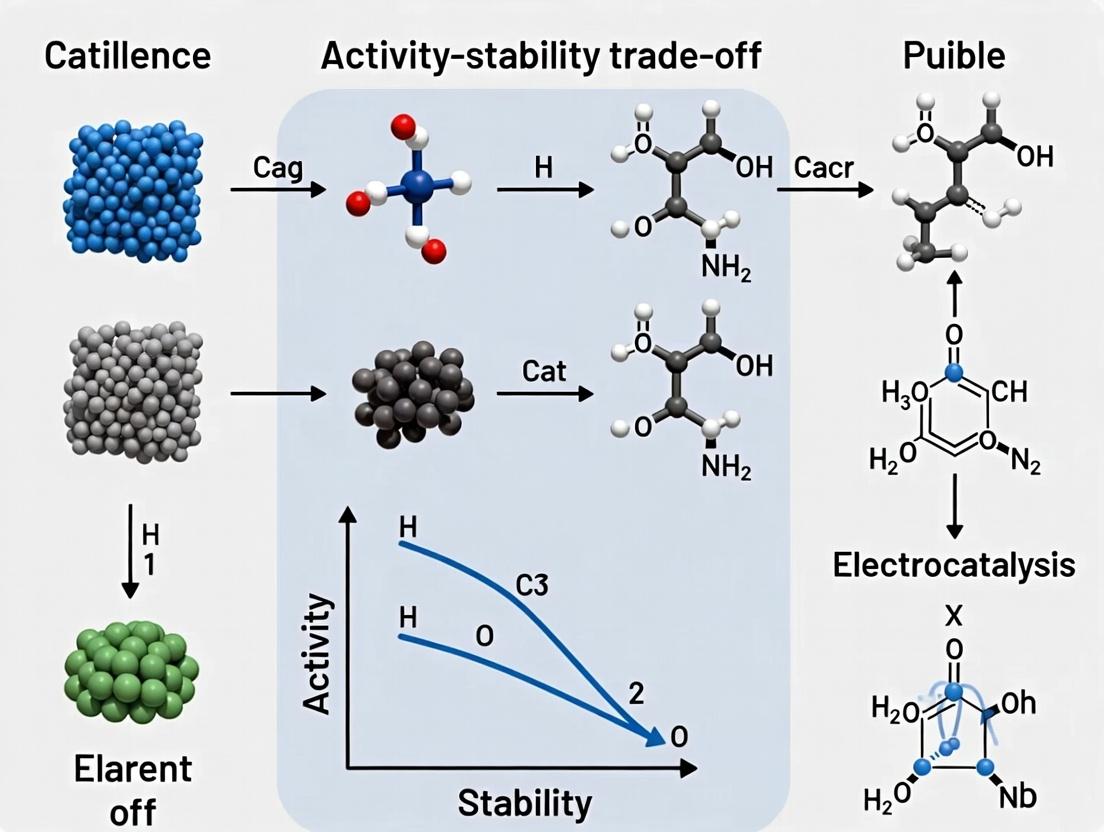
This article provides a comprehensive analysis of the fundamental activity-stability trade-off in electrocatalysis, a critical barrier for next-generation biomedical devices and bio-electrochemical systems.
The Electrocatalysis Conundrum: Innovative Strategies to Overcome the Activity-Stability Trade-off for Advanced Biomedical Applications
Abstract
This article provides a comprehensive analysis of the fundamental activity-stability trade-off in electrocatalysis, a critical barrier for next-generation biomedical devices and bio-electrochemical systems. We explore the atomic-scale origins of catalytic degradation under operational conditions and systematically review state-of-the-art strategies for engineering durable yet highly active electrocatalysts. Methodological approaches for synthesis, in-situ characterization, and performance benchmarking are detailed. The content is specifically tailored for researchers, materials scientists, and drug development professionals working on implantable biosensors, biofuel cells, and electrocatalytic therapeutic platforms, offering a roadmap for designing robust electrocatalytic interfaces essential for reliable long-term biomedical performance.
Unraveling the Core Dilemma: The Inevitable Clash Between High Activity and Long-Term Stability in Electrocatalysis
Technical Support Center: Troubleshooting Electrocatalysis Experiments
This support center addresses common experimental challenges in electrocatalysis research, specifically within the context of investigating the intrinsic thermodynamic and kinetic origins of the activity-stability trade-off.
Frequently Asked Questions (FAQs)
Q1: During accelerated durability tests (ADTs) for oxygen reduction reaction (ORR) catalysts, I observe a rapid initial loss in electrochemical surface area (ECSA), followed by stabilization. Is this normal, and what does it indicate? A: Yes, this is a commonly observed phenomenon. The initial rapid loss often stems from the dissolution of highly unstable, under-coordinated surface atoms (e.g., steps, kinks) or the detachment of nanoparticulate catalysts from the carbon support due to carbon corrosion. The subsequent stabilization suggests the remaining catalyst surface has reached a more thermodynamically stable morphology. This directly illustrates the trade-off: the most active sites are often thermodynamically metastable. Monitor ECSA via in-situ Cu underpotential deposition (UPD) or CO stripping to correlate activity loss with surface area change.
Q2: My transition metal oxide electrocatalyst for the oxygen evolution reaction (OER) shows high initial activity but quickly degrades. Cyclic voltammetry reveals a continuous anodic shift in the redox peak potentials. What is the likely mechanism? A: This is indicative of surface reconstruction or phase transformation. The high anodic potentials and oxidizing conditions of OER can drive the catalyst surface to a more thermodynamically stable, often less active, oxidized phase (e.g., from a spinel to a hydroxyoxide). The shifting redox peaks signal a change in the thermodynamic landscape of the surface cations. To confirm, employ in-situ Raman or X-ray absorption spectroscopy to track phase evolution during operation.
Q3: When testing a new catalyst, how can I decouple intrinsic activity degradation from losses caused by electrode structuring issues, like binder failure or catalyst layer detachment? A: Implement a multi-scale diagnostic protocol:
- Post-mortem Physical Inspection: Use scanning electron microscopy (SEM) on the used electrode to check for cracks or delamination.
- Electrochemical Impedance Spectroscopy (EIS): Track series resistance and charge-transfer resistance. A sudden increase in series resistance may indicate contact loss.
- Redox Probe Method: After durability testing, cycle the electrode in a non-reactive, outer-sphere redox couple (e.g., ([Fe(CN)_6]^{3−/4−})). A significant decrease in peak current suggests structural/conductivity issues rather than just catalytic site deactivation.
Q4: For a platinum-group-metal (PGM) catalyst, I suspect metal dissolution is the primary degradation pathway. What experiment can I perform to quantify this kinetically? A: Use an electrochemical scanning flow cell (SFC) coupled to an inductively coupled plasma mass spectrometer (ICP-MS). This setup allows you to apply potential holds or cycles to the catalyst while simultaneously quantifying the dissolution rate of metals in the effluent with sub-monolayer sensitivity. You can then directly correlate dissolution kinetics (a kinetic degradation process) with the applied potential (thermodynamic driving force).
Troubleshooting Guides
Issue: Inconsistent Activity Measurements for Hydrogen Evolution Reaction (HER) Catalysts
- Symptom: High variance in overpotential at a fixed current density between replicate experiments.
- Potential Causes & Solutions:
- Uncompensated Resistance (Ru): Fluctuations in Ru due to electrode placement or electrolyte level.
- Solution: Always use iR compensation (e.g., 85-95%) and report the compensation level. Measure electrolyte resistance before each experiment with EIS.
- Reference Electrode Drift:
- Solution: Use a freshly prepared reference electrode, employ a double-junction design to prevent contamination, and confirm its potential against a known standard (e.g., reversible hydrogen electrode, RHE) before and after measurement.
- Bubble Adhesion: H₂ bubbles blocking active sites introduce stochastic noise.
- Solution: Use a rotating disk electrode (RDE) at a moderate rotation speed (e.g., 1600 rpm) to dislodge bubbles and ensure consistent mass transport.
- Uncompensated Resistance (Ru): Fluctuations in Ru due to electrode placement or electrolyte level.
Issue: Distinguishing Between True Catalyst Deactivation and Pseudo-Decay from Impurities
- Symptom: Gradual, continuous performance decline over many cycles.
- Diagnostic Workflow:
- Check Electrolyte Purity: Prepare fresh, high-purity electrolyte (e.g., 18 MΩ·cm water, double-distilled acids). Run a blank voltammogram on an inert electrode (e.g., glassy carbon) to check for redox peaks from impurities.
- Replace Electrolyte Mid-Test: During a long-term chronoamperometry test, carefully replace the electrolyte with a fresh batch. If the activity recovers to near-initial levels, the decay was likely due to reactant depletion or impurity accumulation, not permanent catalyst degradation.
- Analyze the Catalyst Surface: Use post-operation X-ray photoelectron spectroscopy (XPS) to detect foreign species (e.g., S, Cl, organics) adsorbed from electrolytes or cell components.
Research Reagent Solutions Toolkit
| Item | Function in Trade-off Studies |
|---|---|
| Ionomer Solution (e.g., Nafion) | Binds catalyst particles to the electrode substrate. Incorrect ionomer-to-catalyst ratio can block active sites or impede mass transport, confounding intrinsic stability measurements. |
| Electrochemical Redox Probes (e.g., 1.0 mM K₃[Fe(CN)₆]) | Used to diagnose changes in electrode conductivity and active surface area independently of the catalyst's intrinsic activity. |
| Metal Salt Solutions (e.g., CuSO₄) | For underpotential deposition (UPD) to determine the electrochemical surface area (ECSA) of precious metal catalysts before and after stability tests. |
| High-Purity Inert Gases (Ar, N₂) | For electrolyte deaeration to remove O₂, which can interfere with non-OER/HER reactions or cause unwanted oxidative degradation. |
| Single-Crystal Catalyst Electrodes | Model systems with well-defined facets (e.g., Pt(111), Pt(100)) to study facet-dependent thermodynamic stability and kinetic activity without the complicating effects of particle size and support. |
Experimental Protocols
Protocol 1: Quantifying Catalyst Stability via Chronopotentiometry Objective: Measure the change in required potential to maintain a constant current over time, indicating catalyst degradation.
- Setup: Use a standard three-electrode cell with a catalyst-coated rotating disk electrode (RDE), Pt counter electrode, and stable reference electrode (e.g., Hg/Hg₂SO₄).
- Activation: Perform 20-50 cyclic voltammetry (CV) cycles in the reactant-saturated electrolyte (e.g., O₂ for ORR) at 50 mV/s within the relevant potential window.
- Stability Test: Switch to chronopotentiometry mode. Apply a constant current density corresponding to a specific overpotential (e.g., -3 mA/cm² for HER). Record the potential for a minimum of 2-24 hours.
- Diagnostic Interlude: Periodically interrupt the test to perform CVs in an inert electrolyte to monitor ECSA loss.
- Data Analysis: Plot potential vs. time. A sharp increase indicates rapid degradation. Calculate the potential decay rate (mV/h).
Protocol 2: In-Situ Electrochemical Surface Area Monitoring via Cu UPD Objective: To track the loss of active surface area of a Pt-based catalyst during stability testing.
- Pre-cleaning: Cycle the catalyst electrode in 0.1 M HClO₄ between 0.05 and 1.0 V vs. RHE until a stable CV is obtained.
- ECSA Initial: Switch to a deaerated 0.1 M HClO₄ + 50 µM CuSO₄ solution. Hold potential at 0.8-0.9 V vs. RHE for 30 s to ensure no Cu adsorption.
- Cu Deposition: Step the potential to 0.25-0.35 V vs. RHE (within the Cu UPD region) and hold for 10-30 s to form a sub-monolayer of Cu.
- Cu Stripping: Perform an anodic linear sweep voltammetry from the holding potential to ~0.8 V vs. RHE at 10 mV/s. The charge under the Cu stripping peak is integrated.
- Calculation: ECSA (cm²) = (Cu stripping charge, Q, in µC) / (420 µC/cm²Pt * catalyst loading, mgPt/cm²). Repeat this protocol at intervals during a long-term stability test.
Table 1: Common Degradation Pathways and Their Signatures
| Degradation Pathway | Primary Driver (Thermodynamic/Kinetic) | Key Experimental Signature | Typical Measurement Technique |
|---|---|---|---|
| Ostwald Ripening | Reduction of surface energy (Thermodynamic) | Increase in average particle size, loss of smallest particles. | Ex-situ TEM, in-situ SAXS. |
| Particle Detachment | Weak metal-support interaction (Thermodynamic) | Loss of catalyst mass, decrease in ECSA without change in particle size. | ICP-MS of electrolyte, SEM of electrode. |
| Dissolution/Re-deposition | Potential-dependent solubility (Thermodynamic) & Diffusion (Kinetic) | Loss of ECSA, possible particle size redistribution. | On-line ICP-MS, EC-STM. |
| Support Corrosion (Carbon) | Electrochemical oxidation at high potentials (Kinetic) | Loss of catalyst layer conductivity, particle aggregation. | EIS, Raman spectroscopy for carbon disorder. |
Table 2: Benchmarking Stability Metrics for ORR Catalysts (Example Data)
| Catalyst Type | Initial Mass Activity @ 0.9 V (A/mg_Pt) | ECSA Loss after 30k ADT cycles (0.6-1.0 V) | Mass Activity Loss after 30k ADT cycles | Dominant Degradation Mode |
|---|---|---|---|---|
| Pt/C (Commercial) | 0.25 | ~40-60% | ~60-80% | Agglomeration, Detachment |
| PtCo/C Alloy | 0.45 | ~30-50% | ~50-70% | Co leaching, Pt dissolution |
| Pt Monolayer on Pd | 0.65 | ~50-70% | ~70-90% | Dissolution of Pt monolayer |
| Pt₃Ni Nanoframes | 0.75 | ~15-30% | ~30-50% | Surface reorganization |
Visualizations
Troubleshooting Guides and FAQs
Q1: During accelerated stress tests (AST) for oxygen reduction reaction (ORR) catalysts, my Pt/C electrode shows a rapid loss in electrochemical surface area (ECA). Which degradation mechanism is most likely, and how can I confirm it? A1: The rapid ECA loss is characteristic of nanoparticle agglomeration or dissolution. To distinguish:
- Perform identical-location transmission electron microscopy (IL-TEM) before and after AST. An increase in average particle size confirms agglomeration.
- Use inductively coupled plasma mass spectrometry (ICP-MS) on the electrolyte after testing. Detectable Pt ions confirm dissolution.
- Electrochemical diagnostic: A positive shift in the underpotential deposited hydrogen (Hupd) peak potential often indicates particle coalescence/agglomeration.
Q2: My non-precious metal Fe-N-C catalyst loses activity in PEMFC MEA testing within 100 hours. What are the likely degradation pathways, and how can I troubleshoot them? A2: For M-N-C catalysts, oxidation and demetallation (a form of poisoning) are dominant.
- Troubleshoot via X-ray photoelectron spectroscopy (XPS): Compare fresh and tested cathode samples. A significant increase in C-O/C=O and N-O bonding, alongside a decrease in pyridinic/graphitic N and Fe-Nx signals, indicates carbon oxidation and active site destruction.
- Protocol: Ex-situ XPS Analysis of M-N-C Cathodes
- Carefully disassemble the tested MEA.
- Cut a small sample (~0.5 cm²) from the cathode.
- Rinse gently with deionized water to remove residual ions, then dry in an inert atmosphere (Ar glovebox).
- Mount the sample without any conductive tape if possible.
- Run high-resolution scans for C 1s, N 1s, O 1s, and Fe 2p (or relevant metal).
- Deconvolute peaks to quantify bond-type changes.
Q3: In an alcohol oxidation fuel cell, my Pd-based anode catalyst performance decays. I suspect poisoning. How can I identify the poisoning species and mitigate it? A3: Pd is highly susceptible to poisoning by strongly adsorbed carbonaceous intermediates (e.g., CO).
- Confirm via in-situ Fourier-transform infrared spectroscopy (FTIR): Set up an electrochemical cell with an IR-transparent window. Operate the catalyst at the anode potential and collect spectra. A strong band ~1950-2050 cm⁻¹ indicates linearly bonded CO.
- Mitigation Strategy: Alloy Pd with a secondary metal (e.g., Au, Sn, Bi) that provides oxygen-containing species at lower potentials to oxidize and remove the CO adsorbate.
Table 1: Common Metrics for Quantifying Electrocatalyst Degradation
| Degradation Pathway | Primary Diagnostic Technique | Key Quantitative Metric | Typical Threshold for Significant Loss |
|---|---|---|---|
| Dissolution | ICP-MS (Post-test electrolyte) | Metal ion concentration (µg/L) | > 5-10% of total loaded metal |
| Agglomeration | TEM / IL-TEM | Increase in average particle diameter (nm) | > 20% increase from initial size |
| Oxidation | XPS (C 1s, O 1s spectra) | Increase in C-O/C=O at.% or O/C ratio | O/C increase by > 0.1 |
| Poisoning (CO) | In-situ FTIR | Integrated area of CO adsorption band | > 50% site blocking estimated from charge |
Table 2: AST Protocol Parameters and Associated Dominant Degradation Mode
| AST Protocol (for Pt) | Common Conditions | Targeted Stress | Dominant Induced Degradation Mode |
|---|---|---|---|
| Potential Cycling (ECA loss) | 0.6 - 1.0 V vs. RHE, 100 mV/s in acid | Support corrosion, Pt dissolution/redeposition | Agglomeration, Detachment |
| Potential Holding | 1.2 - 1.5 V vs. RHE for hours | Carbon support oxidation | Agglomeration, Loss of electrical contact |
| Potential Cycling (Start/Stop) | 1.0 - 1.5 V vs. RHE | Pt dissolution at high potential | Dissolution, Particle Size Growth |
Experimental Protocols
Protocol 1: Standard Accelerated Stress Test (AST) for ORR Catalysts (RDE Setup) Objective: Induce and evaluate catalyst degradation under controlled electrochemical stress. Materials: Rotating disk electrode (RDE) setup, potentiostat, N₂/O₂ saturated electrolyte (e.g., 0.1 M HClO₄), catalyst-coated glassy carbon electrode. Procedure:
- Electrode Preparation: Create catalyst ink (catalyst, Nafion ionomer, water/isopropanol) and deposit onto a polished glassy carbon RDE tip to form a uniform thin film. Dry.
- Initial Characterization: In N₂-saturated electrolyte, perform cyclic voltammetry (CV) (e.g., 0.05 - 1.0 V vs. RHE) to determine initial ECA. Perform ORR polarization in O₂-saturated electrolyte.
- AST Cycling: Under N₂ atmosphere, subject the electrode to a defined potential cycle (e.g., 0.6 V to 1.0 V vs. RHE, 500 mV/s) for a set number of cycles (e.g., 5,000 - 30,000).
- Post-AST Characterization: Repeat Step 2 in fresh electrolyte to determine remaining ECA and ORR activity.
- Analysis: Calculate % loss in ECA and mass activity at a specific potential (e.g., 0.9 V vs. RHE).
Protocol 2: Detecting Dissolution via Online ICP-MS Objective: Measure metal dissolution in real-time during potential cycling. Materials: Electrochemical flow cell coupled to ICP-MS, peristaltic pump, catalyst-coated electrode, electrolyte. Procedure:
- Set up the flow cell with the working electrode upstream of the ICP-MS inlet. Ensure all connections are sealed.
- Start electrolyte flow at a constant rate (e.g., 0.2 mL/min). Begin ICP-MS data acquisition, monitoring the isotope of interest (e.g., 195Pt).
- Initiate electrochemical potential cycling on the working electrode.
- Synchronize the timestamps of the electrochemical data (potential, current) with the ICP-MS signal.
- Correlate dissolution spikes (ICP-MS signal peaks) with specific potential regions (e.g., anodic scans).
Diagrams
Diagram 1: Primary Electrocatalyst Degradation Pathways
Diagram 2: Workflow for Degradation Diagnosis
The Scientist's Toolkit: Key Research Reagent Solutions
Table 3: Essential Materials for Degradation Studies
| Item | Function / Relevance in Degradation Studies |
|---|---|
| Nafion Dispersions (e.g., 5 wt%) | Ionomer for preparing catalyst inks for RDE or MEA; its distribution can affect degradation rates. |
| High-Purity Acids (HClO₄, H₂SO₄) | Standard electrolytes for fundamental studies. Purity is critical to avoid extrinsic poisoning. |
| Carbon Support Materials (Vulcan XC-72, Ketjenblack) | Common catalyst supports. Their structure and corrosion resistance are key to agglomeration studies. |
| Accelerated Stress Test (AST) Kits | Commercial flow cells or hardware designed for standardized, reproducible AST protocols (e.g., from PINE Research, Gaskatel). |
| ICP-MS Standard Solutions | Calibration standards (e.g., Pt, Pd, Co, Fe) for quantifying dissolution in electrolyte samples. |
| Reference Electrodes (RHE, SCE) | Essential for accurate potential control during AST and diagnostics. Must be carefully maintained. |
| Gas Diffusion Layers (GDLs) | For MEA studies. Hydrophobicity and structure impact local environment and thus degradation. |
| Quartz Crystal Microbalance (QCM) Electrodes | For in-situ mass change measurements during potential cycles, directly probing dissolution/adsorption. |
Technical Support Center: Troubleshooting Electrocatalytic Device Performance
FAQ & Troubleshooting Guide
Q1: My implantable glucose sensor shows rapid signal decay (drift) in vivo. What could be the cause and how can I mitigate it?
A: Signal drift is often caused by the activity-stability trade-off in the electrocatalytic interface (e.g., glucose oxidase/hydrogen peroxide detection on Pt). Fouling from proteins (biofouling) and inflammatory cells degrades both activity and stability.
- Troubleshooting Steps:
- Verify Biocompatible Coating: Ensure your Nafion or polyurethane coating is uniform and uncracked. Use SEM imaging.
- Check Catalyst Loading: Incrementally increase Pt or PtIr alloy loading to enhance stability against poisoning, but monitor for increased inflammatory response.
- Pre-test in Fouling Solution: Perform a 72-hour chronoamperometry test in 10 g/L bovine serum albumin (BSA) solution at 37°C before in vivo use. A drift of >15% indicates a high fouling risk.
- Experimental Protocol: Accelerated Fouling Test:
- Prepare a PBS solution with 10 g/L BSA and 5 mM glucose.
- Immerse the working electrode (sensor) and record amperometric current at +0.7V (vs. Ag/AgCl) for 72 hours at 37°C.
- Calculate signal drift as:
((I_initial - I_72h) / I_initial) * 100%.
Q2: The power output of my enzymatic biofuel cell (BFC) decreases by over 50% within 24 hours. How can I improve its operational stability?
A: This core issue is the activity-stability trade-off in bioelectrocatalysis. Enzyme denaturation, cofactor leaching, and degradation of the electron transfer mediator or matrix are typical culprits.
- Troubleshooting Steps:
- Evaluate Immobilization Matrix: Switch from a simple hydrogel (e.g., PVA) to a cross-linked redox polymer (e.g., [Os(bpy)2Cl-PVP]+) or a nanostructured carbon scaffold (e.g., multi-walled carbon nanotubes) to enhance enzyme stability and electron wiring.
- Assess Mediator Stability: If using a soluble mediator (e.g., methylene blue), replace it with a covalently bound or polymer-based mediator to prevent leaching.
- Check Local pH: Enzyme activity is pH-sensitive. Use a buffered electrolyte (e.g., 0.1 M PBS, pH 7.4) and consider incorporating a pH-buffering component like zirconia nanoparticles within the immobilization layer.
- Experimental Protocol: Stability Benchmarking for BFCs:
- Operate the BFC under constant resistive load (e.g., 10 kΩ) in physiologically relevant buffer (PBS, 37°C).
- Record the voltage across the load every minute for 24-72 hours.
- Calculate the Half-Life (t₁/₂) by fitting the voltage decay curve to a first-order exponential decay model.
Q3: During electrocatalytic tumor therapy (e.g., electro-Fenton), the generation of reactive oxygen species (ROS) is inconsistent between experiments. What factors should I control?
A: Inconsistent ROS generation stems from variability in the electrocatalytic process, primarily at the cathode where O₂ is reduced to H₂O₂.
- Troubleshooting Steps:
- Calibrate H₂O₂ Production: Use a standard rotating ring-disk electrode (RRDE) experiment to precisely quantify the H₂O₂ yield (%) of your cathode catalyst (e.g., Fe-N-C) before in vitro tests.
- Control Oxygen Supply: Maintain a constant O₂ sparging rate (e.g., 20 sccm) or use an air-saturation chamber. Monitor dissolved O₂ with a probe.
- Verify Catalyst Conditioning: Pre-cycle your electrode (e.g., 50 CV cycles from -0.8 to 0.2V vs. RHE) to achieve a stable electrochemical surface area (ECSA) before therapy initiation.
- Experimental Protocol: RRDE H₂O₂ Yield Quantification:
- Prepare a 0.1 M HClO₄ or PBS (pH 7.4) electrolyte saturated with O₂.
- Set the disk electrode (catalyst) potential to scan for O₂ reduction. Set the Pt ring potential to +1.2V (vs. RHE) to oxidize any H₂O₂ produced.
- Calculate H₂O₂% using the formula:
H₂O₂% = (200 * I_ring/N) / (I_disk + I_ring/N), where N is the ring collection efficiency.
Table 1: Performance Decay Metrics in Biomedical Electrocatalytic Devices
| Device Category | Key Performance Indicator (KPI) | Typical Baseline | After 1-Week In Vivo/Operational Stress | Common Target Stability | Primary Degradation Cause |
|---|---|---|---|---|---|
| Implantable Sensor | Sensitivity (nA/mM) | 5 - 10 | Decrease by 40-70% | <20% decay over 1 week | Biofouling, Catalyst Poisoning |
| Enzymatic BFC | Power Density (µW/cm²) | 50 - 150 | Decrease by 50-90% | >50% retention at 48 hours | Enzyme Denaturation, Mediator Leaching |
| Electrocatalytic Therapy Electrode | H₂O₂ Yield (%) / Faradaic Efficiency | 60 - 85% | Decrease by 30-50% | >80% stable yield for >1 hour | Catalyst Oxidation/Passivation, pH Shift |
Table 2: Key Reagent Solutions for Stability Enhancement
| Research Reagent Solution | Function | Example Application |
|---|---|---|
| Nafion or Polyurethane Dispersion | Forms a biocompatible, semi-permeable barrier; reduces fouling and cofactor leaching. | Coating for implantable glucose or glutamate sensors. |
| Cross-linked Redox Hydrogels (e.g., [Os(bpy)2Cl-PVP]+) | Provides 3D matrix for enzyme immobilization, facilitates electron transfer, enhances enzyme stability. | Wiring laccase (cathode) or glucose oxidase (anode) in BFCs. |
| Fe-N-C Catalyst Ink | High-activity, selective catalyst for the 2-electron oxygen reduction reaction (ORR) to H₂O₂. | Cathode for electrocatalytic (electro-Fenton) tumor therapy. |
| Zirconia (ZrO₂) Nanoparticles | Incorporated into immobilization layers to buffer local pH shifts that degrade enzyme/mediator function. | Stabilizing pH in enzymatic BFCs operating in weakly buffered physiological fluids. |
Visualizations
Title: Activity-Stability Trade-Off Drives Device Failure
Title: Troubleshooting Workflow for Electrocatalytic Device Failure
Technical Support Center: Troubleshooting Electrocatalyst KPI Measurement
Frequently Asked Questions (FAQs)
Q1: Why is my measured overpotential (η) for the oxygen evolution reaction (OER) significantly higher than literature values for the same catalyst material? A1: High overpotential can stem from multiple experimental factors.
- Check 1: iR Compensation: Uncompensated solution resistance (Ru) is the most common issue. Use positive feedback or current interruption methods with your potentiostat. Validate compensation by ensuring the slope of the current rise in a potential step experiment is finite.
- Check 2: Reference Electrode Calibration: Re-calibrate your reference electrode (e.g., Hg/HgO, Ag/AgCl) frequently against a reversible hydrogen electrode (RHE) in the same electrolyte. Use high-purity H2 for RHE calibration.
- Check 3: Catalyst Layer Integrity: Ensure your catalyst ink is well-dispersed (using Nafion or chitosan binders with appropriate sonication) and evenly coated on the substrate (e.g., glassy carbon). Cracks or delamination increase series resistance.
Q2: My turnover frequency (TOF) calculation yields unrealistic values (too high/low). What are the potential sources of error? A2: TOF inaccuracies typically originate from incorrect determination of the active site count (n).
- Problem: Using total metal loading instead of electrochemically active surface area (ECSA).
- Solution:
- For Pt-group/noble metals: Integrate the hydrogen underpotential deposition (Hupd) or CO-stripping charge in cyclic voltammetry. Use the conversion: n (sites) = Q (C) / (2 * 1.602×10-19 C per site for Hupd, or 420 µC cmPt-2 for CO).
- For non-noble metal oxides (NiFeOx, CoOx): Use the redox peak charge from cyclic voltammetry in a non-Faradaic region if a clear, surface-confined redox couple is identified.
- Report Assumptions: Clearly state the method and assumed number of electrons per site (e.g., 1 e- per surface atom) when reporting TOF.
Q3: How do I differentiate between catalyst deactivation and electrode fouling when measuring lifetime? A3: Implement a diagnostic protocol during your stability test (e.g., chronopotentiometry, CP).
- Step 1: Periodically interrupt CP to run a low-rate cyclic voltammogram (CV, e.g., 10 mV s-1) in the catalyst's redox region.
- Step 2: If the CV shape and ECSA remain constant but the overpotential increases, true catalyst deactivation (e.g., oxidation, dissolution) is likely.
- Step 3: If the CV features diminish and ECSA drops, physical fouling or detachment is probable.
- Step 4: Collect electrolyte for ICP-MS analysis to confirm metal dissolution.
Q4: What is the most robust way to report decay rates for electrocatalysts? A4: Always report multiple metrics. Single-point reporting can be misleading.
- Tafel Decay: Report the increase in overpotential (Δη, in mV) per decade of time (e.g., mV dect-1).
- Activity Half-life: Time for the current density (at fixed η) or ECSA to drop to 50% of its initial value.
- Rate Constant for Deactivation: Fit the current decay to a first-order (or other) kinetic model: j(t) = j0 exp(-kdecayt), and report kdecay.
Table 1: Benchmarking Key Activity & Stability Metrics for OER Catalysts in 1 M KOH
| Catalyst | η @ 10 mA cm-2 (mV) | TOF @ η=300 mV (s-1) | Stability Test | Lifetime (h) @ 10 mA cm-2 | Decay Rate (mV h-1) | Key Ref. |
|---|---|---|---|---|---|---|
| IrO2 (std.) | 280 - 320 | 0.4 - 1.2 | Chronopotentiometry | 20 - 100 | 0.5 - 2.0 | [1] |
| NiFe LDH | 210 - 260 | 0.1 - 0.5 | Chronopotentiometry | 50 - 500 | 0.05 - 0.5 | [2] |
| CoPi (electrodep.) | 345 - 410 | ~0.02 | Chronoamperometry | 10 - 24 | 2.0 - 5.0 | [3] |
| Protocol Note: η measured vs. RHE; TOF based on ECSA from CV; Stability at room temp. |
Detailed Experimental Protocols
Protocol A: Standardized Measurement of OER Overpotential and TOF Objective: Quantify activity KPIs for an oxide electrocatalyst.
- Electrode Prep: Deposit 0.2 mgcat cmgeo-2 on polished glassy carbon (5 mm dia.). Use ink: 5 mg catalyst, 950 µL ethanol, 50 µL 0.5 wt% Nafion, sonicate 30 min.
- ECSA Determination: In N2-sat. 1 M KOH, record CVs from 0.8 to 1.1 V vs. RHE at scan rates 20-100 mV s-1. Plot Δj (at a mid-point potential) vs. scan rate; slope = double-layer capacitance (Cdl). Assume specific capacitance 40 µF cm-2 to calculate ECSA.
- OER Polarization: In O2-sat. 1 M KOH, perform linear sweep voltammetry (LSV) at 5 mV s-1 with 95% iR-compensation. Record η at j = 10 mA cmgeo-2.
- TOF Calculation: TOF = (j A cmgeo-2 * NA) / (n * F). Where j at η=300 mV, n = active sites = (ECSA cmgeo-2) * (site density). Assume site density = 1.5×10¹⁵ sites cm-2.
Protocol B: Accelerated Stability Test & Decay Rate Analysis Objective: Quantify stability KPIs and derive a decay rate constant.
- Stress Test Setup: In a 3-electrode cell with fresh electrolyte, apply constant current density (jstab = 10 mA cmgeo-2 for OER). Record potential (E) vs. time (t) for 24-100 h.
- Diagnostic Intervals: Every 2 hours, pause CP, switch to N2 flow, and record a CV (1.0 - 1.1 V vs. RHE, 50 mV s-1) to monitor Cdl.
- Data Processing:
- Plot E (or η) vs. log(t). The slope is the Tafel decay (mV dect-1).
- Plot normalized activity (j/j0 or Cdl/Cdl,0) vs. t. Fit to exponential decay: y = exp(-kdecayt). Report kdecay.
Visualizing the Activity-Stability Trade-Off & Diagnostics
Activity-Stability Diagnostic Workflow
The Activity-Stability Trade-Off in Electrocatalysis
The Scientist's Toolkit: Research Reagent Solutions
Table 2: Essential Materials for Electrocatalyst KPI Evaluation
| Item | Function / Purpose | Key Consideration |
|---|---|---|
| High-Purity Alkali Salts (e.g., KOH, NaOH) | Electrolyte for OER/HER. Minimizes impurity-driven degradation. | Use ≥99.99% trace metals basis. Re-purify by recrystallization if needed. |
| Nafion Perfluorinated Resin (5 wt% in alcs.) | Binder for catalyst inks. Provides proton conductivity & adhesion. | Dilute to 0.1-0.5% in ink. Excessive amounts block active sites. |
| Isopropanol (HPLC Grade) | Dispersion solvent for catalyst inks. Low water content. | Dry over molecular sieves to prevent oxide catalyst aging during ink prep. |
| CO (Carbon Monoxide), 99.5% | Probe molecule for active site counting (CO-stripping) on noble metals. | Use in a fume hood. Requires proper gas handling system with mass flow control. |
| Reversible Hydrogen Electrode (RHE) | Critical reference for reporting potentials in non-NHE scales. | Requires continuous H2 flow (high purity, >99.999%) over a Pt foil in the same electrolyte. |
| Glassy Carbon Electrodes (Polished) | Standard substrate for rotating disk electrode (RDE) studies. | Polish sequentially with 1.0, 0.3, and 0.05 µm alumina slurry before each use. |
Engineering Robust Catalysts: Synthesis Strategies and Biomedical Applications to Break the Trade-off
Technical Support Center: Troubleshooting & FAQs
This support center is designed for researchers addressing the activity-stability trade-off in electrocatalysis. The following guides address common experimental issues in fabricating and characterizing core-shell nanostructures for stable, active electrocatalysts.
Frequently Asked Questions (FAQs)
Q1: During the synthesis of my Pt@Metal Oxide core-shell nanoparticle, I am getting a heterogeneous mixture of core-shell and separate nanoparticle aggregates. What could be the cause? A: This is typically a kinetic control failure during the shell growth step. The most common causes are:
- Insufficient Stabilizing Agent: The concentration of your capping agent (e.g., PVP, citrate) is too low to prevent homonucleation of the shell precursor.
- Rapid Precursor Injection: Adding the shell precursor too quickly leads to a high local supersaturation, favoring self-nucleation over epitaxial growth on the core.
- Mismatched Surface Energy: The core surface may not be properly functionalized to interact with the shell precursor. Ensure your core nanoparticles are thoroughly cleaned of excess surfactants from their synthesis before shell growth.
Q2: My core-shell catalyst shows excellent initial activity for the Oxygen Reduction Reaction (ORR) but the shell appears to degrade or dissolve during accelerated stability tests (AST). How can I improve shell stability? A: Shell degradation under electrochemical cycling is a key challenge. Solutions include:
- Optimizing Shell Crystallinity: A more crystalline shell (e.g., annealed TiO₂) is often more stable than an amorphous one. Consider a post-synthesis thermal treatment in a controlled atmosphere.
- Introducing a Dopant: Doping the shell material (e.g., Nb-doped TiO₂, N-doped carbon) can improve its electronic conductivity and corrosion resistance.
- Increasing Shell Thickness (Carefully): A thicker shell may offer better protection but can completely block activity if too thick. Use techniques like XPS depth profiling to calibrate your deposition process.
Q3: How can I conclusively prove the formation of a core-shell structure and not just a heterodimer or alloy? A: A multi-technique characterization approach is mandatory. Correlate data from:
- High-Resolution TEM/STEM-EDS: To visualize lattice fringes and map element distribution.
- X-ray Photoelectron Spectroscopy (XPS): To confirm the chemical states of core and shell elements. Look for binding energy shifts in the core element due to the shell coating.
- In-situ/Operando XAFS (XANES/EXAFS): This is a gold standard for proving the structure under reaction conditions, providing data on coordination numbers and bond distances.
Q4: The catalytic activity of my protected catalyst is significantly lower than the bare core nanoparticle. Is this inevitable? A: Not inevitable, but it requires shell engineering. The trade-off can be mitigated by:
- Using Conductive Shells: Employ shells with high electronic conductivity (e.g., doped metal oxides, graphene layers).
- Creating Porous Shells: Develop shells with controlled porosity (e.g., mesoporous silica, metal-organic frameworks) that allow reactant access to the active core.
- Utilizing Strain and Ligand Effects: A thin, epitaxial shell can modify the electronic structure of the core surface, potentially enhancing its intrinsic activity while protecting it.
Troubleshooting Guides
Issue: Inconsistent Shell Thickness Across Core Nanoparticle Batch
- Symptoms: High standard deviation in electrochemical surface area (ECSA) measurements; broad peaks in particle size analysis (DLS).
- Potential Causes & Steps:
- Cause: Non-uniform core size distribution.
- Solution: Implement stricter size-selective precipitation for the core nanoparticles before shell growth.
- Cause: Inefficient mixing during shell precursor addition.
- Solution: Use a syringe pump for slow, dropwise addition into a vigorously stirred core solution. Consider using a flask with baffles.
- Cause: Temperature gradients in the reaction vessel.
- Solution: Use an oil bath with magnetic stirring for uniform heating, not a hot plate.
- Cause: Non-uniform core size distribution.
Issue: Loss of Electrochemical Activity After Shell Coating
- Symptoms: Severe drop in specific activity or ECSA compared to uncoated cores.
- Diagnostic Protocol:
- Measure ECSA via underpotential deposition (UPD): Confirm if the core surface is accessible. If UPD fails, the shell is likely non-porous and too thick.
- Perform Cyclic Voltammetry in a non-Faradaic region: Analyze the double-layer capacitance. A significant increase may indicate a highly insulating, thick shell.
- Conduct XPS Analysis: Check if the shell is completely covering the core. The presence of core element signals may indicate a porous or incomplete shell.
Experimental Protocol: Synthesis of Pt@TiO₂ Core-Shell Nanoparticles via Hydrolysis
Objective: To synthesize Pt nanoparticles coated with a thin, conformal TiO₂ shell for stable electrocatalysis.
Materials: See "Research Reagent Solutions" table below. Procedure:
- Synthesis of Pt Cores: Heat 100 mL of ethylene glycol to 160°C under Ar flow. Rapidly inject 3 mL of 20 mM H₂PtCl₆ in ethylene glycol. Reflux at 160°C for 1 hour. Cool to room temperature.
- Purification: Precipitate Pt NPs by adding acetone and centrifuge at 12,000 rpm for 15 min. Redisperse in 40 mL of isopropanol.
- Shell Growth: In a separate flask, mix 20 mL of the Pt/isopropanol dispersion with 0.1 mL of ammonia solution (28%). Sonicate for 10 min.
- Precursor Addition: Using a syringe pump, add 1 mL of titanium(IV) butoxide (dissolved in 10 mL isopropanol) at a rate of 0.5 mL/hr under vigorous stirring at 30°C.
- Aging: Stir the reaction mixture for 12 hours at 30°C.
- Collection: Centrifuge the product, wash twice with ethanol, and dry under vacuum.
- Annealing (Optional): For a crystalline anatase TiO₂ shell, anneal at 350°C in Ar for 2 hours.
Research Reagent Solutions
| Item | Function & Rationale |
|---|---|
| Chloroplatinic Acid (H₂PtCl₆) | Precursor for Pt core nanoparticles. Ethylene glycol acts as both solvent and reducing agent in polyol synthesis. |
| Titanium(IV) Butoxide (Ti(OBu)₄) | Precursor for the TiO₂ shell. Highly reactive to hydrolysis, allowing low-temperature growth on the NP surface. |
| Ammonia Solution (NH₄OH) | Catalyzes the controlled hydrolysis and condensation of Ti(OBu)₄, preventing rapid bulk precipitation. |
| Polyvinylpyrrolidone (PVP, MW ~55,000) | Common capping agent/stabilizer to control NP growth and prevent aggregation during synthesis. |
| Anhydrous Isopropanol | Solvent for shell growth step. Anhydrous conditions allow precise control over hydrolysis rate. |
| Nafion Perfluorinated Resin | Standard proton-conducting binder for preparing catalyst ink for electrochemical testing. |
| High-Surface-Area Carbon (e.g., Vulcan XC-72) | Conductive catalyst support to prevent NP agglomeration and facilitate electron transfer. |
Data Presentation: Core-Shell ORR Catalyst Performance
Table 1: Comparative Electrochemical Data for Pt-based ORR Catalysts
| Catalyst Structure | Initial ECSA (m²/gₚₜ) | ECSA Retention after 10k AST cycles (%) | Mass Activity @ 0.9 V (A/mgₚₜ) | Specific Activity (mA/cm²ₚₜ) | Key Stability Feature |
|---|---|---|---|---|---|
| Pt/C (Commercial) | 65 | ~55% | 0.25 | 0.38 | Baseline - Significant dissolution/aggregation |
| Pt₃Co Alloy/C | 75 | ~70% | 0.45 | 0.60 | Improved stability via alloying |
| Pt@TiO₂ (Porous)/C | 50 | ~90% | 0.30 | 0.60 | TiO₂ shell protects against dissolution |
| Pt@N-doped C/C | 45 | ~95% | 0.28 | 0.62 | Conductive carbon overlay prevents coalescence |
Table 2: Common Shell Materials & Their Properties
| Shell Material | Primary Protection Mechanism | Typical Synthesis Method | Conductivity | Suited For Reactions |
|---|---|---|---|---|
| TiO₂, SiO₂ | Physical barrier, prevents coalescence & dissolution | Sol-gel, Hydrolysis | Insulating / Semiconductor | ORR, CO₂RR (with careful thickness control) |
| N-doped Carbon | Conductive barrier, prevents coalescence | Pyrolysis of polymer coatings | Highly Conductive | ORR, HER, OER |
| Metal-Organic Framework | Molecular sieving, selective reactant access | Stepwise liquid-phase epitaxy | Tunable | Selective catalysis (e.g., CO₂RR to specific product) |
| Graphene | Conductive, impermeable barrier | Chemical Vapor Deposition | Highly Conductive | HER, CORR |
Visualizations
Title: Addressing the Activity-Stability Trade-off via Core-Shell Design
Title: Core-Shell Synthesis & Characterization Workflow
Technical Support & Troubleshooting Center
This support center addresses common experimental challenges in developing alloy and intermetallic electrocatalysts to overcome the activity-stability trade-off. All content is framed within the broader thesis of achieving durable, high-performance electrocatalysis.
FAQs & Troubleshooting Guides
Q1: During accelerated durability testing (ADT) of my Pt-Li intermetallic nanoparticle catalyst, I observe a rapid loss of electrochemical surface area (ECSA) within the first 500 cycles. What could be the primary cause? A: A rapid initial ECSA loss often points to insufficient elemental intermixing or the presence of non-intermetallic, disordered alloy phases. These phases are prone to rapid dissolution of the more active (less noble) metal under oxidative potentials. Ensure your synthesis protocol includes a high-temperature annealing step (≥600°C) under inert/reducing atmosphere with sufficient hold time to achieve a fully ordered structure. Confirm long-range order via XRD (superlattice peaks) or HR-TEM with FFT analysis.
Q2: My intermetallic PtZn catalyst shows excellent stability but poor oxygen reduction reaction (ORR) mass activity compared to pure Pt. How can I tune this? A: This is a classic over-stabilization issue. The electronic structure has been tuned too far, overly weakening the adsorption energy of key reaction intermediates (e.g., *OH). To correct this:
- Apply a post-synthesis dealloying treatment: Use mild acid leaching (e.g., 0.1M acetic acid or HClO₄) to selectively etch a fraction of Zn from the surface, creating a Pt-rich skin with a lattice strain optimized for *OH binding.
- Consider a ternary alloy: Introduce a third, more oxophilic element (e.g., Ni, Co) at low atomic percent during synthesis to create a PtZnM intermetallic. This can provide a favorable ligand effect for intermediate binding without sacrificing order.
Q3: What is the most definitive ex-situ characterization to confirm the formation of an intermetallic compound versus a random alloy? A: Use a combination of techniques:
- X-ray Diffraction (XRD): Look for the presence of superlattice peaks (e.g., (100), (110) in an L1₀ structure), which are forbidden in a face-centered cubic random alloy. This confirms long-range chemical order.
- Scanning Transmission Electron Microscopy with Energy-Dispersive X-ray Spectroscopy (STEM-EDX): Acquire elemental maps and line scans. An intermetallic will show a perfectly ordered, alternating pattern of atoms in atomic-resolution maps, whereas a random alloy will show a homogeneous mix.
Q4: My catalyst synthesis yields a mix of ordered intermetallic and disordered alloy phases. How can I purify the product? A: Leverage the difference in chemical stability. Perform a selective acid wash. Based on live search data, a controlled potentiostatic hold at 1.1 V vs. RHE in 0.1M HClO₄ for 30-60 minutes can preferentially dissolve the less stable disordered phases while leaving the ordered intermetallic core intact. Monitor the solution with ICP-MS to confirm selective dissolution of the active metal.
Q5: For intermetallic thin-film model catalysts, how do I prevent surface oxidation prior to electrochemical testing? A: Implement an integrated ultra-high vacuum (UHV) to electrochemical transfer system. After synthesis/characterization in UHV, the sample is transferred under inert atmosphere (Ar glovebox) to the electrochemical cell, which is pre-filled with deaerated electrolyte. This preserves the pristine surface. If such a system is unavailable, use a droplet-cell setup within the glovebox to minimize air exposure.
Table 1: Performance Comparison of Selected ORR Catalysts
| Catalyst Type | Structure | Mass Activity @ 0.9V vs. RHE (A/mgₚₜ) | ECSA Loss after 30k ADT Cycles (%) | Reference Year |
|---|---|---|---|---|
| Pt/C | Random Alloy (fcc) | 0.25 | ~ 60% | 2022 |
| Pt₃Co/C | L1₂ Ordered Intermetallic | 0.56 | ~ 25% | 2023 |
| PtFe/C | Disordered Alloy | 0.48 | ~ 45% | 2021 |
| PtFe/C | L1₀ Ordered Intermetallic | 0.72 | ~ 15% | 2023 |
| PtNi/C | L1₀ Ordered Intermetallic | 0.95 | ~ 30% | 2024 |
Table 2: Effect of Annealing Temperature on Pt₃Co Ordering & Stability
| Annealing Temp. (°C) | LRO Parameter* | Initial MA (A/mgₚₜ) | ECSA Retention after 10k cycles | Predominant Phase |
|---|---|---|---|---|
| 400 | 0.15 | 0.50 | 62% | Disordered Alloy |
| 600 | 0.85 | 0.68 | 88% | L1₂ Intermetallic |
| 800 | 0.98 | 0.55 | 95% | L1₂ Intermetallic |
*Long-Range Order (LRO) Parameter from XRD (S=1 is perfect order).
Experimental Protocols
Protocol 1: Synthesis of L1₀-PtFe Intermetallic Nanoparticles Objective: To prepare carbon-supported, ordered PtFe nanoparticles for ORR studies.
- Precursor Co-impregnation: Dissolve H₂PtCl₆·6H₂O and Fe(NO₃)₃·9H₂O in ethanol at a 1:1 atomic ratio. Add Vulcan XC-72R carbon support and ultrasonicate for 1 hour.
- Solvent Evaporation: Stir the mixture at 80°C until completely dry.
- Initial Reduction: Reduce the precursors under 10% H₂/Ar gas flow at 300°C for 2 hours to form disordered alloy nanoparticles.
- Ordering Annealing: Seal the sample in a quartz tube under Ar atmosphere. Anneal in a tube furnace at 700°C for 5 hours. The slow cooling rate (<5°C/min) is critical for atomic ordering.
- Surface Cleaning (Optional): Perform a mild acetic acid wash (0.5M, 12h) to remove surface Fe oxide.
Protocol 2: In-situ Stability Assessment via Inductively Coupled Plasma Mass Spectrometry (ICP-MS) Objective: To quantitatively measure the dissolution rates of Pt and alloying metal (M) during potential cycling.
- Cell Setup: Use a standard 3-electrode electrochemical cell with the catalyst on a rotating disk electrode (RDE). Replace the standard glass cell with a Teflon cell to avoid metal contamination.
- Electrolyte Collection: Collect 1 mL aliquots of the electrolyte (0.1M HClO₄) at defined intervals (e.g., every 500 cycles) during ADT (0.6-1.0 V vs. RHE, 500 mV/s).
- Sample Preparation: Acidify each aliquot with 2% ultrapure HNO₃.
- ICP-MS Analysis: Calibrate the ICP-MS (e.g., Agilent 7900) with standard solutions of Pt and M. Analyze samples and quantify dissolved ion concentrations. Correlate dissolution events with potential cycles.
Visualizations
Diagram 1: Electronic Structure Tuning via Alloying
Diagram 2: ADT Failure Analysis Workflow
The Scientist's Toolkit: Research Reagent Solutions
Table 3: Essential Materials for Intermetallic Catalyst Research
| Item | Function & Rationale |
|---|---|
| Carbon Supports (Vulcan XC-72, Ketjenblack) | High-surface-area conductive support. Ketjenblack's mesoporosity is superior for gas evolution reactions. |
| Metal Salts (Chloroplatinic Acid, Metal Acetylacetonates) | Standard precursors. Acetylacetonates (e.g., Fe(acac)₃) allow for better-controlled thermal decomposition. |
| Tube Furnace with Quartz Tubes | Essential for high-temperature (>600°C) annealing under controlled atmosphere to induce atomic ordering. |
| Rotating Ring-Disk Electrode (RRDE) | For measuring ORR activity (disk) and peroxide yield (ring), critical for assessing mechanism changes. |
| ICP-MS Standard Solutions (Pt, Ni, Co, Fe, etc.) | For calibrating dissolution measurements. Must be trace metal grade. |
| Deaerated Electrolyte (0.1M HClO₄/H₂SO₄) | Prepared by bubbling high-purity N₂ or Ar for >30 mins to remove O₂, which interferes with ECSA measurement. |
| Glovebox (Ar atmosphere) | For air-sensitive sample transfer and electrochemical cell assembly for non-PGM catalysts. |
Technical Support Center: Troubleshooting & FAQs
Thesis Context: This technical support center is designed within the framework of advancing electrocatalysis research by addressing the fundamental activity-stability trade-off. The guides below address practical experimental challenges in synthesizing and characterizing stable, high-utilization SACs.
Troubleshooting Guides
Issue 1: Observed Aggregation of SACs During High-Temperature Treatment
- Problem: HAADF-STEM shows the formation of nanoparticles after pyrolysis or calcination steps, indicating atom aggregation.
- Root Cause: Insufficient anchoring sites on the support, or excessive thermal energy overcoming the diffusion barrier for metal atom migration.
- Solution: Implement a lower-temperature thermal treatment under inert atmosphere. Consider pre-functionalizing the support with heteroatoms (e.g., N, S, P) to create stronger trapping sites. Use a rapid thermal quenching protocol.
- Validation Protocol: Perform in-situ XAS across the temperature ramp to identify the onset temperature of coordination number change, indicating mobility.
Issue 2: Low Metal Loading Without Aggregation
- Problem: Successful atomic dispersion confirmed, but the total loaded metal content is too low (< 0.5 wt%) for practical catalytic activity.
- Root Cause: Saturation of available strong anchoring sites on the support surface.
- Solution: Employ a support with higher defect density or greater specific surface area. Use a stepwise impregnation-deposition method, where metal precursor is added in multiple cycles with mild drying in between.
- Validation Protocol: Use ICP-OES to precisely quantify metal loading. Correlate loading with support surface area (BET) and defect density (Raman spectroscopy).
Issue 3: Inconsistent Electrochemical Activity Measurements
- Problem: Large variance in mass activity or turnover frequency (TOF) between different batches of the same SAC.
- Root Cause: Inhomogeneous distribution of single atoms, presence of trace residual ligands blocking sites, or inconsistent electrode ink formulation.
- Solution: Standardize the post-synthesis washing procedure (e.g., with acid or solvent). Use a rigorous, fixed protocol for catalyst ink sonication and drop-casting (precise time, solvent composition, binder ratio).
- Validation Protocol: Perform XPS to check for residual elements (e.g., Cl, S from precursors). Use identical electrochemical activation cycles (CV sweeps) before data collection.
Frequently Asked Questions (FAQs)
Q1: What are the most reliable characterization techniques to confirm the "single-atom" nature of my catalyst? A: A combination of techniques is mandatory. Aberration-corrected HAADF-STEM provides direct visual evidence of isolated atoms. X-ray Absorption Spectroscopy (XAS), specifically the EXAFS region, is critical to confirm the lack of metal-metal bonds and quantify the coordination environment. These should be complemented by XPS to assess chemical state and ICP-OES for precise loading.
Q2: How can I differentiate the catalytic contribution of single atoms from possible residual nanoparticles or clusters? A: This is a core challenge. Correlate spectroscopic data with electrochemical probes. Use poisoning experiments with selective molecules (e.g., CO, SCN-) that bind preferentially to specific sites. Analyze the Fourier transforms of EXAFS data meticulously for small peaks corresponding to metal-metal scattering. Operando XAS during reaction can link active-state structure to function.
Q3: My SAC shows excellent initial activity but decays rapidly during stability testing. What are the primary degradation mechanisms? A: The main mechanisms are: (1) Electrochemical Ostwald Ripening: Dissolution and re-deposition of metal atoms into nanoparticles. (2) Chemical Reduction: Reduction of isolated cations to neutral atoms under potential, facilitating migration. (3) Support Corrosion: Degradation of the carbon or oxide support, detaching the anchored atoms. Mitigation strategies include strengthening the metal-support bond (M-O-C, M-N-C), using more corrosion-resistant supports (doped carbons, stable oxides), and operating within a potential window that prevents metal reduction/support oxidation.
Q4: For electrocatalytic reactions like ORR or HER, what are the key metrics I should report to benchmark performance against literature? A: You must report metrics normalized to both geometric area and metal mass/atom count.
- Activity: Mass activity (A/gmetal) and Specific activity (A/cm²electrode) at a defined potential.
- Stability: Chronoamperometry/chronopotentiometry results showing activity retention over time (e.g., 10,000 cycles). Report final mass activity.
- Faradaic Efficiency: The percentage of electrons directed to the desired product.
- TOF: Turnover frequency (per site per second), calculated using an estimate of active site density from electrochemical or chemisorption methods.
Table 1: Common SAC Supports and Their Key Properties
| Support Material | Typical Anchoring Sites | Thermal Stability | Electrical Conductivity | Common Synthesis Routes |
|---|---|---|---|---|
| N-doped Carbon | Pyridinic N, Pyrrolic N | High (< 900°C in inert) | High | Pyrolysis of N/C precursors with metal salt |
| Graphene Oxide | Oxygen functionalities (-COOH, -OH) | Moderate | Moderate to High | Wet impregnation, atomic layer deposition |
| Metal Oxides | Oxygen vacancies, Surface hydroxyls | Very High | Low to Moderate (varies) | Co-precipitation, adsorption |
| Metal-Organic Frameworks | Coordinating nodes/organic linkers | Variable (often low) | Low | One-pot synthesis, post-synthetic modification |
Table 2: Quantitative Comparison of Degradation Mechanisms in SACs
| Degradation Mechanism | Typical Onset Condition (vs. RHE) | Characteristic Signature in Operando XAS | Mitigation Strategy Effectiveness |
|---|---|---|---|
| Aggregation via Migration | High temp (>500°C) or reductive potential | Increase in EXAFS coordination number (M-M bond) | High: Use strong anchoring sites (e.g., N4 pockets) |
| Electrochemical Dissolution | Anodic potentials (Oxidative) | Decrease in XANES white-line intensity | Medium: Operate below metal oxidation threshold; use stable supports |
| Support Corrosion | High anodic potentials (>>1.0V for C) | Loss of signal intensity, change in C/O coordination | Low-Medium: Use graphitic, doped carbon or metal oxide supports |
Experimental Protocols
Protocol 1: Synthesis of N-Doped Carbon Supported SAC (M-N-C) via Pyrolysis
- Precursor Mixing: Dissolve 1 g of nitrogen-rich polymer (e.g., polyaniline) or small molecule (e.g., phenanthroline) and 50 mg of target metal salt (e.g., FeCl₃, Co(NO₃)₂) in 50 mL of solvent (e.g., ethanol/water). Stir for 12 hours.
- Drying: Evaporate the solvent at 80°C under continuous stirring to obtain a homogeneous solid mixture.
- First Pyrolysis: Place the mixture in a tube furnace. Anneal under inert atmosphere (Ar/N₂) at 600°C for 2 hours with a ramp rate of 5°C/min. This forms the N-doped carbon matrix with trapped metal atoms.
- Acid Leaching: Treat the pyrolyzed powder in 1M HCl at 80°C for 8 hours to remove unstable nanoparticles or aggregates.
- Second Pyrolysis (Optional): Wash the leached powder thoroughly and dry. Perform a second pyrolysis at 800-900°C under inert gas for 1 hour to enhance graphitization and electrical conductivity.
- Characterization: Proceed to HAADF-STEM, XAS, and ICP-OES analysis.
Protocol 2: Electrochemical Active Site Quantification via Underpotential Deposition (Cu UPD)
- Electrode Preparation: Prepare a thin, uniform working electrode of the SAC on a glassy carbon RDE (loading ~0.2 mg/cm²).
- Electrolyte Preparation: Use a 0.1M H₂SO₄ + 50µM CuSO₄ solution, purged with Ar.
- Electrochemical Cleaning: Activate the catalyst in pure 0.1M H₂SO₄ via cyclic voltammetry (e.g., 50 cycles from 0.05 to 1.2 V vs. RHE at 100 mV/s).
- Cu UPD Stripping: Switch to the Cu-containing electrolyte. Hold potential at 0.3V vs. RHE for 60s to deposit a sub-monolayer of Cu onto available noble metal sites (e.g., Pt single atoms). Immediately run an anodic linear sweep voltammetry from 0.3V to 0.9V at 20 mV/s to oxidatively strip the deposited Cu.
- Calculation: Integrate the charge under the Cu stripping peak. Subtract the double-layer charge. Assuming a one-electron process (Cu⁰ to Cu²⁺) and a charge of 420 µC/cm² for a full monolayer on Pt, calculate the electrochemically active surface area (ECSA) and, knowing total metal loading, the dispersion.
Visualizations
Title: SAC Synthesis Workflow with Key Risks
Title: Primary Degradation Pathways for SACs
The Scientist's Toolkit: Key Research Reagent Solutions
| Item | Function/Benefit | Example/Note |
|---|---|---|
| Zeolitic Imidazolate Frameworks (ZIFs) | Excellent precursor/template for creating high-surface-area, N-rich carbon supports with inherent porosity for SAC synthesis. | ZIF-8 (Zn-based) is common; can be doped with secondary metals during synthesis. |
| Chloroplatinic Acid (H₂PtCl₆) | A standard platinum precursor for Pt-SACs due to its high solubility and well-understood reduction/anchoring chemistry. | Handle with care; corrosive. Requires precise control of loading to avoid clustering. |
| 1,10-Phenanthroline | A chelating ligand used in the "pre-confinement" synthesis strategy. It coordinates to metal ions before pyrolysis, preventing aggregation. | Often used for Fe or Co SACs. Pyrolyzes to form N-coordinating sites. |
| Nafion Binder | A proton-conductive ionomer used in preparing catalyst inks for fuel cell or water electrolysis experiments. | Critical for triple-phase boundary formation. Optimal ratio (e.g., 0.25% wt) is key for performance. |
| CO Gas (for Poisoning Tests) | Used in electrochemistry to selectively poison metal sites (especially Pt-group) to differentiate between single-atom and nanoparticle/cluster activity. | Perform in a controlled environment (fume hood). Monitor via in-situ FTIR or stripping voltammetry. |
| Reference Electrodes (e.g., RHE) | Essential for accurate potential control and reporting in electrochemical experiments. The reversible hydrogen electrode (RHE) scale is standard. | Must be calibrated frequently. Use a clean, properly filled electrode. |
| ICP-OES Standard Solutions | Certified metal standard solutions for calibrating ICP-OES instruments to obtain accurate and quantitative metal loading data on SACs. | Critical for calculating mass activity. Use multi-element standards matching your catalyst composition. |
Troubleshooting Guides
Guide 1: Unintended Reconstruction During Electrochemical Cycling
Problem: The catalyst surface reconstructs despite applied strain, leading to rapid activity decay. Diagnosis Steps:
- Check strain characterization data (XRD, Raman) pre- and post-cycling.
- Perform in situ XPS to monitor surface composition changes.
- Analyze electrochemical impedance spectroscopy (EIS) Nyquist plots for new time constants. Solution: Implement a subsurface dopant (e.g., nitrogen in a metal lattice) to pin the surface atoms. Increase compressive strain by 0.5% to counteract tensile relaxation.
Guide 2: Inconsistent Defect Density Creation via Plasma Treatment
Problem: Plasma etching creates non-uniform defect densities across the catalyst sample. Diagnosis Steps:
- Map surface composition using Scanning Electron Microscopy with Energy Dispersive X-Ray Spectroscopy (SEM-EDX).
- Measure local work function with Kelvin Probe Force Microscopy (KPFM).
- Validate defect density with statistical analysis of High-Resolution Transmission Electron Microscopy (HRTEM) images from 5+ sample regions. Solution: Calibrate plasma power and exposure time using a dummy sample. Use a rotating sample stage during treatment. Standard protocol: 100W, 5 min, Ar/O₂ (4:1), 20 RPM rotation.
Frequently Asked Questions (FAQs)
Q1: How do I quantify the exact strain applied to my nanoparticle catalyst? A: Use geometric phase analysis (GPA) on HRTEM images or calculate lattice parameter shifts from XRD peak positions using Bragg's law and Vegard's law. Correlate with finite element modeling (FEM) simulations.
Q2: What is the most effective characterization technique to confirm surface energy modification? A: Contact angle measurements provide a direct macroscopic average. For local, nanoscale surface energy variations, use Atomic Force Microscopy (AFM) in force spectroscopy mode to measure adhesion forces.
Q3: My strained catalyst shows initial high activity but poor stability for the oxygen evolution reaction (OER). What defect engineering approach should I prioritize? A: Focus on creating anti-site defects or controlled cationic vacancies. These can act as traps for dissolved metal species, slowing down reconstruction. Avoid anionic vacancies in OER conditions as they often act as dissolution initiation points.
Q4: How can I decouple the effects of strain from those of ligand/electronic effects when using core-shell structures? A: Synthesize a series of isostructural coreshell particles with identical shell composition but varying core lattice parameters (using different alloy compositions). This isolates the strain variable.
Table 1: Impact of Strain Type on Reconstruction Onset Potential
| Catalyst System | Strain Type | Strain Magnitude (%) | Onset Potential for Reconstruction (vs. RHE) | Stable Cycling Duration (hours) |
|---|---|---|---|---|
| PtPd / Pt(111) | Tensile | +2.1 | 0.95 V | 12 |
| Au@Pd Core-Shell | Compressive | -3.4 | 1.23 V | 48 |
| Strained PtNi | Compressive | -1.8 | 1.15 V | 32 |
| Defect-Engineered Co3O4 | N/A | N/A | 1.42 V | 100+ |
Table 2: Defect Engineering Methods and Outcomes
| Method | Typical Defect Density (cm⁻²) | Surface Energy Change (J/m²) | Key Characterization Technique |
|---|---|---|---|
| Ar⁺ Plasma Sputtering | 10¹⁴ - 10¹⁵ | +0.8 to +1.5 | Low-energy electron diffraction (LEED) |
| Chemical Etching | 10¹³ - 10¹⁴ | +0.3 to +0.9 | Tunneling electron microscopy (TEM) |
| Laser Annealing | 10¹² - 10¹³ | -0.5 to +0.2 | X-ray photoelectron spectroscopy (XPS) |
| Doping (N, B, P) | Variable (~10¹⁴) | -1.2 to +0.8 | Electron energy loss spectroscopy (EELS) |
Experimental Protocols
Protocol: Creating Precisely Strained Core-Shell Nanoparticles
- Synthesis of Au Core: Heat 100 mL oleylamine to 180°C under Ar. Inject 2 mL of 0.1 M HAuCl₄. React for 30 min. Cool to 80°C.
- Shell Growth for Strain Control: For a +2% tensile Pd shell, prepare a shell precursor solution with a 1:1 molar ratio of Pd(acac)₂ and oleylamine. For a -2% compressive shell, use a Pd:Au alloy shell precursor (95:5 molar ratio). Inject the shell precursor dropwise (1 mL/min) into the core solution at 120°C with vigorous stirring.
- Purification: Precipitate with ethanol, centrifuge at 8000 rpm for 10 min, redisperse in hexane. Repeat 3x.
- Strain Verification: Drop-cast onto a Si wafer for XRD. Calculate lattice mismatch between core and shell peaks using the formula: Strain (%) = (ashell - abulk) / a_bulk * 100, where 'a' is the lattice constant.
Protocol: Defect Density Quantification via TEM
- Sample Preparation: Sonicate catalyst powder in ethanol for 15 min. Drop-cast onto a lacey carbon TEM grid.
- Imaging: Acquire HRTEM images at 300 kV with a dose rate < 20 e⁻/Ų/s to minimize beam damage. Capture 10+ images from different grid squares.
- Analysis: Use open-source software (e.g., ImageJ with FFT filter) to identify atomic vacancies or edge dislocations. Calculate defect density: ρ_defects = (Number of defects) / (Image area in cm²).
Visualizations
Title: Strategy to Overcome Activity-Stability Trade-off
Title: Experimental Workflow for Strain & Defect Studies
The Scientist's Toolkit: Research Reagent Solutions
Table 3: Essential Materials for Strain/Defect Experiments
| Item | Function | Example Product/Catalog # |
|---|---|---|
| Metal Precursors | For controlled synthesis of core-shell/ alloy nanoparticles. | Palladium(II) acetylacetonate (Pd(acac)₂), Sigma-Aldrich 379824. |
| Shape-Directing Agents | To control exposed crystal facets which influence surface energy. | Hexadecyltrimethylammonium bromide (CTAB), Thermo Fisher AC159210050. |
| Plasma Etching System | For creating uniform cationic/anionic vacancies. | Gatan Precision Etching & Coating System (PECS II). |
| Electrochemical Cell (3-electrode) | For stability testing under reaction conditions. | Pine Research Rotating Disk Electrode (RDE) Kit, AFE3T050. |
| Ionomer Binder | For preparing catalyst inks without masking active sites. | Nafion perfluorinated resin solution, Sigma-Aldrich 527084. |
| Single Crystal Substrates | As model supports for epitaxial strain studies. | MaTeck Au(111) single crystal disk, 10mm dia. |
| In-situ XRD Electrochemical Cell | To monitor lattice parameter changes during operation. | DHS (Dispenser, Holder, Sensor) In-situ Cell, from DHS Company. |
Diagnosis and Mitigation: Practical Solutions for Catalytic Degradation in Complex Bio-Environments
Troubleshooting Guides & FAQs
FAQ 1: Why am I observing inconsistent mass change data during an electrochemical cycling experiment using EQCM?
- Answer: Inconsistent mass changes, such as non-monotonic frequency shifts, often indicate poor coupling between the electrode and quartz crystal or viscoelastic effects from forming a non-rigid film. Ensure your electrode deposition creates a thin, uniform, and rigidly attached layer. For in-situ deposition, verify electrolyte viscosity and temperature are stable. A sudden loss of signal can indicate crystal decoupling or failure—check the electrode contacts and oscillator circuit.
FAQ 2: My operando XAS data shows a significant energy shift drift during long-term cycling. What is the source?
- Answer: Energy drift is commonly caused by sample heating from prolonged X-ray exposure or exothermic electrochemical reactions, leading to thermal expansion and detector drift. Implement active sample cooling (e.g., a Peltier stage) and use internal energy references (e.g., a metal foil in the beam path). Also, ensure your beam position is stable on the same sample spot; use a smaller, more stable beam or raster a larger area to mitigate local damage.
FAQ 3: During liquid-cell STEM imaging of catalyst degradation, bubbles frequently obscure the region of interest. How can I mitigate this?
- Answer: Bubble formation results from radiolysis (electron beam-water interaction) and electrolysis from the applied potential. To minimize this:
- Reduce Beam Dose: Use a lower electron dose rate and faster imaging acquisition (e.g., direct electron detector).
- Use Scavengers: Add a radical scavenger like sodium nitrite (NaNO₂) to the electrolyte to mitigate radiolytic bubbles.
- Cell Design: Ensure your liquid cell has thin, uniform silicon nitride windows to improve electron transmission and reduce localized heating/radiolysis.
- Electrochemical Protocol: Start imaging before applying potential to establish a baseline, then use lower current densities.
FAQ 4: How do I differentiate between catalyst dissolution and carbon corrosion in fuel cell catalyst degradation using these tools?
- Answer: A multi-modal approach is required:
- EQCM: Monitors total mass change. Dissolution (mass loss) and carbon corrosion (mass loss) both show negative frequency shifts. However, coupled with...
- XAS: Can speciate dissolved ions in the electrolyte (via fluorescence yield) or track oxidation state and coordination number changes of the catalyst in-situ. Loss of metal-metal coordination suggests nanoparticle dissolution.
- STEM: Provides direct visual evidence of particle size/shape change (dissolution, sintering) or support morphology change (corrosion).
- Protocol: Correlate EQCM mass loss with the appearance of metal ions in XAS spectra and visual support degradation in STEM.
FAQ 5: What are the critical calibration steps for correlating electrochemical current with operando spectral features?
- Answer:
- Synchronization: Use a common trigger signal from your potentiostat to simultaneously start data acquisition for both electrochemical (current, potential) and spectral (XAS, Raman) systems.
- Time Alignment: Post-process data to align timestamps, accounting for any inherent instrumental delays.
- Background Subtraction: Collect a high-quality background spectrum (e.g., at open circuit potential) before the reaction and subtract it from operando spectra.
- Internal Reference: For XAS, use a metal foil spectrum collected concurrently to calibrate energy.
- Quantification: Use established procedures like LCF (Linear Combination Fitting) for XAS or peak deconvolution for vibrational spectra, and plot the weight/area of specific spectral components versus time or applied potential on the same graph as current.
Key Experimental Protocols
Protocol 1: Operando Electrochemical Quartz Crystal Microbalance (EQCM) for Dissolution Monitoring
- Electrode Preparation: Sputter or drop-cast a thin catalyst layer (< 200 nm) onto the Au-coated quartz crystal. Dry thoroughly. Measure resonant frequency (f0) and motional resistance in air.
- Cell Assembly: Assemble an electrochemical cell with the EQCM crystal as the working electrode. Use Pt counter and reversible hydrogen reference (RHE) electrodes.
- Baseline Stabilization: Fill with degassed electrolyte (e.g., 0.1 M HClO₄). Allow frequency to stabilize for 30 mins under inert atmosphere.
- Calibration: Verify Nernstian behavior using a known redox couple (e.g., Cu underpotential deposition). Calculate mass sensitivity via Sauerbrey equation (Δm = -C·Δf, where C is the crystal constant).
- Operando Measurement: Apply your potential cycling protocol (e.g., 0.05 V to 1.0 V vs. RHE at 50 mV/s). Simultaneously record current, potential, frequency (Δf), and motional resistance (ΔR).
- Data Analysis: Convert Δf to mass change. Correlate mass loss events with oxidation/reduction peaks in the voltammogram.
Protocol 2: Operando X-ray Absorption Spectroscopy (XAS) in Fluorescence Mode
- Sample Preparation: Prepare a thin, uniform catalyst ink and coat it onto a conductive carbon cloth or membrane. Optimize thickness to avoid self-absorption effects.
- Cell Assembly: Use a dedicated operando electrochemical XAS cell with X-ray transparent windows (e.g., Kapton) and flow channels for electrolyte.
- Alignment: Align the sample in the X-ray beam at 45° to both beam and fluorescence detector to maximize signal and minimize scattering.
- Reference Collection: Collect XANES and EXAFS spectra of relevant reference foils (e.g., Pt, Ni foil) and standard compounds (e.g., PtO₂, Ni(OH)₂).
- Operando Collection: Apply constant potential or potential steps. At each potential, allow current to stabilize, then collect a quick-scan XANES or a full EXAFS scan. Use ion chambers for incident beam (I0) and transmitted beam (It), and a fluorescence detector (If).
- Data Processing: Align, normalize, and subtract background using software (e.g., Athena). Perform LCF on XANES or fit EXAFS to extract oxidation state, coordination number, and bond distances.
Table 1: Common Failure Modes and Diagnostic Signatures
| Failure Mode | EQCM Signature | XAS Signature | STEM Signature |
|---|---|---|---|
| Catalyst Dissolution | Sustained mass loss during/after oxidation. | Decrease in coordination number (CN); appearance of ionic species in solution. | Reduction in nanoparticle size; change in shape. |
| Support Corrosion | Large, irreversible mass loss. | Limited direct signal. May see changes in nearby metal atoms (e.g., M-C coordination loss). | Pitting, thinning, or collapse of carbon support. |
| Particle Agglomeration | No direct mass change. | Increase in metal-metal CN; decrease in metal-support CN. | Visual coalescence of particles. |
| Surface Oxidation | Small, reversible mass gain (O adsorption). | Shift in absorption edge to higher energy; formation of metal-O paths in EXAFS. | Often not directly visible; possible surface amorphous layer. |
Table 2: Typical Operational Parameters for In-Situ Tools
| Tool | Typical Spatial Resolution | Temporal Resolution | Key Measurable Quantity | Sample Environment |
|---|---|---|---|---|
| STEM | Atomic (~0.1 nm) | Seconds to minutes | Morphology, composition, crystallinity | Liquid cell, gas cell, heating |
| XAS | ~Microns (beam size) | Seconds (QXAS) to minutes | Oxidation state, local coordination | Liquid electrolyte, gas, pressure |
| EQCM | N/A (macroscopic) | < 1 second | Nanogram mass change, viscoelasticity | Liquid electrolyte, controlled atmosphere |
Diagrams
Title: Integrated Workflow for Identifying Failure Modes
Title: Role of Operando Tools in Solving Activity-Stability Trade-off
The Scientist's Toolkit: Research Reagent Solutions
| Item Name | Function & Application |
|---|---|
| Quartz Crystal Microbalance (QCM) Sensor (Au-coated) | The core transducer. Au coating serves as working electrode and catalytic support. Mass changes are inferred from frequency shifts. |
| Radical Scavenger (e.g., Sodium Nitrite, NaNO₂) | Added to liquid electrolyte for STEM to quench reactive radicals from beam-induced radiolysis, minimizing bubble formation. |
| Ion-Exchange Membrane (Nafion) | Used in EQCM/XAS cells to separate compartments, allowing ion flow while preventing crossover of reaction products. |
| XAS Reference Foils (Pt, Ni, Fe, etc.) | Metal foils of high purity used for simultaneous energy calibration during operando XAS experiments. |
| Silicon Nitride Windows (SiNₓ) | Thin, electron-transparent membranes that seal liquid/gas cells for in-situ STEM, containing the sample environment. |
| Sauerbrey Constant Calibration Solution (CuSO₄) | Used for EQCM to verify mass sensitivity via Cu underpotential deposition, a well-known mass-loading process. |
| Conductive Carbon Tape/Cloth | A common, X-ray transparent support for preparing thin, uniform catalyst electrodes for operando XAS measurements. |
Technical Support Center & Troubleshooting Guide
This guide provides targeted support for researchers working on advanced electrolyte systems to address the activity-stability trade-off in electrocatalysis within physiological media. The following FAQs address common experimental challenges.
Frequently Asked Questions (FAQs)
Q1: My electrocatalyst shows a rapid, irreversible decline in activity (e.g., >30% loss in 1 hour) during chronoamperometry in simulated body fluid. What is the most likely cause and how can I diagnose it? A: This is a classic symptom of corrosion or surface fouling. Follow this diagnostic protocol:
- Pre- vs. Post-Test Analysis: Perform XPS or EDX on the catalyst surface before and after the experiment. A new peak for P (from phosphates) or Ca (from calcium complexes) suggests inorganic biofouling. A significant increase in C/O ratio or new C-N peaks suggest organic/protein adsorption.
- Electrochemical Quartz Crystal Microbalance (EQCM): If available, run an EQCM experiment in situ. A mass increase concurrent with activity loss confirms fouling. A mass decrease suggests corrosion/dissolution.
- Post-Test Electrolyte Analysis: Use ICP-MS to analyze the electrolyte for dissolved metal ions from your catalyst, confirming corrosion.
Q2: I am engineering my electrolyte with additives (e.g., corrosion inhibitors, surfactants). How do I differentiate between their effects on charge transfer kinetics versus simple physical blocking of active sites? A: You must decouple these effects using a combination of techniques:
- Electrochemical Impedance Spectroscopy (EIS): Fit the high-frequency semicircle to the charge transfer resistance (Rct). An increase in Rct indicates a direct impact on the charge transfer kinetics of your target reaction (e.g., ORR, HER).
- Active Surface Area Monitoring: Perform under-potential deposition (e.g., Cu UPD) or adsorbate stripping (e.g., CO) experiments before and after adding the additive. A decrease in electrochemically active surface area (ECSA) indicates physical site blocking.
- Compare Normalized Data: Always plot specific activity (current normalized by ECSA). If the specific activity declines after ECSA correction, the additive is affecting the intrinsic activity/kinetics.
Q3: When testing in real biological media (e.g., blood serum), I get highly variable and non-reproducible results. How can I stabilize my measurements? A: Biological media are complex and unstable. Implement these controls:
- Media Pre-treatment: Gently centrifuge (e.g., 3000 rpm, 5 min) the serum to remove particulates. Consider using a 0.22 µm sterile filter, but note this may remove some proteins and alter composition.
- Atmosphere Control: Use a sealed electrochemical cell with an inert gas (N2/Ar) blanket. This prevents O2/CO2 exchange which alters pH and causes oxidative degradation of media components.
- Temperature Stabilization: Use a jacketed cell connected to a circulator to maintain a constant 37°C. Fluctuations cause changes in viscosity, diffusion, and protein conformation.
- Freshness: Always use freshly prepared or freshly thawed aliquots of media. Run control experiments in a standard buffer (e.g., PBS) to isolate catalyst performance from media degradation effects.
Q4: What are the most effective electrochemical protocols to accelerate stability testing for corrosion and fouling? A: Use accelerated stress tests (ASTs) designed to probe specific failure modes. The table below summarizes key protocols.
Table 1: Accelerated Stability Test Protocols for Corrosion and Fouling
| Stress Test Type | Protocol | Parameters to Monitor | What it Probes |
|---|---|---|---|
| Potential Cycling (Corrosion) | Cycle in a wide window (e.g., 0.05 to 1.2 V vs. RHE) at high scan rate (100-500 mV/s) in deaerated electrolyte. | Loss of ECSA (H adsorption charge), shift in catalyst redox peaks, metal ion detection in electrolyte (ICP-MS). | Dissolution/redox instability of catalyst material. |
| Chronoamperometry with Intermittent Pulses (Fouling) | Hold at working potential, with periodic large anodic pulses (e.g., to +1.5 V for 5s every 300s). | Recovery of activity after each pulse. Full recovery suggests reversible fouling; partial recovery indicates irreversible adsorption/corrosion. | Strength of adsorbate binding and its reversibility. |
| Open Circuit Potential (OCP) Drift | Monitor OCP over time (30-60 min) after immersion in fouling media. | The magnitude and direction of OCP drift. A positive drift often indicates adsorption of oxidizing species/proteins. | Tendency for spontaneous, non-Faradaic surface fouling. |
Detailed Experimental Protocols
Protocol 1: Assessing Corrosion via Inductive Coupled Plasma Mass Spectrometry (ICP-MS)
- Setup: Perform a controlled potentiostatic experiment (e.g., at your reaction's working potential) in 50 mL of your physiological electrolyte for a set duration (e.g., 1, 4, 24 h).
- Sample Collection: After the test, carefully collect a 10 mL aliquot of the electrolyte, ensuring no particulates are transferred.
- Acid Digestion: Add 100 µL of concentrated trace metal grade nitric acid to the 10 mL sample. Heat at 70°C for 1 hour to dissolve any colloidal or complexed metal ions.
- Dilution: Dilute the digested sample 1:10 with 2% nitric acid.
- Analysis: Run the sample on ICP-MS calibrated with standards for the metallic components of your electrocatalyst. Quantify the ppb-level concentration of each metal.
- Calculation: Calculate the mass of catalyst lost and the corrosion rate (e.g., ng catalyst lost per cm² per hour).
Protocol 2: In-situ Detection of Fouling using Electrochemical Impedance Spectroscopy (EIS)
- Baseline Measurement: In your clean, fouling-free electrolyte (e.g., PBS), perform EIS at your working potential. Typical settings: 100 kHz to 10 mHz, 10 mV RMS amplitude. Fit the data to a modified Randles circuit to establish baseline Rct and double-layer capacitance (Cdl).
- Introduce Fouling Agent: Add the fouling agent (e.g., 1 mg/mL bovine serum albumin, 10% serum) directly to the cell. Stir gently and allow to equilibrate for 5 minutes.
- Monitor Fouling Kinetics: Immediately run sequential EIS measurements at fixed time intervals (e.g., every 5 minutes for 1 hour). Use a shorter frequency range (e.g., 10 kHz to 0.1 Hz) for speed.
- Data Analysis: Plot Rct and Cdl versus time. An increasing Rct indicates fouling is hindering charge transfer. A *decreasing* Cdl often indicates replacement of water at the interface (high dielectric constant) with proteins/organics (lower dielectric constant), confirming adsorption.
Visualizations
Title: Diagnostic Workflow for Activity Loss
Title: Accelerated Stress Tests for Failure Analysis
The Scientist's Toolkit: Research Reagent Solutions
Table 2: Essential Materials for Advanced Electrolyte Engineering Studies
| Reagent/Material | Function & Rationale |
|---|---|
| Simulated Body Fluid (SBF), ISO 23317 | A standardized, reproducible inorganic solution matching human blood plasma ion concentrations (Na+, K+, Ca²⁺, Mg²⁺, Cl⁻, HCO₃⁻, HPO₄²⁻, SO₄²⁻). Essential for foundational fouling/corrosion studies before using complex biological media. |
| Bovine Serum Albumin (BSA), Fatty Acid Free | A model "sticky" protein to study organic fouling. The fatty-acid-free grade prevents confounding effects from lipid adsorption. Used at physiological concentrations (30-50 mg/mL in serum). |
| Potassium Chloride (KCl), High Purity | Used as a supporting electrolyte to maintain constant ionic strength when testing additives, ensuring changes in activity are due to chemistry, not conductivity. |
| Sodium Dodecyl Sulfate (SDS) & Triton X-100 | Model anionic (SDS) and non-ionic (Triton X-100) surfactants. Used to study how surface-active agents modify the electrode-electrolyte interface and potentially mitigate hydrophobic fouling. |
| 2-Mercaptoethanol or Cysteine | Small, thiol-containing molecules. Used as model corrosion inhibitors that form self-assembled monolayers on metal surfaces, or as proxies for fouling by biologically relevant thiols. |
| Phosphate Buffered Saline (PBS), Deoxygenated | A stable, simple baseline electrolyte for control experiments. Must be sparged with N₂/Ar to remove oxygen, which itself can cause corrosion and complicate analysis of target reactions. |
| Cerium(III) Chloride or Sodium Molybdate | Examples of inorganic corrosion inhibitors. Ce³⁺ forms protective oxide layers on alloys; MoO₄²⁻ is a known anodic inhibitor. Used as electrolyte additives to study corrosion mitigation strategies. |
Technical Support Center
Troubleshooting Guides & FAQs
Q1: During potential cycling of my Pt/C catalyst for oxygen reduction, I observe a rapid decay in electrochemically active surface area (ECSA). What are the primary causes and corrective actions?
A: Rapid ECSA decay during potential cycling is typically caused by nanoparticle dissolution, agglomeration, or detachment from the carbon support.
- Primary Cause: Pt dissolution peaks at high potentials (>0.9 V vs. RHE) during the anodic scan. Ostwald ripening and particle coalescence are accelerated by repeated cycling.
- Corrective Actions:
- Modify Protocol: Limit the upper potential limit to ≤0.9 V vs. RHE if experimentally feasible. Implement a "voltage ceiling" protocol.
- Use Protective Coatings: Apply an ultrathin, conductive overlayer (e.g., 1-2 monolayers of Au, or a nitrogen-doped carbon shell) via atomic layer deposition (ALD) to protect against dissolution.
- Adjust Electrolyte: Ensure electrolyte purity (use trace metal analysis grade acids) to avoid impurity-driven degradation.
- Verify Setup: Check for dissolved oxygen, which can create local mixed potentials. Ensure proper deaeration with inert gas (N₂/Ar) for >30 minutes.
Q2: My catalyst coating (e.g., TiO₂ or carbon shell) is causing a significant increase in charge transfer resistance. How can I maintain activity while improving stability?
A: This is a classic activity-stability trade-off. The goal is to engineer coatings that are selectively permeable or catalytically active themselves.
- Solution Pathways:
- Optimize Coating Thickness: Use ALD to precisely control coating thickness to sub-nanometer accuracy. Perform a thickness-activity-stability screening.
- Use Conductive Coatings: Replace insulating oxides with conductive ceramics (e.g., TiN) or doped carbon matrices.
- Create Defective or Porous Coatings: Introduce micropores via controlled oxidation or plasma etching of the coating to allow reactant access while blocking larger species that cause dissolution/agglomeration.
- Experimental Protocol - ALD of Protective Al₂O₃ (1-5 cycles):
- Substrate Preparation: Deposit catalyst nanoparticles on a Si wafer or carbon paper. Dry at 80°C under vacuum.
- ALD Reactor Conditions: Set temperature to 150°C. Use Trimethylaluminum (TMA) and H₂O as precursors.
- Cycle Steps: (i) TMA pulse for 0.1s, (ii) N₂ purge for 10s, (iii) H₂O pulse for 0.1s, (iv) N₂ purge for 10s. Repeat for desired number of cycles (1 cycle ≈ 1.1 Å).
- Post-treatment: Anneal in forming gas (5% H₂/Ar) at 300°C for 1 hour to improve conductivity.
Q3: How do I design a potential cycling protocol specifically to assess catalyst stability for fuel cell applications?
A: Accelerated Stress Tests (ASTs) are standardized. Key parameters are potential range, sweep rate, and electrolyte.
- Standard PEMFC Catalyst AST (from US DOE & IEEE):
- Electrolyte: 0.1 M HClO₄ or 0.5 M H₂SO₄ at 25-80°C.
- Potential Range: 0.6 V to 1.0 V vs. RHE (to simulate start-up/shutdown).
- Sweep Rate: 500 mV/s (triangular wave).
- Number of Cycles: 5,000 - 30,000 cycles.
- Diagnostics: Measure ECSA via Cu underpotential deposition or H adsorption/desorption every 1,000-5,000 cycles.
Q4: What are the quantitative benchmarks for acceptable catalyst degradation after potential cycling?
A: The U.S. Department of Energy (DOE) sets targets for automotive fuel cells.
| Performance Metric | Initial Value | DOE 2025 Target (After AST) | Typical Measurement Method |
|---|---|---|---|
| Mass Activity | ≥ 0.44 A/mgₚₜ @ 0.9 V | ≤ 40% loss | RDE in O₂-saturated 0.1 M HClO₄ |
| Electrochemically Active Surface Area (ECSA) | - | ≤ 40% loss | Hupd or CO stripping in liquid electrolyte |
| Catalyst Support Stability | - | ≤ 40% loss in support surface area | BET surface area measurement ex-situ |
Q5: My protective coating is delaminating during long-term cycling. How can I improve adhesion?
A: Delamination indicates weak interfacial bonding.
- Solutions:
- Surface Functionalization: Pre-treat the catalyst surface with O₂ plasma or UV-ozone to create hydroxyl (-OH) groups for ALD precursor chemisorption.
- Use an Adhesion Layer: Deposit a sub-monolayer of a reactive metal (e.g., Ti, Cr) via sputtering before ceramic coating deposition.
- Graded Interface: Design a coating with a gradual composition change (e.g., from carbon to TiC to TiO₂) to minimize interfacial stress.
The Scientist's Toolkit: Research Reagent Solutions
| Item | Function & Rationale | Example Product/Catalog # |
|---|---|---|
| High-Purity Perchloric Acid (HClO₄) | Minimizes anion-specific adsorption & corrosion. Essential for accurate ECSA measurement. | Sigma-Aldrich, 311421 (TraceSELECT, ≥70%) |
| Carbon Black Supports (Functionalized) | Provides high surface area & anchoring sites for catalysts. Carboxyl or nitrogen groups enhance metal-support interaction. | Cabot Corp., Vulcan XC-72R or Ketjenblack EC-600JD |
| Atomic Layer Deposition (ALD) Precursors | For conformal, ultrathin protective coatings. | Trimethylaluminum (TMA) for Al₂O₃, Tetrakis(dimethylamido)titanium (TDMAT) for TiN |
| Nafion Ionomer Binder | Binds catalyst layer, provides proton conductivity in fuel cell electrode inks. | FuelCellStore, Nafion D521 5% wt dispersion |
| Rotating Disk Electrode (RDE) Setup | Standardized platform for catalyst activity/stability testing under controlled mass transport. | Pine Research, AFE6R RDE Assembly + MSR Rotator |
| CO Gas (99.99+%) | For CO stripping voltammetry, a key diagnostic for ECSA of Pt-group metals. | AirGas, Carbon Monoxide, CP Grade |
| High-Surface Area Pt/C Catalyst | Benchmark material for stability comparison studies. | Tanaka Kikinzoku Kogyo, TEC10V50E (50% Pt on Vulcan) |
Experimental Protocol: Accelerated Degradation Test & Analysis
Title: Combined Electrochemical & Physical Characterization Workflow
Title: Catalyst Degradation Pathways Under Cycling
Detailed Experimental Protocol: ECSA Measurement via CO Stripping
Objective: Quantify the electrochemically active surface area of a Pt-based catalyst before and after potential cycling.
Materials: Catalyst-modified glassy carbon RDE, 0.1 M HClO₄ electrolyte, high-purity N₂ (≥99.999%), CO (≥99.99%).
Procedure:
- Activation: In N₂-purged electrolyte, perform 50 cyclic voltammetry (CV) cycles between 0.05 V and 1.0 V vs. RHE at 100 mV/s.
- CO Adsorption: Hold potential at 0.1 V vs. RHE. Bubble CO gas through electrolyte for 10 minutes while rotating the electrode at 100 rpm to allow saturated adsorption.
- CO Purging: Switch gas to N₂ and purge the electrolyte for 30 minutes while maintaining potential at 0.1 V to remove dissolved CO.
- Stripping Scan: Run a linear sweep voltammogram from 0.1 V to 1.0 V vs. RHE at 20 mV/s. The anodic peak corresponds to oxidation of adsorbed CO to CO₂.
- Background Scan: Immediately run a second CV scan under identical conditions to serve as the background.
- Calculation: Integrate the charge (Q) under the CO oxidation peak after subtracting the background. ECSA (cm²ₚₜ) = Q / (420 µC cm⁻²). The specific ECSA is obtained by normalizing to Pt loading (cm²ₚₜ/mgₚₜ) or geometric area (cm²ₚₜ/cm²_geo).
Technical Support Center: Troubleshooting & FAQs
FAQ & Troubleshooting Guide
Q1: Our implanted sensor's sensitivity drops by >70% within 2 hours in whole blood. What is the primary mechanism and how can we mitigate it? A: The primary mechanism is rapid, non-specific protein adsorption (the Vroman effect) followed by platelet adhesion, forming a passivating biofilm. This fouling layer insulates the electrode surface, drastically reducing electron transfer kinetics.
- Mitigation Protocol:
- Surface Pretreatment: Clean electrode with sequential sonication in acetone, isopropanol, and deionized water (5 min each).
- Antifouling Coating: Immediately incubate in 10 mM aqueous solution of carboxymethyl chitosan (CMCS) and 2 mM EDC/NHS coupling agent for 12 hours at 4°C.
- PEGylation: React with 5 kDa methoxy-PEG-amine (10 mg/mL in PBS) for 6 hours at room temperature.
- Validation: Test in 10% fetal bovine serum (FBS) for 24 hours; acceptable signal decay is <20%.
Q2: When testing a new oxygen reduction reaction (ORR) electrocatalyst in tumor homogenate, we observe a positive shift in half-wave potential (E1/2) initially, followed by severe decay. What does this indicate? A: The initial positive shift indicates catalyst activation, likely from displacement of surface oxides by biomolecules. Subsequent decay signals irreversible passivation from strong adsorption of sulfhydryl groups (e.g., from glutathione) or lipids, poisoning active sites.
- Troubleshooting Steps:
- Characterize: Perform XPS analysis on the used electrode to identify S or P signatures.
- Pre-filter: Centrifuge the tissue homogenate at 14,000 x g for 30 min and use a 0.22 µm filter to remove cellular debris.
- Use a Guard Electrode: Implement a secondary porous electrode upstream to sacrificially adsorb fouling agents.
Q3: What is the most effective in-situ cleaning method for a passivated microelectrode array during chronic neural recording? A: Application of a high-frequency, low-amplitude biphasic electrical waveform is currently the most effective in-situ method.
- Detailed Protocol:
- Waveform Parameters: -0.3 V to +0.9 V vs. Ag/AgCl, 100 Hz biphasic square wave.
- Application Duration: Apply for 60 seconds between recording sessions.
- Post-Clean Validation: Check electrode impedance at 1 kHz. A recovery to within 115% of baseline is acceptable. If not recovered, apply a second cycle.
Q4: How do we differentiate between insulating biofouling and catalytic poisoning in electrochemical experiments? A: Use a combination of electrochemical and surface analysis techniques as outlined below.
Diagram Title: Diagnostic Workflow for Signal Loss Mechanism
Table 1: Efficacy of Common Antifouling Coatings in Biological Fluids
| Coating Material | Test Medium (37°C) | Signal Retention at 24h (%) | Thickness Increase (nm) | Key Limitation |
|---|---|---|---|---|
| PEG (5 kDa) | Undiluted Serum | 45 ± 12 | 3.5 | Oxidative degradation in vivo |
| Peptide (EKEKE) | CSF | 78 ± 8 | 2.1 | Protease susceptibility |
| Zwitterionic (PSB) | Whole Blood | 85 ± 6 | 5.0 | Complex deposition |
| Hydrogel (PVA) | Tumor Homogenate | 65 ± 15 | 2500 | Mass transfer limitation |
| Diamond-like Carbon | Inflammatory Exudate | 92 ± 4 | 100 | High interfacial stress |
Table 2: Impact of Biofouling on ORR Catalyst Metrics
| Catalyst | Environment | Initial E1/2 (V vs. RHE) | E1/2 after 100 cycles | ΔE1/2 (mV) | Dominant Fouling Agent |
|---|---|---|---|---|---|
| Pt/C | PBS (Control) | 0.841 | 0.835 | -6 | N/A |
| Pt/C | 10% FBS | 0.845 | 0.762 | -83 | Bovine Albumin |
| Fe-N-C | Synovial Fluid | 0.751 | 0.692 | -59 | Hyaluronic Acid |
| MnOx | Bacterial Lysate | 0.682 | 0.501 | -181 | Lipopolysaccharides |
Experimental Protocols
Protocol 1: Evaluating Passivation in Tissue Homogenates
- Homogenate Preparation: Mince 1 g of tissue in 4 mL of ice-cold PBS (pH 7.4). Homogenize with a rotor-stator (30 sec on/off, 3 cycles). Centrifuge at 10,000 x g for 20 min at 4°C. Collect the supernatant. Filter through a 5 µm syringe filter.
- Electrode Preparation: Polish working electrode (e.g., 3 mm glassy carbon) with 0.05 µm alumina slurry. Rinse thoroughly with DI water.
- Electrochemical Testing: Use a standard 3-electrode cell with the homogenate as electrolyte. Perform Cyclic Voltammetry (CV) from -0.2 V to +0.6 V vs. Ag/AgCl at 50 mV/s. Record 100 cycles.
- Data Analysis: Plot the peak current or charge transfer resistance (from EIS) vs. cycle number to generate a passivation rate constant.
Protocol 2: Applying and Testing an Antifouling Zwitterionic Hydrogel
- Solution Prep: Mix 10% w/v sulfobetaine methacrylate (SBMA) and 0.5% w/v Irgacure 2959 photoinitiator in DI water. Degas with N2 for 10 min.
- Coating: Dip-coat the electrode, then expose to UV light (365 nm, 10 mW/cm²) for 3 minutes under N2 atmosphere.
- Curing: Rinse coated electrode in PBS for 24 hours to equilibrate.
- Performance Test: Soak in undiluted human plasma. Measure impedance at 1 kHz daily for 7 days.
Diagram Title: Workflow for Testing Biofouling in Complex Media
The Scientist's Toolkit: Key Research Reagent Solutions
| Item | Function & Rationale |
|---|---|
| Carboxymethyl Chitosan (CMCS) | Hydrophilic, biocompatible primer layer that provides -COOH groups for subsequent covalent immobilization of PEG or peptides. |
| EDC / NHS Coupling Kit | Crosslinkers for activating carboxyl groups to form stable amide bonds with amine-containing antifouling agents (e.g., PEG-amine). |
| Sulfobetaine Methacrylate (SBMA) | Zwitterionic monomer for forming ultra-low fouling hydrogels via UV polymerization; highly hydrated surface. |
| Phosphate-Buffered Saline (PBS) with Tween-20 (0.05% v/v) | Standard washing and baseline testing buffer; mild surfactant helps remove loosely adsorbed contaminants. |
| Fetal Bovine Serum (FBS) | Standard, complex protein mixture for in-vitro simulation of biofouling in bodily fluids. |
| Artificial Cerebrospinal Fluid (aCSF) | Ionicly matched, protein-free solution for neural interface studies, allowing isolation of ionic vs. organic fouling. |
| Glutathione (Reduced) | Standard sulfhydryl-containing molecule used to test catalyst poisoning mechanisms. |
| Lipopolysaccharides (LPS) | Endotoxin standard used to simulate inflammatory response and fouling from bacterial sources. |
Benchmarking Performance: Validating Stability and Comparing Novel Catalyst Architectures
Standardized Accelerated Stress Tests (ASTs) and Protocols for Predictive Lifetime Assessment
Technical Support Center
Troubleshooting Guides & FAQs
Q1: During an accelerated stress test (AST) for a PEMFC electrocatalyst, I observe a sudden, precipitous drop in electrochemical surface area (ECSA) after a specific cycle count, not a gradual decay. What is the likely cause and how can I diagnose it?
A: A sudden ECSA drop often indicates catalyst layer detachment or severe carbon support corrosion, rather than just Pt dissolution/aggregation. To diagnose:
- Perform Post-Test SEM/ TEM: Check for catalyst layer cracks, delamination from the membrane, or collapse of the carbon support structure.
- Analyze Cyclic Voltammetry (CV) Shape: A drastic reduction in hydrogen underpotential deposition (HUPd) charge with a proportional loss in double-layer capacitance suggests detachment. If HUPd loss is greater, Pt aggregation/ dissolution is primary.
- Protocol Adjustment: Incorporate regular (e.g., every 1000 cycles) low-frequency electrochemical impedance spectroscopy (EIS) to monitor proton resistance, which can spike upon detachment.
Q2: My AST protocol for an oxygen evolution reaction (OER) catalyst involves constant potential hold, but the measured activity (current density) increases before it decreases. Is this normal?
A: Yes, this is a common observation in activity-stability trade-off research. An initial activity increase can be due to:
- Continued electrochemical activation (e.g., further oxidation to the active phase).
- Surface roughening or etching of a less active surface layer.
- Leaching of a less active component in a multi-element catalyst, leaving a more active surface behind.
- Diagnostic Action: Use in situ or identical location techniques. Perform ex-situ XPS or SEM on samples extracted at different hold times (e.g., 1hr, 10hr, 100hr) to correlate surface composition/morphology with activity trends.
Q3: How do I choose the appropriate AST potential limits for a novel non-precious metal ORR catalyst to ensure predictive value for real device lifetime?
A: Avoid blindly applying PEMFC AST protocols (e.g., 0.6-1.0 V vs. RHE). You must base limits on the catalyst's operational envelope.
- Determine the Open Circuit Potential (OCP) and operational potential under realistic device loads.
- Set the Upper Limit based on expected transient/start-up potentials, or from a stability window determined via slow-scan CV prior to AST. A common approach is OCP + 200-300 mV.
- Set the Lower Limit at or below the intended operating potential.
- Key Protocol: Always run a baseline CV (e.g., 20 mV/s from lower to upper limit) in N₂-saturated electrolyte before AST to identify any oxidation/reduction features to avoid.
Q4: When conducting rotating disk electrode (RDE) ASTs, my reproducibility is poor between identical catalyst inks. What are the critical control points?
A: Ink formulation and film drying are paramount. Follow this strict protocol:
- Homogenization: Sonicate the catalyst/ionomer/Nafion/solvent mixture for at least 30 minutes in an ice-water bath to prevent solvent evaporation and thermal degradation.
- Film Casting: Use a fixed, small volume (e.g., 10-20 µL) and a consistent pipetting technique. Allow the drop to fall onto the center of a pre-polished, pre-dried glassy carbon electrode.
- Drying: Place the electrode in a covered, level Petri dish with a slight inert gas (N₂/Ar) flow over it. Use ambient temperature drying. Do not use a hot plate, as it creates a "coffee-ring" effect with uneven catalyst distribution.
- Loading Verification: Weigh the catalyst powder and the ink vial before and after casting to accurately determine the true catalyst loading on the electrode.
Experimental Protocols
Protocol 1: Standardized Potential Cycling AST for ORR Catalysts (RDE Half-Cell)
- Objective: Assess catalyst stability against support corrosion and metal dissolution/aggregation.
- Electrolyte: 0.1 M HClO₄ or 0.1 M KOH (O₂-saturated for periodic checkpoints, N₂-saturated for continuous cycling).
- Temperature: 25°C or 60°C (controlled by water jacket).
- Potential Range: Typically 0.6 V to 1.0 V vs. RHE for acidic, 0.6-1.4 V vs. RHE for alkaline (adjust based on catalyst).
- Scan Rate: 500 mV/s.
- Cycles: 5,000 to 30,000.
- Diagnostic Checkpoints: Every 1,000 cycles, perform:
- Slow-scan CV (20-50 mV/s) in N₂ to measure ECSA (for Pt-based) or capacitive current.
- ORR polarization curve (10 mV/s, 1600 RPM) in O₂ to measure mass activity (at 0.9 V) and half-wave potential.
- Post-Test Analysis: Ex-situ TEM, XRD, ICP-MS on electrolyte.
Protocol 2: Constant Potential Hold AST for OER Catalysts
- Objective: Evaluate stability under simulated steady-state operating conditions.
- Electrolyte: 0.1-1.0 M KOH or acidic electrolyte matching target device.
- Temperature: 25°C or elevated temperature (e.g., 60-80°C).
- Applied Potential: Chosen to achieve an initial current density of 10 mA/cm²_geo or at a fixed potential relevant to the device (e.g., 1.8 V vs. RHE).
- Duration: 10 to 100 hours.
- In-situ Monitoring: Chronoamperometry or chronopotentiometry with EIS every 2 hours.
- Diagnostic Checkpoints: At t=0, 2h, 10h, 50h, etc., interrupt hold to perform:
- Short CV to track changes in redox features.
- Full OER polarization curve (IR-corrected).
- Post-Test Analysis: ICP-MS/OES of electrolyte for dissolved ions, SEM/EDX of electrode surface.
Protocol 3: Membrane Electrode Assembly (MEA) AST for Fuel Cells
- Objective: Simulate automotive drive-cycle conditions for PEMFC catalysts.
- Standard Protocol (DOE/ FCCJ):
- Cycling: Square wave cycling between 0.6 V and 0.95 V, 3s hold at each potential.
- Conditions: H₂/N₂, 100% RH, 80°C, 150 kPaabs.
- Cycles: 5,000 - 30,000.
- Diagnostic Checkpoints: Every 1,000-5,000 cycles, perform:
- Polarization curves under H₂/O₂ and H₂/Air.
- ECSA measurement via CO-stripping or HUPd.
- High-frequency resistance (HFR) measurement.
- Post-Test Analysis: Cross-sectional SEM, TEM of catalyst layer, fluoride ion analysis of effluent water.
Table 1: Common AST Protocols and Degradation Metrics
| AST Type | Typical Conditions (Electrolyte, Temp) | Potential Range / Hold | Primary Degradation Metric(s) Measured | Predictive Link to Real Lifetime |
|---|---|---|---|---|
| Potential Cycling (RDE) | 0.1 M HClO₄, 25°C | 0.6-1.0 V vs. RHE, 500 mV/s | ECSA loss %, Mass Activity loss %, Half-wave potential shift (ΔE₁/₂) | Catalyst dissolution/aggregation, Support corrosion |
| Potential Cycling (MEA) | H₂/N₂, 80°C, 100% RH | 0.6-0.95 V, 3s holds | Mass Activity loss %, ECSA loss %, Voltage loss at fixed current | Catalyst & support degradation in relevant environment |
| Constant Potential Hold | 0.1 M KOH, 25°C | e.g., 1.8 V vs. RHE for 10h | Activity decay rate (mA/cm²/hr), Tafel slope change, Metal dissolution (µg/cm²) | Steady-state operational stability, Leaching resistance |
| Start-Stop Cycling | H₂/N₂ or Air, <100% RH | 1.0-1.5 V vs. RHE | Carbon corrosion rate (µA/cm²), Catalyst layer thinning | Resistance to transient high-potential conditions |
Table 2: Key Characterization Techniques for Post-AST Analysis
| Technique | Information Gained | Sample Requirement | Relevance to Activity-Stability Trade-Off |
|---|---|---|---|
| Identical Location TEM | Particle size distribution, morphology, migration | Same physical location pre/post-AST | Direct visual evidence of catalyst degradation mechanisms. |
| ICP-MS | Concentration of dissolved metal ions in electrolyte | Electrolyte from AST | Quantifies dissolution rates, a key stability metric. |
| XPS | Surface elemental composition, chemical states | Dried electrode surface | Reveals surface oxidation, leaching of components, contaminant adsorption. |
| In-situ EIS | Charge transfer resistance, proton resistance | During AST operation | Tracks degradation of active sites and catalyst layer integrity in real time. |
Diagrams
AST Validation Workflow for Electrocatalysts
Key Degradation Pathways in Electrocatalysis
The Scientist's Toolkit: Key Research Reagent Solutions
| Item | Function & Importance in ASTs |
|---|---|
| High-Purity Electrolyte (e.g., HClO₄, KOH, H₂SO₄ from trace metal grade stocks) | Minimizes false degradation signals from impurity adsorption or reactions. Essential for reproducible dissolution measurements. |
| Nafion Ionomer Binder (5% wt solution) | Standard binder for RDE and MEA catalyst layers. Critical for proton conductivity; ratio to catalyst affects mass transport and degradation. |
| CO Gas (≥99.99%) | Used for CO-stripping voltammetry to measure the electrochemical surface area (ECSA) of Pt-based catalysts pre- and post-AST. |
| ICP-MS Calibration Standards | Essential for quantifying trace metal dissolution (Pt, Co, Ni, etc.) in electrolyte with part-per-trillion sensitivity. |
| Reference Electrode (e.g., RHE, Hg/HgO, Ag/AgCl) | Provides stable, known potential reference. Must be calibrated frequently. Double-junction design prevents contamination. |
| Electrode Polishing Kits (Alumina Slurries) | For consistent, reproducible renewal of glassy carbon RDE surfaces, a prerequisite for comparable catalyst film testing. |
| Gas Diffusion Layer (GDL) & Nafion Membrane | Core MEA components for device-relevant ASTs. Their properties (hydrophobicity, thickness) significantly impact catalyst stress. |
Technical Support Center: Troubleshooting & FAQs for Catalyst Testing
FAQs & Troubleshooting Guides
Q1: During accelerated durability testing (ADT) of a non-PGM catalyst in simulated physiological buffer, I observe a rapid initial decay in oxygen reduction reaction (ORR) activity, followed by a plateau. What is the likely cause and how can I diagnose it?
A: This is characteristic of rapid leaching of unstable, non-noble transition metals (e.g., Fe, Co) from the catalyst's structure. The plateau represents the residual, more stable carbon support or inert phases.
- Diagnostic Protocol:
- ICP-MS Analysis: Filter the electrolyte post-ADT through a 0.02 µm membrane. Analyze the filtrate via Inductively Coupled Plasma Mass Spectrometry to quantify leached metal ions.
- XPS Surface Analysis: Perform X-ray Photoelectron Spectroscopy on catalyst-coated electrodes before and after ADT. A significant decrease in the transition metal (e.g., Fe 2p, Co 2p) peak intensities relative to carbon confirms surface leaching.
- Protocol: After standard ADT (e.g., 5000 cycles from 0.6 to 1.0 V vs. RHE at 100 mV/s in 0.1 M PBS, pH 7.4), carefully extract the electrode, rinse with deionized water, and prepare samples for the above analyses.
Q2: My PGM-based catalyst (e.g., Pt-Co nanoalloy) shows excellent initial performance in a glucose oxidation sensor, but performance degrades over 2 weeks of continuous operation. What are the primary failure modes to investigate?
A: The primary failure modes are (i) poisoning by adsorbed intermediates or biological fouling, (ii) nanoparticle agglomeration, and (iii) dissolution/redeposition of Pt or the alloying metal (Ostwald ripening).
- Diagnostic Protocol:
- Electrochemical Active Surface Area (ECSA) Tracking: Monitor hydrogen underpotential deposition (H-UPD) or CO-stripping charge weekly. A continuous drop indicates loss of active sites due to agglomeration or fouling.
- TEM Imaging: Use Transmission Electron Microscopy on samples from fresh and used electrodes. Compare particle size distributions to confirm agglomeration/ripening.
- CV in Clean Electrolyte: After performance decay, run cyclic voltammograms in a fresh, pure acid electrolyte. If activity is not restored, the deactivation is likely permanent (structural change). If restored, it points to reversible poisoning.
Q3: For implantable fuel cell applications, how do I reliably test catalyst stability under simultaneous electrical and chemical stress relevant to the human body?
A: This requires a multi-parameter testing rig simulating the in vivo environment.
- Experimental Protocol:
- Setup: Use a flow-cell electrochemical setup with a temperature controller (37°C). The electrolyte should be a de-aerated, protein-rich simulated body fluid (e.g., containing 50 g/L albumin).
- Stress Test: Apply a constant potentiostatic or galvanostatic load relevant to the device (e.g., 0.4 V vs. anode or 0.5 mA/cm²) while cycling the solution's dissolved oxygen between hypoxic (0.5 mg/L) and normoxic (7 mg/L) levels over 12-hour intervals.
- Analysis: Measure performance decay (voltage or current drop) over time (≥500 hours). Post-mortem SEM/EDS is essential to analyze biofilm formation and catalyst morphology changes.
Table 1: Performance & Stability Metrics of Catalyst Classes in Biomedical Electrolysis (Simulated Physiological Conditions, pH 7.4, 37°C)
| Catalyst Class | Example Material | Initial Mass Activity (ORR) @ 0.9V (A/g) | ECSA Loss after 10k ADT cycles | Metal Ion Leaching after 7 days (µg/cm²) | Key Degradation Mechanism |
|---|---|---|---|---|---|
| Platinum Group (PGM) | Pt/C (20 wt%) | 0.45 | 40-60% | Pt: 0.05 - 0.15 | Dissolution, Particle Agglomeration |
| Platinum Group (PGM) | Pt₃Co/C | 0.68 | 50-70% | Pt: 0.1-0.2; Co: 2.5-5.0 | Co leaching, Pt shell formation |
| Non-PGM | Fe-N-C | 0.12 | 70-90% | Fe: 8.0 - 15.0 | Demetallation, Carbon Oxidation |
| Non-PGM | Co-N-C | 0.09 | 65-85% | Co: 6.0 - 12.0 | Demetallation, Protonation of N-sites |
Table 2: Suitability Assessment for Long-Term (>1 year) Biomedical Applications
| Application | Primary Catalyst Requirement | Recommended Catalyst Type | Critical Test Protocol | Rationale |
|---|---|---|---|---|
| Implantable Biosensor | Stability & Fouling Resistance | PGM (Pt or Pt-Ir alloys) | Long-term potentiostatic hold in protein-rich serum. | Superior resistance to biofouling and stable potential window. Leaching is minimal and tolerable. |
| Implantable Fuel Cell | Cost & Biocompatibility | Non-PGM (if stability improved) | Multi-month testing in dual-chamber cell with variable O₂/glucose. | High catalyst loading needed; PGM cost prohibitive. Non-PGM must meet leachate toxicity standards. |
| Ex Vivo Diagnostic Devices | Activity & Precision | PGM | High-cycle CV in complex biofluids (blood, urine). | High activity ensures signal clarity. Device is single-use or short-term, minimizing stability concerns. |
The Scientist's Toolkit: Research Reagent Solutions
| Item | Function & Relevance |
|---|---|
| Nafion Perfluorinated Resin Solution | Binds catalyst particles to electrode surface (ionomer). Provides proton conductivity in the catalyst layer. |
| Simulated Body Fluid (SBF), ISO 23317 | Standardized electrolyte for in vitro bioactivity and corrosion testing. Mimics inorganic ion concentration of human blood plasma. |
| Rotating Ring-Disk Electrode (RRDE) | Key tool for quantifying ORR activity and hydrogen peroxide yield. H₂O₂ generation is critical for biocompatibility assessment. |
| Accelerated Durability Test (ADT) Protocol Kit | Standardized potentiostat protocols (e.g., potential cycling windows) for benchmarking catalyst stability against DOE or industry targets. |
| Indium Tin Oxide (ITO) Coated Glass Slides | Transparent, conductive substrates for in-situ spectroelectrochemistry or catalyst studies requiring optical access. |
Experimental Protocols
Protocol 1: Standard ADT for Biomedical Catalyst Screening
- Catalyst Ink: Disperse 5 mg catalyst in 1 mL solution of 75% v/v isopropanol, 24.5% DI water, and 0.5% Nafion. Sonicate for 60 min.
- Electrode Preparation: Pipette 10-20 µL of ink onto a polished glassy carbon electrode (0.196 cm²). Dry under ambient air.
- Electrochemical Setup: Use a standard 3-electrode cell with Pt counter and RHE reference in 0.1 M phosphate buffered saline (PBS) at 37±1°C, purged with O₂ or N₂.
- ADT Cycles: Perform potential cycling between 0.6 and 1.0 V vs. RHE at a scan rate of 100 mV/s for 5,000 to 30,000 cycles.
- Performance Check: Record ORR polarization curves from 0.2 to 1.0 V vs. RHE at 10 mV/s, 1600 rpm after every 1,000 cycles.
Protocol 2: Ex Situ Leachate Analysis via ICP-MS
- Leaching Setup: Immerse a known mass of catalyst (e.g., 10 mg) or a coated electrode in 50 mL of sterile SBF in a sealed, incubator-shaker at 37°C, 90 rpm.
- Sampling: At defined intervals (1, 3, 7, 14 days), extract 5 mL of solution and centrifuge at 14,000 rpm to remove any detached particles. Filter supernatant through a 0.02 µm syringe filter.
- Acidification: Acidify the filtered sample with 2% ultrapure nitric acid.
- Analysis: Run ICP-MS with external calibration standards for all relevant metals (Pt, Pd, Ir, Fe, Co, Ni, etc.). Express results as µg of metal leached per mg of catalyst or per cm² of electrode area.
Visualizations
Catalyst Degradation Diagnostic Flowchart
PGM vs. Non-PGM Degradation Pathways
Technical Support Center: Troubleshooting & FAQs
Troubleshooting Guide
Issue: Rapid Performance Decay in Rotating Disk Electrode (RDE) Testing
- Symptom: Initial high activity for ORR/HOR drops >30% within first 100 cycles.
- Likely Cause 1: Catalyst degradation due to carbon support corrosion or metal dissolution.
- Diagnosis: Perform ICP-MS on electrolyte post-testing. Check for Pt/Ir/Co etc. ions.
- Solution: Use more stable, graphitized carbon supports. Consider nitride or oxide-stabilized catalyst designs from recent literature (e.g., Pt skin on Pd-Co core).
- Likely Cause 2: Flooding or poisoning of the catalyst layer.
- Diagnosis: Observe changes in cyclic voltammetry (CV) double-layer capacitance and redox peaks.
- Solution: Optimize ink formulation (ionomer/catalyst ratio). Ensure rigorous purification of all electrolyte chemicals (e.g., KOH, H2SO4).
Issue: Inconsistent H2O2 Selectivity Measurements
- Symptom: Large variance in peroxide yield (%H2O2) between identical RRDE experiments.
- Likely Cause 1: Inadequate calibration of the ring electrode.
- Diagnosis: Re-calibrate using a known redox couple (e.g., Fe(CN)6 3−/4−). Collection efficiency (N) should be stable.
- Solution: Perform fresh RRDE calibration before each major experiment set. Document N value.
- Likely Cause 2: Chemical decomposition of H2O2 at the disk or in solution.
- Diagnosis: Measure yield at different rotation speeds. Consistent yield suggests minimal decomposition.
- Solution: Use catalysts known for minimal H2O2 decomposition activity (e.g., doped carbons) for accurate baseline studies.
Issue: Poor Reproducibility in Membrane Electrode Assembly (MEA) Tests
- Symptom: Fuel cell performance (power density) varies significantly between identical catalyst batches.
- Likely Cause: Inconsistent catalyst layer morphology/porosity.
- Diagnosis: Analyze cross-sections with SEM.
- Solution: Standardize ink sonication time, spray coating parameters, and hot-pressing conditions. Control humidity during fabrication.
Frequently Asked Questions (FAQs)
Q1: How do we accurately differentiate between intrinsic activity loss and electrochemically active surface area (ECSA) loss when studying the activity-stability trade-off? A: You must decouple the two. First, track ECSA in real-time using underpotential deposition (e.g., Cu UPD for Pt) or CO stripping at regular intervals during an accelerated stress test (AST). The specific activity (SA) is mass activity normalized by ECSA. A constant SA with dropping ECSA indicates loss is purely from surface area reduction (e.g., particle aggregation). A drop in SA indicates intrinsic degradation (e.g., alloy leaching, site poisoning).
Q2: For non-precious metal catalysts (NPMCs) for ORR, what is the most reliable protocol to confirm the active site is metal-Nx-C and not metallic nanoparticles? A: Follow a multi-pronged characterization protocol: 1) Pre-experiment: Use acid washing (e.g., 0.5M H2SO4, 80°C) to remove leachable metal species. 2) Post-experiment: Perform XPS to confirm persistence of M-N bonds. 3) Operando/In-situ: Use X-ray absorption spectroscopy (XAS) to monitor the oxidation state and coordination environment of the metal center during reaction conditions.
Q3: What are the critical controls for asserting a "state-of-the-art" HOR activity in alkaline media? A: Benchmarks are essential. 1) Catalyst: Compare mass and specific activity directly against a standard Pt/C (e.g., 20% TKK) under identical testing conditions (same electrolyte purity, temperature, RDE setup). 2) Protocol: Report current densities normalized to both catalyst loading and ECSA. 3) Data: Provide the exchange current density (j0) derived from micro-polarization region fitting. State-of-the-art Pt-based catalysts now aim for j0 > 5 mA cmPt-2 in 0.1 M KOH at 295K.
Q4: Our catalyst shows excellent activity in RDE but fails in a gas diffusion electrode (GDE) or MEA. What are the key translational challenges? A: The three-phase interface is the key. RDE tests a flooded, liquid electrolyte interface. GDE/MEA requires efficient gas diffusion, ion conduction, and water management. Troubleshoot by: 1) Ionomer Optimization: Tune the ionomer (Nafion, Sustainion, etc.) to catalyst ratio for optimal proton/hydroxide transport. 2) Hydrophobicity: Incorporate PTFE or use hydrophobic carbon to prevent pore flooding. 3) Layer Integrity: Ensure the catalyst layer has appropriate porosity and adhesion to the membrane or GDL.
Experimental Protocols & Data
Table 1: Benchmark Performance Metrics for Recent High-Performance Catalysts
| Catalyst System | Reaction | Electrolyte | Mass Activity (A mgM-1) | Specific Activity (mA cm-2) | Stability (Cycles/% Loss) | Key Innovation | Ref (Example) |
|---|---|---|---|---|---|---|---|
| Pt-Pd-Co@Pt skin | ORR | 0.1M HClO4 | 1.52 (0.9V) | 3.2 | 30k / <10% | Core-shell, strain tuning | Nat. Catal. 2023 |
| Ni-N-C / Graphene | H2O2 | 0.1M KOH | - | Selectivity: 95% @ 0.4V | 50h / <5% selectivity loss | Isolated Ni-N4 sites | Joule 2022 |
| Pt-Ru/C | HOR (Alkaline) | 0.1M KOH | 2.1 (0.05V) | 4.5 | 10k / 20% | Bifunctional (H, OH) | Sci. Adv. 2023 |
| Co-SAs/N-C | ORR | 0.1M KOH | - | 15.2 (0.85V) | 10k / 20mV shift | Single-atom, pyrrolic N | Energy Environ. Sci. 2024 |
Table 2: Common Accelerated Stress Test (AST) Protocols
| Test Focus | Potential Range vs. RHE | Electrolyte | Scan Rate (mV s-1) | Cycles | Primary Degradation Mode Assessed |
|---|---|---|---|---|---|
| ORR Catalyst Stability | 0.6 - 1.0 V | 0.1M HClO4 or O2-sat. | 50-100 | 5,000 - 30,000 | Dissolution, Agglomeration |
| Carbon Support Stability | 1.0 - 1.5 V | 0.1M HClO4 | 500 | 5,000 | Carbon Corrosion |
| HOR Catalyst Stability | 0.05 - 0.5 V (H2-sat.) | 0.1M KOH | 50 | 10,000 | Oxidation, Poisoning |
| H2O2 Catalyst Selectivity | 0.2 - 0.8 V (O2-sat.) | 0.1M KOH or PBS | 10 | 500 | Site Transformation, Leaching |
Detailed Experimental Methodologies
Protocol 1: Standard RDE Assessment for ORR Activity & Stability
- Ink Preparation: Weigh 5 mg catalyst. Add 1 mL solvent (e.g., 0.5% Nafion in 3:1 v/v water/isopropanol). Sonicate in ice bath for 60 min.
- Electrode Preparation: Pipette calculated volume onto polished glassy carbon RDE (e.g., 5 mm diameter) to achieve ~20-60 µgcat cmgeo-2. Dry under ambient air.
- ECSA Measurement (for Pt): In N2-saturated 0.1M HClO4, record CVs (20-100 mV s-1, 0.05-1.0 V vs. RHE). Integrate Hupd desorption charge (≈210 µC cmPt-2).
- ORR Polarization: In O2-saturated electrolyte, perform linear sweep voltammetry (LSV) from 1.0 to 0.05 V vs. RHE at 10 mV s-1 and 1600 rpm. Correct for background capacitive current.
- Kinetic Analysis: Extract kinetic current (ik) using the Koutecky-Levich equation. Report mass activity at 0.9 V vs. RHE.
Protocol 2: RRDE Measurement of H2O2 Selectivity
- Ring Calibration: In N2-sat. electrolyte with known Fe(CN)6 3−, hold disk at 1.2 V to generate Fe(CN)6 4−, measure ring current at 1.4 V. Calculate collection efficiency (N).
- Catalyst Testing: In O2-sat. electrolyte, hold ring potential constant at 1.2-1.4 V vs. RHE (to oxidize H2O2). Perform LSV on the disk as in ORR protocol.
- Selectivity Calculation: %H2O2 = 200 * (Iring/N) / (Idisk + (Iring/N)). Idisk and Iring are disk and ring currents.
Visualizations
Diagram 1: Integrated Workflow for Evaluating Activity-Stability Trade-off
Diagram 2: The Fundamental Trade-off and Design Strategies
The Scientist's Toolkit: Research Reagent Solutions
Table 3: Essential Materials for Electrocatalyst Testing
| Item | Function / Purpose | Critical Notes |
|---|---|---|
| High-Purity Electrolytes | Minimize impurity poisoning. Use for baseline tests. | E.g., Suprapur HClO4, KOH pellets (99.99%). Store under inert atmosphere. |
| Ion-Exchange Cartridge | On-line purification of electrolyte in cell. | Crucial for removing metal ions during long-term stability tests. |
| Nafion Perfluorinated Resin Solution | Binder/Proton conductor in catalyst ink. | Standardized dilution (e.g., 0.5-5 wt%) is key for reproducibility. |
| Vulcan XC-72 / Ketjenblack EC | Standard carbon supports for benchmarking. | Pre-treatment (acid washing, annealing) is often required. |
| Commercial Benchmark Catalysts | (e.g., 20-40% Pt/C from TKK, HiSPEC) | Essential reference for claiming "state-of-the-art" performance. |
| CO (99.9%) Gas Cylinder | For CO stripping to measure ECSA of Pt-group metals. | Requires proper gas handling and venting setup. |
| RRDE (Pt ring-GC disk) | For detection of reaction intermediates (H2O2). | Must be re-polished and calibrated frequently. |
| Gas Diffusion Layer (GDL) | e.g., Sigracet or Toray paper. For GDE/MEA testing. | Hydrophobic treatment (PTFE) impacts mass transport. |
Technical Support Center
Troubleshooting Guide & FAQs
Q1: My DFT-calculated formation energy for a candidate alloy does not align with the ML model's prediction, causing a mismatch in the final stability ranking. What are the primary sources of this discrepancy? A: This is a common integration challenge. Key sources include:
- Feature Representation Gap: The descriptors used for training (e.g., elemental properties, atomic radii) may not fully capture the specific quantum mechanical environment your DFT setup models. Ensure your feature space includes electronic structure features (e.g., d-band center estimates, electronegativity differences).
- Training Data Divergence: The ML model was likely trained on a specific DFT functional (e.g., PBE) and pseudopotential set. Verify that your computational parameters are consistent. Differences in k-point mesh, energy cutoffs, or treatment of spin polarization can cause systematic shifts.
- Phase Space Ambiguity: The model may predict stability for a composition, but your DFT calculation is for a specific crystal structure. The "stable" prediction might refer to a different polymorph. Cross-reference with structural prediction databases.
Q2: During active learning for catalyst discovery, the model keeps sampling compositions with very high predicted activity but known poor experimental stability. How do I break this cycle and refocus the search on the activity-stability Pareto front? A: This indicates an imbalance in your multi-objective optimization.
- Adjust the Acquisition Function: Modify your Bayesian Optimization acquisition function (e.g., from Expected Improvement on activity alone) to incorporate stability. Use a weighted sum or, preferably, an entropy-based search for the Pareto front itself.
- Re-weight Training Data: Artificially increase the weight of data points that represent stable, moderately active materials in your loss function during model retraining.
- Introduce a Stability Constraint: Implement a hard filter in your screening loop that excludes any candidate whose predicted dissolution potential or surface energy exceeds a threshold derived from your thesis's stability criteria, before selecting the next batch for DFT validation.
Q3: The performance of my graph neural network (GNN) for structure-property prediction degrades significantly when applied to larger supercells or surface slabs compared to the bulk unit cells it was trained on. How can I improve transferability? A: This is often a limitation of model architecture or training data.
- Implement Scale-Invariant Architectures: Ensure your GNN uses continuous-filter convolutions or other methods that are inherently size-extensive. The message-passing scheme should not depend on absolute graph size.
- Incorporate Global Features: Augment the node/edge features with global, size-normalized descriptors (e.g., average electronegativity, composition vector) to provide context.
- Augment Training Data: Include a diverse set of slab models, defect-containing supercells, and varied cell sizes in your training dataset to expose the model to different scales.
Q4: When building a dataset for ML, how do I systematically handle missing or inconsistent experimental stability data (like contradictory reports on dissolution potential for the same alloy)? A: Implement a data curation pipeline with clear rules:
- Source Tiering: Prioritize data from studies using standardized protocols (e.g., identical electrolyte pH, temperature, potential windows).
- Voting System: For a given composition/structure, flag entries where reported key values (e.g., dissolution onset potential) vary by more than 0.2V.
- Expert Heuristic: Manually review flagged entries. If no consensus, assign a "stability uncertainty" flag and consider excluding from the final training set, or use the most conservative (lowest) stability value to ensure your model errs on the side of caution for your electrocatalysis thesis.
Experimental Protocols & Data
Protocol 1: DFT Benchmarking for ML Training Set Generation Objective: Generate consistent formation energy and dissolution potential data for binary/ternary alloy libraries. Methodology:
- Structure Generation: Use pymatgen's
enumlibinterface to generate symmetrically distinct ordered structures for target compositions. - DFT Calculation: Perform geometry optimization and electronic structure calculations using VASP (v6.3.0+) with the following standardized parameters:
- Functional: RPBE-D3(BJ) for accurate adsorption/bulk energetics.
- Plane-wave cutoff: 520 eV.
- k-point density: ≥ 60 points per Å⁻¹.
- Convergence: Energy ≤ 10⁻⁶ eV, force ≤ 0.02 eV/Å.
- Property Extraction:
- Formation Energy: ΔHf = (Etot - Σ ni Ei) / Σ ni, where Ei is the energy per atom of the pure element in its standard state.
- Dissolution Potential (Estimate): Ediss ≈ - (ΔGsolv / nF), where ΔG_solv is approximated via the computational hydrogen electrode method for the least stable surface element.
Table 1: Benchmark DFT Data for Selected Pt-Based Alloys (RPBE-D3)
| Alloy Composition | Crystal Structure | DFT Formation Energy (eV/atom) | Estimated E_diss (V vs. RHE, pH=1) | ML-Predicted ΔH_f (eV/atom) |
|---|---|---|---|---|
| Pt3Ti | L1₂ | -0.42 | 1.12 | -0.39 |
| Pt3Y | L1₂ | -0.61 | 0.87 | -0.58 |
| PtCo | L1₁ | -0.38 | 0.95 | -0.35 |
| PtNi3 | L1₂ | -0.35 | 0.78 | -0.31 |
Protocol 2: Active Learning Loop for Pareto-Optimal Catalyst Discovery Objective: Iteratively identify alloys maximizing both activity (for ORR) and stability. Workflow:
- Initialization: Train a kernel ridge regression model on an initial dataset of ~200 alloys with known O/OH adsorption energies and dissolution potentials.
- Candidate Pool: Create a feature space for ~10,000 virtual compositions within defined constraints (e.g., cost, elemental filters).
- Acquisition: Use the Thompson Sampling Expected Hypervolume Improvement (TS-EHVI) to select the next 10 candidates for DFT evaluation that are most likely to expand the Pareto front in the 2D space of Activity Metric (ε)-vs-Stability Metric (E_diss).
- Validation & Retraining: Run DFT on the 10 candidates (see Protocol 1), add the new high-fidelity data to the training set, and retrain the model.
- Convergence: Loop until the Pareto front movement between cycles is < 5% for 3 consecutive iterations.
Diagram: Active Learning Workflow for Pareto Optimization
Diagram: Addressing the Activity-Stability Trade-off in Electrocatalysis
The Scientist's Toolkit: Research Reagent Solutions
Table 2: Key Computational & Experimental Resources
| Item / Resource | Function / Description | Relevance to Activity-Stability Screening |
|---|---|---|
| Materials Project API | Database for crystal structures and computed properties. | Source of initial training data for formation energies and reference structures for alloy prototyping. |
| Pymatgen Library | Python library for materials analysis. | Essential for structure manipulation, feature generation (descriptors), and workflow automation between DFT and ML steps. |
| Automated Flow (AFLOW) | Database and tools for high-throughput calculations. | Provides standardized thermodynamic data and prototypes for ordered alloys, critical for stability labeling. |
| Open Catalyst Project (OC22) | Dataset of relaxations for adsorbate-surface systems. | Pre-computed data for training ML models on adsorption energies (activity proxy) on diverse surfaces. |
| VASP Software | DFT calculation package. | The "ground truth" generator for formation energies, surface energies, and dissolution potentials in the active learning loop. |
| CATLAS Database | Experimental electrocatalyst performance database. | For benchmarking ML predictions against real-world activity-stability measurements (e.g., dissolution currents). |
| PyTorch Geometric | Library for GNNs. | Enables building models that directly learn from atomic graph representations of alloys, capturing local environment effects on stability. |
Conclusion
The activity-stability trade-off in electrocatalysis is not an insurmountable barrier but a design challenge that requires a multi-faceted approach. Success hinges on integrating foundational understanding of degradation mechanisms with advanced synthesis of tailored nanostructures, rigorous in-situ diagnostics, and standardized validation. For biomedical research, this translates to developing electrocatalytic systems that maintain high sensitivity and efficiency in complex, corrosive physiological environments over extended periods. Future directions point toward dynamic, self-healing catalytic interfaces, bio-inspired designs, and the integration of AI-driven discovery pipelines. Mastering this trade-off is pivotal for the realization of reliable, long-lasting implantable medical devices, point-of-care diagnostics, and novel electrocatalytic therapeutic platforms, ultimately bridging materials science with clinical translation.