The Essential Glossary of Heterogeneous Catalysis: From Fundamental Terms to Advanced Applications in Research and Drug Development
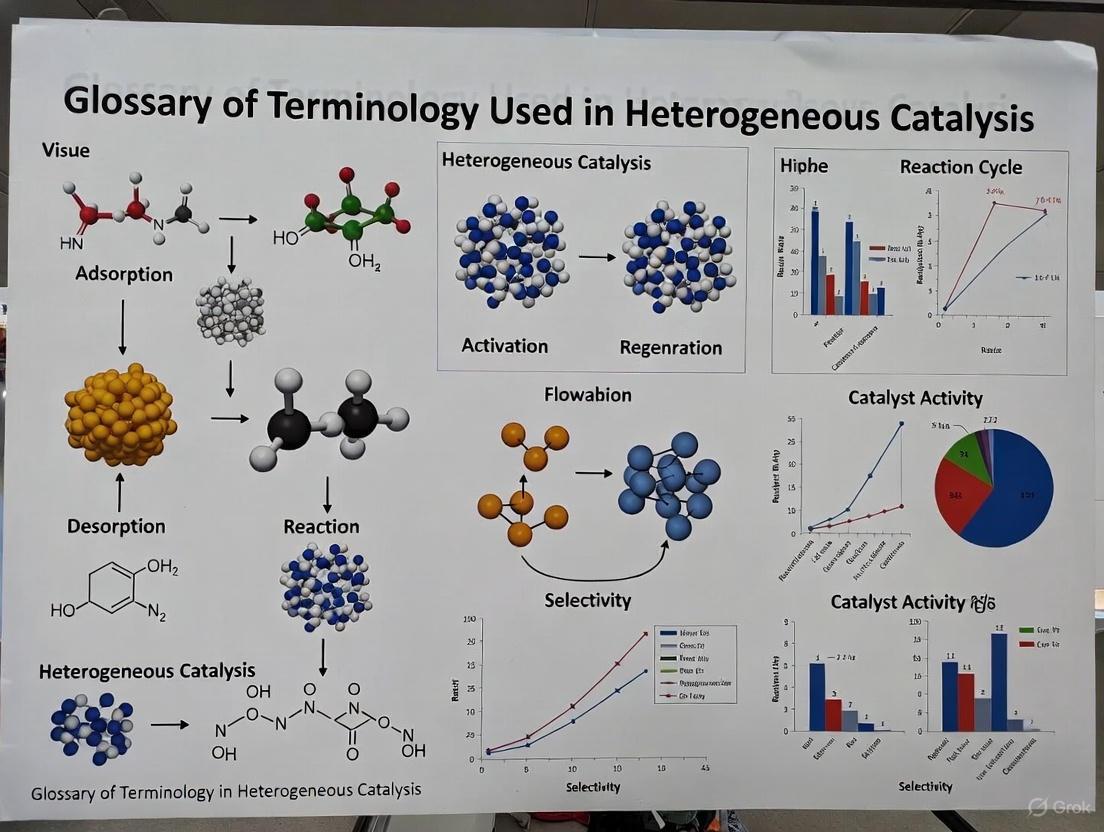
This comprehensive glossary provides researchers, scientists, and drug development professionals with an authoritative reference for terminology used in heterogeneous catalysis.
The Essential Glossary of Heterogeneous Catalysis: From Fundamental Terms to Advanced Applications in Research and Drug Development
Abstract
This comprehensive glossary provides researchers, scientists, and drug development professionals with an authoritative reference for terminology used in heterogeneous catalysis. It bridges foundational concepts—such as adsorption, active sites, and reaction mechanisms—with modern methodological applications, including the use of nanoalloys and Metal-Organic Frameworks (MOFs) in catalytic design. The guide further addresses critical troubleshooting aspects like catalyst deactivation and poisoning, and explores advanced validation techniques such as high-throughput screening and benchmarking. By synthesizing classic principles with cutting-edge trends like single-atom catalysis and data-driven catalyst design, this resource aims to enhance interdisciplinary communication and accelerate innovation in catalytic processes relevant to pharmaceutical synthesis and biomedical research.
Core Principles and Fundamental Terminology of Heterogeneous Catalysis
Heterogeneous catalysis is a foundational concept in chemical technology, defined as a catalytic process where the catalyst exists in a different phase from the reactants [1] [2]. This phase distinction stands in contrast to homogeneous catalysis, where catalysts and reactants share the same phase, typically liquid [3]. The physical separation between the catalyst and reactants provides unique mechanical advantages while introducing specific kinetic considerations that have profound implications for industrial chemical processing [4].
In practical applications, heterogeneous catalysts are most frequently solid materials, while reactants are in gaseous or liquid phases [1] [5]. This configuration is particularly advantageous for large-scale industrial processes where catalyst separation and reuse are critical for economic viability [3]. The strategic importance of heterogeneous catalysis is underscored by its involvement in approximately 35% of the world's GDP and its role in producing 90% of chemicals by volume [1].
Fundamental Principles and Mechanisms
Core Definition and Phase Distinctions
The defining characteristic of heterogeneous catalysis is the existence of a phase boundary between the catalyst and reactants [6]. This boundary creates an interface where catalytic phenomena occur through a sequence of molecular events [1]. The process can be visualized as a "bridge" that lowers the energy barrier for chemical transformations without the catalyst itself being consumed in the process [6].
Table 1: Comparison of Catalysis Types
| Characteristic | Heterogeneous Catalysis | Homogeneous Catalysis |
|---|---|---|
| Phase relationship | Catalyst and reactants in different phases | Catalyst and reactants in same phase |
| Typical catalyst form | Solid | Liquid (dissolved) |
| Separation process | Simple filtration or centrifugation | Complex distillation or extraction |
| Industrial applicability | Large-scale continuous processes | Fine chemicals and pharmaceuticals |
| Resistance to harsh conditions | Generally high | Generally limited |
The Catalytic Cycle: Adsorption, Reaction, and Desorption
The mechanism of heterogeneous catalysis follows a well-established sequence of steps that occur at the catalyst surface [1] [6]:
- Adsorption: Reactant molecules attach to the catalyst surface [1]. This initial bonding is crucial for concentrating reactants and activating them for reaction.
- Surface Reaction: Adsorbed reactants undergo chemical transformation into products through interactions with active sites [6].
- Desorption: Product molecules release from the catalyst surface, freeing active sites for subsequent reaction cycles [1].
Two distinct adsorption mechanisms operate in heterogeneous catalysis. Physisorption involves weak van der Waals forces with energies of 3-10 kcal/mol, where the adsorbate's electronic structure remains largely unchanged [1]. In contrast, chemisorption involves stronger chemical bond formation with energies of 20-100 kcal/mol, significantly altering the electronic structure of the adsorbate and creating precursor states for reaction [1].
Figure 1: The Heterogeneous Catalytic Cycle. This continuous process demonstrates the sequential steps of reaction and catalyst regeneration.
Two principal mechanisms describe surface reactions. The Langmuir-Hinshelwood mechanism involves reaction between two adsorbed species on the catalyst surface, while the Eley-Rideal mechanism describes reaction between an adsorbed species and a non-adsorbed reactant from the fluid phase [1]. Most heterogeneously catalyzed reactions follow the Langmuir-Hinshelwood pathway [1].
Catalyst Design and Characterization
Active Sites and the Sabatier Principle
The concept of active sites is fundamental to heterogeneous catalysis, referring to specific locations on the catalyst surface where catalytic reactions primarily occur [6]. These sites represent only a fraction of the total surface area and possess distinct geometric and electronic properties that enable them to facilitate chemical transformations [4].
The Sabatier principle governs catalyst design by establishing that optimal catalytic activity requires an intermediate strength of interaction between catalyst surface and reactants [1] [4]. If the interaction is too weak, reactants fail to activate; if too strong, products cannot desorb, poisoning the surface [1]. This principle finds quantitative expression in volcano plots, which correlate reaction rates with adsorption energies [1] [4].
Modern catalyst design employs scaling relations between adsorption energies of different intermediates to reduce the dimensionality of the optimization problem [1]. A significant challenge involves "breaking" these scaling relations to access unprecedented combinations of adsorption properties that would enable superior catalytic performance [1].
Advanced Characterization Techniques
Comprehensive catalyst characterization employs multiple analytical techniques to understand structure-activity relationships:
Table 2: Essential Catalyst Characterization Methods
| Technique | Acronym | Information Obtained | Application Example |
|---|---|---|---|
| Brunauer-Emmett-Teller Analysis | BET | Surface area, pore size distribution | Assessing mass transport properties [6] |
| X-ray Photoelectron Spectroscopy | XPS | Elemental composition, oxidation states | Identifying chemical nature of active sites [6] [7] |
| X-ray Diffraction | XRD | Crystalline phases, crystallite size | Determining catalyst structure [6] |
| Transmission Electron Microscopy | TEM | Morphology, particle size, active component dispersion | Visualizing catalyst nanostructure [6] |
| Near-Ambient Pressure XPS | NAP-XPS | Surface composition under reaction conditions | Studying catalyst dynamics during operation [7] |
The Phase Boundary Concept in Catalyst Design
Emerging perspectives suggest that optimal catalytic performance frequently occurs at phase boundaries rather than within stable phases [8]. These boundaries represent regions of particular instability where catalysts can preferably coexist in multiple states, with rapid interconversion potentially driving catalytic turnovers [8].
This paradigm shift emphasizes designing catalysts that operate at boundaries between different adsorbate coverages, stoichiometries, physical structures, or electronic structures [8]. For instance, industrial catalysts for methanol synthesis and Fischer-Tropsch reactions appear to function optimally at specific phase boundaries [8]. Theoretical models should therefore incorporate grand canonical treatments under realistic conditions to reverse-engineer conditions that position the system at desired boundaries for catalysis [8].
Experimental Methodologies in Heterogeneous Catalysis Research
Standardized Catalyst Testing Protocols
Rigorous experimental procedures are essential for generating reliable, reproducible catalytic data [7]. The following methodology, adapted from alkane oxidation studies, exemplifies a comprehensive approach to catalyst evaluation:
Catalyst Activation Protocol:
- Rapid Activation: Fresh catalysts undergo 48-hour exposure to harsh conditions (temperature up to 450°C) where conversion of either alkane or oxygen reaches approximately 80%, quickly establishing a steady-state catalyst [7].
- Kinetic Analysis Sequence:
- Temperature Variation: Determine activation energies and optimal temperature ranges [7].
- Contact Time Variation: Establish residence time effects on conversion and selectivity [7].
- Feed Variation: Systematically modify reactant ratios and introduce intermediates or steam to understand reaction network dependencies [7].
Data Quality Assurance: Implementation of "experimental handbooks" that standardize procedures across laboratories ensures consistent accounting for catalyst dynamics during data generation [7]. This approach minimizes subjective bias and enables meaningful comparison between different catalytic systems.
The Scientist's Toolkit: Essential Research Reagent Solutions
Table 3: Key Research Materials and Their Functions
| Material/Reagent | Function in Catalytic Research | Representative Application |
|---|---|---|
| Vanadyl pyrophosphate (VPP) | Redox-active catalyst for selective oxidation | n-butane oxidation to maleic anhydride [7] |
| MoVTeNbOx mixed oxides | Complex multi-metal oxide catalyst | Propane oxidation to acrylic acid [7] |
| Platinum-group metals (Pt, Pd, Rh) | Oxidation catalysts for emission control | Automotive catalytic converters [5] |
| Iron-based catalysts | Ammonia synthesis | Haber-Bosch process [5] |
| Zeolite materials | Acid catalysts with shape selectivity | Fluid catalytic cracking in petroleum refining [9] |
| Vanadium/Manganese oxides | Redox-active elements for oxidation | Ethane, propane, and n-butane oxidation [7] |
Industrial Significance and Applications
Major Industrial Processes
Heterogeneous catalysis enables numerous large-scale industrial transformations that underpin modern society:
Haber-Bosch Process: Utilizing iron-based catalysts, this process converts nitrogen and hydrogen into ammonia at high temperatures and pressures [5]. The ammonia produced is primarily used for fertilizer production, supporting global agricultural systems [5]. Recent research reveals that under industrial conditions (650-850K, 10-300 bar), the Fe(111) surface becomes highly dynamic, with active sites continuously forming and disappearing [10].
Petroleum Refining: Fluid catalytic cracking employs zeolite catalysts to break heavy hydrocarbon molecules into gasoline, diesel, and other valuable products [5]. This process maximizes yield from crude oil while improving fuel quality [5].
Emission Control: Catalytic converters in vehicles use platinum, palladium, and rhodium to oxidize carbon monoxide and unburned hydrocarbons while reducing nitrogen oxides to harmless nitrogen [5]. This application has significantly improved urban air quality worldwide [5].
Methanol Synthesis: Copper-zinc oxide catalysts facilitate carbon dioxide and carbon monoxide hydrogenation to methanol [8]. Optimal performance occurs at specific coverage boundaries (approximately 0.2 ML) where the catalyst can access multiple relevant states [8].
Economic and Environmental Impact
The economic significance of heterogeneous catalysis is profound, influencing approximately 35% of global GDP through its role in producing fuels, chemicals, and materials [1]. Environmental applications have enabled substantial progress in pollution control, particularly through catalytic emission treatment systems [5].
Emerging applications in renewable energy and biomass conversion further expand the environmental contributions of heterogeneous catalysis [9]. The development of nanostructured catalysts with enhanced surface areas and reactivity supports greener production methods across multiple industrial sectors [5].
Current Challenges and Future Perspectives
Persistent Challenges in Industrial Practice
Despite its maturity, heterogeneous catalysis faces several significant challenges in industrial implementation:
Catalyst Deactivation: Chemical poisoning, sintering, fouling, coking, and vapor-solid reactions cause gradual performance decline, costing industry billions annually in process shutdowns and catalyst replacement [1] [3]. For example, sulfur compounds poison Cu/ZnO catalysts in methanol production [1].
Mass Transfer Limitations: Reactant access to active sites and product removal can become rate-limiting, particularly with poorly designed pore structures [3]. These transport phenomena often mask intrinsic catalytic activity in practical applications [4].
Thermal Stability: High operating temperatures can induce sintering, where catalyst particles coalesce and reduce active surface area [3]. Maintaining structural integrity under harsh conditions remains challenging for many catalytic materials [3].
Scalability Issues: Translating laboratory-optimized catalysts to industrial scale presents difficulties in replicating conditions, with differences in mixing, heat transfer, and mass transfer complicating scale-up efforts [3].
Emerging Solutions and Research Directions
Single-Cluster Catalysis: Supported atomic clusters offer enhanced selectivity and activity through precise molecular control [3]. Their high dispersion improves mass transfer efficiency while maintaining thermal stability under demanding conditions [3].
Dynamic Catalyst Design: Recognizing that catalysts transform under reaction conditions has shifted focus toward designing systems that dynamically evolve to active states [8] [10] [7]. The "phase boundary" perspective encourages targeting metastable states that optimize specific catalytic functions [8].
Data-Centric Approaches: Artificial intelligence and machine learning analyze complex property-function relationships, identifying key "materials genes" that govern catalytic performance [7]. Symbolic regression techniques derive interpretable analytical expressions from high-quality experimental data, providing design rules for improved catalysts [7].
Advanced Simulation Methods: Combining machine learning potentials with enhanced sampling techniques enables realistic modeling of catalytic processes under industrial conditions [10]. These approaches reveal the profound influence of surface dynamics on catalytic activity, explaining why low-temperature studies often fail to predict operational performance [10].
Figure 2: Modern Catalyst Development Workflow. This iterative process integrates characterization, testing, and data analysis to inform catalyst design.
The future of heterogeneous catalysis research lies in embracing complexity and dynamics rather than searching for static optimal compositions [8] [10]. Understanding how catalysts function at phase boundaries under realistic conditions will enable more rational design strategies, reducing reliance on serendipitous discovery that has historically dominated the field [8].
In heterogeneous catalysis, where the catalyst is in a different phase than the reactants, adsorption is the foundational step that initiates the catalytic cycle [1]. It is the process by which atoms, ions, or molecules from a gas or liquid phase (the adsorbate) accumulate on the surface of a solid (the adsorbent) [11]. This surface phenomenon results in the formation of a molecular or atomic film, bringing the reactant molecules into close proximity with the catalyst's active sites and preparing them for chemical transformation [11] [1]. The catalytic process can be generalized as a sequence of steps: diffusion of reactants to the surface, adsorption of at least one reactant, reaction on the surface, desorption of the products, and diffusion of products away from the surface [12]. The efficiency of this cycle is profoundly influenced by the nature of the adsorption interaction, which can be broadly classified into two distinct types: physisorption (physical adsorption) and chemisorption (chemical adsorption) [12] [1]. A critical concept that bridges these two phenomena, particularly in the context of reaction kinetics, is the precursor state [1]. Understanding the differences between these adsorption mechanisms is essential for researchers and scientists designing catalysts for applications ranging from large-scale chemical production to drug development.
Distinguishing Physisorption and Chemisorption
Physisorption and chemisorption are differentiated by the nature of the forces involved, their strength, and their specificity. Physisorption is the result of relatively weak, nonspecific van der Waals forces, which include dipole-dipole interactions, induced dipole interactions, and London dispersion forces [12] [1]. No chemical bonds are formed in this process, and the electronic states of the adsorbate and adsorbent remain largely unperturbed. The binding energies involved are typically low, ranging from 3 to 10 kcal/mol, making physisorption a readily reversible process [1]. A key characteristic of physisorption is that it can form multiple layers on the adsorbent surface, as the adsorbate-adsorbate interactions are similar to the adsorbate-adsorbent interactions [12].
In contrast, chemisorption involves the formation of much stronger chemical bonds through the sharing of electrons between the adsorbate and the adsorbent, which can be regarded as the formation of a surface compound [12] [1]. This process is highly specific, occurring only between certain adsorptive and adsorbent species, and typically requires that the catalytic surface is clean of previously adsorbed molecules [12]. The energies involved are significantly higher, ranging from 20 to 100 kcal/mol, and in some cases, for bonds like C-N, can reach up to 600 kJ/mol [12]. Due to this strong, specific bond formation, chemisorption is inherently a single-layer (monolayer) process and is often difficult to reverse [12]. In many catalytic systems, both processes can occur simultaneously, such as a layer of molecules physically adsorbed on top of an underlying chemisorbed layer [12]. Furthermore, the same surface can exhibit physisorption at lower temperatures and chemisorption at higher temperatures, as seen with nitrogen on iron [12].
Table 1: Fundamental Characteristics of Physisorption and Chemisorption
| Characteristic | Physisorption | Chemisorption |
|---|---|---|
| Binding Forces | Weak van der Waals forces (dipole-dipole, induced dipole, dispersion) [1] | Strong chemical bonds (electron sharing) [1] |
| Binding Energy | 3–10 kcal/mol (typical) [1] | 20–100 kcal/mol (can be higher) [12] [1] |
| Reversibility | Easily reversible [12] | Difficult to reverse, often irreversible [12] |
| Layer Formation | Multi-layer formation possible [12] | Typically limited to a single monolayer [12] |
| Specificity | Non-specific; occurs on all surfaces under suitable conditions [12] | Highly selective; requires specific adsorbent-adsorbate pairs [12] |
| Role in Catalysis | Concentrates reactants at the surface; precursor to chemisorption [1] | Essential step; forms reactive surface intermediates [12] |
The Precursor State in Adsorption Kinetics
In the kinetics of heterogeneous catalysis, the journey of a gas-phase molecule to becoming chemisorbed often involves an intermediate energy state known as the precursor state [1]. This state is characterized by an initial physisorption of the reactant molecule onto the catalyst surface before it transitions into a chemisorbed state. From this precursor state, the molecule has several possible pathways: it can undergo chemisorption if it finds an active site and possesses sufficient energy, it can desorb back into the bulk fluid phase, or it can migrate along the surface to find a more favorable site for reaction [1]. The nature and lifetime of this precursor state can significantly influence the overall observed reaction kinetics, as it affects the probability of a reactant molecule successfully finding and binding to an active site [13] [1]. The Lennard-Jones potential model provides a fundamental theoretical framework for understanding the energy landscape and molecular interactions that define this transition from physisorption to chemisorption as a function of atomic separation [1].
Diagram 1: The adsorption pathway, showing the precursor state as an intermediate physisorbed state before chemisorption and surface reaction. From the precursor state, molecules can proceed to chemisorption or desorb back into the gas phase.
Experimental Methods for Characterizing Adsorption
The accurate characterization of adsorption processes is critical for catalyst development and evaluation. Analytical techniques based on gas sorption provide indispensable tools for probing surface structure and chemistry [12]. The relationship between the quantity of molecules adsorbed and the pressure at a constant temperature, known as the adsorption isotherm, is a primary source of information [12]. Physical adsorption isotherms are used to characterize the overall surface and porosity of catalyst supports, revealing total surface area, mesopore and micropore volume and area, and pore size distribution [12]. In contrast, chemical adsorption isotherms are selective, probing only the active areas of the surface capable of forming a chemical bond with a specific probe molecule [12].
Isothermal Chemisorption Techniques
Isothermal chemisorption analyses are conducted using two main techniques. The static volumetric method involves exposing a cleaned catalyst sample to an adsorptive gas in a closed chamber at a constant temperature. The quantity adsorbed is determined by precise measurements of pressure changes as known doses of gas are sequentially added to the system until equilibrium is reached at each point, building a high-resolution isotherm [12]. This method is well-suited for measurements from very low pressures to atmospheric pressure. The dynamic flowing-gas (pulse chemisorption) technique operates at ambient pressure. Here, small, accurately known quantities of adsorptive are injected in pulses into a carrier gas stream flowing over the catalyst sample. A thermal conductivity detector (TCD) monitors the quantity of adsorptive not adsorbed by the catalyst. The adsorbed quantity is calculated by summing the uptake from each injection until the sample is saturated [12]. This method is particularly suitable for determining the total active metal surface area of a catalyst.
Temperature-Programmed Techniques
Temperature-programmed methods have become indispensable for catalyst characterization [12]. In Temperature-Programmed Desorption (TPD), also known as Thermal Desorption Spectroscopy (TDS), a catalyst surface with pre-adsorbed molecules is heated in a controlled, linear fashion while the desorbing species are monitored, typically with a mass spectrometer or TCD [13]. The temperature at which desorption peaks occur provides information about the binding strength and the distribution of adsorption sites. Related techniques include Temperature-Programmed Reduction (TPR), where a catalyst precursor (e.g., a metal oxide) is heated in a reducing gas stream to determine its reducibility, and Temperature-Programmed Oxidation (TPO), used to study catalyst regeneration or coke burning [12].
Table 2: Key Analytical Techniques for Studying Adsorption Processes
| Technique | Primary Function | Key Measurements | Typical Applications |
|---|---|---|---|
| Volumetric Chemisorption [12] | Measure gas uptake at constant temperature | High-resolution adsorption isotherm; active metal surface area; active site density | Catalyst design and production evaluation; fundamental adsorption studies |
| Pulse Chemisorption [12] | Measure gas uptake at ambient pressure | Total metal dispersion; active metal surface area | Quality control; rapid assessment of catalyst capacity |
| Temperature-Programmed Desorption (TPD) [12] [13] | Probe strength of adsorbate binding | Desorption energy; binding strength; surface site heterogeneity | Characterization of acid/base sites; study of adsorption/desorption kinetics |
| Gas Chromatography (GC) [13] | Quantify adsorbed/desorbed species | Concentration of adsorbed volatiles; desorption efficiency | Evaluation of filter durability; analysis of VOC adsorption/desorption [13] |
Diagram 2: A generalized experimental workflow for characterizing adsorption, showing the main analytical pathways following sample preparation.
The Scientist's Toolkit: Key Research Reagents and Materials
The experimental study of adsorption, as cited in this work, relies on a set of essential materials and reagents. The following table details key components used in the featured research.
Table 3: Essential Research Reagents and Materials for Adsorption Studies
| Material / Reagent | Function in Experiment | Example Use Case |
|---|---|---|
| Alkanethiol Self-Assembled Monolayers (SAMs) [14] | Well-defined model surfaces with specific terminal functional groups (e.g., -OH, -CH₃, -NH₂, -COOH) | Studying peptide-surface interactions and measuring standard state adsorption free energy (ΔG°ads) [14] |
| Host-Guest Peptides (TGTG-X-GTGT) [14] | Model biomolecules with a variable amino acid residue to probe specific residue-surface interactions | Generating a benchmark dataset for amino acid residue adsorption on functionalized surfaces [14] |
| Porous Zeolite Filters (e.g., ZSM-11) [13] | High-surface-area inorganic adsorbents with molecular-sieving properties | Adsorption and desorption studies of Volatile Organic Compounds (VOCs); filter reusability testing [13] |
| Probe Gases (e.g., N₂, CO, H₂) [12] [15] | Analytically selected molecules for characterizing surface properties via physisorption or chemisorption | Determining surface area and porosity (N₂ physisorption); measuring active metal surface area (CO/H₂ chemisorption) [12] |
| Transition Metal & Metal-Oxide Catalysts [15] | Catalytic materials and supports for fundamental adsorption energy measurements | High-throughput DFT and experimental studies of impurity adsorption for catalyst poisoning assessment [15] |
A precise understanding of adsorption fundamentals—clearly distinguishing between physisorption and chemisorption and appreciating the role of the precursor state—is indispensable in heterogeneous catalysis research. These concepts form the lexicon required to describe the initial, critical steps of any surface-mediated reaction. For the researcher, the selection of appropriate characterization techniques, from isothermal chemisorption to temperature-programmed methods, is paramount to elucidating the surface properties and mechanisms that govern catalytic activity, selectivity, and longevity. As catalysis continues to evolve, with new applications emerging in energy systems and life sciences, these foundational principles of adsorption will remain central to the rational design and development of next-generation catalytic materials [16].
In the specialized lexicon of heterogeneous catalysis, an active site is defined as a specific region or group of atoms on a catalyst surface that directly facilitates molecular adsorption and transformation, thereby lowering the activation energy of a chemical reaction [17]. These sites are the fundamental loci where catalytic magic occurs, and their nature is governed by both the intrinsic chemical properties of the catalytic material and its extrinsic physical structure. A related, yet distinct, concept is that of the catalyst support, a material, typically of high surface area, upon which the active catalytic phase is dispersed. The support is not merely an inert carrier; it plays a multifunctional role in modulating the catalyst's electronic properties, stabilizing nanoparticles against sintering, and often contributing directly to the catalytic activity through strong metal-support interactions [4] [18]. The efficiency of a heterogeneous catalyst is therefore not solely a function of the active phase but is an emergent property of the synergistic combination of the active site and its support.
The imperative to maximize surface area is a central tenet in catalyst design. A high surface area provides a greater density of potential active sites, enhancing the interaction between reactants and the catalyst [19] [20]. This is quantified through the specific surface area (SSA), typically measured using the Brunauer-Emmett-Teller (BET) method via N₂ adsorption isotherms [19]. However, the pursuit of high surface area must be balanced against other critical factors. As noted in studies on high-surface-area anatase TiO₂, materials with high SSA often suffer from low thermal stability, leading to sintering—a process where particles agglomerate and grow, resulting in a loss of surface area and active sites—particularly during necessary thermal treatments in synthesis or operation [19]. The interplay between achieving high surface area, maintaining structural and thermal stability, and ensuring the optimal electronic environment at the active site constitutes the core challenge in designing advanced catalytic systems.
The Nature and Design of Active Sites
Fundamental Classifications and Effects
Active sites in heterogeneous catalysts are not uniform; their properties and effectiveness are shaped by two primary effects: the coordination effect and the ligand effect. The coordination effect refers to the geometric arrangement of atoms surrounding the active site, which is influenced by structural features such as crystal facets, defects, steps, and corners [17]. For instance, atoms at a step or kink site on a crystal surface often have lower coordination numbers than those on a flat terrace, making them more reactive for breaking chemical bonds. The ligand effect, on the other hand, concerns the chemical identity and electronic influence of neighboring atoms [17]. In alloys or high-entropy alloys (HEAs), the random distribution of different elements adjacent to an active metal atom can significantly alter its electronic structure, and consequently, its adsorption properties for reactants and intermediates [17]. In real-world catalysts, these two effects are intertwined, creating a complex distribution of active site environments that collectively determine the catalyst's overall activity, selectivity, and stability.
The design of active sites has been revolutionized by advanced computational and machine learning approaches. Traditional "forward design" relies on establishing structure-property relationships through high-throughput density functional theory (DFT) calculations and linear scaling relationships, which often lead to "volcano plots" that identify catalysts with optimal adsorption energies [17]. A more ambitious goal is inverse design, which starts with a desired catalytic property (e.g., an optimal adsorption energy for a key intermediate) and works backward to identify the atomic-level structure that would provide it [17]. Topology-based deep generative models represent a cutting-edge tool for this purpose. These models use mathematical tools like persistent GLMY homology (PGH) to create a refined, quantitative fingerprint of a three-dimensional active site's structure, capturing nuances that are missed by simpler descriptors [17]. This allows for the interpretable inverse design of active sites, paving the way for a more rational catalyst design paradigm beyond traditional trial-and-error methods.
Characterization of Active Sites
The precise identification and quantification of active sites are crucial for understanding catalytic performance. A common experimental method involves the use of probe molecules, such as carbon monoxide (CO), analyzed via in situ infrared (IR) spectroscopy [19]. The vibrational frequency of CO adsorbed on different surface sites (e.g., on different metal atoms or at terraces vs. steps) provides a fingerprint that allows researchers to identify the nature and relative abundance of various active sites. As detailed in a study on TiO₂, the protocol involves preparing a self-supporting catalyst pellet, activating it under controlled temperature and vacuum or gas flow, and then introducing CO at specific pressures and temperatures [19]. The resulting IR spectra are processed by subtracting the background, and the different carbonyl bands are deconvoluted using curve-fitting procedures to quantify the distribution of surface sites. This methodology provides a direct, experimental link between the catalyst's surface structure and its potential chemical activity.
Table 1: Experimental Techniques for Active Site Characterization
| Technique | Measured Property | Key Information on Active Sites | Example Protocol |
|---|---|---|---|
| CO Probe IR Spectroscopy [19] | Vibrational frequency of adsorbed CO | Chemical identity & coordination of surface metal atoms | Pellet activation at 500°C under vacuum/O₂, CO dosing at LN₂ temperature, spectral deconvolution |
| Persistent Homology (PGH) [17] | Topological fingerprint of 3D atomic structure | Geometric sensitivity & correlation with adsorption properties | Generate atomic point cloud from active site, perform algebraic topological analysis, create feature vector |
| N₂ Physisorption (BET) [19] | Specific Surface Area (SSA) | Total area available for reaction & site dispersion | Outgas sample, measure N₂ adsorption isotherms at LN₂ temperature, apply BET equation |
| X-ray Diffraction (XRD) [19] | Crystallite size & phase | Phase-dependent active site structure & thermal stability | Collect pattern on powdered sample, apply Scherrer equation to peak broadening for crystallite size |
Figure 1: Workflow for the identification, computational analysis, and inverse design of catalytic active sites, integrating both coordination and ligand effects [17].
The Role and Engineering of Catalyst Supports
Functions and Material Classes
Catalyst supports are engineered to provide a stable, high-surface-area foundation that maximizes the dispersion of the active catalytic phase, which is often a precious metal like platinum. A high dispersion directly translates to a higher number of accessible active atoms per unit mass of precious metal, improving the cost-effectiveness and activity of the catalyst [18]. Beyond this primary function, modern support materials are designed to actively participate in the catalytic process. They can modulate the electronic structure of metal nanoparticles through strong metal-support interactions (SMSI), which can enhance intrinsic activity and selectivity [18]. Furthermore, conductive supports (e.g., carbon materials) facilitate electron transport in electrocatalytic reactions like the oxygen reduction reaction (ORR), while robust oxide supports enhance thermal and mechanical stability, preventing nanoparticle agglomeration (sintering) and degradation under harsh operating conditions [4] [18].
The choice of support material is critical and depends on the application. A wide range of materials is employed, each with distinct advantages. Mesoporous carbons offer tunable pore structures and high conductivity but can be susceptible to oxidative corrosion. Graphene and carbon nanotubes (CNTs) provide exceptional electrical conductivity and high surface area. Metal oxides like titanium dioxide (TiO₂), zirconia (ZrO₂), and ceria (CeO₂) are valued for their stability and ability to engage in strong metal-support interactions [18]. The case of TiO₂ is particularly instructive: its high surface area is crucial for applications like selective catalytic reduction (SCR) of NOx, but this high surface area can be rapidly lost due to sintering during thermal treatments, a process accelerated by the presence of humidity [19]. This underscores that the selection of a support is a complex trade-off between surface area, stability, and electronic properties.
Support-Driven Catalyst Architectures
Advanced support materials have enabled the development of sophisticated catalyst architectures that go beyond simple nanoparticle dispersion. These engineered structures are designed to maximize the utilization of the active phase and create synergistic effects. Key designs include:
- Core-Shell Structures: A core of one material (which may be the support or an inactive metal) is enclosed by a shell of the active catalytic metal. This structure exposes almost all atoms of the precious metal to the reactant environment, dramatically improving mass activity [18].
- Hollow Structures: These materials provide a high surface-to-volume ratio and can confine reactants in a small volume, potentially enhancing reaction rates [18].
- Single-Atom Catalysts (SACs): This architecture represents the ultimate limit of metal dispersion, where individual metal atoms are anchored to a support. SACs maximize atom efficiency and often exhibit unique catalytic properties due to the isolated, coordinatively unsaturated nature of the active sites [4] [18]. The support in SACs is critical, as its surface functional groups (e.g., defects, nitrogen dopants in carbon) are responsible for stabilizing the isolated metal atoms and preventing their migration and agglomeration.
Table 2: Common Catalyst Support Materials and Their Properties
| Support Material | Key Characteristics | Impact on Catalytic Performance | Common Applications |
|---|---|---|---|
| Mesoporous Carbon [18] | High SSA, tunable porosity, good conductivity | Enhances metal dispersion, improves mass transport | Fuel cells, electrocatalysis |
| Graphene [18] | Ultra-high conductivity, high theoretical SSA | Excellent electron transfer, stabilizes nanoparticles/single atoms | Oxygen reduction reaction (ORR) |
| Carbon Nanotubes (CNTs) [18] | 1D morphology, high conductivity, mechanical strength | Directed electron transport, unique confinement effects | Electrochemical energy storage |
| Anatase TiO₂ [19] | High SSA (when nano-structured), strong metal-support interaction | Stabilizes active phase, prone to sintering at high T | Photocatalysis, selective catalytic reduction (SCR) |
| High-Entropy Alloys (HEAs) [17] | Vast compositional space, complex active sites | Fine-tunes adsorption energies via ligand/coordination effects | Model studies, emerging electrocatalysis |
Experimental Protocols for Support and Active Site Analysis
Protocol: Evaluating Thermal Stability of High-Surface-Area Supports
The thermal stability of a catalyst support is a critical parameter, as many catalysts undergo thermal treatments during synthesis or operation. The following protocol, adapted from a study on anatase TiO₂, provides a methodology for assessing this stability [19].
Objective: To determine the structural and textural evolution of a high-surface-area support (e.g., TiO₂) under different thermal treatment conditions.
Materials and Equipment:
- High-surface-area support material (e.g., anatase TiO₂)
- Tubular furnace or muffle furnace (static and flow conditions)
- Thermogravimetric Analyzer (TGA)
- N₂ Physisorption Analyzer (BET surface area)
- X-ray Powder Diffractometer (XRD)
- In situ IR cell and spectrophotometer
Methodology:
- Baseline Characterization: Begin by measuring the specific surface area (SSA) of the raw, untreated material (r-TiO₂) using N₂ adsorption at liquid nitrogen temperature and applying the BET equation. Perform XRD to determine the crystallite size along different lattice directions using the Scherrer equation [19].
- Controlled Thermal Treatments: Subject identical samples of the support to various thermal treatments:
- Static Air Calcination: Heat samples in a muffle furnace across a temperature range (e.g., 100–500 °C) for a fixed duration (e.g., 1 or 5 hours) [19].
- Flow Condition Treatment: Heat samples in a tubular furnace under a controlled flow of dry or wet air (e.g., 150 mL min⁻¹), ramping the temperature at a defined rate (e.g., 5 °C min⁻¹) [19].
- Vacuum Treatment: Outgas samples inside the physisorption analyzer at elevated temperatures (e.g., up to 450 °C) for 2 hours to assess stability in the absence of air [19].
- Post-Treatment Analysis: After each treatment, repeat the SSA and XRD measurements. Monitor the change in SSA and crystallite growth as a function of treatment type, temperature, and atmosphere.
- Surface Site Investigation: Use in situ IR spectroscopy with a probe molecule like CO. Prepare self-supporting pellets of the samples treated at different conditions. Activate the pellets at high temperature (e.g., 500 °C) under dynamic vacuum. After cooling, introduce CO and collect IR spectra. The resulting carbonyl bands reveal changes in the abundance and nature of surface sites (e.g., Lewis acid sites) after thermal aging [19].
Interpretation: Treatments that best preserve the original SSA and minimize crystallite growth indicate superior thermal stability. Flow conditions often provide better stability than static air, while the presence of humidity typically accelerates sintering. The IR data provides a direct link between textural changes and the loss of specific surface functionalities.
The Researcher's Toolkit: Essential Materials and Reagents
Table 3: Key Reagents and Materials for Support and Active Site Research
| Item | Function/Application | Example Use Case |
|---|---|---|
| Probe Molecules (CO, NH₃) [19] | Characterization of surface acid sites and active sites | Identifying and quantifying Lewis/Brønsted acid sites via IR spectroscopy |
| High-Surface-Area Metal Oxides (e.g., Anatase TiO₂) [19] | Model catalyst support | Studying metal-support interactions and thermal stability |
| Carbon Supports (Graphene, CNTs) [18] | Conductive catalyst support | Dispersing Pt nanoparticles for electrocatalytic ORR |
| Ammonium Metavanadate [19] | Precursor for active phase | Preparing VOx/TiO₂ catalysts for SCR of NOx |
| Single-Atom Catalyst (SAC) Precursors [4] | Creating atomically dispersed active sites | Synthesizing Pt1/C catalysts for maximum atom utilization |
Figure 2: Multifunctional roles of a catalyst support in enhancing the overall performance of a catalytic system [4] [18].
The strategic design of active sites and the engineering of catalyst supports are deeply interconnected disciplines central to advancing heterogeneous catalysis. The pursuit of maximum surface area, while crucial for achieving high active site density, must be intelligently balanced against the imperative for long-term thermal and structural stability. The modern catalyst designer has at their disposal a powerful suite of tools, ranging from topological descriptors for the inverse design of optimal active site geometries [17] to advanced experimental protocols for evaluating the stability of high-surface-area supports [19]. The emerging paradigm moves beyond viewing the support as a passive scaffold to treating it as an integral, active component of the catalytic system. This holistic approach, which considers the synergistic effects between the active phase and its support, is key to developing next-generation catalysts with unparalleled efficiency, selectivity, and durability for energy and chemical transformations.
Heterogeneous catalysis, a process where the catalyst exists in a different phase than the reactants, is fundamental to approximately 35% of the world's GDP and involved in the production of 90% of chemicals by volume [1]. These catalytic processes occur through sequences of reactions involving fluid-phase reagents and the exposed layer of the solid catalyst surface, with thermodynamics, mass transfer, and heat transfer influencing the reaction kinetics [1]. The foundational work of Irving Langmuir in the early 20th century established the basic principles of surface chemistry that underpin our modern understanding of these processes [21]. Within this framework, two principal mechanisms describe how reactions proceed on surfaces: the Langmuir-Hinshelwood (L-H) mechanism and the Eley-Rideal (E-R) mechanism, each with distinct characteristics and kinetic profiles that dictate their applicability to specific catalytic systems.
The core of heterogeneous catalysis lies in the adsorption of reactants onto the catalyst surface, which can occur through physisorption (weak binding via van der Waals forces with energies of 3-10 kcal/mol) or chemisorption (strong binding through chemical bond formation with energies of 20-100 kcal/mol) [1]. In chemisorption, molecules may remain intact or dissociate, with the barrier to dissociation significantly affecting the adsorption rate [1]. These adsorption processes create precursor states that enable subsequent surface reactions, with the nature of these states profoundly influencing the overall reaction kinetics [1]. The Langmuir-Hinshelwood and Eley-Rideal mechanisms represent two fundamentally different pathways by which these surface reactions can proceed, each with characteristic kinetic signatures and implications for catalyst design and operation.
The Langmuir-Hinshelwood Mechanism
Conceptual Foundation and Historical Development
The Langmuir-Hinshelwood mechanism, first proposed by Irving Langmuir in 1921 and further developed by Cyril Hinshelwood in 1926, describes a surface reaction process where two adsorbed reactants undergo a bimolecular reaction on the catalyst surface [22]. This mechanism originally focused on bimolecular reactions involving two kinds of molecules adsorbed at the same surface sites, with the surface reaction serving as the rate-determining step [23]. In its classic formulation, the L-H mechanism requires both reactants to adsorb onto neighboring active sites on the catalyst surface before reacting while both are in thermal equilibrium with the surface [23]. The catalytic oxidation of CO on Pt(111) represents a classic example of a reaction proceeding via the L-H mechanism, involving the chemisorption of CO, dissociative adsorption of O₂, surface reaction between CO and O to form CO₂, and final desorption of CO₂ [23].
The term "Langmuir-Hinshelwood mechanism" has sometimes been broadly applied in photocatalytic literature when a linear reciprocal relation is observed between the reaction rate and substrate concentration, consistent with Langmuir-type adsorption kinetics [23]. However, the original meaning in catalysis specifically refers to bimolecular surface reactions, distinguishing it from monomolecular surface processes [23]. True validation of the L-H mechanism requires demonstrating that the adsorption equilibrium constant obtained kinetically matches that measured from dark adsorption experiments, ensuring that the observed kinetics genuinely result from Langmuirian adsorption behavior [23].
Mathematical Formulation and Kinetic Analysis
The kinetic formulation of the Langmuir-Hinshelwood mechanism for a bimolecular reaction A + B → Products follows a sequence of elementary steps [22]:
- A + S ⇌ AS (adsorption of A)
- B + S ⇌ BS (adsorption of B)
- AS + BS → Products (surface reaction)
The rate equation for this mechanism derives from the assumption that the surface reaction between the two adsorbed species is the rate-determining step. The resulting rate expression is:
[ r = k CS^2 \frac{K1K2CACB}{(1 + K1CA + K2C_B)^2} ]
Where (r) is the reaction rate, (k) is the surface reaction rate constant, (CS) is the surface site concentration, (K1) and (K2) are the adsorption equilibrium constants for A and B respectively, and (CA) and (C_B) are the concentrations of A and B [22].
The kinetic behavior varies significantly depending on the concentration regime and relative adsorption strengths [22]:
Table: Langmuir-Hinshelwood Rate Dependence on Concentration Conditions
| Condition | Rate Expression | Reaction Order |
|---|---|---|
| Low adsorption of both reactants | ( r = k CS^2 K1K2CAC_B ) | First order in A and B |
| Low adsorption of A, high adsorption of B | ( r = k CS^2 \frac{K1K2CACB}{(1 + K1C_A)^2} ) | Complex dependence |
| High adsorption of both reactants | ( r = k CS^2 \frac{K2CB}{K1C_A} ) | Inverse first order in A |
For photocatalytic reactions following L-H kinetics, the rate expression is often simplified to:
[ r = \frac{ksKC}{KC + 1} ]
Where (r) is the reaction rate, (k) is the rate constant of the surface reaction, (K) is the adsorption equilibrium constant, (s) is the limiting amount of surface adsorption, and (C) is the substrate concentration [23]. This equation predicts a linear relationship between the reciprocal of the reaction rate and the reciprocal of concentration, which serves as common experimental evidence for L-H kinetics in photocatalytic systems [23].
Experimental Validation and Methodologies
Establishing that a reaction follows the Langmuir-Hinshelwood mechanism requires rigorous experimental validation beyond simple kinetic fitting. The following methodological approach provides a comprehensive verification protocol:
Adsorption Isotherm Measurement: Conduct dark adsorption experiments (without reaction) to determine the adsorption equilibrium constant (K) and maximum adsorption capacity [23]. This provides an independent measure of adsorption parameters for comparison with kinetic data.
Kinetic Parameter Determination: Perform reaction rate measurements across a wide concentration range. Create both Lineweaver-Burk plots (1/r vs. 1/C) and concentration-to-rate ratio plots (C/r vs. C) to extract kinetic parameters ks and K [23].
Parameter Consistency Verification: Compare the adsorption equilibrium constant K obtained from kinetic analysis with that determined from dark adsorption measurements. The L-H mechanism is only validated if these values agree within experimental error [23].
Light Intensity Studies: For photocatalytic systems, verify "light-intensity limited" conditions where photoabsorption represents the rate-determining step rather than adsorption/desorption processes [23].
Surface Coverage Monitoring: Use techniques like in-situ diffuse reflectance infrared Fourier transform spectroscopy (DRIFTS) to directly monitor surface coverage during reaction and confirm the coexistence of both adsorbed species [24].
This experimental protocol ensures that observed Langmuir-type kinetics genuinely result from the L-H mechanism rather than other pathways that might produce similar kinetic patterns. Particular attention should be paid to the consistency between adsorption equilibria measured in dark conditions and those derived from kinetic analysis, as discrepancies invalidate the L-H assignment [23].
The Eley-Rideal Mechanism
Conceptual Foundation and Historical Context
The Eley-Rideal mechanism proposes a fundamentally different pathway for surface reactions, where a gas-phase reactant directly interacts with an adsorbed species without undergoing adsorption itself [24]. This mechanism was initially studied by Eley and Rideal approximately 75 years ago, though the broader concept of a reaction between a chemisorbed molecule and a gaseous colliding molecule had been previously suggested by Langmuir [25]. In the E-R mechanism, only one reactant adsorbs onto the catalyst surface and achieves thermal equilibrium with it, while the second reactant approaches from the gas phase and reacts directly with the adsorbed species in a "nonthermal surface reaction" where the gas-phase molecule may not equilibrate with the surface temperature [23] [22].
The hydrogenation of ethane on a nickel catalyst (C₂H₂ + 2Hₐd → C₂H₄) represents an early example of a reaction following the Eley-Rideal mechanism [23]. Interestingly, some scholars argue that the reaction between a chemisorbed molecule and a gaseous molecule should more accurately be termed the "Langmuir-Rideal mechanism," as Langmuir originally proposed this type of interaction alongside the reaction between two chemisorbed molecules [25]. The specific case examined by Eley and Rideal has particular importance in both heterogeneous and homogeneous catalysis in the liquid-phase, where it relates to outer-sphere reactions [25].
Mathematical Formulation and Kinetic Analysis
The Eley-Rideal mechanism for a reaction A + B → Products involves two fundamental steps [22]:
- A(g) + S(s) ⇌ AS(s) (adsorption of A)
- AS(s) + B(g) → Products (reaction with gas-phase B)
The rate expression for this mechanism derives from the assumption that the reaction between the adsorbed A and gas-phase B is the rate-determining step:
[ r = k CS CB \frac{K1CA}{K1CA + 1} ]
Where (r) is the reaction rate, (k) is the surface reaction rate constant, (CS) is the surface site concentration, (CA) and (CB) are the concentrations of A and B, and (K1) is the adsorption equilibrium constant for A [22].
This rate equation exhibits distinctive kinetic behavior:
Table: Eley-Rideal Rate Dependence on Concentration Conditions
| Condition | Rate Expression | Reaction Order |
|---|---|---|
| Low concentration of A | ( r = k CS K1CACB ) | First order in A and B |
| High concentration of A | ( r = k CS CB ) | Zero order in A, first order in B |
The Eley-Rideal mechanism is particularly relevant in environmental catalysis applications. For example, the oxidation of gaseous Hg⁰ in the presence of HCl often follows an E-R pathway, where HCl first adsorbs and decomposes into active chlorine species (Cl*), which then react with gaseous Hg⁰ to form HgCl, with subsequent reactions producing HgCl₂ [24]. Similarly, the removal of Hg⁰ on magnetic adsorbents in the presence of H₂S proceeds via E-R mechanism, where H₂S decomposes to active S₂²⁻ species that convert Hg⁰ into HgS [24].
Experimental Validation and Methodologies
Distinguishing the Eley-Rideal mechanism from Langmuir-Hinshelwood requires specific experimental approaches:
Pre-adsorption Experiments: Pre-adsorb species A on the catalyst surface, then expose to gas-phase B in the absence of gaseous A. Reaction observation confirms E-R pathway [24].
Surface Coverage Variation: Measure reaction rate as a function of surface coverage of A (θ_A). Unlike L-H kinetics which show a maximum then decrease at high coverage due to site blocking, E-R kinetics continue to increase with coverage as no additional sites are needed for B [23].
Temperature Dependence Studies: Eley-Rideal reactions may exhibit different temperature dependencies as one reactant remains non-thermalized with the surface [23].
Isotopic Labeling: Use isotopically labeled gas-phase reactants to track reaction pathways and distinguish between E-R and L-H mechanisms.
In-situ Spectroscopy: Apply techniques like DRIFTS to confirm the absence of adsorbed B during reaction while detecting reaction intermediates [24].
For Hg⁰ oxidation systems, mechanistic assignment (E-R vs. L-H) can be determined based on surface analysis of catalysts exposed to oxidants like HCl, followed by mercury oxidation in the absence of gaseous HCl [24]. Reaction systems including Hg⁰ oxidation by HBr on V₂O₅/TiO₂-SCR catalyst, Hg⁰ oxidation by HCl over CeW/Ti catalysts and V₂O₅/TiO₂(001), and Hg⁰ oxidation by H₂S over MnO₂(110) have been shown to occur via the E-R mechanism [24].
Comparative Analysis and Mechanistic Distinction
Direct Comparison of Key Characteristics
The fundamental differences between Langmuir-Hinshelwood and Eley-Rideal mechanisms manifest in multiple aspects of their reaction pathways and kinetic behaviors:
Table: Comprehensive Comparison of L-H and E-R Mechanisms
| Characteristic | Langmuir-Hinshelwood | Eley-Rideal |
|---|---|---|
| Adsorption Requirement | Both reactants must adsorb | Only one reactant adsorbs |
| Nature of Reaction | Thermal reaction between adsorbed species | Nonthermal reaction with gas-phase participant |
| Surface Site Requirement | Two adjacent sites needed | Single site sufficient |
| Rate-Determining Step | Surface reaction between adsorbed species | Reaction between adsorbed and gas-phase species |
| Typical Rate Expression | ( r = k CS^2 \frac{K1K2CACB}{(1+K1CA+K2C_B)^2} ) | ( r = k CS CB \frac{K1CA}{K1CA+1} ) |
| Coverage Dependence | Rate peaks then decreases at high coverage | Rate increases continuously with coverage |
| Temperature Effects | Both reactants thermalized with surface | Gas-phase reactant may not be thermalized |
Diagnostic Kinetic Plots and Mechanistic Assignment
Experimental discrimination between these mechanisms relies on systematic variation of reactant concentrations and surface coverage:
Coverage Variation Experiments: As shown in Figure 4, the reaction rate dependence on surface coverage of A (θA) provides a definitive diagnostic tool [23]. For the L-H mechanism, the rate initially increases with coverage, reaches a maximum when surface sites are optimally occupied, then decreases as high coverage of A blocks adsorption sites for B, eventually dropping to zero at θA = 1 [23]. In contrast, the E-R mechanism shows a continuously increasing rate with θ_A since B does not require adsorption sites, proceeding directly to a plateau at full coverage [23].
Concentration Variation Studies: Methodical variation of reactant concentrations with analysis of reaction orders provides additional discrimination power. The L-H mechanism typically shows complex concentration dependence with fractional or changing reaction orders, while E-R kinetics maintain simpler integer orders (zero or first order) depending on concentration regimes [22].
Graphical Analysis: Linearization plots offer complementary evidence. L-H kinetics often show linearity in reciprocal plots (1/r vs. 1/C), while E-R mechanisms may display different linearization characteristics [23]. However, kinetic analysis alone cannot conclusively establish mechanism without supporting adsorption studies [23].
Visualization of Reaction Mechanisms
Langmuir-Hinshelwood Mechanism Diagram
Eley-Rideal Mechanism Diagram
Coverage-Rate Dependence Diagram
The Scientist's Toolkit: Essential Research Reagents and Methodologies
Catalyst Characterization Materials
Table: Essential Research Reagents for Mechanism Studies
| Reagent/Material | Function | Application Context |
|---|---|---|
| Metal-doped Zeolites (Cu/SSZ-13, Fe-ZSM-5) | Provide well-defined active sites for adsorption and reaction | NH₃-SCR reactions, mechanistic studies of L-H vs E-R pathways [24] |
| Supported Metal Catalysts (Pt/TiO₂, V₂O₅/TiO₂) | Model systems for surface reaction studies | CO oxidation, Hg⁰ oxidation mechanistic investigations [24] |
| Porous Supports (γ-Al₂O₃, MCM-41, Zeolites) | High surface area platforms with controlled porosity | Maximizing active sites, studying diffusion effects in L-H kinetics [1] |
| Promoter Compounds (Alkali metals, Al₂O₃) | Modify catalyst activity and selectivity | Enhancing N₂ dissociation in ammonia synthesis (L-H), altering selectivity [1] |
| Catalyst Poisons (S, Cl compounds) | Selectively block active sites | Mechanistic studies by selective site poisoning, understanding active site requirements [1] |
Advanced Characterization Techniques
Modern mechanistic studies employ sophisticated characterization methods to discriminate between L-H and E-R pathways:
In-situ Diffuse Reflectance Infrared Fourier Transform Spectroscopy (DRIFTS): Enables real-time monitoring of surface species during reaction, confirming coexistence of adsorbed reactants for L-H or absence of adsorbed B for E-R mechanisms [24].
Scanning Tunneling Microscopy (STM): Allows direct observation of reactions at solid-gas interfaces in real space, providing visual evidence of mechanistic pathways [22].
Temperature-Programmed Desorption (TPD): Quantifies adsorption strength and surface coverage, essential parameters for kinetic modeling of both mechanisms.
Solid-State NMR (ssNMR): Probes atomic-level local structures of catalytic sites, their intrinsic reactivity, and site-site proximities relevant to L-H requirements [21].
X-ray Photoelectron Spectroscopy (XPS): Determines surface composition and oxidation states during reaction, identifying adsorbed species.
Microkinetic Modeling with DFT: Computational approach combining density functional theory with kinetic analysis to simulate reaction pathways and discriminate between mechanisms [24].
Experimental Protocol for Mechanistic Discrimination
A standardized experimental approach for distinguishing L-H and E-R mechanisms:
Pre-adsorption Phase: Expose catalyst to reactant A alone, allowing adsorption to equilibrium while monitoring surface coverage.
Reaction Initiation: Introduce reactant B under controlled conditions, with and without continuous supply of A in gas phase.
In-situ Monitoring: Track surface species using DRIFTS and gas-phase composition using mass spectrometry simultaneously.
Coverage Variation: Systematically vary initial coverage of A while measuring initial rates of product formation.
Parameter Extraction: Determine reaction orders with respect to both reactants across concentration ranges.
Validation: Compare adsorption constants from kinetic and equilibrium measurements, with agreement supporting L-H mechanism.
This protocol leverages the fundamental distinction that L-H requires both species to be adsorbed, while E-R involves direct reaction with a gas-phase molecule, enabling clear mechanistic assignment through controlled experimentation.
The Langmuir-Hinshelwood and Eley-Rideal mechanisms represent two fundamentally distinct pathways for heterogeneous catalytic reactions, with the former requiring both reactants to adsorb and achieve thermal equilibrium with the surface before reacting, while the latter involves direct reaction between an adsorbed species and a gas-phase molecule. While many heterogeneously catalyzed reactions follow the Langmuir-Hinshelwood model [1], the Eley-Rideal mechanism remains critically important in specific systems, particularly in environmental catalysis such as mercury oxidation [24]. Proper discrimination between these mechanisms requires comprehensive experimental approaches combining kinetic analysis, adsorption studies, and in-situ spectroscopic characterization. As catalytic science advances with emerging techniques like machine learning potentials and higher-resolution in-situ methods [26], our understanding of these fundamental reaction pathways continues to refine, enabling more precise catalyst design and optimization for industrial applications across chemical production, energy conversion, and environmental protection.
The Sabatier principle stands as a foundational concept in heterogeneous catalysis, providing a critical framework for understanding and designing efficient catalysts. This principle articulates that for a catalyst to be effective, its interaction with reactant molecules must be "just right"—neither too strong nor too weak. This qualitative insight has evolved into a quantitative predictive tool that guides catalyst development across diverse fields, including thermal heterogeneous catalysis, electrocatalysis, and biocatalysis. Within the broader terminology of catalysis research, the Sabatier principle provides the thermodynamic basis for understanding why maximum catalytic activity occurs at intermediate binding strengths, a relationship visually captured in the characteristic "volcano plot" that maps activity against catalyst properties.
This guide explores the fundamental thermodynamic and kinetic aspects of the Sabatier principle, its experimental validation through volcano relationships, and modern computational approaches that leverage this principle for catalyst design. It further examines the concept of catalytic resonance as a strategy to overcome Sabatier limitations and details experimental methodologies for measuring catalytic turnover. Together, these concepts form an essential toolkit for researchers and scientists engaged in catalyst development and optimization.
Core Principles and Theoretical Foundation
The Fundamental Sabatier Principle
The Sabatier principle, named after French chemist Paul Sabatier, serves as a qualitative guide in heterogeneous catalysis. It states that the interactions between a catalyst surface and reactant molecules should be of intermediate strength to maximize catalytic efficiency. This balance is crucial because:
- If the catalyst-reactant interaction is too weak, reactant molecules fail to bind effectively to the catalytic surface, resulting in insufficient activation and minimal reaction rates.
- If the interaction is too strong, the reaction products (or intermediates) become immobilized on the catalyst surface, blocking active sites and preventing further turnover in a phenomenon known as catalyst poisoning [27].
This principle finds mathematical expression in volcano plots, which graphically represent the relationship between catalytic activity and a descriptor of catalyst-adsorbate binding strength, such as the heat of adsorption or formation of surface intermediates. These plots characteristically show activity increasing to a maximum at intermediate binding strengths before declining at stronger interactions, forming an inverted V-shape reminiscent of a volcano [27]. For example, in the catalytic decomposition of formic acid, a volcano relationship emerges when plotting reaction temperature against the heat of formation of metal formate intermediates, with platinum group metals occupying the peak position [27].
Thermodynamic Interpretation and Free-Energy Landscapes
Modern computational approaches have transformed the Sabatier principle from a qualitative concept into a quantitative predictive framework. For electrocatalytic reactions, this interpretation centers on mapping the free-energy landscape of reaction pathways.
In a typical two-step electrocatalytic reaction with one reaction intermediate, the catalyst's role is to optimize the free energies of all states along the reaction coordinate. The ideal catalyst achieves thermoneutral bonding, where the reaction intermediate has approximately the same free energy as both reactants and products at equilibrium potential (ΔG~RI~ = 0) [28]. This thermodynamic interpretation enables calculation of the thermodynamic overpotential (η~TD~), defined as the minimum overpotential required to make all elementary steps exergonic or thermoneutral. For a two-step reaction, η~TD~ = |ΔG~RI~|/e, where e represents the elementary charge, making a thermoneutral landscape (ΔG~RI~ = 0) the condition for zero overpotential [28].
Table 1: Thermodynamic Scenarios in Electrocatalysis Based on the Sabatier Principle
| Binding Strength | Free Energy of Intermediate (ΔG~RI~) | Rate-Limiting Step | Thermodynamic Overpotential (η~TD~) |
|---|---|---|---|
| Too Weak | > 0 (Endergonic) | Adsorption/Activation | > 0 V |
| Ideal (Thermoneutral) | ≈ 0 | Balanced | ≈ 0 V |
| Too Strong | < 0 (Exergonic) | Desorption | > 0 V |
Extensions and Modern Applications
Catalytic Resonance: Overcoming the Sabatier Limit
While static catalysts face fundamental limitations under the Sabatier principle, recent research demonstrates that dynamic catalysts can surpass these constraints through catalytic resonance. This approach involves systematically modulating catalyst properties, such as surface binding energy, between strong and weak binding states rather than maintaining a static intermediate state [29].
Molecular dynamics simulations reveal that when a dynamic catalyst oscillates at an optimal frequency that matches the intrinsic timescale of the surface reaction, a resonance effect occurs that dramatically enhances catalytic turnover. Studies show this approach can boost turnover rates by up to three orders of magnitude compared to optimal static catalysts [29]. This resonance phenomenon represents a fundamental shift from traditional catalysis design, introducing temporal control as a critical dimension for optimizing catalytic systems.
The practical implementation of catalytic resonance has been demonstrated in complex reactions such as electrocatalytic propane oxidation. By applying alternating potentials that individually optimize adsorption and oxidation steps—processes that typically require mutually exclusive optimal potentials under static conditions—researchers achieved significantly higher oxidation rates than possible under constant-potential operation [30]. This dynamic approach effectively decouples traditionally competing steps in the catalytic cycle, enabling each to proceed at its respective optimal condition.
Sabatier Principle in Biocatalysis and Electrocatalysis
The applicability of the Sabatier principle extends beyond traditional thermal heterogeneous catalysis into specialized domains:
In biocatalysis, recent research has established that self-sufficient heterogeneous biocatalysts (ssHBs)—where enzymes and cofactors are co-immobilized on the same support—obey the Sabatier principle. These systems achieve maximum catalytic efficiency at intermediate cofactor-polymer binding strength, with experimental data exhibiting characteristic volcano plots when activity is plotted against binding strength. Adjusting parameters like pH and ionic strength modulates these interactions, enabling optimization of biocatalytic performance [31] [32].
In electrocatalysis, the Sabatier principle provides the fundamental basis for catalyst design, particularly for energy conversion reactions critical to sustainable technologies. The widespread availability of density functional theory (DFT) calculations has made binding energy evaluation a routine practice, enabling computational screening of potential electrocatalysts before experimental validation [28]. This computational approach has been successfully applied to reactions including hydrogen evolution, oxygen reduction, and carbon dioxide reduction.
Table 2: Manifestations of the Sabatier Principle Across Catalytic Domains
| Catalytic Domain | Reaction Example | Binding Strength Descriptor | Optimal Catalyst Examples |
|---|---|---|---|
| Thermal Heterogeneous Catalysis | Formic Acid Decomposition | Heat of Formation of Metal Formate | Platinum Group Metals [27] |
| Electrocatalysis | Hydrogen Evolution Reaction | Hydrogen Adsorption Free Energy (ΔG~H~) | Platinum (ΔG~H~ ≈ 0) [28] |
| Biocatalysis | Redox Biotransformations | Cofactor-Polymer Binding Strength | Intermediate Binding Strength [31] [32] |
| Dynamic Catalysis | Propane Oxidation | Oscillation Between Strong and Weak States | Potential-Modulated Platinum [30] |
Experimental and Computational Methodologies
Computational Approaches: Density Functional Theory and Molecular Dynamics
Modern computational methods have revolutionized the application of the Sabatier principle in catalyst design:
Density Functional Theory (DFT) calculations enable quantitative prediction of adsorption energies and reaction pathways, providing the descriptor values needed to construct volcano relationships. The computational hydrogen electrode (CHE) model allows researchers to calculate the free energy landscape of electrocatalytic reactions, including the effect of applied potential [28]. These approaches have become standard practice for in silico catalyst screening, significantly reducing the experimental parameter space that must be explored.
Molecular Dynamics (MD) Simulation methods have been developed to study dynamic catalytic systems and resonance effects. These simulations introduce a classical model for surface reactions with time-dependent binding energy and employ non-equilibrium molecular dynamics where reactants are systematically added and products removed to simulate multiple catalytic cycles [29]. This approach can identify optimal modulation frequencies, amplitudes, and waveforms for programmable catalysts, providing molecular-scale insights into dynamic catalytic phenomena.
Experimental Protocols for Measuring Catalytic Turnover
Experimental validation of catalytic performance requires precise measurement of turnover frequency, defined as the number of reaction events per catalytic site per unit time. The following protocol for studying electrocatalytic propane oxidation illustrates key methodological considerations:
Electrochemical Mass Spectrometry (EC-MS) Setup: Researchers employ a thin-layer electrochemical cell coupled to a mass spectrometer for simultaneous electrochemical measurement and product quantification. The system uses platinized platinum working electrodes, standard reference electrodes (e.g., SHE), and counter electrodes in 1 M HClO~4~ electrolyte at 60°C [30].
Electrode Pretreatment Protocol:
- Clean electrode by applying 1.4 V for 20 seconds
- Apply 0.05 V for 20 seconds
- Repeat this cycle three times total
- Hold at 0.05 V to establish MS baseline [30]
Turnover Rate Measurement Procedure:
- Initiate reactant adsorption at 0.3 V for 60-900 seconds
- Apply constant oxidation potential (E~turnover~) from 0.4-1.1 V for 360 seconds in propane-saturated electrolyte
- Quantify CO~2~ production via m/z 16 signal using mass spectrometry
- Step potential to 0.3 V to halt oxidation and monitor CO~2~ signal decay to baseline
- Calculate propane consumption using stoichiometry of total oxidation (C~3~H~8~ + 5O~2~ → 3CO~2~ + 4H~2~O) [30]
Data Analysis: Linear regression of propane consumption versus time yields potential-dependent turnover rates, revealing the optimal potential window for maximum activity (0.5-0.8 V for propane oxidation on Pt) [30].
The Scientist's Toolkit: Essential Research Reagents and Materials
Table 3: Essential Materials and Reagents for Sabatier Principle and Turnover Studies
| Material/Reagent | Specifications | Functional Role | Example Application |
|---|---|---|---|
| Platinized Platinum Electrode | Polycrystalline, high surface area | Working electrode for catalytic reactions | Propane oxidation studies [30] |
| Computational Hydrogen Electrode (CHE) Model | DFT-based computational framework | Calculating free energy landscapes | Predicting catalyst activity [28] |
| Perchloric Acid Electrolyte | 1 M concentration, high purity | Proton-conducting medium | Electrocatalytic oxidation [30] |
| Cationic Polymer Coating | e.g., Polyethylenimine derivatives | Cofactor immobilization | Self-sufficient biocatalysts [31] [32] |
| Porous Agarose Support | Functionalized with cationic polymers | Enzyme and cofactor immobilization | Heterogeneous biocatalysts [31] |
| Mass Spectrometer | Electrochemical coupling capability | Product quantification and identification | Measuring CO~2~ evolution rates [30] |
The Sabatier principle remains a cornerstone of heterogeneous catalysis, providing an essential framework for understanding the relationship between catalyst-adsorbate binding strength and catalytic activity. Its manifestation in volcano plots offers a powerful tool for visualizing and optimizing catalyst performance across diverse applications, from industrial chemical synthesis to energy conversion technologies. While the principle establishes fundamental limitations for static catalysts, emerging approaches like catalytic resonance demonstrate how dynamic modulation of catalyst properties can transcend these constraints.
The integration of computational methods, particularly density functional theory and molecular dynamics simulations, with sophisticated experimental techniques such as electrochemical mass spectrometry has transformed the Sabatier principle from a qualitative concept into a quantitative predictive framework. This synergy enables researchers to systematically explore catalytic mechanisms, identify rate-limiting steps, and design optimized catalysts with precisely tuned binding properties. As catalysis research continues to address challenges in sustainable energy and chemical synthesis, the principles outlined in this guide will remain essential for the rational design of next-generation catalytic systems.
Catalyst Design, Characterization Methods, and Applications in Biomedical Research
Catalyst synthesis represents a cornerstone of modern chemical research, enabling the production of materials with tailored properties for applications ranging from large-scale chemical manufacturing to pharmaceutical development. Within heterogeneous catalysis, the strategic design of catalytic active sites—whether as nanoparticles, nanoalloys, or supported systems—directly governs critical performance metrics including activity, selectivity, and stability [33] [4]. The evolution from simple monometallic particles to sophisticated multi-element architectures with controlled interfaces has unlocked unprecedented catalytic capabilities [34] [35]. This technical guide provides a comprehensive overview of contemporary synthesis methodologies, emphasizing the precise control over structural parameters that dictate catalytic performance. By establishing correlations between synthetic strategies and resultant catalyst properties, this resource aims to equip researchers with the fundamental knowledge required to design and implement advanced catalytic systems for specialized applications.
Fundamental Principles of Catalyst Design
The efficacy of a heterogeneous catalyst is governed by the interplay of several foundational principles. The Sabatier principle establishes that optimal catalytic activity requires an intermediate strength of interaction between the catalyst surface and reactant molecules; bonds that are too weak fail to activate reactants, while bonds that are too strong lead to product poisoning [1] [4]. This principle manifests quantitatively in volcano plots that correlate activity with adsorption energies.
Catalytic performance primarily derives from three interconnected effects [33]:
- Size Effect: Catalytic activity typically increases with decreasing particle size due to the enhanced surface-to-volume ratio, exposing a greater number of active sites. At the nanoscale, quantum size effects can further modify electronic properties.
- Alloying Effect: In bimetallic or multimetallic systems, synergistic interactions between different metals can alter electronic band structures, lattice parameters, and adsorption properties, often leading to enhanced activity and selectivity compared to monometallic counterparts.
- Strain Effect: Lattice mismatch between a catalyst nanoparticle and its support or between different metals in an alloy can generate compressive or tensile strain, modifying surface reactivity by shifting d-band centers.
The active site concept posits that catalysis occurs at specific locations on the material surface with distinct geometric and electronic properties [1] [4]. Catalyst design strategies increasingly focus on maximizing the number and accessibility of these active sites while optimizing their intrinsic activity through electronic and geometric engineering [34] [36].
Synthesis of Nanoparticles
Wet-Chemical Methods
Wet-chemical synthesis represents a versatile approach for producing metal nanoparticles with controlled sizes and morphologies. The impregnation method involves loading a porous support material with a metal salt solution, followed by drying and reduction to form metallic nanoparticles [34]. This straightforward procedure benefits from simplicity and scalability but may result in somewhat heterogeneous particle size distributions.
Colloidal synthesis methods utilize stabilizing agents (polymers, surfactants) to control nanoparticle growth and prevent aggregation in solution [35]. These approaches enable precise size control through manipulation of precursor concentrations, reducing agent strength, and temperature profiles. The stabilizing ligands can be subsequently removed through calculated thermal or chemical treatments to activate the catalytic surfaces.
Green Synthesis Approaches
Increasing environmental considerations have spurred the development of sustainable synthesis routes utilizing biological organisms or natural extracts as reducing and stabilizing agents [35]. These methods typically employ plant phytochemicals, microorganisms, or enzymes to facilitate the bioreduction of metal precursors to nanoparticles under mild conditions. While offering improved environmental profiles, these approaches may present challenges in achieving precise size and shape control compared to conventional chemical methods.
Table 1: Common Nanoparticle Synthesis Methods and Characteristics
| Synthesis Method | Key Features | Particle Size Range | Advantages | Limitations |
|---|---|---|---|---|
| Impregnation [34] | Support pores filled with metal salt solution | 2-10 nm | Simple, scalable, inexpensive | Broad size distribution |
| Colloidal Synthesis [35] | Stabilizing agents control growth | 1-20 nm | Precise size/shape control | Ligand removal needed |
| Green Synthesis [35] | Biological reducing agents | 5-50 nm | Environmentally friendly, mild conditions | Less uniform morphology |
Synthesis of Nanoalloys
Immiscible Nanoalloy Systems
The synthesis of nanoalloys from immiscible metal components represents a significant technical challenge due to thermodynamic driving forces favoring phase separation. A recently developed gas-switching reduction method enables the formation of immiscible rhodium-palladium-platinum ternary nanoalloys supported on alumina [34]. This innovative approach integrates alloying principles directly into the impregnation heat-treatment process by switching the treatment gas at a specific temperature, facilitating simultaneous reduction of all metal cations. The resulting ternary nanoalloy demonstrated an 18-fold enhancement in catalytic performance for nitrile hydrogenation compared to monometallic counterparts [34].
This method provides significant advantages over elaborate crystallization control procedures, requiring no specialized equipment and enabling in situ alloy formation without oxidation risks due to the absence of air exposure. The successful implementation of this strategy accelerates catalyst design based on crystalline nature differences through random alloying and bridges toward industrial application [34].
Bimetallic Nanoalloy Systems
Bimetallic nanoalloys exhibit enhanced catalytic performance attributed to synergistic effects between constituent metals. Fe/Ni bimetallic magnetic nano-alloys demonstrate exceptional photo-Fenton-like activity for pollutant degradation, outperforming their monometallic counterparts due to cooperative interactions between the two metal components [37].
Synthesis strategies for bimetallic systems include:
- Co-reduction: Simultaneous reduction of two metal precursors in solution
- Successive Reduction: Controlled deposition of a second metal onto pre-formed seed nanoparticles
- Thermal Decomposition: High-temperature treatment of molecular precursors containing both metals
The choice of synthesis method directly influences the resulting structural architecture (random alloy, core-shell, or intermetallic), which in turn governs the catalytic properties.
Table 2: Nanoalloy Synthesis Methods and Applications
| Nanoalloy System | Synthesis Method | Key Structural Features | Catalytic Applications | Performance Enhancements |
|---|---|---|---|---|
| Rh-Pd-Pt Ternary [34] | Gas-switching reduction | Homogeneous random alloy | Nitrile hydrogenation | 18x activity increase |
| Fe-Ni Magnetic [37] | Co-precipitation & reduction | Cooperative bimetallic sites | Photo-Fenton degradation | Superior to monometallic |
| Pt-M (M=Bi, Sb) [38] | Impregnation & reduction | Second metal blocks specific sites | Glycerol oxidation to DHA | Enhanced secondary C-OH oxidation |
Synthesis of Supported Catalysts
Oxide-Supported Catalysts
Oxide supports (e.g., Al₂O₃, SiO₂, TiO₂, CeO₂) provide high surface area matrices for dispersing catalytic nanoparticles, often enhancing stability and modifying catalytic properties through metal-support interactions [34] [38]. The incipient wetness impregnation method ensures uniform distribution of precursor solutions throughout the support pores, followed by calcination and reduction to generate supported nanoparticles [39].
Support properties critically influence catalytic performance through various mechanisms:
- Acid-base characteristics of supports direct reaction pathways in complex transformations like glycerol oxidation [38]
- Redox properties of cerium or manganese oxides participate in catalytic cycles through oxygen storage and release
- Defect engineering through the creation of oxygen vacancies enhances adsorption and activation of reactant molecules
Advanced synthesis strategies include the preparation of macroporous zeolite supports (e.g., Cu-SSZ-13) using sacrificial templates to create hierarchical pore structures that overcome diffusion limitations for macromolecular reactants [39].
Polymer-Supported Catalysts
Polymer-supported catalysts combine advantages of homogeneous and heterogeneous systems, offering easy separation, recovery, and reuse while maintaining high activity [36]. Common support materials include:
- Polystyrene and its derivatives, often cross-linked with divinylbenzene [36]
- Polyvinyl-based polymers with tailored functional groups
- Porous organic polymers (POPs) with high surface areas and adjustable pore sizes
- Polyaniline and other conductive polymers
- Polyacrylonitrile (PAN) and polyethylene glycol (PEG)
Synthesis methodologies for polymer-supported catalysts include [36]:
- Pre-functionalization: Incorporating metal-binding sites before polymer formation
- Post-functionalization: Modifying pre-formed polymers with catalytic species
- Direct polymerization: Embedding catalytic sites during polymer synthesis
- Impregnation and deposition: Physical adsorption of catalytic species
- Encapsulation: Trapping catalysts within polymer matrices
These systems demonstrate particular utility in organic transformations including cross-coupling reactions, hydrogenation, oxidation, and asymmetric synthesis [36].
Advanced Synthesis and Characterization Techniques
Experimental Protocols
Protocol 1: Gas-Switching Reduction for Immiscible Nanoalloys [34]
- Impregnation: Prepare a solution containing Rh, Pd, and Pt precursor salts. Incipient wetness impregnation is performed on γ-alumina support.
- Drying: Remove solvent at elevated temperature (typically 100-120°C).
- Gas-Switching Reduction:
- Heat impregnated material to critical temperature (e.g., 300-500°C) under inert or oxidizing atmosphere
- Switch gas to reducing atmosphere (e.g., H₂/Ar mixture) at predetermined temperature
- Maintain reducing conditions for 1-4 hours to ensure complete reduction and alloy formation
- Passivation: Optional mild surface oxidation to stabilize nanoparticles for air exposure.
Protocol 2: Synthesis of Polymer-Supported Palladium Catalyst [36]
- Polymer Functionalization: Chloromethylated polystyrene-divinylbenzene beads are functionalized with 2-(2'-quinolyl)benzimidazole ligand through nucleophilic substitution.
- Metal Coordination: Functionalized polymer is stirred with Pd(II) precursor solution (e.g., PdCl₂, Pd(OAc)₂) in appropriate solvent for 12-24 hours.
- Reduction: Reduction to Pd(0) using hydrazine hydrate or sodium borohydride (optional, depending on desired oxidation state).
- Washing and Drying: Extensive washing with solvent followed by vacuum drying.
Protocol 3: Preparation of Macroporous Zeolite-Supported Metal Oxides [39]
- Template Synthesis: Mesoporous silica spheres are prepared using CTAB template.
- Zeolite Crystallization: SSZ-13 zeolite is crystallized around the silica template via steam-assisted conversion.
- Template Removal: Silica template is removed by selective etching with NaOH solution, creating macroporous structure.
- Metal Incorporation: Copper incorporation via ion exchange.
- Metal Oxide Deposition: Incipient wetness impregnation with Fe, Co, or Mn nitrate solutions followed by calcination.
Characterization Methodologies
Advanced characterization is essential for correlating synthetic strategies with catalytic performance:
- X-ray diffraction (XRD): Determines crystallographic structure and phase composition [39]
- N₂ adsorption-desorption: Quantifies surface area, pore volume, and pore size distribution [39]
- Electron microscopy (SEM/TEM): Visualizes morphology, particle size distribution, and elemental mapping [39]
- Temperature-programmed reduction (TPR): Probes redox properties and metal-support interactions [39]
- X-ray photoelectron spectroscopy (XPS): Determines surface composition and elemental oxidation states [33]
Synthesis Strategy Workflow: Integrated approach for catalyst design, synthesis, and evaluation
The Scientist's Toolkit: Essential Research Reagents and Materials
Table 3: Essential Research Reagents for Catalyst Synthesis
| Reagent/Material | Function | Application Examples | Key Considerations |
|---|---|---|---|
| Metal Precursors (Chlorides, Nitrates, Acetates) | Source of active metal components | Supported catalysts, nanoalloys | Anion affects decomposition temperature |
| Polymer Supports (PS, PAN, PEG, POPs) | Solid matrix for catalyst immobilization | Polymer-supported catalysts | Chemical/thermal stability, functional groups |
| Oxide Supports (Al₂O₃, SiO₂, TiO₂, Zeolites) | High-surface-area support | Oxide-supported catalysts | Acid-base properties, pore structure |
| Reducing Agents (NaBH₄, N₂H₄, H₂ gas) | Convert metal precursors to zero-valent state | Nanoparticle synthesis | Reduction potential, kinetics |
| Stabilizing Agents (PVP, CTAB, Thiols) | Control particle growth and prevent aggregation | Colloidal nanoparticle synthesis | Steric vs. electronic stabilization |
| Structure-Directing Agents (Templates) | Create controlled porosity | Zeolite, mesoporous materials | Removal method (calcination, extraction) |
The strategic synthesis of catalysts with controlled composition, structure, and morphology represents a fundamental enabling technology for advances in heterogeneous catalysis. This guide has outlined key methodologies for producing nanoparticles, nanoalloys, and supported catalysts, emphasizing the critical relationship between synthetic parameters and resultant catalytic properties. The development of sophisticated architectures such as immiscible ternary nanoalloys and hierarchically porous supported systems demonstrates the ongoing innovation in this field. As characterization techniques continue to improve, providing deeper insights into structure-activity relationships, catalyst synthesis strategies will increasingly evolve from empirical approaches to rational design principles. This progression promises enhanced catalytic efficiencies for established industrial processes while enabling new transformations with applications across the chemical and pharmaceutical industries.
In heterogeneous catalysis research, the catalytic activity, selectivity, and stability are intrinsically governed by the surface and near-surface properties of catalytic materials. Understanding these properties at the atomic and molecular level is crucial for establishing meaningful structure-activity relationships and guiding the rational design of advanced catalysts. This technical guide provides an in-depth examination of three cornerstone characterization techniques—X-ray Photoelectron Spectroscopy (XPS), Solid-State Nuclear Magnetic Resonance (ssNMR) spectroscopy, and complementary surface science methods. These techniques enable researchers to probe the chemical composition, electronic structure, coordination environments, and surface properties of catalytic materials with exceptional detail. The content is framed within the context of compiling a comprehensive glossary of terminology essential for heterogeneous catalysis research, providing both foundational knowledge and advanced methodological insights for researchers, scientists, and drug development professionals working with solid catalytic materials.
Core Terminology and Fundamental Concepts
Surface Science: The study of physical and chemical phenomena that occur at the interface of two phases, focusing on the top layer of atoms or molecules and their interactions with the environment [40]. This field encompasses adsorption, desorption, surface reconstruction, and surface reactivity.
Surface Atoms: Atoms located at the material-vacuum or material-environment interface which have fewer neighboring atoms compared to bulk atoms, resulting in distinct physical and chemical properties [40].
Adsorption: The adhesion of atoms, ions, or molecules from a gas, liquid, or dissolved solid to a surface. This critical process in catalysis is categorized as either physisorption (weak van der Waals interactions) or chemisorption (strong chemical bond formation) [40].
Desorption: The reverse process of adsorption, involving the release of adsorbed substances from a surface. Common forms include thermal desorption and photodesorption [40].
Surface Reconstruction: The rearrangement of surface atoms to minimize surface energy, resulting in a different structure than the bulk material. Examples include the 7×7 reconstruction of Si(111) and herringbone reconstruction of Au(111) [40].
Surface Energy: The excess energy at the surface of a material compared to the bulk, originating from the reduced coordination of surface atoms and the presence of dangling bonds. Expressed in units of energy per unit area (J/m² or eV/nm²), it determines crystal shape, drives surface segregation, and influences adsorption behavior [40].
Dangling Bonds: Unsatisfied valences on surface atoms that play a key role in adsorption processes and surface reactivity due to their incomplete coordination [40].
X-ray Photoelectron Spectroscopy (XPS)
Fundamental Principles and Instrumentation
XPS, also known as Electron Spectroscopy for Chemical Analysis (ESCA), is based on the photoelectric effect where high-energy photons (typically in the keV range) strike a material, causing the emission of electrons (photoelectrons) [41]. The kinetic energy (Eₖ) of these photoelectrons is measured and related to their binding energy (Eᵦ) through Einstein's law: Eₖ = hν - Eᵦ, where hν is the energy of the incident radiation [41].
The primary components of an XPS instrument include an X-ray source (conventional Mg or Al Kα sources or synchrotron radiation), an electron energy analyzer, an electron detector, and a high vacuum system [41]. The analysis depth of XPS is typically around 10 nm, limited not by the penetration ability of X-rays but by the inelastic mean free path of emitted photoelectrons [42]. The detection limit for surface elements (except H and He) is generally considered to be 0.1–1% [42].
Table 1: Key XPS Parameters and Their Significance in Catalyst Characterization
| Parameter | Description | Catalytic Significance |
|---|---|---|
| Binding Energy | Energy required to remove a core electron | Identifies elemental oxidation states and chemical environment |
| Chemical Shift | Deviation in binding energy from pure element | Reveals electron transfer between metal and support |
| Auger Parameter | Combination of photoelectron and Auger kinetic energies: α = Eₖ(XPS) + Eₖ(Auger) | Provides chemical state information independent of charge referencing [41] |
| Peak Intensity | Number of detected electrons | Enables quantitative analysis of surface composition |
| Peak Width | Full width at half maximum | Indicates heterogeneity of chemical environments |
Advanced XPS Methodologies
Ion Scattering Spectroscopy (ISS): Also known as Low-Energy Ion Scattering Spectroscopy (LEIS), this highly surface-sensitive technique detects only the outermost atomic layer (analysis depth < 0.5 nm) [42]. In catalytic research, ISS has been used to study phenomena such as Pt migration on Fe₂O₃ surfaces during calcination processes, where the Pt:Fe atomic ratio decreased from 0.45 to 0.18 as calcination temperature increased from 773 K to 1073 K while total Pt content remained unchanged, indicating migration into near sub-surface regions [42].
Angle-Resolved XPS (ARXPS): This non-destructive technique enables depth profiling within approximately 1-10 nm by varying the photoelectron collection angle [42]. ARXPS provides valuable insights into chemical composition, electronic states, and atomic arrangements at various depths, making it particularly useful for studying thin films, multilayers, and the effects of environmental processes on surfaces.
In Situ and Operando XPS: The development of inert atmosphere transfer devices and high-temperature reactors enables quasi in situ monitoring of catalysts that are sensitive to air [42]. True in situ techniques, including near-ambient pressure XPS (NAPXPS), allow for real-time observation of catalyst structure and reaction products under realistic conditions, including elevated temperatures, light irradiation, and specific atmospheric conditions [42].
Experimental Protocol: XPS Analysis of Supported Metal Catalysts
Sample Preparation:
- For powder catalysts, gently press the sample into a indium foil or mount on double-sided adhesive tape
- Avoid excessive compression to preserve surface structure
- For air-sensitive samples, use an inert atmosphere transfer device to prevent oxidation prior to analysis
- Pre-reduced catalysts may require special handling to maintain reduction state
Data Acquisition:
- Acquire survey spectra (0-1100 eV binding energy) to identify all elements present
- Collect high-resolution regional scans for elements of interest with appropriate pass energy (typically 20-50 eV)
- Use sufficient dwell times and multiple scans to ensure adequate signal-to-noise ratio
- For insulating samples, employ charge compensation with electron flood gun
- Record spectra at multiple take-off angles for ARXPS depth profiling when needed
Data Analysis:
- Calibrate energy scale using adventitious carbon (C 1s at 284.8 eV) or known internal standard
- Perform background subtraction (typically Shirley or Tougaard background)
- Fit high-resolution peaks with appropriate Gaussian-Lorentzian line shapes
- Quantify elemental composition using relative sensitivity factors
- Calculate Auger parameters when both photoelectron and Auger peaks are available
Solid-State Nuclear Magnetic Resonance (ssNMR) Spectroscopy
Principles and Methodological Advances
ssNMR spectroscopy has evolved to become a primary method for structural characterization of heterogeneous catalytic systems, providing atomic-level knowledge about catalyst supports, active sites, reacting molecules, and their interactions [43]. Unlike higher energy spectroscopies, NMR involves low-energy transitions (10⁻³¹ to 10⁻³² J), resulting in inherently low sensitivity [43]. Modern advances include spectrometers with magnetic field strength up to 23.5 T (1H at 1 GHz), magic angle spinning (MAS) probes capable of spinning samples at 120 kHz, and sophisticated pulse sequences that have substantially improved the technique's sensitivity and resolution [43].
Key methodological developments include Cross Polarization (CP) MAS, which enhances sensitivity of low-abundance nuclei, and multidimensional correlation experiments that probe interactions between different nuclei [43] [44]. For quadrupolar nuclei (representing about two-thirds of stable NMR-active nuclei), advanced techniques such as multiple quantum MAS (MQMAS) and satellite transition MAS (STMAS) have been developed to overcome line broadening effects [43] [44].
Table 2: Key NMR-Active Nuclei in Catalyst Characterization
| Nucleus | Spin | Natural Abundance (%) | Applications in Catalysis |
|---|---|---|---|
| ¹H | 1/2 | 99.99 | Bronsted acid sites, surface hydroxyl groups |
| ¹³C | 1/2 | 1.07 | Probe molecules, coke formation, organic coatings |
| ²⁷Al | 5/2 | 100 | Coordination environment in zeolites, aluminosilicates |
| ²⁹Si | 1/2 | 4.67 | Zeolite framework structure, silanol groups |
| ³¹P | 1/2 | 100 | Probe molecules for acid site characterization |
| ¹⁹⁵Pt | 1/2 | 33.8 | Oxidation state and coordination of Pt sites [45] |
| ¹⁷O | 5/2 | 0.037 | Oxygen environments in metal oxides [43] |
| ⁵¹V | 7/2 | 99.75 | Vanadium sites in oxidation catalysts [43] |
ssNMR Applications in Catalyst Characterization
ssNMR provides unique insights into catalyst structure through several approaches:
Framework Structure Analysis: ssNMR can determine zeolite framework structures, identify crystallographic sites, and detect disorder that may not be evident from X-ray diffraction [44]. For example, ²⁹Si and ²⁷Al NMR can distinguish between different T-site environments in zeolites and quantify framework aluminum content.
Active Site Characterization: Surface active sites, including acid sites in zeolites, can be probed directly or through the use of probe molecules [44]. ³¹P NMR of adsorbed trialkylphosphine oxides has been used to quantify Bronsted acid strength in zeolites, while ¹H NMR can distinguish between different types of hydroxyl groups.
Single-Atom Catalyst Characterization: ¹⁹⁵Pt ssNMR has recently emerged as a powerful tool for characterizing atomically dispersed Pt sites on various supports [45]. The technique can distinguish between different coordination environments with molecular precision, enabling quantitative assessment of Pt-site distribution and homogeneity. For square-planar Pt(II) complexes, ¹⁹⁵Pt NMR parameters (δᵢₛₒ, Ω, κ) serve as precise reporters of local environment and electronic structure [45].
In Situ and Operando Studies: Specialized MAS rotors and probe designs allow for the investigation of catalytic reactions under realistic conditions, providing insights into reaction mechanisms, intermediate species, and catalyst deactivation processes [44].
Experimental Protocol: ¹⁹⁵Pt ssNMR of Single-Atom Catalysts
Sample Preparation:
- Pack approximately 50-100 mg of catalyst powder into a MAS rotor appropriate for the desired spinning speed
- For static measurements, use a larger volume rotor to maximize signal
- Ensure homogeneous packing to avoid spinning sidebands from bulk Pt particles
- For moisture-sensitive samples, perform packing in inert atmosphere
Data Acquisition:
- Use ultra-wideline NMR methodologies under static or MAS conditions
- Employ low temperatures (100 K or below) to enhance signal and reduce relaxation times [45]
- Utilize fast repetition rates enabled by modern cryogenic probes [45]
- For broad patterns exceeding pulse excitation ranges, acquire spectra stepwise in multiple experiments [45]
- Typical acquisition parameters: proton decoupling, recycle delays optimized for Pt relaxation, sufficient scans to achieve adequate signal-to-noise (may require hours to days)
Data Analysis:
- Analyze powder patterns characterized by chemical shift tensor parameters (δ₁₁, δ₂₂, δ₃₃)
- Calculate isotropic chemical shift δᵢₛₒ = 1/3(δ₁₁ + δ₂₂ + δ₃₃)
- Determine span Ω = δ₁₁ - δ₃₃ and skew κ = 3(δ₂₂ - δᵢₛₒ)/Ω
- For heterogeneous sites, employ Monte Carlo simulations to model distributions of CS-tensor parameters [45]
- Compare experimental parameters with reference compounds and DFT calculations
Complementary Surface Science Techniques
Ion Scattering Spectroscopy (ISS)
As mentioned in the XPS section, ISS provides exceptional surface sensitivity, analyzing only the outermost atomic layer (<0.5 nm) [42]. In ISS, a beam of inert gas ions (typically He⁺ or Ne⁺) is directed at the surface, and the energy of the backscattered ions is measured. The energy loss depends on the mass of the surface atoms, allowing elemental identification. The extreme surface sensitivity arises from the high probability that ions penetrating beyond the first atomic layer will be neutralized and not detected.
In catalytic applications, ISS has been used to demonstrate surface segregation phenomena. For example, in CuZnAlOₓ catalysts, HS-LEIS revealed that surface copper content decreased with increasing reduction temperature, while sputtering experiments indicated the formation of a ZnOₓ overlayer on the surface [42]. This information is crucial for understanding the synergistic effects in multicomponent catalysts.
Synchrotron-Based Techniques
Synchrotron radiation sources provide high-brightness, tunable X-rays that enable advanced XPS applications. Synchrotron-based XPS allows for non-destructive depth profiling by varying the incident X-ray energy, which changes the sampling depth due to the dependence of photoelectron inelastic mean free path on kinetic energy [42]. This approach can probe depths up to several tens of nanometers, complementing the shallower depth profiling capabilities of ARXPS.
High-Energy XPS
Using high-energy X-ray sources (Ag Lα or Cr Kα) extends the probing depth of XPS to approximately 50 nm, enabling non-destructive analysis of buried interfaces and thicker films [42]. When combined with argon ion etching techniques, XPS analysis can penetrate to significantly deeper levels, extending into the micrometer scale [42]. This approach is valuable for studying catalyst deactivation processes, such as coke formation or poisoning, that may evolve throughout catalyst particles.
Integrated Workflows and Data Interpretation
Experimental Workflow for Comprehensive Catalyst Characterization
The following diagram illustrates a logical workflow for integrating multiple characterization techniques to obtain comprehensive understanding of catalytic materials:
ssNMR Methodology Development Workflow
The advancement of ssNMR methodologies for catalyst characterization follows a systematic approach as shown below:
Essential Research Reagent Solutions
Table 3: Essential Research Reagents and Materials for Catalyst Characterization
| Reagent/Material | Function | Application Examples |
|---|---|---|
| Model Compounds | Reference materials for method validation and spectral interpretation | K₂PtCl₄, cis-Ptpy₂Cl₂ for ¹⁹⁵Pt NMR reference [45] |
| Deuterated Solvents | Lock solvents for NMR field stabilization | D₂O, CDCl₃, d₆-acetone for ssNMR experiments |
| NMR Probe Molecules | Characterization of surface sites and acidity | Trimethylphosphine (TMP), pyridine-d₅, CO for surface site probing [44] |
| IS Standard Materials | Energy scale calibration for XPS | Gold foil (Au 4f₇/₂ at 84.0 eV), copper foil (Cu 2p₃/₂ at 932.7 eV) |
| Charge Compensation Standards | Referencing for insulating samples | Adventitious carbon (C 1s at 284.8 eV) |
| Sputter Sources | Surface cleaning and depth profiling | Argon ion guns for XPS depth profiling [42] |
| MAS Rotors | Sample containment for NMR | Zirconia, silicon nitride rotors of various diameters (1.3-7 mm) |
| Inert Atmosphere Equipment | Handling of air-sensitive samples | Glove boxes, inert gas transfer holders for XPS and NMR |
The advanced characterization techniques discussed in this guide—XPS, ssNMR, and complementary surface science methods—provide powerful and complementary tools for unraveling the complex structure-property relationships in heterogeneous catalysts. XPS offers exceptional sensitivity to surface composition and oxidation states, with advanced implementations enabling depth profiling and near-ambient pressure studies. ssNMR delivers atomic-level insights into local coordination environments, particularly for quadrupolar nuclei prevalent in catalytic materials, with recent methodological advances dramatically improving sensitivity and resolution. When integrated within a comprehensive characterization workflow, these techniques enable researchers to move beyond average structural descriptions to understand the heterogeneity and dynamics of catalytic sites under working conditions. The continued development of these methods, particularly in the areas of in situ/operando capabilities, sensitivity enhancement, and computational integration, promises to further advance our understanding of catalytic processes and accelerate the design of next-generation catalytic materials.
Porous materials constitute a cornerstone of modern heterogeneous catalysis, a field defined by catalytic processes where the catalyst exists in a different phase from the reactants [46]. Among these materials, zeolites and metal-organic frameworks (MOFs) have emerged as particularly significant due to their unique structural properties, which grant unparalleled control over chemical reactions [47] [48]. Their ability to selectively catalyze reactions, driven by their well-defined pore architectures and tunable active sites, makes them indispensable in applications ranging from petroleum refining to pharmaceutical synthesis [49] [47]. For drug development professionals, this selectivity is paramount for achieving high-purity intermediates and minimizing wasteful byproducts. This guide delves into the synthesis, properties, and catalytic applications of zeolites and MOFs, framing their role within the broader glossary of heterogeneous catalysis research.
Fundamental Concepts and Definitions
- Heterogeneous Catalysis: A catalytic process in which the catalyst resides in a different phase (typically solid) than the reactants (typically liquid or gas) [49]. This facilitates easy separation of the catalyst from the reaction mixture.
- Shape-Selectivity: A phenomenon exclusive to porous solid catalysts, like zeolites, where the pore structure selectively favors the formation, diffusion, or adsorption of specific reactants, intermediates, or products based on their size and shape [47].
- Active Site: The specific location on a catalyst where the chemical reaction occurs. In zeolites, this is often a Brønsted acid site; in MOFs, this can be a metal node or a functionalized organic linker [50] [47].
- Structure Sensitivity: A reaction is considered structure-sensitive if its turnover frequency (TOF) depends on the particle size or specific crystallographic orientation of the catalyst surface [49].
- Turnover Frequency (TOF): The number of catalytic reaction cycles occurring at a specific active site per unit time, providing a measure of intrinsic catalytic activity [49].
Zeolites in Catalysis
Synthesis and Structural Properties
Zeolites are microporous aluminosilicates with crystalline structures comprising channels and cavities of molecular dimensions [47]. The presence of tetrahedrally-coordinated Al³⁺ in the silicate framework generates negative charges, which, when compensated by protons, create strong Brønsted acid sites [47]. A key advancement in their synthesis is the use of organic structure-directing agents (OSDAs), which are molecules that template the formation of specific zeolite pore architectures during synthesis [47]. The "OSDA-mimic" approach involves designing OSDAs that geometrically and electronically resemble the key transition state of a desired reaction, leading to zeolites that optimally stabilize that transition state and dramatically enhance reaction selectivity [47].
Recent synthetic strategies have focused on constructing zeolites with diverse pore sizes, from ultrasmall-pore to extra-large-pore, and even micro-mesopore hierarchical structures [51]. These methods include designed OSDAs, reconstruction, topotactic condensation, and interlayer expansion, providing precise control over the micropore environment [51].
A Case Study in Selective Synthesis: Diethylbenzene Transalkylation
The competing transalkylation and disproportionation of diethylbenzene (DEB) catalyzed by acid zeolites is a paradigmatic example of achieving enzyme-like selectivity [47].
- Objective: To selectively promote the transalkylation of DEB with benzene to yield ethylbenzene (EB), while suppressing the competing disproportionation of DEB into EB and triethylbenzene (TEB).
- Mechanistic Insight: Both reactions can proceed via bulky diaryl intermediates. The key intermediate for transalkylation (Itrans) and the one for disproportionation (Idisp) differ only in the number of ethyl substituents on their aromatic rings [47].
- Experimental Protocol:
- Computational Screening: A high-throughput screening of zeolite structures is performed to calculate the binding energy (BE) for the neutral diaryl intermediates (Itrans and Idisp) using force fields. Zeolite structures that show a significant difference in BE (ΔBE = BE Itrans - BE Idisp) are identified as potential selective catalysts [47].
- Zeolite Synthesis: Candidate zeolites (e.g., IWV, MOR, BEA) are synthesized via solvothermal methods using specifically designed OSDAs, such as the diphenyldimethylphosphonium (DMDPP⁺) cation, which mimics the diaryl intermediates [47].
- Catalytic Testing: The synthesized zeolites are evaluated in a fixed-bed reactor for the DEB transalkylation reaction. The product stream is analyzed using gas chromatography (GC) to determine conversion and selectivity [47].
- Outcome: This methodology demonstrated that subtle changes in the zeolite's pore size and architecture could discriminate between the two intermediates, allowing for the selection of a zeolite structure that favors transalkylation over disproportionation, thereby approaching the molecular recognition level of enzymes [47].
Diagram: The competing reaction pathways for Diethylbenzene (DEB) within a zeolite catalyst. The zeolite's pore architecture selectively stabilizes the Itrans intermediate, steering the reaction toward the desired product (Ethylbenzene) and away from the byproduct (TEB).
Metal-Organic Frameworks (MOFs) in Catalysis
Synthesis and Tunable Properties
MOFs are crystalline porous materials composed of metal ions or clusters (nodes) coordinated to organic ligands (linkers) to form one-, two-, or three-dimensional frameworks [50] [48]. Their most defining characteristic is their exceptional tunability. Pore engineering allows for precise control over pore size, shape, and functionality through strategies such as:
- De novo design: Selecting specific metal nodes and organic linkers during synthesis to build the desired pore environment from scratch [48].
- Mixed linkers/mixed metals: Using multiple ligands or metal ions within a single framework to introduce functional diversity and complexity [48].
- Post-synthetic modification (PSM): Chemically modifying the pre-formed MOF to introduce functional groups that may not be stable under the initial synthesis conditions [48].
MOFs can exhibit extraordinarily high surface areas, often exceeding 6000 m²/g, which facilitates the adsorption of substantial volumes of guest molecules and provides numerous active sites for catalytic reactions [50].
Catalytic Applications and a Protocol for Electrochemical Sensing
MOFs serve as versatile platforms for catalysis, including heterogeneous catalysis, photocatalysis, and electrocatalysis [50]. Their high surface area and tunable porosity make them excellent electrode materials for electrochemical sensors.
- Objective: To develop a highly sensitive and selective MOF-based electrochemical sensor for detecting specific analytes (e.g., heavy metals, organic compounds, gases) [50].
- Experimental Protocol:
- MOF Synthesis: MOFs are typically synthesized via solvothermal, electrochemical, or microwave-assisted methods. For instance, a specific metal salt and organic linker are dissolved in a solvent and heated in a sealed autoclave to crystallize the MOF [50].
- Electrode Preparation: The synthesized MOF is ground into a fine powder. A slurry is made by dispersing the MOF powder in a solvent (e.g., ethanol) along with a binder like Nafion. This slurry is then drop-cast onto the surface of a glassy carbon electrode (GCE) and dried to form a MOF-modified working electrode [50].
- Electrochemical Characterization: The modified electrode is characterized using techniques such as Cyclic Voltammetry (CV) and Electrochemical Impedance Spectroscopy (EIS) to confirm successful immobilization and assess electron transfer properties [50].
- Analytical Measurement: The sensor's performance is evaluated using techniques like amperometry or differential pulse voltammetry (DPV). The analyte is introduced into a cell, and the electrical response (current or impedance change) is measured. A calibration curve is constructed to relate the response to analyte concentration, determining the sensor's sensitivity and limit of detection [50].
- Outcome: MOF-based sensors leverage the framework's ability to selectively preconcentrate analytes within its pores, leading to enhanced sensitivity and lower detection limits for applications in environmental monitoring, healthcare diagnostics, and food safety [50].
Diagram: The workflow for creating and operating a MOF-based electrochemical sensor, from material synthesis to analyte detection.
Comparative Analysis of Zeolites and MOFs
The table below summarizes the key characteristics of zeolites and MOFs, highlighting their differences and respective advantages.
Table: Comparative Analysis of Zeolites and Metal-Organic Frameworks (MOFs)
| Feature | Zeolites | Metal-Organic Frameworks (MOFs) |
|---|---|---|
| Composition | Inorganic (aluminosilicates) [47] | Hybrid organic-inorganic (metal nodes + organic linkers) [48] |
| Primary Bonding | Covalent (Si-O, Al-O) [47] | Coordination bonds [50] [48] |
| Typical Surface Area | Variable, generally lower than MOFs | Extremely high, can exceed 6000 m²/g [50] |
| Pore Tunability | Limited by crystalline frameworks; requires OSDA design [47] [51] | Highly tunable via linker/node selection and PSM [48] |
| Thermal/Chemical Stability | Excellent thermal and hydrothermal stability [47] | Generally lower than zeolites; varies by composition [50] |
| Primary Catalytic Site | Brønsted acid sites [47] | Metal nodes, functionalized linkers [50] [48] |
| Key Catalytic Trait | Shape-selectivity [47] | Functional tunability and ultra-high surface area [50] [48] |
The Scientist's Toolkit: Essential Research Reagents and Materials
Table: Key Reagents and Materials for Working with Porous Catalytic Materials
| Item | Function & Description | Example Use Case |
|---|---|---|
| Organic Structure-Directing Agent (OSDA) | A molecule used to template the formation of specific zeolite pore architectures during synthesis [47]. | Directing the synthesis of zeolite ITQ-27 using diphenyldimethylphosphonium to create pores selective for transalkylation [47]. |
| Metal Salts & Clusters | Serve as the metal-containing "nodes" or secondary building units (SBUs) in the construction of MOFs [48]. | Zinc nitrate (Zn(NO₃)₂) for forming Zn₄O clusters in MOF-5 [48]. |
| Organic Linkers | Multifunctional organic molecules that connect metal nodes in MOFs, defining the framework's geometry and pore size [48]. | 1,4-benzenedicarboxylic acid (H₂BDC) as a linker in MOF-5 and other structures [48]. |
| Solvents for Solvothermal Synthesis | Act as the reaction medium for the crystallization of both zeolites and MOFs under elevated temperature and pressure [50] [47]. | N,N-Diethylformamide (DEF) or water used in autoclaves for MOF or zeolite crystallization [50]. |
| Post-Synthetic Modification (PSM) Agents | Chemical reagents used to introduce new functional groups (e.g., amines, catalytic complexes) into the pores of pre-synthesized MOFs [48]. | Grafting ethylenediamine onto open metal sites to enhance CO₂ adsorption capacity [48]. |
| Binder (e.g., Nafion) | A polymer used to create a stable composite layer, immobilizing powdered catalyst materials (like MOFs) onto electrode surfaces [50]. | Preparing a MOF slurry for drop-casting on a glassy carbon electrode for electrochemical sensing [50]. |
Zeolites and MOFs represent two powerful classes of porous materials that have profoundly advanced the field of heterogeneous catalysis. Zeolites offer robust, shape-selective environments that can be designed for enzyme-like specificity in acid-catalyzed reactions. Meanwhile, MOFs provide a nearly limitless playground for synthetic chemists to engineer pore functionality and surface area for applications ranging from catalysis to sensing. The continued development of both, including the synthesis of novel zeolite structures [51] and sophisticated MOF pore engineering strategies [48], promises to deliver even more efficient and selective catalytic processes. For researchers in drug development and fine chemical synthesis, mastering the properties and applications of these materials is crucial for designing cleaner, more selective, and sustainable synthetic routes.
Heterogeneous catalysis, wherein the catalyst exists in a phase distinct from the reactants, is a cornerstone of modern chemical and biochemical technologies [4]. Its fundamental characteristics include the acceleration of chemical reaction rates, invariance of the thermodynamic equilibrium composition, and the non-consumption of the catalyst during the reaction, though the catalyst may undergo structural modifications [4]. The mechanistic basis for catalytic action is the lowering of the activation energy barrier through specific interactions between reactants and catalytic centers, which influences the energies of frontier molecular orbitals and facilitates transformation processes [4]. The application of heterogeneous catalysis is vital for addressing pressing environmental challenges, including atmospheric pollution, water contamination, and climate change driven by greenhouse gas emissions [52] [33]. By enabling more efficient and selective chemical transformations, heterogeneous catalytic technologies play an instrumental role in carbon capture and utilization (CCU), pollutant degradation, and the production of cleaner fuels, thereby contributing to a more sustainable future [52] [33].
Glossary of Core Terminology
The interdisciplinary nature of heterogeneous catalysis necessitates a clear understanding of its frequently used terms [53]. The following glossary defines key concepts relevant to environmental and green chemistry applications.
- Activation Energy: The minimum energy barrier that must be overcome for a chemical reaction to occur. Catalysts operate by providing an alternative reaction pathway with a lower activation energy [4].
- Active Site: A specific location on a catalyst surface, such as a structural feature (edge, corner, step, vacancy) or a chemical moiety (e.g., –SO3H, metal atom), where the catalytic reaction occurs [4].
- Bifunctional/Multifunctional Catalyst: A catalyst possessing two or more distinct types of active sites that catalyze different elementary reactions in a tandem process. This is crucial for complex reactions like CO2 hydrogenation to C2+ products [54].
- Carbon Capture and Utilization (CCU): A process where carbon dioxide (CO2) is not treated as waste but is utilized as a valuable carbon resource for the chemical or biological synthesis of commercially significant chemicals and fuels [55].
- Heterogeneous Catalyst: A catalyst that exists in a different phase (typically solid) from the reactants (typically gaseous or liquid) [4] [33].
- Metal-Organic Framework (MOF): A class of microporous/mesoporous crystalline materials consisting of metal cations or clusters connected by organic linkers. MOFs are prominent in catalysis due to their high surface area and tunable functionality [55].
- Sabatier Principle: A concept in catalysis stating that the interaction between the catalyst and the reactant should be "just right;" neither too strong nor too weak, for optimal catalytic activity. This often results in a "volcano plot" when reaction rate is plotted against adsorption energy [4].
- Selectivity: The ability of a catalyst to direct a reaction toward the formation of a desired product, minimizing the formation of undesired by-products.
- Single-Atom Catalysis (SAC): A catalytic system where isolated metal atoms anchored to a solid support act as the active sites. Their interaction with the support can significantly modulate reaction activity [4].
- Support Effect: The phenomenon where the material supporting the active catalytic phase (e.g., ZrO2, Al2O3) influences the catalyst's activity, selectivity, and stability through structural, electronic, and chemical promotional effects [54].
Heterogeneous Catalysis for Carbon Dioxide Capture and Conversion
The rising atmospheric concentration of CO2, a major greenhouse gas, has intensified research into capture and conversion technologies [55]. Heterogeneous catalysis is central to conditioning flue gases and enabling capture routes such as chemical looping cycles and sorption-enhanced processes [56].
Catalytic Conversion of CO2 to Cyclic Carbonates
The atom-economical cycloaddition of CO2 to epoxides to form cyclic carbonates is a promising CCU pathway [55]. These carbonates find applications as green solvents, electrolytes in lithium-ion batteries, and pharmaceutical intermediates [55]. The reaction proceeds under relatively mild conditions and can be precisely controlled by the catalyst type and reaction conditions [55].
Table 1: Heterogeneous Catalysts for CO2 Cycloaddition to Epoxides
| Catalyst Type | Example Materials | Key Features/Active Sites | Typical Reaction Conditions |
|---|---|---|---|
| Metal-Organic Frameworks (MOFs) | Zn-based MOFs, Cu-Zr MOF, In-based MOFs [55] | Lewis acid metal sites activate the epoxide; Lewis basic sites assist ring-opening; high surface area and porosity for CO2 adsorption. | 80-120 °C, CO2 pressure (0.1-2 MPa), solvent-free [55] |
| Covalent Organic Frameworks (COFs) | COFs with N-rich walls (e.g., TpPa-1) [55] | Rich Lewis acid-base centers; excellent thermal and chemical stability; ordered and adjustable pore structure. | Similar to MOF-based systems [55] |
| Supported Single-Site Catalysts | Single-atom catalysts (SACs) on oxides [4] | Well-defined active centers; high atom utilization; strong metal-support interactions modulate activity. | Varies with metal and support |
The generally accepted catalytic cycle for this reaction involves six key steps, as illustrated in the diagram below.
CO2 Hydrogenation to Liquid Fuels
CO2 hydrogenation to liquid fuels (e.g., methanol, gasoline, diesel) and higher alcohols represents a direct route to producing renewable, energy-dense liquids [54]. This process faces the challenge of low C–C coupling activity and catalyst deactivation by water, a major by-product [54]. A prevalent strategy employs bifunctional/multifunctional catalysts that couple the reverse water-gas shift (RWGS) reaction with Fischer-Tropsch synthesis (FTS) or methanol-to-hydrocarbons (MTH) processes [54].
Table 2: Selected Heterogeneous Catalysts for CO2 Hydrogenation to Fuels
| Target Product | Catalyst System | Key Design Feature | Reported Performance |
|---|---|---|---|
| Methanol (CH3OH) | Cu/ZnO/Al2O3 (industrial) [54] | Cu-ZrO2 interface promotes formate-to-methanol conversion [54] | High selectivity (>70%) at 200–260°C [54] |
| Methanol (CH3OH) | Co-based catalysts (e.g., Co@Co3O4) [54] | Cobalt oxide phase suppresses CO/CH4 formation; oxygen vacancies enhance performance [54] | STY: 0.096 gMeOH gcat⁻¹ h⁻¹, 70.5% selectivity [54] |
| C2+ Hydrocarbons | Bifunctional oxides/zeolites (e.g., In2O3/HZSM-5) [54] | Oxide component produces methanol; zeolite component performs C–C coupling [54] | High selectivity to gasoline-range hydrocarbons [54] |
Heterogeneous Catalysis for Pollutant Removal
Heterogeneous catalytic technologies are equally critical for the remediation of air and water pollutants, destroying toxic organic compounds and converting them into less harmful substances [57] [52] [33].
Advanced Oxidation Processes (AOPs) for Water Treatment
Advanced Oxidation Processes rely on the in-situ generation of highly reactive hydroxyl radicals (HO•) that non-selectively degrade refractory organic pollutants in wastewater [57]. Heterogeneous photocatalytic ozonation is a powerful AOP that combines semiconductor photocatalysis with ozonation, resulting in a dramatic synergistic effect that enhances oxidation rates and mineralization efficiency [57].
Detailed Experimental Protocol: Photocatalytic Ozonation of Organic Pollutants
The following methodology is adapted from established procedures for treating model wastewater contaminants like pharmaceuticals or dyes [57].
Reactor Setup:
- Use a cylindrical or tubular batch/semi-batch glass reactor equipped with a magnetic stirrer.
- Integrate a thermostatic water bath to maintain constant temperature (e.g., 20-25°C).
- Equip the reactor with a gas inlet for an ozone-oxygen/air mixture and an outlet gas trap (e.g., potassium iodide solution) to destroy residual ozone.
- Position the UV or visible light source (e.g., medium-pressure mercury lamp, LED array) outside or inside the reactor.
Experimental Procedure:
- Catalyst Loading: Disperse the catalyst (e.g., TiO2, TiO2-modified, or other metal oxides) at a typical concentration of 0.5 - 1.5 g/L in the aqueous solution of the target pollutant.
- Adsorption Period: Stir the suspension in the dark for 30-60 minutes to establish adsorption-desorption equilibrium.
- Reaction Initiation: Simultaneously turn on the light source and begin bubbling ozone at a constant flow rate (e.g., 10-50 mg/h) into the slurry.
- Sampling: Periodically withdraw liquid samples (e.g., every 10-15 minutes). Immediately filter samples through a 0.22 μm or 0.45 μm membrane filter to remove catalyst particles.
- Analysis: Analyze filtrates for pollutant concentration (e.g., via HPLC-UV), Total Organic Carbon (TOC) for mineralization extent, and possibly for reaction intermediates.
The synergistic mechanism of this combined process is complex, involving multiple pathways for generating hydroxyl radicals, as shown in the workflow below.
The Scientist's Toolkit: Key Research Reagents and Materials
Table 3: Essential Materials for Catalytic Environmental Remediation Experiments
| Reagent/Material | Function in Research | Specific Examples |
|---|---|---|
| Titanium Dioxide (TiO2) | Benchmark semiconductor photocatalyst; generates electron-hole pairs under UV light to drive redox reactions [57]. | P25 (Degussa), Anatase, Rutile, surface-modified TiO2 (N-doped, metal-loaded) [57]. |
| Metal-Organic Frameworks (MOFs) | Crystalline porous catalysts for CO2 adsorption and conversion; tunable Lewis acid/base sites [55]. | ZIF-8, UiO-66, MIL-100(Fe), MOFs with open metal sites (e.g., Cu, Zn, In) [55]. |
| Transition Metal Oxides | Act as catalysts or supports in thermocatalysis and catalytic ozonation; provide active sites or oxygen vacancies [57] [54]. | ZrO2, CeO2, Al2O3, Co3O4, MnO2 [57] [54]. |
| Ozone Generator | Produces ozone gas (O3), a powerful oxidant used in AOPs for degrading organic pollutants [57]. | Laboratory corona discharge or electrolytic ozone generators. |
| Model Pollutant Compounds | Representative contaminants used to evaluate and benchmark catalyst performance in controlled studies. | Diclofenac, Oxalic Acid, Methylene Blue, Phenol [57]. |
Heterogeneous catalysis provides a powerful and versatile toolkit for addressing critical environmental challenges in carbon management and pollutant abatement. The technologies discussed—from the conversion of CO2 into valuable fuels and chemicals to the synergistic destruction of persistent water pollutants—highlight the field's capacity to contribute to a more sustainable circular economy. Future progress will hinge on the continued development of more efficient, selective, and stable catalysts, the expansion of feasible feedstocks, and the reduction of process costs [33]. Emerging tools like artificial intelligence and machine learning are poised to accelerate this discovery process by uncovering complex patterns in high-dimensional data, thereby transforming the development of next-generation catalytic technologies [58] [59]. Continued interdisciplinary research and collaboration between academia and industry are essential to fully harness the potential of heterogeneous catalysis in protecting our planet.
Asymmetric heterogeneous catalysis represents a pivotal technology at the intersection of chemical synthesis and pharmaceutical manufacturing, enabling the efficient production of single-enantiomer compounds with high precision and practical recyclability. This approach combines the stereochemical precision of homogeneous catalysis with the practical advantages of heterogeneous systems, including facile catalyst separation, enhanced reusability, and compatibility with continuous-flow processes [60]. The significance of this field is underscored by the fact that approximately 35% of the world's GDP is influenced by catalytic processes, with solid catalysts assisting in the production of 90% of chemicals by volume [1].
In pharmaceutical contexts, molecular chirality plays a decisive role in determining biological activity and therapeutic efficacy. Enantiomers of chiral Active Pharmaceutical Ingredients (APIs) often exhibit stark differences in their pharmacological profiles, as tragically demonstrated by thalidomide, where one enantiomer provided therapeutic effects while the other caused severe teratogenic effects [61]. Similarly, D-penicillamine serves as an immunosuppressant and anti-rheumatic agent, while its L-enantiomer is carcinogenic [60]. These examples highlight the critical importance of stereochemical control in drug development and manufacturing.
The evolution of asymmetric heterogeneous catalysis has progressed from early uses of chiral biopolymers as catalyst supports to sophisticated modern approaches employing designed porous materials, including metal-organic frameworks (MOFs), covalent organic frameworks (COFs), and hydrogen-bonded organic frameworks (HOFs) [60] [62]. These advanced materials provide well-defined chiral environments that enable unprecedented control over stereoselective transformations while maintaining the practical benefits of heterogeneous systems.
Fundamental Concepts and Terminology
Defining Asymmetric Heterogeneous Catalysis
Asymmetric heterogeneous catalysis involves catalytic processes where the catalyst phase differs from that of reactants and products, while simultaneously controlling the formation of chiral centers with high enantioselectivity. This field stands in contrast to homogeneous catalysis, where catalysts, reactants, and products exist in a single phase [1]. The heterogeneous nature of these systems introduces unique interfacial phenomena, including adsorption, surface migration, and desorption processes that collectively influence both reaction rate and stereochemical outcome.
The fundamental mechanism of heterogeneous catalysis typically follows either the Langmuir-Hinshelwood model, where both reactants adsorb to the catalytic surface before reacting, or the Eley-Rideal mechanism, where a gas-phase or solution-phase reactant directly interacts with an adsorbed species [1]. Most enantioselective heterogeneous processes operate via the Langmuir-Hinshelwood pathway, with chiral induction occurring through spatially organized active sites that create stereochemically defined microenvironments.
Types of Chirality in Molecular Systems
Molecular chirality manifests in several distinct forms, each with unique structural characteristics and implications for asymmetric catalysis:
- Central chirality: Arises from a stereogenic center, typically a carbon atom with four different substituents [63]
- Axial chirality: Occurs when rotation around a bond is restricted, creating stereogenic axes as seen in binaphthyl compounds [64] [65]
- Planar chirality: Results from hindered rotation or specific substitution patterns in cyclic systems [63]
- Helical chirality: Originates from helical molecular structures that exist as non-superimposable mirror images [66] [63]
- Inherent chirality: A specialized form where chirality emerges from the entire molecular scaffold rather than localized stereogenic elements, exemplified by calix[n]arenes, pillar[n]arenes, and mechanically interlocked molecules [66]
Table 1: Classification of Molecular Chirality with Representative Examples
| Type of Chirality | Structural Basis | Representative Examples |
|---|---|---|
| Central | Stereogenic center with four different substituents | L-DOPA, (S)-ibuprofen |
| Axial | Restricted rotation around a bond | BINOL derivatives, heteroatom-substituted allenes |
| Planar | Hindered rotation in cyclic systems | Paracyclophanes, metallocenes |
| Helical | Screw-shaped molecular architecture | Helicenes, azahelicenes |
| Inherent | Curved molecular scaffold lacking symmetry | Calix[4]arenes, pillar[5]arenes |
Materials and Platforms for Asymmetric Heterogeneous Catalysis
Chiral Covalent Organic Frameworks (CCOFs)
Chiral COFs represent an emerging class of crystalline porous materials constructed from organic building blocks linked via strong covalent bonds into predetermined two-dimensional or three-dimensional networks [67]. Their modular design enables precise spatial organization of chiral moieties within periodic frameworks, creating uniform, accessible, and conformationally fixed active sites [67]. The robust covalent connectivity in CCOFs prevents metal leaching and ensures exceptional chemical stability and structural integrity under harsh conditions, addressing significant limitations of other porous materials.
Three primary synthetic strategies have been developed for constructing chiral COFs:
- Post-synthetic modification: Introducing chiral moieties into preformed achiral frameworks through covalent grafting
- Bottom-up direct synthesis: Using chiral building blocks as direct participants in framework construction
- Template-induced synthesis: Employing chiral templates to direct framework assembly around chiral motifs [67]
The confinement effect created by the well-defined pore architecture of CCOFs plays a crucial role in enantioselective catalysis by restricting the transition-state geometry of prochiral substrates and stabilizing diastereomeric intermediates through non-covalent interactions [67]. This spatial confinement, combined with the precise positioning of catalytic sites, enables CCOFs to achieve enantioselectivities rivaling those of homogeneous catalysts while offering superior recyclability and stability.
Chiral Metal-Organic Frameworks (CMOFs)
Chiral MOFs consist of metal nodes or clusters connected by multitopic organic linkers through coordination bonds, creating well-defined crystalline structures with tunable pore environments [60]. These materials offer exceptional structural diversity, ultrahigh surface areas, and accessible metal sites that impart intrinsic catalytic activity. The synthetic approaches for CMOFs parallel those for CCOFs, with direct synthesis using chiral ligands representing the most straightforward methodology for creating uniformly distributed chiral environments [60].
Despite their advantages, CMOFs face challenges related to structural stability, as their coordination bonds are susceptible to hydrolysis or ligand displacement under harsh reaction conditions. Additionally, the design of chiral ligands that simultaneously provide stereochemical control and maintain framework stability remains non-trivial. Post-synthetic modification of achiral MOFs with chiral catalysts has emerged as an alternative strategy, though this approach often reduces porosity and may lead to uneven distribution of active sites [60].
Supported Chiral Catalysts
Traditional supported chiral catalysts involve immobilizing molecular chiral catalysts, such as organocatalysts or metal complexes, onto solid supports including silica, polymers, or mesoporous materials [60] [62]. This approach aims to combine the excellent stereocontrol of homogeneous catalysts with the practical handling and recyclability of heterogeneous systems. Common immobilization strategies include covalent grafting, electrostatic adsorption, and encapsulation within porous matrices.
The performance of supported chiral catalysts heavily depends on the dispersion uniformity of active sites and the accessibility of these sites to reactant molecules. Inadequate control over these parameters often results in reduced activity or selectivity compared to their homogeneous counterparts. Recent advances have focused on developing supported catalysts with single-site characteristics, where isolated, well-defined catalytic centers operate without interference from neighboring sites [62].
Table 2: Comparison of Major Heterogeneous Chiral Catalyst Platforms
| Platform | Structural Features | Advantages | Limitations |
|---|---|---|---|
| Chiral COFs | Covalent bonds; crystalline; tunable porosity | Exceptional stability; uniform active sites; no metal leaching | Synthetic complexity; limited chiral building blocks |
| Chiral MOFs | Coordination bonds; crystalline; diverse topologies | High surface area; accessible metal sites; structural diversity | Moderate stability; potential metal leaching |
| Supported Catalysts | Chiral complexes on inert supports | Simple preparation; broad catalyst scope | Leaching issues; uneven active sites |
Applications in Pharmaceutical Synthesis
Synthesis of Chiral Active Pharmaceutical Ingredients
The application of asymmetric heterogeneous catalysis in API synthesis has expanded significantly, driven by regulatory emphasis on enantiopure drugs and sustainable manufacturing practices [61]. Continuous-flow systems incorporating heterogeneous chiral catalysts have demonstrated particular utility for producing stereochemically complex pharmaceutical intermediates with enhanced efficiency and reduced environmental impact compared to batch processes [61].
Notable examples include the synthesis of advanced intermediates for AZD5423 through anti-selective asymmetric nitroaldol reactions catalyzed by chiral coordination complexes in continuous flow systems [61]. Similarly, asymmetric hydrogenation, hydroxilylation, and cycloaddition reactions mediated by heterogeneous catalysts have been employed for producing key chiral building blocks for various APIs, often achieving higher productivity and selectivity than traditional batch processes due to improved mass and heat transfer characteristics in flow reactors [61].
Enantioselective Construction of Complex Chiral Scaffolds
The synthesis of inherently chiral molecular architectures represents a particularly challenging application of asymmetric heterogeneous catalysis. These complex scaffolds, including calix[n]arenes, pillar[n]arenes, and mechanically interlocked molecules, possess distinctive three-dimensional structures that confer valuable properties for pharmaceutical applications and materials science [66].
Innovative catalytic approaches have emerged for constructing these challenging targets. For instance, enzymatic catalysis using cross-linked enzyme crystals (CLECs) of Aspergillus niger lipase has enabled the asymmetric desymmetrization of prochiral calix[4]arenes, yielding optically pure monoacetylated derivatives with high enantioselectivity [66]. Transition-metal-catalyzed methods, particularly palladium-catalyzed intramolecular Buchwald-Hartwig macrocyclizations, have provided access to enantiomerically enriched azacalix[4]arenes and related heteracalixaromatics [66]. More recently, chiral phosphoric acid (CPA) catalysts have been employed for the desymmetrizing aromatic sulfenylation of calix[4]arenes, producing inherently chiral sulfur-containing calix[4]arenes with excellent stereocontrol [63].
Experimental Methodologies and Protocols
Synthesis and Characterization of Chiral COFs
Direct Synthesis of Chiral COFs via Solvothermal Method
Materials: Chiral building blocks (e.g., BINOL-, SPIROL-, or Biphenol-derived tetraaldehydes or tetraamines), complementary co-monomers, mixed solvent system (mesitylene/dioxane/ acetic acid), Pyrex tube.
Procedure:
- Dissolve chiral building block (0.2 mmol) and complementary monomer (0.2 mmol) in mixed solvent system (2 mL) in a Pyrex tube
- Sonicate the mixture for 15 minutes to ensure complete dissolution
- Freeze the tube using liquid N₂, evacuate to vacuum, and flame-seal
- Heat at 120°C for 3-7 days to allow framework crystallization
- Collect the precipitate by filtration and wash thoroughly with anhydrous THF
- Activate the material by supercritical CO₂ drying to maintain porosity [67]
Characterization:
- Powder X-ray diffraction (PXRD): Determine crystallinity and phase purity
- Nitrogen sorption analysis (77K): Measure specific surface area and pore size distribution
- Fourier-transform infrared spectroscopy (FT-IR): Confirm chemical connectivity and functional groups
- Solid-state circular dichroism (CD): Verify chiral integrity and configuration [67]
Catalytic Testing Protocols
General Procedure for Asymmetric Catalytic Reactions with Chiral COFs
Reaction Setup:
- Load chiral COF catalyst (5-10 mol%) into a round-bottom flask equipped with magnetic stirrer
- Add solvent (typically 2-5 mL per 0.1 mmol substrate) and substrate mixture
- Conduct reactions under inert atmosphere (N₂ or Ar) when necessary
- Maintain constant temperature using oil bath or heating mantle
- Monitor reaction progress by thin-layer chromatography (TLC) or GC/MS
Product Workup:
- Separate catalyst by centrifugation or filtration
- Wash catalyst thoroughly with reaction solvent for recycling studies
- Concentrate filtrate under reduced pressure
- Purify crude product by flash chromatography on silica gel
Analysis of Enantioselectivity:
- Determine enantiomeric excess (ee) by chiral high-performance liquid chromatography (HPLC) or gas chromatography (GC)
- Use appropriate chiral stationary phases (e.g., Chiralpak AD-H, AS-H, OD-H columns)
- Compare retention times with racemic standards [67] [66]
Continuous Flow Asymmetric Catalysis
Fixed-Bed Reactor Configuration for Continuous API Synthesis
Reactor Setup:
- Pack heterogeneous chiral catalyst (200-500 mg) in stainless-steel column (ID: 4-6 mm)
- Incorporate pre-column filter (2 μm) to prevent particulate contamination
- Connect HPLC pumps for precise solvent and substrate delivery
- Install back-pressure regulator (50-200 psi) to maintain liquid phase
- Implement in-line monitoring with UV-Vis detector or other PAT tools
Operation Parameters:
- Residence time: 1-30 minutes
- Temperature: 25-80°C (controlled by column oven)
- Substrate concentration: 0.1-0.5 M in appropriate solvent
- Flow rate: 0.1-0.5 mL/min [61]
Diagram 1: Continuous Flow System for Asymmetric Catalysis (76 characters)
The Scientist's Toolkit: Essential Research Reagents and Materials
Table 3: Essential Reagents and Materials for Asymmetric Heterogeneous Catalysis Research
| Category | Specific Examples | Function/Application |
|---|---|---|
| Chiral Building Blocks | BINOL derivatives, SPINOL, VAPOL, chiral diamines, amino acids | Construct chiral frameworks for COFs/MOFs; provide source of chirality |
| Metal Precursors | Cu(OTf)₂, Zn(NO₃)₂, Pd(OAc)₂, [Rh(cod)Cl]₂ | Create catalytic metal sites; form coordination nodes in MOFs |
| Solvent Systems | Anhydrous DMF, DMAc, mesitylene/dioxane mixtures, acetonitrile | Framework synthesis; reaction media for catalytic testing |
| Characterization Standards | Racemic product mixtures, chiral HPLC columns (Chiralpak series) | Determine enantioselectivity; establish analytical methods |
| Support Materials | Mesoporous silica (MCM-41, SBA-15), activated carbon, alumina | Catalyst immobilization; comparative studies |
| Activation Agents | Supercritical CO₂, chloranil, DDQ | Framework activation; oxidative aromatization in synthesis |
Current Challenges and Future Perspectives
Despite significant advances, asymmetric heterogeneous catalysis faces several formidable challenges that limit broader implementation. A primary constraint is the inherent complexity of synthesizing chiral porous materials with precise control over both long-range order and local chiral environments [67]. Chiral building blocks often possess reduced symmetry that conflicts with the high-symmetry topologies preferred for crystalline framework formation, complicating the achievement of simultaneous high crystallinity and enantioselectivity [67].
From an industrial perspective, key bottlenecks include catalyst cost, synthesis scalability, and long-term stability under continuous operation conditions [60]. Many sophisticated chiral frameworks require expensive chiral precursors and complex synthesis protocols that hinder large-scale production. Additionally, framework degradation or active-site leaching during prolonged use remains a concern for commercial applications [60].
Future developments will likely focus on several promising directions:
- Multifunctional catalyst design combining multiple active sites for tandem reactions
- Advanced computational screening and machine-learning approaches to predict optimal catalyst structures
- Hierarchical chirality integration across different length scales for enhanced stereocontrol
- Process intensification through continuous-flow systems with integrated separation [67] [60]
The integration of interdisciplinary concepts from homogeneous catalysis, biocatalysis, and materials science will be crucial for overcoming current limitations. Particularly, biomimetic strategies inspired by enzyme active sites may enable the creation of synthetic catalysts with comparable stereoselectivity but superior stability and broader substrate scope [68].
Diagram 2: Catalyst Development Workflow Cycle (51 characters)
Asymmetric heterogeneous catalysis has evolved into a sophisticated field that bridges molecular-level stereochemical control with practical process requirements for pharmaceutical synthesis and chiral compound manufacturing. The development of advanced materials platforms, particularly chiral COFs and MOFs, has enabled unprecedented precision in creating designed chiral environments that rival the selectivity of homogeneous catalysts while offering superior recyclability and stability.
The continuing advancement of this field will require collaborative efforts across disciplinary boundaries, combining insights from organic synthesis, materials science, process engineering, and computational modeling. As these technologies mature, they hold significant promise for enabling more sustainable and efficient production of enantiopure pharmaceuticals and fine chemicals, ultimately contributing to the development of greener manufacturing processes in the chemical and pharmaceutical industries.
Addressing Catalyst Deactivation, Poisoning, and Performance Optimization
Catalyst deactivation represents a fundamental challenge in industrial catalysis, directly impacting process efficiency, operational costs, and environmental compliance. In heterogeneous catalytic processes, the gradual loss of catalyst activity and selectivity is inevitable [69]. The economic implications are substantial, with industry incurring billions of dollars annually for catalyst replacement and process shutdowns [69]. Deactivation mechanisms are broadly classified into three primary categories: sintering (thermal degradation), fouling (physical deposition), and coking (carbon deposition) [69] [70]. Understanding these pathways is crucial for researchers and drug development professionals working with catalytic systems, as it informs the design of more durable catalysts and effective regeneration protocols. This guide provides a comprehensive technical examination of these deactivation modes within the framework of heterogeneous catalysis research terminology.
Fundamental Principles of Catalyst Deactivation
Catalyst deactivation is operationally defined as the loss of catalytic activity over time-on-stream (TOS). The activity ( a(t) ) is quantitatively expressed as the ratio of the reaction rate at a given time ( t ) to the reaction rate at the start of catalyst use ( t=0 ) [69]:
[ a(t) = \frac{r(t)}{r(t=0)} ]
The deactivation behavior varies significantly across different catalytic processes; for instance, fluid catalytic cracking (FCC) catalysts may deactivate within seconds, while ammonia synthesis catalysts can remain functional for 5-10 years [69]. This temporal variation underscores the importance of context-specific deactivation studies. The three major mechanisms—sintering, fouling, and coking—often occur simultaneously and can interact synergistically, accelerating overall catalyst degradation [69] [70].
Sintering (Thermal Degradation)
Mechanisms and Underlying Principles
Sintering, a thermal deactivation process, involves the agglomeration of catalyst particles resulting in reduced active surface area [69] [70]. This phenomenon occurs because high-surface-area materials are thermodynamically unstable, and catalysts will rearrange to form more favorable lower-surface-area agglomerates when exposed to elevated temperatures [69]. Sintering is accelerated by the presence of water vapor and is typically irreversible [70]. The process is particularly detrimental to supported metal catalysts where metal nanoparticles migrate and coalesce, diminishing the number of active sites available for catalysis.
Experimental Characterization Protocols
A multi-technique approach is essential for comprehensive sintering analysis:
- BET Surface Area Analysis: Quantifies the reduction in specific surface area after thermal treatment [70].
- X-ray Diffraction (XRD): Measures crystallite size growth through Scherrer equation analysis of peak broadening [71].
- Temperature-Programmed Methods: Provide insights into metal-support interactions and thermal stability [70].
- Scanning Electron Microscopy (SEM): Visualizes morphological changes and particle agglomeration at the microstructural level [71].
Table 1: Experimental Techniques for Sintering Analysis
| Technique | Parameters Measured | Experimental Protocol |
|---|---|---|
| BET Analysis | Surface area, pore volume, pore size distribution | N₂ adsorption-desorption at 77K after 6-hour degassing at 400°C [71] |
| XRD | Crystallite size, phase changes | Cu Kα radiation at 40 kV and 30 mA, scanning rate of 2° per minute [71] |
| SEM | Particle morphology, agglomeration | High-vacuum mode with appropriate conductive coating [71] |
| TPD/TPR | Metal dispersion, thermal stability | Controlled temperature ramping under specific gas atmospheres [70] |
Mitigation Strategies
- Operational Modifications: Implementing lower operating temperatures and adding dilution air to limit exothermic reactions [70].
- Catalyst Formulation: Developing thermally stable catalyst supports and formulations resistant to precious metal particle agglomeration [70].
- Structural Promoters: Incorporating additives that stabilize nanostructured phases against thermal degradation.
Fouling (Mechanical Deposition)
Mechanisms and Underlying Principles
Fouling, also referred to as masking, involves the physical deposition of foreign materials from the process stream onto the catalyst surface, blocking active sites and pores [70]. This mechanical deactivation mechanism is particularly problematic when elements like silicon or phosphorus decompose directly on the catalyst surface or upstream of the catalyst bed [70]. In fluidized catalytic cracking units (FCCU), feedstock impurities including nickel, vanadium, and iron deposit on catalysts, poisoning active sites and accelerating deactivation [72]. Unlike sintering, fouling is often partially reversible through appropriate cleaning protocols.
Experimental Characterization Protocols
- Elemental Analysis: Techniques like X-ray fluorescence (XRF) and Proton-Induced X-ray Emission (PIXE) identify foreign deposits on catalyst surfaces [70].
- X-ray Photoelectron Spectroscopy (XPS): Detects the presence and chemical state of poisons on the outermost catalyst layers [70].
- Temperature-Programmed Desorption (TPD): Determines adsorption strength of fouling species and their interaction with active sites [70].
- BET Analysis: Reveals pore blockage through reduced accessible surface area and modified pore size distribution [70].
Mitigation Strategies
- Feedstock Pretreatment: Implementing thorough hydrotreating to remove metals, sulfur, and nitrogen compounds [72].
- Guard Beds: Utilizing protective layers (e.g., ZnO for sulfur removal) to capture foulants before they reach the primary catalyst [69] [70].
- Catalyst Design: Developing formulations with optimized pore architectures less susceptible to pore mouth blockage.
Coking (Carbon Deposition)
Mechanisms and Underlying Principles
Coking represents one of the most prevalent deactivation mechanisms in industrial processes involving organic compounds, particularly in petrochemical and refining operations [73]. It involves the formation and deposition of carbonaceous species (coke) on acid sites and subsequent blockage of micropores [74]. The characteristics, mechanisms, and kinetics of coke formation are strongly influenced by catalyst structure, acidity properties, and operating conditions [74]. Coke formation typically progresses through three distinct stages: (1) hydrogen transfer at acidic sites, (2) dehydrogenation of adsorbed hydrocarbons, and (3) gas polycondensation [73].
The following diagram illustrates the progressive mechanism of coking deactivation:
Coking Deactivation Pathway
Experimental Characterization Protocols
Advanced characterization techniques enable precise analysis of coking phenomena:
- Thermogravimetric Analysis-Differential Thermal Analysis (TGA-DTA): Quantifies coke content through controlled combustion and determines coke oxidation temperature profiles [71]. Protocol: ~10 mg catalyst sample heated in air/O₂ (20-50 mL/min) from room temperature to 900°C at 10°C/min, monitoring weight loss and thermal effects.
- Fourier-Transform Infrared Spectroscopy (FTIR): Identifies chemical nature of coke deposits through functional group analysis [71]. Protocol: Spectral collection in range 4000-400 cm⁻¹ with identification of key regions: 1300-1700 cm⁻¹ (polycondensed aromatics) and 2800-3100 cm⁻¹ (conjugated olefins and aliphatics).
- Temperature-Programmed Oxidation (TPO): Profiles coke reactivity and burning characteristics.
- N₂ Physisorption: Measures specific surface area reduction and micropore volume loss due to coke blockage.
Table 2: Coke Characterization Techniques and Findings
| Technique | Coke Type Identified | Characteristic Indicators | Quantitative Measures |
|---|---|---|---|
| TGA-DTA | All carbonaceous deposits | Weight loss regions, exothermic peaks | Coke content (wt%), oxidation temperature |
| FTIR | Chemical nature of coke | Bands at 1300-1700 cm⁻¹ (aromatics), 2800-3100 cm⁻¹ (aliphatics) [71] | Functional group identification |
| BET Surface Area | Pore-blocking coke | Reduced surface area and pore volume | Percentage surface area loss |
| TPO | Coke reactivity | CO/CO₂ evolution profiles | Coke burning kinetics |
Mitigation Strategies
- Catalyst Design: Developing hierarchical pore structures (e.g., hierarchical HZSM-5) to enhance diffusion and prevent coke buildup within micropores [71].
- Metal Modifications: Carefully selected dopants (e.g., Ni, Ga) can optimize hydrogen transfer reactions, though excessive doping may increase coking tendencies [71].
- Process Optimization: Adjusting operating temperatures, pressures, and feed composition to thermodynamically disfavor coking pathways.
- Regeneration Protocols: Implementing controlled oxidation processes (O₂, O₃) to remove coke deposits while minimizing catalyst damage [73].
The Scientist's Toolkit: Research Reagent Solutions
Table 3: Essential Research Reagents for Deactivation Studies
| Reagent/Catalyst | Function in Deactivation Research | Application Context |
|---|---|---|
| Hierarchical HZSM-5 | Model catalyst with enhanced diffusion resistance to coke formation [71] | Coking studies in hydrocarbon conversion |
| Nickel Nitrate Hexahydrate | Metal precursor for doping studies to modify acid site distribution [71] | Investigating metal effects on coking tendencies |
| Ammonium Nitrate | Ion-exchange agent for preparing proton-form zeolites [71] | Catalyst preparation and acidity control |
| Tetrapropylammonium Bromide | Structure-directing agent for ZSM-5 synthesis [71] | Controlled catalyst synthesis |
| 1-Propanol/Other Alcohols | Model feedstocks for coking and deactivation studies [71] | Controlled reaction testing |
Comparative Analysis and Interactive Effects
The three deactivation mechanisms rarely occur in isolation. Understanding their comparative characteristics and potential synergies is essential for comprehensive catalyst design and operational strategy.
Table 4: Comparative Analysis of Deactivation Mechanisms
| Parameter | Sintering | Fouling | Coking |
|---|---|---|---|
| Primary Cause | High temperatures, steam | Impurities in feed (metals, dust) | Side reactions of hydrocarbons |
| Reversibility | Mostly irreversible | Often partially reversible | Frequently reversible |
| Rate of Onset | Gradual (months-years) | Variable (hours-years) | Rapid (seconds-hours) |
| Key Influencing Factors | Temperature, atmosphere | Feedstock purity, filtration | Acid site strength, pore structure [74] |
| Characterization Focus | Crystallite size, surface area | Surface composition, pore volume | Coke quantity, composition, location |
| Primary Impact | Loss of active surface area | Pore blockage, site masking | Site poisoning, pore blockage [73] |
The following diagram illustrates the integrated experimental workflow for deactivation mechanism analysis:
Deactivation Analysis Workflow
Sintering, fouling, and coking represent the three fundamental pathways of catalyst deactivation in heterogeneous catalytic systems. Each mechanism operates through distinct physical and chemical processes, requires specific characterization methodologies, and demands tailored mitigation strategies. Contemporary research focuses on developing advanced catalyst architectures (e.g., hierarchical zeolites) with enhanced resistance to these deactivation modes [71], optimizing regeneration protocols to restore catalyst activity [73], and implementing sophisticated monitoring techniques to track deactivation in real-time [72]. A comprehensive understanding of these deactivation mechanisms enables researchers and drug development professionals to design more sustainable catalytic processes with extended operational lifetimes and improved economic viability.
Heterogeneous catalysis, a process where the catalyst exists in a different phase from the reactants, is fundamental to numerous industrial chemical processes [6]. The performance and longevity of these catalysts are critically influenced by two opposing categories of substances: poisons and promoters. Catalyst poisons are substances that reduce catalyst activity by chemically interacting with active sites, while promoters are additives that enhance activity, selectivity, or stability [53] [75]. Within the glossary of terminology used in heterogeneous catalysis research, understanding these interactions is paramount for designing robust catalytic systems. This guide provides an in-depth technical examination of the identification and mitigation strategies for catalyst poisons and promoters, serving researchers and scientists in developing more efficient and durable catalytic processes.
Catalyst Poisons: Mechanisms and Identification
Catalyst poisoning is a chemical deactivation phenomenon where a component in the feed or product stream interacts strongly with the active sites of a catalyst, rendering them ineffective [75]. The severity of this deactivation is time-dependent and can be either reversible or permanent, depending on the strength of the chemisorption bond [75].
Classification and Mechanisms of Common Poisons
Poisons can be systematically categorized based on their chemical nature and mode of interaction with catalytic sites. The most prevalent poisons include elements from Groups 5A and 6A, heavy metals, and specific molecules that strongly adsorb on catalyst surfaces [75].
Table 1: Classification and Characteristics of Common Catalyst Poisons
| Poison Category | Specific Examples | Primary Mechanisms of Action | Catalysts Most Affected |
|---|---|---|---|
| Group 5A & 6A Elements | N, P, As, Sb, O, S, Se, Te [75] | Interaction with metal active sites via 's' and 'p' orbitals; electron transfer [75]. | Metal catalysts (e.g., Pt, Pd, Ni, Fe) [76]. |
| Toxic Heavy Metals | Pb, Hg, Cd, Cu [75] | Strong, often irreversible chemisorption or formation of surface alloys [75]. | Metallic catalysts in hydrogenation and reforming [75]. |
| Specific Molecules | CO, Acetylene, Organic Bases [76] [75] | Competitive adsorption, blocking active sites more strongly than reactants [76]. | Pt in PEM fuel cells (CO) [75]; Pd in hydrogenation (acetylene) [76]; Acidic catalysts (organic bases) [75]. |
| By-products & Inorganics | H₂O, Sulfur/Phosphorous compounds, Inorganic residues (Ca, Mg) [75] | Blocking of active sites, formation of stable surface compounds [75]. | Catalysts in biomass pyrolysis and refining [75]. |
The oxidation state of the poison significantly influences its toxicity. For instance, the poisoning effect of sulfur increases in the order SO₄²⁻ < SO₂ < H₂S, with H₂S at parts per billion (ppb) levels being sufficient to cause significant surface coverage [75]. In low-temperature processes like those in Proton Exchange Membrane (PEM) fuel cells, CO molecules adsorb so strongly on Pt sites that even 10 ppm can poison the catalyst, leaving almost no active sites for H₂ dissociation [75].
Experimental Protocols for Identifying and Studying Poisons
Identifying and quantifying poisoning requires sophisticated characterization techniques and experimental procedures.
Protocol 1: Assessing Poisoning Strength via Adsorption Experiments
- Objective: To determine the adsorption strength and coverage of a poison on a catalyst surface.
- Materials: Catalyst sample, pure poison gas (e.g., 1000 ppm H₂S in H₂), inert gas (He, N₂), temperature-programmed desorption (TPD) apparatus, mass spectrometer (MS) or gas chromatograph (GC).
- Methodology:
- Catalyst Pretreatment: Reduce/activate the catalyst in a H₂ stream at specified temperature (e.g., 500°C) for 1-2 hours, then purge with inert gas.
- Poison Adsorption: Expose the catalyst to the poison-containing gas mixture at the desired reaction temperature for a fixed duration.
- Purge: Flush with inert gas to remove physisorbed species.
- Temperature-Programmed Desorption (TPD): Heat the catalyst in a controlled linear ramp (e.g., 10°C/min) under inert flow. Monitor the desorbing poison species using MS or GC.
- Data Analysis: The temperature of desorption peaks indicates the adsorption strength. High desorption temperatures suggest strong, irreversible poisoning. The area under the curve quantifies the poison coverage.
Protocol 2: Evaluating Catalytic Performance Degradation
- Objective: To measure the loss of activity and selectivity over time in the presence of a poison.
- Materials: Laboratory-scale fixed-bed reactor, catalyst, reactant gases, poison source, online GC or MS.
- Methodology:
- Baseline Activity: Measure the catalyst's conversion and selectivity for the target reaction with a pure feed.
- Introduction of Poison: Introduce a controlled, trace concentration of the poison into the reactant stream.
- Continuous Monitoring: Track the conversion and selectivity as a function of time-on-stream.
- Post-reaction Characterization: Analyze the spent catalyst using techniques like X-ray Photoelectron Spectroscopy (XPS) to identify the chemical state of the poison on the surface.
- Data Analysis: Plot activity vs. time to determine the deactivation rate. Correlate performance loss with surface composition from XPS.
Mitigation Strategies for Catalyst Poisoning
Managing catalyst poisoning involves a multi-faceted approach, including feed purification, catalyst design, and operational strategies.
Pre-treatment and Feed Purification
The most straightforward strategy is to remove poisons before they contact the catalyst. Hydrodesulfurization (HDS) is a widely used process where sulfur compounds in feedstocks are converted to H₂S over alumina-supported Co-Mo oxides at 623-673 K [75]. The resulting H₂S is subsequently removed by adsorption on a ZnO catalyst, often arranged in a standalone guard bed upstream of the main reactor to minimize H₂S slip [75].
Catalyst Design and Development of Resistant Formulations
Designing catalysts inherently resistant to poisons is a key research area.
- Bimetallic Formulations: For CO poisoning in PEM fuel cells, bimetallic catalysts like Pt/Ru, Pt/Mo, and Pt/Fe have demonstrated increased CO tolerance, allowing operation with CO concentrations up to 100 ppm [75].
- Use of Promoters: Certain promoters can enhance poisoning resistance. For example, in technical ammonia synthesis catalysts, CaO increases resistance against gas impurities [77].
- Optimized Operating Conditions: In some cases, adjusting process conditions can mitigate poisoning. In catalytic combustion, temperatures above 1273 K can prevent the adsorption of sulfur and halogens on the catalyst surface [75].
Table 2: Summary of Mitigation Strategies for Different Catalyst Poisons
| Poison | Primary Mitigation Strategies | Notes on Regeneration |
|---|---|---|
| Sulfur (H₂S, SO₂) | Hydrodesulfurization (HDS), ZnO guard beds, high-temperature operation [75]. | Oxidation at high temperatures can regenerate some S-poisoned catalysts by forming SOₓ [75]. |
| Carbon Monoxide (CO) | Selective oxidation (over Au/Pt catalysts), bimetallic catalysts (Pt/Ru) [75]. | Often reversible upon removal of CO from feed; oxidative treatment. |
| Heavy Metals (Pb, Hg) | Feed pre-treatment, filtration. | Complex removal; often leads to permanent deactivation requiring catalyst replacement [75]. |
| Acetylene | Pre-hydrogenation, selective adsorbents. | Can be reversible with thermal treatment in H₂. |
| By-products (Coke) | Oxidation (air/O₂, O₃), gasification (CO₂, H₂), supercritical fluid extraction [73]. | Coke combustion is exothermic; can cause hotspot damage [73]. |
Catalyst Promoters: Functions and Mechanisms
Promoters are substances added to catalysts in small quantities to improve their performance. Unlike active components or supports, they themselves may have low activity. Their role is to electronically or structurally modify the catalyst, enhancing activity, selectivity, or stability [77] [78].
Classification and Action of Promoters
Promoters can be broadly classified based on their primary function, though many exhibit multiple effects.
Table 3: Classification, Functions, and Examples of Catalyst Promoters
| Promoter Type | Primary Function | Specific Examples and Mechanisms |
|---|---|---|
| Electronic Promoters | Alter the electronic structure of active sites, influencing adsorption/desorption [77]. | K₂O in Fe-based ammonia catalysts: Enhances basicity, weakens N₂ adsorption, reduces poisoning [77]. K in Fe-based CO₂ hydrogenation: Enhances CO/CO₂ adsorption, suppresses H₂ adsorption, improving olefin selectivity [78]. |
| Structural Promoters | Stabilize the physical structure, increase surface area, prevent sintering [77]. | Al₂O₃ in ammonia catalysts: Increases surface area, forms FeAl₂O₄ to control reduction kinetics [77]. Zn in Fe-K catalysts: Forms ZnFe₂O₄, reduces crystallite size, increases surface area, stabilizes active phase [78]. |
| Textural Promoters | Influence porosity and pore structure, affecting mass transport. | Activated Carbon Template: Used in synthesis to achieve uniform metal dispersion and high surface area [78]. |
| Mobility Enhancers | Provide mobile species that facilitate reaction. | 'Ammonia K': Mobile K-containing adsorbates on Fe nano-dispersions in ammonia synthesis [77]. |
| Asymmetric Active Site Creators | Create unique interfacial structures for enhanced activation. | Single-atom Zr in CeO₂: Forms Zr₁-O-Pt₁ structure, boosting activation of lattice and chemisorbed oxygen [79]. |
The Role of Multiple Promoters in Technical Catalysts
Industrial catalysts often use multiple promoters for a synergistic effect. A prime example is the technical multi-promoted wüstite-based ammonia synthesis catalyst, which contains Al₂O₃, CaO, SiO₂, and K₂O [77]. Operando studies reveal that the activation process is critical, forming a hierarchical porous nanodispersion of metallic Fe covered by mobile "ammonia K" entities [77]. The promoters work in concert: Al₂O₃ and CaO provide structural stability and create cementitious phases, while K₂O acts as an electronic promoter. This orchestrated action results in a catalyst with high activity, structural stability, hierarchical architecture, and poisoning resistance, crucial for its 7-10 year lifespan under industrial conditions [77].
Experimental Analysis of Promoters
Understanding promoter effects requires carefully designed synthesis and characterization protocols.
Protocol for Synthesizing and Testing Promoted Fe-based Catalysts for CO₂ Hydrogenation
This protocol is adapted from studies on metal-promoted Fe-K catalysts [78].
- Objective: To prepare and evaluate the performance of transition metal (Zn, Cu, Co, Mn, Mg) promoted Fe-K catalysts for CO₂ hydrogenation to light olefins.
- Materials:
- Precursors: Fe(NO₃)₃·9H₂O, M(NO₃)ₓ·xH₂O (M= Zn, Cu, Co, Mn, Mg), KNO₃ (or other K source).
- Template: High-surface-area activated carbon (e.g., HSAG400).
- Equipment: Tube furnace, high-pressure fixed-bed reactor, online GC, calcination setup.
- Synthesis Methodology (Activated Carbon Template Method):
- Impregnation: Gradually add an aqueous solution of Fe, promoter metal (M), and K nitrates dropwise to the activated carbon under stirring.
- Drying: Dry the mixture at 110°C for 12 hours.
- Calcination: Heat the dried material in a muffle furnace at a specific ramp rate (e.g., 2°C/min) to 500°C and hold for 5 hours in static air to decompose nitrates and form metal oxides.
- Cooling and Storage: Cool the calcined catalyst to room temperature in a desiccator.
- Catalytic Testing:
- Reactor Loading: Load the catalyst into a fixed-bed reactor.
- Reduction/Activation: Reduce the catalyst in a H₂ stream (e.g., at 400°C for several hours).
- Reaction: Switch to CO₂/H₂ feed gas at desired pressure (e.g., 20-30 bar) and temperature (e.g., 300-400°C).
- Product Analysis: Analyze effluent gas using online GC to determine CO₂ conversion and product selectivity (CO, CH₄, C₂-C₄ olefins/paraffins, etc.).
Characterization Techniques for Elucidating Promoter Effects
Advanced characterization is crucial to link structure to performance.
- X-ray Absorption Spectroscopy (XAS): Probes the local coordination environment and oxidation state of promoter atoms. Used to confirm single-atom dispersion of Zr in Pt/Zr₁-CeO₂ catalysts [79].
- Operando Scanning Electron Microscopy (OSEM): Visualizes structural transformations in real-time under reaction conditions. Revealed the exsolution of nanometric Fe particles and formation of "ammonia K" during activation of ammonia synthesis catalysts [77].
- Near-Ambient Pressure XPS (NAP-XPS): Analyzes surface composition and chemical states at pressures closer to realistic reaction conditions, providing insights into the "ammonia K" layer [77].
- Temperature Programmed Reduction (TPR): Assesses the reducibility of the catalyst, which can be influenced by promoters like MgO or Cu that enhance the reduction and carburization of Fe oxides [78].
The Scientist's Toolkit: Key Reagents and Materials
Table 4: Essential Research Reagents for Studying Poisons and Promoters
| Reagent/Material | Function in Research | Specific Application Example |
|---|---|---|
| High-Surface-Area Graphite (HSAG) | Catalyst support; maximizes metal-promoter interaction [80]. | Support for Ni-based RWGS catalysts promoted with Cs and Ba [80]. |
| Activated Carbon | Template for catalyst synthesis; ensures uniform dispersion [78]. | Preparation of promoted Fe-K catalysts for CO₂ hydrogenation [78]. |
| Metal Nitrates (e.g., Fe, Zn, K) | Precursors for active and promoter phases. | Synthesis of Fe-Zn-K and other promoted catalyst series [78]. |
| Cerium-Zirconia Mixed Oxides | Reducible oxide support with high oxygen storage capacity. | Support for Pt in oxidation catalysis; single-atom Zr promotion [79]. |
| Controlled Poison Gases (e.g., H₂S, CO) | Model poisons for deactivation studies. | Evaluating sulfur tolerance of catalysts in fixed-bed reactors [75]. |
| Alkali Metal Precursors (e.g., K₂CO₃) | Source of electronic promoters. | Enhancing basicity and olefin selectivity in Fe-based CO₂ hydrogenation [78]. |
| Transition Metal Promoters (Zn, Cu, Mn, Co) | Modify structural and electronic properties. | Tuning selectivity and stability of Fe-based catalysts [78]. |
The intricate interplay between catalyst poisons and promoters defines the efficiency, selectivity, and operational lifespan of heterogeneous catalytic systems. A fundamental understanding of the mechanisms through which poisons deactivate surfaces and promoters enhance performance is essential within the glossary of catalysis research. This guide has outlined systematic approaches for identifying poisons through experimental protocols and advanced characterization, and has detailed the multifaceted roles of promoters, from electronic modification to structural stabilization. The ongoing development of mitigation strategies—ranging from advanced guard beds and feed purification to the rational design of bimetallic and single-atom-promoted catalysts—continues to push the boundaries of catalytic technology. For researchers and scientists, leveraging these insights and tools is key to designing next-generation catalysts with enhanced resistance to poisoning and superior activity, ultimately leading to more sustainable and economically viable industrial processes.
Catalyst deactivation represents a fundamental challenge in heterogeneous catalysis, compromising the efficiency, sustainability, and economic viability of numerous industrial processes from petroleum refining to environmental protection [81]. This technical guide examines the principal deactivation pathways—with a particular focus on sintering—and explores the interconnected strategies of regeneration and sinter-resistant catalyst design. Framed within the broader context of catalytic terminology, this review establishes that sintering describes the thermally-driven agglomeration of catalytic metal particles, leading to reduced active surface area and catalytic activity [81] [82]. The persistent challenge has been that ultrafine nanoparticles,
Principal Deactivation Mechanisms
Catalyst deactivation occurs through several distinct but often interrelated pathways. Understanding these mechanisms is essential for developing effective mitigation strategies.
Sintering: This thermal degradation process involves the growth of metal particles at elevated temperatures (>500°C) through mechanisms such as Ostwald ripening (migration of atomic species) and particle migration-coalescence [81] [82]. Sintering is particularly problematic for ultrafine nanoparticles (<2 nm) which offer near 100% atom utilization but exhibit high surface energy that promotes thermodynamic instability [82].
Poisoning: Chemical deactivation occurs when strong chemisorption of species like heavy metals (Pb, Hg, As) or alkali/alkaline earth metals (K, Na, Ca) blocks active sites [81] [83]. For instance, in iron-based NH₃-SCR catalysts, alkali metals neutralize surface acid sites essential for ammonia adsorption, severely degrading NOx reduction efficiency [83].
Coking: This chemical deactivation pathway involves the formation of carbonaceous deposits (coke) on catalyst surfaces through side reactions, physically blocking active sites and pores [81]. This is a significant concern in hydrocarbon processing reactions like propane dehydrogenation [82].
Other Mechanisms: Additional deactivation pathways include mechanical damage (attrition, crushing), chemical transformation (phase changes, vapor formation), and masking (pore blockage by foreign deposits) [81].
Regeneration Techniques and Technologies
Regeneration strategies aim to restore catalytic activity by reversing specific deactivation mechanisms. The choice of technique depends on the primary deactivation pathway and catalyst composition.
Table 1: Catalyst Regeneration Techniques and Applications
| Regeneration Technique | Primary Mechanism Addressed | Process Conditions | Applications | Limitations |
|---|---|---|---|---|
| Oxidation/Gasification | Coking | Controlled O₂ atmosphere, 400-600°C | Refinery processes, Pd-based methane oxidation [84] [81] | Potential thermal damage, incomplete carbon removal |
| Hydrogenation | Coking | H₂ atmosphere, elevated temperatures | Hydroprocessing catalysts [81] | May require high pressure, not effective for all coke types |
| Supercritical Fluid Extraction (SFE) | Coking | Supercritical CO₂ with modifiers | Laboratory-scale regeneration [81] | High pressure requirements, scalability challenges |
| Microwave-Assisted Regeneration (MAR) | Coking, Sulfation | Selective heating with microwave energy | Sulfated Pd catalysts [81] | Limited penetration depth, potential hot spots |
| Plasma-Assisted Regeneration (PAR) | Coking, Poisoning | Non-thermal plasma environments | Low-temperature regeneration [81] | Energy intensive, specialized equipment needed |
| Acid/Washing Treatments | Poisoning | Acidic solutions to dissolve poisons | Alkali-poisoned iron-based SCR catalysts [83] | Potential support damage, wastewater treatment |
Recent advances have focused on developing more energy-efficient and targeted regeneration approaches. For coking mitigation, supercritical fluid extraction utilizes CO₂ in supercritical state to dissolve and remove carbon deposits with minimal thermal stress on the catalyst [81]. Microwave-assisted regeneration offers selective heating of coke deposits rather than the entire catalyst bed, potentially enabling more efficient energy utilization [81]. For poisoning resistance, strategic acid washing can effectively remove alkali metal poisons from iron-based SCR catalysts, though this requires careful control of acid concentration and exposure time to prevent damage to the catalyst support [83].
Sinter-Resistant Catalyst Design Strategies
Modern catalyst design incorporates fundamental understanding of sintering mechanisms to create thermally stable architectures. Two particularly effective approaches—nanoconfinement and nano-island stabilization—have demonstrated remarkable success in preserving ultrafine metal clusters under demanding conditions.
Nanoconfinement in Molecular Sieves
The space-confined synthesis strategy utilizes molecular sieves (MSs) with well-defined nanopores as hosts to encapsulate and stabilize high-entropy nanoparticles (HE-NPs) [85]. This approach employs an ICQ (Incipient wetness impregnation - Calcination - Quenching) process where metal salt precursors are introduced into MS pores, rapidly calcined at 900°C for ~60 seconds, then immediately quenched in ice-water [85]. This process "freezes" liquid metal nanodroplets within the confined spaces, preventing their migration and coalescence.
The thermodynamic basis for this approach lies in the fundamental difference between open and confined spaces. On open surfaces, the Gibbs free energy (GTotal) is inversely proportional to droplet radius (GTotal ∝ 1/R), driving spontaneous growth [85]. In contrast, within confined nanopores, the energy relationship changes dramatically (GTotal ∝ (m - 1/h)), where h represents the length of a middle cylinder formed when droplets exceed pore diameter [85]. This energy landscape creates a thermodynamic sink that stabilizes nanoparticles at sizes equivalent to the pore diameter.
This strategy enables the creation of sinter-resistant catalysts such as Pt-Quinary-HEOs@MCM-41, containing five metal elements plus trace Pt confined within MCM-41 mesopores [85]. These materials maintain nanoparticle sizes of 3.0 ± 0.5 nm even after high-temperature treatment, demonstrating exceptional stability in propane dehydrogenation reactions [85].
Nano-Island Stabilization Architectures
The nano-island approach involves grafting isolated oxide islands (e.g., LaOₓ, MgO) onto inert supports (e.g., SiO₂) to create geometrically and electronically distinct anchoring sites for metal nanoparticles [82] [86]. A novel mechanochemistry-assisted seed adsorption (MCA) strategy decouples precursor deposition from isoelectric point considerations that traditionally limited material combinations [82].
The MCA synthesis involves: (1) preparing sub-1 nm high-entropy acetylacetonate metal salt clusters via solid-state ball milling, and (2) adsorbing these precursors onto in-situ precipitated Mg(OH)₂ nanoparticles, which subsequently transform to MgO nano-islands [82]. This architecture provides three key advantages: enhanced thermal stability (maintaining dispersion after reduction at 800°C), electronic modification that weakens propylene adsorption to suppress coking, and exceptional catalytic longevity (>200 hours without H₂, >1000 hours with H₂ in propane dehydrogenation) [82].
This approach has demonstrated remarkable stability, with Ru/LaOₓ-SiO₂ catalysts maintaining a mean Ru particle size of 1.4 nm during 400 hours of methane dry reforming at 800°C [86].
High-Entropy Alloy Stabilization
The incorporation of multiple principal elements (five or more) in high-entropy alloys (HEAs) creates configurational entropy that exceeds 1.5 R (where R is the ideal gas constant), imparting unique stabilization effects [85] [82]. These materials exhibit sluggish diffusion and local lattice distortions that kinetically inhibit atomic rearrangement and sintering [85]. In propane dehydrogenation applications, HEAs demonstrate progressive electron density increase at Pt sites with increasing alloy entropy, which weakens propylene adsorption and lowers barriers for C-H reductive elimination, simultaneously suppressing both coking and sintering [82].
Table 2: Sinter-Resistant Design Strategies and Performance Metrics
| Design Strategy | Material System | Synthesis Method | Particle Size | Stability Performance |
|---|---|---|---|---|
| Nanoconfinement | Pt-HEOs@MCM-41 [85] | ICQ (Impregnation-Calcination-Quench) | 3.0 ± 0.5 nm | Maintained confinement after reaction at 550°C |
| Nano-Island | Ru/LaOₓ-SiO₂ [86] | Wet impregnation & calcination | 1.4 nm mean size | 400 h methane dry reforming at 800°C |
| Nano-Island | Pt-HEACs/MgO/SiO₂ [82] | Mechanochemistry-assisted adsorption | <2 nm clusters | >200 h without H₂, >1000 h with H₂ in PDH |
| High-Entropy Alloy | Pt-containing HE-NPs [85] | Space-confined synthesis | 1-5 nm | 31.6× higher propylene formation rate vs. monometallic Pt |
Experimental Protocols for Sinter-Resistant Catalyst Synthesis
Space-Confined Synthesis via ICQ Method
The ICQ (Incipient wetness impregnation - Calcination - Quenching) protocol enables the encapsulation of high-entropy nanoparticles within molecular sieves [85]:
Incipient Wetness Impregnation: Prepare a mixed metal chloride solution containing desired elements (e.g., Mn, Fe, Co, Cu, In in equal molar ratios with H₂PtCl₆ at 1/12.5 molar ratio). Slowly add the solution to MCM-41 (or other molecular sieves) until pore saturation is achieved.
Short-Time Calcination: Transfer the impregnated material to a preheated furnace at 900°C for approximately 60 seconds. This rapid thermal treatment decomposes metal salts to form liquid metal droplets within the confined pores.
Rapid Quenching: Immediately submerge the calcined material in ice-water bath to "freeze" the liquid metal nanodroplets into solid nanoparticles.
This method produces HE-NPs@MSs with narrow size distributions (1-5 nm diameter, ±20%) and can be scaled to produce over 20 grams of material within 5 minutes [85].
Mechanochemistry-Assisted Nano-Island Synthesis
The MCA (Mechanochemistry-Assisted seed adsorption) strategy for creating Pt-high entropy alloy clusters on MgO nano-islands [82]:
Precursor Preparation: Combine metal acetylacetonates (Pt(acac)₂, Zn(acac)₂, Cu(acac)₂, Ga(acac)₃, Sn(acac)₂) in stoichiometric ratios. Subject the mixture to ball milling (e.g., 500 rpm for 2 hours) to generate sub-1 nm high-entropy Mₓ(acac)ᵧ clusters.
Seed Formation: Precipitate Mg(OH)₂ nanoparticles in situ by adding ammonia solution to a magnesium salt precursor in the presence of SiO₂ support.
Cluster Adsorption: Expose the Mg(OH)₂-seeded SiO₂ support to the ball-milled Mₓ(acac)ᵧ clusters, allowing selective adsorption onto the Mg(OH)₂ seeds.
Thermal Transformation: Convert the structure to Pt-HEACs/MgO/SiO₂ through controlled thermal treatment (e.g., 500-800°C in reducing atmosphere).
This method maintains cluster dispersion after reduction at 800°C, whereas conventional preparations exhibit significant sintering [82].
The Scientist's Toolkit: Essential Research Reagents and Materials
Table 3: Key Reagents for Sinter-Resistant Catalyst Synthesis
| Reagent/Material | Function | Application Example | Technical Notes |
|---|---|---|---|
| MCM-41 | Mesoporous molecular sieve support | Nanoconfinement host [85] | Pore diameter ~3-6 nm, high surface area (>700 m²/g) |
| Metal Chlorides | Precursors for high-entropy nanoparticles | ICQ synthesis [85] | MnCl₂, FeCl₃, CoCl₂, CuCl₂, InCl₃ commonly used |
| Metal Acetylacetonates | Stabilized metal precursors | Nano-island synthesis [82] | Pt(acac)₂, Zn(acac)₂, Cu(acac)₂, Ga(acac)₃, Sn(acac)₂ |
| Ammonia Solution | Precipitation agent | Mg(OH)₂ seed formation [82] | 25-28% NH₃ in H₂O for controlled precipitation |
| SiO₂ Support | High-surface-area inert support | Nano-island substrate [82] [86] | Various mesoporous forms available |
| CTAB (Cetyltrimethylammonium bromide) | Structure-directing agent | Molecular sieve synthesis [82] | For controlling pore morphology |
| Octadecene (ODE) | High-boiling solvent | Nanocrystal synthesis [82] | Non-polar solvent with high thermal stability |
The integration of sinter-resistant design principles with advanced regeneration technologies represents a paradigm shift in catalyst development. Nanoconfinement and nano-island architectures have demonstrated exceptional capability to preserve ultrafine metal clusters under extreme conditions that would rapidly degrade conventional catalysts [85] [82] [86]. Concurrently, emerging regeneration technologies like microwave-assisted and plasma-assisted regeneration offer more energy-efficient and targeted approaches to reversing deactivation [81].
Future advancements will likely focus on computational design approaches that leverage machine learning and generative models to accelerate the discovery of novel catalyst compositions and architectures [87] [88]. Frameworks like CatDRX demonstrate how reaction-conditioned generative models can propose promising catalyst candidates by learning from broad reaction databases [88]. Additionally, the growing emphasis on sustainability will drive research toward regeneration technologies that minimize energy consumption and environmental impact while extending catalyst service life [81].
As these technologies mature, the traditional boundaries between prevention (sinter-resistant design) and remediation (regeneration) will continue to blur, leading to integrated catalyst systems that actively resist deactivation while enabling efficient in-situ regeneration—ultimately delivering the catalytic longevity required for sustainable industrial processes.
High-Throughput Experimentation (HTE) for Rapid Catalyst Optimization
High-Throughput Experimentation (HTE) represents a fundamental methodological shift in catalytic science, moving beyond traditional single-experiment approaches to enable the rapid, parallel synthesis and testing of numerous catalytic materials. This approach has transformed catalyst development from a slow, empirical process to a systematic, accelerated discovery and optimization platform. The origins of this methodology can be traced to early systematic investigations, such as Mittasch and colleagues' work at BASF in 1909, which involved approximately 20,000 experiments to discover the first ammonia synthesis catalyst [89]. However, modern HTE, characterized by intentional sample libraries and automated screening, emerged from pioneering work in the 1970s and gained significant momentum with the application of combinatorial principles to materials science in the 1990s [89]. Today, HTE has matured into an indispensable tool throughout the chemical industry, with dedicated companies and specialized departments within large chemical corporations driving innovation through integrated hardware and software solutions that dramatically increase productivity in catalyst screening [89].
The economic imperative for HTE is substantial. Catalysis underpins approximately 80% of commercial chemical processes, forming the foundation for manufacturing chemicals, plastics, pharmaceuticals, and fertilizers [89]. Europe's chemical industry alone accounts for €1.5 trillion, representing 14% of the continent's GDP [89]. As conventional catalytic processes mature, the likelihood of innovation diminishes with traditional trial-and-error approaches. HTE addresses this challenge through pragmatic, systematic screening of diverse sample libraries, enabling breakthroughs that revitalize chemical research and development [89].
Core HTE Methodology and Workflow
The implementation of HTE in heterogeneous catalysis follows a structured workflow encompassing library design, parallel synthesis, high-throughput screening, and data analysis. This systematic approach enables researchers to efficiently navigate complex parameter spaces in catalyst development.
Library Design Strategies
Library design constitutes the foundational step in any HTE campaign, with the chosen strategy directly influencing the scope and objectives of the study. The design must carefully balance exploration breadth with practical constraints of synthesis feasibility and screening capabilities [89].
Table 1: HTE Library Design Strategies
| Design Strategy | Primary Objective | Typical Applications |
|---|---|---|
| Focused Libraries | Optimize known catalyst systems by fine-tuning compositions and preparation parameters | Optimization of noble metal loadings, support properties, or promoter elements in established catalysts |
| Exploratory Libraries | Discover novel catalytic materials by investigating broad compositional spaces | Identification of new mixed-metal oxide catalysts for selective oxidation reactions |
| Gradient Libraries | Study continuous variations across a single parameter or between two components | Mapping phase diagrams or investigating promoter effects across concentration ranges |
The design choice profoundly impacts subsequent experimental phases. Focused libraries typically employ Design of Experiments (DoE) principles to systematically explore the influence of multiple variables and their interactions, enabling statistical optimization of catalyst performance [90]. For instance, DoE has been successfully applied to optimize Pt/Ba/Co catalysts for NOx storage and reduction systems [90]. Conversely, exploratory libraries prioritize compositional diversity, often drawing inspiration from the "similar property principle" – the concept that structurally similar materials should exhibit similar catalytic properties [89].
Synthesis and Screening Technologies
Parallel synthesis techniques enable the efficient preparation of catalyst libraries, utilizing automated liquid handling systems, impregnation robots, and specialized reactors for combinatorial synthesis. These systems can create composition-spread libraries through various deposition methods, including sequential impregnation, co-impregnation, and vapor deposition techniques [89].
High-throughput screening methodologies have evolved significantly, moving beyond simple qualitative ranking to quantitative performance evaluation. Modern screening platforms incorporate various detection technologies:
- Photoionization Detection (PID): Provides rapid detection of organic products in gas-phase reactions [90].
- Gas Sensor Systems: Enable rapid evaluation of oxidation catalysis through monitoring of total oxidation, oxidative dehydrogenation, and selective oxidation products [90].
- Spatially-Resolved Techniques: Systems such as spatially-resolved Fourier transform infrared (FTIR) spectroscopy allow parallel kinetic measurements across multiple reactor channels [90].
- Gas Chromatography (GC): Adapted for high-throughput screening, particularly for evaluating enantioselective catalysts [90].
These screening technologies are integrated into specialized reactor systems designed for parallel operation. Examples include 16-channel reactor systems with FTIR detection for CO oxidation and DeNOx studies [90], multipurpose 49-channel reactors for methane oxidation screening [90], and fixed-bed continuous-flow high-throughput reactors for long-chain n-alkane hydroconversion [90].
Integrated HTE Workflow
The following diagram illustrates the comprehensive workflow integrating library design, parallel synthesis, screening, and data analysis in heterogeneous catalysis HTE:
Diagram 1: Comprehensive HTE workflow for catalyst optimization showing iterative cycles between design, testing, and analysis.
Quantitative Data Analysis in HTE
The transformation of raw screening data into reliable catalytic performance parameters represents a critical phase in HTE. Quantitative analysis enables proper catalyst ranking, identification of structure-activity relationships, and predictive modeling.
Concentration-Response Modeling
In quantitative high-throughput screening (qHTS), concentration-response relationships are routinely modeled using sigmoidal functions to extract key performance parameters. The Hill equation (HEQN) serves as the predominant model for describing these relationships in catalytic and biological screening [91]:
Equation 1: Hill Equation (Logistic Form)
Where:
- Ri = measured response at concentration Ci
- E₀ = baseline response
- E∞ = maximal response
- h = shape parameter (Hill coefficient)
- AC₅₀ = concentration for half-maximal response (potency indicator)
The parameters AC₅₀ and E_max (calculated as E∞ - E₀) serve as crucial indicators of catalyst potency and efficacy, respectively, and are frequently used to prioritize candidates for further investigation [91].
Parameter Estimation Reliability
A critical consideration in HTE data analysis is the reliability of parameter estimates derived from nonlinear models. The precision of AC₅₀ estimation depends heavily on experimental design factors including concentration range, spacing, and response variability [91].
Table 2: Factors Influencing Parameter Estimation Reliability in HTE
| Factor | Impact on Parameter Estimation | Mitigation Strategies |
|---|---|---|
| Concentration Range | Inadequate range failing to capture asymptotes leads to highly variable AC₅₀ estimates spanning orders of magnitude | Extend concentration range to establish both upper and lower response asymptotes |
| Replicate Measurements | Improves precision of parameter estimates and enables better uncertainty quantification | Incorporate technical replicates (3-5 replicates recommended) throughout screening campaign |
| Heteroscedasticity | Non-constant variance across concentration range biases parameter estimates | Implement weighted regression approaches or variance-stabilizing transformations |
| Systematic Error | Batch effects, compound carryover, or signal drift introduce bias in response measurements | Randomize run order, include control standards, and implement statistical batch correction |
Simulation studies demonstrate that when the tested concentration range establishes both asymptotes, AC₅₀ estimates show excellent repeatability with narrow confidence intervals. Conversely, when only one asymptote is defined, estimates exhibit poor repeatability, sometimes spanning several orders of magnitude [91]. Increasing replicate number from 1 to 5 significantly improves estimation precision for both AC₅₀ and E_max parameters [91].
Data Analysis Workflow
The data analysis pipeline in catalytic HTE involves multiple stages from raw data processing to predictive modeling, as illustrated in the following workflow:
Diagram 2: HTE data analysis workflow showing sequential stages from raw data processing to predictive modeling with quality control checkpoints.
Experimental Design and Optimization Strategies
Effective implementation of HTE requires careful experimental design to maximize information gain while managing resource constraints. Statistical design principles play a crucial role in achieving this balance.
Design of Experiments (DoE) in Catalysis
Design of Experiments (DoE) methodologies provide structured approaches to efficiently explore multivariable parameter spaces in catalyst optimization. Rather than testing one variable at a time (OVAT), DoE enables simultaneous investigation of multiple factors and their interactions, dramatically increasing experimental efficiency [90]. The application of statistically guided DoE has proven particularly valuable in optimizing complex catalytic systems such as NOx storage and reduction catalysts, where multiple compositional and process variables interact nonlinearly [90].
Key DoE approaches in catalytic HTE include:
- Factorial Designs: Systematically vary all factors simultaneously across multiple levels to identify main effects and interactions.
- Response Surface Methodology (RSM): Model and optimize response surfaces using central composite or Box-Behnken designs.
- Mixture Designs: Specialized designs for optimizing compositional blends where component proportions sum to a constant.
- Adaptive Design: Iterative approaches where initial screening results inform subsequent design rounds.
Successful implementation of DoE requires careful consideration of effect sparsity, effect hierarchy, and effect heredity principles to balance design resolution with practical constraints [92].
Error Partitioning and Bias Mitigation
A fundamental challenge in HTE data interpretation involves distinguishing meaningful catalytic effects from experimental artifacts through proper error partitioning. Experimental variability can be categorized as:
- Noise: Random variability that averages out with sufficient replication.
- Bias: Systematic error that persists with replication and requires explicit modeling [92].
Common sources of bias in catalytic HTE include batch effects from different reagent lots, spatial effects across multiwell plates, temporal drift during extended screening campaigns, and compound carryover between tests [91] [92]. Strategic experimental design incorporates randomization, blocking, and balancing to mitigate these biases. For instance, randomizing run order helps temporal effects average out, while blocking groups similar experiments conducted under comparable conditions [92].
Latent factor analysis provides a statistical approach to identify and correct for unmeasured confounding variables that introduce correlated noise patterns across multiple measurements [92]. These methods exploit correlations in high-dimensional data to estimate and subtract out systematic biases, improving subsequent inference of genuine catalytic effects.
Essential Tools and Reagents for Catalytic HTE
Successful implementation of HTE for catalyst optimization requires specialized materials, instrumentation, and software tools integrated into a cohesive workflow.
Research Reagent Solutions
Table 3: Essential Research Reagents and Materials for Catalytic HTE
| Reagent/Material | Function in HTE | Application Examples |
|---|---|---|
| Catalyst Precursors | Source of active catalytic components | Metal salts, organometallic compounds, metal oxides |
| Support Materials | High-surface-area carriers for active components | Alumina, silica, zeolites, carbon, mesoporous materials (e.g., MCM-41) |
| Promoters | Additives that enhance activity, selectivity, or stability | Alkali metals, alkaline earth metals, rare earth elements |
| Structural Directing Agents | Control porosity and morphology during synthesis | Surfactants, templating agents for zeolites and mesoporous materials |
| Libraries & Arrays | Structured collections for systematic screening | Composition-spread libraries, focused catalyst arrays |
Catalyst supports are particularly crucial in heterogeneous catalysis HTE, as they provide the high surface area necessary to maximize active site availability. Industrial catalysts typically achieve surface areas of 50–400 m²/g, while specialized mesoporous materials like MCM-41 can exceed 1000 m²/g [1]. These supports must be carefully selected to ensure reactant and product molecules can readily access and exit the porous structure [1].
Software and Data Management Platforms
Modern HTE campaigns generate enormous datasets requiring specialized software for experimental design, instrument control, data processing, and analysis. These platforms provide critical functionality including:
- Automated Data Collection and Analysis: Streamline processing of large screening datasets.
- Instrument Integration: Interface with robotic liquid handlers, plate readers, and analytical instruments.
- Customizable Workflows: Adaptable experimental protocols and analysis pipelines.
- Advanced Visualization: Tools for rapid evaluation of screening results [93].
Integrated electronic platforms, such as the HTE AG system, address data consistency challenges by automating data logging and acquisition while minimizing manual entry steps [89]. These systems emphasize machine-readable data formats and robust processing pipelines to maintain data integrity throughout complex screening campaigns.
Emerging trends in HTE software include incorporation of artificial intelligence for quality control, cloud-based platforms for enhanced collaboration, and predictive modeling capabilities that leverage accumulated screening data to guide future experiments [93].
HTE has fundamentally transformed the landscape of catalytic science, evolving from simple qualitative screening to sophisticated quantitative approaches that generate fundamental mechanistic understanding [94]. This evolution enables HTE to rise above mere screening to address the "Holy Grail" of catalysis: rational catalyst design based on first principles [94].
Future developments in catalytic HTE will likely focus on several key areas:
- Increased Integration: Tighter coupling of synthesis, testing, and characterization modules into fully automated workflows.
- Advanced Modeling: Enhanced predictive capabilities through machine learning and artificial intelligence applied to accumulated screening data.
- Miniaturization: Further reduction in reaction scales to increase throughput and reduce resource consumption.
- In Situ Characterization: Incorporation of parallel characterization techniques to provide mechanistic insights alongside performance data.
- Data Standardization: Development of common data standards (such as AniML and ThermoML) to improve data interoperability and enable more effective data mining [89].
The continued maturation of HTE approaches promises to accelerate the discovery and optimization of catalytic materials, addressing emerging challenges in energy, sustainability, and chemical production. By enabling systematic exploration of complex parameter spaces and facilitating the development of quantitative structure-activity relationships, HTE serves as a powerful catalyst for innovation throughout the chemical industry.
As the field advances, successful implementation will require close integration of experimental expertise, statistical design principles, and computational analysis capabilities. Researchers who master this interdisciplinary approach will be uniquely positioned to drive the next generation of breakthroughs in catalytic science and technology.
Breaking Scaling Relations for Enhanced Selectivity and Activity
In heterogeneous catalysis, the scaling relations describe the linear correlations between the adsorption energies of different reaction intermediates on catalytic surfaces [95]. These relations arise because the binding strengths of various intermediates often depend on similar electronic or geometric properties of the catalyst. While these relationships help simplify catalyst screening, they fundamentally limit catalytic performance by creating an activity-selectivity tradeoff [95]. For multistep reactions, this manifests as a constraint where optimizing the binding strength for one intermediate automatically creates suboptimal binding for others, preventing the catalyst from simultaneously achieving high activity and selectivity.
Breaking these scaling relations represents a fundamental challenge in catalysis research. Recent advances demonstrate that moving beyond traditional pure-metal or single-site catalysts to complex materials with multiple distinct active sites provides a promising path forward. This guide examines the theoretical foundations and experimental methodologies for breaking scaling relations, with a focus on applications in clean energy and sustainable chemistry.
Theoretical Foundations of Scaling Relations
Origin and Thermodynamic Constraints
Scaling relations originate from the similar chemical bonding of different intermediates to catalyst surfaces. For instance, in CO₂ reduction reaction (CO₂RR), intermediates *CO, *CHO, and *H often exhibit correlated adsorption energies because they bind through similar metal-carbon or metal-oxygen interactions [95]. The Sabatier principle dictates that optimal catalytic activity requires intermediate binding energies - neither too strong nor too weak [4]. This creates characteristic "volcano plots" where activity peaks at an intermediate binding strength.
The thermodynamic limitation arises because scaling relations fix the relative energies of intermediates along reaction pathways. When the energy differences between key intermediates are constrained, it becomes impossible to independently optimize each elementary step, creating an inherent compromise between activity and selectivity.
Strategies for Breaking Scaling Relations
- Multisite Catalysts: Employing catalysts with diverse active sites that can simultaneously optimize binding for different intermediates [95]
- Electronic Modulation: Tuning d-band centers through strain, ligand effects, or metal-support interactions
- Local Environment Engineering: Creating unique microenvironments through secondary coordination spheres [96]
- Dynamic Catalysis: Utilizing materials that undergo reconstruction under reaction conditions to create transient active sites
Case Study: High-Entropy Alloys for CO₂ Reduction
Material System and Experimental Design
High-entropy alloys (HEAs) have emerged as promising multisite catalysts due to their inherent diversity of active sites. A recent study systematically investigated (FeCoNiCuMo)₅₅ HEA clusters for CO₂RR using a combined computational and machine learning approach [95].
The research workflow encompassed:
- DFT Calculations: Binding energy determination for *CO, *CHO, and *H on numerous unique active sites
- Machine Learning: Training regression models to predict binding energies across the entire configuration space
- Statistical Analysis: Evaluating activity-selectivity relationships across hundreds of thousands of potential sites
- Descriptor Construction: Developing simplified metrics for rapid catalyst screening
Key Quantitative Findings
Table 1: Binding Energy Statistics for (FeCoNiCuMo)₅₅ HEA Clusters [95]
| Intermediate | Number of Sites Analyzed | Energy Range (eV) | Standard Deviation (eV) |
|---|---|---|---|
| *CO | 81,900 | -2.1 to -0.3 | 0.42 |
| *CHO | 488,250 | -3.8 to -1.2 | 0.51 |
| *H | 488,250 | -0.7 to +0.3 | 0.38 |
Table 2: Performance Comparison: HEAs vs. Pure Metals [95]
| Catalyst Type | Scaling Relationship | Activity-Selectivity Tradeoff | Optimal Candidates |
|---|---|---|---|
| Pure Metals | Strictly maintained | Pronounced | Limited (Cu) |
| HEAs | Effectively broken | Moderate | 10 out of 26,334 |
The statistical analysis revealed that HEA surfaces can achieve binding energy combinations inaccessible to pure metals, effectively breaking the scaling relations. However, they still face a moderate activity-selectivity tradeoff originating from the positive role of unpaired d-electrons in enhancing the binding strength of both *CHO and *H [95].
Experimental and Computational Methodologies
Density Functional Theory (DFT) Protocols
The first-principles calculations followed these standardized protocols [95]:
Computational Parameters:
- Software: Vienna Ab initio Simulation Package (VASP)
- Functional: Perdew-Burke-Ernzerhof (PBE) with Grimme's D3 van der Waals correction
- Cutoff Energy: 450 eV for plane-wave basis set
- K-point Sampling: Gamma-point only for cluster calculations
- Convergence Criteria: 10⁻⁵ eV for energy, 0.02 eV Å⁻¹ for forces
- Spin Polarization: Included in all calculations
Binding Energy Calculations: Binding energies were computed using:
- ΔECO = ECO − E* − ECO
- ΔECHO = ECHO − E* − (ECO + 0.5EH₂)
- ΔEH = EH − E* − 0.5EH₂
where E* denotes the energy of the clean HEA cluster, and E*X represents the energy with adsorbed intermediate X.
Machine Learning Workflow
The machine learning framework employed the following components [95]:
Feature Engineering:
- Coordination features from top, bridge, and hollow sites
- Element vectors from coordination regions (R1, R2, R3)
- Composition features via group counting of different elements
- Atomic property features from averaged atomic properties
Model Training:
- Algorithm: XGBRegressor for regression tasks
- Validation: 5-fold cross-validation to mitigate data splitting bias
- Performance Metric: Mean square error (MSE) for evaluation
- Interpretability: SHapley Additive exPlanations (SHAP) for feature importance
Figure 1: Machine Learning Workflow for HEA Catalyst Discovery [95]
Advanced Generative Models for Catalyst Design
Recent approaches employ generative artificial intelligence for inverse design of catalytic surfaces [97]:
Table 3: Generative Models for Catalyst Surface Design [97]
| Model Type | Representative Examples | Applications | Advantages |
|---|---|---|---|
| Variational Autoencoders (VAE) | CD-VAE, ChemicalVAE | CO₂RR on alloy catalysts [97] | Good interpretability, efficient latent sampling |
| Generative Adversarial Networks (GAN) | TOF-GAN | Ammonia synthesis with alloy catalysts [97] | High-resolution generation |
| Diffusion Models | Diffusion-surface | Surface structure generation [97] | Strong exploration capability, accurate generation |
| Transformer Models | CatGPT, CrystaLLM | 2e- ORR reaction [97] | Conditional and multi-modal generation |
The Scientist's Toolkit: Research Reagents and Materials
Table 4: Essential Research Materials for Scaling Relation Studies [95] [4]
| Category | Specific Items | Function/Application |
|---|---|---|
| Computational Software | VASP, Gaussian, LOBSTER | DFT calculations, electronic structure analysis [95] |
| Machine Learning Libraries | XGBoost, SHAP, Scikit-learn | Predictive modeling, feature importance analysis [95] |
| Catalytic Materials | High-entropy alloys (FeCoNiCuMo), Porphyrin complexes [95] [96] | Multisite catalysts, molecular platforms for mechanistic studies |
| Characterization Techniques | X-ray crystallography, Cyclic voltammetry, Mass spectrometry | Structural determination, electrochemical analysis [96] |
| Support Materials | Alumina, Carbon supports, Functionalized polymers [4] | Catalyst supports, heterogenized catalytic systems |
Characterization and Validation Techniques
Experimental Validation Protocols
For molecular catalyst systems, comprehensive characterization involves [96]:
- Spectroscopic Analysis: UV-vis, NMR, and mass spectrometry for structural validation
- Electrochemical Measurements: Cyclic voltammetry to determine redox potentials and kinetics
- Product Selectivity Analysis: Faradaic efficiency calculations, product quantification
- Structural Determination: X-ray crystallography for precise molecular geometry
Performance Metrics
Key metrics for evaluating success in breaking scaling relations:
- Turnover Frequency (TOF): Measures catalytic activity per active site
- Faradaic Efficiency: Quantifies selectivity toward desired products in electrochemical reactions
- Overpotential Reduction: Measures decreased energy requirement for target reaction
- Stability Metrics: Catalyst lifetime under operating conditions
Breaking scaling relations through rational design of multisite catalysts represents a paradigm shift in heterogeneous catalysis. The integration of machine learning with high-throughput computational screening enables efficient exploration of complex material spaces like high-entropy alloys. Future research directions include dynamic catalysts that adapt under reaction conditions, generative AI for inverse catalyst design, and advanced operando characterization to validate predicted mechanisms. As these approaches mature, they will accelerate the development of catalysts with unprecedented activity-selectivity profiles for sustainable chemical transformations.
Benchmarking, Data Standards, and Comparative Analysis of Catalytic Systems
In the field of heterogeneous catalysis research, the ability to quantitatively compare newly developed catalytic materials and technologies remains fundamentally dependent on consistent experimental benchmarking. The performance of catalytic materials is governed by an intricate interplay of several processes, including surface chemical reactions and dynamic restructuring of the catalyst material under reaction conditions. Without standardized reference points, comparing catalytic performance across studies becomes challenging due to variability in reaction conditions, reporting procedures, and types of data collected. Experimental benchmarking establishes reliable baselines against which novel catalysts can be evaluated, providing context for claimed advancements and enabling meaningful comparisons across research laboratories and timelines. This practice is particularly crucial as catalysis evolves beyond traditional thermal activation to include non-thermal plasma, electrical charge, electric fields, strain, and light as energetic stimuli.
The concept of benchmarking in heterogeneous catalysis represents the evaluation of quantifiable observables against an external standard, allowing researchers to contextualize their results relative to an agreed-upon reference. This process answers critical questions: Is a newly synthesized catalyst more active than existing predecessors? Is a reported turnover rate free from corrupting influences like diffusional limitations? Has the application of an energy source genuinely accelerated a catalytic cycle? In the absence of natural benchmarks, the catalysis community establishes standards through open-access, community-based measurements that enable validation and reproducibility across the research ecosystem.
Established Standard Catalysts and Reference Materials
The development of standard reference catalysts represents a significant community effort to create reliable benchmarks for heterogeneous catalysis research. Several institutions and consortia have developed well-characterized catalyst materials that are abundantly available to researchers worldwide, enabling direct comparison of experimental results across different laboratories and studies.
Table 1: Historically Significant Standard Reference Catalysts
| Catalog Name | Material Composition | Developing Organization | Primary Applications | Availability |
|---|---|---|---|---|
| EuroPt-1 | Platinum on silica | Johnson-Matthey | Hydrogenation, dehydrogenation reactions | Commercial sources |
| EuroNi-1 | Nickel-based catalyst | EUROCAT | Hydrogenation reactions | Consortium members |
| World Gold Council Standards | Gold nanoparticles on various supports | World Gold Council | Oxidation reactions | Commercial sources |
| International Zeolite Standards | MFI and FAU framework zeolites | International Zeolite Association | Acid-catalyzed reactions | By request |
| VO-based Oxidation Catalysts | Vanadium-based mixed oxides | Research consortium | Propane selective oxidation | Research community |
These standard materials enable researchers to verify their experimental setups, validate measurement techniques, and contextualize newly developed catalysts' performance. For instance, the international zeolite association synthesized standard zeolite materials with MFI and FAU frameworks, which are readily available to researchers by request. Similarly, the World Gold Council developed standard gold catalysts to enable efficient comparisons between researchers investigating gold-based catalytic systems. Despite the availability of these common materials, a significant challenge remains—no universal standard procedure or condition for measuring catalytic activity has been widely implemented across the research community.
Methodological Framework for Catalytic Benchmarking
Core Principles of Experimental Benchmarking
Effective benchmarking in heterogeneous catalysis requires meticulous attention to experimental design, data collection, and reporting standards. The fundamental methodology involves several critical components that ensure reliable and comparable results across different laboratories and research studies. First, benchmark catalysts must be well-characterized and abundantly available, sourced through commercial vendors, research consortia, or reliably synthesized by individual researchers using standardized protocols. Second, turnover rates for catalytic reactions must be measured under agreed-upon reaction conditions that eliminate confounding influences such as catalyst deactivation, heat/mass transfer limitations, and thermodynamic constraints. Finally, all data must be housed in open-access databases with standardized metadata, allowing the broader community to access, validate, and utilize the benchmark information.
The generation of "clean data" through standardized protocols is essential for meaningful benchmarking. This requires careful catalyst synthesis in reproducible manner, often in large batches (15-20g) to guarantee that comprehensive characterization and testing are performed using samples from the same batch. The catalyst preparation typically includes synthesis, calcining, pressing, and sieving processes, resulting in what are termed "fresh catalysts." Prior to activity measurements, an activation procedure is often necessary, during which synthesized materials are exposed to reaction feed at elevated temperatures for extended periods (e.g., 48 hours at 450°C), resulting in "activated catalysts" that resemble the catalytically active materials formed during the induction period of reactions.
Standardized Testing Protocols
Catalyst testing protocols for benchmarking purposes must maintain consistency across several parameters to enable valid comparisons. The gas hourly space velocity (GHSV) should be kept constant for all catalysts during testing to ensure consistent comparison among materials. Temperature variation studies typically proceed in incremental steps (e.g., 25°C increments from 225°C to 450°C), with steady-state operation reached at each temperature before product analysis. Performance metrics including conversion (indicating the molar fraction of converted reactant) and selectivity (indicating the molar fraction of specific products) must be calculated using standardized formulas and reported with complete information about reaction conditions.
Beyond activity measurements, comprehensive characterization of both fresh and activated catalysts provides crucial insights into structure-activity relationships. Modern benchmarking approaches incorporate detailed characterization using multiple techniques to obtain more than 40 distinct material properties per catalyst. This extensive characterization enables the identification of key descriptive parameters or "materials genes" that correlate with catalyst performance through advanced data analysis approaches including artificial intelligence and machine learning methods.
Contemporary Benchmarking Initiatives and Databases
CatTestHub: A Community Resource for Experimental Benchmarking
CatTestHub represents a significant advancement in experimental catalysis database development, specifically designed to standardize data reporting across heterogeneous catalysis and provide an open-access community platform for benchmarking. The database architecture follows FAIR principles (Findable, Accessible, Interoperable, and Reusable), ensuring relevance to the heterogeneous catalysis community. Implemented as a spreadsheet-based database, CatTestHub offers ease of findability and curates key reaction condition information necessary for reproducing experimental measurements of catalytic activity, along with details of reactor configurations.
Table 2: Current Scope of CatTestHub Benchmarking Database
| Database Aspect | Current Implementation | Expansion Roadmap |
|---|---|---|
| Catalyst classes | Metal catalysts, solid acid catalysts | Additional catalyst classes |
| Probe reactions | Methanol decomposition, formic acid decomposition, Hofmann elimination of alkylamines | Additional benchmark reactions |
| Unique catalysts | 24 solid catalysts | Continuous community additions |
| Data points | >250 unique experimental data points | Expanded community contributions |
| Data structure | Spreadsheet format with metadata | Maintain simplicity while adding capabilities |
| Accessibility | Open-access via cpec.umn.edu/cattesthub | Continued open access |
In its current iteration, CatTestHub hosts two primary classes of catalysts—metal catalysts and solid acid catalysts—with specific probe reactions selected for each category. For metal catalysts, decomposition of methanol and formic acid serve as benchmarking chemistries, while for solid acid catalysts, Hofmann elimination of alkylamines over aluminosilicate zeolites provides the benchmark reaction. The database includes structural characterization for each unique catalyst material, enabling researchers to contextualize macroscopic measures of catalytic activity on the nanoscopic scale of active sites. Unique identifiers in the form of digital object identifiers (DOI), ORCID, and funding acknowledgements provide electronic means for accountability, intellectual credit, and traceability.
Complementary Computational Benchmarking Efforts
While experimental benchmarking provides crucial validation, computational catalysis datasets also contribute significantly to catalyst development efforts. The Open Catalyst Project represents a major initiative in this domain, with the OC25 dataset featuring over 7.8 million density functional theory (DFT) calculations across explicit solvent and ion environments. This comprehensive resource incorporates off-equilibrium geometries and high-quality DFT force labels, achieving energy mean absolute errors as low as 0.060 eV for enhanced model performance. Such computational resources facilitate realistic simulations of solid-liquid interfaces, advancing catalyst discovery and energy storage research with expanded chemical diversity.
The integration of artificial intelligence approaches with experimental benchmarking represents a promising frontier. Tailored AI methods can model catalysis and determine key descriptive parameters ("materials genes") reflecting processes that trigger, facilitate, or hinder catalyst performance, even when applied to small numbers of carefully characterized materials. By combining standardized experimental data with symbolic regression approaches, researchers can identify correlations between the most relevant material properties and reactivity, highlighting underlying physicochemical processes and accelerating catalyst design.
Experimental Workflow for Catalytic Benchmarking
The experimental workflow for catalytic benchmarking follows a systematic progression from catalyst selection and characterization through activity testing and data reporting. The following diagram illustrates this standardized workflow:
Standardized Benchmarking Workflow
This workflow encompasses several critical stages that ensure reliable and comparable benchmarking data. Researchers begin with standard catalyst selection, choosing from established reference materials that are widely available and well-characterized. Catalyst synthesis and preparation follow standardized protocols to ensure reproducibility, often including calcining, pressing, and sieving processes to create consistent catalyst particles. Comprehensive characterization using multiple analytical techniques provides structural and chemical information about the catalyst materials before and after activation.
The catalyst activation procedure represents a crucial step where synthesized materials are exposed to reaction feed at controlled temperatures to create the active catalytic structures. Standardized activity testing then measures catalytic performance under carefully controlled conditions, minimizing transport limitations and other confounding factors. Data processing and validation ensure that reported metrics accurately represent catalytic behavior, followed by FAIR (Findable, Accessible, Interoperable, and Reusable) data reporting that includes all necessary metadata for interpretation and reproduction. Finally, submission to community databases like CatTestHub makes the benchmarking data available to the broader research community, contributing to the establishment of robust catalytic benchmarks.
The Scientist's Toolkit: Essential Materials for Catalytic Benchmarking
Successful experimental benchmarking requires specific materials, reagents, and equipment that enable standardized evaluation of catalytic performance. The following table details key components of the benchmarking researcher's toolkit:
Table 3: Essential Research Reagents and Materials for Catalytic Benchmarking
| Category | Specific Examples | Function/Role in Benchmarking |
|---|---|---|
| Standard Reference Catalysts | EuroPt-1, EuroNi-1, International Zeolite Standards | Established benchmark materials for cross-study comparison |
| Probe Molecules | Methanol (>99.9%), formic acid, alkylamines | Well-characterized reactants for benchmark reactions |
| Catalyst Supports | SiO₂, Al₂O₃, activated carbon | Standardized support materials for consistent metal dispersion |
| Metal Precursors | Chloroplatinic acid, palladium nitrate, nickel nitrate | Sources of active metal components for catalyst synthesis |
| Gases | Nitrogen (99.999%), hydrogen (99.999%), oxygen | Purge gases, reactants, and carrier gases for reaction systems |
| Characterization Standards | Reference materials for XRD, BET, chemisorption | Calibration of characterization equipment |
| Reactor Systems | Fixed-bed reactors, suspension reactors, flow microreactors | Controlled environments for activity measurements |
The selection of appropriate probe reactions is particularly important in catalytic benchmarking. These reactions should be representative of important catalytic transformations while providing clear, quantifiable metrics of performance. Commonly employed probe reactions include methanol decomposition and formic acid decomposition for metal catalysts, which provide insights into dehydrogenation capability, and Hofmann elimination of alkylamines for solid acid catalysts, which characterizes acid site functionality. Each probe reaction illuminates specific aspects of catalytic behavior while generating data that can be directly compared across laboratories using the same standard catalyst materials.
Experimental benchmarking using standard catalysts represents a foundational practice in heterogeneous catalysis research, enabling meaningful comparison of results across laboratories, timelines, and research initiatives. While historical efforts to establish standardized reference materials have provided valuable resources, contemporary initiatives like CatTestHub are advancing the field through systematic data collection, standardized reporting formats, and open-access distribution. The integration of comprehensive catalyst characterization with performance metrics allows researchers to establish correlations between material properties and catalytic function, accelerating the development of improved catalytic materials.
Future advancements in catalytic benchmarking will likely include expanded libraries of standard reference materials covering emerging catalyst classes such as single-atom catalysts, metal-organic frameworks, and engineered enzymes. Increased integration of computational and experimental approaches will provide deeper insights into structure-function relationships, while machine learning methods applied to standardized benchmarking data will identify key descriptive parameters governing catalytic performance. As these developments unfold, consistent adherence to standardized benchmarking practices will remain essential for validating new catalytic materials and technologies, ultimately accelerating the development of efficient, selective, and stable catalysts for applications ranging from energy conversion to pharmaceutical synthesis.
The increasing volume and complexity of data in heterogeneous catalysis research have necessitated a paradigm shift toward systematic data management. The FAIR Guiding Principles—ensuring that digital assets are Findable, Accessible, Interoperable, and Reusable—provide a critical framework for this transformation [98]. These principles emphasize machine-actionability, enabling computational systems to process data with minimal human intervention, which is essential given the rapid pace of data generation in catalysis science [98]. Within this context, two specialized databases have emerged with distinct yet complementary approaches: Catalysis-Hub for computational surface reaction data and CatTestHub for experimental catalytic benchmarking [99] [100]. Their development represents a significant advancement toward community-wide standards that accelerate catalyst discovery and validation through open data sharing.
Core Database Architectures and Design Philosophies
Catalysis-Hub: An Open Electronic Structure Database for Surface Reactions
Catalysis-Hub.org serves as an open repository specifically designed for storing and sharing data from electronic structure calculations on catalytic surfaces. Its primary content includes chemisorption energies, reaction energies, and activation barriers obtained through quantum-mechanical calculations, predominantly using density functional theory (DFT) [100]. The platform architecture consists of a database server for data storage, a web application programming interface (API) that handles queries, and a frontend application serving the main web page [100]. A key innovation in Catalysis-Hub's design is its storage of all atomic geometries involved in calculations—including bulk structures, surface slabs, and adsorbate-surface systems—ensuring full reproducibility of the reported reaction energies [100]. The database supports multiple DFT codes and exchange-correlation functionals, with BEEF-vdW, RPBE, and PBE+U being the most prevalent [100].
CatTestHub: A Benchmarking Database for Experimental Heterogeneous Catalysis
CatTestHub adopts a fundamentally different approach, focusing exclusively on experimental catalysis data to establish community-wide benchmarks [99]. The database was intentionally designed using a simple spreadsheet structure to ensure long-term accessibility and ease of use, informed by the FAIR data principles [99] [101]. Its architecture curates key reaction condition information necessary for reproducing experimental measurements, along with detailed reactor configurations and material characterization data [99]. A distinctive feature of CatTestHub is its inclusion of metadata to provide context for both structural and functional data, alongside unique identifiers such as digital object identifiers (DOI) and ORCID iDs to ensure accountability and intellectual credit [99]. The database currently hosts two primary classes of catalysts—metal catalysts and solid acid catalysts—with probe reactions including methanol decomposition, formic acid decomposition, and Hofmann elimination of alkylamines [99].
Table 1: Comparative Overview of Catalysis Database Architectures
| Feature | Catalysis-Hub | CatTestHub |
|---|---|---|
| Primary Data Type | Computational electronic structure calculations | Experimental kinetic measurements |
| Data Volume | >100,000 chemisorption and reaction energies [100] | Curated benchmark datasets for specific probe reactions [99] |
| Key Content | Reaction energies, activation barriers, atomic geometries | Turnover rates, reaction conditions, material characterization |
| Access Method | Web interface & Python API [100] | Online spreadsheet (cpec.umn.edu/cattesthub) [99] |
| Surface Systems | Transition metals, alloys, oxides, 2D materials [100] | Metal/support catalysts, aluminosilicate zeolites [99] |
| Metadata Standard | DFT functional, slab geometry, adsorption sites [100] | Reactor configuration, characterization data, provenance [99] |
Implementation of FAIR Principles
Both databases explicitly adhere to the FAIR principles, though their implementations differ according to their specific data types and user communities:
- Findability: Catalysis-Hub enables discovery through searchable reactions by specifying reactants, products, surface composition, and surface facets [100]. CatTestHub employs a spreadsheet format with standardized metadata fields to enhance discoverability [99].
- Accessibility: Catalysis-Hub provides multiple access routes including a web interface and Python API, allowing direct data retrieval to researchers' workstations [100]. CatTestHub offers immediate open access via its online spreadsheet format [99].
- Interoperability: Catalysis-Hub supports data integration through its structured representation of reactions and surfaces, facilitating combination with other computational materials databases [100]. CatTestHub promotes interoperability through consistent reporting of reaction conditions and material properties [99].
- Reusability: Both databases emphasize reusability through comprehensive metadata and detailed methodological information. Catalysis-Hub enables replication of computational studies through storage of atomic geometries and calculation parameters [100], while CatTestHub supports experimental replication via standardized reporting of reactor configurations and catalyst characterization [99].
Methodological Frameworks: From Data Generation to Validation
Computational Data Curation in Catalysis-Hub
The process of generating and curating data for Catalysis-Hub involves rigorous computational workflows. Each reaction energy typically requires at least three separate electronic structure calculations: the clean surface slab, the surface with adsorbed species, and gas-phase references of the adsorbate [100]. Prior to adsorption energy calculations, the surface slab structure is optimized, often starting from a bulk calculation. For activation barriers, additional calculations are needed to locate and verify transition state geometries [100]. The database handles this complexity by storing all atomic geometries and linking them to pre-parsed reaction and activation energies, ensuring full reproducibility. This approach allows researchers to trace any reported reaction energy back to the individual DFT calculations that produced it.
Experimental Benchmarking in CatTestHub
CatTestHub employs systematic experimental protocols designed to generate reliable benchmarking data. For metal-catalyzed reactions such as methanol decomposition, the database includes kinetic data collected under well-defined conditions that avoid diffusional limitations and catalyst deactivation [99]. The experimental methodology involves precise control of reaction conditions with materials typically obtained from commercial sources to ensure reproducibility [99]. For solid acid catalysts, the Hofmann elimination of alkylamines over aluminosilicate zeolites serves as a benchmark reaction, with careful attention to the determination of active site concentrations and turnover frequencies [99]. A critical aspect of CatTestHub's methodology is its inclusion of catalyst characterization data, enabling users to correlate macroscopic kinetic measurements with nanoscopic active site properties.
Diagram 1: FAIR Data Curation Workflow in Catalysis Databases. This diagram illustrates the parallel pathways for computational and experimental data generation, followed by the sequential implementation of FAIR principles leading to community validation.
Research Reagent Solutions and Essential Materials
Table 2: Key Research Reagents and Materials in Catalysis Databases
| Reagent/Material | Function/Purpose | Database Context |
|---|---|---|
| Vanadium-based catalysts | Redox-active elements for selective oxidation reactions | Featured in data-centric studies of alkane oxidation [7] |
| Manganese-based catalysts | Alternative redox-active elements with diverse oxidation states | Used in property-function relationship studies [7] |
| Pt/SiO₂, Pd/C, Ru/C | Supported metal catalysts for decomposition reactions | Benchmark materials in CatTestHub for methanol/formic acid decomposition [99] |
| Aluminosilicate zeolites | Solid acid catalysts with well-defined porous structures | Used for Hofmann elimination benchmark reactions in CatTestHub [99] |
| Bimetallic alloy surfaces | Tunable adsorption properties through composition control | Extensive coverage in Catalysis-Hub for adsorption energy trends [100] |
| Zeolitic Imidazolate Frameworks (ZIF-8) | High-surface-area carbon precursors for single-atom catalysts | Identified as popular carrier material in text-mined synthesis data [102] |
Experimental and Computational Protocols
Standardized Catalyst Testing Procedures
The development of reliable catalysis data requires rigorous experimental protocols. CatTestHub implements standardized procedures for catalyst activation and kinetic analysis [99]. The process begins with a rapid activation procedure designed to quickly bring catalysts into a steady state, accomplished by exposing fresh catalysts to conditions where either alkane or oxygen conversion reaches approximately 80% by increasing temperature, with a maximum limit of 450°C to minimize gas-phase reactions [99]. Following activation, catalyst testing proceeds through three systematic steps: (1) temperature variation to determine apparent activation energies, (2) contact time variation to assess rate dependencies, and (3) feed composition variation to evaluate the impact of reaction intermediates and steam concentration [99]. This multi-step approach ensures collection of comprehensive kinetic information under conditions free from transport limitations.
Data-Centric Approaches for Property-Function Relationships
Recent advances in catalysis research emphasize data-centric approaches that identify key physicochemical parameters correlated with catalytic performance [7]. These parameters, sometimes called "materials genes" in analogy to biology, capture the complex interplay of processes governing catalyst function, including local transport, site isolation, surface redox activity, adsorption, and material restructuring under reaction conditions [7]. By applying advanced symbolic-regression methods like the sure-independence-screening-and-sparsifying-operator (SISSO) approach to consistent datasets, researchers can identify nonlinear property-function relationships that provide "rules" for catalyst design [7]. These relationships depend on parameters derived from characterization techniques such as N₂ adsorption, X-ray photoelectron spectroscopy (XPS), and near-ambient-pressure in situ XPS, which capture the dynamic state of catalysts under working conditions [7].
Diagram 2: Integrated Workflow for Catalysis Data Generation and Analysis. This diagram shows the comprehensive process from catalyst preparation through characterization, testing, and data analysis, culminating in model development and database integration.
Community Impact and Future Directions
The establishment of FAIR-compliant databases in heterogeneous catalysis represents a transformative shift toward more collaborative and accelerated research practices. Catalysis-Hub has demonstrated substantial impact by providing open access to computational data that serves as a foundation for new calculations and surrogate model development [100]. The platform's inclusion of atomic geometries and calculational parameters enables both reproduction and extension of existing studies, reducing redundant computational efforts [100]. CatTestHub addresses the critical need for experimental benchmarking by providing standardized reference data against which new catalytic materials and technologies can be evaluated [99]. This function is particularly valuable for contextualizing novel catalytic strategies that utilize non-thermal energy inputs such as plasma, light, or electric fields [99].
Future development in catalysis databases will likely focus on enhanced integration between computational and experimental data, improved natural language processing tools for extracting information from literature, and greater standardization of synthesis reporting [102]. The application of transformer models for automated extraction of synthesis protocols from text, as demonstrated in recent studies, shows promise for accelerating literature analysis and data collection, though its effectiveness is currently limited by non-standardized reporting practices [102]. As these databases evolve through community participation and technological advancement, they will increasingly serve as the foundation for data-driven catalyst discovery and optimization, ultimately reducing the time from catalyst concept to practical implementation.
Comparative Analysis of Homogeneous vs. Heterogeneous Catalytic Pathways
Within the lexicon of catalytic science, the terms homogeneous catalysis and heterogeneous catalysis represent a fundamental classification based on the physical phase of the catalyst relative to the reactants. Homogeneous catalysis is defined as catalysis where the catalyst exists in the same phase as the reactants, most commonly as a soluble catalyst in a liquid solution [103]. Conversely, heterogeneous catalysis is catalysis in which the phase of the catalyst differs from that of the reagents or products, most typically involving a solid catalyst and gaseous reactants [1]. This phase distinction is critical, as it dictates the mechanistic pathway, the design of the catalytic system, and the methods required for catalyst separation and recycling. Understanding these pathways is essential for researchers, scientists, and drug development professionals who must select the optimal catalytic system for a given synthetic transformation, balancing factors such as activity, selectivity, and ease of product purification.
The following diagram illustrates the core distinction between these two catalytic pathways and their generalized workflows.
Mechanistic Pathways and Reaction Mechanisms
Mechanism of Homogeneous Catalysis
Homogeneous catalytic cycles typically involve the formation of discrete, molecular intermediates. A classic pattern can be described by the following sequence [104]: ( \ce{C + S <=> X + Y} ) ( \ce{X + W -> P + Z} ) Here, C is the catalyst, S is the substrate, X is a reaction intermediate, and P is the product. The species Y, W, and Z undergo further processes. In acid catalysis, a prevalent type of homogeneous catalysis, the mechanism often involves proton transfer. For instance, in the acid-catalyzed hydrolysis of esters, the proton (( \ce{H+} )) acts as the homogeneous catalyst [103]. The mechanism proceeds through the nucleophilic attack of water on the protonated ester, leading to the formation of a tetrahedral intermediate, which subsequently collapses to yield the carboxylic acid and alcohol products [105]. Another major class of homogeneous catalysts are organometallic complexes, where the metal center, surrounded by organic ligands, coordinates to the substrate, activating it for subsequent reactions such as hydrogenation, carbonylation, or polymerization [103] [104]. The key advantage is that every catalyst molecule is a potential active site, and the ligand environment can be finely tuned to achieve high selectivity.
Mechanism of Heterogeneous Catalysis
Heterogeneous catalysis is a multi-step process that occurs at the interface between the solid catalyst and the fluid-phase reactants. The mechanism is generally described by a sequence of five distinct stages [106] [107]:
- Diffusion of Reactant(s) to the Surface: Reactants move from the bulk fluid phase to the external surface of the catalyst particle.
- Adsorption of Reactant(s): Reactants bind to active sites on the catalyst surface. This can be physisorption (weak binding via van der Waals forces) or chemisorption (strong binding involving chemical bond formation) [1] [107].
- Surface Reaction: The adsorbed species react on the catalyst surface to form products. This can follow a Langmuir-Hinshelwood mechanism, where two adsorbed species react, or an Eley-Rideal mechanism, where a gas-phase molecule reacts with an adsorbed species [1].
- Desorption of Products: The product molecules release from the active sites back into the fluid phase.
- Diffusion of Product(s) away from the Surface: Products move from the catalyst surface into the bulk fluid stream.
A representative example is the hydrogenation of ethene ((\ce{C2H4})) on a nickel catalyst. The (\ce{H2}) molecule undergoes dissociative chemisorption on the Ni surface, and the (\ce{C2H4}) molecule is also adsorbed. The surface reaction between adsorbed H atoms and the adsorbed (\ce{C2H4}) leads to the formation of ethane ((\ce{C2H6})), which subsequently desorbs [105]. The active sites are often limited to surface defects, kinks, and steps, which explains the importance of high surface area in heterogeneous catalyst design.
The following diagram details this multi-step mechanistic pathway.
Comparative Analysis: Advantages, Disadvantages, and Industrial Applications
The choice between homogeneous and heterogeneous catalysis is guided by a trade-off between activity and selectivity versus ease of separation and stability. The table below provides a structured comparison of their core characteristics.
Table 1: Comparative Analysis of Homogeneous and Heterogeneous Catalysis
| Characteristic | Homogeneous Catalysis | Heterogeneous Catalysis |
|---|---|---|
| Phase Relationship | Catalyst and reactants in the same phase (usually liquid) [103] | Catalyst and reactants in different phases (usually solid catalyst and gas/liquid reactants) [1] |
| Active Centers | All metal atoms or molecules in solution [108] | Only surface atoms of the solid catalyst [108] |
| Activity & Selectivity | High activity and high selectivity (chemo-, regio-, stereo-) [103] [108] | Lower activity and selectivity compared to homogeneous systems [108] |
| Catalyst Separation | Difficult, tedious, and expensive (requires distillation or extraction) [108] [107] | Easy and straightforward (filtration or centrifugation) [108] [107] |
| Thermal Stability | Limited; organometallic complexes often degrade below 100°C [103] | High; stable at very high temperatures [107] |
| Mechanistic Understanding | Well-defined, characterized, and tunable [103] [108] | Less defined; surface mechanisms are harder to study [108] [109] |
| Process Cost & Lifespan | Short life, requires extensive purification, high cost of catalyst losses [108] [107] | Long life, less purification, low cost of catalyst losses [108] [107] |
| Typical Applications | Hydroformylation, carbonylation, asymmetric synthesis, acid/base catalysis [103] | Haber-Bosch process, Contact process, catalytic cracking, hydrogenations [106] [107] |
Experimental Protocols and Methodologies
Protocol for a Homogeneous Catalytic Reaction: Acid-Catalyzed Ester Hydrolysis
This is a fundamental experiment demonstrating homogeneous catalysis by protons ((\ce{H+})) in aqueous solution [103].
- Objective: To investigate the kinetics of methyl acetate hydrolysis catalyzed by a strong mineral acid.
- Materials:
- Substrate: Methyl acetate ((\ce{CH3COOCH3}))
- Homogeneous Catalyst: Hydrochloric acid ((\ce{HCl})) solution
- Solvent: Deionized water
- Equipment: Thermostatted batch reactor, magnetic stirrer, burette or pH meter for titration, sampling syringes.
- Procedure: a. Reaction Setup: Charge the batch reactor with a known volume of deionized water and bring it to the desired constant temperature (e.g., 30°C) using a thermostatted water bath. b. Catalyst Introduction: Add a precise volume of standardized (\ce{HCl}) solution to the reactor to achieve a specific catalyst concentration (e.g., 0.5 M). c. Initiation: Introduce a measured quantity of methyl acetate into the reactor with rapid mixing to start the reaction. This is considered time zero. d. Monitoring: At regular time intervals, withdraw small aliquots (e.g., 1 mL) from the reaction mixture. e. Quenching and Analysis: Quench each aliquot by rapidly diluting it into a cold solution of standardized sodium hydroxide ((\ce{NaOH})). The base neutralizes the catalyst and stops the reaction. The amount of unreacted (\ce{NaOH}) is then determined by back-titration with standardized acid. Alternatively, the concentration of the acetic acid product can be directly monitored via titration.
- Data Analysis: The rate of reaction is proportional to the concentration of methyl acetate and the catalyst ((\ce{H+})). Plot the concentration of the product (acetic acid) versus time to determine the reaction rate. The dependence of the rate on (\ce{[H+]}) confirms its role as a homogeneous catalyst.
Protocol for a Heterogeneous Catalytic Reaction: Hydrogenation of an Alkene
This protocol outlines a general procedure for a gas-liquid-solid heterogeneous catalytic reaction [105] [107].
- Objective: To hydrogenate an alkene (e.g., 1-octene) to the corresponding alkane using a solid metal catalyst.
- Materials:
- Substrate: 1-octene
- Heterogeneous Catalyst: Powdered Nickel ((\ce{Ni})) or Palladium on carbon ((\ce{Pd/C}))
- Reactant Gas: Hydrogen ((\ce{H2})
- Solvent: Inert solvent (e.g., cyclohexane, ethanol)
- Equipment: High-pressure autoclave or Parr reactor, gas supply system, magnetic stirrer, gas chromatograph (GC).
- Procedure: a. Reactor Charging: Load the reactor with a known mass of the solid catalyst and a solution of the alkene in the solvent. b. Purging: Seal the reactor and purge it with an inert gas (e.g., (\ce{N2})) to remove air. Pressurize and depressurize with (\ce{H2}) several times to ensure an oxygen-free atmosphere. c. Reaction Initiation: Pressurize the reactor to the desired (\ce{H2}) pressure (e.g., 5 bar). Start the stirrer vigorously to agitate the mixture and initiate the reaction. Maintain constant temperature and pressure. d. Reaction Monitoring: The reaction progress can be monitored by the drop in (\ce{H2}) pressure (if using a constant-volume reactor) or by analyzing liquid samples withdrawn periodically via Gas Chromatography (GC). e. Reaction Termination & Work-up: Once hydrogen uptake ceases, stop the stirrer and carefully release the excess (\ce{H2}) pressure. f. Catalyst Separation: Separate the solid catalyst from the liquid reaction mixture by filtration. g. Product Isolation: The catalyst-free filtrate, containing the product (octane) and solvent, can be analyzed by GC and/or purified by distillation. The solid catalyst can be washed, dried, and potentially recycled for subsequent runs.
- Data Analysis: Calculate the conversion of the alkene and the selectivity to the alkane based on GC data. The turnover frequency (TOF) can be calculated as (moles of product formed) / (moles of active sites × time) to quantify catalyst activity.
The Scientist's Toolkit: Key Research Reagent Solutions
The following table lists essential materials and their functions in catalytic research, particularly for the experimental protocols described above.
Table 2: Essential Research Reagents and Materials for Catalytic Studies
| Reagent/Material | Function/Description | Example Use Case |
|---|---|---|
| Transition Metal Complexes (e.g., (\ce{Pd2(dba)3}), (\ce{RhCl(PPh3)3})) | Soluble, well-defined molecular catalysts for homogeneous reactions. The ligand sphere (e.g., phosphines) can be modified to tune activity and selectivity [103] [110]. | Homogeneous hydrogenation, hydroformylation, cross-coupling reactions [103]. |
| Solid Catalyst Supports (e.g., Alumina ((\ce{Al2O3})), Silica ((\ce{SiO2})), Zeolites, Activated Carbon) | High-surface-area, often porous materials used to disperse and stabilize active metal nanoparticles (e.g., (\ce{Pd}), (\ce{Pt}), (\ce{Ni})) [1]. | Providing a stable, high-surface-area platform for heterogeneous catalysts in hydrogenations and reforming [107]. |
| Acid/Base Catalysts (e.g., (\ce{HCl}), (\ce{H2SO4}), (\ce{NaOH})) | Provide (\ce{H+}) or (\ce{HO-}) ions as homogeneous catalysts in solution, facilitating proton transfer steps [103] [104]. | Ester hydrolysis, condensation reactions, aldol condensations [105] [103]. |
| Ligands (e.g., Triphenylphosphine ((\ce{PPh3})), TPPTS, Chiral ligands) | Organic molecules that coordinate to a metal center in a homogeneous catalyst. They control the steric and electronic environment, critically influencing rate and selectivity [103] [104]. | Fine-tuning homogeneous catalysts for asymmetric synthesis (e.g., to achieve high enantioselectivity) [104]. |
| Promoters (e.g., (\ce{K2O}), (\ce{Al2O3}) added to (\ce{Fe})) | Substances that, when added in small quantities, enhance the activity, selectivity, or stability of a heterogeneous catalyst without being catalytic themselves [1] [107]. | (\ce{Al2O3}) acts as a structural promoter in the (\ce{Fe})-catalyst for ammonia synthesis, preventing sintering [1]. |
| P-Doped Carbon Materials | Advanced support materials where doping with phosphorus atoms increases the binding energy with supported metal particles (e.g., Pd), potentially reducing leaching and improving stability [110]. | Supports for palladium catalysts in cross-coupling reactions like Suzuki-Miyaura, aiming for a more robust heterogeneous system [110]. |
Advanced Concepts and Future Directions
The stark dichotomy between homogeneous and heterogeneous catalysis is increasingly being bridged by advanced research. One significant challenge in heterogeneous catalysis is catalyst deactivation through mechanisms such as sintering, fouling (coking), and poisoning by strong-adsorbing species, which costs industry billions annually [1]. Conversely, the primary drawback of homogeneous catalysis—difficult separation—is being addressed by innovative approaches.
Hybrid Systems and Tunable Solvents: A powerful strategy involves creating systems that combine the advantages of both types. For example, Organic-Aqueous Tunable Solvents (OATS) are homogeneous mixtures of water with miscible organics (e.g., THF, dioxane) used for reactions with hydrophilic catalysts. After the reaction, the application of modest pressures of (\ce{CO2}) triggers a phase split, creating a heterogeneous system that allows for easy separation of products from the catalyst with efficiencies up to 99% [108]. This provides homogeneous kinetics with heterogeneous separation.
Immobilization and Stabilization: Another frontier is the immobilization of molecular catalysts onto solid supports to create "heterogenized" homogeneous catalysts. A key challenge is the stability of the linker binding the catalyst to the surface. Advanced techniques like Atomic Layer Deposition (ALD) can be used to deposit an ultra-thin, conformal overlayer (e.g., (\ce{TiO2})) over a surface-bound molecular catalyst. This overlayer dramatically enhances the binding stability of the catalyst, allowing it to function over a wide pH range where it would otherwise leach into solution, thus creating a more robust hybrid catalytic system [109].
These emerging technologies demonstrate the dynamic nature of catalytic science, where the goal is to design systems that deliver high activity and selectivity while maintaining the practical benefits of straightforward catalyst recovery and reuse.
The rational design of high-performance catalysts is a pivotal challenge in chemical engineering and materials science. Traditional methods, which often rely on empirical trial-and-error or computationally intensive quantum mechanics simulations, struggle to efficiently navigate the vast chemical space of potential catalyst materials [111]. The core challenge lies in simultaneously optimizing two key properties: activity, which defines the rate of the catalytic reaction, and stability, which determines the catalyst's lifespan under operating conditions. The emergence of computational modeling and machine learning (ML) now offers a transformative path to accelerate the discovery and development of catalysts by establishing predictive relationships between a catalyst's composition/structure and its operational performance [112] [111]. This guide details the methodologies and protocols for building robust predictive models for catalyst activity and stability, framed within the established terminology of heterogeneous catalysis [53] [1].
Fundamental Concepts in Catalysis
In heterogeneous catalysis, the catalyst exists in a different phase from the reactants, typically a solid catalyst facilitating reactions among gaseous or liquid reactants [6] [1]. The process occurs via a cycle of adsorption, surface reaction, and desorption [1]. The performance of a catalyst is quantified by three primary metrics:
- Activity: The rate of reactant conversion per unit amount of catalyst.
- Selectivity: The ability to direct the reaction toward a desired product.
- Stability: The ability to maintain activity and selectivity over time, resisting deactivation via sintering, fouling, or poisoning [1].
A fundamental principle guiding catalyst design is the Sabatier principle, which states that the interaction between the catalyst surface and reactant molecules must be optimal—neither too weak nor too strong [1]. This principle gives rise to "volcano plots" that correlate a descriptor of adsorbate-catalyst binding strength with catalytic activity, visually defining the optimal peak [1] [113].
Data Acquisition and Feature Engineering for Catalysis
The development of accurate ML models hinges on the quality and relevance of the underlying data.
Data can be sourced from high-throughput experiments (HTE) and computational simulations, particularly Density Functional Theory (DFT) [111]. Key data types include:
- Intrinsic Properties: Elemental composition, crystal structure, d-band center for transition metals, and surface energy.
- Operational Performance Data: Reaction rates, turnover frequencies (TOF) for activity, and decay rates or time-on-stream data for stability.
Feature engineering is the process of creating meaningful numerical representations, or descriptors, that capture the critical factors governing catalytic behavior [111]. An effective descriptor reduces the complexity of the catalyst system to a manageable number of informative variables.
Table 1: Common Descriptor Types in Catalytic Machine Learning
| Descriptor Category | Description | Example Use Case |
|---|---|---|
| Elemental & Structural | Basic physical/chemical properties (e.g., atomic radius, electronegativity, bulk modulus). | Initial screening of bulk catalyst composition [111]. |
| Electronic | Properties describing the electron distribution (e.g., d-band center, valence band width). | Predicting adsorbate binding energies and reaction pathways [111]. |
| Geometric | Metrics describing the surface atom arrangement (e.g., coordination number, nearest-neighbor distance). | Modeling structure-sensitive reactions [111]. |
| Experimental Spectroscopic | Features derived from characterization techniques (e.g., X-ray Absorption Spectroscopy, XPS). | Linking measurable spectral features to activity/stability [113]. |
A notable example of an advanced experimental descriptor is one derived from X-ray Absorption Spectroscopy (XAS), which was used to predict both the activity and stability of Pt-alloy catalysts for the oxygen reduction reaction. This descriptor successfully captured the combined effects of strain and alloying metal coupling [113].
Machine Learning Models and Workflows
The typical workflow for ML in catalysis involves data collection, feature engineering, model selection and training, and finally, model validation and interpretation [111].
Model Selection and Training
Different ML algorithms are suited to different types of problems and data volumes.
- Supervised Learning: Used when target properties (like activity or stability) are known. Common algorithms include Random Forest, XGBoost, and neural networks [111].
- Unsupervised Learning: Used to discover inherent patterns or groupings in data without pre-defined labels, such as clustering catalysts based on their descriptor profiles.
A critical step is model validation, typically done via techniques like k-fold cross-validation, to ensure the model generalizes well to unseen data and avoids overfitting [111].
Workflow Diagram
The following diagram illustrates the integrated machine learning and experimental workflow for catalyst prediction.
Predicting Catalyst Activity
Predicting activity involves building a model that correlates catalyst descriptors with a metric of performance, such as reaction rate or turnover frequency (TOF).
Key Methodological Steps
- Define a Training Set: Assemble a diverse set of catalysts with known activities for the target reaction.
- Compute or Measure Descriptors: For each catalyst, calculate relevant descriptors. These can be simple elemental properties or complex electronic structure descriptors.
- Train the Model: Use an ML algorithm to learn the mapping from the descriptor space to the activity target.
- Generate a Predictive Model: The trained model can predict the activity of new, unexplored catalysts.
Case Study: Oxygen Reduction Reaction (ORR) Catalysts
For Pt-alloy ORR catalysts, researchers developed an experimental Sabatier plot using a descriptor derived from X-ray Absorption Spectroscopy (XAS) [113]. This descriptor integrated both strain and ligand effects, allowing the model to accurately predict catalytic activity and position different catalysts on a volcano-shaped plot, identifying the most promising candidates.
Table 2: Experimental Protocol for Descriptor-Based Activity Prediction
| Step | Protocol Description | Key Parameters & Instruments |
|---|---|---|
| 1. Catalyst Synthesis | Prepare a series of Pt-alloy catalysts with controlled morphologies and compositions via a dealloying process. | Precursor salts, reducing agents, temperature, pH. |
| 2. Characterization | Analyze catalyst structure and electronic properties using X-ray Absorption Spectroscopy (XAS). | Synchrotron light source (e.g., NSLS II), XAS beamline. |
| 3. Descriptor Extraction | Extract specific XAS spectral features (e.g., energy shift, white-line intensity) that correlate with electronic structure. | Spectral analysis software, theoretical simulations for validation. |
| 4. Activity Measurement | Evaluate electrochemical activity for ORR using a rotating disk electrode (RDE). | Electrochemical workstation, RDE, O2-saturated electrolyte, measurement of kinetic current. |
| 5. Model Construction | Correlate the XAS descriptor with the measured activity to construct a predictive Sabatier plot (volcano plot). | Statistical fitting software, establishment of a regression model. |
Predicting Catalyst Stability
Stability is often more challenging to predict than activity, as it involves modeling dynamic processes like sintering, dissolution, or poisoning over time.
Key Methodological Steps
- Define Stability Metrics: Quantify stability via metrics like loss of active surface area over time, dissolution rate of metal atoms, or percentage activity drop after a set number of reaction cycles.
- Identify Stability Descriptors: Descriptors for stability often relate to the strength of metal-metal bonds (resistance to sintering) or metal-support interactions [113]. The cohesive energy of a catalyst nanoparticle is a common thermodynamic descriptor for stability.
- Model Development: Use ML to correlate stability descriptors with the chosen stability metric. This may require time-series data or data from accelerated stress tests.
Advanced Simulation Methods
Machine-learned interatomic potentials (ML-potentials) are revolutionizing the simulation of catalyst dynamics. For example, the Weighted Active Space Protocol (WASP) combines the accuracy of multireference quantum chemistry (MC-PDFT) with the speed of ML-potentials, enabling accurate and efficient simulation of transition metal catalysts under realistic conditions of temperature and pressure [114]. This allows researchers to directly observe degradation mechanisms like sintering over molecular dynamics timescales.
Integrated Workflow for Simultaneous Prediction of Activity and Stability
The ultimate goal is to predict both properties simultaneously to find catalysts that are both highly active and durable. The XAS descriptor for Pt-alloy catalysts is a prime example, where a single descriptor was shown to predict both activity and stability, enabling the rational design of superior catalysts [113].
The Scientist's Toolkit: Research Reagent Solutions
Table 3: Essential Computational and Experimental Tools for Catalyst Prediction
| Tool / Reagent | Function in Research |
|---|---|
| Density Functional Theory (DFT) | Provides foundational data on electronic structure, adsorption energies, and reaction pathways for training ML models [111]. |
| Multiconfiguration Pair-Density Functional Theory (MC-PDFT) | A more accurate quantum chemistry method for describing complex electronic structures in transition metal catalysts, used for generating high-fidelity training data [114]. |
| Machine-Learned Potentials (MLPs) | Enables fast, quantum-accurate molecular dynamics simulations to study catalyst behavior and deactivation under realistic conditions [114]. |
| X-ray Absorption Spectroscopy (XAS) | An experimental technique used to probe the electronic and geometric structure of catalysts, from which powerful predictive descriptors can be extracted [113]. |
| High-Throughput Experimentation (HTE) Rigs | Automated systems for synthesizing and testing large libraries of catalyst candidates, generating the vast datasets required for robust ML model training [111]. |
The integration of computational catalysis and machine learning is ushering in a new paradigm for the predictive design of catalysts. By leveraging robust descriptor development and advanced algorithms, it is now possible to build models that simultaneously inform on both catalyst activity and stability. This data-driven, physically informed approach is rapidly overcoming the limitations of traditional methods, significantly accelerating the discovery of next-generation catalysts for energy, environmental, and industrial applications.
Validating Catalyst Performance Under Operando Conditions and in Flow Reactors
Within the lexicon of heterogeneous catalysis research, the terms operando and flow reactors signify a paradigm shift toward understanding and applying catalysts under realistic, dynamic conditions. Operando spectroscopy, defined as the simultaneous measurement of catalytic activity/selectivity and catalyst structure under working conditions, has become indispensable for moving beyond static catalyst characterization to establish genuine structure-activity relationships [115] [116]. Concurrently, continuous flow reactors provide a platform that bridges laboratory discovery and industrial-scale manufacturing, offering enhanced safety, scalability, reproducibility, and process control [117]. Validating catalyst performance by integrating these two approaches is critical for the development of next-generation catalytic systems, particularly in sustainable chemical and pharmaceutical manufacturing. This guide details the foundational methodologies and advanced protocols for this integrated validation, providing a rigorous framework for researchers.
Fundamentals of Operando Methodology
The core principle of operando investigation is the correlation of a catalyst's electronic, geometric, or morphological state—measured in real-time—with its actual performance metrics (e.g., conversion, selectivity) under authentic reaction conditions [115]. This approach distinguishes itself from in-situ studies by the mandatory, simultaneous collection of catalytic activity data.
Core Definitions and Rationale
- Operando Conditions: Experimental conditions that replicate or closely approximate the true working environment of a catalyst, including the presence of reactants, products, operational temperature, pressure, and flow, while simultaneously measuring both spectroscopic and catalytic performance data [115] [116].
- Flow Reactors: Systems where reactants are continuously passed through a catalyst bed, enabling precise control over residence time, improved mass/heat transfer, and often easier scalability compared to batch systems [117]. In catalysis validation, they serve as the physical platform for both testing and analysis.
The primary rationale is to observe and account for dynamic catalyst transformations that govern performance. As demonstrated in studies on cobalt oxide (Co3O4) catalysts, a network of solid-state processes—including exsolution, diffusion, and defect formation—occurring under reaction conditions directly control selectivity in oxidation reactions [116]. Such processes are often missed in conventional ex-situ analysis.
Operando Analytical Techniques: Principles and Workflows
A suite of spectroscopic techniques can be deployed in an operando manner. The choice of technique depends on the specific catalytic phenomenon under investigation.
Table 1: Key Operando Techniques for Catalyst Validation
| Technique | Primary Information | Spatial Resolution | Key Applications in Catalysis |
|---|---|---|---|
| X-ray Absorption Spectroscopy (XAS) | Local electronic structure, oxidation states, coordination geometry [115] | Bulk-sensitive (typically) | Tracking redox behavior of active sites (e.g., Co2+/Co3+ in Co3O4) [116] |
| Vibrational Spectroscopy (IR, Raman) | Molecular fingerprints of reactants, intermediates, and surface species [115] | Surface-sensitive | Identifying reaction intermediates and mechanisms (e.g., in CO2 reduction) [115] |
| Electrochemical Mass Spectrometry (EC-MS) | Identity and quantity of gaseous or volatile products [115] | N/A | Quantitative product analysis, especially for reactions involving gases (HER, OER, CO2RR) [115] |
| X-ray Photoelectron Spectroscopy (XPS) | Elemental composition and chemical states at the surface [116] | Highly surface-sensitive (top few nm) | Measuring surface oxidation states under reaction conditions (e.g., Co oxidation state in spinels) [116] |
| Transmission Electron Microscopy (TEM) | Morphological and crystallographic structure [116] | Atomic-scale | Visualizing structural dynamics like particle exsolution and void formation [116] |
Synergistic Multi-Technique Approaches
The most powerful insights are often gained by combining techniques. A leading example is the combined use of operando XPS and operando TEM to study Co3O4 during 2-propanol oxidation [116]. XPS revealed the surface oxidation state (Co^(III)/Co^(II) ratio) peaked at 200°C, while TEM directly visualized the concomitant morphological and crystallographic changes (exsolution of CoO particles, void formation). This synergy provided a direct link between the catalyst's electronic structure, its physical structure, and its selectivity toward acetone [116].
Reactor Design and Integration for Operando Studies
The reactor is the central component that unites the reaction environment with the analytical probe. Its design is critical for generating meaningful, translatable data.
Key Design Considerations and Challenges
A primary challenge is the mismatch between ideal characterization conditions and real-world reactor operation [115]. Many operando reactors are batch-type with planar electrodes, leading to poor mass transport compared to continuous flow or gas diffusion electrode systems used in benchmarking. This can result in misinterpretation of data, as mass transport effects can be conflated with intrinsic reaction kinetics [115].
Best practices in reactor design include:
- Minimizing Dead Volume and Path Lengths: For techniques like differential electrochemical mass spectrometry (DEMS), depositing the catalyst directly onto the pervaporation membrane drastically reduces response time and enhances signal detection for intermediates [115].
- Co-design with Spectroscopic Requirements: This involves integrating optical windows transparent to the relevant portion of the electromagnetic spectrum (e.g., IR, Raman, X-rays) into reactor configurations that also maintain adequate flow and transport properties [115]. For X-ray techniques, modifying zero-gap reactor endplates with beam-transparent windows allows for characterization under industrially relevant conditions [115].
- Matching Flow Reactor Configurations: Operando flow reactors must be engineered to provide the same residence time distribution, mixing efficiency, and catalyst environment as the targeted production-scale system [117].
Experimental Protocols for Integrated Validation
This section provides detailed methodologies for setting up and executing a robust operando validation experiment within a flow reactor system.
Protocol: Operando XAS in a Packed-Bed Flow Reactor
Objective: To correlate the oxidation state of a transition metal catalyst (e.g., Co, Ni, Cu) with its activity and selectivity during a flow reaction.
Materials and Setup:
- Reactor: A packed-bed capillary flow reactor (e.g., SiO₂ capillary) compatible with the X-beamline.
- Catalyst: Catalyst powder packed into the capillary to form a fixed bed.
- Gas Delivery System: Mass flow controllers for precise delivery of reactant and inert gases.
- Analytical: On-line gas chromatograph (GC) or mass spectrometer (MS) for product analysis.
- Spectroscopic: Synchrotron X-ray source and detector.
Procedure:
- Catalyst Loading: Pack the catalyst uniformly into the capillary reactor. Ensure the bed is stable and free of channels.
- Reactor Integration: Mount the capillary reactor in the X-ray beam path and connect it to the gas delivery and analytical systems.
- System Calibration: Flush the system with an inert gas (e.g., He, N₂). Calibrate the GC/MS with standard gas mixtures of reactants and expected products.
- Baseline Collection: Collect a reference XAS spectrum of the fresh catalyst under inert flow at room temperature.
- Operando Measurement: a. Initiate the reactant flow (e.g., 2-propanol/O₂ for oxidation [116]) at the desired composition and space velocity. b. Begin heating the reactor to the target temperature profile. c. Simultaneously: - Continuously or intermittently collect XAS spectra. - Record product composition and flow rates via GC/MS to calculate conversion and selectivity.
- Data Correlation: Post-process the XAS data to extract quantitative oxidation states (e.g., linear combination fitting). Plot these values against reaction time/temperature and the corresponding activity data.
Protocol: Combining Operando Raman Spectroscopy with Flow Reactor Performance
Objective: To identify surface-adsorbed intermediates and link them to deactivation mechanisms in a catalytic flow process.
Materials and Setup:
- Reactor: A flow cell with a transparent window (e.g., quartz) for optical access, containing a catalyst-coated plate or a packed catalyst bed.
- Spectroscopic: Raman spectrometer with a laser excitation source suitable for the catalyst and reactants (e.g., 532 nm).
- Analytical: On-line HPLC or GC for liquid product analysis.
Procedure:
- Catalyst Preparation: Coat a solid substrate with the catalyst to create a thin, Raman-accessible layer, or pack the catalyst in a windowed cell.
- Setup Alignment: Align the laser focus on the catalyst surface within the reactor and optimize the Raman signal.
- Background Measurement: Collect a Raman spectrum of the catalyst under inert solvent flow.
- Operando Measurement: a. Switch the flow to the reaction mixture. b. Collect sequential Raman spectra over time at a fixed temperature and flow rate. c. Simultaneously, collect liquid samples from the reactor effluent via an automated sampler for HPLC/GC analysis.
- Analysis: Identify the appearance/disappearance of Raman bands associated with reaction intermediates or carbonaceous deposits (coke). Correlate the temporal evolution of these spectral features with changes in catalytic activity and selectivity derived from the chromatographic data.
Table 2: Essential Research Reagent Solutions for Operando Flow Catalysis
| Reagent/Material | Function & Importance | Example Specifications |
|---|---|---|
| Heterogeneous Catalyst | The core material under investigation; its form (powder, pellet, coated surface) is critical for reactor design and mass transport [118]. | High-purity, well-characterized materials (e.g., Co3O4 platelets, Pt/Al₂O₅) [116]. |
| Packed-Bed Reactor Tubes | The vessel for catalyst immobilization; material must be inert and compatible with operando probes (e.g., SiO₂ for X-rays) [115]. | Fused silica capillaries (1-2 mm inner diameter) for X-ray transparency. |
| Mass Flow Controllers (MFCs) | Precisely control the flux of gaseous reactants, ensuring stable and reproducible reaction conditions [115]. | Calibrated for specific gases (e.g., CO₂, H₂, O₂), with low flow rate capability. |
| On-line Analytical Instruments | Provide real-time activity and selectivity data, which is the cornerstone of operando analysis [115]. | Gas Chromatograph (GC) with TCD/FID detectors, or Mass Spectrometer (MS). |
| Calibration Gas Mixtures | Essential for quantifying reactant conversion and product formation rates from analytical instruments [115]. | Certified standard mixtures of reactants and possible products in balance gas. |
Data Interpretation and Common Pitfalls
Robust interpretation of operando data requires caution to avoid common pitfalls.
- Over-interpretation of Spectra: Assigning spectral features without proper controls (e.g., spectra without reactant or without catalyst) can lead to false positives. The use of isotope labeling (e.g., ¹⁸O₂, D₂) is a powerful strategy to confirm the origin of spectral signals [115].
- Ignoring Transport Limitations: As emphasized in [115], data collected in a sub-optimally designed operando reactor with poor mass transport may reflect diffusion limitations rather than intrinsic catalyst kinetics. It is crucial to perform calculations (e.g., Weisz-Prater criterion) to rule this out.
- Correlation vs. Causation: Observing a structural change concurrently with a change in activity is correlative. Stronger mechanistic claims require complementary experiments and theoretical modelling (e.g., DFT calculations) to establish a causal link [115] [116].
- Catalyst Deactivation: Operando studies are ideal for probing deactivation mechanisms such as coking, poisoning, sintering, and leaching [117]. Tracking the catalyst structure over time under flow conditions is essential for developing regeneration strategies and durable catalyst formulations.
The integration of operando spectroscopic techniques with flow reactor validation represents the current gold standard for advancing heterogeneous catalysis. This approach moves beyond static characterization to capture the dynamic, often metastable states of a catalyst that truly govern its performance and selectivity [116]. While challenges in reactor design, data interpretation, and technique integration remain, the methodology provides an unambiguous pathway to establish the critical link between catalyst structure and function. As these methodologies become more sophisticated and accessible, they will undoubtedly accelerate the rational design of more efficient, selective, and stable catalysts for sustainable chemical synthesis and pharmaceutical development.
Conclusion
This glossary synthesizes the critical terminology spanning the entire lifecycle of heterogeneous catalysis, from fundamental principles to advanced validation. The field is rapidly evolving, moving from trial-and-error approaches to a rational, data-driven design paradigm powered by machine learning and high-throughput experimentation. For biomedical and clinical research, these advancements promise more efficient and selective catalytic routes for drug synthesis, including asymmetric transformations and the development of continuous flow processes. Future directions will likely focus on breaking traditional scaling relations to achieve unprecedented selectivity, designing dynamic catalysts that respond to external stimuli, and further integrating experimental data with computational models to accelerate the discovery of next-generation catalysts for pharmaceutical applications. The ongoing standardization of benchmarking and data reporting, as seen in initiatives like CatTestHub, will be crucial for validating new catalytic systems and translating laboratory discoveries into industrial-scale biomedical manufacturing.
References
- 1. Heterogeneous catalysis [https://en.wikipedia.org/wiki/Heterogeneous_catalysis]
- 2. Heterogeneous Catalysis - (Intro to Chemistry) [https://fiveable.me/key-terms/intro-chem/heterogeneous-catalysis]
- 3. Challenges & Advantages of Heterogeneous Catalysis ... [https://catalysts.com/challenges-advantages-of-heterogeneous-catalysis-in-industrial-practice/]
- 4. Research and Developments of Heterogeneous Catalytic ... [https://www.mdpi.com/1420-3049/30/15/3279]
- 5. Industrial Applications of Heterogeneous Catalysis | MSNC 2026 [https://chemistry-meetings.com/industrial-applications-of-heterogeneous-catalysis]
- 6. Heterogeneous Catalysis → Term [https://climate.sustainability-directory.com/term/heterogeneous-catalysis/]
- 7. Data-Centric Heterogeneous Catalysis: Identifying Rules ... [https://pmc.ncbi.nlm.nih.gov/articles/PMC9936587/]
- 8. Heterogeneous catalysis: Optimal performance at a phase ... [https://www.sciencedirect.com/science/article/abs/pii/S2590238525002528]
- 9. Progress in heterogeneous catalysis for renewable energy ... [https://www.sciencedirect.com/science/article/pii/S0378382025000918]
- 10. Surface diffusivity and N2 decomposition on Fe(111) - PMC [https://pmc.ncbi.nlm.nih.gov/articles/PMC10723053/]
- 11. Adsorption - (Organic Chemistry) - Vocab, Definition ... [https://fiveable.me/key-terms/organic-chem/adsorption]
- 12. Introduction to Chemical Adsorption Analytical Techniques ... [https://micromeritics.com/resources/introduction-to-chemical-adsorption-analytical-techniques-and-their-applications-to-catalysis/]
- 13. Quantitative analysis of adsorption and desorption of volatile ... [https://journals.plos.org/plosone/article?id=10.1371/journal.pone.0227430]
- 14. Benchmark Experimental Data Set and Assessment of ... [https://pmc.ncbi.nlm.nih.gov/articles/PMC2756418/]
- 15. High-throughput dataset of impurity adsorption on common ... [https://www.nature.com/articles/s41597-024-03872-2]
- 16. 15 FOA - Fundamentals of Adsorption: Welcome [https://foa15.events.chemistry.pt/]
- 17. Inverse design of catalytic active sites via interpretable ... [https://www.nature.com/articles/s41524-025-01649-8]
- 18. Recent advances on support materials for enhanced Pt- ... [https://link.springer.com/article/10.1007/s10853-025-10606-1]
- 19. Effect of thermal treatments on high surface area anatase ... [https://pubs.rsc.org/en/content/articlehtml/2025/cp/d5cp01731a]
- 20. Heterogeneous catalysis - (Inorganic Chemistry II) [https://fiveable.me/key-terms/inorganic-chemistry-ii/heterogeneous-catalysis]
- 21. sciencedirect.com/topics/chemistry/ heterogeneous - catalysis [https://www.sciencedirect.com/topics/chemistry/heterogeneous-catalysis]
- 22. Reactions on surfaces [https://en.wikipedia.org/wiki/Reactions_on_surfaces]
- 23. Langmuir-Hinshelwood Mechanism - an overview [https://www.sciencedirect.com/topics/engineering/langmuir-hinshelwood-mechanism]
- 24. Eley-Rideal Mechanism - an overview [https://www.sciencedirect.com/topics/engineering/eley-rideal-mechanism]
- 25. Eley–Rideal, the Other Mechanism | Topics in Catalysis [https://link.springer.com/article/10.1007/s11244-018-0948-8]
- 26. General reactive element-based machine learning... | Nature Catalysis [https://www.nature.com/articles/s41929-025-01398-3?error=cookies_not_supported&code=b0c87555-4384-42a8-ae5c-fe1a97a73352]
- 27. Sabatier principle [https://en.wikipedia.org/wiki/Sabatier_principle]
- 28. The Sabatier Principle in Electrocatalysis: Basics, ... [https://www.frontiersin.org/journals/energy-research/articles/10.3389/fenrg.2021.654460/full]
- 29. Simulating Catalytic Resonance with Molecular Dynamics [https://chemrxiv.org/engage/chemrxiv/article-details/69002d73a482cba1226ab300]
- 30. Linking electrocatalytic turnover to elementary step rates in ... [https://www.nature.com/articles/s41467-025-63910-4]
- 31. The Sabatier principle governs the performance of self ... [https://www.sciencedirect.com/science/article/pii/S2666386425002930]
- 32. The Sabatier principle governs the performance of self ... [https://pubmed.ncbi.nlm.nih.gov/40688399/]
- 33. Heterogeneous Catalysis - an overview [https://www.sciencedirect.com/topics/materials-science/heterogeneous-catalysis]
- 34. Synthesis of supported immiscible nanoalloy catalysts via ... [https://pubs.rsc.org/en/content/articlelanding/2025/cy/d5cy00654f]
- 35. Critical learning from industrial catalysis for nanocatalytic ... [https://pmc.ncbi.nlm.nih.gov/articles/PMC11079063/]
- 36. Recent advances in the synthesis of polymer supported ... [https://link.springer.com/article/10.1007/s42452-025-07106-x]
- 37. Biomedical Applications of Nanoalloys [https://www.sciencedirect.com/science/article/abs/pii/B9780128198476000164]
- 38. Heterogeneous catalytic strategies on the selective ... [https://www.oaepublish.com/articles/cs.2025.53]
- 39. Preparation of macroporous Cu-SSZ-13-supported MOx ... [https://www.sciencedirect.com/science/article/abs/pii/S1385894725049733]
- 40. 1.2 Basic concepts and terminology in surface science [https://fiveable.me/surface-science/unit-1/basic-concepts-terminology-surface-science/study-guide/Bq3tAKilpDtVaxbM]
- 41. X-ray photoelectron spectroscopy (XPS) for catalysts ... [https://www.sciencedirect.com/science/article/abs/pii/S0920586102003802]
- 42. Advanced XPS-Based Techniques in the Characterization ... [https://www.mdpi.com/2073-4344/14/9/595]
- 43. Modern ssNMR for heterogeneous catalysis [https://www.sciencedirect.com/science/article/abs/pii/S0920586116307192]
- 44. Advanced solid-state NMR spectroscopy and its ... [https://pubmed.ncbi.nlm.nih.gov/38705634/]
- 45. Coordination environments of Pt single-atom catalysts from ... [https://www.nature.com/articles/s41586-025-09068-x]
- 46. IUPAC - catalyst (C00876) [https://goldbook.iupac.org/terms/view/C00876]
- 47. Approaching enzymatic catalysis with zeolites or how to ... [https://www.nature.com/articles/s41467-023-38544-z]
- 48. Pore engineering in metal–organic frameworks and covalent ... [https://pubs.rsc.org/en/content/articlehtml/2025/sc/d5sc01635e]
- 49. Heterogeneous Catalysis - an overview [https://www.sciencedirect.com/topics/physics-and-astronomy/heterogeneous-catalysis]
- 50. Metal-organic framework-based materials: From synthesis ... [https://www.sciencedirect.com/science/article/abs/pii/S0010854525002504]
- 51. Recent syntheses of novel zeolites with different pore sizes - Dalton Transactions (RSC Publishing) [https://pubs.rsc.org/en/Content/ArticleLanding/2025/DT/D5DT02510A]
- 52. Heterogeneous catalysis for the environment - The Innovation [https://www.the-innovation.org/article/doi/10.59717/j.xinn-mater.2024.100090]
- 53. Glossary of Terminology Used in Catalysis [https://link.springer.com/chapter/10.1007/978-3-642-61005-9_2]
- 54. Novel Heterogeneous Catalysts for CO2 Hydrogenation to ... [https://pmc.ncbi.nlm.nih.gov/articles/PMC7596863/]
- 55. Heterogeneous catalytic conversion of carbon dioxide and ... [https://www.sciencedirect.com/science/article/abs/pii/S246802302400004X]
- 56. Heterogeneous Catalysis for CO 2 Purification and Capture [https://www.mdpi.com/journal/catalysts/special_issues/I61QQDYE2N]
- 57. Organic pollutants removal in wastewater by ... [https://www.sciencedirect.com/science/article/abs/pii/S0045653514012594]
- 58. Roadmap for Transforming Heterogeneous Catalysis with ... [https://chemrxiv.org/engage/chemrxiv/article-details/68bda931728bf9025eea9b2c]
- 59. Developing machine learning for heterogeneous catalysis ... [https://pubmed.ncbi.nlm.nih.gov/40681922/]
- 60. Evolution and prospects of heterogeneous chiral catalysis [https://www.sciencedirect.com/science/article/abs/pii/S138718112500263X]
- 61. Continuous flow asymmetric synthesis of chiral active ... [https://pmc.ncbi.nlm.nih.gov/articles/PMC8447942/]
- 62. Asymmetric heterogeneous catalysis [https://pubmed.ncbi.nlm.nih.gov/16802397/]
- 63. Chiral phosphoric acid-catalyzed asymmetric synthesis of ... [https://pmc.ncbi.nlm.nih.gov/articles/PMC12434929/]
- 64. Advances in Asymmetric Catalysis for Organic Chemistry [https://www.nature.com/collections/cdfabegaag]
- 65. Catalytic asymmetric synthesis and synthetic application ... [https://pubs.rsc.org/en/content/articlelanding/2025/qo/d4qo02004a]
- 66. Recent progress towards catalytic asymmetric construction of ... [https://pubs.rsc.org/en/content/articlehtml/2025/cs/d5cs00235d]
- 67. Research Progress on Asymmetric Catalysis Using Chiral ... [https://www.sciencedirect.com/science/article/abs/pii/S1387181125004378]
- 68. The importance of interdiscipline in heterogeneous ... [https://www.sciencedirect.com/science/article/pii/S2667109322003517]
- 69. Catalyst deactivation Common causes [https://ammoniaknowhow.com/catalyst-deactivation-common-causes/]
- 70. How Characterization Can Identify the Root Cause [https://catalysts.com/catalyst-deactivation/]
- 71. Influence of metal doping on the coke formation of a novel ... [https://pmc.ncbi.nlm.nih.gov/articles/PMC11799881/]
- 72. Deep Dive: Catalyst Deactivation and Attrition in FCCU [https://www.linkedin.com/pulse/deep-dive-catalyst-deactivation-attrition-fccu-causes-maryam-davari-omsge]
- 73. Unlocking catalytic longevity: a critical review of catalyst ... [https://pubs.rsc.org/en/content/articlehtml/2025/ya/d5ya00015g]
- 74. Coke-induced deactivation in zeolite catalysts - RSC Publishing [https://pubs.rsc.org/en/content/articlehtml/2025/dt/d5dt01936b]
- 75. Catalyst Poisoning - an overview [https://www.sciencedirect.com/topics/engineering/catalyst-poisoning]
- 76. How to Prevent Catalyst Poisoning at the Industrial Scale [https://catalysts.com/how-to-prevent-catalyst-poisoning-at-the-industrial-scale/]
- 77. Decoding technical multi-promoted ammonia synthesis ... [https://www.nature.com/articles/s41467-025-63061-6]
- 78. Unraveling the role of metal promoters (Zn, Cu, Co, Mn and ... [https://www.sciencedirect.com/science/article/abs/pii/S2468823125002901]
- 79. Single-atom Zr promoter boosts oxygen activation on ceria ... [https://www.nature.com/articles/s41467-025-62447-w]
- 80. Effect of Cs and Ba promoters on Ni/graphite catalysts for ... [https://pubs.rsc.org/en/content/articlelanding/2025/cy/d4cy01331j]
- 81. Unlocking catalytic longevity: a critical review of catalyst ... [https://pubs.rsc.org/en/content/articlelanding/2025/ya/d5ya00015g]
- 82. Nanoconfinement-Engineered Sintering-Resistant Pt–High ... [https://www.sciencedirect.com/science/article/abs/pii/S0926337325011853]
- 83. Deactivation mechanisms and strategies to mitigate ... [https://www.sciencedirect.com/science/article/abs/pii/S1383586624040073]
- 84. Research progress on the deactivation mechanism and ... [https://pubs.rsc.org/en/content/articlelanding/2025/cy/d5cy00498e]
- 85. Space-confined synthesis of sinter-resistant high-entropy ... [https://www.nature.com/articles/s41467-025-62729-3]
- 86. Ultrafine metal nanoparticles isolated on oxide nano- ... [https://pubmed.ncbi.nlm.nih.gov/40065091/]
- 87. The design and optimization of heterogeneous catalysts ... [https://pubs.rsc.org/en/content/articlelanding/2024/cy/d3cy01160g]
- 88. Reaction-conditioned generative model for catalyst design ... [https://www.nature.com/articles/s42004-025-01732-7]
- 89. High-throughput heterogeneous catalysis [https://www.sciencedirect.com/science/article/abs/pii/S0167572908000733]
- 90. Chapter 11 Design of experiments combined with high- ... [https://www.sciencedirect.com/science/article/pii/S0167299107802126]
- 91. Quantitative high-throughput screening data analysis [https://pmc.ncbi.nlm.nih.gov/articles/PMC4375054/]
- 92. 13 Design of High Throughput Experiments and their ... [https://web.stanford.edu/class/bios221/book/13-chap.html]
- 93. Top High Throughput Screening Software for Labs | Trends [https://www.scispot.com/blog/top-high-throughput-screening-software-for-labs]
- 94. High-Throughput Heterogeneous Catalytic Science [https://scholarcommons.sc.edu/eche_facpub/873/]
- 95. Deciphering the structure–activity–selectivity relationship of ... [https://pubs.rsc.org/en/content/articlehtml/2025/sc/d5sc05762k?page=search]
- 96. Localized Cation Unlocks Unique Activity–Selectivity ... [https://chemrxiv.org/engage/chemrxiv/article-details/6862462dc1cb1ecda03ef0ea]
- 97. Heterogeneous catalyst design by generative models [https://www.oaepublish.com/articles/jmi.2025.38]
- 98. FAIR Principles [https://www.go-fair.org/fair-principles/]
- 99. CatTestHub: A benchmarking database of experimental ... [https://www.sciencedirect.com/science/article/abs/pii/S0021951724006158]
- 100. Catalysis-Hub.org, an open electronic structure database ... [https://www.nature.com/articles/s41597-019-0081-y]
- 101. CatTestHub: A Benchmarking Database of Experimental ... [https://chemrxiv.org/engage/chemrxiv/article-details/65b1b5e5e9ebbb4db9e91c68]
- 102. Language models and protocol standardization guidelines ... [https://www.nature.com/articles/s41467-023-43836-5]
- 103. Homogeneous catalysis [https://en.wikipedia.org/wiki/Homogeneous_catalysis]
- 104. Homogeneous Catalysis - an overview [https://www.sciencedirect.com/topics/materials-science/homogeneous-catalysis]
- 105. 3.8: Day 25- Homogeneous and Heterogeneous Catalysis [https://chem.libretexts.org/Bookshelves/General_Chemistry/Interactive_Chemistry_(Moore_Zhou_and_Garand)/03%3A_Unit_Three/3.08%3A_Day_25-_Homogeneous_and_Heterogeneous_Catalysis]
- 106. Heterogeneous catalysis [https://chem.libretexts.org/Bookshelves/Inorganic_Chemistry/Supplemental_Modules_and_Websites_(Inorganic_Chemistry)/Catalysis/Heterogeneous_catalysis]
- 107. Applications of Heterogeneous Catalysis in Industry [https://www.cademix.org/applications-of-heterogeneous-catalysis-in-industry/]
- 108. Combining the Benefits of Homogeneous and ... [https://pmc.ncbi.nlm.nih.gov/articles/PMC6259171/]
- 109. Crossing the divide between homogeneous and ... [https://pmc.ncbi.nlm.nih.gov/articles/PMC3876227/]
- 110. Comparative assessment of heterogeneous and ... [https://www.sciencedirect.com/science/article/abs/pii/S0022328X22000675]
- 111. Machine learning for catalysis: Bridging data-driven ... [https://www.sciencedirect.com/science/article/abs/pii/S2468519425005415]
- 112. Computational Catalysis and Machine Learning ... [https://chemrxiv.org/engage/chemrxiv/article-details/688d576e728bf9025e954e13]
- 113. Predicting the Durability and Activity for Pt Catalysts [https://www.bnl.gov/newsroom/news.php?a=221017]
- 114. New method improves the accuracy of machine-learned ... [https://pme.uchicago.edu/news/new-method-improves-accuracy-machine-learned-potentials-simulating-catalysts]
- 115. Best practices for in-situ and operando techniques within ... [https://www.nature.com/articles/s41467-025-57563-6]
- 116. Local solid-state processes adjust the selectivity in catalytic ... [https://www.nature.com/articles/s41929-025-01449-9]
- 117. Catalysis in continuous flow: Foundations and advances ... [https://www.sciencedirect.com/science/article/abs/pii/S036005642500001X]
- 118. Immobilization strategies for heterogeneous catalysts in ... [https://www.sciencedirect.com/science/article/abs/pii/S0010854525002930]