TPR Protocol Mastery: A Complete Standard Operating Procedure for Catalyst Characterization
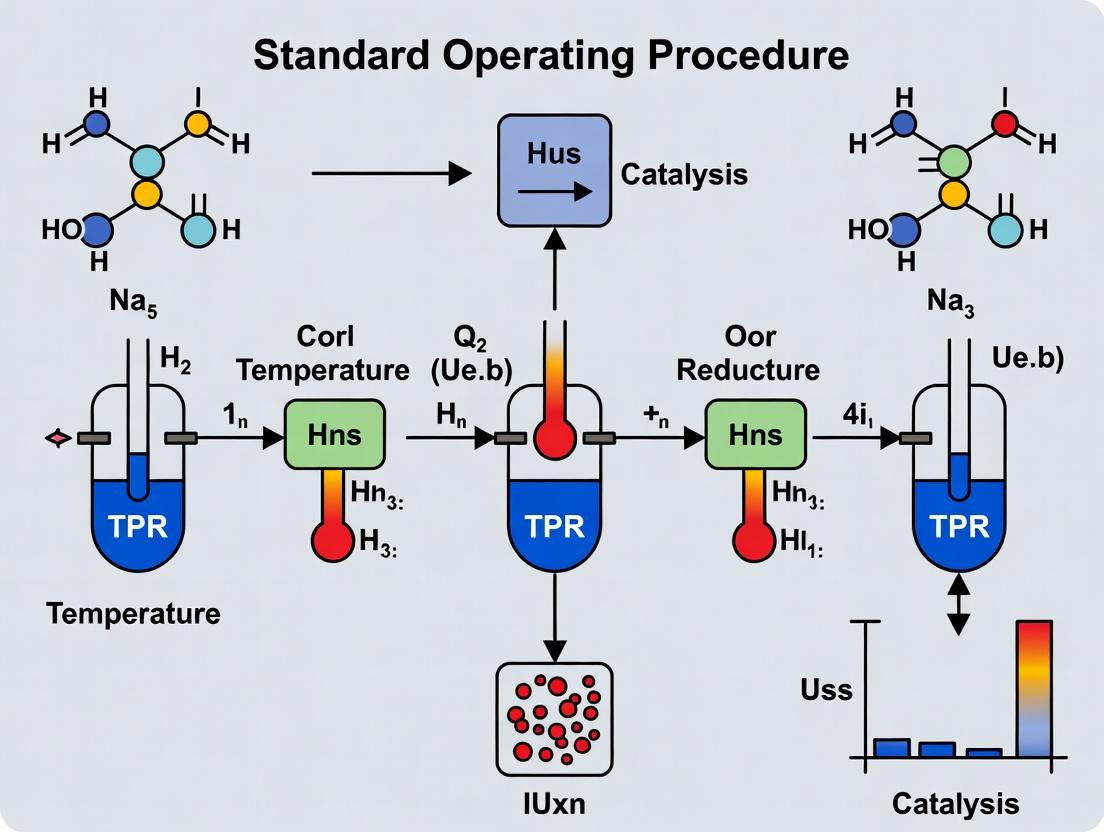
This comprehensive guide provides researchers and drug development professionals with a complete standard operating procedure for Temperature Programmed Reduction (TPR).
TPR Protocol Mastery: A Complete Standard Operating Procedure for Catalyst Characterization
Abstract
This comprehensive guide provides researchers and drug development professionals with a complete standard operating procedure for Temperature Programmed Reduction (TPR). Covering fundamental principles through advanced applications, the article details systematic methodologies for catalyst characterization, troubleshooting common experimental challenges, and validating TPR data against complementary techniques. The content addresses the needs of scientists seeking to implement or optimize TPR protocols for pharmaceutical catalyst development, heterogeneous catalysis research, and material characterization in biomedical contexts.
Understanding TPR Fundamentals: Principles, Theory, and Why It Matters for Catalyst Research
Core Concept and Historical Development
Temperature-Programmed Reduction (TPR) is a versatile and quantitative analytical technique used primarily in the field of heterogeneous catalysis and materials science. It involves the controlled reduction of a solid sample by a flowing gas mixture (typically containing H₂ in an inert carrier like Ar or N₂) while linearly increasing the temperature. The consumption of the reducing agent is monitored as a function of temperature, producing a characteristic profile (or spectrum) that serves as a fingerprint for the reducible species present.
The core principle lies in the fact that different oxides, metal complexes, or supported metal precursors reduce at distinct, characteristic temperatures. This temperature is influenced by the metal's identity, its oxidation state, particle size, and interaction with the support material. A TPR profile provides critical information about:
- Reducibility: The ease with which a material reduces.
- Dispersion and Interaction: The strength of the metal-support interaction.
- Quantification: The total amount of reducing agent consumed, allowing calculation of the active metal content or oxygen stoichiometry.
- Identification of Phases: Discrimination between different reducible species in a complex solid.
The historical development of TPR is intrinsically linked to the evolution of catalytic research in the mid-20th century. The need to understand catalyst activation (pre-reduction) and the nature of active sites drove the adaptation of thermal analysis and gas titration methods. Key milestones include:
- 1960s-1970s: Emergence of foundational principles alongside other temperature-programmed techniques (TPD, TPO). Initial setups were often custom-built by research groups.
- 1980s: Commercialization of dedicated TPR units and the standardization of methodology. The work of J.W. Niemantsverdriet and others helped formalize the theory and experimental practice.
- 1990s-Present: Integration with other characterization techniques (e.g., in-situ XRD, XAS), automation, and advanced data analysis. The focus shifted towards more complex nanomaterials and precise kinetic modeling.
Application Notes and Protocols
Standard Operating Procedure for TPR Research
1.0 Purpose To define the standard procedure for conducting Temperature-Programmed Reduction analysis to characterize the reducible components of solid catalyst and material samples.
2.0 Scope Applicable to researchers analyzing supported metals, metal oxides, mixed oxides, and other reducible solid materials.
3.0 Experimental Protocol: TPR Measurement
3.1 Materials and Reagent Solutions
| Research Reagent / Material | Function |
|---|---|
| Sample (e.g., 10-50 mg) | The solid material under investigation (e.g., CuO/γ-Al₂O₃). |
| Reducing Gas (5-10% H₂/Ar) | The reactive component. Argon acts as an inert carrier/diluent. |
| Quartz Reactor Tube | Holds the sample in the heating furnace; inert at high temperatures. |
| Quartz Wool | Used to support and position the sample bed within the reactor. |
| Thermal Conductivity Detector (TCD) | Measures the change in H₂ concentration in the effluent gas stream. |
| Calibration Gas (e.g., pure H₂) | Used for quantitative calibration of the TCD signal. |
| High-Purity Argon | Used for system purging and as a carrier gas baseline. |
| Liquid Nitrogen Trap | Placed before TCD to remove produced water (H₂O) from the gas stream. |
3.2 Sample Preparation Protocol
- Weigh an appropriate amount of sample (typically 10-50 mg) to ensure a detectable signal without mass/heat transfer limitations.
- Load the sample onto a plug of quartz wool placed in the center of a U-shaped or straight quartz reactor tube.
- Secure the sample with additional quartz wool plugs to prevent movement during gas flow.
- Mount the reactor tube in the furnace of the TPR apparatus.
3.3 Pre-Treatment Protocol
- Connect the reactor to the gas manifold.
- Purge the system with inert gas (Argon, 20-30 mL/min) at room temperature for at least 30 minutes to remove air (O₂, N₂).
- Optionally, pre-treat the sample in an inert gas flow with a temperature ramp to remove adsorbed species (e.g., water, CO₂), if required for the study.
3.4 Reduction and Data Acquisition Protocol
- Switch the gas flow from pure Ar to the reducing mixture (e.g., 5% H₂ in Ar). Maintain a constant flow rate (e.g., 20-50 mL/min). Allow the baseline of the Thermal Conductivity Detector (TCD) to stabilize.
- Initiate the temperature program. A standard linear ramp is commonly used.
- Start Temperature: 50°C
- Ramp Rate: 5-10°C/min
- End Temperature: 800-1000°C (material dependent)
- The TCD continuously monitors the difference in thermal conductivity between the reference gas stream (pure reducing mix) and the sample effluent stream. As the sample consumes H₂ during reduction, the H₂ concentration in the effluent drops, causing a signal response.
- The instrument software records the TCD signal (µV) versus sample temperature (°C) or time.
3.5 Calibration for Quantification Protocol
- After the run, inject a known volume of pure H₂ (or the reducing gas mixture) into the carrier gas stream via a calibrated loop.
- Measure the area of the resulting TCD peak. This correlates a peak area to a known molar quantity of H₂.
- The total H₂ consumption of the sample is calculated by integrating the area under all reduction peaks in the TPR profile and comparing it to the calibration peak area.
4.0 Data Presentation and Analysis
Table 1: Typical TPR Data for Reference Metal Oxides (Theoretical Values)
| Metal Oxide | Theoretical H₂ Consumption (mmol/g oxide) | Characteristic Peak Temperature Range (°C) | Reduction Product |
|---|---|---|---|
| CuO | 12.6 | 180 - 300 | Cu |
| NiO | 13.4 | 350 - 500 | Ni |
| Fe₂O₃ (→Fe₃O₄) | 3.7 | 300 - 400 | Fe₃O₄ |
| Fe₂O₃ (→Fe) | 18.7 | Multiple peaks (300-800) | Fe |
| Co₃O₄ | 8.3 | 200-350 | CoO → Co |
Table 2: Key Experimental Parameters and Their Impact
| Parameter | Typical Range | Impact on TPR Profile |
|---|---|---|
| Sample Mass | 10 - 50 mg | High mass can cause broadening, shifting to higher T. |
| Heating Rate (β) | 5 - 20 °C/min | Higher rate shifts peaks to higher T, may reduce resolution. |
| H₂ Concentration | 2 - 10% in Ar | Affects reduction kinetics and peak temperature. |
| Gas Flow Rate | 20 - 50 mL/min | Influences heat/mass transfer and signal-to-noise. |
Visualizations
TPR Experimental Workflow
Interpreting TPR Profile Features
Temperature-Programmed Reduction (TPR) is a pivotal analytical technique for characterizing reducible solid materials, particularly catalysts and metal oxides. Within a standardized research framework, understanding the thermodynamic and kinetic principles governing TPR profiles is essential for interpreting reduction behavior, metal-support interactions, and active site dispersion. This application note details the core scientific principles and provides validated protocols for TPR experimentation.
Fundamental Principles
Thermodynamic Basis
The thermodynamic feasibility of a reduction reaction is governed by the Gibbs free energy change (ΔG°). For a general reduction reaction: MOₓ + yH₂ → M + xH₂O, the equilibrium constant Kₐ relates to the reduction potential. The driving force is the difference in oxygen chemical potential between the metal oxide and the reducing gas (typically H₂).
Kinetic Basis
The observed TPR profile (hydrogen consumption rate vs. temperature) is a convolution of intrinsic kinetics and experimental parameters. The reduction rate is often described by a contracting sphere or nucleation model. The Polanyi-Wigner equation frequently models the rate: [ r(T) = -\frac{d\alpha}{dt} = A \cdot e^{-Ea/(RT)} \cdot f(\alpha) \cdot C{H2}^n ] where α is the fraction reduced, A is the pre-exponential factor, Eₐ is the apparent activation energy, f(α) is the reaction model, and n is the order in H₂.
Key Quantitative Parameters in TPR Analysis
The following table summarizes critical data extracted from TPR profiles for material characterization.
Table 1: Quantitative Parameters from TPR Profiles and Their Significance
| Parameter | Symbol | Typical Units | Significance & Interpretation |
|---|---|---|---|
| Peak Temperature | Tₘ | °C or K | Indicator of reducibility. Lower Tₘ suggests easier reduction. Governed by oxide stability and metal-support interaction. |
| Hydrogen Consumption | V_(H₂) | mol H₂/g or mmol/g | Quantitative measure of reducible species. Used to calculate reduction stoichiometry and metal dispersion. |
| Peak Width | ΔT_(1/2) | °C or K | Related to uniformity of reducible species. Broader peaks indicate a distribution of particle sizes or interaction strengths. |
| Onset Temperature | T_(onset) | °C or K | Temperature where reduction begins kinetically. Useful for comparing initiation of reduction processes. |
| Activation Energy | Eₐ | kJ/mol | Barrier for the reduction step. Calculated via Kissinger or model-fitting methods. Key kinetic descriptor. |
Experimental Protocol: Standard TPR Measurement
Materials and Equipment
The Scientist's Toolkit: Essential Research Reagent Solutions
| Item | Function & Specification |
|---|---|
| TPR Reactor System | Quartz U-tube microreactor housed in a programmable furnace. |
| Reducing Gas | 5-10% H₂ in Ar or N₂, ultra-high purity (99.999%). Provides the reducing agent. Must be oxygen-free. |
| Thermal Conductivity Detector (TCD) | Measures H₂ concentration in effluent gas by comparing thermal conductivity. Primary sensor for TPR profile. |
| Mass Flow Controllers (MFCs) | Precisely control and blend gas flows (typically 20-50 mL/min total). |
| Cool Trap | Liquid nitrogen/isopropanol or molecular sieve trap to remove water produced during reduction before the TCD. |
| Reference Material | High-purity CuO (e.g., 99.99%). Used for system calibration and validation of temperature and H₂ consumption accuracy. |
| Quartz Wool | For supporting the catalyst bed within the reactor tube. Must be inert and pre-cleaned. |
| Temperature Calibrator | Thermocouple (K-type) placed within the catalyst bed for accurate temperature measurement. |
Pre-Treatment Protocol
- Sample Loading: Weigh 10-50 mg of sample (accurately recorded) and mix with inert quartz sand (if needed) to ensure uniform heating and gas flow. Pack uniformly in the reactor using quartz wool plugs.
- System Leak Check: Pressurize the gas lines and check for leaks using a soap solution or electronic leak detector.
- Pre-Reduction Cleaning: Heat the sample in an inert gas flow (Ar, 30 mL/min) to 150-200°C at 10°C/min, hold for 30-60 minutes, to remove physisorbed water and contaminants.
- Cooling: Cool the sample in inert flow to the desired starting temperature (typically 50°C or room temperature).
TPR Measurement Protocol
- Baseline Stabilization: Switch the gas flow to the reducing mixture (e.g., 5% H₂/Ar, 30 mL/min). Allow the TCD signal to stabilize at the starting temperature.
- Temperature Programming: Initiate a linear temperature ramp (β = dT/dt). A standard rate is 5-10°C/min. Common final temperature: 800-900°C.
- Data Acquisition: Continuously record TCD signal (mV) versus sample temperature (T) and time (t).
- Profile Completion: Hold at the final temperature for 10-15 minutes until the TCD signal returns to baseline, indicating completion of reduction.
- Cool Down: Cool the reduced sample in inert gas flow.
Calibration and Quantification
- H₂ Consumption Calibration: Inject known volumes of pure H₂ or the reducing gas mixture into the carrier stream via a calibration loop. Record the TCD peak area. Establish a calibration factor (μmol H₂/mV·s or similar).
- Temperature Calibration: Perform a TPR run on a standard material (e.g., pure CuO). The peak maximum for CuO should be at ~300°C (for 5-10°C/min ramp). Adjust the thermocouple reading if necessary.
- Quantitative Analysis: Integrate the area under the TPR peak(s). Apply the calibration factor to calculate total H₂ consumption.
Data Analysis and Interpretation Workflow
TPR Data Analysis Workflow
Kinetic Analysis Protocol: Kissinger Method for Eₐ Determination
This protocol extracts the apparent activation energy (Eₐ) without assuming a specific reaction model f(α).
Procedure
- Perform a series of TPR experiments on identical samples (same mass, preparation) using at least three different heating rates (β), e.g., 2, 5, 10, and 15°C/min.
- For each experiment, record the peak maximum temperature (Tₘ) for the reduction feature of interest.
- Apply the Kissinger Equation: [ \ln\left(\frac{\beta}{Tm^2}\right) = \ln\left(\frac{A R}{Ea}\right) - \frac{Ea}{R Tm} ]
- Plot (\ln(\beta / Tm^2)) versus (1/Tm) (where Tₘ is in Kelvin).
- Perform a linear fit. The slope of the line is equal to (-E_a / R).
Table 2: Example Kissinger Analysis for CuO Reduction
| Heating Rate, β (°C/min) | Peak Max, Tₘ (K) | 1/Tₘ (x10⁻³ K⁻¹) | ln(β / Tₘ²) |
|---|---|---|---|
| 3 | 528.2 | 1.893 | -11.42 |
| 5 | 543.7 | 1.839 | -10.80 |
| 8 | 558.9 | 1.789 | -10.28 |
| 12 | 575.4 | 1.738 | -9.80 |
Linear Fit Slope = -6042 K → Eₐ = Slope * R ≈ 50.2 kJ/mol (R=8.314 J/mol·K)
Principles of Profile Shape and Deconvolution
Factors Influencing TPR Profile Shape
Deconvolution Protocol
- Assume the overall profile S(T) is a sum of m individual reduction processes: [ S(T) = \sum{i=1}^{m} wi \cdot ri(T, Ai, E{a,i}, modeli) ] where w_i is the contribution of component i.
- Use non-linear least-squares fitting software (e.g., Origin, MATLAB).
- Fix or constrain parameters based on known chemistry (e.g., expected stoichiometry).
- Iteratively fit until the residual between simulated and experimental data is minimized. Validate with statistical parameters (R², χ²).
Application Notes
Temperature Programmed Reduction (TPR) is a critical analytical technique within pharmaceutical catalysis, primarily used to characterize supported metal catalysts essential for key synthetic transformations. By measuring hydrogen consumption as a function of temperature, TPR provides quantitative data on reducibility, metal-support interaction strength, and metal dispersion—parameters directly governing catalyst activity, selectivity, and stability in API synthesis.
Table 1: TPR Characterization of Common Pharmaceutical Catalysts
| Catalyst System | Typical Reduction Peak Temp. (°C) | H₂ Consumption (μmol/g cat) | Inferred Interaction Strength | Primary Drug Synthesis Application |
|---|---|---|---|---|
| 5% Pd/Al₂O₃ | 50 - 80 | ~250 | Weak | Hydrogenation of nitro groups, deprotection |
| 1% Pt/TiO₂ | 200 - 250 | ~45 | Medium | Enantioselective hydrogenation |
| 3% Ru/SiO₂ | 150 - 200 | ~180 | Medium | Reductive amination for amine APIs |
| 5% Ni/Al₂O₃ | 300 - 400 | ~850 | Strong | Cost-effective bulk hydrogenations |
Table 2: Correlation of TPR Metrics with Catalyst Performance
| TPR Metric | Impact on Catalyst Performance | Optimal Range for Pharma |
|---|---|---|
| Reduction Temperature | Lower temp → higher activity at mild conditions | 50-250°C for noble metals |
| Peak Width (FWHM) | Narrower peak → more uniform particle size | < 50°C |
| H₂ Consumption / Theoretical | Ratio indicates dispersion; >80% is excellent | > 0.8 |
Strong metal-support interactions (SMSI), identified by high reduction temperatures, can suppress sintering but may also reduce activity. Screening via TPR allows rational selection: weak interactions (low TPR peak) suit low-temperature hydrogenations, while strong interactions (high TPR peak) benefit harsh, continuous flow processes.
Experimental Protocols
Protocol 1: Standard TPR for Catalyst Screening in Hydrogenation Reactions
Objective: To determine the reduction profile and hydrogen consumption of a novel supported metal catalyst candidate for pharmaceutical hydrogenation.
Materials & Equipment:
- TPR analyzer with thermal conductivity detector (TCD)
- 10% H₂/Ar gas mixture (reducing gas)
- High-purity Argon (carrier gas)
- Cold trap (e.g., isopropanol/liquid N₂)
- U-shaped quartz sample tube
- Micromeritics AutoChem II or equivalent
- Catalyst sample (50-100 mg, sieved 150-250 μm)
Procedure:
- Pretreatment: Load catalyst into quartz tube. Purge with Ar (30 mL/min) at room temperature for 30 minutes. Heat to 150°C under Ar (10°C/min) and hold for 1 hour to remove adsorbed water and contaminants.
- Baseline Stabilization: Cool to 50°C under Ar. Switch gas to 10% H₂/Ar and stabilize flow at 25 mL/min until TCD baseline is steady (≈30 min).
- Reduction: Initiate a linear temperature ramp from 50°C to 800°C at a rate of 10°C/min under the 10% H₂/Ar flow.
- Data Acquisition: Record TCD signal (μV) versus temperature and time. The negative peak corresponds to H₂ consumption.
- Calibration: Perform a calibration pulse using a known volume of H₂ after analysis to quantify total consumption.
- Cool Down: Switch back to Ar flow and cool the reactor to room temperature.
Data Analysis: Integrate the TPR peak area. Calculate total H₂ consumed using calibration factor. Determine peak temperature (Tmax) and Full Width at Half Maximum (FWHM). Compare with reference catalysts.
Protocol 2: TPR-H₂ Chemisorption for Metal Dispersion Analysis
Objective: To quantify active metal surface area and dispersion following reduction, linking TPR profile to active site count.
Procedure:
- Perform standard TPR (Protocol 1) up to desired reduction temperature (e.g., 300°C).
- Cool and Flush: Cool the reduced catalyst to 35°C under Ar. Hold for 30 minutes to remove weakly adsorbed H₂.
- Pulse Chemisorption: Inject calibrated pulses of 10% H₂/Ar (e.g., 0.05 mL pulses) into the Ar carrier stream flowing over the catalyst. Monitor TCD signal until peaks no longer decrease (saturation).
- Calculation: From total H₂ adsorbed, calculate metal dispersion: D (%) = (Number of H atoms adsorbed / Total number of surface + bulk metal atoms) * 100. Assume a stoichiometry (e.g., H:Pt = 1:1).
The Scientist's Toolkit: Research Reagent Solutions
Table 3: Essential Materials for TPR in Pharmaceutical Catalyst Development
| Item/Chemical | Function & Specification | Example Supplier |
|---|---|---|
| 10% H₂/Ar Calibration Gas | Standard reducing mixture for TPR profiles and pulse calibration. Must be high purity (99.999%). | Linde, Airgas |
| UHP Argon Carrier Gas | Inert purge and carrier gas; removes oxygen and water impurities. | Praxair |
| Quartz Wool & U-Tubes | Sample containment; inert, high-temperature stable. | Micromeritics |
| Reference Catalysts (e.g., 5% Pt/Al₂O₃) | Benchmark materials for instrument and method validation. | Sigma-Aldrich, Johnson Matthey |
| Cold Trap (Isopropanol/LN₂) | Removes water and hydrocarbons from gas stream to protect TCD. | Custom or part of analyzer |
| Calibrated Pulse Loop (e.g., 0.05 mL) | For quantitative H₂ chemisorption post-TPR. | Valco Instruments |
| Sieves (150-250 μm mesh) | Standardizes catalyst particle size for reproducible packing. | Cole-Parmer |
Title: TPR Analysis and Catalyst Screening Workflow
Title: Support-Metal Interaction Analysis via TPR
Application Notes
Temperature Programmed Reduction (TPR) is a cornerstone analytical technique in catalysis and materials science, used to characterize reducible materials by measuring the hydrogen consumption as a function of temperature. The evolution from basic manual setups to modern automated systems has enhanced reproducibility, data quality, and throughput, which is critical for SOP-driven research. The core principle involves a linear temperature ramp of a sample in a reducing gas stream (typically H₂ in an inert carrier), with the consumption of H₂ monitored by a thermal conductivity detector (TCD).
Modern automated TPR systems integrate gas handling, temperature programming, data acquisition, and often in-situ mass spectrometry (MS) for evolved gas analysis. Key advancements include:
- Multi-sample Autosamplers: Enable sequential analysis of up to 12+ samples unattended, crucial for high-throughput catalyst screening.
- Integrated Calibration Loops: Automated injection of known gas volumes for quantitative H₂ consumption calculation, improving accuracy over manual methods.
- Downstream MS Coupling: Provides simultaneous detection of reduction products (e.g., H₂O, H₂S, CO₂), offering mechanistic insights beyond simple consumption profiles.
- Software Control & SOP Integration: Full parameter control and data logging allow for precise replication of experimental conditions, a fundamental requirement for thesis research and industrial R&D.
The quantitative data derived (reduction temperature peaks, H₂ consumption, peak deconvolution) informs on metal dispersion, metal-support interactions, and reducibility kinetics.
Table 1: Comparison of TPR System Configurations
| Feature | Basic Manual Setup | Modern Automated System |
|---|---|---|
| Sample Loading | Single, manual | Automated carousel (6-12 samples) |
| Gas Switching | Manual valves | Automated solenoid or pneumatic valves |
| Temperature Control | Stand-alone programmer | Integrated software control |
| Calibration | External, manual syringe | Internal, automated loop injector |
| Detection | TCD only | TCD + optional downstream MS |
| Quantification | Manual peak integration | Automated software with calibration |
| Reproducibility | Moderately variable | High (SOP-enforced) |
| Throughput | ~2-3 samples/day | ~8-12 samples/day (unattended) |
| Approx. Cost Range | $20,000 - $50,000 | $80,000 - $200,000+ |
Protocols
Protocol 1: Standard Operating Procedure for TPR Analysis on an Automated System
Objective: To determine the reduction profile and quantitative hydrogen consumption of a supported metal catalyst.
I. Materials Preparation & Pre-Treatment
- Sample Weight: Accurately weigh 20-50 mg of dry catalyst (precision ±0.01 mg) into a pre-cleaned, tared U-shaped quartz reactor tube.
- Sample Pretreatment: Place loaded reactor in the analysis port. Purge with inert gas (Ar or He, 20-30 mL/min) at room temperature for 15 minutes. Activate the pre-treatment furnace to heat the sample to 150°C (rate 10°C/min) under inert flow and hold for 60 minutes to remove physisorbed water and contaminants. Cool to initial analysis temperature (e.g., 50°C) under inert flow.
II. System Setup & Calibration
- Gas Selection: Ensure reducing gas (5-10% H₂/Ar) and pure inert gas supplies are connected and valves are open. Set reducing gas flow to 20-50 mL/min as per SOP.
- Detector Stabilization: Power on the Thermal Conductivity Detector (TCD). Set bridge current and temperature as specified (e.g., 150 mA, 100°C). Allow ≥2 hours for stabilization until baseline is flat (drift <0.1 mV/min).
- Automated Calibration: Using system software, execute the calibration routine. This typically injects a predefined volume (e.g., 100 µL) of the reducing gas mixture into the inert stream via a calibrated loop. Record the detector response (peak area). Perform in triplicate. The system calculates a response factor (µmol H₂/mV·s).
III. TPR Experiment Execution
- Parameter Programming: In the control software, input the following method parameters:
- Initial Temperature: 50°C
- Final Temperature: 800°C or 900°C
- Ramp Rate: 5-10°C/min (select based on material)
- Reducing Gas: 5% H₂/Ar at 30 mL/min
- TCD Data Sampling Rate: 10 Hz
- Run Initiation: Start the method. The system will automatically:
- Switch the sample flow from inert to the reducing gas mixture.
- Begin the temperature ramp.
- Record TCD signal (voltage drop due to H₂ consumption) and temperature.
- Cool-down: After reaching the final temperature, hold for 5-10 minutes, then cool the furnace to <100°C under inert gas flow.
IV. Data Analysis
- Baseline Correction: Apply a linear or curved baseline to the raw TCD signal vs. time/temperature plot.
- Peak Integration: Integrate the area of each reduction peak.
- Quantification: Calculate total H₂ consumption using the formula:
H₂ Consumed (µmol) = (Peak Area / Calibration Factor)Normalize to sample weight (µmol/g) or metal content (H₂/Metal molar ratio). - Peak Deconvolution: Use fitting software to deconvolute overlapping peaks, assuming Gaussian or asymmetric peak shapes, to identify individual reduction events.
Protocol 2: Coupled TPR-MS Analysis
Objective: To simultaneously monitor hydrogen consumption and the evolution of specific reduction products (e.g., H₂O, SO₂, CO₂).
Procedure:
- Follow Protocol 1 for setup and execution.
- Connect the outlet of the TCD to the capillary inlet of a Mass Spectrometer (MS).
- In the MS software, select relevant mass-to-charge ratios (m/z) to monitor:
- m/z = 2: H₂ (confirm consumption)
- m/z = 18: H₂O (primary reduction product)
- m/z = 44: CO₂ (carbonate decomposition)
- m/z = 64: SO₂ (sulfate/sulfide related)
- Start MS data acquisition synchronized with the TPR method start.
- Correlate MS ion current profiles with TCD peaks to assign reduction events to specific chemical reactions.
Table 2: Quantitative Data from a Typical TPR Study of a CuO/ZnO/Al₂O₃ Catalyst
| Sample | Low-T Peak Max (°C) | High-T Peak Max (°C) | Total H₂ Uptake (µmol/g) | H₂O Evolution (MS m/z=18) Correlated Peak |
|---|---|---|---|---|
| Catalyst Batch A | 215 ± 3 | 250 ± 5 | 4850 ± 120 | Yes, aligns with both peaks |
| Catalyst Batch B | 220 ± 4 | 255 ± 4 | 4720 ± 110 | Yes, aligns with both peaks |
| Pure CuO Reference | 305 ± 2 | N/A | 7800 ± 150 | Yes, single peak |
Diagrams
TPR Experimental Workflow
Modern Automated TPR System
The Scientist's Toolkit: Research Reagent Solutions & Essential Materials
| Item | Function in TPR |
|---|---|
| U-Shaped Quartz Reactor Tubes | Holds sample during analysis; inert, withstands high temperature. |
| Quartz Wool | Used to plug reactor tube, securing sample bed in position. |
| Certified Gas Mixtures (5-10% H₂ in Ar/He) | The precise reducing atmosphere. Certified standards ensure quantitative accuracy. |
| High-Purity Inert Gas (Ar, He, N₂) | For pretreatment, purging, and carrier gas. Low O₂/H₂O content (<1 ppm) is critical. |
| Thermal Conductivity Detector (TCD) | The primary sensor measuring H₂ concentration in the effluent gas stream. |
| Calibration Gas Loop (e.g., 100 µL) | A fixed-volume loop for automated injection of standard gas to calibrate the TCD response. |
| Reference Catalyst (e.g., CuO, Ag₂O) | A material with known reduction profile and H₂ uptake, used for system validation. |
| Mass Spectrometer (MS) with Capillary Inlet | Optional for detecting and quantifying gaseous products (H₂O, CO₂, etc.) during reduction. |
| Automated Valve System | Enables precise, software-controlled switching between gases and calibration sequences. |
Temperature-Programmed Reduction (TPR) is a pivotal analytical technique in heterogeneous catalysis and materials science for characterizing solid-state materials, particularly supported metal catalysts. By monitoring the consumption of a reducing gas (typically H₂) as a function of temperature, TPR provides quantitative and qualitative insights into three critical parameters: the reducibility of metal species, the dispersion of active phases, and the strength of metal-support interactions (MSI). This application note, framed within a standard operating procedure for TPR research, details experimental protocols, data interpretation, and practical tools for researchers.
Core Insights from TPR Profiles
Reducibility
Reducibility refers to the ease with which a metal oxide can be reduced to its metallic or lower oxidation state. In TPR, it is directly indicated by the reduction temperature (Tpeak). A lower Tpeak suggests easier reduction. The degree of reduction is calculated from the total H₂ consumption.
Metal Dispersion
Dispersion describes the fraction of metal atoms exposed on the surface relative to the total amount. While TPR itself does not directly measure dispersion, the shape and width of reduction peaks provide indirect evidence. A broad, low-temperature peak often indicates well-dispersed, small particles that are easier to reduce, while a sharp, high-temperature peak may signal large, bulk-like particles.
Metal-Support Interactions (MSI)
MSI define the chemical and physical interplay between the active metal phase and its support. Strong Metal-Support Interactions (SMSI) can lead to peak shifts in TPR profiles. A shift to higher temperatures signifies stronger interactions that stabilize the metal oxide phase, making reduction more difficult. The appearance of multiple peaks can indicate the sequential reduction of different species or species in different chemical environments created by the support.
Table 1: TPR Data Interpretation for Critical Parameters
| Parameter | What TPR Measures | Key Indicator in Profile | Typical Data Output | Implications |
|---|---|---|---|---|
| Reducibility | Ease of reduction | Peak Temperature (Tmax, °C) | Single or multiple Tmax values | Lower Tmax = easier reduction. Compares different catalysts or supports. |
| Extent of reduction | Total H₂ Uptake (μmol H₂/g-cat) | Calculated from peak area | Quantifies amount of reducible species. Verifies stoichiometry. | |
| Dispersion | Particle size/Surface accessibility | Peak Shape & Width | Broad vs. Sharp Peaks | Broad, low-T peaks suggest high dispersion/small particles. |
| Metal-Support Interaction | Strength of bonding/encapsulation | Peak Shift & Number of Peaks | ΔTmax vs. reference; Multiple peaks | Higher Tmax = stronger MSI. Multiple peaks = multiple species/environments. |
Table 2: Example TPR Data for Supported Ni Catalysts
| Catalyst | Support | Tpeak 1 (°C) | Tpeak 2 (°C) | Total H₂ Consumption (μmol/g) | Inferred Characteristics |
|---|---|---|---|---|---|
| NiO (Bulk) | None | ~400 | - | ~1300* | Large NiO crystals, weak interaction. |
| 5% Ni/Al₂O₃ | Al₂O₃ | 350 | 550 | 850 | Moderate MSI, some NiAl₂O₄ spinel formation (high-T peak). |
| 5% Ni/SiO₂ | SiO₂ | 300 | - | 820 | Weaker MSI, better NiO dispersion than bulk. |
| 5% Ni/TiO₂ | TiO₂ | 200 | 500 | 800 | Strong SMSI after high-T reduction, partial encapsulation. |
*Theoretical value for pure NiO.
Experimental Protocols
Protocol 1: Standard TPR Experiment for Supported Metal Catalysts
Objective: To obtain a reduction profile and quantify H₂ consumption for a catalyst sample.
Materials & Preparation:
- Sample: 50-100 mg of catalyst (powder, sieved to 150-250 μm).
- Pretreatment: Load sample into U-shaped quartz reactor. Heat to 300°C (5°C/min) under inert flow (Ar, 30 mL/min) for 1 hour to remove adsorbed water and contaminants.
- Cool: Cool to 50°C under inert flow.
Reduction Experiment:
- Gas Switch: Switch gas flow to 5% H₂/Ar (or 10% H₂/Ar) reducing mixture. Total flow: 30 mL/min. Ensure stable baseline on Thermal Conductivity Detector (TCD).
- Temperature Program: Initiate a linear heating ramp (e.g., 5-10°C/min) from 50°C to a final temperature (typically 800-900°C, depending on material). Hold at final T for ~15 min.
- Data Acquisition: Record TCD signal (μV) and sample temperature continuously. Calibrate TCD response periodically using known pulses of H₂.
Calculation of H₂ Consumption:
- Integrate the area under the TPR peak(s).
- Compare to the area from a known volume of H₂ (calibration pulse).
- Calculate total H₂ consumed:
H₂ (μmol) = (Area_sample / Area_calibration) * H₂_calibration (μmol). - Normalize to sample mass (μmol H₂/g).
Protocol 2: TPR for Determining Metal Dispersion (Indirect Method)
Objective: To correlate TPR profile features with metal particle size/dispersion.
Procedure:
- Perform Standard TPR (Protocol 1) on a series of catalysts with varying known dispersions (e.g., from CO chemisorption or TEM).
- Analyze the full width at half maximum (FWHM) and Tpeak of the main reduction peak.
- Construct a calibration curve linking FWHM/Tpeak to independently measured dispersion.
- For unknown samples, run TPR and use the calibration to estimate dispersion.
Note: This is an indirect method and requires system-specific calibration.
Protocol 3: Probing Metal-Support Interactions via Comparative TPR
Objective: To assess the strength of MSI by comparing reduction profiles.
Procedure:
- Prepare or obtain the supported catalyst (e.g., M/S) and its corresponding unsupported metal oxide (e.g., MOx).
- Run Standard TPR (Protocol 1) on both samples under identical conditions.
- Compare profiles:
- Calculate ΔTpeak = Tpeak(supported) - Tpeak(unsupported).
- A positive ΔTpeak indicates the support stabilizes the oxide (stronger MSI).
- Identify any new reduction peaks unique to the supported catalyst, indicating compound formation (e.g., metal aluminates, silicates).
Visualization of Concepts and Workflows
TPR Experimental Workflow and Outputs
How TPR Profile Features Link to Critical Parameters
The Scientist's Toolkit: Key Research Reagent Solutions & Materials
Table 3: Essential Materials for TPR Experiments
| Item | Function/Description | Key Considerations |
|---|---|---|
| Quartz U-Tube Reactor | Holds the catalyst sample during analysis. | Chemically inert at high T, minimal dead volume. |
| Reducing Gas Mixture | Typically 5-10% H₂ balanced with Ar or N₂. | High purity (>99.999%). Ar preferred for thermal conductivity. |
| Inert Purge Gas | Ultra-high purity Ar or He. | Used for pretreatment and cooling. Must be dry and oxygen-free. |
| Thermal Conductivity Detector (TCD) | Measures the H₂ concentration in the effluent gas. | Requires stable reference flow. Calibrated with known H₂ pulses. |
| Temperature Controller & Furnace | Provides precise, linear heating ramp. | Accurate thermocouple placement (in or near sample bed) is critical. |
| Cold Trap | Placed before TCD to remove water produced during reduction. | Prevents damage to TCD and baseline drift. |
| Calibration Loop | A fixed-volume loop for injecting known amounts of H₂. | Essential for quantitative H₂ uptake calculation. |
| Reference Catalyst | Well-characterized material (e.g., CuO, Ag₂O). | Used to validate instrument performance and calibration. |
Step-by-Step TPR Protocol: From Sample Prep to Data Acquisition
Within the framework of a Standard Operating Procedure (SOP) for Temperature Programmed Reduction (TPR) research, rigorous pre-analysis protocols are critical for generating reliable and reproducible data. This document outlines the essential steps for sample qualification, mass calculation, and pretreatment, serving as a mandatory checklist prior to any TPR experiment.
Sample Qualification
Not all materials are suitable for TPR analysis. The sample must be qualified based on its chemical nature and the research objectives.
Table 1: Sample Qualification Criteria for TPR
| Qualification Parameter | Acceptable Criteria | Reason for Qualification |
|---|---|---|
| Reducible Species | Presence of metal oxides, sulfides, or other reducible compounds. | TPR measures hydrogen consumption during reduction; samples must contain reducible components. |
| Thermal Stability | Stable up to at least 50°C beyond anticipated reduction temperature. | Prevents decomposition or sintering unrelated to reduction, which confuses TCD signals. |
| Particle Size | Ideally <100 μm, uniformly powdered. | Ensures uniform gas-solid contact and eliminates internal diffusion limitations. |
| Moisture Content | Must be dry (or moisture accounted for). | Water evolution mimics reduction peaks; pre-drying is often essential. |
| Initial Oxidation State | Known or well-defined. | Necessary for accurate calculation of theoretical hydrogen consumption. |
Mass Calculation Protocol
Accurate sample mass calculation is paramount to determine the active reducible content and ensure the signal falls within the detector's linear range.
Theoretical Hydrogen Consumption
The sample mass is calculated based on the expected total hydrogen uptake.
Formula:
m_sample = (n_H2_desired * M_metal) / (x * ω)
Where:
m_sample: Required sample mass (mg)n_H2_desired: Desired amount of H₂ consumption (typically 50-200 μmol for optimal detector response)M_metal: Molar mass of the reducible metal (g/mol)x: Stoichiometric number of H₂ molecules per metal atom (e.g., CuO → Cu: x=1; Fe₂O₃ → Fe: x=3)ω: Mass fraction of the reducible metal in the sample
Experimental Protocol:
- Identify Reducible Phase: Determine the exact reducible compound (e.g., NiO, PtO₂).
- Define Reduction Stoichiometry: Write the balanced reduction reaction (e.g., NiO + H₂ → Ni + H₂O).
- Calculate Metal Mass Fraction (ω): Use the formula
ω = (n*M_metal) / M_compoundfor pure phases. For supported catalysts, factor in the support weight (e.g., 5 wt% Pt/Al₂O₃: ω = 0.05). - Select Target H₂ Uptake: A target of 100 μmol H₂ is standard for most laboratory setups.
- Calculate Mass: Plug values into the formula.
Example Calculation for 5 wt% NiO/Al₂O₃:
- Reaction: NiO + H₂ → Ni + H₂O (x = 1)
- M_Ni = 58.69 g/mol
- ω = 0.05 * (58.69 / 74.69) = 0.0393 (accounting for oxygen in NiO)
- Target n_H2 = 100 μmol = 0.0001 mol
m_sample = (0.0001 mol * 58.69 g/mol) / (1 * 0.0393) ≈ 0.149 g or 149 mg
Table 2: Sample Mass Guide Based on Active Loadings
| Active Reducible Loading | Approx. Sample Mass (for 100 μmol H₂ uptake) | Notes |
|---|---|---|
| 100% (Pure oxide, e.g., CuO) | 5 - 15 mg | Very strong signal; use minimal mass. |
| 10 wt% (e.g., 10% Co₃O₄/SiO₂) | 50 - 120 mg | Common range for supported catalysts. |
| 1 wt% (e.g., 1% Pt/Al₂O₃) | 300 - 800 mg | Large mass may require careful packing to avoid pressure drop. |
| <0.5 wt% | >1 g | May be impractical for TPR; consider more sensitive techniques. |
Pretreatment Requirements Protocol
Pretreatment removes contaminants and standardizes the sample's initial state.
Experimental Protocol: Standard In-Situ Pretreatment for TPR
Objective: To clean the sample surface and eliminate adsorbed species (water, carbonates) without pre-reducing the sample.
Materials:
- High-purity Argon or Helium (≥99.999%)
- High-purity Oxygen (≥99.999%, optional, for oxidation step)
- Quartz U-tube reactor
- Tube furnace
- Mass flow controllers
Procedure:
- Loading: Weigh the calculated sample mass into the quartz reactor. Plug ends with quartz wool.
- Gas Switching: Install reactor in the TPR system. Under a gentle inert gas flow (e.g., 20 mL/min Ar), heat to 150°C at 10°C/min.
- Drying: Hold at 150°C for 60 minutes to remove physisorbed water.
- (Optional) Oxidation: For samples that may have reduced surfaces, switch to 20 mL/min O₂ and heat to 300°C (rate: 5°C/min). Hold for 30 minutes. This re-oxidizes the surface to a uniform state.
- Cooling: Switch back to inert gas (Ar). Cool to room temperature (<50°C).
- Stabilization: Maintain inert flow for at least 15 minutes to stabilize the baseline.
- TPR Initiation: The system is now ready for the TPR experiment by switching to the H₂/Ar mix and starting the temperature program.
Critical Checkpoints:
- Do not expose the sample to reducing atmospheres (H₂, CO) before the TPR experiment.
- Ensure cooling to RT is complete to avoid an initial negative drift in the TCD signal.
- Record all pretreatment conditions (gases, flow rates, temperatures, hold times) in the lab notebook.
The Scientist's Toolkit: Key Research Reagent Solutions
Table 3: Essential Materials for TPR Sample Preparation
| Item | Function in TPR Pre-Analysis |
|---|---|
| High-Purity Gases (H₂, Ar, O₂) | Reactive (H₂) and inert (Ar) gases for reduction and purge; O₂ for pretreatment. Impurities can cause artifact peaks. |
| Quartz Wool & Reactor Tubes | Inert, high-temperature packing and reaction vessel. Must be cleaned before each use to prevent contamination. |
| Microbalance (0.01 mg precision) | Precisely weighs small sample masses (10-200 mg) for accurate quantitative calculation. |
| Mortar and Pestle (Agate) | For gentle, contaminant-free grinding of samples to achieve uniform, fine powder. |
| Sieves (e.g., 100 mesh) | Standardizes particle size distribution to ensure kinetic rather than diffusion-limited results. |
| Drying Oven (110°C) | For preliminary ex-situ drying of samples to remove bulk moisture prior to in-situ pretreatment. |
| Certified Reference Materials (e.g., CuO) | Standard compounds with known, reliable reduction profiles to calibrate and validate the TPR system performance. |
Visualized Workflows
Title: TPR Pre-Analysis Decision and Workflow
Title: Logic Flow for TPR Sample Mass Calculation
This Standard Operating Procedure (SOP) defines the detailed protocol for executing a Temperature-Programmed Reduction (TPR) experiment. TPR is a pivotal analytical technique in heterogeneous catalysis and materials science research for characterizing reducible solids, determining metal dispersion, identifying reduction mechanisms, and quantifying active sites. This protocol is framed within a thesis establishing robust, reproducible SOPs for advanced catalyst characterization. The procedure covers instrument setup, sample preparation, calibration, experimental execution, data acquisition, and initial data processing.
The Scientist's Toolkit: Essential Research Reagent Solutions & Materials
| Item | Function/Brief Explanation |
|---|---|
| TPR Instrument | A dedicated reactor system with a programmable furnace, thermal conductivity detector (TCD), and gas handling panels for precise control of temperature and reducing gas flow. |
| U-Tube Quartz Reactor | Holds the sample during analysis. Quartz is inert at high temperatures and in reducing atmospheres. |
| Quartz Wool | Used to support and position the sample plug within the reactor tube. |
| High-Purity Reducing Gas (e.g., 5% H₂ in Ar) | The reactive mixture. H₂ is the reductant; Ar is the diluent and carrier gas. Concentration must be precisely known. |
| High-Purity Inert Gas (e.g., Ar, He) | Used for system purging, cooling, and as a reference gas for the TCD. |
| Thermal Conductivity Detector (TCD) | Measures the change in thermal conductivity of the effluent gas stream due to H₂ consumption, providing the primary TPR signal. |
| Calibration Standard (e.g., CuO) | High-purity reference material with a known reduction profile (peak temperature) to validate instrument performance and calibrate H₂ consumption. |
| Microbalance (0.01 mg precision) | For accurate weighing of sample mass (typically 10-100 mg). |
| Sample Sieve (e.g., 150-250 µm mesh) | To ensure uniform particle size, minimizing mass and heat transfer limitations. |
| Temperature Calibrator (e.g., K-type Thermocouple) | For verifying the accuracy of the sample zone temperature reading. |
| Data Acquisition Software | Computer software interfaced with the instrument to control parameters and record temperature and TCD signal versus time. |
Detailed Pre-Experimental Protocols
Instrument Preparation & Leak Check
- Ensure the TPR system is connected to the required gas cylinders (reducing mix, inert gas) via appropriate pressure regulators.
- Check all gas lines and fittings for integrity. Perform a full-system leak check by pressurizing the gas lines with inert gas to ~2 bar and monitoring for pressure drop over 30 minutes. A drop >0.1 bar requires inspection and sealing of connections.
- Power on the TCD, furnace controller, and data acquisition system. Allow the TCD filament to stabilize for a minimum of 2 hours.
- Set the TCD bridge current as per manufacturer specifications (typically 80-120 mA for H₂/Ar mixtures). Set the inert gas flow through both reference and sample sides of the TCD to establish a stable baseline. A typical total flow rate is 30-50 mL/min.
- Program a test temperature ramp (e.g., 10°C/min to 500°C) without sample to confirm furnace response and baseline stability.
Sample Preparation Protocol
- Calculation: Calculate the required sample mass based on its expected reducible metal content to avoid saturating the TCD. A general guideline is 0.01-0.05 mmol of reducible H₂.
- Weighing: Accurately weigh the calculated mass of catalyst powder (e.g., 20.0 mg ± 0.1 mg) into a clean vial.
- Loading: Place a small plug of quartz wool into the center of the U-tube quartz reactor. Using a long funnel, transfer the weighed sample onto the quartz wool. Add a second small plug of quartz wool on top to secure the sample bed.
- Mounting: Carefully insert the loaded reactor tube into the furnace, ensuring the sample bed is aligned in the uniform temperature zone (pre-determined by prior calibration). Connect the gas inlet/outlet lines.
Core TPR Experiment Execution Protocol
Pre-Treatment (In-Situ Oxidation/Cleaning)
- Switch the gas flow to the inert gas (Ar or He) at the standard flow rate (e.g., 30 mL/min).
- Heat the sample from room temperature to 300°C at 20°C/min.
- Hold at 300°C for 60 minutes to remove adsorbed water and contaminants.
- For Pre-Oxidation: Switch gas to 5-10% O₂ in He for 60 minutes to ensure a fully oxidized starting state.
- Cool the sample in inert gas flow to the desired starting temperature (typically 50°C).
Reduction & Data Acquisition
- Switch the gas from inert to the pre-mixed reducing gas (e.g., 5% H₂/Ar). Ensure the flow rate is identical to the inert gas flow (e.g., 30 mL/min) to maintain a stable TCD baseline. Allow gas flow to stabilize for 15-20 minutes.
- Simultaneously start the data acquisition software and initiate the programmed linear temperature ramp. Standard ramp rates are between 5 and 15°C/min. The final temperature is typically 800-1000°C, sufficient to complete reduction.
- The TCD continuously monitors the H₂ concentration in the effluent. As the sample reduces, it consumes H₂, causing a drop in the TCD signal (voltage). This signal (V) is recorded against sample temperature (T) and time (t).
- After reaching the final temperature, hold for 10-15 minutes to ensure complete reduction, then stop heating.
Post-Experiment Protocol
- Once the experiment is complete, switch the gas back to pure inert gas (Ar/He).
- Allow the furnace to cool to below 100°C with inert gas flowing.
- Safely remove the reactor tube once cool.
- Export the data file (T, t, V) for analysis.
Calibration & Quantitative Data Analysis
System Calibration with Standard
To convert the TCD signal (area under the peak) to an absolute amount of H₂ consumed, a calibration must be performed using a standard of known reducibility.
- Protocol: Follow the exact procedure in Sections 3.2 and 4.0, but using a known mass of high-purity CuO (e.g., 20.0 mg). CuO reduces in a single, sharp peak: CuO + H₂ → Cu + H₂O.
- Calculation: The theoretical H₂ consumption for m grams of CuO is:
Theoretical H₂ (mol) = m / M_CuO, where M_CuO is the molar mass of CuO (79.55 g/mol). - Integrate the area under the TPR peak for the CuO standard.
- The calibration factor CF (mol H₂ per unit area) is:
CF = (m / 79.55) / Peak Area.
Sample Data Calculation
For an unknown sample:
- Integrate the area under its TPR peak(s).
- Calculate total H₂ consumption:
H₂_consumed (mol) = Peak Area × CF. - The degree of reduction or metal dispersion can be further calculated based on sample composition.
Table 1: Characteristic Reduction Peak Temperatures (Tp) for Common Metal Oxides (10°C/min, 5% H₂/Ar).
| Metal Oxide | Typical Tp Range (°C) | Stoichiometry (Example) |
|---|---|---|
| CuO | 180 - 250 | CuO + H₂ → Cu + H₂O |
| NiO | 350 - 450 | NiO + H₂ → Ni + H₂O |
| Fe₂O₃ | 300-400 (Fe³⁺→Fe²⁺), 600-800 (Fe²⁺→Fe⁰) | Fe₂O₃ + 3H₂ → 2Fe + 3H₂O |
| Co₃O₄ | 200-300 (Co³⁺→Co²⁺), 300-400 (Co²⁺→Co⁰) | Co₃O₄ + 4H₂ → 3Co + 4H₂O |
| PtO₂ | 0 - 50 | PtO₂ + 2H₂ → Pt + 2H₂O |
Table 2: Critical Experimental Parameters and Recommended Ranges.
| Parameter | Recommended Range | Impact on Measurement |
|---|---|---|
| Sample Mass | 10 - 100 mg | Too high masks peaks; too low gives weak signal. |
| Particle Size | 150 - 250 µm | Minimizes internal diffusion limitations. |
| Heating Rate (β) | 5 - 15 °C/min | Lower β increases resolution; higher β increases sensitivity. |
| Gas Flow Rate | 20 - 50 mL/min | Must be optimized for reactor geometry. Affects signal shape. |
| H₂ Concentration | 2 - 10% in Ar | Lower % increases sensitivity to low H₂ uptake. |
Visualized Experimental Workflows
TPR Experiment Sequential Workflow
TPR Instrumentation and Data Flow
Within the framework of establishing a Standard Operating Procedure (SOP) for Temperature Programmed Reduction (TPR) research, the selection and purification of the reducing gas are critical pre-analytical variables. The choice between H₂, CO, or mixed gases directly influences the mechanism, kinetics, and quantification of reduction profiles for catalytic materials. This document provides detailed application notes and protocols for reductant selection and purification to ensure reproducibility and accuracy in TPR experiments.
Reductant Selection: Key Properties and Applications
The selection hinges on the material under study and the specific reduction information required. Key properties are compared below.
Table 1: Comparison of Common Reductants for TPR
| Reductant | Typical Concentration (Balance Inert) | Common Use Cases | Advantages | Disadvantages & Considerations |
|---|---|---|---|---|
| Hydrogen (H₂) | 5-10% in Ar or N₂ | Reduction of metal oxides (e.g., CuO, NiO, Fe₂O₃), supported noble metals. | Clean reduction product (H₂O), well-understood chemistry, high sensitivity in TCD. | Pyrophoric; requires safety protocols. Can form hydrides. May reduce some supports (e.g., at high temps). |
| Carbon Monoxide (CO) | 5-10% in He or Ar | Study of carbide formation, reduction of specific oxides (e.g., MoO₃), Fischer-Tropsch catalyst characterization. | Probe for carbonyl and carbide formation. Different reduction pathways vs. H₂. | Toxic. Produces CO₂, complicating MS analysis. Can dissociate and deposit carbon (coking). |
| Mixed Gases (e.g., H₂/CO, H₂/H₂O) | Variable ratios | Simulating industrial syngas environments, studying water-gas shift activity, stabilizing specific intermediates. | Mimics real process conditions. Can control reduction thermodynamics. | Complex signal interpretation. Requires precise mixing and analysis. |
| Methane (CH₄) | 1-5% in Ar | Studying direct methane activation, coke-resistant materials. | Mild reductant; useful for selective reduction. | Strongly endothermic reactions; can cause severe coking. |
Gas Purification Protocols
Impurities (O₂, H₂O, hydrocarbons) cause baseline drift, pre-reduction, and inaccurate quantification. Purification is mandatory.
Protocol 3.1: In-line Gas Purification System Setup
Objective: To remove trace O₂ and H₂O from reductant streams. Materials: Gas cylinder with regulator, stainless steel or PFA tubing, inline particulate filter (0.5 µm), oxygen trap (e.g., MnO/SiO₂ or copper catalyst), moisture trap (molecular sieve 5Å or 13X), check valves, pressure gauges. Workflow:
- Connect gas cylinder outlet to tubing via a dedicated regulator.
- Install an inline particulate filter to capture cylinder-derived particles.
- Install an oxygen removal trap. Activation: For a commercial MnO-based trap, condition at 250°C under a flow of pure Ar for 2 hours before connecting to reactive gas.
- Install a moisture trap downstream. Regeneration: Bake molecular sieve traps at 250-300°C under dry Ar purge for >12 hours before use.
- Ensure all connections are leak-tight (check with Snoop liquid leak detector).
- The purified gas outlet connects directly to the TPR reactor gas inlet.
Protocol 3.2: Validation of Gas Purity
Objective: Quantify impurity levels post-purification. Method: Use a dedicated analytical setup or bypass the TPR reactor.
- For H₂O: Divert gas stream to a calibrated hygrometer (e.g., chilled mirror dew point meter). Acceptable purity: Dew point < -70°C (< 10 ppmv H₂O).
- For O₂: Use a trace oxygen analyzer (electrochemical or zirconia sensor). Connect gas stream to analyzer. Acceptable purity: [O₂] < 1 ppmv.
- Document the measured impurity levels for the SOP. Traps must be replaced or regenerated when impurity levels exceed thresholds.
TPR Experimental Protocol with Purified Gases
Protocol 4.1: Standard TPR Experiment with H₂/Ar
Objective: Obtain a reproducible reduction profile for a metal oxide catalyst. Materials:
- TPR Apparatus: Quartz U-tube reactor, furnace with programmable temperature controller, thermal conductivity detector (TCD), water/ice trap, data acquisition system.
- Research Reagent Solutions Table:
| Item | Function |
|---|---|
| Quartz Wool | Supports catalyst bed, minimizes dead volume. |
| 5% H₂/Ar (Purified) | Standard reducing mixture. |
| High-Purity Ar (99.999%) | Pretreatment and cooling gas. |
| Reference Catalyst (e.g., CuO Std.) | Calibration standard for quantification. |
| Liquid N₂ Trap | Removes produced H₂O before TCD. |
| Thermocouple (K-type) | Accurate temperature measurement in catalyst bed. |
| Cold Trap (Isopropanol/LN₂) | Alternative for H₂O/CO₂ removal. |
| Calibrated Gas Loop | For quantitative peak calibration via H₂ pulses. |
Procedure:
- Load 50-100 mg of sample (diluted 1:1 with inert SiO₂) between quartz wool plugs in the reactor.
- Pretreat: Heat to 150°C (10°C/min) under 30 mL/min Ar for 1 hour to remove physisorbed species. Cool to 50°C.
- Equilibrate: Switch gas to 5% H₂/Ar (30 mL/min). Allow baseline stabilization on TCD (~30 min).
- Reduce: Initiate linear temperature ramp (e.g., 5-10°C/min) to a final temperature (e.g., 800°C or as required). Maintain gas flow.
- Trap: Pass effluent gas through a liquid N₂ or cold trap to condense H₂O.
- Detect: Dry gas enters TCD. Record signal (negative for H₂ consumption) vs. temperature.
- Calibrate: After analysis, inject known volumes of pure H₂ via a calibrated loop to quantify total H₂ consumption.
- Cool: Under Ar flow.
Visualization of Experimental Workflow
Diagram Title: TPR Experimental Workflow with Gas Purification
Diagram Title: Decision Logic for Reductant Selection in TPR
1. Introduction
Temperature-Programmed Reduction (TPR) is a pivotal analytical technique in heterogeneous catalysis and materials science, used to characterize reducible solids by monitoring hydrogen consumption as a function of temperature. The optimization of the temperature program—comprising ramp rates, isothermal holds, and maximum temperature—is critical for obtaining resolvable, quantitative, and kinetically meaningful data. This application note details standardized protocols within the broader framework of a Standard Operating Procedure (SOP) for TPR research, aimed at ensuring reproducibility and accurate interpretation.
2. Key Parameters and Optimization Guidelines
The optimal temperature program is determined by the material's properties (e.g., reduction mechanism, thermal stability) and the experimental objective (qualitative fingerprinting vs. kinetic analysis).
- Ramp Rate (β): Controls the resolution of overlapping reduction events and the sensitivity of detection. A slower ramp rate generally improves resolution but increases experiment duration and may broaden peaks.
- Isothermal Holds: Used to complete slow reduction processes, clean the surface after reduction, or perform pre-treatment steps (e.g., oxidation, drying).
- Maximum Temperature (Tmax): Must be high enough to ensure complete reduction of all species but must avoid sintering, decomposition, or reaction with the support.
Table 1: Optimized Temperature Program Parameters for Common Catalyst Systems
| Catalyst Type | Typical Ramp Rate (°C/min) | Recommended Isothermal Holds | Typical Tmax (°C) | Rationale |
|---|---|---|---|---|
| Supported Noble Metals (Pt, Pd) | 5-10 | 30 min at 120°C (drying); 10 min at Tmax | 500-600 | Fast reduction kinetics. Low Tmax prevents metal sintering. |
| Transition Metal Oxides (CuO, NiO) | 5-8 | 15-30 min at Tmax | 700-800 | Moderate kinetics. Hold ensures complete reduction. |
| Bulk Fe₂O₃ (Hematite) | 2-5 | 30-60 min at 350°C; 30 min at Tmax | 900-1000 | Multi-step reduction (Fe³⁺→Fe²⁺→Fe⁰). Low-rate ramp resolves steps. Isothermal at 350°C stabilizes Fe₃O₄ intermediate. |
| Mixed Oxides (Ce-Zr) | 5-10 | 30 min at Tmax | 900 | Assess bulk reducibility. Hold ensures equilibrium. |
3. Detailed Experimental Protocol
Protocol: Standard TPR Experiment with Program Optimization
I. Materials and Pre-Treatment
- Weigh 10-50 mg of catalyst (exact mass recorded) into a quartz U-tube reactor.
- Load quartz wool plugs to secure the sample bed.
- Mount reactor in the system.
II. System Preparation and Leak Check
- Purge the system with an inert gas (Ar or He) at 30 mL/min for 20 minutes.
- Set the thermal conductivity detector (TCD) reference flow to 30 mL/min.
- Perform a leak check by pressurizing the system to 1.5 bar and monitoring for pressure drop.
III. Pre-Treatment (Oxidation/Cleaning)
- Switch gas flow to 5% O₂/Ar (or air) at 30 mL/min.
- Heat the sample to 300°C at 10°C/min and hold for 60 minutes to remove contaminants and standardize initial oxidation state.
- Cool to room temperature under oxidizing flow.
- Switch to inert gas and purge for 30 minutes to remove traces of oxygen.
IV. Reduction Experiment
- Switch the gas flow to the reducing mixture (typically 5% H₂/Ar) at a total flow rate of 30 mL/min. Allow baseline stabilization.
- Start data acquisition.
- Initiate the optimized temperature program, for example:
- Ramp from 50°C to 120°C at 10°C/min. Hold for 30 minutes (to remove residual moisture).
- Ramp from 120°C to Tmax (e.g., 800°C) at the optimized rate (e.g., 5°C/min).
- Hold at Tmax for 30 minutes.
- Continue data acquisition until hydrogen signal returns to baseline.
V. Post-Experiment Calibration
- Cool the reactor to below 100°C under inert flow.
- Inject multiple known volumes of the reducing gas mixture into the carrier gas stream via a calibrated loop to generate a calibration curve (area vs. μmol H₂).
4. Visualization of Workflow and Decision Logic
Diagram 1: TPR Temperature Program Optimization Workflow
5. The Scientist's Toolkit: Essential Research Reagent Solutions
Table 2: Key Materials and Reagents for TPR Experiments
| Item | Function/Benefit |
|---|---|
| 5% H₂ in Ar (Balance Gas) | Standard reducing gas mixture. Argon provides an inert background for TCD. |
| Ultra-High Purity Inert Gases (He, Ar) | Used for system purging, carrier gas, and diluent. High purity prevents contamination. |
| Calibrated Gas Injection Loop | Essential for quantitative calibration by injecting known amounts of H₂. |
| Quartz Wool & U-Tube Reactors | Chemically inert at high temperatures; does not interact with samples or gases. |
| Thermal Conductivity Detector (TCD) | Universal detector that measures changes in gas thermal conductivity due to H₂ consumption. |
| Reference Catalyst (e.g., CuO STD) | Well-characterized material (known H₂ uptake) used for periodic validation of instrument performance. |
| Mass Flow Controllers (MFCs) | Precisely regulate and blend gas flows, ensuring reproducible atmospheric conditions. |
Within the framework of a Standard Operating Procedure (SOP) for Temperature Programmed Reduction (TPR) research, the accurate quantification of hydrogen consumption is paramount. This measurement is critical for determining reducible metal dispersion, oxidation states, and metal-support interactions. Calibration and baseline correction are non-negotiable prerequisites for ensuring data reproducibility, comparability across laboratories, and accurate kinetic/thermodynamic analysis. Failure to implement rigorous protocols systematically introduces errors, leading to irreproducible and misleading conclusions in catalyst characterization.
The Critical Role of Calibration and Baseline
- Quantification: Converts the detector signal (typically Thermal Conductivity Detector - TCD) into absolute moles of H₂ consumed.
- Reproducibility: Accounts for day-to-day variations in carrier gas flow, detector sensitivity, and environmental conditions.
- Baseline Stability: Corrects for signal drift caused by changes in thermal conductivity of the carrier gas with temperature and flow fluctuations.
- Accuracy: Isolates the reduction signal from instrumental artifacts, enabling precise integration of peak areas.
Key Experimental Protocols
TCD Calibration via Pulse Chemisorption
Objective: To establish a direct relationship between TCD signal area (µV·s) and moles of H₂.
Materials:
- Calibrated loop (e.g., 100 µL, exact volume determined gravimetrically or via calibration).
- High-purity H₂ (99.999%) and inert carrier gas (Ar, 99.999%).
- Six-port switching valve.
- Data acquisition system.
Detailed Protocol:
- System Preparation: Flush the entire system with inert carrier gas. Set flow rate (e.g., 30 mL/min) and allow stabilization. Record baseline.
- Loop Calibration: Isolate the calibrated loop. Fill it with pure H₂ at known pressure and temperature. Calculate moles of H₂ in the loop using the Ideal Gas Law: n = (P * V) / (R * T).
- Pulse Injection: Switch the six-port valve to inject the H₂ slug from the loop into the carrier gas stream flowing through the TCD.
- Data Collection: Record the resulting positive peak. Integrate the peak area (A_cal).
- Repetition: Repeat steps 2-4 at least 5 times to obtain a statistically reliable average peak area.
- Calibration Factor Calculation: Compute the calibration factor (CF): CF (mol/µV·s) = (n_H₂) / (A_cal)
Table 1: Example Calibration Data (V_loop = 101.2 µL, P = 1.01 bar, T = 298.15 K)
| Pulse # | Peak Area (µV·s) | Calculated n_H₂ (µmol) | CF (µmol/µV·s) |
|---|---|---|---|
| 1 | 12,450 | 4.12 | 3.31 x 10⁻⁴ |
| 2 | 12,380 | 4.12 | 3.33 x 10⁻⁴ |
| 3 | 12,520 | 4.12 | 3.29 x 10⁻⁴ |
| 4 | 12,410 | 4.12 | 3.32 x 10⁻⁴ |
| 5 | 12,435 | 4.12 | 3.31 x 10⁻⁴ |
| Mean ± SD | 12,439 ± 52 | 4.12 | 3.31 x 10⁻⁴ ± 1.5 x 10⁻⁶ |
Dynamic Baseline Correction Protocol
Objective: To record and subtract the system's background signal under operating conditions without a sample reducing.
Detailed Protocol:
- Blank Experiment: Load an empty, inert sample tube or a tube with non-reducible material (e.g., calcined SiO₂) of similar volume/packing to actual samples.
- Method Reproduction: Run the identical temperature program (ramp rate, final temperature, hold time) and gas flow conditions as used for actual TPR experiments.
- Baseline Recording: Record the TCD output throughout the entire temperature program. This signal represents the instrumental baseline drift (B(T)).
- Data Correction: For each subsequent TPR experiment, digitally subtract the baseline profile B(T) from the raw sample signal (Sraw(T)) to obtain the corrected reduction signal (Scorr(T)): S_corr(T) = S_raw(T) - B(T)
- Validation: Perform a blank run periodically (e.g., every 5-10 experiments) to confirm baseline stability.
Integrated TPR Workflow with Calibration
Diagram Title: Integrated TPR Workflow with Calibration & Baseline
The Scientist's Toolkit: Essential Research Reagent Solutions
Table 2: Key Materials for TPR Calibration & Measurement
| Item | Function & Specification | Rationale |
|---|---|---|
| Certified Calibration Gas | 5.0% H₂ in Ar (or N₂), certified ±1% accuracy. | Provides a traceable standard for external calibration validation. Eliminates errors from manual loop filling. |
| Precision Sample Loops | Fixed volume (e.g., 50 µL, 100 µL), SS316, with valve. | Enables precise, repeatable injection of known gas quantities for calibration factor determination. |
| Inert Reference Material | High-purity, calcined silica (SiO₂) or alpha-alumina (Al₂O₃). | Used in blank runs for baseline correction. Must be non-reducible under experimental conditions. |
| Reducible Standard | Certified reference material (e.g., CuO, Ag₂O, NiO). | Validates the entire TPR protocol (calibration, temperature accuracy, quantification). |
| High-Purity Gases | H₂ (99.999%), Ar (99.999%), with in-line traps (O₂, H₂O). | Minimizes baseline noise and prevents unintended sample oxidation/contamination. |
| Thermocouple Calibrant | Melt point standards (e.g., In, Sn, Zn). | Verifies furnace temperature reading accuracy, critical for reporting accurate reduction temperatures. |
| Data Acquisition Software | Capable of real-time signal subtraction and peak integration. | Essential for applying baseline correction and calculating calibrated hydrogen consumption. |
Within the Standard Operating Procedure (SOP) framework for Temperature Programmed Reduction (TPR) research, meticulous data collection is paramount for deriving accurate and reproducible insights into catalyst properties. This protocol details best practices to ensure signal stability, implement noise reduction strategies, and maintain rigorous run log documentation.
Signal Stability Assurance
A stable baseline is critical for accurate hydrogen consumption quantification.
Table 1: Primary Factors Affecting TPR Signal Stability
| Factor | Impact on Stability | Mitigation Protocol |
|---|---|---|
| Carrier Gas Flow Rate | Fluctuations cause baseline drift. | Use a mass flow controller (MFC) calibrated for 5-10% H₂ in Ar/N₂. Stabilize flow for >30 min pre-run. |
| Thermal Drift | Changes in detector temperature alter response. | Equilibrate Thermal Conductivity Detector (TCD) for >2 hours at set point before analysis. |
| Moisture in System | H₂O peaks obscure reduction signals. | Employ in-line gas dryers (e.g., molecular sieves) post-reactor and pre-detector. Purge system overnight. |
| Leaks | Cause unstable baseline and erroneous consumption data. | Perform a leak check (< 1 x 10⁻⁹ mbar L/s) using a helium leak detector on the entire gas path monthly. |
| Catalyst Preparation | Inconsistent sample mass/packing alters flow dynamics. | Use a precise microbalance (±0.01 mg). Pack sample uniformly in quartz U-tube with quartz wool plugs. |
Protocol: Baseline Stability Validation
- Pre-Run Check: With carrier gas flowing and reactor at room temperature, record the baseline from the TCD for 20 minutes.
- Criterion: The baseline drift must be < 0.5% of the full-scale signal output over this period. If drift exceeds this, troubleshoot for leaks, moisture, or thermal issues.
- Documentation: Note the starting baseline voltage and its final value in the run log.
Noise Reduction Strategies
Noise diminishes the signal-to-noise ratio (SNR), obscuring minor reduction events.
Table 2: Noise Sources and Reduction Techniques
| Source | Type | Reduction Method |
|---|---|---|
| Electrical Interference | High-frequency spikes. | Use shielded cables, ground all instruments to a common point, employ Faraday cages. |
| Vibrations | Low-frequency baseline ripple. | Place instrument on anti-vibration table. Isolate from building vibrations. |
| Gas Pulsations | Periodic noise from pump/valves. | Install pulse dampeners in gas lines. Use buffer volumes between pump and detector. |
| Inherent Detector Noise | Electronic/thermal noise. | Apply hardware/software low-pass filters. Optimize detector bridge current. |
| Statistical Noise | Random signal variance. | Increase sample size appropriately, use signal averaging over multiple scans. |
Protocol: Signal Averaging for SNR Enhancement
- Set the data acquisition system to a sampling rate at least 10x the filter frequency.
- For each experiment, configure the software to collect n scans (typically n=3-5).
- Align scans temporally using the temperature ramp as the reference.
- Compute the arithmetic mean of the aligned scans point-by-point. This reduces random noise by a factor of √n.
Run Log Documentation SOP
A comprehensive run log is essential for experimental reproducibility and data integrity.
Table 3: Mandatory Run Log Entries for TPR
| Category | Specific Data to Record | Format/Units |
|---|---|---|
| Sample Identification | Catalyst ID, composition, synthesis batch. | Alphanumeric code. |
| Sample Preparation | Exact mass, dilution ratio (with inert SiO₂), packing sketch. | mg, weight %, digital photo. |
| Instrument Parameters | Reactor type, TCD reference/manifold pressures, bridge current. | Text, bar, mA. |
| Gas Conditions | Carrier gas mix, purity, flow rate (MFC setpoint & verified). | % H₂, sccm. |
| Temperature Program | Start/end temps, ramp rate, hold times. | °C, °C/min, min. |
| Raw Data Files | File names/paths for thermal program and TCD output. | List of *.txt or *.csv. |
| Observations | Any deviations, color changes, baseline anomalies. | Qualitative notes. |
| Post-Run Calibration | Pulse injection volume/date for quantitative calibration. | µL, date. |
Protocol: Digital Run Log Entry
- Use a standardized digital form (e.g., ELN - Electronic Lab Notebook template).
- Complete all fields prior to initiating the experiment.
- Attach or link directly to all raw data files and calibration certificates for MFC/TCD.
- Sign and date the entry electronically. Any post-run adjustments to data must be recorded as a separate, linked entry with justification.
The Scientist's Toolkit: Key Research Reagent Solutions
| Item | Function in TPR Experiments |
|---|---|
| 5-10% H₂/Ar Gas Mix | Standard reducing atmosphere; balance gas (Ar) provides thermal conductivity contrast for TCD. |
| High-Purity Quartz Wool | For retaining and positioning catalyst bed in U-tube reactor; inert up to high temperatures. |
| Inert Diluent (SiO₂, Al₂O₃) | Dilutes catalyst bed to prevent thermal gradients and ensure uniform reduction. |
| Calibration Standard (CuO) | Well-characterized reference material (reduction peak ~300°C) for system validation. |
| Molecular Sieve Trap | Removes trace H₂O from gases to prevent baseline instability and sample degradation. |
| Certified Leak Check Solution | Soap-based solution applied to fittings to identify gas leaks during pressure tests. |
Visualization: TPR Data Integrity Workflow
Title: TPR Data Integrity Assurance Workflow
Visualization: TPR Noise Source Identification
Title: Common TPR Signal Noise Sources
TPR Troubleshooting Guide: Solving Common Problems and Enhancing Data Quality
Within the standard operating procedure for Temperature Programmed Reduction (TPR) research, obtaining a clean, interpretable spectrum is paramount. Irregular profiles—baseline drifts, negative peaks, peak broadening, or shoulder artifacts—compromise quantitative analysis of reducible species, metal dispersion, and metal-support interactions. This application note provides a systematic protocol for diagnosing the root causes of common TPR artifacts and outlines corrective experimental procedures to ensure data fidelity.
Common Artifacts: Identification and Quantitative Signatures
The following table categorizes key TPR artifacts, their visual characteristics, and typical quantitative indicators.
Table 1: Common TPR Artifacts and Their Signatures
| Artifact Type | Visual Profile Characteristic | Potential Quantitative Impact | Common Root Cause |
|---|---|---|---|
| Baseline Drift | Gradual upward or downward slope during heating. | Incorrect H₂ consumption calculation; obscured small peaks. | Thermal conductivity detector (TCD) imbalance; inadequate gas flow stabilization; column bleed. |
| Negative Peaks | Sharp deflection below the baseline. | Negative hydrogen consumption values; data inversion. | Sudden release of impurities (e.g., water, CO₂) from catalyst or reactor walls; switching artifacts. |
| Peak Broadening | Peak width at half-height >15-20°C for sharp reductions. | Overestimation of reduction temperature range; inaccurate kinetic analysis. | Excessive sample mass; poor thermal conductivity of sample bed; high heating rate; gas channeling. |
| Peak Splitting/Shoulders | Unresolved or partially resolved multiple peaks. | Misidentification of distinct reducible species. | Heterogeneous particle sizes; multiple metal phases; strong metal-support interactions; artifact of mass transfer. |
| Signal Noise | High-frequency fluctuations superimposed on signal. | Poor signal-to-noise ratio; difficulty pinpointing peak maxima. | Electronic interference; contaminated filaments in TCD; unstable gas flow/pressure; vibrations. |
Diagnostic and Corrective Protocols
Protocol 1: Systematic Diagnosis of Irregular Profiles
- Objective: To trace the source of an artifact through a sequence of blank and calibration runs.
- Materials: Empty reactor tube, calibration standard (e.g., CuO), high-purity reductant gas (e.g., 5% H₂/Ar), thermal conductivity detector (TCD).
- Methodology:
- Blank Run: Perform a TPR experiment with an empty, clean reactor tube under standard conditions (e.g., 5-10°C/min to 900°C). This identifies artifacts from the system itself (baseline drift, impurity desorption).
- Calibrant Run: Load a small, well-characterized standard (e.g., 10-20 mg of pure CuO). Run the standard TPR. Compare the obtained peak temperature, shape, and hydrogen consumption with literature values. Deviations indicate issues with calibration, gas flow, or detector response.
- Flow Variation Test: Repeat a sample run while deliberately altering the total gas flow rate by ±10-20%. Significant changes in peak shape or temperature indicate mass or heat transfer limitations.
- Mass Variation Test: Run the same sample at different masses (e.g., 10 mg, 50 mg). Proportional peak area confirms consistency; increased broadening with mass indicates thermal diffusion issues.
Protocol 2: Correction for Baseline Drift and Negative Peaks
- Objective: To establish a stable, flat baseline.
- Experimental Procedure:
- Conditioning: Prior to analysis, condition the system by running a high-temperature bake-out (e.g., under inert gas flow at the maximum analysis temperature) for 1-2 hours.
- Gas Purification: Install high-capacity moisture and oxygen traps on both the reductant and reference gas lines.
- Flow & Pressure Stabilization: Ensure gas flows are regulated by high-quality mass flow controllers (MFCs) and that system pressure is stabilized via a back-pressure regulator. Allow sufficient equilibration time (≥30 min) before initiating heating.
- Detector Balancing: Precisely match the flow rates in the sample and reference sides of the TCD. Adjust the bridge current/voltage to achieve a stable zero signal before analysis.
Protocol 3: Optimizing Parameters for Sharp, Reproducible Peaks
- Objective: To minimize peak broadening and spitting due to experimental parameters.
- Procedure:
- Sample Preparation: Dilute the catalyst sample (10-50 mg) with an inert, thermally conductive material (e.g., high-purity quartz or α-Al₂O₃) in a ~1:5 to 1:10 ratio. Mix thoroughly.
- Packing: Pack the diluted sample uniformly into the U-shaped or straight quartz reactor tube using quartz wool plugs. Avoid creating voids or dense plugs.
- Parameter Standardization: Adhere to validated SOP parameters. A recommended starting point is:
- Sample Mass: 10-30 mg (active component)
- Heating Rate (β): 5-10 °C/min
- Gas Flow Rate: 20-40 mL/min
- Particle Size: 150-250 μm
The Scientist's Toolkit: Essential Research Reagent Solutions
Table 2: Key Materials for Artifact-Free TPR
| Item | Function & Importance |
|---|---|
| High-Purity Quartwool | Inert packing material to hold sample bed in place; prevents channeling. |
| Quartz Reactor Tube (U-shaped) | Provides a well-mixed, isothermal zone for the reaction; minimizes dead volume. |
| Calibration Standard (e.g., CuO, Ag₂O, NiO) | Validates instrument response, heating rate accuracy, and temperature calibration. |
| Inert Diluent (High-Purity α-Al₂O₃ or SiO₂) | Improves thermal conductivity in the sample bed, reducing temperature gradients and peak broadening. |
| Moisture/Oxygen Trap (Molecular Sieve, Oxisorb) | Removes trace H₂O and O₂ from feed gases, preventing oxidation and baseline noise. |
| Thermal Conductivity Detector (TCD) with Tungsten-Rhenium Filaments | Provides universal detection of H₂ consumption; high-sensitivity filaments are essential for low-metal-loading catalysts. |
| Mass Flow Controller (MFC), calibrated | Ensures precise, reproducible, and stable flow of reductant/inert gases. |
Visual Guide: TPR Artifact Diagnosis Workflow
Title: TPR Artifact Diagnostic Decision Tree
Table 3: Summary of Corrective Experimental Protocols
| Protocol Name | Key Steps | Critical Parameters to Monitor |
|---|---|---|
| System Diagnosis | 1. Blank Run 2. Calibrant Run 3. Flow Test | Baseline stability, CuO peak temp (~210°C for 5%H₂/Ar at 10°C/min), peak symmetry. |
| Baseline Correction | 1. System Bake-out 2. Install Gas Traps 3. Balance TCD | Detector zero signal stability over 30 min at max flow rate. |
| Peak Sharpening | 1. Dilute Sample 2. Uniform Packing 3. Standardize Heating Rate | Sample mass ≤30 mg, dilution ratio ≥1:5, heating rate 5-10°C/min. |
Integrating these diagnostic and corrective protocols into the SOP for TPR research ensures robust, reproducible data. By methodically isolating artifacts stemming from the apparatus, gases, parameters, or the sample itself, researchers can confidently interpret TPR spectra, leading to accurate characterization of catalyst reducibility—a cornerstone in catalysis research and development.
Within the rigorous framework of a Standard Operating Procedure (SOP) for Temperature Programmed Reduction (TPR) research, maintaining signal integrity is paramount. Baseline drift and high noise levels are primary adversaries, compromising the accurate quantification of hydrogen consumption and the determination of reduction profiles. This application note details systematic technical checks and maintenance protocols to mitigate these issues, ensuring data reliability and reproducibility.
Identifying the root cause is the first step in remediation. Common sources are categorized below.
Table 1: Common Sources of Baseline Drift and Noise in TPR Systems
| Source Category | Specific Component/Issue | Effect on Baseline/Noise |
|---|---|---|
| Gas Supply & Purity | Contaminated carrier gas (e.g., Ar, He) | Drift, increased noise, spurious peaks. |
| Leaks in gas lines or fittings | Drift, unstable baseline, increased noise. | |
| Impurities in reducing gas (H2/Ar mix) | Drift and altered reduction profiles. | |
| Thermal & Flow Instabilities | Fluctuations in mass flow controllers (MFCs) | Baseline drift correlated with flow changes. |
| Oven temperature instability | Thermal drift in detector response. | |
| Inadequate thermal equilibrium | Gradual baseline shift during ramping. | |
| Detector System | Dirty or aged thermal conductivity detector (TCD) filaments | Increased noise, reduced sensitivity, drift. |
| Unbalanced TCD bridge | Severe drift and offset. | |
| Contaminated or leaky detector cells | Noise and drift. | |
| Sample & Reactor | Improper sample pretreatment (e.g., moisture) | High initial drift and noise. |
| Inadequate quartz wool packing or reactor leaks | Flow-path noise and drift. | |
| Electronics | Unstable power supply to detector/electronics | Electronic noise and drift. |
| Grounding (earthing) issues | 60/50 Hz line noise pickup. |
Technical Check Protocols
Daily Pre-Experiment Checks
Protocol: System Integrity and Baseline Stability Test
- Gas Flow Setup: Set carrier gas flow to standard operating rate (e.g., 30 mL/min). Ensure all valves are configured for bypass (reactor off-line).
- Detector Activation: Power on the TCD and set the bridge current to the standard value. Allow 60-90 minutes for full thermal stabilization.
- Baseline Recording: With gas flowing and oven at initial temperature (e.g., 50°C), record the baseline signal for at least 30 minutes.
- Acceptance Criteria: Baseline drift should be < 5 µV over 30 min. Peak-to-peak noise should be < 2 µV. If criteria are not met, proceed to diagnostic protocols.
Weekly Diagnostic Protocols
Protocol A: Leak Check
- Isolate the downstream end of the flow path (e.g., at the vent).
- Install a pressure gauge or close the system using a valve.
- Pressurize the system to 1.5x operating pressure using the carrier gas.
- Shut off the gas supply and monitor pressure for 10 minutes.
- Acceptance: Pressure drop must be < 0.5% per minute.
Protocol B: Mass Flow Controller (MFC) Calibration Verification
- Connect a calibrated soap-bubble flowmeter or digital flow calibrator downstream of the MFC to be tested.
- Set MFC to 20%, 50%, and 100% of its full scale.
- Measure the actual flow at each setpoint.
- Acceptance: Measured flow must be within ±1% of setpoint value.
Protocol C: TCD Filament Resistance and Balance Check
- With power OFF and detector at room temperature, measure resistance across each filament pair using a multimeter.
- Compare to manufacturer's specification (typically 30-100 Ω). Pairs should match within 0.5 Ω.
- For balance check, power the TCD under standard gas flow with reactor bypassed.
- Record the output voltage offset.
- Acceptance: Offset should be < 1% of full-scale output for your operating range.
Systematic Maintenance Protocols
Table 2: Scheduled Maintenance for TPR Systems
| Component | Task | Frequency | Procedure & Notes |
|---|---|---|---|
| Gas Purification | Replace traps | Every 3-6 months or per usage | Replace oxygen/moisture traps (e.g., molecular sieves, copper catalysts). Record change date. |
| Gas Lines | Purge lines | After system shutdown | Evacuate and flush lines with dry, inert gas before starting experiments. |
| Reactor | Clean quartz tube | Between samples | Calcine at 800°C in air for 2h, then rinse with dilute HF (10%) if inorganic residues persist (Use PPE). |
| TCD | Clean detector cells | Biannually or if contaminated | Soak in methanol, sonicate, dry in oven. For severe contamination, use dilute nitric acid (Use PPE). |
| Filters | Replace in-line filters | Every 6 months | Replace 2µm frits or filters in gas lines to prevent particulate ingress. |
| Oven | Verify temperature calibration | Annually | Use external calibrated thermocouple at multiple setpoints (100°C, 500°C). |
Troubleshooting Workflow
A logical decision pathway for diagnosing persistent baseline issues.
Diagram Title: TPR Baseline Issue Diagnostic Decision Tree
The Scientist's Toolkit: Key Research Reagent Solutions
Table 3: Essential Materials for TPR System Maintenance & Calibration
| Item | Function | Specification/Notes |
|---|---|---|
| Ultra-High Purity (UHP) Gases | Carrier and reactive gas source. | Argon/Helium and 5-10% H2/Ar mix, 99.999% purity with certified in-line purifiers. |
| Gas Purification Traps | Removal of O2 and H2O from gas streams. | Oxygen trap (e.g., copper catalyst at RT), Moisture trap (Molecular sieve 5Å). |
| Calibrated Flowmeter | Verification of MFC accuracy. | Digital bubble flow calibrator, traceable to NIST standards. |
| Leak Detection Fluid | Identification of minute gas leaks. | Non-foaming, non-corrosive solution for use on all fittings. |
| Quartz Reactor Tubes & Wool | Sample containment and support. | High-purity quartz, pre-calcined to remove organics. |
| TCD Cleaning Solvents | Detector maintenance. | HPLC-grade methanol, 2% nitric acid solution (for severe contamination). |
| Calibration Thermocouple | Oven temperature verification. | Type K or S, externally calibrated with certificate. |
| Standard Reference Material | System performance validation. | Certified CuO or NiO powder with known reduction profile. |
Within the framework of a standard operating procedure (SOP) for Temperature Programmed Reduction (TPR) research, analyzing low-loading catalysts (<1 wt% active metal) presents significant sensitivity challenges. This document provides detailed application notes and protocols to overcome these issues through systematic optimization of sample mass and detector configuration, ensuring reliable and reproducible data for critical applications in catalyst development and materials science.
Table 1: Recommended Sample Mass Ranges for Low-Loading Catalysts
| Active Metal Loading (wt%) | Optimal Sample Mass (mg) | Typical Hydrogen Consumption (µmol H₂) | Notes |
|---|---|---|---|
| < 0.1 | 100 - 500 | 0.5 - 5 | Maximize mass within reactor limits; risk of bed effects. |
| 0.1 - 0.5 | 50 - 200 | 2.5 - 50 | Balance signal and heat/mass transfer. |
| 0.5 - 1.0 | 20 - 100 | 50 - 200 | Standard range for most TPR systems. |
| Reference Material (e.g., CuO) | 10 - 20 | ~300 | Use for calibration and sensitivity verification. |
Table 2: Detector Settings for Enhanced Sensitivity
| Parameter | Standard Setting | Optimized for Low-Loading | Function & Impact |
|---|---|---|---|
| TCD Bridge Current (mA) | 75 - 100 | 120 - 150 | Increases sensitivity; monitor baseline stability. |
| Gas Flow Rate (ml/min) | 20 - 30 | 10 - 20 | Increases residence time, sharper peaks. |
| Data Acquisition Rate (Hz) | 1 - 2 | 5 - 10 | Improves peak definition for small signals. |
| Temperature Ramp Rate (°C/min) | 10 | 5 - 10 | Lower rate improves resolution for overlapping peaks. |
| Carrier/Reactive Gas | 5% H₂/Ar | 5% or 10% H₂/Ar | Higher H₂ % increases signal but may alter reduction profile. |
Experimental Protocols
Protocol 3.1: Calibration of TCD Response
Objective: To establish a quantitative relationship between TCD signal area and moles of H₂ consumed.
- Materials: High-purity CuO (≥99.9%), calibration loop (e.g., 100 µL), 5% H₂/Ar gas.
- Procedure: a. Connect a calibrated gas injection loop to the carrier gas stream via a 6-port valve before the reactor. b. With reactor empty, run the standard TPR temperature program (e.g., 50 to 400°C at 10°C/min). c. At 50°C, inject a known volume (e.g., 100 µL) of pure H₂ from the loop into the carrier stream. Record the resulting positive TCD peak. d. Repeat triplicate. Calculate the average peak area (Acal) per µmol of injected H₂. e. Perform a TPR on a precise mass (e.g., 10.0 mg) of CuO. Integrate the reduction peak area (ACuO). f. Calculate the theoretical H₂ consumption: µmol H₂theo = (massCuO / MCuO) * 1. Assume 100% reduction of CuO to Cu. g. Determine the calibration factor: CF = µmol H₂theo / ACuO. Verify it matches Acal.
Protocol 3.2: Optimization of Sample Mass for Low-Loading Catalysts
Objective: To determine the optimal sample mass that maximizes signal-to-noise without introducing diffusion or thermal artifacts.
- Materials: Low-loading catalyst sample (e.g., 0.3 wt% Pt/Al₂O₃), inert diluent (α-Al₂O₃).
- Procedure: a. Prepare a series of sample masses (e.g., 20 mg, 50 mg, 100 mg, 200 mg). For masses >50 mg, dilute 1:1 with inert α-Al₂O₃ to maintain consistent bed geometry. b. Pack each sample into the quartz reactor tube using quartz wool plugs. Ensure uniform packing density. c. Under standard 5% H₂/Ar flow (20 ml/min), pre-treat at 150°C for 30 min to remove adsorbed species. Cool to 50°C. d. Run TPR from 50 to 800°C at a 5°C/min ramp rate. Use optimized TCD current (e.g., 135 mA). e. Plot total integrated peak area (normalized per mg catalyst) vs. sample mass. The optimal mass is at the plateau where signal/mg remains constant, indicating no mass/heat transfer limitations. f. Confirm peak shape (symmetry, FWHM) does not broaden significantly with increasing mass.
Protocol 3.3: Baseline Acquisition and Signal Processing
Objective: To obtain a clean, stable baseline for accurate integration of small peaks.
- Procedure: a. With an empty reactor or a bed of inert material, run the exact TPR temperature program to be used for the sample. b. Record this as the "blank" baseline. Key parameters (flow, current, ramp) must be identical. c. Subtract this blank baseline from subsequent sample runs before peak integration. d. Apply mild smoothing (e.g., Savitzky-Golay filter, polynomial order 2, window 5-9 points) to reduce high-frequency noise without distorting peak shape. e. Integrate peaks using a consistent baseline interpolation method (e.g., linear between peak start and end points).
Visualization of Workflows
Optimized TPR Workflow for Low-Loading Catalysts
Root Cause Analysis for TPR Sensitivity Issues
The Scientist's Toolkit: Key Research Reagent Solutions
Table 3: Essential Materials for Sensitive TPR Experiments
| Item | Function & Rationale |
|---|---|
| High-Purity Calibration Standard (CuO) | Provides a known, quantitative reduction signal for TCD calibration and system performance validation. |
| Inert Diluent (α-Alumina, SiO₂) | Used to maintain consistent reactor bed volume and geometry when using large sample masses, preventing flow channeling. |
| High-Purity Reactive Gas Mixture (5% H₂/Ar or 10% H₂/Ar) | Minimizes baseline noise from impurities; certified mixtures ensure reproducible reduction conditions. |
| Molecular Sieve Trap & Oxygen Scrubber | Placed in gas lines to remove trace H₂O and O₂, preventing sample pre-oxidation or baseline drift. |
| Quartz Wool & Reactor Tubes | High-temperature inert materials for sample containment; preconditioning at high temperature removes surface contaminants. |
| Thermal Conductivity Detector (TCD) with High-Stability Power Supply | The primary sensor; a stable power supply is critical for maximizing bridge current (sensitivity) without excessive noise. |
| Certified Gas Injection Loop (e.g., 50-500 µL) | Enables direct injection of known H₂ quantities for absolute TCD calibration without a solid standard. |
| Data Acquisition Software with Signal Processing | Allows for high-frequency data collection, baseline subtraction, and smoothing to extract weak signals from noise. |
Within the context of establishing a robust Standard Operating Procedure (SOP) for Temperature Programmed Reduction (TPR) research, preventing and managing contamination is paramount. Contaminants, including atmospheric gases, volatile organics, and previous sample residues, can drastically alter reduction profiles, leading to erroneous quantification of active sites, metal dispersion, and metal-support interactions. This document details application notes and protocols for leak detection and reactor cleaning, which are critical pre- and post-experimental procedures to ensure data integrity.
Leak Detection Protocols
A leak-free system is non-negotiable for TPR studies. Even minor leaks introduce oxygen, invalidating the inert/reducing atmosphere and compromising the quantification of hydrogen consumption.
Pressure Hold Test (Static Leak Test)
Objective: To identify the presence and approximate location of gross leaks. Protocol:
- Isolate the reactor system by closing all inlet and outlet valves.
- Pressurize the system with an inert gas (e.g., He, N₂) to 1.5 - 2 times the typical operating pressure (e.g., 2-3 bar).
- Close the gas cylinder valve and monitor the system pressure using a calibrated pressure gauge for a minimum of 30 minutes.
- A pressure drop greater than 1% per hour indicates a significant leak.
Dynamic Leak Test using Thermal Conductivity Detector (TCD)
Objective: To detect minor leaks with high sensitivity, especially prior to high-temperature operations. Protocol:
- Establish a steady flow of a 5-10% H₂ in Ar mixture (the common TPR carrier gas) through the system at standard flow rates (e.g., 20-50 mL/min).
- Set the TCD reference flow to the same gas mixture. Balance and zero the detector signal.
- Systematically spray or brush a leak detection fluid (e.g., a 1% aqueous solution of a non-corrosive soap like Snoop) or use a portable helium leak detector over every connection, valve stem, and weld.
- Soap Solution Method: Formation of bubbles indicates a leak.
- Helium Method: Use He as the probe gas and trace connections with the sniffer probe. A spike in the TCD signal (or leak detector readout) indicates a leak.
- Note and repair all leak points. Repeat the test until no leaks are detected.
Table 1: Acceptable Leak Rate Standards for TPR Systems
| System Component | Maximum Acceptable Leak Rate (mbar·L/s) | Recommended Test Method |
|---|---|---|
| Full System (Upstream of Detector) | < 1 x 10⁻⁴ | Dynamic TCD/Helium Sniffer |
| Reactor & Sample Zone | < 1 x 10⁻⁵ | Dynamic TCD/Helium Sniffer |
| High-Pressure Fittings | < 1 x 10⁻⁶ | Pressure Hold Test |
Reactor Cleaning Procedures
Thorough reactor cleaning prevents cross-contamination between samples, which can cause false reduction peaks and baseline drift.
Standard Post-Run Cleaning Protocol
Objective: To remove residual catalyst and support material from the reactor tube and quartz wool. Protocol:
- Cool Down & Vent: After a TPR run, cool the reactor to near room temperature under inert gas flow. Safely vent the system.
- Physical Removal: Carefully extract the reactor tube. Remove and discard the used quartz wool and sample into appropriate waste.
- Sonication: Place the empty quartz reactor tube and any reusable quartz wool holders in a bath of aqua regia (3:1 HCl:HNO₃) OR a 10% HF solution for quartz-specific residues. CAUTION: Use appropriate PPE, fume hood, and acid-compatible containers.
- Sonication Duration: 30-60 minutes.
- Rinsing: Rinse thoroughly with deionized water (minimum 5 cycles) until the effluent is neutral pH.
- Drying: Dry in an oven at 120°C for 2 hours, then calcine in air at 500°C for 4 hours to remove any organic contaminants.
In-Situ High-Temperature Oxidation Cleaning
Objective: To remove carbonaceous or tenacious deposits from the reactor walls and internal fittings in-situ. Protocol:
- Ensure the reactor is empty and physically clean of bulk residue.
- Under a flow of pure oxygen (20-50 mL/min), heat the reactor to 550-600°C at a ramp rate of 10°C/min.
- Hold at this temperature for 2-4 hours to oxidize any carbon deposits to CO₂.
- Cool to room temperature under O₂, then purge thoroughly with inert gas before the next experiment.
Table 2: Summary of Reactor Cleaning Methods
| Method | Primary Use | Conditions | Key Agents |
|---|---|---|---|
| Aqua Regia Sonication | Removal of metal/metal oxide residues | 30-60 min, RT | HCl, HNO₃ |
| HF Solution Soak | Removal of silicate-based supports | 15-30 min, RT (Extreme Hazard) | Hydrofluoric Acid |
| In-Situ Oxidation | Removal of carbonaceous coke | 550-600°C, 2-4 hrs | O₂ |
| Calcination | Final drying & organic removal | 500°C, 4 hrs | Air |
The Scientist's Toolkit: Essential Research Reagent Solutions
Table 3: Key Materials for Leak Detection & Cleaning
| Item | Function in TPR Contamination Control |
|---|---|
| Helium Leak Detector | Highly sensitive instrument for locating minute leaks using He as a tracer gas. |
| Non-Corrosive Leak Detection Fluid (e.g., Snoop) | Forms bubbles at leak points during pressure tests for visual identification. |
| Aqua Regia (3:1 HCl:HNO₃) | Powerful oxidizing acid mixture for dissolving noble metal and metal oxide residues from quartzware. |
| Hydrofluoric Acid (HF, dilute) | For etching and cleaning quartz reactor tubes; requires specialized training and extreme caution. |
| High-Purity Quartz Wool | Inert packing material to hold sample; must be cleaned or replaced after each run. |
| Calibrated Pressure Gauge (Digital) | For performing accurate pressure-hold tests to quantify leak rates. |
| Ultrasonic Cleaning Bath | Provides cavitation energy to enhance cleaning efficacy of reactor tubes in acid or solvent baths. |
| High-Temperature Oven & Furnace | For drying and calcining cleaned reactor components to remove moisture and organics. |
Experimental Workflow Diagrams
TPR Contamination Control Workflow
Reactor Cleaning Method Selection Logic
Within the Standard Operating Procedure (SOP) for Temperature Programmed Reduction (TPR) research, a central challenge is the accurate deconvolution of overlapping reduction peaks. Complex catalytic systems, such as mixed metal oxides, supported metal catalysts, or multicomponent pharmaceuticals, often exhibit reduction events that occur in close proximity, leading to convoluted TPR profiles. Failure to properly resolve these peaks can lead to erroneous conclusions about reducibility, metal-support interactions, dispersion, and quantitative composition. This application note provides a systematic protocol for separating overlapping reduction signals, enhancing the fidelity of data interpretation in both materials science and drug development, where precise characterization of reducible species is critical.
Core Principles and Data Interpretation
Overlapping peaks arise when multiple reduction processes (e.g., reduction of different metal oxides, surface vs. bulk reduction, reduction of species with varying interaction strengths) occur at similar temperatures. Deconvolution is the mathematical process of isolating individual component peaks from the composite profile.
Key Quantitative Parameters from Deconvolution:
- Peak Temperature (Tmax): Indicative of the reducibility of a specific species.
- Peak Area (Hydrogen Consumption): Directly proportional to the quantity of the reducible species.
- Peak Shape and Width: Contains information on the kinetics and heterogeneity of the reduction process.
Table 1: Common Causes of Peak Overlap in TPR of Complex Systems
| Cause | Description | Example System |
|---|---|---|
| Multiple Active Phases | Co-existence of two or more reducible oxides. | NiO-CuO/Al₂O₃ |
| Support Interactions | Same metal species interacting differently with the support, creating a distribution of reduction temperatures. | Pt on various sites of a zeolite. |
| Sequential Reduction | Reduction of a higher oxide to a lower oxide, then to metal, in close temperature ranges. | Co₃O₄ → CoO → Co⁰ |
| Bulk vs. Surface Reduction | Surface species reduce at lower temperatures than bulk species. | Ceria-based materials (surface and bulk oxygen). |
Detailed Experimental Protocols
Protocol 3.1: Pre-Deconvolution TPR Experimental SOP
Objective: To acquire high-quality, reproducible TPR data suitable for subsequent deconvolution.
- Sample Preparation: Precisely weigh (typically 10-50 mg) the catalyst/drug compound into a quartz U-tube reactor. Standardize pretreatment (e.g., calcination, drying) per SOP.
- Gas Flow Setup: Employ a reducing gas mixture (e.g., 5% H₂/Ar or 5% H₂/N₂) at a constant flow rate (e.g., 20-40 mL/min). Ensure gas purity and use traps to remove contaminants.
- Temperature Program: Use a linear heating rate (β). Critical: The choice of β (e.g., 5, 10, 15 K/min) significantly affects peak resolution. Lower rates improve separation but increase experiment time. A standard rate of 10 K/min is recommended for initial scans.
- Calibration: Calibrate the thermal conductivity detector (TCD) signal for absolute hydrogen consumption using a known standard (e.g., pure CuO). Record the calibration factor.
- Data Acquisition: Record the TCD signal (µV) versus temperature and time at a high sampling frequency (≥1 Hz). Perform a blank run with inert material under identical conditions and subtract from the sample signal.
Protocol 3.2: Deconvolution Procedure for Overlapping Peaks
Objective: To mathematically resolve the composite TPR profile into its constituent Gaussian or asymmetric peak components.
- Baseline Correction: Import the calibrated hydrogen consumption rate (d(H₂)/dT) vs. T data into analysis software (e.g., Origin, PeakFit, MATLAB). Subtract a linear or polynomial baseline anchored to signal regions before and after reduction events.
- Initial Peak Estimation: Visually inspect the profile to estimate the number (n) of underlying peaks. Use derivative or smoothing algorithms cautiously to identify inflection points.
- Model Selection: Assume each component peak can be modeled by a Gaussian, Lorentzian, or mixed (e.g., Voigt) function. For TPR, asymmetric functions (e.g., Gaussian with a trailing edge) often provide better fits due to reduction kinetics.
- Gaussian Model: y = A exp(-(T - Tmax)² / (2w²))
- Where A = amplitude, Tmax = peak temperature, w = width parameter.
- Non-Linear Curve Fitting: Use an iterative non-linear least squares algorithm (e.g., Levenberg-Marquardt) to fit the sum of n peak models to the experimental data.
- Constraint Application (Crucial): Apply physically meaningful constraints during fitting:
- Peak Areas: Relate to theoretical H₂ consumption based on sample composition.
- T_max Ranges: Constrain based on literature values for suspected species.
- Positive Definiteness: All peak amplitudes must be positive.
- Validation: Assess the quality of fit using the coefficient of determination (R²), residual plot (should be random), and physical plausibility of extracted parameters. Test the sensitivity of the result to the initial guess for n.
Table 2: Example Deconvolution Output for a Hypothetical Bimetallic Catalyst (Ni-Co/Al₂O₃)
| Component Peak | Tmax (°C) | Peak Area (a.u.) | H₂ Consumption (µmol/g) | Assigned Species | % of Total Reduction |
|---|---|---|---|---|---|
| Peak 1 | 220 | 1450 | 85 | Surface NiO species, weak interaction | 25% |
| Peak 2 | 320 | 2320 | 136 | Bulk NiO / Co₃O₄ → CoO | 40% |
| Peak 3 | 410 | 1740 | 102 | CoO → Co⁰, Strongly interacting NiO | 30% |
| Unresolved/Error | - | 145 | 8 | - | 5% |
Visualizing the Workflow and Logic
TPR Deconvolution Workflow & Validation
The Scientist's Toolkit: Research Reagent Solutions
Table 3: Essential Materials and Reagents for TPR-Deconvolution Studies
| Item / Reagent | Function / Purpose in Protocol | Critical Specifications |
|---|---|---|
| High-Purity Reductant Gas | Source of hydrogen for reduction reactions. | 5% H₂ in Ar/N₂ balance, 99.999% purity, with in-line filters and moisture traps. |
| Quartz Reactor Tube | Holds sample during temperature-programmed analysis. | High-temperature grade, U-shaped or straight, compatible with reactor furnace. |
| Calibration Standard (e.g., CuO) | Calibrates the TCD for absolute hydrogen consumption quantification. | High-purity (>99.9%), well-defined stoichiometry (CuO → Cu⁰). |
| Thermal Conductivity Detector (TCD) | Measures the change in H₂ concentration in the effluent gas stream. | High sensitivity, stable baseline, calibrated with known gas pulses. |
| Data Acquisition Software | Records TCD signal, temperature, and time at high frequency. | Capable of exporting clean, high-resolution data columns for external analysis. |
| Peak Deconvolution Software | Performs mathematical fitting and separation of overlapping peaks. | OriginPro, PeakFit, Fityk, or custom MATLAB/Python scripts with non-linear fitting libraries. |
| Inert Reference Material | Used for blank runs and baseline subtraction. | Calcined α-alumina or silica, non-porous, non-reducible under test conditions. |
1. Introduction Within the standardized framework of Temperature Programmed Reduction (TPR) research, advanced in-situ and operando modifications are critical for extracting mechanism-specific insights. While standard TPR provides reducibility profiles, integrating complementary analytical techniques under reaction conditions bridges the gap between characterization and catalytic performance, directly addressing specific research questions about active site formation, reaction intermediates, and structure-activity relationships.
2. Application Notes: Tailored Modifications for Specific Research Questions
Question 1: What is the nature of reactive intermediates during reduction?
- Modification: In-situ TPR-MS with Pulse Injection.
- Rationale: Mass spectrometry (MS) detects gaseous products (H₂O, NH₃, NOₓ, COₓ), but pulsing probe molecules (e.g., O₂, NO, CO) during the H₂-TPR ramp can titrate surface intermediates, differentiating between various reduced species.
- Key Data: Quantification of pulsed molecule consumption/production versus temperature.
Question 2: How does the catalyst's local atomic structure evolve during reduction?
- Modification: Operando TPR-XAS (X-ray Absorption Spectroscopy).
- Rationale: X-ray Absorption Near Edge Structure (XANES) and Extended X-ray Absorption Fine Structure (EXAFS) provide real-time data on oxidation state changes and coordination geometry of the absorbing metal during reduction.
- Key Data: Pre-edge energy shift (oxidation state) and Fourier transform EXAFS coordination numbers.
Question 3: Are reducible species on the surface or in the bulk?
- Modification: In-situ TPR-LEIS (Low Energy Ion Scattering) or XPS.
- Rationale: These surface-sensitive techniques (≤ 5 nm depth) can track the composition of the outermost atomic layers before and after reduction cycles, identifying surface segregation or encapsulation phenomena.
- Key Data: Surface atomic concentration ratios (e.g., Metal/Support) pre- and post-TPR.
Question 4: What is the specific consumption of H₂ and its kinetic relevance?
- Modification: High-Precision Calibrated TPR with Microflow Reactors.
- Rationale: Using highly accurate mass flow controllers, small catalyst masses (10-50 mg), and calibrated thermal conductivity detectors (TCD) allows for quantitative H₂ uptake calculation, distinguishing between stoichiometric reduction and hydrogen spillover.
- Key Data: Absolute H₂ consumption (μmol/g) per reduction peak.
Table 1: Summary of Advanced TPR Modifications and Resolved Parameters
| Modification | Primary Research Question Addressed | Key Measured Parameter | Typical Quantitative Output |
|---|---|---|---|
| TPR-MS with Pulse Injection | Identity/Reactivity of Surface Intermediates | Consumption/Production of Pulsed Probe | Peak Area (μmol) vs. Temp |
| Operando TPR-XAS | Evolution of Atomic Structure & Oxidation State | XANES Edge Position, EXAFS FT Magnitude | Energy Shift (eV), Coord. # |
| In-situ TPR-LEIS/XPS | Surface vs. Bulk Reduction | Surface Atomic Concentration Ratio | Ratio (e.g., Ni/Ti) |
| High-Precision Calibrated TPR | Stoichiometry & H₂ Uptake Kinetics | H₂ Consumption from TCD | Total H₂ Uptake (μmol/g cat) |
| TPR-IR (FTIR) | Evolution of Surface Functional Groups | Intensity of Specific IR Bands | Absorbance (a.u.) vs. Temp |
3. Detailed Experimental Protocols
Protocol 3.1: In-situ TPR-MS with CO Pulse Injection for Metal Oxide Reduction Studies Objective: To identify the reduction state of copper species by probing with CO pulses. Materials: See "Scientist's Toolkit" (Section 5). Procedure:
- Load 100 mg of catalyst into a U-shaped quartz microreactor. Place in furnace.
- Connect reactor outlet directly to a capillary inlet of a mass spectrometer.
- Activate the catalyst under 50 mL/min Ar at 300°C for 1 hr, then cool to 50°C.
- Switch gas to 5% H₂/Ar at 50 mL/min. Start a linear temperature ramp (10°C/min) to 800°C.
- At predetermined temperatures (e.g., 200, 250, 300°C), inject a 250 μL pulse of 5% CO/Ar into the H₂/Ar stream via a automated sampling valve.
- Monitor MS signals for m/z = 28 (CO), 44 (CO₂), 18 (H₂O), and 2 (H₂) continuously.
- Correlate the production profile of CO₂ from CO pulses with the concurrent H₂ consumption profile (from MS m/z=2 or a parallel TCD).
Protocol 3.2: High-Precision Calibrated TPR for Absolute H₂ Uptake Objective: To quantitatively determine the H₂ consumption of a Pt/Al₂O₃ catalyst. Calibration:
- Bypass the reactor. Using a six-port valve, inject known volumes (e.g., 50, 100, 250 μL) of 5% H₂/Ar into the TCD carrier gas (Ar). Record peak areas to create a calibration curve (Area vs. μmol H₂). Experiment:
- Load exactly 50.0 mg of catalyst into the reactor. Pre-treat in 50 mL/min O₂ at 400°C for 30 min, then cool to 40°C in Ar.
- Stabilize gas flow: 5% H₂/Ar at 30.0 mL/min (controlled by calibrated MFC).
- Start TPR from 40°C to 600°C at 5°C/min while recording the TCD signal.
- After the run, integrate the reduction peak area. Use the calibration curve to convert the area to total μmol of H₂ consumed.
- Calculate: H₂ Uptake (μmol/g) = (μmol H₂ from calibration) / (0.0500 g).
4. Visualizations
Operando TPR Experimental Workflow
Modification Selection Logic Flow
5. The Scientist's Toolkit: Key Research Reagent Solutions & Materials
| Item | Function/Benefit | Example Specification/Chemical |
|---|---|---|
| Quartz Microreactor (U-shaped) | Provides a well-defined, inert, and temperature-uniform zone for the catalyst bed during gas flow. | 4-6 mm inner diameter, with porous quartz frit. |
| Certified Calibration Gas Mixtures | Essential for accurate quantification and pulse experiments. | 5.0% H₂/Ar (balance), 5.0% CO/Ar, 1.0% Ne/Ar (for dead volume calibration). |
| Certified Mass Flow Controllers (MFCs) | Provide precise, repeatable, and computer-controlled gas flows for kinetic studies. | 0-50 mL/min range, ±0.1% full scale accuracy. |
| High-Sensitivity Thermal Conductivity Detector (TCD) | Measures changes in gas thermal conductivity, primarily for H₂ concentration. | Micro-TCD with baseline stability <±5 μV. |
| High-Temperature In-situ/Operando Cell | Allows simultaneous TPR and spectroscopic measurement under controlled atmosphere and temperature. | Compatible with XAS (Kapton windows) or FTIR (CaF₂ windows), max temp >600°C. |
| Reference Reducible Oxide | Used for system calibration and method validation. | CuO (Puratronic, 99.995%), known H₂ uptake = ~15.7 mmol/g. |
| Quartz Wool & Chips | Used to position the catalyst bed and pre-heat gases within the reactor. | Acid-washed, calcined prior to use to remove contaminants. |
Validating TPR Results: Cross-Technique Correlation and Quantitative Analysis
Application Notes
Temperature Programmed Reduction (TPR) is a core analytical technique for probing the reducibility and metal-support interactions in heterogeneous catalysts. Its true power is unlocked when data is correlated with structural, surface chemical, morphological, and textural information from complementary techniques. This protocol, part of a broader thesis on TPR Standard Operating Procedures, details the integrated application of X-Ray Diffraction (XRD), X-Ray Photoelectron Spectroscopy (XPS), Transmission Electron Microscopy (TEM), and Chemisorption to provide a holistic view of catalyst properties before, during, and after reduction events identified by TPR.
Key Correlations:
- TPR-XRD: Correlates reduction peak temperatures with the crystalline phases present. The disappearance of oxide phases and emergence of metallic phases can be tracked. Broad or multiple TPR peaks often correspond to stepwise reduction of different crystalline phases or crystallite sizes.
- TPR-XPS: Provides direct correlation between bulk reduction behavior (TPR) and surface chemical state. Shifts in metal oxidation state (binding energy) pre- and post-TPR can be quantified, identifying surface enrichment or segregation.
- TPR-TEM: Links reducibility to nanoparticle morphology, size distribution, and dispersion. High-resolution TEM can visualize structural changes (e.g., lattice fringes of metal vs. oxide) post-reduction.
- TPR-Chemisorption: Correlates the extent of reduction (from H₂ consumption in TPR) with the number of exposed metal atoms (from H₂ or CO chemisorption). This calculates metal dispersion and active site density for reduced catalysts.
Table 1: Exemplar Data from a Ni/γ-Al₂O₃ Catalyst Study
| Technique | Key Parameter Pre-TPR | Key Parameter Post-TPR (after 500°C TPR) | Correlation with TPR Peak at 380°C |
|---|---|---|---|
| TPR | N/A | H₂ Consumption: 520 μmol/gₐₜ | Primary reduction event |
| XRD | NiO phases detected (2θ = 37.2°, 43.3°) | Metallic Ni phases detected (2θ = 44.5°, 51.8°) | Confirms reduction of NiO → Ni⁰ |
| XPS | Ni 2p₃/₂ BE: 855.5 eV (Ni²⁺) | Ni 2p₃/₂ BE: 852.6 eV (Ni⁰) | Surface reduction confirmed; Ni⁰/Ni²⁺ ratio = 4.1 |
| TEM | Avg. particle size: 8.2 ± 1.5 nm | Avg. particle size: 7.8 ± 1.8 nm; lattice spacing 0.203 nm (Ni⁰) | Slight sintering; HRTEM confirms metallic phase. |
| H₂ Chemisorption | N/A | Uptake: 85 μmol H₂/gₐₜ | Dispersion: 12.5%; Active Site Density: 5.1 x 10¹⁷ sites/g |
Table 2: TPR Peak Interpretation Guide via Complementary Data
| TPR Profile Feature | Potential Meaning | Correlative Technique for Validation | Expected Observation |
|---|---|---|---|
| Single, sharp peak | Reduction of a single, well-dispersed phase | XRD, XPS | Single phase change; uniform surface species. |
| Multiple peaks | Sequential reduction of different species (e.g., Fe³⁺→Fe²⁺→Fe⁰) or phases | XRD, XPS | Multiple crystalline/chemical states. |
| Broad peak | Reduction of a non-uniform phase or large particles with strong support interaction | TEM, XPS | Wide particle size distribution or a range of binding energies. |
| High-temp. shift vs. pure oxide | Strong Metal-Support Interaction (SMSI) | TEM, Chemisorption | High dispersion, decoration of particles. |
| H₂ consumption > theoretical | Partial support reduction or spillover | XPS (support cation) | Change in support element oxidation state. |
Experimental Protocols
Protocol 1: Integrated TPR & Post-Reduction Characterization Workflow
Objective: To reduce a catalyst in situ and subsequently characterize its structural, surface, and chemisorptive properties without air exposure.
- In-situ Reduction: Load ~50 mg of catalyst into the TPR/chemisorption reactor quartz tube. Heat to 150°C under Ar (20 mL/min) for 1 hour to clean. Cool to 50°C.
- TPR Experiment: Switch to 5% H₂/Ar (30 mL/min). Program the furnace to ramp from 50 to 800°C at 10°C/min while monitoring H₂ consumption via TCD.
- Cool & Purge: After the TPR cycle, cool the sample to a safe temperature (e.g., 50°C for noble metals, 300°C for base metals) under flowing H₂/Ar, then purge with inert gas (Ar) for 30 minutes.
- Sample Transfer to In-situ Cell: Using an attached glovebox or a vacuum transfer vessel, transfer the reduced catalyst to the in-situ characterization cells for XRD, XPS, or TEM without air contact.
- Post-Reduction Characterization: Perform XRD (in-situ cell), XPS (in-situ introduction chamber), or load into a TEM in-situ gas holder.
Protocol 2: Ex-situ Correlation using Sequentially Treated Samples
Objective: For techniques requiring extensive sample preparation or where in-situ transfer is unavailable.
- Bulk Reduction: Perform TPR on multiple identical batches (~100 mg each) of fresh catalyst using identical parameters (Protocol 1, steps 1-2).
- Quenching: At the end of the TPR ramp, quickly cool the reactor to room temperature under continuous H₂/Ar flow.
- Passivation (Optional but Recommended): For pyrophoric samples, introduce a 1% O₂/He stream for 2 hours at room temperature to form a thin protective oxide layer.
- Sample Recovery: Recover the reduced (and passivated) sample in air. This sample is now suitable for ex-situ XRD, TEM, and Chemisorption.
- Control: Always retain a sample of the untreated catalyst for baseline measurements.
Protocol 3: Specific Measurement Protocols
A. XPS of TPR Samples:
- Preparation: Use Protocol 2 to create reduced samples. Press into a pellet and mount on a stainless steel holder.
- Transfer: Use an ultra-high vacuum (UHV) transfer vessel if available to minimize air exposure.
- Analysis: Acquire wide and high-resolution spectra (C 1s, O 1s, Al 2p, Ni 2p, etc.). Use C 1s (284.8 eV) for charge correction.
- Data Processing: Deconvolve high-resolution peaks using appropriate software (e.g., CasaXPS). Quantify atomic percentages and oxidation states.
B. H₂ Chemisorption on Reduced Catalysts:
- Pre-reduction: Reduce the catalyst in the chemisorption apparatus using the exact TPR conditions.
- Evacuation: Evacuate at the reduction temperature for 1 hour to remove adsorbed hydrogen.
- Cool & Dose: Cool to the analysis temperature (typically 35-50°C). Perform a pulsed chemisorption experiment using 5% H₂/Ar pulses until saturation.
- Calculation: Calculate total metal dispersion: D(%) = (Number of surface metal atoms / Total number of metal atoms) x 100. Relate H₂ uptake to the total H₂ consumption from TPR to gauge reduction completeness.
Visualizations
Title: TPR-Centered Catalyst Characterization Workflow
Title: Interpreting TPR Peaks with Complementary Data
The Scientist's Toolkit
Table 3: Essential Research Reagent Solutions & Materials
| Item | Function in TPR Correlation Studies |
|---|---|
| 5-10% H₂/Ar or H₂/N₂ Gas | Standard reducing mixture for TPR experiments. Inert balance prevents explosion risk. |
| High-Purity Inert Gases (Ar, He) | Used for purging, cooling, and as carrier/diluent gas. Essential for sample transfer and chemisorption. |
| In-situ XRD/XRPD Cell | A reactor cell allowing XRD patterns to be collected while the sample is under reactive gas (H₂) and temperature. |
| UHV Transfer Vessel | Allows air-sensitive, reduced catalysts to be moved between reactor and XPS/TEM instruments without oxidation. |
| Quantachrome or Micromeritics Chemisorption Unit | Automated system for performing precise TPR and subsequent pulsed chemisorption on the same sample. |
| XPS In-situ Reaction Chamber | A small reactor attached to the XPS introduction lock, enabling reduction and analysis without air break. |
| TEM In-situ Gas/Liquid Holder | Allows TEM observation of nanoparticles while flowing H₂ gas and heating to simulate TPR conditions. |
| Calibration Materials (e.g., Ag, CuO) | Used to calibrate TCD response in TPR and particle size in XRD/TEM. CuO standard TPR verifies temperature accuracy. |
| Passivation Gas (1% O₂/He) | For safely stabilizing highly pyrophoric reduced metal catalysts (e.g., Ni, Fe, Co) for ex-situ handling. |
| Reference Compounds (Pure Metals, Oxides) | Essential for XPS binding energy calibration and XRD phase identification pre- and post-reduction. |
Within the framework of a Standard Operating Procedure (SOP) for Temperature Programmed Reduction (TPR) research, quantitative analysis is critical for interpreting catalyst behavior. This Application Note details protocols for calculating three key parameters from TPR data: hydrogen consumption, degree of reduction (DoR), and active surface area. These metrics are fundamental for characterizing reducible materials in catalysis and materials science.
Core Quantitative Calculations
Calculating Hydrogen Consumption
Hydrogen consumption ((H{cons})) quantifies the total moles of (H2) consumed during the reduction process.
Protocol:
- Data Acquisition: Perform TPR experiment using a thermal conductivity detector (TCD). Record the output signal (in mV or arbitrary units) versus temperature (or time).
- Calibration: Prior to the sample run, inject a known volume of pure hydrogen ((V{cal})) into the carrier gas stream. Measure the resulting peak area ((A{cal})) from the TCD.
- Determine Calibration Factor ((k)): [ k = \frac{n{H{2,cal}}}{A{cal}} ] where (n{H_{2,cal}}) is the moles of hydrogen in the calibration pulse.
- Integrate Sample Peak: Integrate the area under the TPR curve ((A_{sample})) for the reduction feature(s) of interest.
- Calculate Consumption: [ H{cons} (mol) = k \times A{sample} ]
- Normalization: Report consumption normalized to sample mass ((mol\ g^{-1})) or moles of metal ((mol\ mol_{metal}^{-1})).
Calculating Degree of Reduction (DoR)
The DoR represents the fraction of a reducible species (e.g., metal oxide) that has been reduced under the experimental conditions.
Protocol:
- Determine Theoretical Hydrogen Uptake ((H{theoretical})): Calculate based on the sample's mass ((m)) and the assumed stoichiometric reduction reaction. For a general oxide: (MOx + xH2 \rightarrow M + xH2O) [ H{theoretical} (mol) = \frac{m \times w}{M{MOx}} \times x ] where (w) is the mass fraction of (MOx) in the sample, and (M{MOx}) is its molar mass.
- Measure Actual Hydrogen Consumption: Follow the protocol in Section 1 to obtain (H_{cons}).
- Calculate DoR: [ DoR (\%) = \frac{H{cons}}{H{theoretical}} \times 100\% ] Note: This calculation assumes a known, simple reduction stoichiometry. Complex or multi-step reductions require careful deconvolution of peaks.
Calculating Active Surface Area (via (H_2) Chemisorption)
Active metal surface area is determined by static volumetric or flow chemisorption after controlled reduction.
Protocol (Pulse Chemisorption):
- Pre-treatment: Reduce the catalyst sample in situ using the TPR SOP. Hold at final reduction temperature under (H_2) flow, then purge with inert gas and cool to chemisorption temperature (often ambient or 0°C).
- Pulse Saturation: Inject repeated, small, calibrated pulses of (H_2) in an inert carrier gas over the sample.
- Monitor Uptake: Use a TCD to monitor the effluent. Pulses will be adsorbed until the surface is saturated. The detector signal will then return to baseline.
- Calculate Uptake: [ H{uptake} (mol) = \sum{i=1}^{n} (n{H{2,pulse}} - n{H{2,eluted}})_i ] where (n) is the number of pulses until saturation.
- Calculate Active Surface Area:
- Assume a stoichiometry (e.g., (H:Metal{surface} = 1:1)).
- Assume an area occupied per surface metal atom ((AM), e.g., ~0.066 nm² for Pt). [ \text{Active Surface Area} (m^2 g{cat}^{-1}) = H{uptake} \times NA \times AM \times 10^{-18} \times \text{Dispersion Factor} ] [ \text{Dispersion (\%)} = \frac{\text{Number of surface metal atoms}}{\text{Total number of metal atoms}} \times 100\% ]
Table 1: Summary of Quantitative Parameters from TPR Analysis
| Parameter | Formula | Typical Units | Key Requirement for Calculation |
|---|---|---|---|
| Hydrogen Consumption | (H{cons} = k \times A{sample}) | mol, mol g⁻¹ | Reliable calibration with known (H_2) quantity |
| Degree of Reduction | (DoR = (H{cons} / H{theoretical}) \times 100\%) | % | Known reduction stoichiometry of the target phase |
| Active Surface Area | (SA = H{uptake} \times NA \times A_M \times 10^{-18}) | m² g⁻¹ | Saturation uptake, assumed (H:Ms) ratio & (AM) |
Table 2: Research Reagent Solutions & Essential Materials
| Item | Function/Description |
|---|---|
| 10% (H_2)/Ar (Balance Gas) | Standard, safe reducing mixture for TPR experiments. |
| High-Purity Calibration (H_2) | Ultra-high purity (UHP, 99.999%) for accurate pulse calibration. |
| Metal Oxide Reference (e.g., CuO) | Standard material for validating TPR system performance and calibration. |
| Quartz Wool/Tube Reactor | Inert support for holding powder samples within the reactor. |
| Thermal Conductivity Detector (TCD) | Primary detector for measuring (H_2) concentration changes in effluent gas. |
| Cold Trap (e.g., Isopropanol/LN₂) | Removes water produced during reduction before gas reaches the TCD. |
| Micromeritics ASAP 2020 / Chemisorption Analyzer | Automated instrument for precise volumetric (H_2) chemisorption measurements. |
Visualized Workflows and Relationships
TPR Quantitative Analysis Workflow
Logical Relationship Between Calculated Parameters
Within the comprehensive framework of a Standard Operating Procedure (SOP) for Temperature Programmed Reduction (TPR) research, the validation of analytical methods is paramount. This application note details the critical practice of benchmarking against certified reference materials (CRMs), specifically standard catalysts, to establish method accuracy, precision, and reliability. For researchers and drug development professionals, particularly those utilizing TPR to characterize catalysts or functional materials, this protocol ensures data integrity and enables cross-laboratory comparability.
The Scientist's Toolkit: Essential Research Reagent Solutions
| Item | Function in TPR Method Validation |
|---|---|
| Certified Reference Catalyst (e.g., EuroPt-1, NIST SRM 1965) | A catalyst with certified composition, metal dispersion, and reducibility properties. Serves as the primary benchmark for validating TPR instrument response, quantification accuracy, and temperature calibration. |
| High-Purity Calibration Gas Mixtures (e.g., 5-10% H₂ in Ar) | Provides a known, traceable concentration of reducing agent. Essential for calibrating mass flow controllers and ensuring consistent reducing atmosphere composition across experiments. |
| Inert Standard Material (e.g., α-Alumina, SiO₂) | A non-reducible material with similar thermal conductivity to typical catalysts. Used for baseline correction, testing for spurious signals, and validating temperature measurement accuracy. |
| Thermocouple Calibration Materials (e.g., Ni, Pd, Ag) | Pure metals with well-defined magnetic transition or melting points. Used for in-situ calibration and verification of the sample thermocouple temperature reading. |
| Quantitative Reducible Salt (e.g., CuO, Ag₂O) | A material with a simple, stoichiometric reduction profile and known oxygen content. Used for absolute calibration of hydrogen consumption (quantitative TPR). |
Experimental Protocol: Validation of a TPR Method Using a Standard Catalyst
Scope
This protocol describes the procedure to validate a TPR instrument and analytical method using a certified reference catalyst (e.g., EuroPt-1, 6.3% Pt/SiO₂).
Pre-Experimental Requirements
- Instrument Calibration: Verify/calibrate mass flow controllers (MFCs) for carrier and reducing gases using a traceable flow meter. Calibrate the thermal conductivity detector (TCD) response stability.
- Gas System: Ensure gas lines are leak-free and properly purged. Use high-purity gases (H₂, Ar) and traps to remove residual O₂ and H₂O.
- Temperature Accuracy: Validate the sample thermocouple reading using magnetic (Ni, Curie point) or melting point (Ag) standards.
Step-by-Step Procedure
Baseline Establishment
- Load an appropriate amount of inert standard (e.g., 50 mg α-Al₂O₃) into the quartz reactor.
- Under inert flow (e.g., 20 mL/min Ar), run the temperature program (e.g., 50 to 800°C at 10°C/min).
- Record the baseline signal. The baseline should be flat and stable.
Reference Catalyst Analysis
- Weigh exactly 20.0 mg of the dried standard catalyst (EuroPt-1) into the reactor.
- Pre-treatment: Activate the catalyst in-situ under 20 mL/min flowing air at 400°C for 1 hour. Cool to 50°C under inert gas (Ar).
- Reduction: Switch to the reducing gas mixture (e.g., 5% H₂/Ar, 20 mL/min). Allow gas flow and TCD signal to stabilize for 15 min.
- Initiate the TPR program: heat from 50°C to 800°C at a controlled rate of 10°C/min. Record the hydrogen consumption (TCD signal) versus temperature.
Data Acquisition & Replication
- Perform a minimum of n=3 replicate analyses of the standard catalyst.
- Record all raw data: temperature (T), TCD voltage (V), gas flow rate (F), and sample mass (m).
Data Processing & Validation Metrics
- Peak Temperature (Tmax): Determine the temperature at the maximum of the reduction peak for each replicate.
- Hydrogen Consumption: Integrate the TCD signal area under the reduction peak.
- Quantification: Calculate the total H₂ uptake using a calibration from a known quantity of a reducible standard (e.g., pure CuO).
Benchmarking & Acceptance Criteria
Compare the measured values from your system to the certified or literature values for the standard catalyst.
Table 1: Benchmarking Data for TPR Method Validation Using EuroPt-1
| Validation Metric | Certified/Literature Reference Value | Typical Acceptance Criteria (±) | Measured Value (Example) | Pass/Fail |
|---|---|---|---|---|
| Main Reduction Peak Tmax | 205 - 215 °C [1] | 5 °C | 210 °C | Pass |
| H₂ Uptake (μmol/g cat.) | 125 - 135 μmol/g [2] | 10% | 130 μmol/g | Pass |
| Peak Width at Half Height | 40 - 50 °C | 20% | 45 °C | Pass |
| Inter-Replicate Precision (Tmax) | — | 2 °C (Std. Dev.) | 1.5 °C | Pass |
[1,2] Values based on established literature consensus for EuroPt-1.
Visualizing the Validation Workflow and Data Relationships
TPR Method Validation and Benchmarking Workflow
TPR Benchmarking Metrics and Influencing Factors
Integrating rigorous benchmarking against standard catalysts into the TPR SOP is non-negotiable for producing credible, reproducible research. This protocol provides a clear pathway to validate instrumental parameters and analytical methods, ensuring that subsequent data on novel catalysts or materials are accurate and reliable. Consistent application of this validation routine forms the bedrock of quality assurance in catalytic characterization.
Temperature Programmed Reduction (TPR), Temperature Programmed Desorption (TPD), and Temperature Programmed Oxidation (TPO) form a suite of complementary thermal analysis techniques crucial in heterogeneous catalysis and materials science research. Framed within a standard operating procedure for TPR research, this article details how these methods provide distinct yet interrelated information on redox properties, surface chemistry, and catalyst stability. TPR probes reducibility, TPD examines surface adsorption/acid-base sites, and TPO assesses coke formation and oxidative regeneration. Together, they offer a comprehensive profile of a material's behavior under reactive conditions.
Core Principles and Complementary Data
TPR measures hydrogen consumption as a function of temperature to identify reduction events, providing data on metal oxide reducibility, dispersion, and metal-support interactions.
TPD monitors desorption of pre-adsorbed probe molecules (e.g., NH₃, CO₂) with temperature ramping, quantifying the strength and population of surface acid or base sites.
TPO tracks oxygen consumption or CO₂ production during temperature ramping in an oxidizing atmosphere, characterizing carbonaceous deposits (coke) and the oxidative stability of materials.
The table below summarizes the key parameters and outputs.
Table 1: Comparison of TPR, TPD, and TPO Core Characteristics
| Parameter | TPR | TPD | TPO |
|---|---|---|---|
| Atmosphere | H₂/Inert (e.g., 5% H₂/Ar) | Pure Inert (He, Ar) | O₂/Inert (e.g., 2% O₂/He) |
| Primary Measurement | H₂ Consumption (TCD signal negative) | Desorbed Probe Molecule (TCD signal varies) | O₂ Consumption / CO₂ Production (TCD) |
| Information Gained | Reduction temp., H₂ uptake, stoichiometry | Acid/Base site strength & density, adsorption energy | Coke burn-off temp., coke quantification, oxidative stability |
| Typical Probe | H₂ | NH₃ (acid sites), CO₂ (base sites) | O₂ |
| Sample Pre-treatment | Often oxidation to standardize state | Adsorption of probe gas, then purge | Often after reaction (coked sample) |
Table 2: Representative Quantitative Data from Combined Studies
| Catalyst | TPR Peak Max (°C) | TPD Peak Max (°C) (NH₃) | TPO Coke Burn-off Max (°C) | Interpretation |
|---|---|---|---|---|
| CuO/ZnO/Al₂O₃ | 210, 240 (shoulder) | 180, 350 | 320, 550 (if coked) | Low-temp Cu reducibility; weak & strong acid sites; two coke types. |
| Pt/γ-Al₂O₃ | 150, 400 | 200 | 400 | Low-temp Pt reduction; weak acid sites; moderate-temperature coke. |
| Fe-ZSM-5 | 420, 650 | 220, 450 | 520 | High-temp Fe oxide reduction; strong acid sites; high-temp coke. |
Experimental Protocols
Protocol 1: Standard Temperature Programmed Reduction (TPR)
Objective: Determine the reduction profile of a metal oxide catalyst.
- Preparation: Load 20-100 mg of sample (pre-calcined if required) into a U-shaped quartz reactor.
- Pre-treatment: Heat to 300°C (5°C/min) in inert gas (Ar, 30 mL/min) for 1 hour to remove adsorbed species. Cool to 50°C.
- Reduction: Switch gas to 5% H₂/Ar (30 mL/min). Stabilize flow and baseline on Thermal Conductivity Detector (TCD).
- Analysis: Heat from 50°C to 900°C at a ramp rate of 10°C/min under the reducing flow.
- Calibration: Inject known volumes of H₂ into the carrier gas for quantitative H₂ consumption calculation.
- Data Analysis: Plot TCD signal vs. temperature. Integrate peak areas for H₂ uptake.
Protocol 2: Temperature Programmed Desorption of Ammonia (NH₃-TPD)
Objective: Characterize the acidity (strength and amount) of a catalyst.
- Preparation: Load catalyst in reactor. Pre-treat in He flow at 500°C (10°C/min) for 1 hour.
- Ammonia Adsorption: Cool to 100°C. Expose to a stream of 5% NH₃/He for 30-60 minutes.
- Physisorbed NH₃ Removal: Switch to pure He at 100°C for 1-2 hours to remove weakly physisorbed NH₃.
- Desorption: With He flow stable, heat from 100°C to 700°C at 10°C/min. Monitor desorbed NH₃ via TCD or Mass Spectrometer (MS).
- Quantification: Calibrate TCD response with known NH₃ pulses. Deconvolute peaks to assign acid site strengths.
Protocol 3: Temperature Programmed Oxidation (TPO)
Objective: Quantify and characterize carbonaceous deposits on a spent catalyst.
- Preparation: Load spent (coked) catalyst sample (20-50 mg) into reactor.
- Pre-treatment: Purge with inert gas (He, 30 mL/min) at room temperature to remove air.
- Oxidation: Switch gas to 2% O₂/He (30 mL/min). Heat from 50°C to 800°C at 10°C/min.
- Detection: Monitor effluent gas with TCD for O₂ consumption and/or with MS or NDIR for CO₂ production (m/z=44 or IR signal).
- Quantification: Use calibrated CO₂ response to calculate total carbon content. Peak temperature indicates coke reactivity.
Visualizing Workflow and Relationships
Title: Complementary Workflow of TPR, TPD, and TPO Techniques
Title: Information Synthesis from TPR, TPD, and TPO
The Scientist's Toolkit: Research Reagent Solutions & Essential Materials
Table 3: Essential Materials for Temperature Programmed Studies
| Item | Function / Explanation |
|---|---|
| U-Shaped Quartz Reactor | Holds catalyst sample, inert at high temperatures, compatible with various gas atmospheres. |
| Thermal Conductivity Detector (TCD) | Primary detector for monitoring changes in gas composition (H₂, O₂, desorbed molecules) relative to a reference flow. |
| Mass Spectrometer (MS) | For precise identification and quantification of desorbed/products gases (e.g., NH₃, CO₂, H₂O). Highly complementary to TCD. |
| Calibrated Gas Mixtures | 5% H₂/Ar (TPR), 5% NH₃/He (TPD), 2% O₂/He (TPO). Essential for creating reactive atmospheres and for quantitative calibration. |
| High-Purity Inert Gases | Argon (Ar) and Helium (He). Used as carrier gases, for pre-treatment, and as dilution gas. Purity >99.999% is critical. |
| Automated Flow Controllers | Precisely regulate gas flow rates (typically 20-50 mL/min), ensuring reproducibility of experiments. |
| Temperature Programmer/Controller | Precisely controls the linear heating rate of the furnace, a fundamental parameter in all TPR/TPD/TPO experiments. |
| Quartz Wool | Used to support the catalyst bed within the reactor and prevent sample movement. |
| Calibration Loop/Syringe | For injecting precise volumes of pure gases (H₂, CO₂) into the system to calibrate the TCD response for quantification. |
Application Note 1: TPR for Noble Metal Catalyst Optimization in API Synthesis
Thesis Context: This protocol standardizes TPR for characterizing reducible catalysts used in critical hydrogenation and oxidation steps during Active Pharmaceutical Ingredient (API) synthesis.
Objective: To determine the optimal reduction temperature and hydrogen consumption of a Pd/CeO₂ catalyst used in a nitro-group hydrogenation step.
Key Quantitative Data:
Table 1: TPR Profile Data for Pd/CeO₂ Catalyst (5 wt% Pd)
| Parameter | Value | Interpretation |
|---|---|---|
| Main Reduction Peak (Tmax) | 85 °C | Reduction of PdO species. Indicates high dispersion and metal-support interaction. |
| Secondary Peak (Tmax) | 480 °C | Surface reduction of CeO₂ support. |
| Total H₂ Consumption | 520 µmol H₂/g_cat | Correlates with active PdO content; ~95% of theoretical value. |
| Peak Width at Half Height | 22 °C (Peak 1) | Suggests uniform PdO particle size distribution. |
| Onset Temperature | 50 °C | Catalyst is easily reducible under mild conditions. |
Experimental Protocol:
- Sample Preparation: Load 50 mg of dried catalyst (sieve fraction 150-200 µm) into a U-shaped quartz reactor tube.
- Pre-treatment: Purge with inert gas (Ar, 30 mL/min) at 150 °C for 1 hour to remove adsorbed volatiles.
- Cooling: Cool to 50 °C under Ar flow.
- Baseline Stabilization: Switch to the reducing gas mixture (5% H₂ in Ar, 30 mL/min). Allow the Thermal Conductivity Detector (TCD) signal to stabilize.
- Temperature Program: Initiate a linear temperature ramp of 10 °C/min from 50 °C to 800 °C.
- Data Collection: Record TCD signal (µV) versus sample temperature and versus time. Continuously monitor effluent gas with Mass Spectrometer (MS) for H₂ (m/z=2) and H₂O (m/z=18).
- Calibration: Post-analysis, inject known pulses of H₂ (e.g., 100 µL) using a calibrated loop for quantitative H₂ consumption calculation.
- Data Analysis: Integrate peak areas. Calculate H₂ consumption using calibration factor. Report Tmax for each reduction event.
The Scientist's Toolkit:
- 5% H₂/Ar Gas: Standard reducing mixture for TPR; balance Ar ensures safety and consistent thermal conductivity.
- Quartz Reactor Tube: Chemically inert at high temperatures, prevents catalytic interference.
- Thermal Conductivity Detector (TCD): Primary detector measuring H₂ concentration in effluent gas.
- Mass Spectrometer (MS): Secondary detector for verifying reduction events (H₂ consumption) and detecting by-products like H₂O.
- α-Alumina (Inert Filler): Used to standardize reactor bed volume and improve gas flow dynamics.
TPR Workflow for Pharmaceutical Catalyst Analysis
Application Note 2: TPR for Characterization of Reducible Iron Oxide Biomedical Nanoparticles
Thesis Context: This protocol establishes TPR as a standard method for quantifying the composition and reducibility of iron oxide nanoparticles (IONPs) used as MRI contrast agents or drug carriers.
Objective: To characterize the thermal reduction profile of oleate-coated Fe₃O₄/γ-Fe₂O₃ nanoparticles and correlate it with batch biocompatibility.
Key Quantitative Data:
Table 2: TPR Data for Biomedical IONP Batches
| Parameter | Batch A | Batch B | Interpretation |
|---|---|---|---|
| Peak 1 Tmax (Low-T) | 365 °C | 420 °C | Reduction of γ-Fe₂O₃ (maghemite) to Fe₃O₄ (magnetite). Higher Tmax suggests larger crystals or stronger coating interaction. |
| Peak 2 Tmax (High-T) | 580 °C | 605 °C | Reduction of Fe₃O₄ to FeO (wüstite) and ultimately to α-Fe. |
| H₂ Cons. Peak 1 | 1.2 mmol/g | 0.9 mmol/g | Proportion of oxidizable (γ-Fe₂O₃) phase. Batch A has higher maghemite content. |
| Total H₂ Consumption | 4.1 mmol/g | 3.8 mmol/g | Total reducible iron content; deviation from theoretical 4.4 mmol/g indicates impurities. |
| Biocompatibility Score | 95% Viability | 78% Viability | Batch A's lower reduction temps correlate with higher cellular viability in screening. |
Experimental Protocol:
- Sample Preparation: Weigh 20 mg of lyophilized IONPs. Mix thoroughly with 80 mg of high-purity inert quartz wool to prevent sintering and ensure gas permeation.
- Reactor Loading: Pack the mixture gently into a micro-reactor suitable for small sample masses.
- Pre-treatment: Heat under flowing Ar (20 mL/min) at 120 °C for 2 hours to remove water and volatile organics from the oleate coating.
- Equilibration: Cool to 40 °C. Switch to 4% H₂/Ar (20 mL/min) and stabilize for 30 min.
- Reduction Run: Execute a temperature ramp of 5 °C/min from 40 °C to 700 °C. Hold at 700 °C for 15 min.
- Multi-Detection: Record TCD signal. Use MS to track H₂ (m/z=2) and also monitor for organic decomposition products (e.g., CO₂, m/z=44) from the coating.
- Post-Run Calibration: Perform multiple H₂ pulse injections at analysis end temperature for accurate quantification.
- Analysis: Deconvolute overlapping reduction peaks. Calculate phase ratios based on stoichiometric H₂ consumption for each transition.
The Scientist's Toolkit:
- Quartz Wool (Inert): Dispersant to prevent nanoparticle agglomeration during heating.
- 4% H₂/Ar Gas: Lower concentration suitable for highly reducible nanomaterials.
- Micro-Reactor: Minimizes dead volume for high sensitivity with sub-50mg samples.
- Cryogenic Trap (Optional): Placed pre-TCD to condense water/organics, protecting the detector and clarifying H₂ signal.
- Lyophilized IONPs: Dry powder ensures consistent mass and avoids steam during heating.
TPR Protocol for Iron Oxide Nanoparticle Characterization
Temperature-Programmed Reduction (TPR) is a pivotal analytical technique in catalysis and materials science for characterizing the reducibility of metal oxides, supported metal catalysts, and other materials. Within the broader framework of a Standard Operating Procedure (SOP) for TPR research, achieving data reproducibility and enabling valid inter-laboratory comparisons are critical challenges. Variations in instrument configuration, calibration methods, sample preparation, and data processing can lead to significant discrepancies. This document provides detailed application notes and protocols aimed at establishing rigorous, harmonized practices to build confidence in TPR measurements.
The following table summarizes primary variables influencing TPR reproducibility, based on literature surveys and inter-laboratory study analyses.
Table 1: Critical Variables Impacting TPR Measurement Reproducibility
| Variable Category | Specific Parameter | Typical Optimal Range / Standard | Impact on Result (H2 Consumption Peak) |
|---|---|---|---|
| Instrumental | Thermal Conductivity Detector (TCD) Calibration | Regular calibration with Ag2O or CuO standards | >10% shift in peak area without calibration |
| Baseline Stability | <±5 µV drift over analysis temperature range | High drift obscures low-intensity peaks | |
| Heating Rate | 5-10 °C/min (must be consistent) | Alters peak temperature (Tp); ~10-30 °C shift per rate change | |
| Gas Flow Rate | 20-50 mL/min (Ar/H2 mix), controlled by MFC | Affects peak shape and Tp; must be steady | |
| Sample-Related | Sample Mass | 10-50 mg (dependent on reducible content) | Excessive mass causes temperature gradients |
| Particle Size | 100-200 mesh (63-150 µm) | Fine powders can cause pressure drop; large particles slow reduction | |
| Sample Packing | Consistent, loose packing in U-tube | Tight packing causes gas channeling and peak broadening | |
| Procedural | Pre-treatment (Drying) | 120°C in inert gas for 1 h | Removes physisorbed water; prevents spurious peaks |
| Moisture Traps | Efficient cryo-trap or desiccant post-reactor | Water vapor poisons TCD; creates unstable baseline | |
| Data Processing | Consistent baseline subtraction and peak integration method | Major source of variance in quantifying H2 consumption |
Detailed Experimental Protocols
Protocol: Instrument Calibration and Qualification
Objective: To verify and calibrate the TPR system response prior to sample analysis. Materials: Calibration standard (e.g., 99.9% pure Ag2O), U-shaped quartz reactor, mass flow controllers (MFCs), data acquisition system. Procedure:
- System Leak Check: Under inert flow (20 mL/min Ar), isolate the reactor outlet. Pressure should stabilize. A drop indicates a leak.
- Flow Calibration: Calibrate all MFCs (for Ar, H2, and mix) using a traceable bubble flowmeter.
- TCD Calibration: a. Weigh exactly 20.0 mg of Ag2O standard. b. Load into reactor, support with quartz wool. c. Under 30 mL/min of 5% H2/Ar, heat from 50°C to 400°C at 10 °C/min. d. Integrate the reduction peak area (Ag2O → 2Ag + 0.5O2; consumes H2). e. The theoretical H2 consumption is (2* sample mass) / (Molar mass Ag2O) = X µmol. The response factor (RF) is RF = Peak Area / X µmol. f. Re-calibrate monthly or with any change in detector settings.
Protocol: Standardized Sample Preparation and Analysis
Objective: To ensure consistent sample state and analysis conditions. Materials: Sieves (100-200 mesh), analytical balance, quartz wool, temperature-controlled drying oven. Procedure:
- Preparation: Gently grind the catalyst/sample. Sieve to collect the 100-200 mesh fraction.
- Drying: Transfer ~20 mg (±0.1 mg) to a tared vial. Dry in a static oven at 120°C for 60 minutes. Store in a desiccator.
- Loading: Place a small quartz wool plug in the reactor center. Add the dried sample. Add a second quartz wool plug to secure. Ensure packing is uniform but not compressed.
- Pre-treatment: Mount reactor. Flow 30 mL/min Ar. Heat to 150°C (5 °C/min), hold for 30 min. Cool to initial temperature (e.g., 50°C).
- TPR Analysis: Switch gas to 5% H2/Ar (30 mL/min). Stabilize for 15 min. Start data acquisition and initiate heating to 900°C at 10 °C/min. Record TCD signal vs. temperature.
- Trap Maintenance: Ensure moisture trap (e.g., dry ice/isopropanol) is active throughout.
Protocol: Data Processing and Reporting SOP
Objective: To harmonize data interpretation across laboratories. Procedure:
- Baseline Correction: Subtract a linear baseline drawn from the start of the trace (before any deflection) to the end (after signal returns).
- Peak Integration: Integrate the baseline-corrected peak area for all reduction events.
- Quantification: Calculate H2 consumption:
H2 (µmol) = (Integrated Peak Area) / (Calibration Response Factor RF). - Peak Temperature: Report the temperature at the maximum of each peak (Tp).
- Reporting: Include in report: Sample ID, mass, heating rate, gas flow/composition, Tp(s) for each peak, H2 consumption (µmol/g), and calibration standard/date.
Visualization of Workflows and Relationships
Title: TPR SOP Workflow for Reproducibility
Title: TPR Data Processing Pathway
The Scientist's Toolkit: Essential Research Reagents & Materials
Table 2: Key Research Reagent Solutions for Reproducible TPR
| Item | Function in TPR Analysis | Specification/Note |
|---|---|---|
| Calibration Standards | To calibrate the TCD response for absolute H2 consumption quantification. | High-purity (≥99.9%) Ag2O or CuO. Certified reference materials preferred. |
| Reduction Gas Mixture | The reactive atmosphere for the reduction process. | Typically 5% or 10% H2 balanced with Ar. Must use certified gas with precise composition. |
| Inert Carrier Gas | For pre-treatment, purging, and baseline establishment. | Ultra-high purity (UHP) Argon (≥99.999%), with moisture/oxygen traps. |
| Quartz Reactor Tubes | Holds the sample during analysis. Must be inert. | U-shaped or straight tube, high-temperature quartz. Consistent internal diameter. |
| Quartz Wool | To secure the sample plug within the reactor. | High-purity, acid-washed. Must be pre-fired to remove contaminants. |
| Moisture Trap | Removes H2O produced during reduction to protect TCD. | Efficient cryogenic trap (dry ice/isopropanol) or high-capacity desiccant (MgClO4). |
| Mass Flow Controllers (MFCs) | Precisely control gas flow rates, a critical variable. | Calibrated for specific gases. Require annual re-calibration. |
| Sieves | To standardize sample particle size distribution. | 100 and 200 mesh stainless steel sieves for 63-150 µm fraction. |
| Thermocouple | Accurately measures sample temperature. | Type K (chromel-alumel) calibrated, placed in direct contact with sample bed. |
Conclusion
Mastering the Temperature Programmed Reduction standard operating procedure provides researchers with a powerful, reproducible tool for probing catalyst properties critical to pharmaceutical and biomedical applications. From establishing foundational understanding to executing optimized protocols and validating findings through complementary techniques, a systematic approach to TPR ensures reliable characterization of reducibility, metal dispersion, and support interactions. As catalyst design grows increasingly important in drug synthesis and biomaterial development, robust TPR methodologies will continue to enable innovations in heterogeneous catalysis. Future directions will likely integrate TPR more tightly with machine learning for predictive analysis and with operando setups for real-time process monitoring, further solidifying its role in advancing catalyst science for biomedical breakthroughs.