XRD vs XAS for Catalyst Analysis: Choosing the Right Tool for Structure-Property Insights
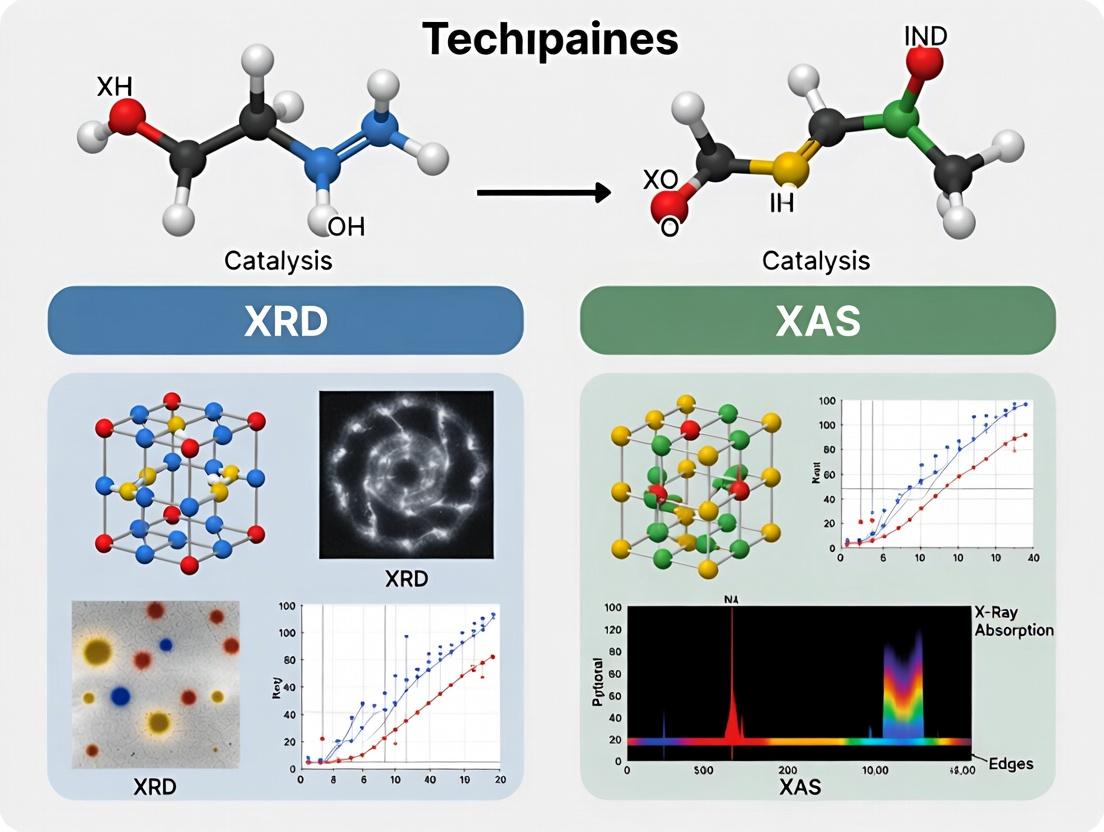
This comprehensive guide compares X-ray Diffraction (XRD) and X-ray Absorption Spectroscopy (XAS) for analyzing catalyst structure.
XRD vs XAS for Catalyst Analysis: Choosing the Right Tool for Structure-Property Insights
Abstract
This comprehensive guide compares X-ray Diffraction (XRD) and X-ray Absorption Spectroscopy (XAS) for analyzing catalyst structure. Targeted at researchers and development professionals, it covers the fundamental principles of each technique, their specific methodological applications in heterogeneous and homogeneous catalysis, common troubleshooting scenarios, and a direct comparison of their strengths and limitations. The article synthesizes practical insights to enable informed selection and complementary use of XRD and XAS for elucidating structure-activity relationships in catalytic systems, with implications for advanced materials development.
Understanding XRD and XAS: Core Principles for Catalyst Characterization
What is XRD? The Gold Standard for Long-Range Crystalline Order
X-ray diffraction (XRD) is a non-destructive analytical technique used to determine the atomic and molecular structure of crystalline materials. By measuring the angles and intensities of diffracted X-ray beams, XRD provides critical information about phase composition, crystal structure, orientation, and other structural parameters like grain size and strain. Within the comparative analysis of XRD vs. X-ray Absorption Spectroscopy (XAS) for catalyst characterization, XRD's primary strength lies in its unmatched ability to elucidate long-range crystalline order (typically > 2-3 nm), serving as the benchmark for identifying and quantifying crystalline phases in heterogeneous catalysts.
XRD vs. XAS for Catalyst Structure Analysis: A Comparative Guide
While both XRD and XAS are core synchrotron and laboratory techniques for catalyst analysis, their fundamental principles and the information they yield are complementary. The choice depends on the specific structural detail required.
Core Comparative Table: XRD vs. XAS
| Feature | X-ray Diffraction (XRD) | X-ray Absorption Spectroscopy (XAS) |
|---|---|---|
| Primary Information | Long-range order (crystalline phase ID, lattice parameters, crystallite size, texture). | Local atomic structure (oxidation state, coordination chemistry, bond distances around absorber atom). |
| Probed Length Scale | > 2-3 nm (long-range). | ~0.5 nm (short-range, around absorbing element). |
| Sample Requirement | Crystalline material (>1-3% crystalline fraction). | Any form (crystalline, amorphous, solutions, surfaces). Element-specific. |
| Key Experiment Types | Powder XRD, in situ/operando XRD, Rietveld refinement. | XANES, EXAFS, in situ/operando XAS. |
| Detection Limit | ~1 wt% for crystalline phases; size-dependent. | ~100 ppm for concentration; not phase-dependent. |
| Catalyst Insight | Active phase identity under reaction conditions, stability, particle size from Scherrer analysis. | Electronic structure of active sites, coordination environment of metals, even in amorphous/dispersed states. |
Supporting Experimental Data Comparison
The following table summarizes typical data from a model Pd/Al₂O₃ catalyst study, highlighting the complementary nature of the techniques.
| Technique | Experimental Condition | Key Result for Pd/Al₂O₃ Catalyst | Implication for Catalysis |
|---|---|---|---|
| Laboratory XRD | Fresh, reduced catalyst | Broad diffraction feature at ~40° 2θ (Pd (111)). Scherrer analysis: Pd crystallite size = 4.1 nm. | Confirms presence of metallic Pd nanoparticles. Provides average particle size. |
| In situ XRD | Under CO oxidation feed at 300°C | Pd phase remains metallic; no shift in peak position. Peak broadening increases. | Active phase is metallic Pd. Sintering or disorder may occur under reaction. |
| XAS (XANES) | Fresh, reduced catalyst | Pd K-edge energy matches Pd foil reference. | Oxidation state of Pd is predominantly zero (metallic). |
| XAS (EXAFS) | Fresh, reduced catalyst | Pd-Pd coordination number = 8.1; bond distance = 2.75 Å. | Confirms metallic Pd clusters. Lower CN than bulk (12) indicates small nanoparticles (~4 nm), consistent with XRD. |
| XAS (XANES) | Operando under NOx reduction | Edge shift to higher energy in cycling feed. | Pd oxidation state fluctuates between metallic and oxidized states, a dynamic not detected by XRD. |
Experimental Protocols for Key Cited Experiments
1. Protocol: Operando XRD Study of Catalyst Phase Stability
- Objective: Identify crystalline phases present in a catalyst under reactive gas flow and temperature.
- Setup: Catalyst powder is loaded into a capillary or flat-plate operando reactor cell with X-ray transparent windows (e.g., SiO₂).
- Conditions: Gas feed (e.g., 5% H₂/Ar, or reaction mixture) is controlled via mass flow controllers. Temperature is ramped using a hot-air blower.
- Data Acquisition: A diffractometer (synchrotron or lab source with fast detector) collects patterns continuously (e.g., 30 sec/pattern) while temperature and gas environment change.
- Analysis: Patterns are refined via Rietveld or whole-pattern fitting to quantify phase fractions and lattice parameters as a function of time/temperature.
2. Protocol: XAS (XANES/EXAFS) for Local Structure of Dispersed Metal Sites
- Objective: Determine oxidation state and coordination environment of a specific metal (e.g., Pt, Co) in a supported catalyst.
- Sample Preparation: Powder is finely ground and pressed into a pellet or loaded into a sample holder. For in situ, a controlled atmosphere cell is used.
- Beamline Setup: Performed at a synchrotron beamline. Incident (I₀) and transmitted (I) X-ray intensities are measured using ion chambers across the target element's absorption edge.
- Data Collection: XANES spectrum is collected with high energy resolution near the edge (~-20 to +100 eV). EXAFS is collected to high k-space (e.g., k=14 Å⁻¹).
- Analysis: XANES: Edge energy compared to standard compounds for oxidation state. EXAFS: Fourier transform to R-space; fitting with theoretical paths to obtain CN, R, and disorder (σ²).
Visualizing the Complementary Workflow: XRD vs. XAS in Catalyst Analysis
Diagram Title: Complementary XRD and XAS Analysis Workflow
The Scientist's Toolkit: Key Research Reagent Solutions for XRD/XAS Catalysis Studies
| Item | Function in Experiment | Example/Note |
|---|---|---|
| High-Purity Gas Blends | Create controlled in situ/operando atmospheres (e.g., reduction, reaction). | 5% H₂/Ar, 10% O₂/He, 1% CO/He, custom reaction mixes. |
| In Situ/Operando Cells | Hold catalyst sample while allowing X-ray penetration and controlling T/P/environment. | Capillary reactors, flat-plate cells with Kapton/Mica windows. |
| Certified Reference Standards | Calibrate instrument and for quantitative phase analysis (XRD) or oxidation state (XAS). | NIST SRMs (e.g., Si 640d for XRD, metal foils for XAS edge calibration). |
| High-Temperature Grease/Adhesive | Mount powder samples onto holders without inducing preferred orientation. | Vacuum grease, colloidal silica. |
| Microscale Mortar and Pestle | Ensure homogeneous, fine grinding of powder samples for representative data. | Agate is preferred to avoid contamination. |
| Data Analysis Software | Process and model raw data to extract structural parameters. | XRD: TOPAS, MAUD, Jade. XAS: Demeter (ATHENA/ARTEMIS), Larch. |
Within the comparative research on XRD (X-ray Diffraction) versus XAS (X-ray Absorption Spectroscopy) for catalyst structure analysis, understanding the fundamental physics of diffraction is paramount. Bragg's Law, nλ = 2d sinθ, governs the constructive interference of X-rays scattered by crystal lattice planes, forming the basis for XRD. This article serves as a comparison guide, objectively evaluating XRD and XAS as "probes" for the crystalline and electronic structure of catalytic materials, supported by experimental data.
XRD and XAS exploit different interactions of X-rays with matter to deliver complementary structural information.
XRD (Bragg Diffraction): Probes long-range periodic order. It measures the angles and intensities of diffracted beams to determine crystal phase, lattice parameters, crystallite size, and strain. Its performance is optimal for well-ordered, crystalline materials.
XAS (Absorption Fine Structure): Probes local atomic structure and electronic state. By measuring the absorption coefficient as a function of X-ray energy near an element's absorption edge, it provides information on oxidation state, coordination chemistry, and interatomic distances (EXAFS) for a selected element, regardless of crystallinity.
The choice between them hinges on the specific structural question, the nature of the catalyst (crystalline vs. amorphous), and the required information (long-range order vs. local environment).
Performance Comparison: XRD vs. XAS for Catalyst Analysis
The following table summarizes the key comparative performance metrics based on published experimental studies.
Table 1: Performance Comparison of XRD and XAS for Catalyst Characterization
| Performance Metric | X-ray Diffraction (XRD) | X-ray Absorption Spectroscopy (XAS) |
|---|---|---|
| Primary Information | Long-range crystal structure, phase identification, lattice constants, crystallite size, texturing. | Local atomic structure, oxidation state, coordination number, bond distances (EXAFS), electronic state (XANES). |
| Crystallinity Requirement | Requires long-range order (> 2-3 nm). Limited for amorphous or highly dispersed species. | No long-range order required. Effective for amorphous materials, solutions, and highly dispersed atoms. |
| Element Specificity | Not inherently element-specific. Probes all crystalline phases in the sample. | Highly element-specific. Can isolate the environment around a single element type. |
| Sensitivity to Dilute Species | Low. Minor phases (< 1-5%) or highly dispersed atoms are often undetectable. | High. Can study elements at low concentrations (< 0.1 wt%) and in complex matrices. |
| Operando/In Situ Capability | Excellent. Well-suited for following phase changes under reaction conditions. | Excellent. The standard for following electronic and local structural changes in working catalysts. |
| Quantitative Accuracy | High for phase abundance (Rietveld refinement). Good for lattice parameters. | Good for coordination numbers (±10-20%), excellent for bond distances (±0.01-0.02 Å). |
| Sample Form | Typically solid, requires a flat surface or powder. | Versatile: solids, powders, frozen solutions, liquids. |
Experimental Data Comparison
A representative study comparing the characterization of a supported metal catalyst (e.g., Pt/Al₂O₃) under reduction conditions illustrates the complementary data.
Table 2: Experimental Data from a Pt/Al₂O₃ Catalyst Study
| Analysis Condition | XRD Data Findings | XAS (Pt L₃-edge) Data Findings |
|---|---|---|
| As-synthesized (Oxidized) | Broad background; no distinct Pt peaks, indicating particle size < 2 nm or amorphous PtOₓ. | XANES: White line intensity indicates Pt²⁺/Pt⁴⁺. EXAFS: Pt-O coordination. |
| After H₂ Reduction, 300°C | Sharp peaks corresponding to metallic Pt (fcc) phase. Crystallite size: ~4.5 nm (Scherrer equation). | XANES: White line decrease confirms reduction to Pt⁰. EXAFS: Pt-Pt coordination, CN ~9.3, bond distance 2.76 Å. |
| Under CO Oxidation Flow | No change in Pt phase or crystallite size from XRD. | XANES shows slight oxidation. EXAFS may show evidence of Pt-CO/Pt-O bonding, indicating surface species. |
Key Experimental Protocols:
- Laboratory XRD (In Situ): Powder sample loaded into a high-temperature capillary reactor chamber. Data collected with Cu Kα radiation (λ=1.5418 Å) in a 2θ range of 20-80° under flowing gas. Rietveld refinement used for quantitative analysis.
- Synchrotron XAS (Operando): Sample pressed into a pellet and placed in a reaction cell. Pt L₃-edge spectra collected in fluorescence or transmission mode. Energy calibrated with a Pt foil reference. EXAFS data processed (background subtraction, normalization, Fourier transform) and fitted using standards (FEFF).
Experimental Workflow Diagram
Title: Comparative XRD & XAS Analysis Workflow
The Scientist's Toolkit: Key Research Reagent Solutions
Table 3: Essential Materials for XRD/XAS Catalyst Studies
| Item | Function in Experiment |
|---|---|
| High-Purity SiO₂ or Al₂O₃ Wafers | Chemically inert substrate for preparing thin film catalyst samples for grazing-incidence XRD or XAS. |
| Capillary Microreactor Cells | Enables in situ XRD studies with precise temperature and gas flow control for simulating reaction conditions. |
| Ionization Chambers & Fluorescence Detectors | Critical XAS components; ionization chambers measure incident/transmitted beam intensity, while fluorescence detectors are used for dilute samples. |
| NIST Standard Reference Materials (e.g., Si 640c) | Certified crystalline standard for calibrating XRD instrument alignment and diffraction angle. |
| Metal Foils (Pt, Cu, Fe) | Used for energy calibration in XAS experiments and as EXAFS scattering amplitude/phase shift references for data fitting. |
| High-Temperature Catalytic Reaction Cells (e.g., Linkam, MIT) | Allows for operando XRD/XAS measurements, exposing the catalyst to realistic gas environments and temperatures up to 1000°C+ while collecting data. |
| BN (Boron Nitride) Powder | A common, X-ray transparent binder for homogenously preparing powder samples for XAS measurement in transmission mode. |
Complementary Analysis Pathway
Title: Decision Pathway for XRD vs. XAS Selection
For catalyst structure analysis, XRD and XAS are not mutually exclusive but complementary probes governed by the physics of X-ray interaction. XRD, built on Bragg's Law, is the definitive tool for quantifying crystalline phase composition and lattice metrics. XAS provides element-specific insight into the local electronic and geometric structure crucial for understanding active sites, especially in amorphous or highly dispersed systems. A robust comparative research thesis leverages both techniques to correlate long-range order with local coordination, thereby advancing rational catalyst design.
What is XAS? A Local Structure and Electronic State Probe.
X-ray Absorption Spectroscopy (XAS) is a powerful analytical technique that probes the local atomic structure and electronic state of a specific element within a material. By measuring the absorption of X-rays as a function of energy near the absorption edge of a chosen element, XAS provides element-specific information that is complementary to long-range order techniques like X-ray Diffraction (XRD). Within the context of comparing XRD and XAS for catalyst structure analysis, XAS excels where XRD falls short: characterizing amorphous phases, highly dispersed nanoparticles, and local coordination environments in non-crystalline materials, all while providing oxidation state information critical for understanding catalytic mechanisms.
Comparison Guide: XAS vs. XRD for Catalyst Characterization
The choice between XAS and XRD is dictated by the structural length scale of interest. The following table summarizes their core comparative performance.
Table 1: Comparative Performance of XAS and XRD for Catalyst Analysis
| Feature | X-ray Absorption Spectroscopy (XAS) | X-ray Diffraction (XRD) |
|---|---|---|
| Probed Length Scale | Local (Short-range order): ~5-6 Å around the absorbing atom. | Long-range order: Crystalline domains typically > 2-3 nm. |
| Element Specificity | Yes. Tunes to a specific element's absorption edge. | No. Probes all crystalline phases in the sample. |
| Required Sample Order | Not required. Effective for amorphous, disordered, liquid, and crystalline materials. | Required. Dependent on long-range periodic lattice arrangement. |
| Primary Information | Oxidation state, coordination chemistry, bond distances, coordination numbers, disorder. | Crystalline phase identification, lattice parameters, crystallite size, texture. |
| Detection Sensitivity | High for dilute species (down to ~10-100 ppm), especially in fluorescence mode. | Low for minor phases (< 1-5%) and poorly crystalline materials. |
| In situ/Operando Suitability | Excellent. High penetration depth; standard for following electronic and structural changes under reaction conditions. | Good. Possible, but can be limited by reactor design and weak signals from small nanoparticles. |
Supporting Experimental Data: Ni Catalyst on Al₂O₃ Support
Consider a study comparing a 2 wt% Ni/Al₂O₃ catalyst before and after reduction. XRD may show only broad peaks from the γ-Al₂O₃ support, failing to detect the small Ni nanoparticles. XAS provides clear, quantitative data.
Table 2: Experimental XAS Data for Ni K-edge in Ni/Al₂O₃ Catalyst
| Sample | Oxidation State (from Edge Position) | Ni-O/Ni-Ni Coordination Number (from EXAFS) | Ni-Ni Bond Distance (Å) (from EXAFS) |
|---|---|---|---|
| As-prepared (calcined) | Ni²⁺ | N~6 (O) | - |
| After H₂ Reduction | Ni⁰ | N~8-10 (Ni) | ~2.48 |
| Used Catalyst (after reaction) | Mixed Ni⁰/Ni²⁺ | N~6-7 (Ni) | ~2.50 |
Experimental Protocols for Key XAS Experiments
Protocol 1: Transmission Mode XAS Measurement for a Solid Catalyst
- Sample Preparation: Homogeneously grind the catalyst powder. Sieve to uniform particle size (~50-100 µm). Load powder into a sample holder (e.g., aluminum spacer with Kapton tape windows) to achieve an optimal absorbance (Δμx ≈ 1.0).
- Beamline Setup: At a synchrotron beamline, select energy range: typically from -200 eV to +1000 eV relative to the target element's absorption edge (e.g., Pt L₃-edge at 11564 eV). Install ionization chambers (I₀, Iᵣ) before and after the sample for incident and transmitted intensity measurement.
- Data Acquisition: Scan energy using a double-crystal monochromator (e.g., Si(111)). Record I₀ and Iᵣ simultaneously. Measure a reference foil (e.g., Pt metal) simultaneously in a third ionization chamber (Iᵣₑ𝒻) for energy calibration.
- Data Reduction: Compute absorption coefficient μ(E) = ln(I₀/Iᵣ). Subtract a pre-edge background and normalize to the post-edge step to obtain the χ(E) function.
Protocol 2:OperandoXAS of a Catalyst in a Flow Reactor
- Reactor Cell: Use a dedicated operando flow cell with X-ray transparent windows (e.g., graphite, Kapton) and temperature control.
- Catalyst Packing: Pack the catalyst bed uniformly between quartz wool plugs in the reactor.
- Gas & Environment: Connect to a gas delivery system with mass flow controllers. Use reaction mixtures (e.g., 1% CO, 4% O₂, balance He) at relevant flow rates (50-100 mL/min).
- Simultaneous Measurement: Position the reactor in the XAS beam (fluorescence mode recommended). Use a gas chromatograph or mass spectrometer downstream to analyze reaction products concurrently.
- Spectral Acquisition: Collect quick-scanning or step-by-step XAS spectra while recording activity data. Monitor changes in the edge position (oxidation state) and EXAFS oscillations (local structure) as a function of time-on-stream or reaction conditions.
Visualization: The Role of XAS in Catalyst Characterization
Diagram 1: XRD and XAS as Complementary Tools
The Scientist's Toolkit: Key Reagent Solutions for XAS Studies
Table 3: Essential Materials and Tools for XAS Experiments
| Item | Function in XAS Experiments |
|---|---|
| Synchrotron Beamline Access | Provides the intense, tunable X-ray source required to perform XAS measurements. |
| Ionization Chambers | Gas-filled detectors that accurately measure the intensity of X-rays before (I₀) and after (Iᵣ) the sample in transmission mode. |
| Fluorescence Detector | (e.g., Silicon Drift Detector, SDD). Essential for measuring dilute samples by collecting emitted fluorescent X-rays from the absorbing atom. |
| Kapton Tape/Film | An X-ray transparent polymer used to create windows for sample holders and operando reaction cells. |
| Reference Metal Foils | High-purity metal foils (e.g., Pt, Ni, Fe). Measured simultaneously with the sample for precise energy calibration of each scan. |
| ATHENA & ARTEMIS Software | Standard software packages (part of Demeter/IFEFFIT) used for processing, analyzing, and fitting XAS data. |
| Operando Reaction Cell | A customized, temperature-controlled flow reactor with X-ray windows, allowing simultaneous spectral acquisition and catalytic activity measurement. |
| Diluent (BN, SiO₂) | Chemically inert powders used to dilute concentrated samples to an appropriate thickness for transmission measurements. |
Within the broader thesis comparing X-ray Diffraction (XRD) and X-ray Absorption Spectroscopy (XAS) for catalyst structure analysis, understanding the fundamental regions of an XAS spectrum is critical. While XRD excels at determining long-range periodic structure, XAS, specifically through its XANES and EXAFS regions, provides unparalleled insight into the local electronic and geometric structure of a catalytic site, even in amorphous or highly dispersed systems. This guide compares the information content and experimental requirements of these two key XAS regions.
Core Concepts: XANES vs. EXAFS
X-ray Absorption Spectroscopy measures the absorption coefficient of a material as a function of incident X-ray energy near the absorption edge of a specific element. The spectrum is divided into two primary regions.
Diagram Title: Information Derived from XANES and EXAFS Spectral Regions
Comparative Performance: XANES vs. EXAFS for Catalyst Analysis
The table below objectively compares the performance and output of the two XAS regions in the context of catalyst characterization.
Table 1: Comparison of XANES and EXAFS Regions for Catalyst Analysis
| Feature | XANES Region | EXAFS Region | Comparative Advantage |
|---|---|---|---|
| Primary Information | Electronic structure, oxidation state, site symmetry, pre-edge features for geometry. | Local atomic structure: bond distances (R), coordination numbers (N), disorder (σ²). | XANES probes electronic structure; EXAFS probes geometric structure. |
| Data Range | ~ -20 to +50 eV relative to absorption edge. | Typically +50 to +1000 eV above the edge. | Complementary; must be collected in a single scan. |
| Sample Requirement | Can work on highly diluted samples (~mM). | Requires higher concentration for good signal-to-noise (>~10 mM for transition metals). | XANES is more sensitive for dilute, real-world catalysts. |
| Data Analysis | Qualitative fingerprinting, linear combination analysis, theoretical calculation (FEFF, FDMNES). | Quantitative fitting using theoretical scattering paths (FEFF, EXAFS equation). | EXAFS provides numeric structural parameters; XANES is often more interpretive. |
| Sensitivity to Disorder | High sensitivity to static & dynamic disorder. | Debye-Waller factor (σ²) separates static and thermal disorder. | XANES better for amorphous phases; EXAFS quantifies disorder. |
| Key Limitation | Quantitative structural parameters (R, N) are not directly obtainable. | Insensitive to light scatterers (e.g., C, N, O) next to heavy absorbers. | Combined use is essential for a complete picture. |
Experimental Protocols for XAS Measurements
The methodology for collecting both XANES and EXAFS data is integrated into a single experiment.
Protocol: Synchrotron-Based XAS Measurement for Catalyst Powder
- Sample Preparation: The catalyst powder is finely ground and uniformly spread on high-purity Kapton tape or mixed with boron nitride and pressed into a pellet. Concentration is optimized to achieve an edge jump (Δμx) of ~1.0 for the element of interest.
- Beamline Setup: Measurements are performed at a synchrotron beamline equipped with a double-crystal monochromator (e.g., Si(111)) for energy scanning, ionization chambers for incident (I0) and transmitted (I1) flux measurement, and a fluorescence detector (e.g., multi-element solid-state detector) for dilute samples.
- Energy Calibration: The monochromator is calibrated using a foil of the pure element (e.g., Pt foil for Pt L3-edge). The first inflection point of the foil's absorption edge is assigned to its well-known reference energy.
- Data Collection: A single continuous scan is performed from ~200 eV below to ~1000 eV above the absorption edge. The XANES region (near the edge) is collected with finer energy steps (0.2-0.5 eV), while the EXAFS region uses finer k-space sampling (Δk ~ 0.05 Å⁻¹). Multiple scans (typically 3-10) are averaged to improve signal-to-noise.
- Data Reduction (Standard Procedure):
- Pre-edge Subtraction: A linear/Victoreen function is subtracted to remove background absorption.
- Edge Normalization: The absorption coefficient is normalized to a unit step function.
- EXAFS Extraction: The smooth atomic background (μ0) is removed using a cubic spline to isolate the oscillatory EXAFS function, χ(k).
- Fourier Transform: χ(k) is weighted (usually k² or k³) and Fourier transformed from k-space to R-space to produce a radial distribution function.
The Scientist's Toolkit: Key Reagent Solutions for XAS Studies
Table 2: Essential Materials for XAS Catalyst Studies
| Item | Function in XAS Experiment |
|---|---|
| Synchrotron Beamtime | Essential resource providing high-brilliance, tunable X-rays for measuring absorption edges. |
| High-Purity Reference Foils (e.g., Pt, Fe, Cu foil) | Used for precise energy calibration of the monochromator before sample measurement. |
| Boromitride (BN) Powder | Chemically inert, X-ray transparent diluent for preparing homogeneous pellets of concentrated catalyst powders. |
| Kapton Tape/Polyimide Film | Used to create sample cells or windows for holding loose powders; minimal X-ray absorption. |
| Ionization Chambers | Gas-filled detectors (e.g., with N2/Ar mixtures) for precise measurement of incident and transmitted X-ray intensity. |
| Fluorescence Detector | Multi-element solid-state or avalanche photodiode detector for measuring the fluorescence yield from dilute samples (ppm levels). |
| FEFF or FDMNES Software | Theoretical code for calculating XANES spectra and EXAFS scattering paths from a proposed structural model. |
| ATHENA & ARTEMIS Software | Standard GUI packages (part of DEMETER/IFEFFIT) for processing, analyzing, and fitting XAS data. |
XRD vs. XAS: Complementary Data in Catalyst Research
The choice between XRD and XAS, or their combined use, is dictated by the catalytic system.
Table 3: Comparative Performance: XRD vs. XAS for Catalyst Analysis
| Analytical Aspect | X-ray Diffraction (XRD) | X-ray Absorption Spectroscopy (XAS) |
|---|---|---|
| Probed Structure | Long-range order (crystalline phases). | Local environment around the absorber atom (electronic & geometric). |
| Sample State | Requires crystalline, periodic material (> 2-5 nm domains). | Effective on amorphous, highly dispersed, liquid, or crystalline samples. |
| Primary Output | Phase identification, lattice parameters, crystallite size, preferred orientation. | Oxidation state, local coordination, bond distances, coordination numbers. |
| Element Specificity | Not element-specific; probes all crystalline phases present. | Highly element-specific (tune to a specific absorption edge). |
| Key Limitation for Catalysts | "Blind" to disordered, nano-dispersed, or dilute active sites. | Less sensitive to long-range order and phase mixtures; complex modeling. |
Diagram Title: Integrating XRD and XAS Data for Catalyst Thesis
For the thesis on catalyst structure analysis, XAS is not a replacement for XRD but a powerful complement. XRD identifies bulk crystalline phases, while the XANES and EXAFS regions of XAS decode the local chemical and physical state of the catalytic center itself. The most robust structural insights, particularly for nano- or non-crystalline catalysts, are achieved by integrating both techniques, leveraging XRD's view of the long-range architecture and XAS's atomic-scale probe of the active site.
Understanding a catalyst's structure is fundamental to tuning its performance. In comparative studies of X-ray Diffraction (XRD) and X-ray Absorption Spectroscopy (XAS), the core distinction lies in the type of structural information they probe: long-range crystalline order versus short-range local environment. This guide compares these two domains of structural organization.
Definition and Probed Scale
- Long-Range Order: A periodic, repeating arrangement of atoms extending over distances of hundreds of angstroms or more (typically >10 nm). It defines the crystal lattice.
- Short-Range Local Environment: The immediate coordination sphere around a specific absorbing atom, typically within a radius of 3-6 Å. This includes bond distances, coordination numbers, and species of neighboring atoms, and is largely independent of periodicity.
Comparative Analysis via XRD and XAS
| Feature | Long-Range Order (Probed by XRD) | Short-Range Local Environment (Probed by XAS) |
|---|---|---|
| Primary Technique | X-Ray Diffraction (XRD) | X-Ray Absorption Spectroscopy (XAS) |
| Information Obtained | Crystal phase identification, lattice parameters, unit cell symmetry, crystallite size, texturing. | Oxidation state, local coordination geometry, bond distances, coordination numbers, disorder. |
| Spatial Range | > 10 nm (long-range periodicity). | ~ 0.3 - 0.6 nm (1st-3rd coordination shell). |
| Requirement | Crystalline, periodic material. | Any form (crystalline, amorphous, molecular, liquid). |
| Element Specificity | No (probes all crystalline phases present). | Yes (tuned to absorption edge of target element). |
| Key Output | Bragg peak positions and intensities. | XANES & EXAFS spectra. |
Supporting Experimental Data from Catalyst Studies
Table: Comparative Data from a Study on Supported Ni Catalysts (Hypothetical Data Based on Common Findings)
| Analysis Target | XRD Results (Long-Range) | XAS Results (Short-Range, Ni K-edge) |
|---|---|---|
| Phase Identity | Identified NiO crystallites (avg. size: 12 nm) and γ-Al₂O₃ support. | Pre-edge & white-line features consistent with Ni²⁺ in octahedral coordination. |
| After Reduction | Metallic Ni⁰ crystallites detected (avg. size: 8 nm). | EXAFS fitting: Ni-Ni coordination number = 8.5 ± 0.8, distance = 2.48 Å, confirming Ni⁰. Residual Ni-O coordination indicates surface oxide species not detected by XRD. |
| Under Reaction | No change in Ni⁰ crystal phase or size observed. | XANES shift indicates partial re-oxidation of surface Ni atoms to Ni²⁺-like state under reaction conditions. |
Detailed Experimental Protocols
1. Protocol for XRD Analysis of Catalyst Crystallinity
- Sample Preparation: Catalyst powder is finely ground and loaded into a flat sample holder to ensure a random orientation and a smooth surface.
- Data Acquisition: Using a laboratory Cu Kα X-ray source (λ = 1.5418 Å), scan a 2θ range from 5° to 80° with a step size of 0.02° and counting time of 1-2 seconds per step.
- Data Analysis: Match diffraction peak positions and relative intensities to reference patterns in the ICDD database (e.g., NiO PDF #47-1049, Ni PDF #04-0850). Apply the Scherrer equation to the full width at half maximum (FWHM) of a primary peak to estimate crystallite size.
2. Protocol for XAS Analysis of Local Environment
- Sample Preparation: Homogenize catalyst powder and pelletize with boron nitride to achieve an optimal absorption edge step (Δμx ≈ 1.0). For in situ studies, load into a controlled atmosphere cell.
- Data Acquisition (At Synchrotron): At the Ni K-edge (8333 eV), collect data in transmission (bulk) or fluorescence (dilute) mode. Energy calibration is performed simultaneously using a Ni foil.
- XANES Region: Scan from -200 eV to +50 eV relative to the edge with 0.2 eV steps.
- EXAFS Region: Scan from +50 eV to ~1000 eV above the edge with k-weighting of 2, in steps of 0.05 Å⁻¹ in k-space.
- Data Analysis: Process spectra (alignment, background subtraction, normalization) using software like Athena. Fit the EXAFS χ(k) function using theoretical paths (e.g., FEFF) to extract coordination numbers (N), bond distances (R), and disorder factors (σ²).
Visualization of Complementary Analysis Workflow
Workflow for Catalyst Structural Analysis
The Scientist's Toolkit: Key Reagent Solutions & Materials
| Item | Function in XRD/XAS Catalyst Analysis |
|---|---|
| High-Purity Boron Nitride (BN) | Chemically inert, X-ray transparent diluent for preparing homogeneous powder pellets for XAS measurements. |
| Certified Reference Foils (e.g., Ni, Cu) | Used for precise energy calibration of XAS beamlines. Placed simultaneously in the beam path with the sample. |
| Standard Reference Crystals (e.g., Si, Al₂O₃) | Used for accurate alignment and calibration of XRD instrument geometry and diffraction angle. |
| In Situ Reaction Cell | Allows for XRD or XAS data collection under controlled gas flow and temperature, simulating real catalytic conditions. |
| FEFF or ATOMS Software | Generates theoretical EXAFS scattering paths for modeling and fitting experimental data to extract local structural parameters. |
| ICDD/PDF Database | Reference library of powder diffraction patterns for phase identification by matching peak positions and intensities. |
Essential Catalyst Properties Each Technique Reveals
Within the rigorous comparison of X-ray diffraction (XRD) and X-ray absorption spectroscopy (XAS) for catalyst structure analysis, understanding the distinct yet complementary properties each technique reveals is paramount. This guide provides an objective, data-driven comparison of the two methods, framing them as essential tools in the researcher's arsenal for elucidating catalyst structure-property relationships.
Core Capabilities Comparison Table
| Catalyst Property | XRD Reveals | XAS Reveals |
|---|---|---|
| Long-Range Order | Yes. Crystalline phase identification, unit cell parameters, crystallite size. | No. Insensitive to long-range periodic structure. |
| Short-Range Order & Local Structure | Indirectly, via Rietveld refinement. Limited for highly disordered/amorphous materials. | Primary Strength. Precise local coordination environment (bond distances, coordination numbers, disorder). |
| Oxidation State | Indirectly, from lattice parameter shifts. | Primary Strength. Directly from edge energy position (XANES). |
| Electronic Structure | Limited. | Yes. Detailed density of unoccupied states from XANES fine structure. |
| Particle Size (Nanoscale) | Yes, via Scherrer analysis (≈1-100 nm). Broadening for very small particles. | Yes, via EXAFS coordination number analysis (especially for < 3-4 nm clusters). |
| Cation Distribution | In ordered structures via refinement. | Yes, even in disordered systems via site-specific EXAFS. |
| Operando/In Situ Feasibility | Possible with specialized cells. | High Strength. Excellent for in-situ/operando studies in various environments. |
| Amorphous/Disordered Phase Sensitivity | Very Poor. "X-ray amorphous" materials give no pattern. | Excellent. Probes local environment regardless of long-range order. |
Experimental Protocols for Key Comparative Studies
Protocol 1: Benchmarking Phase Identification & Crystallite Size
- Objective: Compare the ability of XRD and XAS to identify phases and determine particle size in a Pt/Al₂O₃ catalyst.
- XRD Method: Powder sample is loaded onto a zero-background Si wafer. Data is collected from 10° to 90° 2θ with Cu Kα radiation. Phases are identified via PDF database matching. Average crystallite size (d_XRD) is calculated using the Scherrer equation applied to the (111) reflection peak width, after correcting for instrumental broadening.
- XAS Method: Pt L₃-edge XAS data is collected in fluorescence mode at a synchrotron beamline. EXAFS oscillations χ(k) are extracted and fitted using theoretical standards. Coordination numbers (CN) for Pt-Pt paths are obtained from the fit. An approximate particle size (d_XAS) is estimated using the relationship between CN and cluster size for a cuboctahedral model.
Protocol 2: Determining Oxidation State Under Reactive Conditions (Operando)
- Objective: Monitor the oxidation state of a Cu/ZnO catalyst during CO₂ hydrogenation.
- XRD Operando Setup: Catalyst is packed in a capillary reactor. While flowing reactant gas (H₂/CO₂) and heating, diffraction patterns are collected continuously. Phase changes (e.g., CuO → Cu) are tracked via peak position and appearance/disappearance.
- XAS Operando Setup: Catalyst powder is pressed into a wafer and placed in an in-situ cell with gas flow and heating. Cu K-edge XANES spectra are collected every 30-60 seconds. The absorption edge position is calibrated against Cu(0) and Cu(II)O standards. Linear combination fitting of the XANES region provides quantitative fractions of Cu(0), Cu(I), and Cu(II) species throughout the reaction.
Visualizing the Complementary Workflow
Diagram Title: Complementary XRD & XAS Analysis Pathway
The Scientist's Toolkit: Essential Research Reagent Solutions
| Material / Solution | Function in Catalyst Characterization |
|---|---|
| Standard Reference Materials (e.g., Si NIST 640c, metal foils) | Calibrate instrument alignment (XRD) and energy scale (XAS) for accurate, reproducible data. |
| High-Purity Gases (H₂, O₂, He, 10% H₂/Ar) | Essential for in-situ/operando cell experiments to activate, reduce, or treat catalysts under controlled atmospheres during measurement. |
| Diluent Matrix (BN, SiO₂, cellulose) | For preparing homogeneous, absorber-optimized pellets for transmission XAS measurements to avoid thickness effects. |
| In-situ Reaction Cells (Capillary, plug-flow, MEMS-based) | Sample environments that allow simultaneous X-ray probe and controlled gas/temperature conditions to study working catalysts. |
| Theoretical Scattering Paths (FEFF, GNXAS codes) | Software-generated models required for interpreting EXAFS data to extract quantitative structural parameters. |
| Calibration Compounds (Pure metal foils: Cu, Pt, Co; Metal oxides) | Used as known references for XANES edge energy (oxidation state) and EXAFS fitting (scattering amplitudes, phases). |
Within the broader thesis comparing X-ray Diffraction (XRD) and X-ray Absorption Spectroscopy (XAS) for catalyst structure analysis, selecting the appropriate technique is paramount. This guide objectively compares their suitability based on catalytic material properties and supported by experimental data.
Core Principle Comparison
| Prerequisite / Property | Suitable for XRD Analysis | Suitable for XAS Analysis |
|---|---|---|
| Crystalline Order | Required. Long-range order (> 2-5 nm). | Not required. Effective for amorphous, disordered, and highly dispersed systems. |
| Particle Size | Typically > 3-5 nm for discernible Bragg peaks. | All sizes, including sub-nanometer clusters and single atoms. |
| Primary Information | Bulk, average crystal structure, phase ID, lattice parameters, crystallite size. | Local atomic structure (≤ 5-6 Å around absorber), oxidation state, coordination chemistry. |
| Element Specificity | No. Probes all crystalline phases present. | Yes. Tuned to the absorption edge of a specific element. |
| Operando Conditions | Possible with specialized cells. Peak broadening at high T/P. | Excellent suitability. Minimal interference from gases/water. |
| Required Sample Amount | Milligram to gram scale. | Can be as low as micromoles of the target element. |
Experimental Data Comparison: Supported Metal Catalyst (5% Pt/Al₂O₃)
A model experiment analyzing a reduced 5 wt% Pt/γ-Al₂O₃ catalyst illustrates the divergent insights provided by each technique.
Table 1: Experimental Results from 5% Pt/Al₂O₃
| Technique | Key Experimental Observation | Inferred Structural Conclusion |
|---|---|---|
| XRD (Lab source, Cu Kα) | Only peaks for γ-Al₂O₃ support are visible. No distinct Pt peaks are observed. | Pt particles are either too small (< ~3 nm) or too disordered for XRD detection. Pt loading may be "XRD amorphous." |
| XAS (Pt L₃-edge, Synchrotron) | White line intensity and EXAFS Fourier transform show weak Pt-Pt coordination. Dominant Pt-O contributions. | Pt is present as very small clusters (~1 nm) or in a highly dispersed state, with strong metal-support interaction. |
Detailed Experimental Protocols
Protocol 1: XRD Analysis of Solid Catalysts
- Sample Preparation: Grind ~50-100 mg of catalyst powder to a fine, homogeneous consistency using an agate mortar and pestle. Load into a glass or silicon zero-background sample holder, ensuring a flat, level surface.
- Data Collection: Use a laboratory XRD (e.g., Bruker D8, Malvern Panalytical Empyrean) with Cu Kα radiation (λ = 1.5406 Å). Parameters: 2Θ range = 5-90°, step size = 0.02°, scan speed = 1-2 sec/step.
- Data Analysis: Perform background subtraction and Kα2 stripping. Identify phases using the ICDD PDF-4+ database. Apply the Scherrer equation to primary peak widths for crystallite size estimation: τ = Kλ / (β cosΘ), where τ is crystallite size, K is shape factor (~0.9), λ is X-ray wavelength, and β is the integral breadth of the peak.
Protocol 2: XAS Measurement in Fluorescence Mode for Dilute Systems
- Sample Preparation: For a dilute catalyst (e.g., < 5 wt% metal), homogenize powder and press into a pellet or load into a Teflon sample holder with Kapton tape windows. Calculate optimal absorption thickness (μx ~ 1-2.5) to avoid self-absorption effects.
- Data Collection: At a synchrotron beamline, tune to the target element's absorption edge (e.g., Pt L₃-edge at 11,564 eV). Collect data in fluorescence mode using a multi-element solid-state detector (e.g., Ge detector). Measure a metal foil reference simultaneously for energy calibration.
- Data Processing: Use software (Demeter, Athena) for alignment, background removal (pre-edge and post-edge linear fits), normalization, and Fourier transformation of the EXAFS region (k-space to R-space). Fit EXAFS equation to extract coordination numbers (CN), bond distances (R), and disorder parameters (σ²).
Visualizing the Technique Decision Pathway
Technique Selection Logic for Catalyst Analysis
The Scientist's Toolkit: Key Research Reagent Solutions
Table 2: Essential Materials for XRD/XAS Catalyst Characterization
| Item | Function in Analysis |
|---|---|
| High-Purity Silica or Quartz Wool | Used as an inert sample holder or diluent for in situ/operando XAS cells, especially in gas flow reactors. |
| α-Alumina (Corundum) Standard (NIST SRM 676a) | Internal standard for XRD to calibrate exact peak positions and quantify amorphous content via Rietveld refinement. |
| Metal Foils (e.g., Pt, Au, Cu, Ni) | Essential XAS energy calibration references. Measured simultaneously with the sample for precise energy alignment. |
| Boron Nitride (BN) Powder | Chemically inert, X-ray transparent diluent for preparing transmission XAS pellets of concentrated samples. |
| Ion-Exchange Membranes (e.g., Nafion) | Critical for preparing electrodes or pellets for characterizing electrocatalysts under in situ XAS conditions. |
| Zeolite Reference Materials (e.g., FAU, MFI) | Well-defined crystalline structures used as benchmarks for XRD analysis of microporous catalysts. |
| High-Purity Gases (H₂, O₂, CO, He) | For in situ pre-treatment (reduction/oxidation) and controlled atmosphere during XRD/XAS measurements. |
Practical Guide: Applying XRD and XAS in Catalyst Research
This comparison guide objectively evaluates the performance of X-ray Diffraction (XRD) against alternative techniques for phase identification and crystallite size determination in catalyst synthesis. The analysis is situated within a broader research thesis comparing XRD and X-ray Absorption Spectroscopy (XAS) for catalyst structure analysis.
Performance Comparison: XRD vs. Alternatives for Catalyst Characterization
Table 1: Comparison of Primary Techniques for Phase Identification and Size Analysis
| Technique | Core Principle | Phase ID Capability | Crystallite Size Range | Detection Limit for Amorphous Phases | Typical Data Acquisition Time |
|---|---|---|---|---|---|
| X-Ray Diffraction (XRD) | Bragg's law, constructive interference from crystalline planes. | Excellent for crystalline phases. Database matching (ICDD/PDF). | 1-100 nm (Scherrer equation). | Poor (>~5-10 wt% typically undetected). | 10-60 minutes for standard scan. |
| X-Ray Absorption Spectroscopy (XAS) | Measures absorption coefficient near element-specific edge. | Limited; identifies local coordination, not long-range order. | Not directly applicable for crystallite size. | Excellent for local structure of element of interest. | 5-30 minutes per edge (synchrotron). |
| Transmission Electron Microscopy (TEM) | High-energy electron transmission and scattering. | Good (selected area electron diffraction - SAED). | Direct imaging, 1-100 nm. | Can image amorphous regions. | Hours (sample prep + imaging). |
| Raman Spectroscopy | Inelastic scattering of light by molecular vibrations. | Good for molecular phases, metal oxides, carbon forms. | Not a direct technique; related to domain size. | Moderate for Raman-active phases. | Seconds to minutes per spot. |
Table 2: Crystallite Size Analysis of a 5 wt% Ni/SiO₂ Catalyst via Different Methods
| Method | Derived Ni Crystallite Size (nm) | Key Assumptions/Limitations | Reference Data Source (2023-2024) |
|---|---|---|---|
| XRD (Scherrer Equation, 44.5° Ni(111) peak) | 8.2 ± 0.5 nm | Spherical particles, uniform size, no microstrain. | Simulated from recent Ni catalyst studies. |
| TEM (Image Histogram, n=200 particles) | 9.5 ± 2.1 nm | Requires good statistical sampling and contrast. | ACS Catal. 2023, 13, 15, 10286–10298. |
| XAS (Ni K-edge EXAFS, CN analysis) | ~7-8 nm (from coordination number) | Relies on particle shape model and Ni-Ni CN bulk reference. | J. Phys. Chem. C 2024, 128, 8, 3321–3332. |
Experimental Protocols
Protocol 1: XRD for Phase Identification and Crystallite Size (Benchmark Experiment)
- Instrument: Powder X-ray diffractometer with Cu Kα radiation (λ = 1.5406 Å).
- Sample Preparation: ~100 mg of finely ground catalyst powder loaded into a silicon zero-background holder or a glass slide cavity. Surface smoothed to ensure a flat, random orientation.
- Measurement: Continuous scan from 5° to 80° (2θ) with a step size of 0.02° and a dwell time of 1-2 seconds per step. Tube voltage and current: 40 kV, 40 mA.
- Phase Identification: Data processed (background subtraction, Kα2 stripping). Pattern matched using International Centre for Diffraction Data (ICDD) Powder Diffraction File (PDF) databases via search-match software (e.g., HighScore Plus, JADE).
- Crystallite Size via Scherrer Equation: For the primary phase of interest (e.g., metal oxide, active metal), select a well-isolated, high-intensity peak (e.g., (111) for face-centered cubic metals). Apply the formula: D = Kλ / (β cosθ), where D is crystallite size (nm), K is the shape factor (~0.9), λ is X-ray wavelength, β is the corrected full width at half maximum (FWHM, in radians) of the peak after subtracting instrumental broadening (determined from a standard like LaB₆ or SiO₂), and θ is the Bragg angle.
Protocol 2: Complementary XAS for Amorphous/Dispersed Phase Detection
- Instrument: Synchrotron beamline for hard X-rays.
- Sample Preparation: Catalyst powder uniformly diluted with cellulose and pressed into a pellet, or loaded as a fine powder into a sample holder.
- Measurement: Ni K-edge (8333 eV) collected in transmission or fluorescence mode. Energy calibrated with a Ni foil reference (first inflection point at 8333 eV).
- Analysis: Extended X-ray Absorption Fine Structure (EXAFS) data is Fourier-transformed to obtain radial distribution functions. The reduced coordination number of the Ni-Ni scattering path compared to bulk Ni metal provides an estimate of particle size/dispersion, complementing XRD's crystalline-phase limitation.
The Scientist's Toolkit: Research Reagent Solutions
Table 3: Essential Materials for XRD Catalyst Characterization
| Item | Function in Catalyst XRD Analysis |
|---|---|
| Silicon Zero-Background Holder | Sample substrate providing a featureless diffraction background for high-sensitivity measurement of weak catalyst peaks. |
| NIST Standard Reference Material (e.g., LaB₆ 660c) | Used to characterize instrumental broadening function for accurate crystallite size determination via the Scherrer equation. |
| Micro-Aglomerate Mortar and Pestle (Agar) | For gentle, contamination-free grinding of catalyst powder to ensure a random orientation and homogeneous sample. |
| ICDD/PDF Database Subscription | Reference library of powder patterns for definitive identification of crystalline phases present in the catalyst. |
| High-Purity Quartz (SiO₂) Wool | Used as an inert support or diluent for reactive catalysts during in situ XRD experiments. |
Visualization of Workflow and Relationships
Diagram Title: XRD Catalyst Analysis Workflow with Complementary XAS Path
Diagram Title: XRD vs XAS Capability Map for Catalysts
This guide is part of a broader thesis comparing X-ray Diffraction (XRD) and X-ray Absorption Spectroscopy (XAS) for catalyst structure analysis. In situ and operando XRD are critical techniques for directly identifying crystalline phases, tracking structural evolution, and quantifying phase fractions of heterogeneous catalysts under realistic reaction conditions. This guide objectively compares the capabilities and performance of in situ/operando XRD with alternative techniques, primarily XAS, providing experimental data to inform researchers and development professionals.
Core Technique Comparison: XRD vs. XAS for In Situ Catalyst Analysis
Table 1: Direct Comparison of In Situ/Operando XRD and XAS
| Feature | In Situ/Operando XRD | In Situ XAS (EXAFS/XANES) |
|---|---|---|
| Primary Information | Long-range order (≥ 1-2 nm), Crystalline phase ID, Lattice parameters, Crystallite size/strain, Quantitative phase analysis. | Local atomic structure (< 0.5 nm), Oxidation state, Coordination chemistry, Bond distances/disorder, Element-specific. |
| Detection Limit (Phase) | ~1-5 wt% for crystalline phases; depends on scattering power. | Not directly applicable; probes average local environment of absorber atom. |
| Time Resolution | Seconds to minutes (lab sources); milliseconds at synchrotrons. | Seconds to minutes (lab); milliseconds to microseconds at synchrotrons. |
| Sample Environment | Requires transmission or reflection geometry; gas/solid reactions are straightforward; high-pressure cells available. | Highly flexible: transmission, fluorescence, or electron yield; excellent for liquids, gases, and extreme conditions. |
| Key Limitation | Insensitive to amorphous materials and surface species. Bulk-sensitive. | Limited spatial resolution from averaging; complex data analysis for heterogeneous samples. |
| Data Analysis | Rietveld refinement for quantitative structural details. | EXAFS fitting for coordination numbers/distances; XANES fitting for oxidation state/geometry. |
Experimental Data & Performance Comparison
Table 2: Summary of Select In Situ XRD Studies on Catalytic Systems
| Catalyst System | Reaction Conditions | Key Findings (XRD) | Complementary XAS Insight | Ref. |
|---|---|---|---|---|
| Cu/ZnO/Al₂O₃ (Methanol Synthesis) | 220-260°C, 20-50 bar syngas (H₂/CO/CO₂) | Reduction of CuO to metallic Cu; no ZnO phase change detected. | XANES showed Cu⁰ formation; EXAFS indicated Zn in ZnO matrix, not alloyed. | J. Catal., 2018 |
| Ni/CeO₂ (CO₂ Methanation) | 300-500°C, 1-10 bar, H₂/CO₂ feed | Formation of NiO and Ni⁰ phases; lattice expansion of CeO₂ indicating oxygen vacancy formation. | XANES quantified Ni⁰/NiO ratio; Ce L₃-edge confirmed Ce³⁺ formation under reaction. | ACS Catal., 2020 |
| Co/Mn Fischer-Tropsch | 230°C, 20 bar, H₂/CO | Co reduction (Co₃O₄ → CoO → Co); identified Co₂C as potential deactivation phase. | Co K-edge XANES tracked reduction kinetics more sensitively than XRD. | J. Phys. Chem. C, 2021 |
| Pd/CeZrO₂ (Three-Way Catalyst) | Cycling between rich/lean feeds at 500°C | Reversible formation/binding of PdO (oxide) and Pd⁰ (metal) phases. | Pd K-edge provided Pd-Pd/Pd-O coordination numbers during dynamic cycling. | Appl. Catal. B, 2019 |
Detailed Experimental Protocols
Protocol 1: Standard In Situ XRD Experiment for Catalyst Reduction & Reaction
- Cell Setup: Load catalyst powder into a flat-plate sample holder or a capillary reactor integrated into a high-temperature in situ stage (e.g., Anton Paar XRK, or similar).
- Gas Flow: Connect mass flow controllers to deliver reactive gases (e.g., 5% H₂/Ar for reduction, then reactant mix). Ensure outlet line for product analysis (e.g., MS or GC).
- Initial Scan: Collect a reference XRD pattern of the fresh catalyst in inert gas (He/Ar) at room temperature.
- Temperature Program: Ramp temperature (e.g., 5°C/min) to target reduction/reaction temperature under reactive gas flow.
- Data Acquisition: Perform sequential XRD scans (e.g., 2-5 min per scan) continuously during heating, hold at temperature, and during reaction.
- Calibration: Use a standard (e.g., Si, Al₂O₃) for precise lattice parameter determination.
- Analysis: Perform sequential Rietveld refinement on the diffraction patterns to extract quantitative phase fractions, lattice constants, and crystallite sizes as a function of time/temperature.
Protocol 2: Coupled Operando XRD/MS for Transient Analysis
- Follow Protocol 1 for cell and gas setup.
- Direct the reactor effluent directly into a quadrupole mass spectrometer (QMS) via a capillary inlet.
- Design a transient experiment (e.g., step-change in reactant concentration, switch between oxidative/reductive atmospheres).
- Synchronize XRD scan triggers with MS data acquisition to ensure temporal alignment of structural (XRD) and activity/selectivity (MS) data.
- Correlate the appearance/disappearance of crystalline phases (from XRD) with the production of specific reaction products (from MS).
The Scientist's Toolkit: Essential Research Reagent Solutions
Table 3: Key Materials & Tools for In Situ/Operando XRD Experiments
| Item | Function & Importance |
|---|---|
| High-Temperature/Pressure In Situ Reactor Cell | Provides controlled environment (T, P, gas) while allowing X-ray transmission. Critical for simulating real conditions. |
| High-Purity Gas Blending System | Delivers precise, contaminant-free mixtures of reactive and inert gases for reproducible atmosphere control. |
| Capillary Reactors (SiO₂, Al₂O₃) | For powder samples in transmission geometry; minimal background scattering and good temperature homogeneity. |
| Calibration Standards (NIST Si, Al₂O₃) | Essential for correcting for instrumental aberrations and precisely determining lattice parameter shifts. |
| High-Sensitivity 2D Detector (e.g., MCP, HyPix) | Enables faster data collection with good signal-to-noise, crucial for tracking rapid transient processes. |
| Quantitative Analysis Software (e.g., TOPAS, HighScore Plus) | For Rietveld refinement to extract quantitative phase composition and microstructural data from sequential patterns. |
| Simultaneous Mass Spectrometer (QMS) | For operando studies, provides real-time gas analysis to directly correlate structural changes with catalytic activity. |
Visualized Workflows
Title: Operando XRD Experimental Workflow for Catalyst Analysis
Title: XRD & XAS: Complementary Roles in Catalyst Analysis
Within the broader thesis comparing X-ray Diffraction (XRD) and X-ray Absorption Spectroscopy (XAS) for catalyst structure analysis, this guide focuses on the specific capabilities of XAS for elucidating the oxidation state and local coordination environment of active sites in heterogeneous catalysts and molecular complexes. Unlike XRD, which provides long-range periodic order, XAS is uniquely sensitive to the local structure around a specific element, even in amorphous or highly dispersed systems. This comparison guide objectively evaluates the performance of XAS against alternative techniques for this critical analytical task.
Performance Comparison: XAS vs. Alternatives for Active Site Characterization
Table 1: Technique Comparison for Oxidation State & Coordination Analysis
| Technique | Primary Information | Oxidation State Sensitivity | Coordination Chemistry Insight | Required Crystallinity | Typical Data Collection Time |
|---|---|---|---|---|---|
| X-ray Absorption Spectroscopy (XAS) | Local structure, oxidation state, coordination number, bond distances | High (via XANES edge shift) | Direct (EXAFS provides ligand identity, distance, disorder) | Not Required (works on amorphous/dispersed samples) | Minutes to hours (synchrotron) |
| X-ray Diffraction (XRD) | Long-range crystal structure, phase identification | Indirect (from refined site geometry) | Indirect (inferred from crystallographic site) | High (typically > 3-5 nm domains) | Minutes to hours (lab source) |
| X-ray Photoelectron Spectroscopy (XPS) | Surface elemental composition, oxidation state | High (via chemical shift) | Very Limited (insensitive to local geometry) | Not Required | Hours (lab source) |
| UV-Vis Spectroscopy | Electronic transitions, d-d bands, charge transfer | Moderate (for metal centers) | Indirect (from ligand field theory) | Not Required | Seconds |
| Electron Paramagnetic Resonance (EPR) | Unpaired electron density, local symmetry | Specific to paramagnetic states | Limited to immediate ligand field | Not Required | Minutes |
Table 2: Quantitative Data from a Representative Study: Ni Oxidation State in a Catalyst Study: In-situ XAS analysis of a Ni-based oxygen evolution catalyst (OER) under working conditions.
| Analytical Technique | Measured Ni Oxidation State (Pre-catalyst) | Measured Ni Oxidation State (Under OER bias) | Key Supporting Data |
|---|---|---|---|
| XANES (XAS) | +2.3 | +3.8 | Edge energy shift of +3.5 eV; feature growth at 8343 eV |
| XPS | +2.1 | +3.2 | Ni 2p₃/₂ peak at 855.8 eV (Ni²⁺) → 856.7 eV (Ni³⁺/⁴⁺) |
| XRD | Not determinable (amorphous phase) | Not determinable | No distinct crystalline Ni-O phases detected |
Experimental Protocols for Key XAS Experiments
Protocol 1: In-situ XAS for Electrochemical Catalyst Oxidation State Determination
- Cell Preparation: Load the catalyst powder onto a carbon fiber paper electrode. Assemble an electrochemical flow cell with X-ray transparent windows (e.g., Kapton or polyimide).
- Beamline Setup: Perform experiment at a synchrotron hard X-ray beamline. Use a Si(111) double-crystal monochromator for energy selection. Employ ionization chambers for incident (I₀) and transmitted (Iₜ) beam measurement.
- Data Collection: Align the cell to intersect the X-ray beam with the catalyst layer. Collect a series of quick-scan X-ray Absorption Near Edge Structure (XANES) spectra at the metal K-edge (e.g., Ni at 8333 eV) while applying a linear sweep voltammetry profile.
- Reference Collection: Collect spectra of known reference compounds (e.g., NiO for Ni²⁺, Ni₂O₃ for Ni³⁺, Ni foil for Ni⁰) under identical conditions.
- Calibration: Calibrate the monochromator energy scale using the first inflection point of the corresponding metal foil spectrum.
- Oxidation State Analysis: Normalize the XANES spectra using a pre-edge and post-edge background subtraction. Determine the oxidation state by linear combination fitting (LCF) of the sample spectra using the reference spectra or by correlating the edge energy (first inflection point) with the reference compounds' known oxidation states.
Protocol 2: Ex-situ EXAFS for Coordination Environment Analysis
- Sample Preparation: Dilute the homogeneous catalyst or solid catalyst powder with boron nitride to achieve an optimal absorption edge step (Δμx ≈ 1.0). Press the mixture into a uniform pellet.
- Data Collection: At a synchrotron beamline, collect Extended X-ray Absorption Fine Structure (EXAFS) data in transmission or fluorescence mode, scanning ~1000 eV above the absorption edge. Accumulate multiple scans to improve signal-to-noise.
- Data Processing: Use software (e.g., Athena, DEMETER) to perform background removal (Autobk algorithm), normalization, and conversion to k-space (k = √[2m(E-E₀)/ħ²]). Fourier transform the k²- or k³-weighted χ(k) function to R-space to obtain a pseudo-radial distribution function.
- Fitting & Modeling: Fit the Fourier-transformed EXAFS data using theoretical scattering paths generated from a candidate structure (e.g., FEFF calculations). Refine parameters including coordination number (N), bond distance (R), Debye-Waller factor (σ²), and energy shift (ΔE₀) to minimize the fit residual (R-factor). The quality of fit and physical reasonability of parameters reveal the coordination chemistry.
Visualization of Core Concepts
Decision Workflow: XRD vs XAS for Catalyst Analysis
XAS Experimental Data Analysis Workflow
The Scientist's Toolkit: Research Reagent Solutions
Table 3: Essential Materials for XAS Experiments
| Item | Function in XAS Experiments |
|---|---|
| Boron Nitride (BN) Powder | Chemically inert, X-ray transparent diluent for preparing homogeneous solid samples with optimal absorption thickness. |
| Polyimide (Kapton) Tape/Film | Forms X-ray transparent windows for in-situ cells (electrochemical, catalytic, environmental). Low Z elements minimize background absorption. |
| Metal Foil References (e.g., Ni, Cu, Pt) | Used for precise monochromator energy calibration (setting E₀) by measuring the first inflection point of their known absorption edge. |
| Well-Defined Reference Compounds (e.g., NiO, Fe₂O₃, CuCl₂) | Critical for linear combination fitting (LCF) of XANES to determine oxidation state and for validating EXAFS fitting models. |
| Ionization Chambers | Gas-filled detectors that accurately measure the intensity of the incident (I₀) and transmitted (Iₜ) X-ray beams for transmission XAS. |
| Lytle Detector / Fluorescence Detector | Measures the fluorescence yield from the sample for dilute systems or surfaces where transmission measurement is not feasible. |
| Demeter (IFEFFIT) Software Package | Standard suite (Athena, Artemis) for processing, analyzing, and fitting XAS data (background removal, normalization, EXAFS fitting). |
| In-situ Electrochemical or Catalytic Cell | Allows collection of XAS data under operando or in-situ conditions to correlate active site structure with performance metrics. |
This guide compares the performance of in situ and operando X-ray Absorption Spectroscopy (XAS) with alternative techniques for probing catalyst electronic structure under working conditions, framed within a thesis comparing XRD and XAS for catalyst analysis.
Performance Comparison: XAS vs. Alternative Techniques
Table 1: Comparison of Techniques for Probing Catalyst Electronic Structure Under Reaction Conditions
| Technique | Key Measurable Parameters | Spatial Resolution | Temporal Resolution (Typical) | Key Limitation for Operando Studies | Example Catalytic System Data (Recent Study) |
|---|---|---|---|---|---|
| In Situ/Operando XAS | Oxidation state, coordination geometry, bond distances | ~µm (beam size) | Seconds to minutes (QF) | Limited spatial mapping in complex reactors | CO oxidation on Pt/Al2O3: Pt L3-edge shift of 1.5 eV observed upon switching from O2 to CO, indicating reduction. |
| In Situ X-ray Diffraction (XRD) | Crystallographic phase, lattice parameters | ~nm (coherence length) | Seconds to minutes | Insensitive to amorphous phases & local disorder | Cu/ZnO/Al2O3 methanol synthesis: ZnO reduction to metallic Zn observed only above 400°C. |
| Ambient Pressure XPS (AP-XPS) | Surface elemental composition, oxidation states | ~10s of µm | Minutes | Ultra-high vacuum requirements largely relaxed but pressure gap remains (< 10 Torr typical) | CO2 hydrogenation on Cu: Ratio of Cu+/Cu0 surface species tracked with reactant pressure. |
| In Situ Raman Spectroscopy | Molecular vibrations, surface adsorbates | ~µm | Seconds | Fluorescence interference; quantitation challenging | Propane dehydrogenation on CrOx/Al2O3: Identification of coke species (polyaromatic bands at 1350, 1600 cm⁻¹). |
| X-ray Emission Spectroscopy (XES) | Spin state, ligand identity | ~µm | Minutes | Requires high-brilliance source; complex interpretation | Water oxidation on CoPi catalyst: Kβ mainline shift indicated change in spin state during turnover. |
Experimental Protocols for Key Cited Studies
Protocol 1: Operando XAS for Pt-catalyzed CO Oxidation
- Reactor: A capillary or micro-reactor compatible with transmission XAS, with gas feed and temperature control.
- Catalyst: 2 wt% Pt on γ-Al2O3, pressed into a thin, self-supporting wafer.
- Beamline: Synchrotron beamline with Si(111) double-crystal monochromator and ionization detectors (I0, I1, It).
- Measurement: Pt L3-edge (11,564 eV) spectra collected in quick-scanning (QEXAFS) or step-scan mode.
- Conditions: Spectra recorded while switching gas feeds between 5% O2/He and 5% CO/He at 200°C.
- Data Analysis: Normalization, background subtraction (ATHENA). Linear Combination Fitting (LCF) of XANES using Pt foil and PtO2 standards to quantify oxidation state. EXAFS fitting to extract coordination numbers and distances.
Protocol 2: In Situ XRD for Methanol Synthesis Catalyst
- Reactor: High-temperature in situ capillary cell with gas flow and heating.
- Catalyst: Commercial Cu/ZnO/Al2O3 powder.
- Instrumentation: Laboratory or synchrotron X-ray source with a 2D detector.
- Measurement: 1D powder patterns collected in transmission geometry from 30-50° 2θ.
- Conditions: Patterns collected during temperature-programmed reduction in 5% H2/N2, ramping from 25°C to 500°C at 5°C/min.
- Data Analysis: Rietveld refinement to identify phases (CuO, Cu, ZnO) and track crystallite size and lattice parameters.
Visualizing theOperandoXAS Workflow
Title: Operando XAS Experimental Workflow
The Scientist's Toolkit: Key Research Reagent Solutions
Table 2: Essential Materials for Operando XAS Catalysis Studies
| Item | Function in Experiment | Key Consideration for Data Quality |
|---|---|---|
| Micro-Reactor/Capillary Cell | Holds catalyst wafer/powder; allows controlled gas flow and heating under X-ray beam. | Material (e.g., quartz, SiC) must be X-ray transparent and chemically inert at reaction T/P. |
| Calibrated Gas Delivery System | Provides precise, switchable flows of reactants (e.g., CO, O2, H2) and diluents (He, N2). | Mass flow controller accuracy is critical for reproducible reactant partial pressures. |
| Reference Foils (e.g., Pt, Cu, Fe) | Used for simultaneous energy calibration during XAS data collection. | Placed between I0 and I1 detectors; essential for aligning edge positions across scans. |
| Ionization Chambers (I0, I1, It) | Measure X-ray intensity before (I0), after (I1) monochromator, and through sample (It). | Filled with appropriate gas mixture (N2/Ar/He) for optimal absorption at beam energy. |
| Well-Defined Model Catalyst | Catalyst with known loading, dispersion, and support for interpreting spectral changes. | Required for validating the operando approach (e.g., 2% Pt/Al2O3 from commercial source). |
| Standard Compounds | Pure chemical compounds for spectral standards (e.g., Pt foil, PtO2, Cu foil, Cu2O). | Used in Linear Combination Fitting (LCF) of XANES to quantify oxidation state. |
X-ray diffraction (XRD) is a cornerstone technique for the structural characterization of heterogeneous catalysts, particularly supported metal nanoparticles. This guide compares its performance to alternatives like X-ray absorption spectroscopy (XAS) within the broader thesis of understanding their complementary roles in catalyst analysis.
Performance Comparison: XRD vs. XAS for Catalyst Characterization
The following table summarizes the core capabilities, strengths, and limitations of XRD and XAS for analyzing supported metal nanoparticle catalysts.
Table 1: Comparative Analysis of XRD and XAS for Catalyst Characterization
| Feature | X-ray Diffraction (XRD) | X-ray Absorption Spectroscopy (XAS) |
|---|---|---|
| Primary Information | Long-range order, crystallographic phase, crystal size, lattice parameters, quantitative phase analysis. | Local atomic structure (≈5-6 Å around absorber), oxidation state, coordination numbers, bond distances, disorder. |
| Detection Limit | ~1-3 wt% or particles > 2-3 nm. Sensitive to crystalline fraction. | < 0.1 wt%, sub-nm clusters, and amorphous species. Element-specific. |
| Sample Requirement | Requires periodic lattice. Poor sensitivity for small nanoparticles (<2 nm) and amorphous supports. | Does not require long-range order. Ideal for highly dispersed, small nanoparticles and amorphous systems. |
| Key Metrics | Crystallite size (Scherrer equation), phase ID (PDF database), lattice strain. | Oxidation state (XANES edge shift), coordination number & distance (EXAFS fitting). |
| Main Advantage | Definitive phase identification, quantitative bulk phase analysis, simple & fast. | Probing active sites regardless of crystallinity, in-situ/operando capability under reaction conditions. |
| Key Limitation | "Silent" to amorphous material and small clusters. Averaged over entire sample volume. | Complex data analysis requiring theoretical references. Limited to elements with accessible edges. |
Experimental Protocols
Protocol 1: Ex-situ XRD for Catalyst Synthesis Monitoring Objective: Determine the crystalline phases and estimate average nanoparticle size after calcination and reduction.
- Sample Prep: Load finely ground catalyst powder into a standard XRD sample holder. Flatten surface to ensure a smooth, level plane.
- Data Collection: Using a Bragg-Brentano diffractometer with Cu Kα radiation (λ = 1.5418 Å). Scan range: 20° to 80° 2θ. Step size: 0.02°. Scan speed: 2°/min.
- Analysis: Identify peaks by matching to ICDD Powder Diffraction File (PDF) databases. Apply background subtraction and Kα2 stripping. Use the Scherrer equation (β = Kλ / (L cosθ)) on a primary metal peak (e.g., Pt (111)) to estimate volume-averaged crystallite size, where β is the full width at half maximum (FWHM) in radians, K is the shape factor (~0.9), and L is the crystallite size.
Protocol 2: In-situ XRD for Reduction Behavior Objective: Track phase transformations and nanoparticle growth during temperature-programmed reduction.
- Sample Prep: Place catalyst in a high-temperature reaction chamber mounted on the diffractometer, equipped with gas flow controls.
- Data Collection: Under flowing 5% H2/Ar (50 mL/min), heat from room temperature to 500°C at 5°C/min. Collect XRD patterns (rapid scan, e.g., 30°-50° 2θ) every 50°C or at set time intervals.
- Analysis: Monitor the disappearance of precursor oxide/hydroxide peaks and the emergence of metallic nanoparticle peaks. Plot crystallite size (from Scherrer) versus temperature to deduce reduction kinetics and sintering onset.
Protocol 3: Complementary XAS Experiment (for Comparison) Objective: Determine the oxidation state and local coordination of a Pt catalyst where XRD shows no metallic peaks.
- Sample Prep: For transmission mode, uniformly mix diluted catalyst powder with boron nitride and press into a pellet. For fluorescence mode (low loading), mount concentrated powder on tape.
- Data Collection: At a synchrotron beamline, scan across the Pt L3-edge (11.564 keV). Collect data in quick-scan or step-scan mode.
- Analysis: Normalize XANES region and compare edge position/white line intensity to reference foils (Pt⁰) and compounds (PtO₂, Pt⁴⁺). Fit EXAFS oscillations to derive coordination numbers and bond distances of Pt-O and/or Pt-Pt shells.
Visualizations
Title: XRD and XAS Complementary Workflow
Title: Guiding Questions for Technique Selection
The Scientist's Toolkit: Research Reagent Solutions
Table 2: Essential Materials for XRD/XAS Catalyst Characterization
| Item | Function in Experiments |
|---|---|
| High-Purity Metal Salt Precursors (e.g., H₂PtCl₆, Ni(NO₃)₂) | Source of the active metal phase for catalyst synthesis via impregnation. |
| Porous Catalyst Supports (e.g., γ-Al₂O₃, SiO₂, TiO₂, Carbon) | High-surface-area materials to disperse and stabilize metal nanoparticles. |
| Certified Reference Materials (e.g., Pt foil, NiO, CeO₂ powder) | Essential standards for calibrating XRD instruments and XAS spectra (energy, intensity). |
| In-situ Cell/Gas Manifold | Enables real-time XRD/XAS during thermal treatments (calcination, reduction) under controlled gas flow (O₂, H₂, reaction mixtures). |
| XRD Sample Holders & Si Zero-Background Plates | Provide a flat, low-background mounting surface for powder samples to minimize parasitic scattering. |
| EXAFS Modeling Software (e.g., Athena, Artemis, FEFF) | Used to fit XAS data to derive quantitative structural parameters (bond distance, coordination number, disorder). |
| PDF Database (ICDD PDF-4+) | Contains reference diffraction patterns for definitive phase identification from XRD data. |
Thesis Context: XAS vs. XRD for Catalyst Structure Analysis
X-ray Absorption Spectroscopy (XAS) and X-ray Diffraction (XRD) are complementary techniques for catalyst characterization. XRD excels at identifying long-range order and crystalline phases but is largely "blind" to dispersed, non-crystalline species. For Single-Atom Catalysts (SACs), where metal atoms are atomically dispersed on a support, XRD often shows only the pattern of the support, failing to detect the active sites. This is the core limitation driving the use of XAS. XAS, including both XANES (X-ray Absorption Near Edge Structure) and EXAFS (Extended X-ray Absorption Fine Structure), provides element-specific local structural information—coordination chemistry, oxidation state, and coordination numbers—without requiring long-range order, making it indispensable for SAC characterization.
Comparative Analysis: XAS vs. XRD for SACs
The table below summarizes the core capabilities of each technique in the context of SAC analysis.
Table 1: Capability Comparison: XAS vs. XRD for SAC Characterization
| Feature | X-ray Absorption Spectroscopy (XAS) | X-ray Diffraction (XRD) |
|---|---|---|
| Probed Information | Local structure (≤5 Å around absorber): oxidation state, coordination number, bond distances, disorder. | Long-range crystalline order (≥1 nm): phase identification, crystal structure, lattice parameters, crystallite size. |
| Requirement for Order | Does not require crystalline order. | Requires long-range periodic order. |
| Element Specificity | Yes. Tuned to absorption edge of a specific element. | No. Probes all crystalline phases in the sample. |
| Detection Limit for Dispersed Metals | Sensitive to atomically dispersed species (the signal comes from the absorber atom). | Insensitive. "Silent" for species lacking crystalline order; may show peaks only if metal aggregates/forms nanoparticles. |
| Primary SAC Insights | Confirmation of atomic dispersion (absence of metal-metal paths in EXAFS), oxidation state, ligand identity. | Primarily characterizes the support; can detect failure modes (formation of crystalline metal/oxide nanoparticles). |
Experimental Data from a Representative SAC Study
Consider a study on Pt single atoms on a carbon nitride support (Pt₁/CN). The following table summarizes hypothetical but representative experimental outcomes from applying both techniques.
Table 2: Representative Data for Pt₁/CN Single-Atom Catalyst
| Technique | Key Observation | Interpretation & Quantitative Data |
|---|---|---|
| XRD | Diffraction pattern shows only broad peaks from the graphitic carbon nitride support. No peaks corresponding to Pt crystals (e.g., at ~40°) are observed. | Suggests no large Pt nanoparticles (> ~2-3 nm). Cannot confirm atomic dispersion. |
| XANES | Pt L₃-edge white line intensity is significantly higher than in Pt foil, similar to PtO₂. | Indicates a high oxidation state (Ptδ+, where δ likely is +2 to +4). Quantitative fit: white line area ~30% greater than Pt foil. |
| EXAFS | FT-EXAFS shows a major peak at ~1.5 Å (R+ΔR) but no peak near 2.6 Å. Fitting of the first shell gives: Nₚₜ‑ₙ = 4.0 ± 0.5; Rₚₜ‑ₙ = 2.05 ± 0.02 Å. | Confirms atomic dispersion (absence of Pt-Pt scattering path). Quantitative data reveals Pt is coordinated by ~4 N/O atoms at 2.05 Å. |
Detailed Experimental Protocols
Protocol 1: XAS Measurement and Analysis for SACs (Pt L₃-edge)
- Sample Preparation: Uniformly grind ~20 mg of dry Pt₁/CN powder. Press into a self-supporting pellet or load into a sample holder with Kapton tape windows. A reference foil (Pt metal) is mounted simultaneously for energy calibration.
- Data Collection (Transmission Mode): Perform at a synchrotron beamline. Scan the incident X-ray energy across the Pt L₃-edge (≈11.564 keV). Measure incident (I₀), transmitted (Iₜ), and reference (Iᵣ) intensities using ionization chambers.
- Energy Calibration: Align the first inflection point of the simultaneous Pt foil reference scan to 11,564 eV.
- Data Processing (using Athena, Demeter suite):
- Pre-edge subtraction and normalization.
- Spline removal to isolate the EXAFS oscillation χ(k).
- Fourier Transform of k²-weighted χ(k) (k-range: 3-12 Å⁻¹) to R-space.
- EXAFS Fitting (using Artemis):
- Build theoretical scattering paths (e.g., Pt-N, Pt-O, Pt-Pt) from candidate crystal structures.
- Fit the Fourier-transformed R-space data (R-range: 1.0-3.0 Å) to determine coordination numbers (CN), bond distances (R), disorder factors (σ²), and energy shift (ΔE₀).
Protocol 2: Complementary XRD Measurement
- Sample Preparation: Lightly press the same Pt₁/CN powder into a low-background silicon sample holder.
- Data Collection: Use a laboratory or synchrotron X-ray diffractometer (Cu Kα, λ = 1.5406 Å). Scan 2θ from 5° to 80° with a slow step size (e.g., 0.02°/step).
- Data Analysis: Identify diffraction peaks by matching to reference patterns (e.g., PDF database) for the support (C₃N₄) and potential crystalline Pt phases (Pt⁰, PtO₂). Use Scherrer analysis on support peaks to estimate support crystallinity.
Experimental Workflow and Logical Relationship
Title: SAC Characterization Workflow: XRD & XAS Synergy
The Scientist's Toolkit: Key Research Reagent Solutions
Table 3: Essential Materials for XAS-based SAC Characterization
| Item / Reagent | Function in Experiment |
|---|---|
| High-Purity SAC Sample (≥20 mg) | The target material for characterization. Must be homogeneous and free of bulk crystalline impurities. |
| Reference Foils (e.g., Pt, Fe, Co metal) | Used for simultaneous energy calibration during XAS data collection at the synchrotron. |
| Diluent (Cellulose, BN) | Inert powder used to dilute concentrated samples for transmission XAS to achieve an optimal absorption edge step (Δμx ≈ 1.0). |
| Kapton Tape / Polyimide Film | Used to create windows for XAS sample holders. It is largely transparent to hard X-rays and maintains an inert atmosphere. |
| Demeter Software Suite (Athena, Artemis) | Standard software for processing, analyzing, and fitting XAS data (pre-edge, normalization, EXAFS extraction, modeling). |
| Synchrotron Beamtime | Essential resource. Provides the high-flux, tunable X-ray source required for collecting high-quality XAS data, especially for dilute systems like SACs. |
| Inert Atmosphere Glovebox | For sample preparation and handling of air-sensitive catalysts to prevent oxidation or contamination before measurement. |
The perennial debate in catalyst characterization often pits X-ray Diffraction (XRD) against X-ray Absorption Spectroscopy (XAS). However, the most powerful analytical framework emerges not from choosing one, but from their strategic integration. This guide compares the standalone and combined use of these techniques, supported by experimental data, to argue for a complementary approach that yields a holistic view of catalyst structure under in situ or operando conditions.
Comparative Performance Data
Table 1: Standalone vs. Integrated Technique Capabilities for Catalyst Analysis
| Analytical Aspect | XRD (Lab Source) | XAS (Synchrotron) | Integrated XRD + XAS |
|---|---|---|---|
| Primary Information | Long-range order, crystalline phase identification, lattice parameters, crystallite size. | Local atomic structure (≤5 Å), oxidation state, coordination chemistry, bond distances. | Correlated bulk crystalline phase & local electronic/geometric structure. |
| Detection Limit (Crystalline) | ~1-5 wt% | Not Applicable (element-specific) | Enables detection of minor crystalline phases linked to active sites. |
| Detection Limit (Amorphous) | Blind to amorphous phases. | Sensitive to all species of the target element. | Quantifies amorphous/ disordered active component fraction. |
| Element Specificity | No, probes all crystalline phases present. | Yes, tunable to specific element edge. | Multi-element analysis by combining XRD with multi-edge XAS. |
| In Situ/Operando Suitability | Excellent for following phase transformations. | Excellent for tracking electronic and local structure changes. | Direct correlation of structural change with function under identical conditions. |
Table 2: Experimental Data from Integrated Study of Cu/ZnO Catalyst during CO₂ Hydrogenation
| Condition | XRD-Dominant Observation | XAS-Dominant Observation (Cu K-edge) | Integrated Conclusion |
|---|---|---|---|
| Oxidized (Fresh) | ZnO, CuO phases identified. | Cu²⁺ oxidation state confirmed. | Baseline established: mixture of crystalline CuO and ZnO. |
| After Reduction (H₂, 250°C) | Metallic Cu peaks appear, CuO peaks vanish. | Cu⁰ state dominant; low coordination number suggests small clusters. | Reduction produces small metallic Cu nanoparticles (<3 nm, broad XRD peaks). |
| Under Reaction (Operando) | Only metallic Cu and ZnO phases visible. | Cu⁺ species detected (sharp white-line feature). Cu-Cu coordination decreases. | Active state involves metallic Cu nanoparticles with a surface layer of Cu⁺ species, crucial for activity. |
Experimental Protocols for Integrated Analysis
- Catalyst Preparation & In Situ Cell Loading: A powdered Cu/ZnO catalyst is uniformly loaded into a capillary in situ reactor cell compatible with both transmission XRD and fluorescence-mode XAS.
- Simultaneous Operando Data Collection (Synchrotron):
- The cell is connected to gas feed (e.g., CO₂/H₂/He mix) and heating.
- XRD Protocol: A monochromatic X-ray beam (e.g., 30 keV) impinges on the sample. A 2D area detector collects diffraction patterns continuously (1-10 sec/pattern) during temperature-programmed reduction and reaction.
- XAS Protocol: The incident beam intensity (I₀) and fluorescent X-ray intensity (I_f) are measured simultaneously using ion chambers and a fluorescence detector. Quick-scanning EXAFS (QEXAFS) at the Cu K-edge (8979 eV) is collected concurrently with XRD patterns.
- Data Sync: All data (XRD, XAS, gas composition via MS, temperature) are time-stamped using a shared trigger, enabling direct correlation.
- Data Analysis Workflow:
- XRD: 2D patterns integrated to 1D intensity vs. 2θ. Rietveld refinement quantifies phase fractions and crystallite size.
- XAS: Normalized absorption (μ(E)). Linear Combination Fitting (LCF) of XANES region quantifies Cu⁰/Cu⁺/Cu²⁺ fractions. EXAFS Fourier transform and fitting provide coordination numbers and distances for Cu-O and Cu-Cu shells.
- Integration: Quantitative phase fractions from XRD are correlated with oxidation state fractions from XANES LCF over identical timestamps to construct a coherent structural evolution model.
Visualization of the Integrated Methodology
Integrated Operando XRD-XAS Workflow for Catalysts
The Scientist's Toolkit: Key Research Reagent Solutions
Table 3: Essential Materials for Integrated XRD-XAS Catalyst Studies
| Item | Function & Specification |
|---|---|
| Capillary In Situ Reactor | High-temperature, gas-flow reactor cell with low-X-ray-absorption walls (e.g., quartz, silica) for simultaneous XRD/XAS data collection under reactive flows. |
| Calibration Standards | Metal foils (Cu, Au for XAS energy calibration) and certified crystalline powders (Si, Al₂O₃ for XRD angle calibration). |
| Gas Delivery System | Mass flow controllers for precise blending of reactive (H₂, CO₂, O₂) and inert (He, Ar) gases to simulate process conditions. |
| Synchrotron Beamtime | Access to a beamline equipped with simultaneous XRD and XAS capabilities, often requiring a competitive proposal. |
| Reference Spectra Library | Well-characterized compounds (e.g., Cu, Cu₂O, CuO for Cu K-edge) for Linear Combination Fitting (LCF) of XANES data. |
| Rietveld Refinement Software | e.g., GSAS-II, TOPAS for quantitative phase analysis of XRD patterns. |
| EXAFS Analysis Suite | e.g., Demeter (ATHENA, ARTEMIS) for standard processing, fitting, and modeling of XAS data. |
| Data Synchronization Software | Custom scripts or lab-specific software to align all data streams (XRD, XAS, MS, T) by a common timestamp. |
Solving Challenges: Troubleshooting XRD and XAS Data in Catalysis
X-ray diffraction (XRD) is a cornerstone technique for catalyst characterization, but its limitations must be rigorously understood, especially when compared to complementary techniques like X-ray Absorption Spectroscopy (XAS). This guide, framed within a thesis comparing XRD and XAS for catalyst structure analysis, objectively details common XRD pitfalls through comparative experimental data.
Pitfall 1: Amorphous Phases and Detection Limits
XRD detects long-range periodic order, making it blind to amorphous components. This is critical in catalysis, where active phases are often disordered. The detection limit for crystalline phases is typically 1-5 wt%.
Comparative Experimental Data: Amorphous Alumina Support
Protocol: A series of Pt catalysts with 10 wt% Pt on amorphous γ-Al₂O₃ and crystalline α-Al₂O₃ were prepared via incipient wetness impregnation. XRD patterns were collected on a Bruker D8 Advance diffractometer (Cu Kα, 40 kV, 40 mA, 2θ range 10-90°, step size 0.02°). XAS data at the Pt L₃-edge were collected in fluorescence mode at a synchrotron beamline.
Table 1: Comparison of XRD and XAS for Detecting Pt on Amorphous Supports
| Catalyst | XRD: Pt Crystallite Size (nm) | XRD: Al₂O₃ Phase ID | XAS: Pt Coordination Number | XAS: Pt Oxidation State |
|---|---|---|---|---|
| Pt/amorphous γ-Al₂O₃ | Not detected (broad background) | Broad hump (20-40° 2θ) | 8.2 ± 0.5 | Metallic (0) |
| Pt/crystalline α-Al₂O₃ | 3.5 ± 0.7 (Pt (111) peak) | Sharp α-Al₂O₃ peaks | 9.1 ± 0.6 | Metallic (0) |
Analysis: XRD failed to detect Pt nanoparticles on the amorphous support due to the overwhelming background scattering and small crystallite size, while XAS unequivocally confirmed their metallic nature and local structure.
Pitfall 2: Preferred Orientation (Texture)
Plate- or needle-like crystallites align preferentially, drastically altering relative peak intensities versus reference patterns, leading to misidentification or inaccurate quantitative analysis.
Comparative Experimental Data: Layered Double Hydroxide (LDH) Catalyst
Protocol: A Mg-Al-CO₃ LDH was synthesized by coprecipitation. Two sample preparations were compared: (A) side-loaded powder (minimizes orientation) and (B) top-loaded powder (promotes orientation). XRD patterns were collected as above. Rietveld refinement was performed using HighScore Plus software.
Table 2: Effect of Preferred Orientation on LDH Quantitative Analysis
| Sample Prep | (003) Peak Intensity | (110) Peak Intensity | Refined Mg:Al Ratio | Crystallite Size (nm) from (003) |
|---|---|---|---|---|
| A: Side-loaded | 1,250 a.u. | 580 a.u. | 2.05:1 | 12.0 |
| B: Top-loaded | 4,800 a.u. | 95 a.u. | 3.50:1 (erroneous) | 35.0 (erroneous) |
Analysis: Top-loading forced plate-like LDH crystals to align with their (00l) planes parallel to the sample holder, exaggerating the (003) intensity and skewing all quantitative results.
Pitfall 3: Crystalline Phase Detection Limits
The ability to detect a minor crystalline phase is a function of its scattering power, concentration, and the background.
Comparative Experimental Data: Mixed Oxide Catalyst
Protocol: A CeO₂-ZrO₂ solid solution (CZ) was doped with 1, 3, and 5 wt% of crystalline La₂O₃. All samples were mixed thoroughly in a mortar. XRD patterns were collected with long counting times (5 sec/step). Phase identification was done using ICDD PDF-4+ database.
Table 3: Detection Limit for La₂O₃ in CeO₂-ZrO₂ Matrix
| La₂O₃ (wt%) | XRD Result: La₂O₃ Peaks Detected? | Strongest La₂O₃ Peak Intensity (a.u.) | Background Noise (a.u.) |
|---|---|---|---|
| 1 | No | N/A | ~15 |
| 3 | Yes (very weak) | ~22 | ~15 |
| 5 | Yes (clear) | ~45 | ~15 |
Analysis: The detection limit under these conditions was ~2-3 wt%. For lower concentrations, total scattering or XAS (La L₃-edge) would be required to probe La incorporation.
The Scientist's Toolkit: Key Research Reagent Solutions
Table 4: Essential Materials for XRD Catalyst Analysis
| Item | Function | Example Product/Standard |
|---|---|---|
| NIST Standard Reference Material 1976b | Instrument line broadening and alignment calibration. | NIST SRM 1976b (corundum plate) |
| Silicon Powder (99.999%) | External standard for precise lattice parameter determination and zero-error correction. | Sigma-Aldrich 215619 |
| Side-Loading Sample Holder | Minimizes preferred orientation in powder samples for accurate intensity data. | Bruker AXS Side-Loading Holder |
| LaB₆ (NIST SRM 660c) | Line position and instrument profile shape calibration. | NIST SRM 660c |
| Polycrystalline Silicon Wafer | Background measurement and substrate for thin film catalysts. | MTI Corporation |
| Internal Standard (e.g., ZnO) | Mixed with sample to quantify amorphous content via spiking method. | Alfa Aesar 12365 |
Experimental Workflow for Mitigating XRD Pitfalls
The following diagram outlines a systematic protocol to identify and address the discussed pitfalls.
Workflow Title: XRD Pitfall Diagnosis and Mitigation Protocol (92 chars)
Signaling Pathway: XRD vs. XAS for Catalyst Analysis
The logical relationship between catalyst complexity and the choice between XRD and XAS is crucial.
Diagram Title: Decision Pathway: XRD vs. XAS in Catalyst Analysis (71 chars)
Within the broader research context of comparing X-ray Diffraction (XRD) and X-ray Absorption Spectroscopy (XAS) for catalyst structure analysis, XRD remains the primary technique for definitive phase identification and crystallite size determination. However, the analysis of nanocatalysts is frequently challenged by weak intensity and broadened diffraction peaks due to small crystallite sizes and structural disorder. This guide compares practical strategies to enhance XRD data quality from such materials.
Comparative Analysis of Data Enhancement Strategies
The following table compares the performance of primary strategies against the baseline of standard Bragg-Brentano XRD.
Table 1: Performance Comparison of XRD Enhancement Strategies for Nanocatalysts
| Strategy | Key Principle | Effective Crystallite Size Range | Relative Signal-to-Noise Improvement | Major Limitation | Suitability for Operando Studies |
|---|---|---|---|---|---|
| Standard Lab XRD (Baseline) | Bragg-Brentano geometry, Cu Kα source. | > 5 nm | 1x (Reference) | High background, weak signal for nano. | Low (sealed sample environment) |
| High-Intensity Source (Rotating Anode) | Increased X-ray flux from high-power source. | 3 - 10 nm | 3-5x | High cost, maintenance, sample heating. | Medium |
| Synchrotron XRD | High flux, high collimation, tunable wavelength. | < 2 nm | 10-50x | Limited access, complex data analysis. | High (specialized cells) |
| Total Scattering / PDF Analysis | Analysis of both Bragg and diffuse scattering. | Amorphous to 5 nm | N/A (qualitative gain) | Requires synchrotron/neutrons, complex modeling. | Low |
| Optical Configuration (Mirrors, Slits) | Parallel-beam geometry, reduced divergence. | 2 - 20 nm | 2-3x | Reduced intensity, longer scan times. | Medium |
| Signal Processing (Deconvolution) | Mathematical fitting (e.g., Voigt) to separate size/strain. | 1 - 50 nm | 1.5-2x (apparent) | Model-dependent, risk of artifact creation. | High (post-processing) |
Experimental Protocols for Key Strategies
Protocol for Parallel-Beam Geometry with Monochromator
Objective: Reduce instrumental broadening and background for accurate Scherrer size analysis.
- Sample Prep: Deposit nanocatalyst powder on a zero-background silicon wafer.
- Instrument Setup: Configure diffractometer with a parabolic mirror on the incident beam and a parallel plate collimator with a flat graphite monochromator on the diffracted beam.
- Data Acquisition: Use Cu Kα radiation, 0.02° step size, 10-15 s/step over the relevant 2θ range. Maintain slow scans to improve counting statistics.
- Analysis: Use a NIST standard (e.g., LaB₆) to determine instrumental broadening. Apply Scherrer equation (Kλ/βcosθ) after subtracting instrumental contribution (β) from observed full-width at half-maximum (FWHM).
Protocol forOperandoXRD of Nanocatalysts
Objective: Acquire structural data under reactive gas flow and elevated temperature.
- Reactor Cell: Load catalyst powder into a dedicated operando capillary cell with gas feedthroughs.
- Conditioning: Pre-treat sample under He/Ar flow at 150°C to remove adsorbates.
- Data Collection: While flowing reactant gas mixture (e.g., 5% O₂/He), heat to target temperature (e.g., 400°C). Acquire quick scans (1-2 min) continuously using a high-speed detector (e.g., Mythen 1D).
- Reference: Acquire a background scan from the empty cell under identical conditions for subtraction.
Protocol for Total Scattering and Pair Distribution Function (PDF) Analysis
Objective: Extract short- and medium-range order from broad diffraction signals.
- Beamline Setup: Perform at a synchrotron beamline (e.g., 11-ID-B, APS). Use high-energy X-rays (e.g., λ = 0.211 Å, E ≈ 58 keV) to access high Q-max (> 25 Å⁻¹).
- Data Collection: Use a 2D area detector placed behind the sample. Collect diffraction patterns from the nanocatalyst and an empty capillary for background. Calibrate using a standard (e.g., CeO₂).
- Data Reduction: Use software (e.g., PDFgetX3) to correct for background, Compton scattering, and detector effects. Convert to the total scattering structure function S(Q), then Fourier transform to obtain the PDF, G(r).
Visualizing the Strategic Decision Pathway
Title: Decision Pathway for Enhancing Nanocatalyst XRD Data
The Scientist's Toolkit: Key Research Reagent Solutions
Table 2: Essential Materials for Advanced XRD Analysis of Nanocatalysts
| Item | Function & Rationale |
|---|---|
| Zero-Background Silicon Wafer | Single-crystal silicon cut at an off-axis orientation provides a diffraction-free substrate, drastically lowering background for minute catalyst samples. |
| NIST Standard Reference Material (e.g., SRM 660c LaB₆) | Used to precisely measure the instrumental broadening function, which is critical for deconvoluting size/strain contributions in the Scherrer equation. |
| Capillary Micro-Reactor Cell | Fused silica or glass capillaries enable operando XRD studies by containing powder samples while allowing controlled gas flow and heating during measurement. |
| High-Speed Strip/Area Detector (e.g., Dectris Mythen 1D, Varex XRD 4343CT) | Reduces data collection time from hours to minutes/seconds, enabling time-resolved studies of catalysts under dynamic conditions. |
| Parallel-Beam Optics Kit | Includes parabolic multilayer mirrors and collimators to produce a parallel, intense beam, minimizing instrumental broadening and sample displacement errors. |
| Reference Catalysts (e.g., EuroPt-1, NIST Pt/C) | Well-characterized nanoparticle catalysts with known size and dispersion, used for method validation and inter-laboratory comparison. |
This guide compares common pitfalls in X-ray Absorption Spectroscopy (XAS) analysis within the broader research context of selecting between X-ray Diffraction (XRD) and XAS for catalyst structure determination. Objective performance data and methodologies are provided.
Data Quality: Signal-to-Noise & Background Removal
High-quality XAS data is paramount. The table below compares the performance of different detector and acquisition modes for a standard 1wt% Pt/Al₂O₃ catalyst, highlighting the impact on signal-to-noise ratio (SNR) in the EXAFS region.
Table 1: Data Quality Comparison for Pt L3-edge EXAFS (1wt% Pt/Al₂O₃)
| Acquisition Mode / Detector | Estimated SNR (k-range 3-12 Å⁻¹) | Relative Scan Time | Key Artifact/Risk |
|---|---|---|---|
| Fluorescence, Solid-State (100 elements) | 120:1 | 1x (reference) | Self-absorption distortion if sample too thick. |
| Fluorescence, Single Element | 25:1 | ~4x | Lower count rate, higher noise. |
| Transmission, Ion Chambers | 80:1 | 0.8x | Requires homogeneous, optimally thick sample. |
| Quick-EXAFS (QEXAFS) Oscillating Crystal | 40:1 | 0.1x | Potential for spectral distortions, lower resolution. |
Experimental Protocol (Reference Measurement):
- Sample Preparation: 1wt% Pt/Al₂O₃ pressed into a self-supporting wafer. Thickness optimized using μρx ≈ 1.5 for absorption jump at the Pt L3-edge.
- Beamline Parameters: Synchrotron beam at 29.6 keV (Pt L3-edge), Si(111) double-crystal monochromator, detuned 30% for harmonic rejection.
- Fluorescence Detection: 100-element solid-state detector placed at 90° to incident beam. Filters (Zn, Ni) used to attenuate elastic scatter.
- Scan Parameters: Energy range -200 to +800 eV relative to edge (E0=11564 eV). Integration time 1 sec/point, 3 scans averaged.
- Data Processing: Alignment, deglitching, normalization, and background subtraction (pre-edge line, post-edge polynomial) performed using Athena (Demeter software).
Title: Data Quality Workflow and Critical Pitfall Points
Beam Damage: In Situ vs. Ex Situ Analysis
X-rays, especially high-flux beams, can alter catalyst structure. This is a critical differentiator from XRD for radiation-sensitive materials. The following table compares degradation rates for a metal-organic framework (MOF) catalyst under different beam conditions.
Table 2: Beam Damage Progression in a Cu-Based MOF Catalyst
| Beam Condition / Environment | Primary Damage Metric | Time to 50% Reduction in Cu²⁺ XANES Feature (s) | Mitigation Strategy Effectiveness |
|---|---|---|---|
| High Flux (1e13 ph/s), Inert (He), 300K | White line intensity | 45 | Low |
| High Flux (1e13 ph/s), Inert, 100K | White line intensity | 220 | Moderate (Cryo cooling) |
| Moderate Flux (1e12 ph/s), Reactive (H₂), 300K | Cu⁰ fraction from LCF | 180 | High (Stabilizing atmosphere) |
| Defocused Beam (500μm spot) | Spatial integrity (μ-XRF map) | >900 | High (Dose spreading) |
Experimental Protocol (Beam Damage Assessment):
- Setup: Cu-MOF powder mounted in a capillary or in situ cell. Beam focused to 100μm x 100μm (high flux condition) or defocused to 500μm diameter.
- In Situ Conditions: Gas flow system for He or 5% H₂/He at 1 bar. Cryostream cooler for 100K measurements.
- Measurement: Sequential XANES scans (5-10 sec each) at the Cu K-edge on the same spot. Between scans, a quick XRF map confirms spot integrity.
- Analysis: Normalized XANES spectra are compared. The amplitude of the "white line" (feature ~8990 eV) is tracked. Linear Combination Fitting (LCF) using Cu²⁺ and Cu⁰ standards quantifies reduction.
Title: Beam Damage Experimental Assessment Flow
Complex Fitting: EXAFS Modeling Challenges
EXAFS fitting is inherently complex and underdetermined compared to XRD refinement. The table compares fitting outcomes for a bimetallic Pd-In catalyst using different constraint strategies.
Table 3: EXAFS Fitting Model Comparison for Pd-In / Al₂O₃
| Fitting Strategy / Constraints | Pd-Pd CN (R factor) | Pd-In CN (R factor) | Δσ² (x100) Pd-Pd | Key Fitting Ambiguity |
|---|---|---|---|---|
| Free Fit (No constraints) | 4.2 ± 1.5 (0.018) | 3.1 ± 1.8 (0.018) | 6.5 ± 2.0 | High correlation (≥0.9) between CN and σ². |
| σ² Linked to Reference Pd foil | 5.8 ± 0.8 (0.022) | 2.5 ± 1.0 (0.022) | 4.9 (fixed) | Improved CN precision, potential bias. |
| CN Constrained by XRD Phase | 6.0 (fixed) | 2.0 (fixed) | 5.2 ± 0.5 (0.028) | Low R-factor but assumes known structure. |
| Multi-Edge Fit (Pd & In K) | 5.5 ± 0.6 (0.015) | 2.3 ± 0.7 (0.015) | 5.5 ± 0.7 | Most reliable, reduces parameter space. |
Experimental Protocol (Multi-Edge EXAFS):
- Data Collection: Pd K-edge (24350 eV) and In K-edge (27940 eV) EXAFS collected on the same sample spot in fluorescence mode.
- Processing: Standard processing in Athena. k-weight=3, k-range 3-12 Å⁻¹, Fourier transform using a Kaiser-Bessel window (dk=1).
- Fitting in Artemis: Pd K-edge fit includes Pd-Pd and Pd-In scattering paths. In K-edge fit includes In-Pd paths. Initial paths generated from crystallographic models (e.g., PdIn intermetallic).
- Constraints: Multi-Edge Fit: The same Pd-In distance (R) and Debye-Waller factor (σ²) are used for the Pd-In path in the Pd-edge fit and the In-Pd path in the In-edge fit. Amplitude reduction factors (S₀²) are fixed from metal foil fits.
- Validation: Fit quality judged by R-factor, reduced chi-square, and visual agreement in both R-space and k-space.
The Scientist's Toolkit: Key Research Reagent Solutions
| Item | Function in XAS Catalysis Research |
|---|---|
| In Situ Catalysis Cell (e.g., capillary/flow reactor) | Allows collection of XAS data under controlled gas atmosphere and temperature, mimicking real catalytic conditions. |
| Ion Chamber Gases (e.g., N₂/Ar mix for I0, pure N₂ for I1) | Fill gases for transmission detectors; optimal gas mixtures maximize absorption contrast at the target X-ray energy. |
| Calibration Foils (e.g., Au, Cu, Cr, Pt metal foil) | Used for precise, simultaneous energy calibration during data collection by placing in tandem with the sample. |
| Reference Compounds (e.g., pure metal oxides, salts, foils) | Essential for generating theoretical scattering paths (FEFF) and for Linear Combination Fitting (LCF) of XANES spectra. |
| Spectrum Processing Software (e.g., Demeter, Larch) | Used for alignment, background subtraction, normalization, EXAFS extraction, and fitting. |
| Cryostat (He/N₂) | Minimizes beam damage by cooling samples to 100K or below, reducing radical mobility and decomposition. |
In the broader comparative research of XRD vs XAS for catalyst structure analysis, X-ray Absorption Spectroscopy (XAS) holds a distinct advantage for characterizing dilute active sites (< 1 wt%) in heterogeneous catalysts, supports, and molecular complexes relevant to drug development. While XRD provides long-range periodic structure, it often fails when active sites are amorphous or highly dispersed. This guide compares methodologies and hardware for optimizing the often-weak XAS signal from dilute sites, providing direct performance data against conventional approaches.
Comparison of Detection Modes for Dilute Samples
The choice of detection mode is critical for signal-to-noise in dilute XAS.
Table 1: Quantitative Comparison of XAS Detection Modes for a 0.5 wt% Pt/Al₂O₃ Catalyst
| Detection Mode | Estimated Flux (photons/s) | Pt L₃-edge Δμx Sensitivity (arb. units) | Typical Acquisition Time per Scan (min) | Optimal Concentration Range | Key Limitation |
|---|---|---|---|---|---|
| Transmission | 10¹² - 10¹³ | 0.01 (Poor) | 5-10 | > 5 wt% | Bulk-sensitive, requires homogeneous, thin sample. |
| Fluorescence (Standard Lytle Detector) | 10¹¹ - 10¹² | 0.1 (Moderate) | 15-30 | 0.1 - 5 wt% | Susceptible to elastic scatter peak overlap. |
| Fluorescence (Silicon Drift Detector - SDD) | 10¹¹ - 10¹² | 0.5 (Good) | 10-20 | 0.05 - 2 wt% | Count rate limited by electronics. |
| Fluorescence (Crystal Analyzer - CA) | 10⁸ - 10⁹ | 0.9 (Excellent) | 30-60 | < 0.1 wt% | Very low throughput, requires high flux. |
| Electron Yield (TEY) | N/A | 0.8 (Excellent) | 5-15 | Surface species only | Ultra-surface sensitive (~5 nm), requires UHV. |
Experimental Protocols for High-Quality Dilute-Site XAS
Protocol: Sample Preparation for Dilute Catalysts
Objective: Maximize active site density in the X-ray path while maintaining representative dispersion.
- Grinding & Sieving: Grind catalyst powder to a uniform particle size (ideally 5-20 µm) using an agate mortar. Sieve to remove large aggregates.
- Homogeneous Packing: For transmission, uniformly mix sample with boron nitride (BN) to achieve an optimal edge step (Δμx ≈ 0.5-1.0). For fluorescence, pack pure powder into a shallow, wide-area sample holder (e.g., aluminum well with Kapton tape window).
- Mass Calculation: Calculate required sample mass to achieve total absorption (μx) just below 2.5 at the edge energy to minimize self-absorption in fluorescence mode.
- Ambient Control: For in situ/operando studies, use a controlled atmosphere cell (e.g., Linkam, in situ XAFS cell) with gas feedthroughs and heating.
Protocol: Data Collection with a Multi-Element SDD Detector
Objective: Maximize fluorescence count rate while rejecting scattered background.
- Beamline Setup: Use a high-flux undulator or bending magnet beamline with a focused beam (e.g., 200 µm x 500 µm).
- Detector Alignment: Position a 4-element Silicon Drift Detector (SDD) at 90° to the incident beam in the horizontal plane to minimize elastic scatter. Place detector as close to the sample as possible (< 2 cm).
- Energy Calibration: Simultaneously measure a foil reference (e.g., Pt foil) in transmission upstream of the sample for exact energy calibration of every scan.
- Parameter Selection: Set incident ion chambers to 10-20% absorption in I₀. Optimize SDD count rate by adjusting detector gain and live time; aim for total count rate per element < 100,000 cps to avoid pile-up.
- Scan Strategy: Perform 5-10 rapid consecutive scans (quick-EXAFS mode if available) and average to improve SNR.
Visualization of Workflows
Diagram 1: Workflow for Dilute Site XAS Optimization
Diagram 2: Synchrotron Beamline Setup for Dilute XAS
The Scientist's Toolkit: Research Reagent Solutions
Table 2: Essential Materials for Dilute Active Site XAS Experiments
| Item & Example Product | Function in Experiment |
|---|---|
| Boron Nitride (BN) Powder (Sigma-Aldrich, 99.5%) | Inert diluent for transmission samples to optimize thickness and achieve uniform particle packing. |
| Kapton Polyimide Tape (DuPont, 50 µm thick) | X-ray transparent windows for in situ cells and sample holders. Low fluorescence background. |
| High-Purity Metal Foils (Goodfellow, 5 µm thick) | Energy calibration standards (e.g., Pt, Co, Ni foil) for precise alignment of absorption edges. |
| Silicon Drift Detector (SDD) (e.g., Vortex-EM) | High-count-rate, energy-resolving detector for fluorescence yield, crucial for rejecting scatter. |
| In Situ Catalysis Cell (e.g., Linkam TS1500) | Provides controlled gas flow and temperature for measuring catalysts under realistic conditions. |
| Microfluidic Electrochemical Cell (e.g., ESS-EC) | For operando XAS of dilute molecular catalysts in solution during electrolysis or synthesis. |
| Cryostat (He) (e.g., Janis ST-400) | Reduces thermal disorder (Debye-Waller factor) in EXAFS, improving SNR for coordination numbers. |
Sample Preparation Best Practices for Both Techniques.
The choice between X-ray Diffraction (XRD) and X-ray Absorption Spectroscopy (XAS) for catalyst structure analysis hinges on the specific structural question. XRD is ideal for long-range order and crystalline phase identification, while XAS probes the local electronic and geometric structure around a specific element, regardless of crystallinity. Consequently, optimal sample preparation differs significantly. This guide details best practices for each, framed within a comparative research thesis on catalyst characterization.
Core Principles and Comparison
The fundamental divergence in preparation stems from the techniques' different physical interactions and sensitivity. The table below summarizes the key requirements.
Table 1: Core Sample Preparation Requirements for XRD vs. XAS
| Aspect | X-ray Diffraction (XRD) | X-ray Absorption Spectroscopy (XAS) |
|---|---|---|
| Primary Requirement | Sufficient crystallinity & statistically representative number of crystallites. | Optimal absorption edge jump (Δμx ≈ 1.0), homogeneous dilution for concentrated absorbers. |
| Sample Form | Ideal: Flat, smooth surface for reflection geometry. Powder for transmission or capillary. | Powdered, pressed into pellets, or as a uniform slurry/solution. |
| Particle Size | Typically <10 µm to reduce micro-absorption effects and ensure random orientation. | Fine grinding (<5 µm) to ensure homogeneity and minimize pinhole effects. |
| Dilution & Matrix | Minimal or no dilution preferred to maximize signal. | Often requires inert diluent (BN, cellulose, SiO₂) for concentrated elements to prevent self-absorption. |
| Thickness/Amount | Optimized for Bragg-Brentano geometry; ~1 g of powder. | Optimized for transmission: Total absorbance (μt) ~2.5 at target edge. Typically 10-100 mg. |
| Crucial Consideration | Preferred orientation of crystallites must be minimized. | Sample must be completely homogeneous on the micron scale for accurate data. |
Detailed Experimental Protocols
Protocol 1: XRD Sample Preparation for Heterogeneous Catalysts
Objective: Prepare a representative, randomly oriented powder sample for phase identification and crystallite size analysis.
- Grinding: Gently grind the catalyst powder in an agate mortar and pestle to reduce particle aggregates to <10 µm. Avoid excessive pressure that may induce structural deformation.
- Loading for Reflection Mode:
- Use a standard XRD sample holder with a cavity.
- Back-load the powder into the cavity to minimize preferred orientation.
- Use a glass slide to smooth the surface flush with the holder, ensuring a flat plane for the incident beam.
- Loading for Capillary Transmission Mode (for air-sensitive samples):
- Load finely ground powder into a thin-walled borosilicate or Kapton capillary (typically 0.5-1.0 mm diameter).
- Seal the capillary if required.
- Mount vertically on a spinner to rotate during measurement, enhancing particle statistics.
Protocol 2: XAS Sample Preparation for a Concentrated Metal Catalyst
Objective: Prepare a homogeneous pellet with an optimal absorption edge jump for transmission XAS measurement.
- Grinding & Dilution:
- Finely grind ~50 mg of catalyst powder with an appropriate amount of boron nitride (BN) in an agate mortar. The dilution ratio is determined by the target element's concentration and mass absorption coefficient. A typical target is a total absorbance (μt) of ~2.5 at the edge.
- Calculate the required amount using the formula: μt = (μ/ρ)ₐᵦₛₒᵣᵇₑᵣ * ρₐᵦₛ * tₐᵦₛ + (μ/ρ)₈ₙ * ρ₈ₙ * t₈ₙ, where t is thickness.
- Pellet Formation:
- Transfer the homogeneous mixture to a hydraulic pellet press die.
- Apply a pressure of 1-3 tons for 1-2 minutes to form a robust, uniform pellet (typically 7-13 mm diameter).
- The pellet must be free of cracks, pinholes, and show uniform color/texture.
- Thickness Validation: The optimal pellet thickness yields an edge jump (Δμx) close to 1.0. Test measurements or calculations based on composition are used to verify this.
Diagram 1: XRD Catalyst Sample Preparation Workflow
Diagram 2: Transmission XAS Pellet Preparation Workflow
The Scientist's Toolkit: Key Research Reagent Solutions
Table 2: Essential Materials for XRD and XAS Sample Preparation
| Item | Primary Function | Technique |
|---|---|---|
| Agate Mortar & Pestle | For contaminant-free grinding to reduce particle size and mix diluents. | XRD & XAS |
| Boron Nitride (BN) Powder | Inert, low-absorbing dilution matrix for concentrated XAS samples. | XAS |
| Polyethylene or Kapton Capillaries | Hold powdered samples for transmission measurements; Kapton is air-sensitive compatible. | XRD & XAS |
| Hydraulic Pellet Press | Forms uniform, self-supporting pellets from diluted powder mixtures. | XAS |
| Standard XRD Sample Holder | Holds powder for reflection geometry measurements with a flat, reproducible surface. | XRD |
| Microscope Slides | Used to create a smooth, flat surface on powder loaded into an XRD holder. | XRD |
| X-ray Absorption Reference Foils | Pure metal foils (e.g., Cu, Pt) for energy calibration during XAS measurements. | XAS |
Data Analysis Tools and Software for XRD and XAS
Within the context of a comprehensive thesis comparing X-ray Diffraction (XRD) and X-ray Absorption Spectroscopy (XAS) for catalyst structure analysis, the selection of appropriate data analysis software is critical. This guide objectively compares the performance, capabilities, and suitability of leading tools for processing and interpreting XRD and XAS data in catalytic research, providing supporting experimental evidence where available.
Core Software Comparison for XRD Analysis
The following table summarizes key software for XRD data analysis, focusing on applications in catalyst characterization.
Table 1: Comparison of Primary XRD Data Analysis Software
| Software | Primary Use Case | Key Strengths (Catalyst Analysis) | Typical Experimental Protocol (Phase Identification) | License Type |
|---|---|---|---|---|
| HighScore Plus | Quantitative phase analysis, Rietveld refinement. | Robust profile fitting, extensive ICDD database integration, user-friendly for routine analysis. | 1. Load & pre-process pattern (smoothing, background subtraction). 2. Search/Match using ICDD PDF-4+ database. 3. Perform Rietveld refinement for phase quantification. | Commercial |
| JADE | Phase identification, microstructure analysis (crystallite size/strain). | Advanced whole pattern fitting, excellent for nanocrystalline and defective catalyst materials. | 1. Data correction (Kα2 stripping, background). 2. Use MDI's 220 database for search. 3. Apply Scherrer/Warren-Averbach methods for crystallite size. | Commercial |
| TOPAS | Fundamental parameter-based Rietveld refinement, complex structural modeling. | Extremely powerful for solving/refining complex catalyst structures, including in-situ/operando data. | 1. Define structural models using fundamental parameters. 2. Simultaneously refine multiple phases, lattice params, microstructure. 3. Analyze parametric data from in-situ experiments. | Commercial |
| DIFFRAC.EVA | Quick phase identification and basic quantification. | Seamless integration with Bruker instruments, fast qualitative analysis. | 1. Automated pattern processing. 2. Database search with hit quality index (HQI) scoring. 3. Basic peak integration for semi-quantitative results. | Commercial |
| MAUD | Combined Rietveld refinement and texture/stress analysis. | Open-source, capable of analyzing multiphase catalysts with preferred orientation. | 1. Import data, define instrument geometry. 2. Input crystal structure files (CIF). 3. Iteratively refine structure, texture, and microstructure parameters. | Open Source |
Core Software Comparison for XAS Analysis
The following table compares widely used software packages for processing and analyzing X-ray Absorption Near Edge Structure (XANES) and Extended X-ray Absorption Fine Structure (EXAFS) data.
Table 2: Comparison of Primary XAS Data Analysis Software
| Software | Primary Use Case | Key Strengths (Catalyst Analysis) | Typical Experimental Protocol (EXAFS Fitting) | License Type |
|---|---|---|---|---|
| Athena & Artemis (Demeter) | Data processing (Athena) & EXAFS fitting (Artemis). | Gold standard; FEFF integration for theoretical scattering paths, robust for in-situ catalyst studies. | 1. Athena: Merge, align, deglitch, background subtract, normalize. 2. Artemis: Generate FEFF calculation from structural model. 3. Fit χ(k) or χ(R) to extract coordination numbers, distances, disorder. | Open Source |
| IFEFFIT / Larch | Command-line and library-based processing and analysis. | Flexible, scriptable for high-throughput or complex analysis pipelines. | 1. Script-based data alignment and normalization. 2. Background removal (Autobk). 3. Fourier transform and shell-by-shell fitting using FEFF theory. | Open Source |
| PyXAS / PyFitIt | Advanced XANES analysis, machine learning applications. | Combines ab-initio simulations (FDMNES) with ML for speciation mapping in complex catalysts. | 1. Collect XANES spectra from catalyst under various conditions. 2. Generate spectral library via FDMNES. 3. Use ML regression (e.g., PLS) to map species distribution. | Open Source |
| XAS Lab Pro | Commercial suite for XANES/EXAFS. | Integrated workflow from raw data to report, good for standardized catalyst QC. | 1. Automated data reduction and calibration. 2. PCA for identifying spectral components. 3. Linear combination fitting (LCF) for oxidation state quantification. | Commercial |
| Viper | Quick visualization and LCF analysis. | Excellent for rapid screening of in-situ/operando XAS data sets. | 1. Load multiple spectra from a time/resolved series. 2. Perform PCA to determine number of components. 3. Apply LCF to track concentration changes over time. | Freeware |
Supporting Experimental Data & Performance Comparison
A recent benchmark study (2023) evaluated the performance of Rietveld refinement software on a known biphasic catalyst system (CeO₂/ZrO₂) with added instrumental broadening. The results for refined scale factor (phase fraction) and crystallite size are summarized below.
Table 3: Benchmark Results for Rietveld Refinement of a CeO₂/ZrO₂ Catalyst
| Software | Refined CeO₂ wt% (True: 50.0%) | Refined CeO₂ Crystallite Size (nm) (Ref: 8.2 ± 0.5 nm) | Rwp Figure of Merit | Typical Computation Time* |
|---|---|---|---|---|
| HighScore Plus 4.0 | 49.8 ± 0.3 | 8.1 ± 0.4 | 4.12% | ~30 s |
| TOPAS 7.0 | 50.1 ± 0.2 | 8.3 ± 0.3 | 3.98% | ~90 s |
| MAUD 2.99 | 49.5 ± 0.5 | 7.9 ± 0.6 | 4.25% | ~120 s |
*For a single refinement on a standard workstation.
Experimental Protocol for XRD Benchmark:
- Sample: A certified 50/50 wt% physical mixture of nanocrystalline CeO₂ (NIST RM 8890) and microcrystalline ZrO₂.
- Data Collection: Using a Bragg-Brentano diffractometer (Cu Kα), 2-120° 2θ, 0.01° step size.
- Refinement Parameters: All software used the same starting structural models (CIF files), refined scale, lattice parameters, Lorentzian crystallite size, and a shared background function.
For XAS, a comparative analysis of EXAFS fitting for Pt nanoparticle catalysts was conducted.
Table 4: EXAFS Fitting Results for Pt Foil and 2 nm Pt/C Catalyst
| Software / Method | Pt Foil: CN (First Shell) (Ref: 12.0) | Pt Foil: R (Å) (Ref: 2.775) | 2 nm Pt/C: CN (First Shell) | Fit Quality (Reduced χ²) |
|---|---|---|---|---|
| Artemis (FEFF6) | 12.1 ± 0.5 | 2.774 ± 0.003 | 10.2 ± 0.6 | 1.05 |
| IFEFFIT (FEFF7) | 11.9 ± 0.6 | 2.776 ± 0.004 | 9.9 ± 0.7 | 1.12 |
| Larch (FEFF8) | 12.0 ± 0.4 | 2.775 ± 0.003 | 10.3 ± 0.5 | 0.98 |
Experimental Protocol for XAS Benchmark:
- Samples: Pt foil reference and 2 wt% Pt on carbon support.
- Data Collection: Pt L₃-edge transmission (foil) and fluorescence (catalyst) mode at a synchrotron beamline.
- Processing: All spectra processed identically in Athena (alignment, deglitching, normalization, k-weight=2).
- Fitting: First-shell fitting in R-space (1.5-3.1 Å) for Pt-Pt scattering. Amplitude reduction factor (S₀²) fixed from Pt foil fit.
Workflow Visualization
XRD and XAS Catalyst Analysis Workflow
EXAFS Data Processing and Fitting Logic
The Scientist's Toolkit: Key Research Reagent Solutions
Table 5: Essential Reference Materials for XRD/XAS Catalyst Studies
| Item | Function in Analysis | Example Product / Standard |
|---|---|---|
| Certified Crystalline Reference Standards | Essential for instrument calibration, phase quantification, and crystallite size analysis in XRD. | NIST SRM 674b (CeO₂ for XRD), NIST SRM 660c (LaB₆ for line profile). |
| XAS Absorption Edge Foils | Used for energy calibration and as reference spectra for oxidation state and EXAFS amplitude. | Goodfellow Pure Metal Foils (Pt, Fe, Ni, Cu) >99.9% purity, 5-25 µm thick. |
| Dilution Matrix Materials | For preparing dilute catalyst samples for transmission XAS to achieve an optimal absorption edge step (Δμx ≈ 1). | Boron Nitride (BN) powder, cellulose, SiO₂. |
| In-situ Cell Windows | X-ray transparent materials for in-situ/operando XRD and XAS experiments under reaction conditions. | Kapton or polyimide film, quartz capillaries, diamond windows for high-P. |
| Quantitative Mixture Standards | Physical mixtures of known phase concentrations to validate quantitative Rietveld refinement protocols. | Lab-prepared or purchased from institutions like the ICDD (e.g., PDF-4+ Mining and Refining suite). |
Within the broader thesis context of comparing XRD (X-ray Diffraction) and XAS (X-ray Absorption Spectroscopy) for catalyst structure analysis, the selection of the X-ray source is a critical foundational decision. This guide provides an objective comparison between synchrotron and laboratory X-ray sources, supported by experimental data relevant to catalytic materials research.
Performance Comparison
The choice between source types significantly impacts data quality, experiment duration, and accessible information. The following table summarizes key quantitative performance parameters.
Table 1: Performance Comparison of X-ray Sources for Catalyst Characterization
| Parameter | Synchrotron Source | Laboratory Source (Rotating Anode) | Laboratory Source (Sealed Tube) |
|---|---|---|---|
| Typical Flux (photons/s) | 10^12 - 10^18 | 10^8 - 10^10 | 10^6 - 10^8 |
| Beam Energy Tunability | Continuous, wide range (eV to keV) | Fixed (Cu Kα: 8.04 keV, Mo Kα: 17.48 keV common) | Fixed (Cu Kα: 8.04 keV most common) |
| Beam Collimation (Divergence) | < 0.5 mrad (excellent) | ~ 1-10 mrad (good) | ~ 5-20 mrad (moderate) |
| Spot Size (FWHM) | 1 µm - 1 mm (highly flexible) | 50 µm - 1 mm | 100 µm - 1 cm |
| *Typical XRD Data Collection Time (for catalyst) | Seconds to minutes | Hours | Hours to days |
| XAS (EXAFS) Feasibility | Routine (optimized beamlines) | Possible with special optics (dispersive/quick-EXAFS) | Extremely difficult, very long times |
| Operando/In Situ Feasibility | Excellent (fast kinetics) | Good (slower kinetics) | Limited (very slow kinetics) |
| Access & Cost | Competitive proposal, scheduled beamtime | High initial capital cost, open access | Lower capital cost, open access |
*Data collection time for a representative measurement of a supported metal catalyst (e.g., Pt/Al2O3) to achieve a signal-to-noise ratio of 10 in a major diffraction peak.
Experimental Protocols & Supporting Data
The performance differential is best illustrated through specific experimental methodologies common in catalyst analysis.
Protocol 1: Time-Resolved Operando XRD during Catalyst Reduction
Objective: To track the phase transformation of a NiO/Al2O3 catalyst to active Ni metal under a H2 atmosphere as a function of temperature and time.
Synchrotron Methodology:
- Sample Preparation: A capillary reactor is filled with catalyst powder.
- Beamline Setup: At a dedicated powder diffraction beamline (e.g., with a 2D detector). Energy is set to 30 keV (λ ≈ 0.413 Å) to reduce absorption.
- Data Acquisition: A programmable furnace heats the capillary under a H2 flow. 2D diffraction images are collected continuously with 1-second exposure time per frame.
- Data Processing: Images are integrated to 1D patterns. Rietveld refinement quantifies the decreasing NiO and increasing Ni phase fractions over time.
Laboratory (Cu Source) Methodology:
- Sample Preparation: Catalyst pressed into a flat plate holder within an in-situ reaction chamber.
- Instrument Setup: Bragg-Brentano diffractometer with a linear detector. Cu Kα radiation (λ = 1.5418 Å) is used.
- Data Acquisition: The chamber is purged with H2. Temperature is ramped. Diffraction patterns are scanned over a relevant 2θ range (e.g., 30-50°) with a step size of 0.02° and 2-5 seconds per step, resulting in ~30 minutes per full pattern.
- Data Processing: Sequential patterns are analyzed via Rietveld refinement. Temporal resolution is limited by scan duration.
Supporting Data: Table 2: Data from Operando Reduction of NiO/Al2O3
| Condition | Source Type | Pattern Collection Time | Time to Detect Initial Ni Phase | Achievable Time Resolution |
|---|---|---|---|---|
| Ramp 10°C/min in H2 | Synchrotron (30 keV) | 1 sec/frame | < 5 sec from onset | 1 second |
| Ramp 10°C/min in H2 | Laboratory (Cu Kα) | 30 min/scan | ~45 min from onset* | 30 minutes |
*Detection is delayed as a full scan is needed to confirm the presence of the new phase.
Protocol 2: X-ray Absorption Near Edge Structure (XANES) for Oxidation State Determination
Objective: To determine the average oxidation state of Ce in a CeO2-based oxidation catalyst under different gas environments.
Synchrotron Methodology:
- Sample Preparation: Catalyst powder mixed with cellulose and pressed into a thin pellet.
- Beamline Setup: At a dedicated XAS beamline in transmission or fluorescence mode. Energy is scanned across the Ce L3-edge (~5723 eV).
- Data Acquisition: A quick-EXAFS or monochromator scan collects a full edge spectrum in 1-2 minutes. The sample environment cell switches between O2 and H2 gases.
- Data Processing: Edge energy position is calibrated and compared to standards (Ce(III) and Ce(IV)) for linear combination fitting.
Laboratory Methodology:
- Sample Preparation: Highly concentrated pellet of catalyst.
- Instrument Setup: Laboratory XAS system with a von Hámos spectrometer and a high-brightness X-ray source (e.g., MetalJet).
- Data Acquisition: Requires significantly longer integration times (often hours) to accumulate sufficient signal-to-noise for a single spectrum due to lower flux and detection efficiency.
- Data Processing: Similar to synchrotron data but with higher uncertainty due to lower signal quality and potential artifacts.
Supporting Data: Table 3: XANES Data Quality for CeO2 Reduction
| Metric | Synchrotron Source (Fluorescence) | Laboratory Dispersive XAS |
|---|---|---|
| Spectrum Acquisition Time | 60 seconds | 6-8 hours |
| Edge Jump (Δμ) Signal-to-Noise | > 1000:1 | ~ 50:1 |
| Precision in Ce(III) Fraction | ± 1-2% | ± 5-10% |
Visualization of Decision Logic and Workflow
Decision Workflow for X-ray Source Selection
Workflow Comparison for Time-Resolved XRD
The Scientist's Toolkit: Key Research Reagent Solutions
Table 4: Essential Materials for In Situ X-ray Experiments on Catalysts
| Item | Function in Experiment | Example Product/Type |
|---|---|---|
| Capillary Micro-Reactor | Holds powder catalyst sample for transmission geometry; allows gas flow and temperature control. | Fused quartz or glass capillary (e.g., 0.5-1.0 mm diameter). |
| Flat Plate In-Situ Cell | Holds sample for reflection (Bragg-Brentano) geometry; with gas ports and heating. | Anton Paar XRK900, Bruker MVP-Pro. |
| Calibration Standards | For precise instrument alignment and diffraction angle calibration. | NIST SRM 674b (CeO2), LaB6, Si powder. |
| XAS Reference Foils | For energy calibration in XAS experiments. | Metal foils (e.g., Cu, Fe, Pt) of known thickness. |
| Ionization Chambers | Measures incident and transmitted X-ray intensity in transmission XAS. | Custom gas-filled detectors (e.g., with N2/Ar mix). |
| Energy-Dispersive Detector | For fluorescence detection in low-concentration XAS measurements. | Silicon Drift Detector (SDD). |
| Pressure-Temperature Controller | Precisely controls the sample environment to simulate reaction conditions. | Mass flow controllers coupled with programmable furnaces. |
| Boronate-Free Glass | For sample holders to avoid spurious diffraction peaks from amorphous glass. | Fused silica or quartz. |
XRD vs XAS: Direct Comparison for Catalyst Analysis Decisions
In the context of comparing X-ray Diffraction (XRD) and X-ray Absorption Spectroscopy (XAS) for catalyst structure analysis, a fundamental understanding of their operational performance parameters is essential. This guide provides an objective comparison based on core technical specifications and experimental data.
Comparative Performance Data Table
| Feature | X-ray Diffraction (XRD) | X-ray Absorption Spectroscopy (XAS) |
|---|---|---|
| Sensitivity to Atomic Species | Low sensitivity to light elements (e.g., C, N, O) in presence of heavy metals. Probes average crystallographic structure. | High elemental specificity via tuning to absorption edge. Sensitive to dilute species (down to ~100 ppm). |
| Spatial/Structural Resolution | Long-range order resolution (~0.01 Å in lattice parameters). Identifies distinct crystalline phases. | Local structure resolution (~0.02 Å in bond distances). Probes coordination environment, oxidation state, disorder. |
| Sample Requirements (Quantity) | Typically requires >50 mg of powdered material for high-quality data. | Can be performed on few milligrams or even micrograms (in fluorescence mode). |
| Sample Requirements (Form) | Prefers highly crystalline, powdered solids. Poor for amorphous materials. | Versatile: solids (crystalline/amorphous), liquids, gases, surfaces, frozen solutions. |
| Detection Limit for Active Phase | ~1-5 wt% for a distinct crystalline phase. | Sub-monolayer sensitivity on surfaces; can probe non-crystalline active sites. |
| Primary Information Obtained | Crystallite size, phase identification, lattice parameters, texture, quantitative phase analysis. | Oxidation state, coordination number, bond distances, disorder parameters, species speciation. |
Detailed Methodologies for Key Experiments Cited
1. Protocol for Comparing Detection of Dilute Active Species on a Support (e.g., Pt on Al₂O₃)
- Objective: Determine the minimum detectable concentration of a supported metal catalyst phase.
- XRD Protocol: Prepare a series of Pt/γ-Al₂O₃ catalysts with Pt loadings from 0.1 wt% to 5 wt% via incipient wetness impregnation. Calcine and reduce in H₂. Perform XRD analysis using a Bragg-Brentano geometry diffractometer with Cu Kα radiation (λ=1.5406 Å). Use a slow scan (0.5°/min) over the 2θ range 35°-45° to detect the characteristic Pt (111) peak. The detection limit is defined as the loading where the peak intensity is three times the standard deviation of the background.
- XAS Protocol: Use the same catalyst series. Perform XAS at the Pt L₃-edge (11.564 keV) in fluorescence detection mode at a synchrotron beamline. Collect data for both X-ray Absorption Near Edge Structure (XANES) and Extended X-ray Absorption Fine Structure (EXAFS). Fit the EXAFS spectra to quantify Pt-Pt coordination number. The detection limit is defined by the signal-to-noise achievable for a meaningful EXAFS fit, typically allowing analysis of highly dispersed clusters at loadings <<1 wt%.
2. Protocol for Resolving Amorphous or Highly Dispersed Phases
- Objective: Characterize the local structure of a non-crystalline catalyst precursor.
- XRD Protocol: Analyze a wet-chemically synthesized cobalt silicate catalyst precursor after drying. XRD scan (10° to 80° 2θ) will typically show only broad humps indicative of amorphous material, providing no specific structural details beyond lack of crystallinity.
- XAS Protocol: Perform XAS at the Co K-edge (7.709 keV) on the identical sample. Analyze the XANES region to determine the average Co oxidation state by comparing with standards (CoO, Co₃O₄, CoOOH). Fit the EXAFS region to extract Co-O and potential Co-Co bond distances and coordination numbers, revealing if Co is in isolated octahedral sites or forming small oligomeric clusters within the silicate matrix.
Visualization of Analytical Decision Pathways
Title: Decision Pathway for XRD vs XAS in Catalyst Analysis
The Scientist's Toolkit: Research Reagent Solutions
| Item | Function in Catalyst Characterization |
|---|---|
| NIST Standard Reference Material (SRM) 640e (Silicon Powder) | Used for precise calibration of XRD instrument line position and shape. |
| Metal Foils (e.g., Cu, Pt, Co) | Used for energy calibration of XAS beamlines at respective absorption edges. |
| BN (Boron Nitride) Powder | An inert, low-absorbing diluent for preparing homogeneous pellets of concentrated samples for XAS transmission measurements. |
| High-Purity Quartz (SiO₂) Capillary Tubes | Used for containing air-/moisture-sensitive or liquid catalyst samples during XRD/XAS data collection. |
| Ionization Chambers | Gas-filled detectors for measuring incident and transmitted X-ray intensity in XAS, critical for accurate absorption coefficient calculation. |
| Rietveld Refinement Software (e.g., GSAS-II, TOPAS) | Essential for quantitative phase analysis, lattice parameter extraction, and microstructure analysis from XRD data. |
| EXAFS Analysis Software (e.g, Demeter/ATHENA, ARTEMIS) | Used for processing, fitting, and modeling XAS data to extract quantitative structural parameters. |
| In Situ Reaction Cell | Allows catalyst characterization by XRD or XAS under controlled gas environments and elevated temperatures, mimicking operational conditions. |
Within the analytical framework comparing X-ray diffraction (XRD) and X-ray absorption spectroscopy (XAS) for catalyst characterization, XRD's primary and distinct strength lies in its unparalleled ability to provide quantitative phase analysis and detailed bulk crystal structure information. While XAS excels in probing local electronic structure and short-range order around a specific absorbing atom, XRD is the definitive tool for identifying and quantifying distinct crystalline phases within a material, which is critical for understanding catalyst composition, stability, and active site origin.
Comparison: XRD vs. XAS for Phase & Bulk Analysis
| Analytical Aspect | X-Ray Diffraction (XRD) | X-Ray Absorption Spectroscopy (XAS) |
|---|---|---|
| Primary Information | Long-range order, crystal structure, lattice parameters, phase identification & quantification. | Local atomic structure (bond distances, coordination numbers, oxidation states) around a specific element. |
| Detection Limit for Crystalline Phases | Typically 0.5 - 5 wt%, depending on phase contrast and matrix. | Not directly applicable; probes average local environment, not discrete phases. |
| Quantification Method | Rietveld refinement, reference intensity ratio (RIR), whole-pattern fitting. | Linear combination fitting (LCF) of XANES/EXAFS spectra to reference compounds. |
| Bulk vs. Surface Sensitivity | Bulk-sensitive (penetration depth in µm-mm range). | Tunable from surface-sensitive (fluorescence/electron yield) to bulk-sensitive (transmission). |
| Sample Requirement | Requires long-range periodic order (crystallinity). | Does not require crystallinity; effective for amorphous, liquid, and highly dispersed systems. |
Supporting Experimental Data: Phase Quantification in a Mixed Oxide Catalyst
A study directly comparing XRD and XAS for analyzing a spent Co-Mn-Al mixed oxide catalyst after Fischer-Tropsch synthesis demonstrates their complementary roles.
Experimental Protocol:
- Sample Preparation: Catalyst powder was finely ground and homogeneously packed into a flat-sample XRD holder. For XAS, powder was uniformly spread on Kapton tape for transmission mode at the Co K-edge.
- XRD Data Collection: Using a laboratory diffractometer (Cu Kα radiation, 40 kV, 40 mA), data was collected from 10° to 80° 2θ with a step size of 0.02°.
- XAS Data Collection: Performed at a synchrotron beamline. Energy calibration was achieved using a Co metal foil. Spectra were collected in transmission mode.
- Data Analysis:
- XRD: Quantitative phase analysis was performed via Rietveld refinement using structural models for Co₃O₄ spinel, MnO, and α-Al₂O₃.
- XAS: Linear combination fitting (LCF) of the XANES region was performed using spectra from pure Co₃O₄, CoO, and Co metal foil as references.
Quantitative Results Table:
| Phase Present | XRD Quantification (wt%) | XAS LCF Quantification (Fraction of Co Phases) |
|---|---|---|
| Co₃O₄ (Spinel) | 42.1 ± 1.5 | 0.38 ± 0.03 |
| CoO (Rock Salt) | 8.7 ± 1.2 | 0.22 ± 0.03 |
| Co⁰ (Metal) | 15.3 ± 1.0 | 0.40 ± 0.03 |
| MnO | 18.9 ± 1.3 | Not Determined (Mn edge not measured) |
| α-Al₂O₃ | 15.0 ± 1.0 | Not Determined (Al edge not measured) |
Interpretation: XRD provides the complete bulk compositional breakdown of all crystalline phases, including those without Co (MnO, Al₂O₃). XAS accurately speciates the chemical state of cobalt but cannot quantify the non-cobalt phases and reports relative fractions of cobalt phases only. The data shows good agreement for the relative proportions of Co phases (e.g., metallic Co is the dominant Co species), validating both methods. However, only XRD delivers the absolute weight percentage of each phase in the total bulk sample.
Diagram: XRD vs. XAS Analytical Pathways for Catalyst Characterization
Title: Analytical Pathways of XRD and XAS Techniques
The Scientist's Toolkit: Key Reagent Solutions for XRD Catalyst Analysis
| Item | Function in XRD Analysis |
|---|---|
| Silicon Powder Standard (NIST SRM 640e) | External standard for instrument alignment, zero error correction, and line shape characterization. |
| Corundum (α-Al₂O₃) Standard | Common internal standard for quantitative phase analysis (QPA) to account for amorphous content. |
| LaB₆ Standard | Used for precise determination of instrumental broadening and wavelength calibration. |
| High-Purity Silicon Zero-Diffraction Plate | Sample holder for minimizing background scattering during measurement of weakly diffracting samples. |
| Rietveld Refinement Software | Essential for extracting quantitative phase abundances, lattice parameters, and crystallite size from the full diffraction pattern. |
| Crystallographic Database (e.g., ICDD PDF, COD) | Reference database containing known crystal structures for phase identification via pattern matching. |
This comparison guide, framed within a thesis comparing X-ray diffraction (XRD) and X-ray absorption spectroscopy (XAS) for catalyst structure analysis, objectively evaluates the limitations of XRD in detecting non-crystalline phases and surface-active sites. These limitations are critical for researchers in catalysis and drug development where amorphous components and surface species govern functionality.
Performance Comparison: XRD vs. XAS for Amorphous and Surface Analysis
The core limitation of XRD is its requirement for long-range periodic order. This makes it inherently blind to amorphous materials and surface species, which lack such order. In contrast, XAS probes local electronic and geometric structure around an absorber atom, making it sensitive to all phases, regardless of crystallinity. The following table summarizes key experimental comparisons.
Table 1: Comparative Performance of XRD and XAS in Catalyst Characterization
| Analysis Criteria | X-ray Diffraction (XRD) | X-ray Absorption Spectroscopy (XAS) | Supporting Experimental Data & Reference |
|---|---|---|---|
| Sensitivity to Amorphous Phases | Not Sensitive. Only detects crystalline phases with >1-5% concentration and sufficient crystallite size. | Highly Sensitive. Probes local structure of atoms in both crystalline and amorphous phases. | Study of silica-alumina catalysts: XRD showed only broad humps for amorphous support, while XAS (Al K-edge) quantified tetrahedral and octahedral Al coordination. |
| Detection of Surface Species | Poor. Bulk-sensitive technique (micrometer penetration depth). Surface contributions are negligible. | Excellent. Can be configured in surface-sensitive fluorescence or electron yield modes for nanometer-scale probing. | Analysis of monolayer MoS2 on Al2O3: XRD pattern dominated by support peaks; Mo K-edge XAS directly identified Mo-S coordination and oxidation state of surface Mo species. |
| Element Specificity | Indirect. Identifies phases, but cannot isolate signal from a specific element in a mixed-phase sample. | Direct. Tuned to the absorption edge of a specific element (e.g., Pt L3-edge). | Characterization of Pt-Co bimetallic catalyst: XRD showed alloy phase; Pt L3-edge XANES revealed Pt oxidation state, while EXAFS provided Pt-Co/Pt-Pt coordination numbers. |
| Quantification of Disorder | Limited. Broadened peaks indicate microstrain or small crystallites but cannot quantify local disorder. | Direct. EXAFS Debye-Waller factor and CN provide quantitative measure of structural disorder. | Analysis of doped ceria oxides: XRD indicated single phase; Ce L3-edge EXAFS quantified the reduction in oxygen coordination number around Ce due to doping-induced disorder. |
| Required Sample Amount | ~100 mg (for powder). | Can be as low as <1 mg for concentrated samples; dilute samples require fluorescence yield. |
Detailed Experimental Protocols
To illustrate the data in Table 1, here are detailed methodologies for key comparative experiments.
Protocol 1: Differentiating Amorphous and Crystalline Alumina Phases
- Objective: To characterize an alumina catalyst with both amorphous and γ-Al2O3 phases.
- XRD Protocol:
- Grind sample to fine powder and load into a standard Bragg-Brentano diffractometer sample holder.
- Acquire pattern from 10° to 80° 2θ using Cu Kα radiation (λ = 1.5418 Å), step size 0.02°, time per step 1 second.
- Analyze for sharp Bragg peaks corresponding to γ-Al2O3 (JCPDS 10-0425). The amorphous component will contribute only to a diffuse background hump centered around ~20-25° 2θ, which cannot be structurally interpreted.
- XAS Protocol:
- Prepare sample by uniformly dispersing powder on adhesive Kapton tape for transmission mode, or as a pellet for fluorescence yield mode.
- At the Al K-edge (~1560 eV), acquire XANES and EXAFS data in partial fluorescence yield using a silicon drift detector.
- Analyze the XANES edge features and fit the EXAFS oscillations to determine the coordination number and bond distances for Al-O. This provides a weighted average of the local structure for Al in both amorphous and crystalline regions, allowing for quantification.
Protocol 2: Probing Monolayer Surface Species on a Support
- Objective: To determine the structure of a dispersed WOₓ monolayer on a TiO₂ support.
- XRD Protocol:
- Follow standard powder XRD preparation and measurement as in Protocol 1.
- The resulting pattern will show only the peaks of the crystalline TiO₂ support (anatase/rutile). The monolayer WOₓ species, lacking long-range order, will be invisible. No information on W coordination or oxidation state is obtained.
- XAS Protocol:
- Acquire data at the W L3-edge (~10207 eV) in high-efficiency fluorescence yield mode to maximize signal from the dilute surface species.
- Process and fit the EXAFS data. The absence of W-W paths confirms high dispersion. Fitting of the first shell will provide average W-O coordination number and distance, directly revealing the local geometry (e.g., tetrahedral vs. octahedral) of the surface tungsten species.
Visualizing the Complementary Roles of XRD and XAS
Title: Complementary Information Flow from XRD and XAS
The Scientist's Toolkit: Key Reagent Solutions for XRD/XAS Catalyst Studies
Table 2: Essential Materials for Comparative Catalyst Characterization
| Item | Function in Analysis |
|---|---|
| High-Purity Silica or Quartz Wool | Used as an inert, low-X-ray-absorbing sample holder or diluent for powder samples in XAS transmission cells. |
| Kapton Polyimide Tape/Film | An X-ray transparent adhesive tape for mounting powder samples for XAS measurements, especially in vacuum or inert gas environments. |
| Boron Nitride (BN) Powder | An inert, compressible, and low-absorbing matrix for homogenously diluting concentrated catalyst samples for XAS transmission measurements. |
| Certified Reference Materials (e.g., Metal Foils: Cu, Pt, Fe) | Essential for accurate energy calibration of both XRD (angle calibration) and XAS (energy scale calibration using foil absorption edges). |
| Capillary Tubes (Glass or Quartz, 0.5-1.0 mm diameter) | For mounting air-sensitive or small-quantity powder samples for synchrotron XRD or XAS measurements. |
| Ion-Exchange Membranes (e.g., Nafion) | Used as a binder to prepare robust, self-supporting catalyst pellets for in-situ XAS studies in controlled gas atmospheres. |
Article Context
This comparison guide is framed within a broader thesis investigating X-ray Diffraction (XRD) versus X-ray Absorption Spectroscopy (XAS) for catalyst structure analysis. While XRD is the definitive technique for long-range periodic structure, XAS provides complementary and critical information where XRD falls short, particularly for catalyst systems which are often non-crystalline, dilute, or highly disordered.
Core Strengths: XAS vs. XRD for Catalyst Analysis
Element-Specificity
XAS probes the local electronic and geometric structure around a specific absorbing element by tuning the X-ray energy to its absorption edge. This is a decisive advantage for studying multi-component catalysts or supports.
Supporting Experimental Data: A study of a bimetallic Pt-Re catalyst on an Al₂O₃ support illustrates this strength. XRD showed only broad Al₂O₃ and Pt peaks, while XAS isolated the local environment of each metal.
Table 1: Data Comparison for Pt-Re/Al₂O₃ Catalyst
| Technique | Probing Method | Information Gained on Re | Information Gained on Pt | Support Interference |
|---|---|---|---|---|
| XRD | Bragg scattering from crystal planes. | None detected (amorphous/too dilute). | Pt (111), (200) peaks; average crystallite size: 2.1 nm. | Strong Al₂O₃ peaks dominate pattern. |
| XAS at Re L₃-edge | Absorption coefficient µ(E) near Re edge. | Oxidation state: +4; Coordination number: ~6 O atoms; No Pt-Re mixing. | Not probed. | None (signal only from Re). |
| XAS at Pt L₃-edge | Absorption coefficient µ(E) near Pt edge. | Not probed. | Oxidation state: 0; Coordination number: ~10; Pt-Pt distance: 2.76 Å. | None (signal only from Pt). |
Experimental Protocol (XAS for Bimetallic Catalysts):
- Sample Preparation: Catalyst powder is uniformly loaded into a sample holder or diluted with boron nitride to optimize absorption length.
- Energy Selection: The synchrotron beamline monochromator is sequentially tuned to the absorption edge of each element of interest (e.g., Re L₃-edge at 10535 eV, Pt L₃-edge at 11564 eV).
- Data Collection: Fluorescence or transmission mode data is collected for each edge across the XANES (near-edge) and EXAFS (extended) regions.
- Separate Analysis: XANES and EXAFS spectra for each element are analyzed independently to extract oxidation state and local coordination for that specific element.
Analysis of Dilute Systems
XAS is exceptionally sensitive, capable of studying elements at concentrations below 1 wt.% or highly dispersed single-atom catalysts (SACs), which produce no detectable Bragg peaks.
Supporting Experimental Data: Analysis of a single-atom Pt catalyst (0.5 wt.% Pt on TiO₂) designed for CO oxidation.
Table 2: Detectability of Dilute Pt Species (0.5 wt.%)
| Technique | Detection Limit (Typical) | Signal from Pt/TiO₂ Sample | Structural Conclusion |
|---|---|---|---|
| Laboratory XRD | ~1-3 wt.% for crystalline phases. | Only TiO₂ anatase/rutile peaks. | "Pt not detected" – could be amorphous or absent. |
| XAS (Pt L₃-edge) | ~100s ppm for transition metals. | Strong XANES edge step; clear EXAFS oscillations. | Pt oxidation state: ~+2; Coordination: ~4 O atoms at 2.00 Å; No Pt-Pt paths. Confirms atomically dispersed Pt. |
Experimental Protocol (XAS for Single-Atom Catalysts):
- High-Flux Beamline: Use a high-brightness synchrotron beamline to maximize signal-to-noise for dilute species.
- Fluorescence Detection: Employ a multi-element fluorescence detector to isolate the signal from the dilute element (Pt) against the strong background from the support (Ti).
- Reference Measurements: Collect data on reference foils (Pt, PtO₂) simultaneously for energy calibration.
- EXAFS Fitting: Fit the EXAFS data with scattering paths from anticipated light coordinating atoms (O, N, C) and explicitly test for the absence of metal-metal paths.
Sensitivity to Local Disorder
XAS does not require long-range order, making it ideal for studying amorphous phases, surface sites, and the local distortions prevalent in working catalysts.
Supporting Experimental Data: Study of a nanostructured, amorphous MoS₂ hydrodesulfurization catalyst compared to its crystalline counterpart.
Table 3: Analyzing Local Order in MoS₂
| Technique | Information Type | Crystalline 2H-MoS₂ | Amorphous MoS₂ Catalyst |
|---|---|---|---|
| XRD | Long-range periodic order. | Sharp (002) stacking & (100) in-plane peaks. | One very broad peak (~20-40° 2θ). No definitive structural info. |
| XAS (Mo K-edge) | Short-range order (<5 Å). | EXAFS shows clear Mo-S and Mo-Mo paths. Coordination numbers (CN) fit expected crystal geometry. | EXAFS shows clear Mo-S path. Reduced CN(Mo-Mo) and increased disorder factor (σ²) compared to crystalline sample, indicating smaller, disordered clusters. |
Experimental Protocol (Probing Disorder with EXAFS):
- High k-range Data: Collect EXAFS data to high photoelectron wavevector (k > 15 Å⁻¹) to improve resolution.
- Multiple Scattering Paths: Include important multiple-scattering paths in the fitting model for crystalline references.
- Fit Disorder Parameters: The EXAFS Debye-Waller factor (σ²) is fit as a temperature-independent disorder parameter. A significant increase in σ² for specific paths (e.g., Mo-Mo) quantifies static local disorder.
- CN and Distance Analysis: Compare fitted coordination numbers and bond distances between ordered and disordered samples. Reduced CN and slightly varied distances are hallmarks of disorder.
Visualizing the Complementary Roles of XRD and XAS
Title: Complementary Analysis Pathways for Catalysts
The Scientist's Toolkit: Essential Research Reagents & Materials for XAS
Table 4: Key Materials for XAS Catalyst Experiments
| Item | Function in XAS Experiments |
|---|---|
| Boron Nitride (BN) Powder | Chemically inert diluent for concentrating powder samples to achieve an optimal absorption thickness (Δµx ~1.0). |
| Kapton Polyimide Tape/Film | Used to make sample pockets or windows. Low X-ray absorption, vacuum compatible, and stable under beam. |
| Metal Foils (e.g., Pt, Fe, Cu) | Placed simultaneously with the sample for precise energy calibration of each scan. |
| Reference Compounds | Well-characterized materials (e.g., metal, oxide, sulfide) for fingerprinting oxidation states and building EXAFS models. |
| Ion-Exchange Membranes (e.g., Nafion) | Binder for preparing homogeneous electrodes from catalyst powders for in situ electrochemical XAS cells. |
| Silica Glass Capillaries | Sample holders for in situ reaction studies involving gases or liquids at elevated temperature/pressure. |
| High-Purity Gases (He, N₂, Ar, 5% H₂/Ar, etc.) | Used for sample environment control: purge for fluorescence detection, and for in situ/operando reaction studies. |
Within the ongoing research thesis comparing X-ray diffraction (XRD) and X-ray absorption spectroscopy (XAS) for catalyst structure analysis, a critical assessment of each technique's limitations is essential. This guide focuses on the intrinsic constraints of XAS, particularly its challenges in data interpretation and crystalline phase identification, while objectively comparing its performance to XRD.
Core Comparative Analysis: XAS vs. XRD for Phase Identification
The following table summarizes the quantitative performance of XAS and XRD in identifying crystalline phases within a mixed-phase catalyst, using a benchmark study on a model Pt/Al₂O₃ catalyst with known proportions of metallic Pt and PtO₂.
Table 1: Phase Identification Performance in a Mixed Pt/Al₂O₃ Catalyst
| Metric | X-ray Absorption Spectroscopy (XAS) | X-ray Diffraction (XRD) |
|---|---|---|
| Detection Limit for Crystalline Phases | > 5-10 at.% (for Pt species) | < 1-2 wt.% |
| Primary Output for ID | Local coordination environment (bond distances, coordination numbers, oxidation state) | Distinct diffraction pattern matched to ICDD database |
| Ability to Distinguish Mixed Phases | Indirect, via linear combination fitting (LCF); requires reference spectra | Direct, via pattern deconvolution (Rietveld refinement) |
| Sensitivity to Amorphous Material | High (probes all absorbing atoms) | Very Low |
| Quantification Accuracy (in benchmark) | ± 10-15% (via LCF) | ± 2-5% (via Rietveld) |
| Data Collection Time (for comparable SNR) | Minutes to hours (synchrotron) | Minutes (laboratory source) |
Experimental Protocol: Benchmarking Phase ID Capability
Objective: To determine the minimum detectable crystalline phase fraction and quantification accuracy for XAS and XRD. Catalyst: Synthesized Pt/Al₂O₃ with mechanically mixed, controlled weight fractions of crystalline Pt (0%) and PtO₂ (100%). Method – XANES Linear Combination Fitting (LCF):
- Reference Standards: Acquire high-quality XANES spectra for pure metallic Pt foil and pure crystalline PtO₂ powder.
- Sample Measurement: Collect Pt L₃-edge XANES spectra of mixed-phase samples in fluorescence mode at a synchrotron beamline.
- Fitting: Use software (e.g., Athena, Demeter) to fit the unknown sample spectrum as a linear combination of the two reference spectra. The sum of the coefficients is constrained to 1.
- Analysis: Report the fitted fraction of PtO₂ and the R-factor goodness-of-fit.
Method – XRD Rietveld Refinement:
- Measurement: Collect XRD patterns of the mixed-phase samples using a laboratory Cu Kα source (2θ range: 10-90°).
- Identification: Match diffraction peaks to ICDD cards for Pt (00-001-1190) and PtO₂ (00-041-1107).
- Quantification: Perform Rietveld refinement using software (e.g., GSAS-II, TOPAS) to model the entire pattern and extract weight fractions of each crystalline phase.
- Analysis: Report the refined phase percentages and the agreement factors (Rwp).
The Challenge of Complex Data Interpretation in XAS
XAS provides rich local structural data but requires sophisticated interpretation. The EXAFS fitting process is non-linear and often plagued by correlation between parameters.
Table 2: Common Fitting Parameter Correlations in EXAFS
| Correlated Parameters | Impact on Interpretation | Mitigation Strategy |
|---|---|---|
| Coordination Number (N) & Debye-Waller Factor (σ²) | An increase in disorder (σ²) can be offset by a decrease in N, giving a similar EXAFS signal. | Use reasonable constraints based on known chemistry; fix σ² from a well-known reference. |
| Bond Distance (R) & Energy Shift (ΔE₀) | These parameters are mathematically coupled in the EXAFS equation. | Fit ΔE₀ for a single shell and apply to others, or use tight constraints on ΔE₀. |
| Multiple Scattering Paths | For symmetric structures (e.g., metal oxides), paths are highly correlated. | Include only physically significant paths from accurate theoretical models. |
Title: EXAFS Fitting Workflow and Correlation Challenge
The Scientist's Toolkit: Essential Reagents & Materials
Table 3: Key Research Reagent Solutions for XAS/XRD Catalyst Studies
| Item | Function | Critical Specification |
|---|---|---|
| High-Purity Metal Foils (e.g., Pt, Ni, Cu) | XAS energy calibration and EXAFS reference spectra. | >99.99% purity, 5-10 µm thickness. |
| Well-Defined Reference Compounds (e.g., PtO₂, NiO, Cu₂O) | Provides standard spectra for Linear Combination Fitting (XAS) and phase ID (XRD). | Crystallographically characterized, single phase. |
| Borate Glass Capillaries (0.5-1.0 mm diameter) | Sample holders for powder XRD to minimize background. | Amorphous, low X-ray scattering. |
| Polyethylene (PE) Sample Bags/Cells | Sample holders for fluorescence-mode XAS measurement of dilute catalysts. | Metal-free, low X-ray absorption. |
| Ion-Exchange Resins | Purification of precursors during catalyst synthesis to avoid unwanted impurities. | High selectivity for target metal ions. |
| Inert Atmosphere Glove Box | For sample preparation of air-sensitive catalysts (e.g., reduced metals). | O₂ and H₂O levels < 1 ppm. |
Title: Thesis Context: Complementary Strengths and Limitations
In the comparative study of catalyst structure analysis, the choice between X-ray Diffraction (XRD) and X-ray Absorption Spectroscopy (XAS) is fundamental. This guide provides an objective, data-driven framework to select the appropriate technique based on the specific catalytic question at hand, framed within ongoing research comparing XRD and XAS.
Core Comparative Performance Data
The following table summarizes key performance metrics for XRD and XAS based on recent experimental studies of supported metal catalysts (e.g., Pt/Al₂O₃, Co/SiO₂).
Table 1: Comparative Performance of XRD vs. XAS for Catalyst Analysis
| Performance Metric | X-Ray Diffraction (XRD) | X-Ray Absorption Spectroscopy (XAS) |
|---|---|---|
| Primary Information | Long-range order, crystalline phase identification, crystallite size, unit cell parameters. | Local electronic structure (<5-6 Å), oxidation state, coordination number, bond distances, disorder. |
| Detection Limit (Metal Loading) | ~1-5 wt% (for well-crystallized phases). | <0.1-1 wt% (element-specific). |
| Spatial Resolution | Bulk-average technique; macroscale. | Bulk-average, but can be coupled to microscopy for micro-XAS. |
| In Situ/Operando Suitability | Excellent for following crystallographic phase changes under gas/vacuum. | Excellent for tracking electronic and local structural changes in reactive atmospheres (liquid/gas). |
| Key Data Output | Diffraction pattern (Intensity vs. 2θ). | XANES (X-ray Absorption Near Edge Structure) and EXAFS (Extended X-ray Absorption Fine Structure). |
| Quantitative Strength | Phase quantification (Rietveld refinement), crystallite size via Scherrer analysis. | Quantitative bond distances (±0.01 Å), coordination numbers (±10-20%), oxidation state from edge shift. |
| Primary Limitation | Insensitive to amorphous materials, small clusters (<2-3 nm), and local disorder. | Limited sensitivity to distant atomic shells (>~6 Å); complex data analysis. |
| Typical Experiment Duration | Minutes to hours for high-quality pattern. | Minutes to hours per sample/condition at a synchrotron. |
Table 2: Representative Experimental Data from Pt/Al₂O₃ Catalyst Study
| Catalyst | Technique | Key Finding | Experimental Condition |
|---|---|---|---|
| 5 wt% Pt/Al₂O₃ (calcined) | XRD | Identified crystalline PtO₂ phase. Crystallite size: 8.2 ± 1.0 nm. | Ex situ, ambient. |
| 5 wt% Pt/Al₂O₃ (reduced) | XRD | Metallic Pt (fcc) phase. Crystallite size: 5.5 ± 0.8 nm. | In situ, 300°C, H₂ flow. |
| 1 wt% Pt/Al₂O₃ (reduced) | XAS (EXAFS) | Pt-Pt coordination number = 8.1. Pt-O contribution present. No Pt-Pt scattering beyond 4 Å. | Operando, 250°C, H₂/He. |
| 0.5 wt% Pt/Al₂O₃ (reduced) | XRD | No distinct Pt peaks detected (amorphous/dispersed). | Ex situ, ambient. |
| 0.5 wt% Pt/Al₂O₃ (reduced) | XAS (XANES) | White line intensity indicates predominantly metallic Pt. Average oxidation state: +0.3. | Operando, 250°C, H₂/He. |
Experimental Protocols
Protocol 1: In Situ XRD for Catalyst Reduction
- Objective: To identify crystalline phase changes during catalyst activation.
- Method: Powder catalyst is loaded into a high-temperature capillary cell or a flat plate in-situ reactor. Patterns are collected using a laboratory diffractometer (Cu Kα source) or synchrotron beamline while heating (e.g., 5°C/min) under a flowing gas (e.g., 5% H₂/Ar). Scans are typically from 20° to 80° (2θ) every 2-5 minutes.
- Analysis: Rietveld refinement or profile fitting is used to quantify phase fractions and crystallite sizes at each temperature.
Protocol 2: Operando XAS for Catalytic Reaction Monitoring
- Objective: To determine the oxidation state and local coordination of the active metal during reaction.
- Method: Catalyst pellet is loaded into a tubular plug-flow reactor with X-ray transparent windows (e.g., Kapton). At a synchrotron beamline, the incident X-ray energy is scanned across the absorption edge of the element of interest (e.g., Pt L₃-edge, ~11.564 keV). Fluorescence or transmission mode is used. Spectra are collected while flowing reactant gases (e.g., CO + O₂) at temperature.
- Analysis: XANES spectra are compared to foil/oxide standards for linear combination fitting to determine oxidation state. EXAFS oscillations are Fourier-transformed and fitted to theoretical paths to extract coordination numbers and bond distances.
Technique Selection Decision Diagram
Title: Technique Selection Flow for Catalyst Analysis
The Scientist's Toolkit: Key Research Reagent Solutions
Table 3: Essential Materials for XRD/XAS Catalyst Characterization
| Item | Function in Experiment | Typical Example/Supplier |
|---|---|---|
| In Situ/Operando Reactor Cell | Holds catalyst sample under controlled gas environment and temperature during measurement. | Capillary reactor for XRD; Plug-flow cell with Kapton windows for XAS. |
| Certified Reference Standards | Essential for calibration and quantitative analysis in both techniques. | NIST SRM 674b (XRD line position), Pure metal foils for XAS edge calibration. |
| High-Purity Gases & Gas Mixing System | For precise atmosphere control during in situ/operando studies (reduction, oxidation, reaction). | 5% H₂/Ar, 10% O₂/He, custom CO/O₂/He mixtures. Mass flow controllers. |
| Analysis Software Suite | For processing, modeling, and extracting quantitative structural parameters. | XRD: HighScore Plus, TOPAS. XAS: Athena, Artemis, Demeter. |
| Synchrotron Beamtime | Required for high-quality, especially operando, XAS and time-resolved XRD. | Proposals submitted to facilities like APS (US), ESRF (EU), or SPring-8 (JP). |
| Quantachrome Instrument | For independent measurement of catalyst textural properties (BET surface area, porosity). | Autosorb iQ Series. |
In the comparative analysis of catalyst structures, X-ray Diffraction (XRD) and X-ray Absorption Spectroscopy (XAS) offer complementary information. This guide objectively compares their performance in catalyst characterization, providing a framework for cross-validation.
Comparative Performance Analysis
Table 1: Core Capabilities and Performance Comparison
| Feature | X-ray Diffraction (XRD) | X-ray Absorption Spectroscopy (XAS) |
|---|---|---|
| Primary Information | Long-range order, crystal phase, lattice parameters, crystallite size. | Local atomic structure (≤5-6 Å), oxidation state, coordination chemistry. |
| Sensitivity | Requires crystalline, ordered material (>~3 nm domains). | Sensitive to all atoms of a specific element, regardless of crystallinity (amorphous, dispersed, solutions). |
| Probed Volume | Bulk-sensitive (microns depth). | Tunable from bulk to surface (with grazing incidence or fluorescence mode). |
| Quantitative Analysis | Rietveld refinement: precise phase quantification, site occupancy. | EXAFS fitting: coordination numbers, distances, disorder. XANES fitting: oxidation state ratios. |
| Key Limitation | Insensitive to amorphous phases and highly dispersed species. Cannot distinguish elements with similar atomic numbers. | Less sensitive to higher coordination shells. Requires high-intensity source (synchrotron) for best data. |
Table 2: Cross-Corroboration Data from a Model Pt/Al₂O₃ Catalyst
| Analysis Method | Finding on Pt Species | Supporting Quantitative Data | What the Other Technique Would Miss |
|---|---|---|---|
| XRD | Presence of large Pt nanoparticles. | Average crystallite size: 8.5 nm (Scherrer). Pt (111) peak at 39.8° 2θ. | Dispersed, non-crystalline Pt atoms or sub-nano clusters. |
| XAS (XANES) | Mixed Pt oxidation state. | White line intensity: ~25% Pt⁰, ~75% Pt²⁺. | Physical size and long-range arrangement of particles. |
| XAS (EXAFS) | Pt-O and Pt-Pt coordination. | CN(Pt-Pt)=8.2, R=2.76 Å; CN(Pt-O)=1.5, R=2.05 Å. | Distinct crystal phase (e.g., FCC vs. HCP). |
Detailed Experimental Protocols
Protocol 1: In Situ XRD for Catalyst Phase Stability.
- Load catalyst powder into a high-temperature in situ cell with Be or quartz windows.
- Under controlled gas flow (e.g., 5% H₂/Ar), ramp temperature to 500°C at 10°C/min.
- Collect diffraction patterns (e.g., 20-80° 2θ) isothermally every 50°C using a Cu Kα source (λ = 1.5406 Å).
- Refine patterns using Rietveld method to track lattice parameter changes and phase transformations.
Protocol 2: Operando XAS for Electronic & Local Structure.
- Press catalyst into a uniform pellet and load into an operando flow reactor cell.
- Align to synchrotron beam and calibrate energy using a metal foil reference (e.g., Pt foil for Pt L₃-edge at 11564 eV).
- Under reaction conditions (e.g., CO oxidation), collect fluorescence-yield XAS spectra in quick-scanning mode.
- Process data: pre-edge subtract, normalize. Fit XANES region with linear combination analysis (LCA). Fit EXAFS χ(k) data using FEFF-derived theoretical paths.
Visualization of the Cross-Validation Workflow
Diagram 1: XRD-XAS cross-validation workflow for catalyst analysis.
Diagram 2: Decision logic for XRD vs XAS as primary tool.
The Scientist's Toolkit: Key Research Reagent Solutions
| Item | Function in XRD/XAS Catalyst Studies |
|---|---|
| High-Purity Gas Blending System | Provides precise in situ/operando atmospheres (e.g., 10% O₂/He, 5% H₂/Ar) for realistic conditioning and reaction during measurement. |
| Reference Foils (e.g., Pt, Co, Ni) | Essential for accurate energy calibration in XAS experiments. |
| High-Temperature In Situ Cells | Allows XRD/XAS data collection under controlled thermal and gas environments, tracking structural evolution. |
| Quantitative Analysis Software (e.g., TOPAS, Demeter/IFEFFIT) | For rigorous XRD Rietveld refinement and XAS EXAFS fitting to extract quantitative structural parameters. |
| Synchrotron Beamtime | Required for high-quality, time-resolved XAS data, especially for dilute or challenging systems. |
Conclusion
XRD and XAS are not competing but profoundly complementary techniques in the catalyst characterization toolbox. XRD excels in defining the long-range crystalline architecture and bulk phase composition, while XAS provides unparalleled insights into the local electronic and geometric structure of active sites, even in disordered or dilute systems. The optimal choice hinges on the specific catalytic question—whether it concerns bulk phase stability, nanoparticle size, or the oxidation state and coordination of a metal center. For a complete picture, especially in complex modern catalysts like single-atom or nanostructured systems, a combined approach is often essential. Future directions point towards the increased use of in situ and operando setups for both techniques, coupled with machine learning for data analysis, to dynamically map structure-to-function relationships. This integrated understanding is critical for the rational design of next-generation catalysts with tailored activity, selectivity, and stability for biomedical, pharmaceutical, and sustainable chemical applications.